
Specs are compiled from manufacturer listings and verified buyer reviews and can change over time — please confirm the key details on the product page before buying.
You know the feeling: your lawn is more dirt than grass, water puddles on the surface, and the mower leaves muddy ruts. The quickest fix is renting a gas-powered aerator, but that means a truck, a full day of work, and a sore back. The better answer is owning the right tool for your yard size and soil type, and it doesn’t have to be a massive machine.
I’m Rikta — the founder and writer behind Lawn Gear Lab. This guide is built by comparing the manufacturers’ published specifications and the patterns across verified customer reviews, so you get each pick’s real strengths and trade-offs instead of marketing spin.
You need an aerator that fits your lawn size and your tractor. The nine models below cover every approach — tow-behind pluggers, manual core pullers, and spike rollers — so whether you have a quarter-acre or a full lawn, you can find a lawn mower aerator that matches your machine and your ambition.
Our Picks at a Glance


How To Choose The Best Lawn Mower Aerator
Not every aerator works the same way, and the wrong type can make your lawn worse. Spike aerators punch holes that can actually compact the soil around them, while plug (core) aerators remove a finger of dirt — giving roots room to spread. For most lawns with clay-heavy soil, plug aeration is the better bet. For sandy or loamy yards, spikes often do the job with less effort.
Tow-Behind vs. Push vs. Manual
If you own a riding mower or ATV, a tow-behind unit like the Brinly or Agri-Fab turns aeration into a short afternoon task rather than a full day of labor. Push aerators (the rolling drum type) are a solid middle ground for yards under half an acre — you walk behind them, but you don’t lift. Manual stand-on tools like the Landzie are for small patches, tight corners, or post-rental touch-ups.
Weight and Soil Penetration
An aerator that bounces across the surface is useless. Almost every tow-behind model includes a weight tray, and the data shows most owners add 80–150 pounds of sandbags or cinder blocks to get consistent plugs. If you have rocky or extremely compacted clay, look for a model with a 150-pound weight capacity and a hitch that lets you adjust the angle of attack.
Quick Comparison
| Model | Best For | Working Width | Type | Weight Capacity | Amazon |
|---|---|---|---|---|---|
| Brinly 40″ Plug★ Best Overall | Large yards, deep plugs | 40 in | Plug (Core) | 150 lbs | Amazon |
| Agri-Fab 40″ PlugBest Value | Mid-size yards, value | 40 in | Plug (Core) | — | Amazon |
| Brinly 40″ SpikePremium Spike | Hard soil, 3-D tines | 40 in | Spike (Tow) | 150 lbs | Amazon |
| Seeutek 18″ Push | Manual spike aeration | 18 in | Spike (Push) | 220 lbs | Amazon |
| 21″ Rolling Spike | Quick assembly, small lawns | 21 in | Spike (Roller) | — | Amazon |
| Landzie Manual | Tight areas, no assembly | — | Manual Plug | — | Amazon |
| CRAFTSMAN 36″ Spike | Large lawns, budget tow | 36 in | Spike (Tow) | 90 lbs | Amazon |
| Rolling Coring Tool | DIY plug aeration | — | Manual Plug (Roller) | — | Amazon |
| Yard Tuff 36″ Drum | Large areas, water weight | 36 in | Spike (Tow / Drum) | 24 gal water | Amazon |
In‑Depth Reviews
1. Brinly Tow Behind Plug Aerator, 40″
Our pick — over 4★ from 950+ verified ratings; the strongest balance of quality and price.
Pulls 3-inch plugs from compacted clay without breaking a sweat.
This is the crowd favorite for a reason — the Brinly uses 24 heat-treated, 16-gauge steel plugging spoons that pull real cores of soil up to 3 inches deep, not just poke holes. The design is narrower with sharpened ends, so it requires less extra weight than other pluggers. The fully enclosed weight tray holds up to 150 pounds, and most owners find that loading it with cinder blocks or a water-filled tote is enough to get clean 2.5-inch plugs even in tough ground.
Build quality is all steel, including the three independently rotating tine sections that follow uneven terrain without scalping the turf. A single transport lever lifts the tines off the ground when you cross a driveway or sidewalk. Assembly takes about an hour, and the universal single-pin hitch fits every lawn tractor and most ZTRs. Three-year limited warranty backs it.
The main trade-off is the weight — at 63.9 pounds, it is 3.7 times heavier than the 21-inch rolling spike aerator (17.2 pounds), and storage is a real consideration. The instruction manual covers two sizes, which a few owners found slightly confusing, and the spoons are tedious to install. But as owners put it: “Produces ~2.5″ plugs; well-built.”
Deep Puller
- Pulls real plugs up to 3 inches — not just spike holes
- Rugged all-steel frame with 150-pound weight capacity
- Transport lever lifts tines easily for hard surfaces
Heavy Hauler
- Weighs 63.9 pounds — takes some muscle to move around
- Assembly instructions cover two sizes, which can be confusing
- Storing a 40-inch-wide, 63-pound unit needs garage space
Best for: Owners with a riding mower and at least half an acre of compacted soil who want real core aeration without renting a machine.
A note on storage: At 63.9 pounds and 37 x 51 x 28 inches, you will need a garage wall or a dedicated shelf to keep it out of the weather.
2. Agri-Fab 45-0474 SmartLink Plug Aerator, 40″
Twenty-four rustproof knives that pull plugs without the premium price.
Agri-Fab’s plug aerator costs less than the Brinly above, so it suits anyone new to core aeration or working a mid-size yard. Its 24 rustproof aerator knives pull 3-inch soil plugs (cores of dirt that let air, water, and fertilizer reach grass roots). The SmartLink system (a quick-attach hitch) lets you swap between this aerator and other attachments if you already own an Agri-Fab platform.
What wins people over is how straightforward it is — assembly takes about 30 minutes, and owners consistently say the plug quality is excellent on moist soil. However, lighter weight also means it relies more on your tractor’s horsepower and soil moisture to get full-depth plugs.
The weak point some mention is durability — a number of reviews note that welds can break on the unit over time. The recurring advice is to run this aerator on slightly damp ground, not saturated, and to go slow on the first pass. Made in the USA, with a 3-year limited warranty.
Clean entry to plug aeration: Light enough to assemble solo, affordable enough that a bad first pass doesn’t hurt, and the 24 rustproof knives pull plugs that let you see results immediately.
Honest caveat: Lightweight design means it bounces on hard-packed soil; a few weight plates or sandbags in the weight tray help a lot.
3. Brinly SAT2-40BH-P Tow Behind Spike Aerator, 40″
Eleven tine stars with 12 spikes each for serious spike aeration.
If your soil is sandy or loamy and you don’t need to pull plugs, the Brinly spike aerator is built for durability. It features 11 tine stars — each 8 inches in diameter with 12 spike tips — that penetrate soil up to 2 inches deep. The patent-pending 3-D tines are made from galvanized steel, offering 2X the strength of standard flat tines and resisting rust even in wet conditions.
The all-steel frame uses an extra-strength double tow bar, a 5/8-inch solid steel axle, and nylon spacers between each star to prevent wear. The rigid weight tray holds up to 150 pounds, and a single lever engages the turf-tread transport wheels for easy movement across driveways. Buyers report it transformed cracked clay-like dirt after a single season, and it hooks up easily to a John Deere mower.
The assembly process is a real sticking point — the blades are extremely sharp, and the instructions are somewhat sparse, so the recurring advice is to wear heavy ANSI-5 gloves and watch an online video. A few owners also note that the wheel nuts can loosen during use and recommend replacing them with 5/8-inch nylon lock nuts. Two-year warranty.
Spike Overachiever
- 11 tine stars with 144 total spike tips cover a 40-inch swath
- 3-D galvanized steel tines resist bending and rust
- 150-pound weight tray and easy transport lever
Sharp Assembly
- Extremely sharp tines make assembly risky without cut-resistant gloves
- Instructions are thin; online video is almost required
- Wheel nuts can loosen; aftermarket lock nuts recommended
Reach for this if: You have hard, cracked clay and want a spike aerator that can handle extra weight without bending tines.
Look elsewhere if: You prefer plug aeration for heavy clay — this is a spike-only unit.
4. Landzie Original Hollow Tine Lawn Aerator
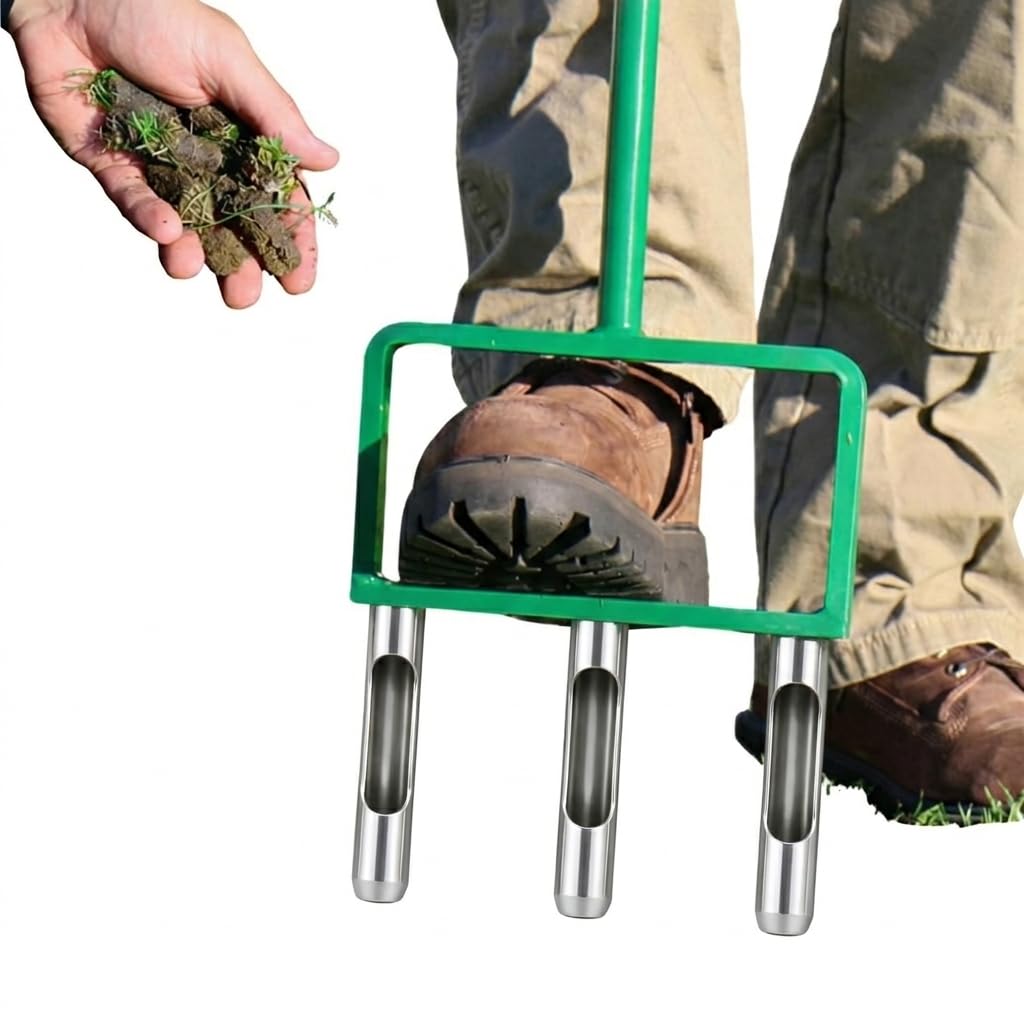
Three stainless steel tines that pull 4-inch plugs with zero assembly.
The Landzie is the manual stand-on corer that arrives ready to use right from the start — no tools, no instructions, no confusion. Three solid stainless steel tines break up compacted soil and push old material up and out each time you press it into the ground. The design is self-cleaning, which means you don’t have to stop and poke out clogged cores.
At 5.6 pounds, it is by far the lightest option here, but don’t mistake that for weakness. Owners consistently say it is very sturdy and will last many years, particularly for dense clay soil after a light watering. It produces 4-inch plugs, and the tines can be removed for cleaning or replacement. The powder-coated steel frame resists rust, and Landzie backs it with a satisfaction guarantee.
The honest downside: this is hard physical work. Owners who covered 1,200 square feet described it as “brutal,” and even a 2,200-square-foot lawn took 4 hours. Dry ground is nearly impossible to penetrate — the key is damp soil after rain. The foot bar can also be slippery when wet. Best for small patches, garden beds, or touch-ups between machine aeration passes.
Sturdy and simple: No assembly, no batteries, no trailer hitch — just step, push, and pull a clean 4-inch core every time. The stainless tines resist rust and stay sharp season after season.
Real talk: A full lawn of aeration with this tool is a serious workout; rent a machine for anything over 2,000 square feet unless you want cross-training.
5. Rolling Lawn Aerator Compacted Soil Loosening Manual Coring Tool
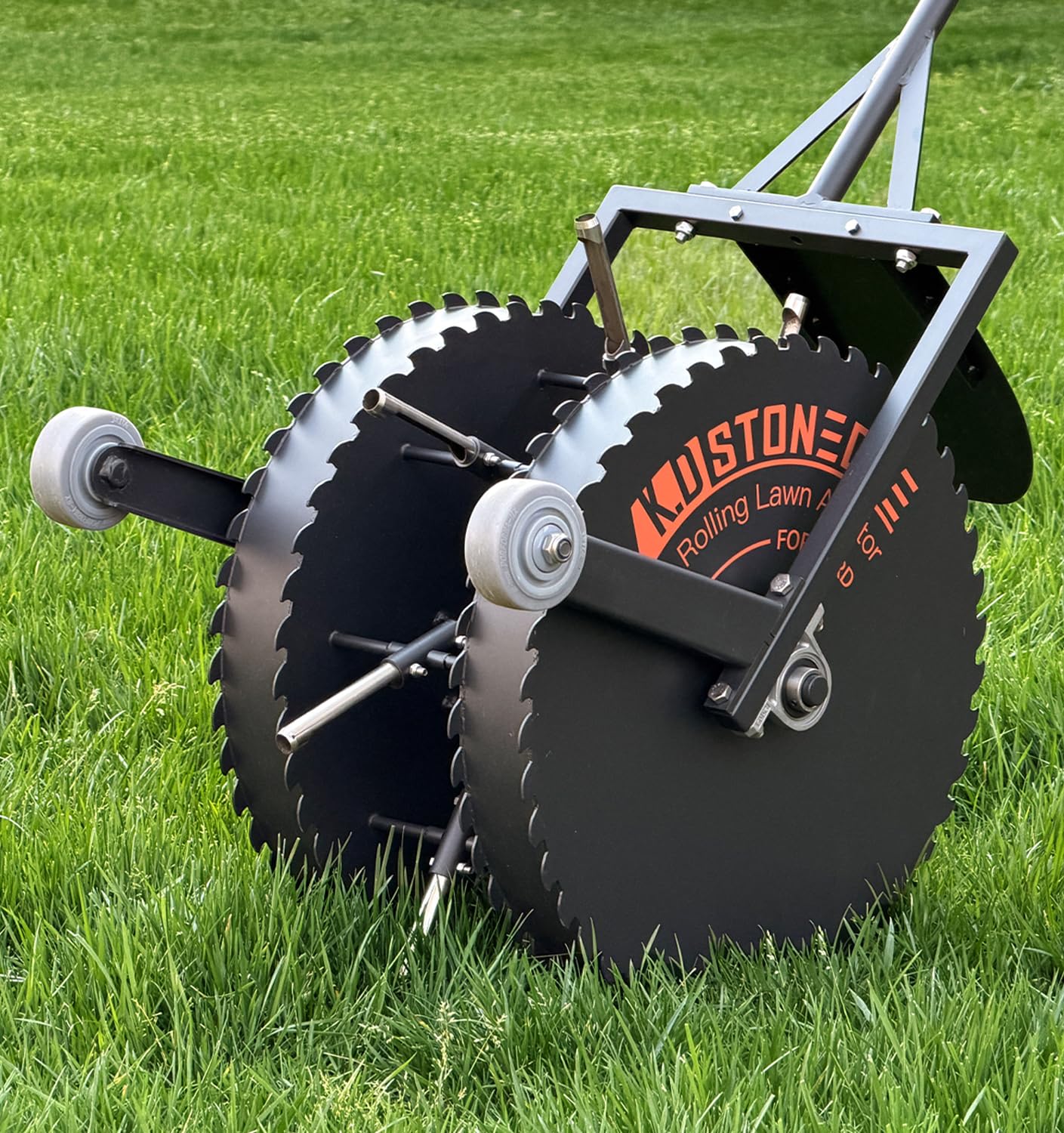
A push roller that pulls real plugs — if you bring the muscle.
This rolling coring tool bridges the gap between a manual stand-on aerator and a tow-behind unit. It uses a patented rotary coring design that punches holes and extracts soil plugs as you push it forward, and at 43.9 pounds, it has enough heft to stay planted. The wheels can be filled with sand for extra weight, and the design is built around scientifically balanced weight to deliver effective aeration without climbing on top of it.
The results are impressive on moist soil — owners mention deep 2- to 3-inch holes on clay soil, and the core ejection sound is satisfying proof of work. Assembly takes about 20 minutes, and the unit covers ground faster than a manual corer because of the rolling motion. It comes with a wheel set for easier transport, and the version 2 fixed the major stability issues of the earlier design.
The catch is the physical demand — this is very intense cardio, especially on hard or dry ground. The instructions are notoriously poor, and the axle attachment has been noted as a weak point by some owners. Filling the wheels with sand is a bit tricky, and tight turns can tear the grass. Best for DIYers who want plug aeration without renting a machine and have the stamina for it.
Rolling Core
- Pulls real 2-3 inch plugs from clay soil — not spike holes
- Way faster than a manual stand-on corer
- Fills with sand for adjustable weight
Physical Grind
- Physically demanding — owners call it intense cardio
- Poor assembly instructions; expect some trial and error
- Weak axle attachment noted; tight turns tear grass
Best for: The determined DIYer who wants plug aeration on a smaller yard and has the grit to push through a tough workout.
Think twice if: Your soil is rock-hard or your yard has lots of tight corners — this unit needs momentum and a running start.
6. CRAFTSMAN 36-Inch Tow Spike Aerator

A 36-inch working width that punches holes without breaking the budget.
The CRAFTSMAN spike aerator delivers a wide 36-inch swath at a price that makes it an easy first purchase for anyone with a riding mower. The 9 galvanized steel spike disks penetrate the soil as you tow, and the 90-pound capacity weight tray lets you add sandbags or cinder blocks for better bite. The 10-gauge steel frame is a step up from lighter-duty units, and the universal hitch adjusts to different tractor heights.
Functionality is what owners praise most — it creates numerous holes across the yard quickly. One owner aerated half an acre without issues after adding 4 sandbags for weight. Assembly is manageable but takes about an hour, and the instructions rely heavily on pictures rather than step-by-step text. The 3-year limited warranty is a plus at this price tier.
The most common frustration is missing parts — several owners received units with key components missing, which is a packaging quality issue. The spike design also means it works best on soft ground after rain; on hard-packed soil, it will bounce without enough added weight. Despite those quirks, owners consistently say it is a “great little tool” that does what it promises.
Big coverage, small spend: 36 inches wide with 9 spike disks means you cover ground quickly, and the 90-pound weight tray helps you dial in penetration depth.
Packaging lottery: Some units arrive with missing hardware; inspect the box carefully and contact support if anything is short.
7. Seeutek 18 Inch Heavy Duty Manual Push Spike Aerator
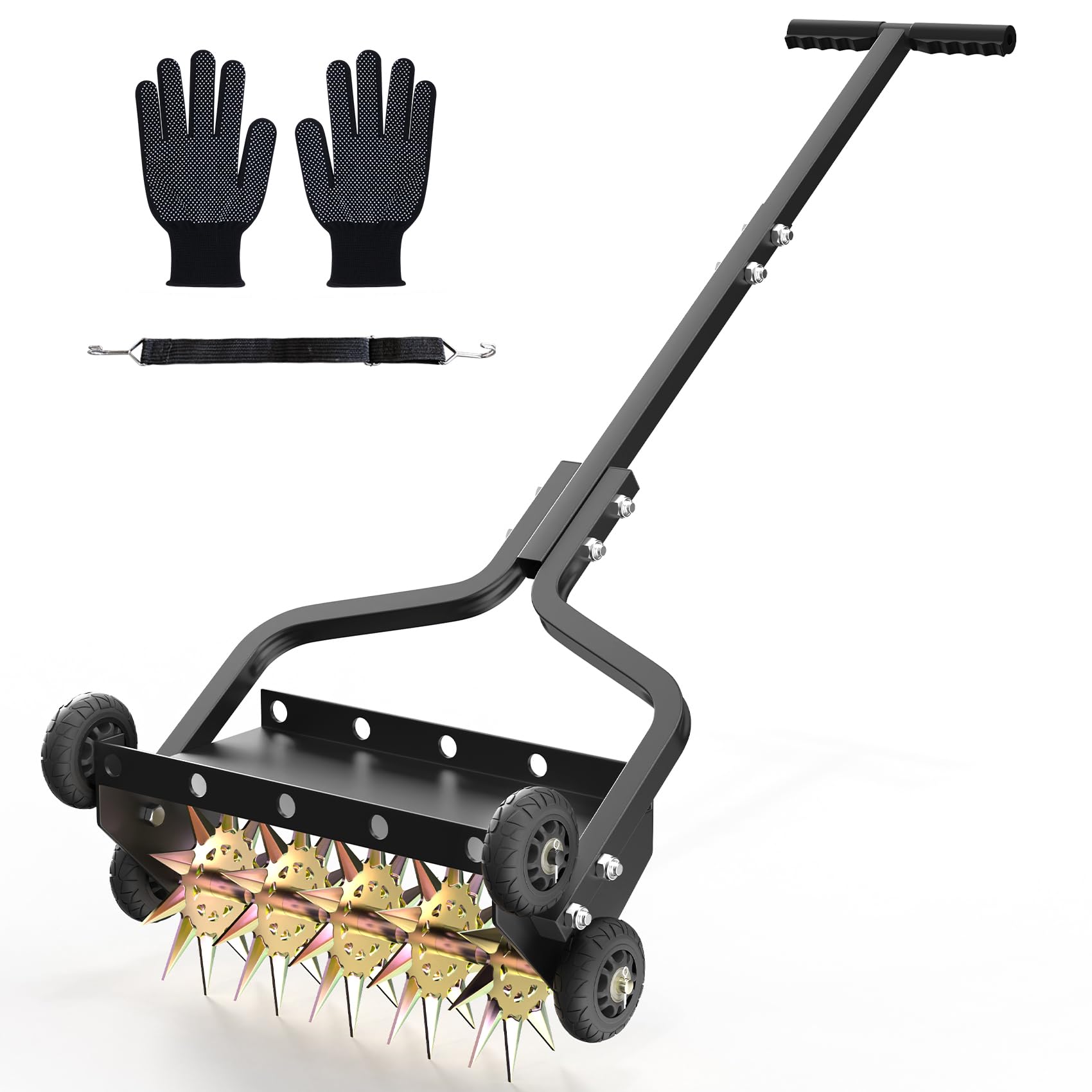
Five 8-inch star tines that penetrate up to 2 inches deep with push power.
The Seeutek push aerator is built for the manual laborer — it uses five 8-inch 3D star-shaped tines, each with 10 sharp irregular tips, made from thickened galvanized steel for 2X the strength of standard tines. Each star rotates independently even when turning, which reduces missed spots. The heavy-duty tray supports up to 220 pounds, so you can pile on concrete blocks or sandbags for deeper penetration.
Functionality is the top praise from owners — it effectively penetrates soil and helps with compaction, especially after a rain. The ergonomic T-handle adjusts to 3 heights to reduce back strain, and the four rubber wheels provide smooth maneuverability. Assembly is minimal — just the handle and two wheels — and all necessary hardware is included along with protective gloves.
The real-world trade-off is exactly what customers note: “works well, but does need weight to penetrate deep enough.” A concrete paving stone works, but adding too much weight makes it extremely hard to push through grass. On bare ground for new lawn prep, it is much easier to manage. Assembly instructions have tiny images and a few owners received units that were missing parts.
Star Power
- 5 rotating star tines cover 18 inches with 50 penetration points
- 220-pound weight tray allows serious ballasting
- Adjustable T-handle and 4-wheel design improve control
Push Demands
- Needs considerable weight and physical effort on grassy ground
- Assembly instructions have very small images
- Some units arrive with missing hardware
Best for: Owners with sandy or loamy soil who want a push-behind spike aerator and have the upper body strength to manage it.
Who it is not for: Anyone with heavy clay soil — you would need more weight than is practical to push.
8. 21″ Rolling Lawn Aerator with 45 Preassembled Spikes
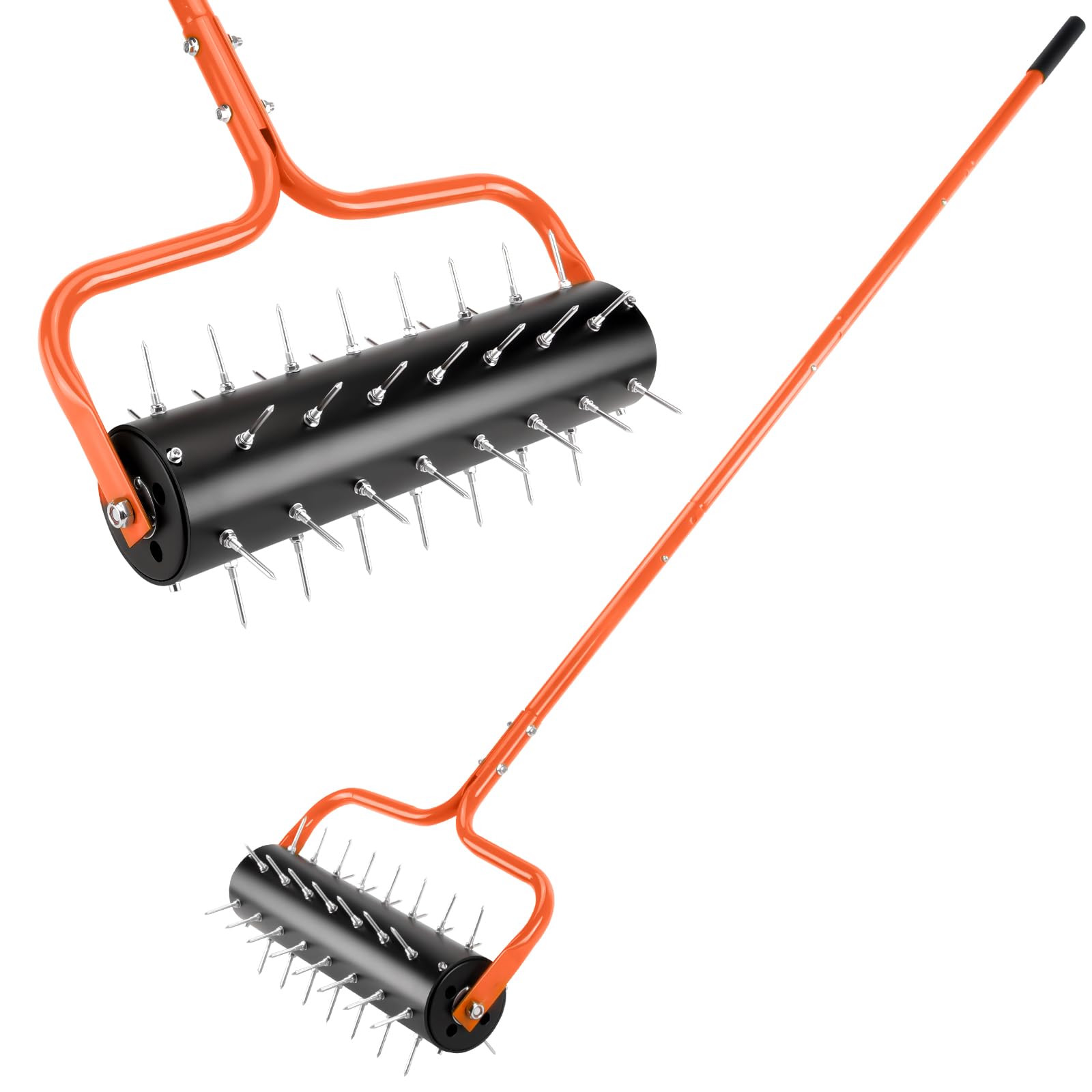
Forty-five carburized spikes that assemble in under 5 minutes.
If your top priority is getting out of the garage and onto the lawn fast, this rolling aerator is the answer. The 45 preassembled spikes are carburized for 30% greater strength than standard spikes, meaning they resist bending when you hit a hidden rock. The 75-inch long handle is one of the longest on the market, which means less bending and back strain while you walk.
Reviewers point out the convenience stands out — the handle connects with quick-clip snap-on connectors, and the cylinder arrives already assembled. One owner called it “heavy, sturdy and pretty easy to use,” noting it took just a few minutes to put together. The dual-action locking system uses gaskets at each connection point to keep the spikes firmly in place during operation. The 12-month service commitment provides some confidence.
The main safety concern is the exposed spikes — there is no guard included, and owners recommend storing the roller separately to avoid accidental contact. A few units arrived with misaligned spring pin holes that prevented the handle from locking. Adding weight to the cylinder (rocks or sand) is necessary for hard ground, and this is a spike-only tool — it does not pull plugs.
Throw-and-go convenience: Three to five minutes of assembly, 45 carburized spikes, and a 75-inch handle make this the quickest path from box to lawn.
Safety note: No spike guard included — store the roller separately and keep kids and pets away during use.
9. Yard Tuff 36 Inch Tow Behind Drum Aerator

A 125-pound drum with 78 spikes that fills with water for weight.
The Yard Tuff is the heavyweight of the spike aerator category — a 36-inch-wide drum that weighs 125 pounds empty and can be filled with water via the 24-gallon water holder for deeper penetration. The 78 steel spikes permeate up to 2.5 inches of soil, and the tow-behind design connects to ride-on mowers and ATVs. When empty, the drum is easy to move around the garage.
This is the widest and heaviest spike aerator on the list, and shoppers say it digs in deep without uprooting the lawn. The drum tracks well even on thick thatch, and the water-fill method means you avoid messing with sandbags or cinder blocks. It shipped in a reusable wood crate, which is a nice bonus for later storage or transport.
The downsides are real. Quality control is inconsistent — some owners describe it as terrific, while others point to poor weld quality. The drum is 125 pounds empty, so moving it before filling requires some muscle. Tight corners can cause the spikes to pull up grass, so the recommendation is to turn with the wheels fully rotated rather than in straight lanes. Best for large, open lawns of half an acre or more where a zero-turn mower can make wide passes.
Water Ballast
- 78 steel spikes on a 36-inch drum cover ground fast
- 24-gallon water holder eliminates sandbags and cinder blocks
- Fills deep — 2.5 inch penetration on moist soil
Quality Lottery
- 125 pounds empty — heavy to maneuver before adding water
- Quality varies; some buyers report poor welds
- Spikes can pull up grass on tight turns
Best for: Owners with half an acre or more and a riding mower who want a tow-behind spike aerator with easy water-weighted ballast.
Who should skip it: Anyone with small, irregularly shaped lawns — the 36-inch drum needs wide passes to avoid tearing up the edges.
Understanding the Specs
Plug (Core) vs. Spike Aeration
Plug aerators remove a cylinder of soil about 2 to 3 inches long — this gives roots room to expand and relieves compaction without pushing dirt sideways. Spike aerators simply poke a hole, which can actually compact the surrounding soil in heavy clay. For most lawns, core aeration is the better long-term choice, but spike aeration works fine on sandy or loamy ground.
Weight and Penetration Depth
An aerator that bounces across the top of the lawn is doing nothing. The weight tray capacity (usually 90 to 220 pounds) tells you how much ballast you can add. Most owners find that 80 to 150 pounds of sandbags, concrete blocks, or water is the balance for getting consistent 2- to 3-inch penetration (the depth needed to relieve compaction) on all but the hardest soil. Start light and add weight until the aerator stays planted.
Working Width and Hitch Compatibility
Tow-behind aerators range from 36 to 40 inches wide. A 40-inch unit covers more ground per pass but is heavier and harder to store. All modern tow-behind aerators use a universal single-pin hitch that fits most lawn tractors and ZTRs — but check your mower’s hitch height before buying, as some models need an adjustable tongue for level operation.
Material and Tine Durability
Spike tines and plug spoons take a beating from rocks and hard soil. Look for heat-treated steel (the Brinly model uses 16-gauge heat-treated spoons) or galvanized steel (the Brinly spike model uses 3-D galvanized tines). Carburized spikes are 30% stronger than standard steel. Stainless steel tines resist rust and stay sharp longer, which is why the Landzie manual corer uses them.
FAQ
What is the difference between a spike aerator and a plug aerator?
How much weight should I add to a tow-behind aerator?
Will a lawn aerator fit my riding mower?
Can I use a lawn aerator on wet soil?
How often should I aerate my lawn?
Is a manual push aerator worth it for a small lawn?
What does “3-D tine” mean on a spike aerator?
Can I aerate after overseeding?
Will a spike aerator damage my lawn?
How do I store a tow-behind aerator?
Final Thoughts: The Verdict
For the majority of shoppers, the lawn mower aerator winner is the Brinly 40-Inch Plug Aerator because it pulls real 3-inch cores, handles up to 150 pounds of extra weight, and the all-steel construction holds up season after season. If you want a spike aerator that can handle hard clay without bending tines, grab the Brinly 40-Inch Spike Aerator. And for manual core aeration in tight spots with zero assembly, the Landzie is the one to reach for.
How We Picked
We do not accept paid placement. Every pick is matched to a real buyer and a real use-case; we do not hands-on test units.
Sources & Methodology
Specifications: manufacturer listings and product documentation. Review insights: verified customer reviews, as of July 2026. Pricing: not shown on this page (it changes often); check the current price via the retailer link.
As an Amazon Associate, Lawn Gear Lab earns from qualifying purchases. This does not affect which products we feature.