
A thin, yellowing lawn after winter isn’t a failure of will — it’s a nitrogen deficit. Spring grass needs a precise ratio of quick- and slow-release nitrogen to wake up without surging into weak, disease-prone growth. Choosing the wrong bag or bottle can mean burning your turf or feeding the weeds instead of the grass.
I’m Rikta — the co-founder and writer behind Lawn Gear Lab. I’ve spent hundreds of hours cross-referencing NPK ratios, analyzing slow-release technologies, and correlating granular particle sizes with real-world spread patterns so you don’t have to guess which bag delivers measurable green-up without the burn.
Whether you manage a postage-stamp front yard or a full-acre property, this guide pinpoints the best lawn fertilizer for spring by matching formulations to your specific grass type, soil condition, and application preference — no marketing fluff, just the hard data.
How To Choose The Best Lawn Fertilizer For Spring
Spring fertilization isn’t about dumping the highest nitrogen number you can find. It’s about matching the release type to your grass’s growth stage, your region’s climate, and your schedule. A mistake here costs you either burnt turf or a weak lawn heading into summer stress.
Release Type: Slow vs. Quick vs. Combination
Quick-release nitrogen delivers visible green in 3–5 days but carries a high burn risk and fades fast. Slow-release nitrogen (typically sulfur- or polymer-coated urea) feeds steadily for 8–12 weeks, supporting root development without a growth spike. The smartest spring fertilizers blend both — a fast hit to wake the lawn up and a slow tail to carry it into early summer.
NPK Ratio Context: What Spring Grass Actually Needs
Spring grass demands higher nitrogen (the first number) because it’s rebuilding leaf tissue and tillers. Phosphorus (the middle number) is often unnecessary unless a soil test shows a deficiency — many phosphorus-free formulas exist to protect local waterways. Potassium (the last number) strengthens cell walls and disease resistance. A ratio around 24-0-6 or 27-0-5 aligns well with typical spring soil conditions.
Iron and Humic Acid: The Color Boosters
Iron creates that deep, blue-green color without triggering a growth surge — critical when you want cosmetic improvement without weekly mowing. Humic acid improves nutrient uptake efficiency by increasing cation exchange capacity in the soil, meaning the nitrogen you apply actually gets used instead of leaching away.
Liquid vs. Granular: Application Differences
Granular fertilizers are better for large lawns (over 5,000 sq ft) and provide longer residual feeding. Liquids offer faster foliar uptake and more precise spot-treatment but require reapplication every 2–4 weeks. If you own a broadcast spreader, granular is the default. If you want immediate green-up on a small area, liquid wins the race.
Quick Comparison
On smaller screens, swipe sideways to see the full table.
| Model | Category | Best For | Key Spec | Amazon |
|---|---|---|---|---|
| Yard Mastery 24-0-6 Flagship | Granular Slow-Release | Large lawns needing steady season-long feeding | 24% nitrogen (slow release) + 3% iron | Amazon |
| The Andersons PGF 16-0-8 (40lb) | Granular High-Efficiency | Phosphorus-sensitive soils and large properties | Super-fine DG particles, 8% potassium | Amazon |
| Petramax Liquid Nitrogen 28-0-0 | Liquid High-Nitrogen | Rapid green-up on small to mid-sized lawns | 28-0-0 NPK with 30% slow release | Amazon |
| The Andersons Green Shocker 7-1-2 | Granular Fast-Release | Quick cosmetic green-up in 3 days | 100% fast-release nitrogen + Humic DG | Amazon |
| The Andersons PGF 16-0-8 (18lb) | Granular Balanced | Mid-sized lawns needing phosphorus-free feeding | 18 lb bag, covers 5,000 sq ft | Amazon |
| PetraMax Neighbor’s Envy 7-in-1 | Liquid Multi-Nutrient | Small lawns wanting deep color with soil health | 19% nitrogen + 2.5% iron + humic acid | Amazon |
| GreenView Fairway Formula 27-0-5 | Granular Budget-Friendly | Entry-level spring feeding on a budget | 63% slow-release nitrogen, 10,000 sq ft cover | Amazon |
In‑Depth Reviews
1. Yard Mastery 24-0-6 Flagship Granular Lawn Fertilizer

This 45-pound bag delivers 24% nitrogen (all slow-release), 6% potassium, and 3% iron — a tightly balanced spring ratio that feeds grass for weeks without the rapid surge that forces twice-weekly mowing. The inclusion of Bio-Nite chicken manure compost adds organic micronutrients that granular synthetics typically skip. Coverage of 15,000 square feet makes it a practical choice for homeowners with half-acre lots who want a single application per spring feeding window.
Real-world feedback from Bermuda lawn owners reports noticeable thickening within two weeks and weed suppression without a separate herbicide — the nitrogen density gives desired grass a competitive edge. The slow-release mechanism means you won’t see an overnight color flush, but you also won’t wake up to burnt stripes from an uneven spreader pass. The 24-0-6 ratio assumes your soil already has adequate phosphorus, so check a soil test before committing.
Where this product earns its top rank is predictability: the granules are consistent in size, the spread pattern is even, and the 24% nitrogen content is high enough for aggressive spring green-up but encapsulated enough to avoid volatilization loss in warming soils. It’s the closest thing to a set-and-forget spring program for cool- and warm-season grasses alike.
What works
- High 24% slow-release nitrogen for steady 8-week feeding
- 3% iron delivers deep color without excessive growth
- Bio-Nite compost adds micronutrients for soil health
What doesn’t
- No phosphorus — must verify soil levels before use
- Large 45 lb bag may be heavy for smaller spreader hoppers
2. The Andersons Professional PGF 16-0-8 with Humic DG (40lb)

The 40-pound variant of The Andersons’ PGF formula uses the same Humic DG delivery technology — meaning every granule is infused with humic acid that breaks down in soil moisture to improve nutrient uptake. The 16-0-8 ratio is intentionally phosphorus-free, making it the right choice for lawns where soil tests already show sufficient phosphorus levels or for properties near watersheds where phosphorus runoff restrictions apply. This bag covers 10,000 square feet with super-fine particles that provide twice the distribution points per square foot compared to standard prills, reducing the risk of the striped “skunk lawn” effect.
Customer reports consistently highlight even greening without streaking and the absence of turf burn even on sensitive fescue varieties. The dual-release nitrogen supplies immediate feeding from the quick-release portion and sustained feeding from the slow- release coating over an 8-week window — ideal for spring timing where you want uniform green-up across a large property without reapplying mid-season. The 40-pound size hits the sweet spot between coverage depth and physical handling.
The trade-off is the premium investment per bag compared to standard home-center brands. But when you calculate that one bag handles 10,000 square feet for a full spring cycle without a second application, the cost-per-square-foot becomes competitive. This is the fertilizer to buy when you’re done guessing and want a professional-grade spread pattern.
What works
- Humic DG enhances nutrient efficiency in variable soils
- Super-fine particles eliminate spreader striping
- Phosphorus-free and safe for sensitive watersheds
What doesn’t
- Not sold in CA or OR
- Higher initial cost per bag than big-box alternatives
3. Petramax Liquid Nitrogen Fertilizer 28-0-0

This 1-gallon liquid concentrate packs a 28-0-0 NPK profile with a split-release design: 70% quick-release for visible green within days and 30% slow-release to sustain feeding between applications. The concentration is potent — at maintenance rates, 5 ounces per gallon of water treats approximately 1,000 square feet, and a full gallon covers up to 25,600 square feet at the maintenance rate. For lawns exhibiting clear nitrogen deficiency (yellowing, slow growth), the higher correction rate of 10 ounces per gallon covers 12,800 square feet.
Liquid application means the nitrogen bypasses soil incorporation delays and goes directly to the leaf blade, making this the fastest route to deep green from dormancy. Owners report visible transformation within a week, even on cool-season grasses emerging from winter. The slow-release portion helps smooth the transition so you don’t get a single week of explosive growth followed by collapse — a common complaint with straight-liquid urea products. Compatibility with all grass types is confirmed by the manufacturer.
The limitation is the reapplication cycle: because even the encapsulated portion is liquid-based, you’ll need to reapply every 3–4 weeks to maintain color through late spring. That means a full season for a 5,000-square-foot lawn requires roughly two gallons. It’s best suited for smaller lawns (under 10,000 sq ft) where the per-gallon cost is manageable and the owner is comfortable with a sprayer routine.
What works
- 70/30 quick/slow split gives fast green with residual feed
- High coverage — up to 25,600 sq ft per gallon at maintenance
- Works on all grass types including Bermuda and Fescue
What doesn’t
- Requires a sprayer for even application
- Needs reapplication every 3-4 weeks through spring
4. The Andersons Green Shocker 7-1-2 with Humic DG
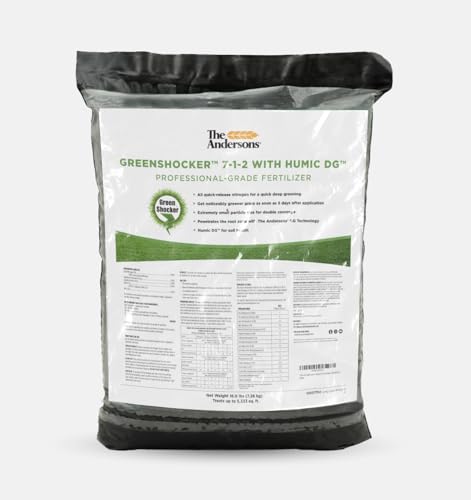
Green Shocker breaks the slow-release norm on purpose — all 7% nitrogen is fast-release, designed for what The Andersons calls “spoon feeding” — small, frequent applications to maintain peak color without overloading the plant. The 7-1-2 ratio is deliberately low to prevent turf burn even when applied every 2–3 weeks. Combined with Humic DG, the formula ensures that the nitrogen you apply is absorbed efficiently rather than leaching. The 16-pound bag covers approximately 5,000 square feet at the recommended rate, making it a targeted tool for smaller lawns or high-visibility front-yard areas.
Owner testimonials describe visible green-up within three days — the fastest results in this lineup. One user reported transforming the “worst lawn in the county” to the best in the neighborhood within 72 hours. The deep blue-green color comes from the iron content working in tandem with the fast nitrogen. Because the nitrogen is entirely unbuffered, the risk of burn increases if you over-apply or miss a watering cycle — this is not a product for the forgetful applicator.
The low NPK numbers mean this isn’t a standalone spring program for large properties — you’d need multiple bags or a primary fertilizer plus this as a top-dress. Where it excels is in cosmetic precision: for homeowners who already have a solid spring feeding plan but want a quick color boost before an event or photo, Green Shocker delivers on its name.
What works
- Visible green-up in as little as 3 days
- Humic DG reduces leaching and improves soil efficiency
- Safe for turf when applied at correct rates
What doesn’t
- Requires frequent reapplication every 2–3 weeks
- High burn risk if spreader calibration is off
5. The Andersons Professional PGF 16-0-8 with Humic DG (18lb)
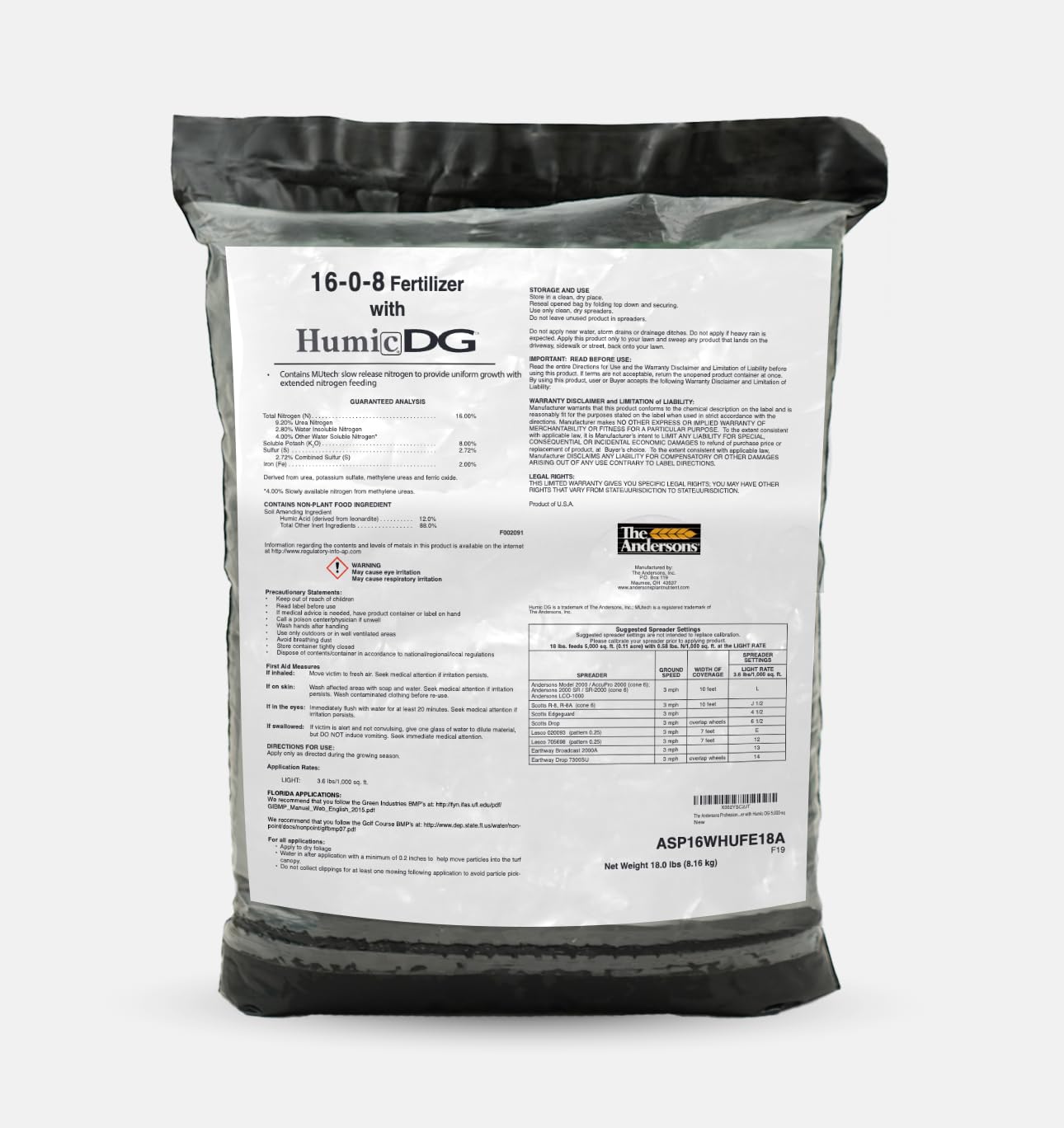
This 18-pound bag of the same proprietary PGF 16-0-8 formula offers the same Humic DG technology as its larger sibling but in a footprint suited for mid-sized lawns around 5,000 square feet. The dual-release nitrogen structure provides immediate feeding from the quick-release component and extended nutrition from the slow-release coating, sustaining grass for up to 8 weeks. The phosphorus-free formulation reflects modern lawn science — most established turf soils don’t need additional phosphorus, and skipping it protects local waterways from runoff.
Customer reviews from users who switched from phosphorus-containing products cite better results after soil tests confirmed high existing phosphorus levels — the PGF 16-0-8 prevented further accumulation while still delivering strong green-up. The DG (dispersible granule) technology means the humic acid activates upon contact with soil moisture, improving the root zone’s ability to hold and exchange nutrients. For lawns already on a professional program or following test-based fertilization, this is the logical mid-season pivot.
At this size, the cost per square foot is noticeably higher than the 40-pound bag. If your lawn exceeds 5,000 square feet, the larger bag is the more economical route. But for homeowners with compact yards who want the same professional-grade chemistry without storing a 40-pound sack, the 18-pound option is the right fit.
What works
- Identical professional formula as 40lb bag for smaller lawns
- Humic DG improves soil CEC and nutrient retention
- Phosphorus-free — safe for high-P soils and watersheds
What doesn’t
- Higher per-pound cost than larger bag
- Not for sale in CA or OR
6. PetraMax Neighbor’s Envy 7-in-1 Liquid Lawn Fertilizer
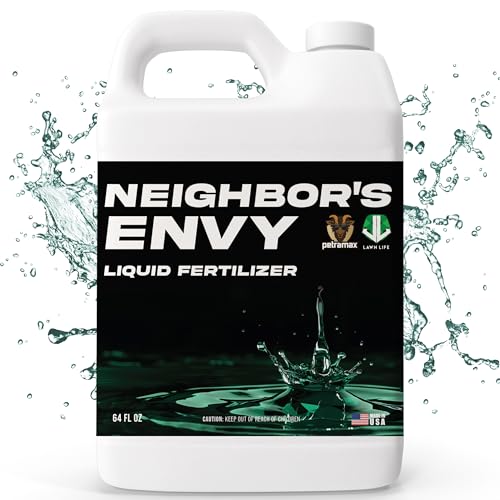
Neighbor’s Envy bundles 19% nitrogen, 2.5% iron, humic acid, potassium, sea kelp, and sulfur into a single liquid concentrate that covers up to 8,000 square feet per 64-ounce bottle. The 7-in-1 approach eliminates the need for separate soil conditioners or iron supplements — just mix with water in a hose-end sprayer and apply. The iron and humic acid combination produces a dark green color within 7–14 days without the growth spike of a high-nitrogen-only formula.
Users consistently note that the liquid formulation allows precise control — you can spot-treat thin areas or adjust the concentration based on grass type. One verified review noted that combining this product with overseeding produced noticeably thicker turf in 1–3 days, outperforming neighbors during a hot, dry spell. The sea kelp component improves root stress tolerance, which is useful for spring lawns transitioning from wet to dry weather patterns. The liquid form means the nutrients are available immediately, not waiting for soil moisture to break down granules.
The trade-off is the 2–4 week reapplication window — you’ll use multiple bottles over a full spring season. The per-bottle cost positions it between entry-level granular options and premium liquids. It’s best as a spring kick-starter or a maintenance product for homeowners who enjoy weekly lawn work and want the flexibility of liquid feeding.
What works
- 7 nutrients in one bottle — no mixing multiple products
- Safe for pets, kids, and plants when applied correctly
- Fast uptake — visible results within 7-14 days
What doesn’t
- Needs reapplication every 2-4 weeks for sustained green
- Can cause temporary leaf staining from iron content
7. GreenView Fairway Formula 33 lb Lawn Fertilizer 27-0-5

GreenView’s Fairway Formula delivers a 27-0-5 NPK ratio with 63% of the nitrogen in slow-release form — a high percentage that reduces application frequency to a single spring dose lasting up to 12 weeks. The 33-pound bag covers 10,000 square feet, making it one of the most cost-effective options on this list for covering medium-to-large lawns. The phosphorus-free composition (0 in the middle) is well-suited for established lawns where soil P levels are already adequate, and it aligns with local fertilizer restrictions in many counties.
Real-world users report visible greening within days of application, with the slow-release mechanism preventing the growth surge that forces extra mowing cycles. One reviewer noted that the granules distributed evenly through a standard broadcast spreader without clumping, and another confirmed it worked well on centipede grass — a notoriously sensitive species. The high slow-release percentage means you can apply in early spring and not worry about reapplying until summer, which is a major convenience advantage over liquid or fast-release options.
The formula lacks iron and humic acid, so the color depth won’t match what you’d get from the iron-fortified products in this list. It also contains phosphate-free coverage but no soil-conditioning additives. For the price per square foot, it’s a reliable entry-level spring program — just don’t expect the deep blue-green hue that iron-enhanced fertilizers provide.
What works
- 63% slow-release nitrogen for up to 12 weeks of feeding
- Covers 10,000 sq ft per bag at a strong value
- Phosphorus-free for watershed-sensitive areas
What doesn’t
- No iron or humic acid for deep color
- Mid-spring application may require a summer follow-up
Hardware & Specs Guide
NPK Ratio Context
The three-number ratio on every fertilizer bag tells you the percentage by weight of Nitrogen (N), Phosphate (P₂O₅), and Potash (K₂O). For spring feeding, the first number (N) is the priority — it drives leaf and tiller growth after winter dormancy. A ratio like 24-0-6 means 24% nitrogen, 0% phosphorus, and 6% potassium. The zero in the middle is intentional for phosphorus-rich soils and environmental compliance.
Slow-Release vs. Quick-Release Nitrogen
Quick-release nitrogen (ammonium nitrate, urea) dissolves rapidly and green turf in days but burns easily and washes out quickly. Slow-release nitrogen (sulfur-coated urea, polymer-coated urea, IBDU) breaks down via soil bacteria or moisture permeation over 6–12 weeks, supplying steady nutrition. Spring formulas that blend both — like 70% quick and 30% slow — give an immediate visual boost and maintain color without weekly reapplication.
Humic DG Technology
Humic DG stands for dispersible granule — a technology developed by The Andersons that coats each fertilizer prill with humic acid. When the granule hits moisture, the humic acid disperses into the soil and increases Cation Exchange Capacity (CEC), which means the soil holds onto positively charged nutrients (ammonium, potassium, iron) longer. This reduces leaching by up to 30% compared to uncoated fertilizers.
Spreader Calibration for Granular Products
Granular fertilizers require a broadcast or drop spreader calibrated to deliver the rated pounds per 1,000 square feet. Apply at half the recommended setting in two perpendicular passes (cross-hatching) to ensure no striping. For super-fine particles like The Andersons PGF, a rotary spreader with a small opening setting prevents the granules from pouring out too fast. Always sweep excess fertilizer off hardscapes to prevent runoff.
FAQ
Should I fertilize before or after spring rain?
What NPK ratio is best for spring grass recovery?
Can I apply spring fertilizer if I overseeded in fall?
Final Thoughts: The Verdict
For most gardeners, the lawn fertilizer for spring winner is the Yard Mastery 24-0-6 Flagship because its 24% slow-release nitrogen and 3% iron deliver weeks of steady green without the growth spike that forces extra mowing. If you want professional-grade spread precision and Humic DG soil benefits, grab the The Andersons PGF 16-0-8 (40lb). And for rapid liquid green-up on smaller lawns, nothing beats the Petramax Liquid Nitrogen 28-0-0.