
Specs are compiled from manufacturer listings and verified buyer reviews and can change over time — please confirm the key details on the product page before buying.
Your Florida lawn faces problems lawns up north never see. Sandy soil (it drains nutrients before your grass can drink them up) and scorching summer heat make it tough to keep St. Augustine or Bahia grass green. A generic bag from the big-box store often leaves you with more weeds than turf. The trick is finding a fertilizer that matches Florida’s soil chemistry and grass types — not one designed for a Kentucky bluegrass lawn in Ohio.
I’m Rikta — the founder and writer behind Lawn Gear Lab. This guide is built by comparing the manufacturers’ published specifications and the patterns across verified customer reviews, so you get each pick’s real strengths and trade-offs instead of marketing spin.
You have three things to look for: nitrogen content (the main leaf-greening nutrient), iron for fast color, and if you need a liquid that works in hours or a slow-release granule. This breakdown of the best lawn fertilizer for florida homes in on the four formulas that actually do the job without wasting your weekend.
Quick Picks
- Medina HastaGro 16-0-2 SuperGro Plus — Best Overall
- St Augustine Grass Fertilizer — St. Augustine Special
- Sunday Weed & Green + Liquid Lawn Kickstart — Smart Spring Kit
- SeedRanch St. Augustine Lawn 24-2-11 Fertilizer — Iron Powerhouse
How To Choose The Best Lawn Fertilizer For Florida
Florida lawns live in a world of their own. The sandy soil does not hold onto nutrients the way clay or loam does, so your grass needs a steady supply of nitrogen (leaf-greening nutrient) just to stay green. At the same time, many Florida counties restrict phosphorus (a root-support mineral) to protect local waterways, which rules out standard balanced fertilizers. Here is what to look for when you are scanning labels.
Nitrogen (N) is your biggest priority
Florida’s warm-season grasses — St. Augustine, Bahia, Bermuda, Zoysia — are heavy nitrogen feeders. A fertilizer with a first number around 16 to 24 (like a 16-0-2 or 24-2-11) gives your lawn the growth energy it needs. Higher nitrogen also helps your grass stay thick enough to crowd out weeds naturally.
Phosphorus (P) and local regulations
Many counties across Florida ban or restrict phosphorus application because it feeds algae blooms in lakes and rivers. A zero-phosphorus formula (the second number is 0, like 16-0-2) keeps you compliant and still delivers all the nitrogen your lawn wants. Always check your local county rules before buying.
Iron for color without the surge
If you want a deep green lawn fast without the growth burst that comes with extra nitrogen, look for iron (the mineral that darkens grass leaf tone) on the label. A fertilizer with 6% iron, for example, darkens leaves within days while roots stay healthy. This is particularly useful for St. Augustine, which shows color change quickly.
Quick Comparison
| Model | Best For | Coverage | Form | Unit Count | Amazon |
|---|---|---|---|---|---|
| Medina HastaGro 16-0-2 | Phosphorus-restricted areas & large lawns | 16,000 sq ft | Liquid | 128.0 Ounce | Amazon |
| St. Augustine Grass Fertilizer | St. Augustine runners & root growth | Low | Liquid | 128.0 Fluid Ounces | Amazon |
| Sunday Weed & Green + Kickstart | Spring prep & weed control | 5,000 sq ft | Liquid | 73.3 Ounce | Amazon |
| SeedRanch St. Augustine 24-2-11 | Heavy iron greening & St. Augustine | 12,000 sq ft | Granules | 800.0 Ounce | Amazon |
In‑Depth Reviews
1. Medina HastaGro 16-0-2 SuperGro Plus
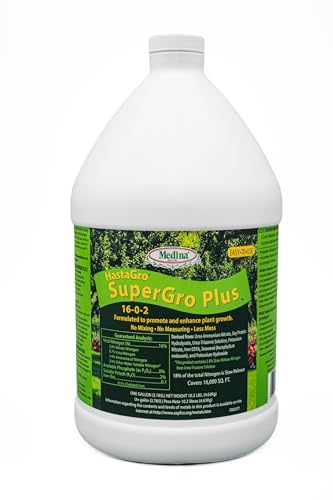
One 128-ounce bottle covers 16,000 square feet and greens up your lawn in a day or two — double the area of the SeedRanch 50-pound bag.
You reach for this fertilizer when you need results fast and your county says no to phosphorus (the second number in N-P-K ratios). The 16-0-2 ratio delivers 16% nitrogen straight to the grass, so you see a visible green-up within 24 to 48 hours — customers describe it as lush and thicker. What makes it different from a plain high-nitrogen spray is the 15% cane molasses that feeds soil microbes and the 1% humic acid that helps roots dig deeper into sandy Florida ground.
The 128 fluid ounces of liquid concentrate covers a massive 16,000 square feet, which is roughly three standard residential lots. One quart alone handles 4,000 sq ft. Just attach a hose-end sprayer and walk the yard — no mixing or measuring. At 9 pounds total weight, it is a fraction of what the 50-pound SeedRanch granular bag weighs, though unlike those granules with 6% iron, this formula relies on the nitrogen and humic acid for its color boost.
Buyers report that the phosphorus-free formula gives them confidence in regulated areas and works well on sandy soils that otherwise flush nitrogen out fast. Beyond the lawn, it also feeds tropical plants and houseplants, since it will not overload them with phosphorus.
Why it earns the top spot
- 16-0-2 ratio (zero phosphorus) complies with Florida phosphorus restrictions
- Molasses + humic acid improve soil life and root moisture retention
- 128 ounces cover 16,000 sq ft — great value for large lawns vs the 12,000 sq ft from the SeedRanch bag
A couple of notes
- Liquid requires a hose-end sprayer, not a simple broadcast spreader
- No added iron (0% iron) for those who want a quick color darkening
Great call if: you have a large Florida lawn, sandy soil, or local phosphorus bans — and you want visible greening within two days.
Think twice if: you prefer a granular slow-release feed you can toss with a spreader, or you need iron for deep color.
2. St Augustine Grass Fertilizer – Liquid Lawn Food by TPS Nutrients
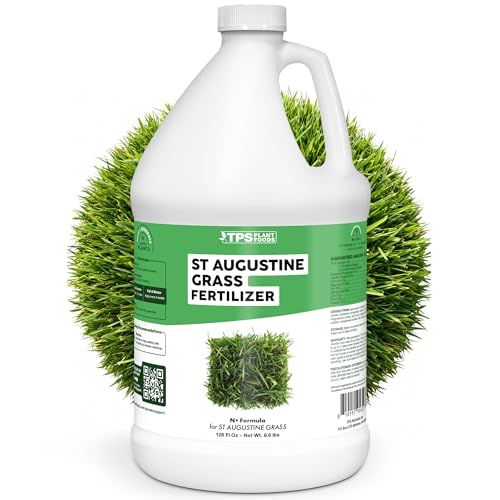
Built specifically for St. Augustine, with a fast-absorbing liquid formula that pushes new runners (the above-ground stems that fill in bare spots) — unlike the broad-spectrum Medina mix.
While the Medina formula covers a broad range of grasses and soils, this one from TPS Nutrients is laser-focused on St. Augustine grass — the most common lawn type across central and south Florida. The liquid formula is designed to boost deep green color and encourage new runners, which is exactly what a tired St. Augustine lawn needs after a hot summer.
It comes in 128 fluid ounces, the same liquid volume as the Medina, though the brand lists its coverage as “Low” rather than the 16,000 sq ft you get from the Medina. That gap means you may need more product per application. On the plus side, the fast-absorbing nature delivers visible improvement in growth, color, and turf health — something owners mention works well for lawns that see heavy foot traffic or full Florida sun.
If you are comparing it to the 50-pound SeedRanch granules, the liquid format here is much easier to handle. The 22-0-2 or 24-2-11 numbers you see on granular bags are not directly comparable; this product focuses on root support and resilience rather than just a quick nitrogen hit. It is made in the USA.
Best use case: homeowners with St. Augustine who want a gentle, root-building feed that promotes new runners rather than a sudden growth surge.
Reach for this if: you want a St. Augustine-specific formula that targets runner growth and heat tolerance — ideal for patching thin lawns.
Consider another if: you have a mixed grass lawn or need maximum coverage per dollar, since the coverage spec is low for the volume.
3. Sunday Weed & Green + Liquid Lawn Kickstart Spring Weed and Feed Kit
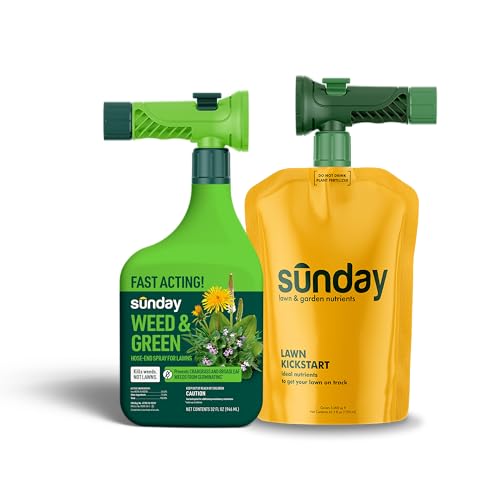
A two-step system that kills winter weeds first, then feeds your lawn with iron-rich 22-0-2 — and at 3.1 pounds, it is far lighter than the 50-pound SeedRanch bag.
Most weed-and-feed products mix herbicide (weed killer) and fertilizer into one pass. Sunday separates them, which is smarter for Florida lawns that may need pre-emergent crabgrass control and post-emergent dandelion killing at different times. The kit includes a 32 oz Weed & Green spray that kills dandelion, oxalis, white clover, chickweed, thistle, and plantain while also delivering iron (Iron HEDTA, a form of iron the grass can absorb quickly) to green up the grass. Then you follow up with Liquid Lawn Kickstart, a 22-0-2 fertilizer that adds deep color in days, not weeks.
At 3.1 pounds for the whole kit and 73.3 total ounces of product, this is much lighter and more portable than the 50-pound SeedRanch bag. It covers up to roughly 5,000 sq ft when you combine both products for the full weed-and-feed routine. The Weed & Green portion covers up to 1,250 sq ft on its own. The 22-0-2 ratio means zero phosphorus, which keeps you compliant in regulated counties, while the nitrogen and potassium support deeper root growth. Customers note that the hose-end sprayer makes application quick, taking under 15 minutes per treatment.
It works on all grass types including Bermuda, Zoysia, St. Augustine, Centipede, and Fescue. Unlike the Medina or TPS liquids that are straight fertilizers, this kit tackles weeds first — so if your Florida lawn came through winter with a patch of chickweed or clover, this is the one to grab. The maker notes that established weeds may need a second application.
What stands out
- Two-step system applies herbicide and fertilizer separately for better results
- 22-0-2 feeds without phosphorus while iron (Iron HEDTA) delivers fast color
- Lightweight kit (3.1 lbs) with hose-end sprayers makes application simple
What to watch
- Covers 1,250 sq ft for the weed spray vs 4,000-16,000 for a straight liquid fertilizer like Medina
- Established weeds may require multiple applications to fully die off
Best for spring: this is the kit you want if your lawn has visible winter weeds and you need one complete routine to kill them and green up the grass.
skip it if: your lawn is already weed-free and you just want a straight fertilizer for maintenance feeding.
4. SeedRanch St. Augustine Lawn 24-2-11 Fertilizer – 50 Lbs.
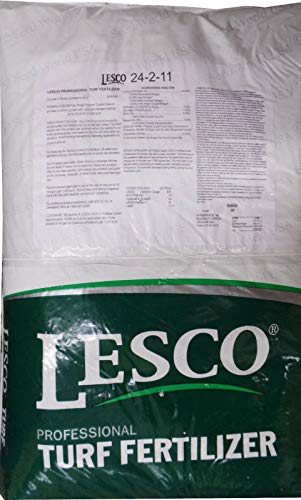
A 50-pound granular bag with 6% iron — three times the iron of the Sunday kit — that gives St. Augustine a deep green in days.
If you prefer the low-maintenance feel of broadcasting granules with a spreader rather than mixing liquids, this is your option. The 24-2-11 analysis packs the highest nitrogen of any pick here (24%), plus 6% iron — a spec that directly translates to fast, rich green color. Unlike the liquid formulas that require a hose-end sprayer, you pour these 50 pounds of granules into a broadcast spreader, walk the yard, and let the soil moisture do the work.
Coverage comes in at 12,000 square feet per 50-pound bag. The 24-2-11 ratio also provides potassium (the 11), which helps St. Augustine handle Florida’s heat and drought stress better than a straight nitrogen-plus-iron formula would. Reviewers point out that the 6% iron content makes a visible difference in lawns that looked pale or yellowing before application.
At 800.0 ounces unit count and 50 pounds item weight, this is a significant physical investment compared to the 3.1-pound Sunday kit. But for large St. Augustine lawns where you want steady feeding with strong color correction, the iron content here beats the 0% iron in the Medina or TPS liquids. Just check your local phosphorus rules — the 2 in the middle means it contains some phosphorus.
Big bag, big color: if you have a spreader and at least 12,000 sq ft of St. Augustine, the 24-2-11 with 6% iron delivers color and stress tolerance that no liquid in this list matches on its own.
Grab this for: iron-deficient St. Augustine lawns where you want deep green without applying a separate iron supplement — the 6% does it in one pass.
Skip this if: your county bans phosphorus (the 2 in the ratio), or you want a lighter, easier-to-store liquid that does not require a spreader.
Understanding the Specs
N-P-K Ratio — The Three Numbers
Every fertilizer label shows three numbers like 16-0-2 or 24-2-11. The first is nitrogen (N), which drives leaf growth and green color. The second is phosphorus (P), which supports root development but is restricted in many Florida counties because it runs off into waterways. The third is potassium (K), which helps grass handle heat, drought, and foot traffic. For Florida lawns, you want a high first number (16 to 24) and a low or zero middle number (0 or 2).
Liquid vs Granular
Liquid fertilizers like the Medina and TPS options absorb into the leaf and soil within hours, giving you visible results in one to two days. Granular options like the SeedRanch 50-pound bag release nutrients slowly over weeks, so you water them in and wait longer for the color change, but the feeding lasts longer per application. Your choice depends on if you want fast results or longer intervals between feedings.
Iron Content for Color
Iron (often listed as a percentage on the label) darkens grass leaves directly without pushing rapid leaf growth. A fertilizer with 6% iron, like the SeedRanch, can green up a yellowing St. Augustine lawn within days. Liquids with 0% iron rely entirely on nitrogen for color, which works fine but may encourage more mowing between applications.
Coverage Area
Coverage tells you how many square feet one bottle or bag treats. The Medina liquid covers 16,000 sq ft per 128 oz; the SeedRanch granules cover 12,000 sq ft per 50 lbs. Matching coverage to your actual lawn size prevents you from running out mid-application. If your lot is 5,000 sq ft, any of these picks works — but the coverage number helps you plan how often you buy.
FAQ
Can I use a regular lawn fertilizer on St. Augustine grass in Florida?
Why do many Florida fertilizers have a zero in the middle (like 16-0-2)?
How often should I fertilize my lawn in Florida?
Is liquid fertilizer better than granular for Florida lawns?
Will the Sunday Weed & Green kit kill existing weeds in my St. Augustine lawn?
What does 6% iron do for my lawn that regular nitrogen does not?
How many square feet does a 50-pound bag of granular fertilizer actually cover?
Can I mix two different fertilizers together?
Will the Medina HastaGro work on my sandy Florida soil?
Is it safe for pets to walk on the lawn after fertilizing?
Final Thoughts: The Verdict
For most Florida lawns, the best lawn fertilizer for florida is the Medina HastaGro 16-0-2 because it covers 16,000 square feet with one 128-ounce bottle, feeds through sandy soil with humic acid, and stays phosphorus-free for regulated counties. If you want targeted St. Augustine feeding that pushes new runners, grab the TPS Nutrients St. Augustine Grass Fertilizer. And for a complete spring renovation that kills winter weeds and greens up the lawn in under 15 minutes, the Sunday Weed & Green + Kickstart Kit does both jobs — just be aware its weed-killer covers 1,250 square feet, not a full acre.
How We Picked
We do not accept paid placement. Every pick is matched to a real buyer and a real use-case; we do not hands-on test units.
Sources & Methodology
Specifications: manufacturer listings and product documentation. Review insights: verified customer reviews, as of July 2026. Pricing: not shown on this page (it changes often); check the current price via the retailer link.
As an Amazon Associate, Lawn Gear Lab earns from qualifying purchases. This does not affect which products we feature.