
Specs are compiled from manufacturer listings and verified buyer reviews and can change over time — please confirm the key details on the product page before buying.
You want a border that stays put and looks good for years, not one you have to replace every season like mulch. But picking the right bag of rocks can be a gamble — size, color, and cleanliness vary between brands, and what arrives might surprise you. This guide helps you choose the right stones for your flower beds or walkways without wasting money on a bag that is too small or too dusty.
I’m Rikta — the founder and writer behind Lawn Gear Lab. This guide is built by comparing the manufacturers’ published specifications and the patterns across verified customer reviews, so you get each pick’s real strengths and trade-offs instead of marketing spin.
Just use our curated list of the best lawn edging rocks to find the right fit for your garden project — whether you are edging a large flower bed or topping indoor pots.
Our Picks at a Glance

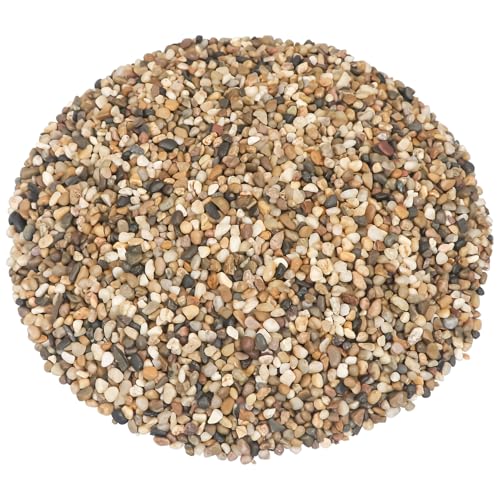
How To Choose The Best Lawn Edging Rocks
The wrong rock choice turns a weekend project into a headache. Here is what to check before you click “buy.”
Size matters more than you think
Rocks under 1 inch (the diameter of a quarter coin) will shift with rain, get kicked into the lawn, and need a thick layer to look substantial. Stones in the 2- to 3-inch range (about the size of a large egg) stay put better as a single-layer edging because their weight holds them in place. For a clean border that does not need a deep trench, aim for the larger end of that range.
Weight is a number, volume is the reality
A 20-pound bag sounds heavy — and it is to carry — but rocks are dense. That bag may only cover a few square feet. Look at the diameter (the size of individual stones) together with the total weight. Bigger stones in a 20-pound bag mean fewer total rocks and less coverage. Smaller stones give you more pieces per pound but may need to be layered deeper to look full.
Color consistency tells the story
“Mixed color” can mean a pleasing blend of browns, tans, and grays, or it can mean a few bright whites that stand out. If you want uniform edging, consider a single-color bag (black or white). If you want a natural look, mixed tones hide debris better.
Quick Comparison
| Model | Best For | Rock Size | Total Weight | Color | Amazon |
|---|---|---|---|---|---|
| FANTIAN 20 lbs (2-3 Inch)★ Best Overall | Best Overall | 2–3 in | 20 lbs | Mixed | Amazon |
| Virekm 10 lbsBest for Small Pots | Small pots & trays | — | 10 lbs | Mix Color | Amazon |
| Lechloris 10 lbs (1-2 Inch) | Uniform black edging | 1–2 in | 10 lbs | Black | Amazon |
| Pulovin 20 lbs (2-3 Inch) | Natural garden beds | 2–3 in | 20 lbs | Mixed | Amazon |
| Mulctun 45 lb White (1/4-3/4 Inch) | Pathways & large areas | 0.25–0.75 in | 45 lbs | White | Amazon |
| FANTIAN 40 lbs (1-2 Inch) | Big mixed-color projects | 1–2 in | 40 lbs | Mixed | Amazon |
In-Depth Reviews
1. FANTIAN 20 lbs Natural River Rocks Mexican Beach Pebbles
Our pick — 4.5★ from 600+ verified ratings; the strongest balance of quality and price.
The top pick because its 2- to 3-inch rocks are the perfect size for a single-layer border that stays in place.
You get 20 pounds of smooth, natural river rocks that each measure 2 to 3 inches across — the balance for a lawn edge that does not look skimpy. Buyers report the rocks arrive “beautiful in my flower beds,” with a matte finish and a mix of round and oval shapes that stack together nicely.
The thing owners love most is the appearance: 38 people single it out, with another 21 praising the color range. These are unpolished, dye-free stones that display deeper tones when wet, which means your edging looks different — and arguably better — after a rain. A few rocks may arrive chipped, which the brand notes is normal for natural stone, but the overall quality score is strong at 16 positive mentions.
Here is the honest trade-off: some buyers find the rocks smaller than they imagined for the price. At 20 pounds with individual stones this big, you get fewer total rocks than a bag of smaller gravel. If you are covering a long border, measure your square footage first. But for a medium flower bed, a bird bath base, or a fire pit ring, this bag hits the mark.
What wins people over
- Generous 2- to 3-inch size works perfectly as a single-layer edge that stays put
- Mixed colors (browns, grays, tans) look natural and hide fallen leaves well
- Unpolished surface means no artificial shine — just a clean matte look
Worth knowing
- 20 pounds covers less linear footage than you might expect with rocks this large
- A few stones may have minor chips (common for natural, unprocessed rock)
Who this is for: Gardeners who want a substantial, natural-looking border without the polished sheen. Best for medium flower beds, tree rings, and accent areas where each rock will be visible.
Think twice if: You need to cover a long sidewalk edge or a large driveway border — you will likely need multiple bags, and the per-bag cost adds up.
2. River Rocks, Landscaping Pebbles, Mixed Color Decor Stones, 10 Pounds
Tiny, smooth pebbles built for indoor pots — not for stopping weeds, so skip them for outdoor edging.
Owners mention the 10-pound bag covered two planter bowls, and a single pound fills about two 6-inch pots. The pebbles are lightly polished so they feel smooth and have no sharp edges, making them a good choice for orchid trays or vase filler.
Color is the star here — 28 buyers praise the mix of creams, greens, and browns. They work especially well in a nano aquarium (a small tank under 10 gallons); one owner says only a single rinse was needed versus 20-plus for other gravels. The finish is smooth enough that you can run your hand through them, which matters if you are topping houseplants that you handle frequently.
The catch is that the size is genuinely small. These are not edging rocks in the traditional sense; they are more of a decorative topper. A few customers note the bag looks small relative to the price tag, so read the weight carefully before assuming you are getting a yard’s worth of coverage.
Where it shines
- Smooth polished finish means they are easy to clean and safe for aquarium use
- Light-colored mix brightens up indoor planters and orchid trays
- 10 pounds goes a long way for small pots (about 20 six-inch pots)
Where it falls short
- Too small for outdoor edging — rain and foot traffic will scatter these easily
- The bag is physically small; 10 pounds of 0.4-inch pebbles is not a lot of volume
Reach for this if: You need a clean, colorful topper for indoor houseplants, orchid humidity trays, or a small aquarium. The smooth finish is a bonus for any project where you touch the stones.
Look elsewhere if: You are edging a lawn or garden bed outdoors — these are too small to stay put and lack the mass for a visible border.
3. 10lb Black River Rocks for Landscaping, Polished Pebbles by Lechloris

Where mixed-color bags go for natural camouflage, these polished black stones go for a bold, high-contrast look — buyers call them “outstanding obsidian.”
Each stone is tumbled smooth and falls between 1 and 2 inches — large enough to create a solid, unbroken dark surface when laid side by side. Buyers use them for everything from garden edging to epoxy table projects. Appearance is the top praise at 17 mentions, followed by quality at 11. The rocks are hand-selected to avoid broken pieces, and the polished finish means no grit or dust when you pour them out. One owner ran a 20-pound bag (two 10-pound orders) in a 20-gallon aquarium with no substrate underneath — the rounded shape allows detritus to settle between stones where a siphon can reach it.
The size is a mixed bag for some: at 1 to 2 inches, these are on the larger side for smaller pots. A few buyers expected something smaller for terrarium work. And value for money gets negative marks from 6 owners, who find them pricey for a 10-pound bag — a real trade-off given that the FANTIAN 20-pound top pick gives you double the weight.
The big wins
- Deep, consistent black color that does not fade and provides a modern look
- Polished and smooth — no sharp edges, no debris, ready to use out of the bag
- Large 1–2 inch size creates a dense, cohesive edging line that weeds struggle to breach
The honest downsides
- 10 pounds is a light bag for the price; scaling up to a full garden edge gets expensive
- Shiny finish reflects sunlight — if you want a matte, natural look, these are not it
Grab these for: A modern, high-contrast garden border or a polished planter topper where the black color steals the show. Epoxy and craft projects love the smooth texture.
Skip them if: You are on a tight budget for a large area — you will need several bags, and the per-pound cost is higher than mixed-color river rock.
4. Pulovin 20 lbs River Rocks for Landscaping, 2-3 Inch Garden Rocks
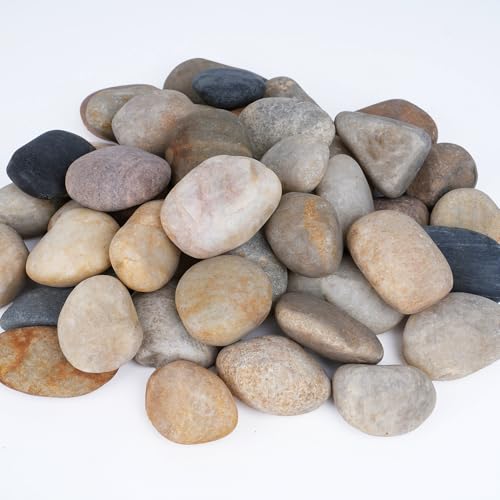
The no-frills option for purists who want unpolished, dye-free rocks that look like they came from a creek — because they basically did. Reviewers point out they are “great in my garden.”
This bag gives you 20 pounds of 2- to 3-inch mixed stones that are unpolished, dye-free, and non-toxic. They are smooth enough to handle but keep their natural matte finish. The size at 3 inches matches the upper end of the FANTIAN 2- to 3-inch range, so these are comparable in coverage. Where they differ is the brand’s emphasis on clean, ready-to-use stones that are safe for fish and reptiles. The smooth surface is large enough that small animals cannot accidentally ingest them.
The honest note here is price: several buyers call these “a little pricey” but admit they “look great and will last a long time.” Rocks do not rot or fade, so the one-time cost matters less over a decade than the price of annual mulch. But if you are on a strict budget for a large yard project, you may find the per-bag cost stings compared to the top-pick FANTIAN, which offers a similar size and weight.
What works
- True natural river rock with no polish or additives — the most authentic look in the lineup
- Large 2–3 inch size stays in place as lawn edging and resists being kicked onto the grass
- Versatile for both garden beds and aquarium/reptile habitats
What to consider
- Mid-range price point that some buyers feel is steep for a 20-pound bag
- Color variation is natural — you may get more gray or tan in one bag than another
Best match for: Gardeners who want the most natural, unprocessed look for their flower beds and do not mind paying a little more for authenticity. Also great for reptile owners who need safe, large stones.
Not ideal if: You want a super consistent color across multiple bags — natural stone varies by batch, and mixed colors mean no two rocks are identical.
5. Mulctun 45LB Natural White Rocks, 1/4″-3/4″ Garden River Rock

A 45-pound sack of tiny white gravel for covering ground — but be ready for small stones (0.25 to 0.75 inches) and initial dust.
This is the heaviest bag in the lineup at 45 pounds, and it has the smallest individual stones — each rock is just 0.25 to 0.75 inches. The white color is a bright, chalky matte that stands out sharply against dark soil or green grass. Owners use these for herb garden planters, pathways, and as a clean ground cover that reflects light.
Versatility gets the most praise at 9 mentions, and landscape use follows at 8. The stones have a unique “chalky” matte finish that gives a low-gloss look, which some buyers love. But the size is a major mixed bag: it is the most-discussed aspect at 10 mentions, and many buyers found the stones “extremely small” compared to what they expected. One owner noted the bag itself looks small for 45 pounds and could lift it with one hand.
The staining category is also mixed — 7 owners mention it. The manufacturer notes that dust will adhere to the natural stone surface and should wash off with water. If you want a bright white look immediately, plan to rinse the bag before use.
Where it delivers
- 45 pounds offers the most coverage per bag — best value for filling a large area or pathway
- Bright white color creates a clean, modern look that contrasts well with greenery
- Small size works well as a fill gravel that compacts into a stable surface
Where it disappoints
- Stones are tiny — 0.25 to 0.75 inches — and some buyers felt misled by the “river rock” label
- Initial chalky dust requires rinsing before the white color truly pops
- Bag may feel lighter than expected for 45 pounds, raising doubts about the weight
Reach for this if: You need a large volume of bright white gravel to fill a pathway, a dry creek bed, or a decorative border where you can use 2–3 inches of depth. The per-pound cost is the lowest here.
skip it if: You want visible, chunky edging rocks that stand out individually — these are closer to coarse sand than landscape boulders. Rinsing is also a must for the best look.
6. FANTIAN 40 lbs River Rocks for Landscaping, 1-2 Inch Decorative Stones
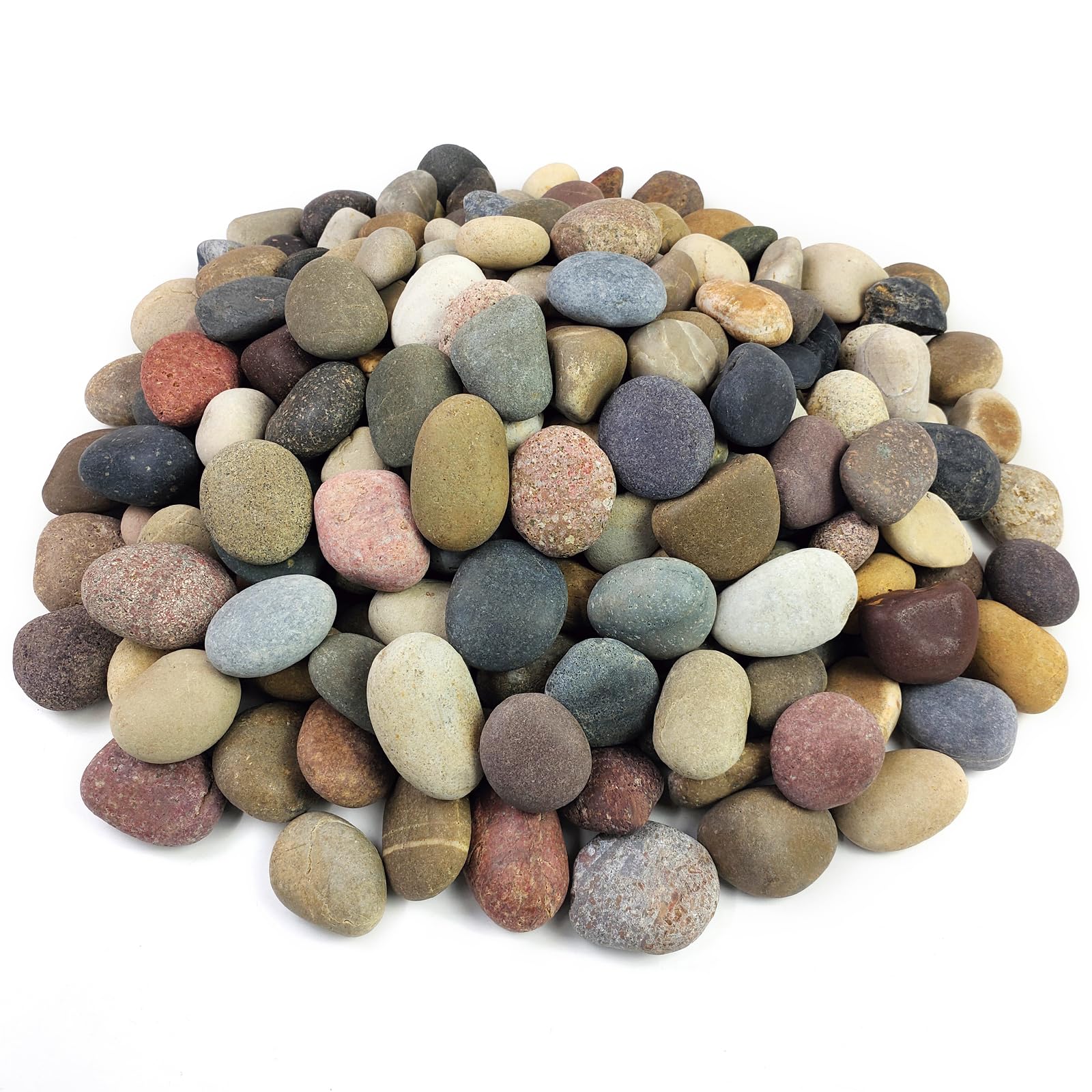
Double the weight of the top pick (40 pounds) but with smaller stones (1–2 inches) — a solid bulk option for mixed-color edging, though you may need a deeper layer.
Think of this as the big brother to the top pick. You get 40 pounds of mixed-color river rocks at 1 to 2 inches, which is a step down in individual stone size from the 2- to 3-inch version but a big step up in total weight. Buyers call them “really pretty” and note they are “perfect size for a dry river project.” The rocks have a smooth, flat surface that sits well in a trench without rolling.
Appearance is the top praise at 13 mentions, and rock quality follows at 9. The mixed colors include browns, grays, and tans, and the stones shift in tone when wet. Each 40-pound box arrived securely packed in thick plastic bags, which buyers appreciated for reducing mess.
The recurring gripe is value for money at 5 mixed mentions. Some owners feel the rock count does not match the price tag, especially if they expected more volume from a 40-pound bag. The size is also mixed — at 1.6 inches average diameter, these are noticeably smaller than the 2- to 3-inch top pick, so the same linear footage may need a deeper layer to look full.
The strong points
- 40 pounds provides good bulk coverage for medium to large landscaping projects
- Flat, smooth shapes stack well and create a stable surface for walkways or edging
- Mixed natural colors look attractive and hide dirt and debris between cleanings
The trade-offs
- 1.6-inch average size means these are not as chunky as the 2-3 inch top pick — you may need a double layer for the same visual impact
- Some buyers find the price steep for the amount of rock you actually get in the bag
Choose this if: You have a dry creek bed or a larger border area and want the convenience of a single 40-pound bag with a versatile mixed-color look. The flat shape is great for stable placement.
Consider the alternative if: You prefer chunky, 2-3 inch statement rocks — the top-pick FANTIAN 20-pound bag gives you bigger individual stones, and you can always buy two of them to match the total weight.
Understanding the Specs
Rock Size vs. Coverage
The single most important number on a bag of edging rocks is the individual stone diameter, not the total weight. A 20-pound bag of 2-3 inch rocks gives you fewer total stones than a 10-pound bag of 0.4-inch pebbles, but each stone has enough mass to stay put against rain, sprinklers, and foot traffic. For a single-layer lawn edge that you want to see and that will stay in place, aim for 1.5 inches or larger. Smaller rocks (under 1 inch) are better as fill or mulch topper — they will need a deeper layer and a retaining edge.
Polished vs. Natural Finish
Polished rocks are tumbled smooth and often have a slight sheen. They feel nicer in the hand, show off their color better when wet, and are less likely to have sharp edges — good for aquariums, craft projects, or anywhere you handle the stones. Natural (unpolished) river rocks have a matte, earthy look that blends into the landscape rather than standing out. They tend to look more authentic in a garden setting but may carry more dust or minor chips. The finish also affects slip resistance: polished rocks can be slick when wet, while natural ones offer more traction underfoot.
FAQ
How many pounds of edging rocks do I need for my flower bed?
Can I use any of these rocks in a fish tank or aquarium?
How do I keep lawn edging rocks from sinking into the soil?
Will the color of these rocks fade in direct sun?
Can I use these rocks for a fire pit ring or surrounding area?
How do I clean river rocks that have gotten dirty or dusty?
Are larger rocks always better for edging?
How many bags should I buy for a 20-foot lawn edge?
Will these rocks attract pests or rodents?
Can I mix different colored bags together for a custom look?
Final Thoughts: The Verdict
For most buyers, the best lawn edging rocks winner is the FANTIAN 20 Pounds Natural River Rocks because it hits the ideal 2- to 3-inch size, offers beautiful mixed colors, and has the highest owner satisfaction in this range. If you want a bold, modern contrast, grab the Lechloris 10lb Black River Rocks for their polished obsidian look. And for covering a large pathway on a budget, the Mulctun 45LB White Rocks give you the most weight per bag, though you will want to rinse them first for the brightest finish.
How We Picked
We do not accept paid placement. Every pick is matched to a real buyer and a real use-case; we do not hands-on test units.
Sources & Methodology
Specifications: manufacturer listings and product documentation. Review insights: verified customer reviews, as of July 2026. Pricing: not shown on this page (it changes often); check the current price via the retailer link.
As an Amazon Associate, Lawn Gear Lab earns from qualifying purchases. This does not affect which products we feature.