
Specs are compiled from manufacturer listings and verified buyer reviews and can change over time — please confirm the key details on the product page before buying.
Aerating your lawn is one of the simplest things you can do to wake it up—but only if you pull real cores out of the ground. Stabbing the soil with solid spikes just creates more compaction around the hole, which is the opposite of what you want. A true core aerator uses hollow tines to lift plugs of soil to the surface, giving air, water, and fertilizer a direct path to the root zone where they actually do some good.
I’m Rikta — the founder and writer behind Lawn Gear Lab. This guide is built by comparing the manufacturers’ published specifications and the patterns across verified customer reviews, so you get each pick’s real strengths and trade-offs instead of marketing spin.
You want a lawn core aerator that pulls clean plugs without clogging or bending, no matter your soil type. The key specs to compare are the number of tines, how deep they go (measured in inches), how easily the tool ejects the plugs, and whether the frame can handle rocky or clay soil without damage.
Our Picks at a Glance

How To Choose The Best Lawn Core Aerator
Every aerator on this list pulls plugs instead of just poking holes, but the right one for you depends on the size of your yard, your soil type, and how much effort you want to put in. Here is what to weigh before you buy.
Manual vs. Tow-Behind
A manual core aerator is a tool you push into the ground with your foot and lift out. It works well on lawns up to about 5,000 square feet, and it gives you control around trees, beds, and curbs. A tow-behind model attaches to a lawn tractor or ATV and covers large areas quickly, but it costs more and takes up storage space. The trade-off is time—a manual tool takes patience, while a tow-behind finishes in a fraction of the time.
Tine Count and Plug Depth
More tines mean more holes per step, but they also mean more force needed to push them into the ground. Three and four-tine hand tools are the most common because they strike a practical balance. For tow-behind units, 24 tines is the standard. The depth of the plugs matters more than the number of holes—you want at least two to three inches of core removal to relieve compaction effectively. Shorter plugs mean the tool is not reaching the compacted layer.
Core Ejection and Clogging
An aerator that pulls plugs but holds onto them inside the tines is useless after a few steps. Good ejection is what separates a useful tool from a frustrating one. Some designs push plugs out the side, some have open tops, and some include a storage tray. Wet or sticky soil causes clogs in any tool, so look for an aerator with wider tines or a cleaning tool included. Moist soil is still non-negotiable—dry ground turns any aerator into a workout with poor results.
Build Material and Durability
Stainless steel and alloy steel tines resist rust and stay sharp longer than basic carbon steel. The frame and foot platform need to handle your weight without flexing, especially when the ground is hard. A warranty is a good sign—most quality manual aerators carry at least a satisfaction guarantee, while tow-behind models from established brands often include a multi-year limited warranty.
Quick Comparison
| Model | Best For | Tines | Plug Depth | Weight | Amazon |
|---|---|---|---|---|---|
| Lawn Aerator Tool (Xuperace)★ Best Overall | Ease of use and non-clog design | 3 | ~3 in | 5.69 lbs | Amazon |
| Manual Core Aerator (LawnVigor)Top Performer | Ease of assembly and quality | 3 | ~3 in | 3.52 lbs | Amazon |
| EEIEER Manual Lawn AeratorClever Design | Neatness with soil storage basket | 3 | ~2 in | — | Amazon |
| Dolibest 4-Corer Plug Aerator | Stainless steel durability | 4 | 3.5 in | 5.54 lbs | Amazon |
| Dolibest with Storage Tray | Mess-free plug collection | 4 | — | 2.81 kg | Amazon |
| Agri-Fab SmartLink Plug Aerator | Value and versatility | 24 | ~3 in | 29 lbs | Amazon |
| Landzie Hollow Tine Aerator | No-assembly convenience | 3 | ~4 in | 5.6 lbs | Amazon |
| Craftsman Tow Behind Plug Aerator | Large properties with weight tray | 24 | ~3 in | 78.8 lbs | Amazon |
| Brinly Tow Behind Plug Aerator | Heavy duty and durable build | 24 | ~3 in | 63.9 lbs | Amazon |
In‑Depth Reviews
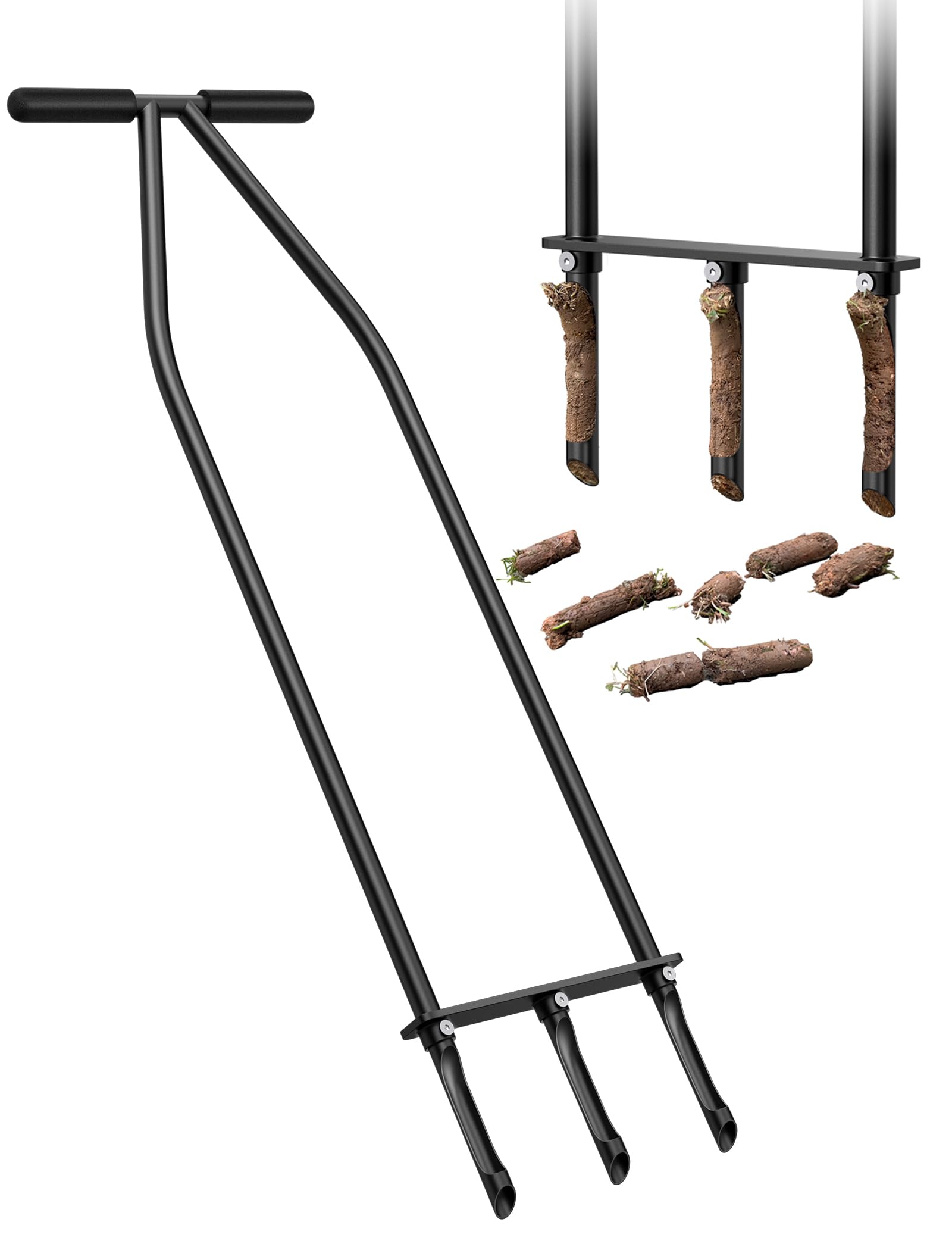
1. Lawn Aerator Tool, Core Aerator Lawn Tool with Alloy Steel Material
Our pick — over 4.5★ from 100+ verified ratings; the strongest balance of quality and price.
The manual aerator that solved clogging by ejecting plugs out the side.
Most manual aerators push the core straight up, where it stacks and jams. This one routes the soil plug sideways through a ramp, so it slides out cleanly without you having to stop and poke a stick through the tines every few steps. The thing is heavy—5.69 pounds—but that weight works in your favor: it drives the three alloy steel tines deep with less force from you. The frame is a single formed piece, not welded, which eliminates a common failure point on cheaper tools.
Owners call it “sturdy and easy to use,” with one buyer noting it produced excellent plugs in St. Augustine grass on a 1,000-square-foot lawn. The knee-friendly open-center footplate is a smart detail—it lets you drive straight down without banging your shin or pinching your knee against a center bar. At 5.69 pounds, this is noticeably heavier than the 3.52-pound LawnVigor model below, but the extra heft and side-ejection design make it the most frustration-free manual aerator you can buy.
The only real caveat: those tines are sharp, and the side ejection means the plug flies out laterally. Wear boots and keep your feet clear. Moist soil is still required for best results, same as every other tool here.
What Wins People Over
- Side-ejection ramp prevents jamming — a genuine innovation
- One-piece alloy steel frame with replaceable tines
- Knee-friendly open footplate design is comfortable to use
The Trade-Off
- At 5.69 pounds, it is one of the heavier manual options
- Sharp tines will cut through shoes — use sturdy boots
Grab it if: you want the best-engineered manual aerator that minimizes clogging, feels solid, and was literally designed by a team focused on lawn care ergonomics.
Think twice if: you have a very large lawn (over 5,000 sq ft) and would rather tow something behind a tractor — that is a different tool for a different job.
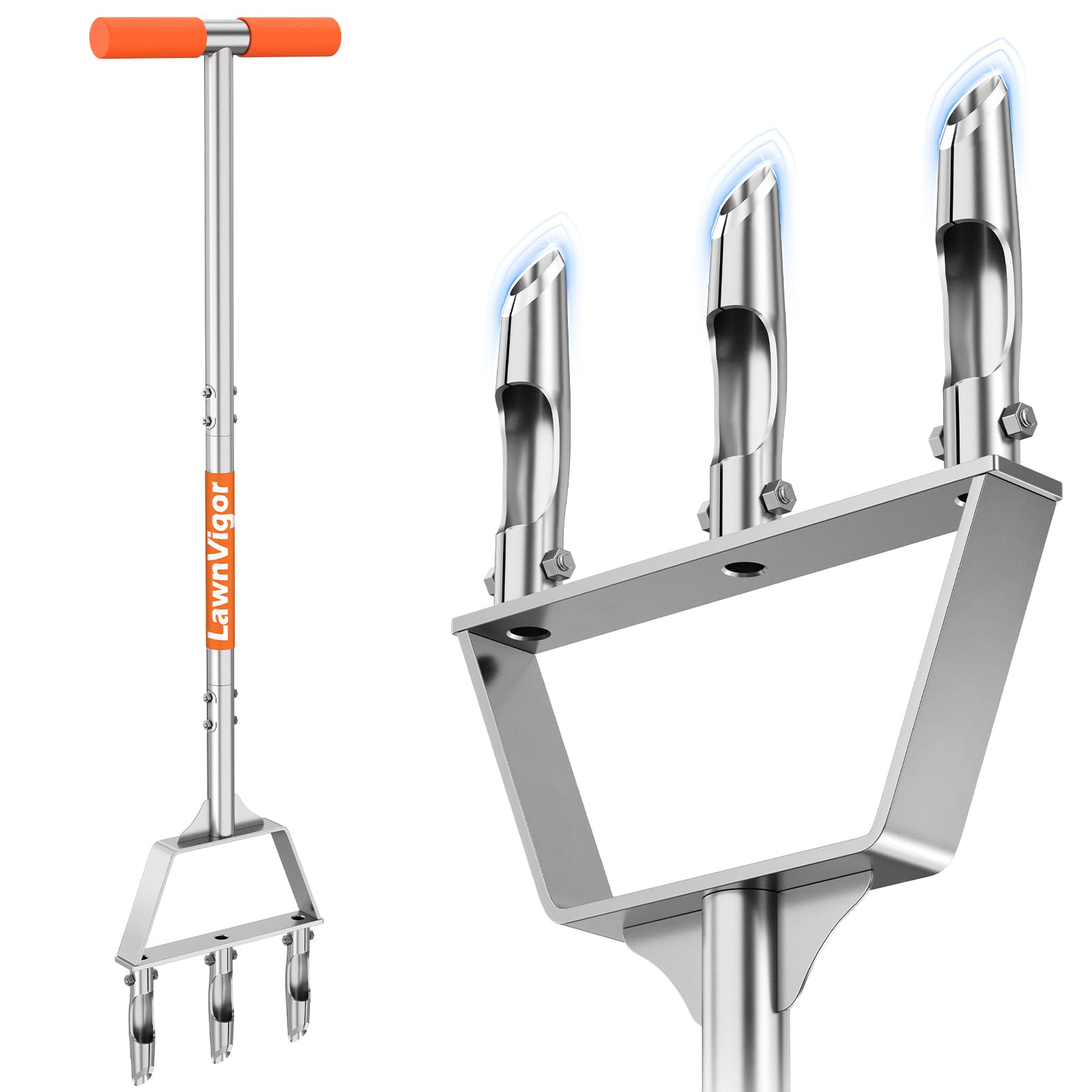
2. Manual Core Aerator Lawn Tool (LawnVigor)
A crowd-favorite manual aerator that punches well above its 3.52-pound weight.
This three-tine plugger from LawnVigor weighs 3.52 pounds, while the top pick weighs 5.69 pounds, yet owners consistently call it “super stable during use” and praise its heat-treated hollow tines that stay sharp. The semi-assembled design means you spend minutes, not an hour, putting it together. It pulls about three-inch plugs reliably on moist soil, and the large dirt-release holes at the top of the tines help the cores fall out without you shaking the tool.
The ergonomic handle is designed to reduce back strain, and the foot bar gives you good leverage. It has drawn over 900+ ratings with a 4.5-star score, making it among the most popular manual aerators on the market. One owner called it “the only manual aerator I have used that works,” saying it performed “10x better” than a previous purchase. It is lighter and quicker than the Xuperace tool above—easier on your body over a long session but lacks the side-ejection ramp. For small to medium lawns, it is an outstanding choice. skip it if you have heavy clay soil that clogs standard tines.
The Highlights
- Very easy to assemble; semi-assembled from the start
- Heat-treated hollow tines grip and penetrate tough soil
- Reliable plug ejection with large release holes
The Downside
- No side-ejection system — can still clog in very wet soil
- Some owners noted foam handle covers can loosen over time
Best suited for: the person with a small to medium lawn who wants a lightweight, easy-to-assemble tool that works reliably while staying affordable.
Look elsewhere if: you are dealing with thick, heavy clay that tends to stick inside tines — the Xuperace side-ejection model handles that better.
3. EEIEER Manual Lawn Aerator with Soil Storage Basket
The three-tine aerator with a basket that catches ejected soil cores.
Nobody likes scattering soil plugs across the lawn and then having to rake them up. EEIEER added a storage frame on top that catches the squeezed-out cores as you work, keeping your grass tidy. It is a simple fix for a real annoyance. The tool also includes a dedicated cleaning stick for when the hollow tines do clog, and a 38-inch handle that reduces the bending you would do with shorter tools.
The build uses high-density alloy with walls thickened to 2mm, which is a meaningful upgrade from the 1.2mm walls on earlier versions. That extra thickness cuts down on tine breakage in dense soil. Owners say it works well for soft soil and small lawns up to about 3,000 square feet. The catch is that the basket fills up fast—you will need to dump it repeatedly on a larger yard. Clogging also gets mixed reviews; the cleaning tool helps, but it is an extra step that slows the rhythm. If you hate cleaning up after aerating, this neatness-first design is worth the trade-off.
Why It Stands Out
- Soil storage basket catches ejected plugs — less cleanup
- Thickened 2mm inner wall on the tines for durability
- Comes with a cleaning stick and a 38-inch ergonomic handle
Consider This
- Storage basket fills quickly; requires frequent emptying
- Can still clog in sandy or very wet soil despite the cleaning tool
Reach for this if: you value a tidy lawn and want to avoid the extra step of raking up soil plugs after you finish aerating.
pass on it if: your lawn is larger than a quarter acre — the basket capacity and manual effort become a bottleneck.
4. Dolibest Lawn Coring Aerator, 4-Corer Stainless Steel
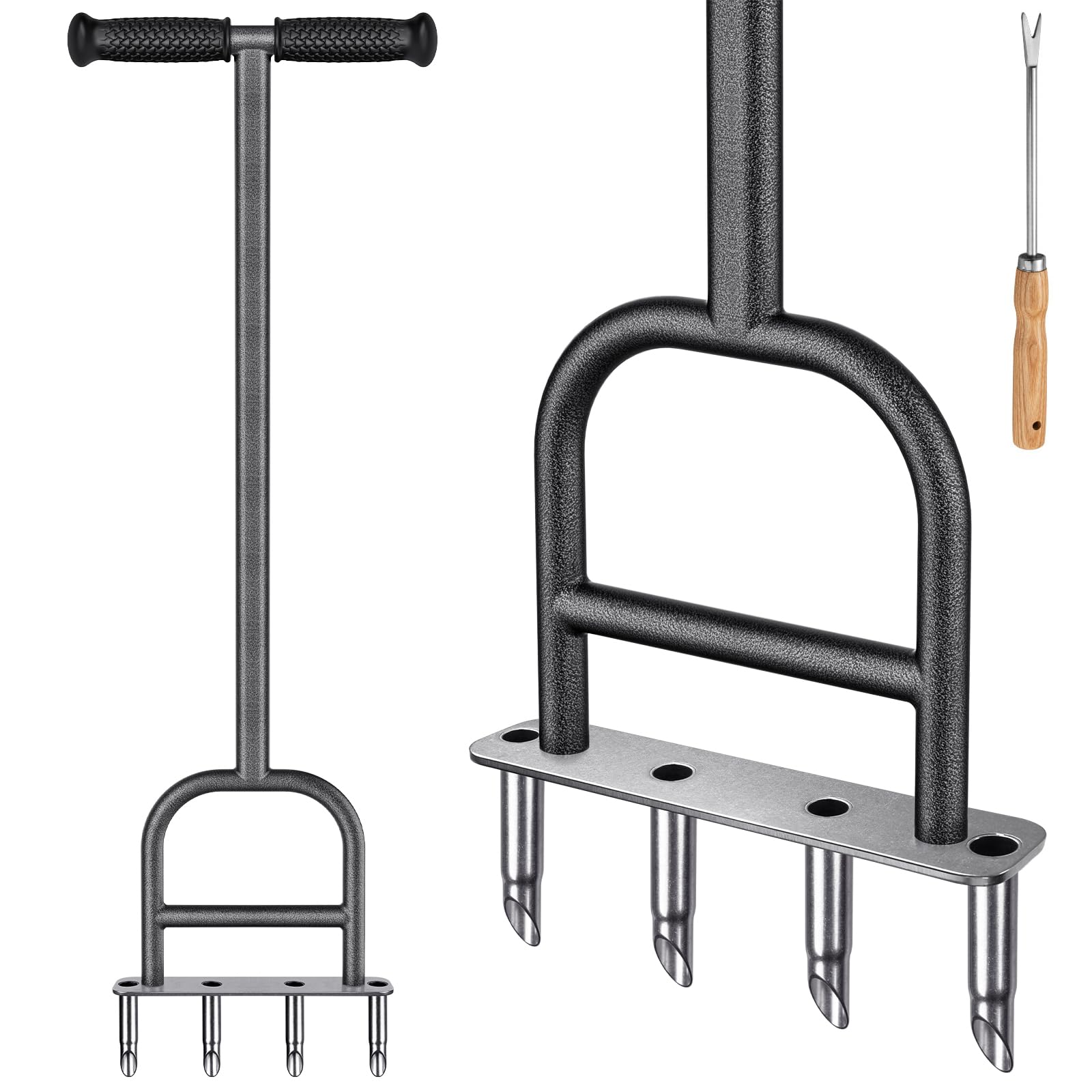
Four hollow stainless steel tines that refuse to rust, priced to beat the competition.
Most manual aerators use painted steel that chips and rusts over time. Dolibest went with a stainless steel bottom section and coring plugs, so corrosion is not something you will worry about even if you leave it in the shed after a wet job. The four tines are each 3.5 inches long and half an inch in diameter, producing deep, narrow plugs. That extra tine means you cover 33% more ground per step compared to a three-tine tool, which adds up fast on a medium yard.
The soft rubber grip prevents blisters, and the improve foot bar keeps your shoe from interfering with plug ejection. A 12-inch weeding tool is included for cleaning the tines or pulling weeds. Owners say the single welded construction is very sturdy, with one calling it “a must for spots in my yard.” The honest trade-off: clogging gets some negative mentions, especially in dry clay soil. The four tines also require more downward force than a three-tine tool, so you will want moist ground and sturdy boots for good depth.
Strong Points
- Stainless steel plugs resist rust and bending
- Four tines offer faster coverage than three-tine tools
- Comfortable soft rubber grip reduces hand fatigue
Weak Points
- Rounded foot step reduces leverage compared to a flat step
- Clogs more frequently in sticky clay soil than some three-tine models
Pick it for: the buyer who wants a rust-proof, four-tine aerator that covers ground efficiently and feels solid without breaking a budget.
Think twice if: your soil is heavy clay that stays wet — you will fight with clogs on the four narrower tines.
5. Dolibest Lawn Coring Aerator with Soil Core Storage Tray
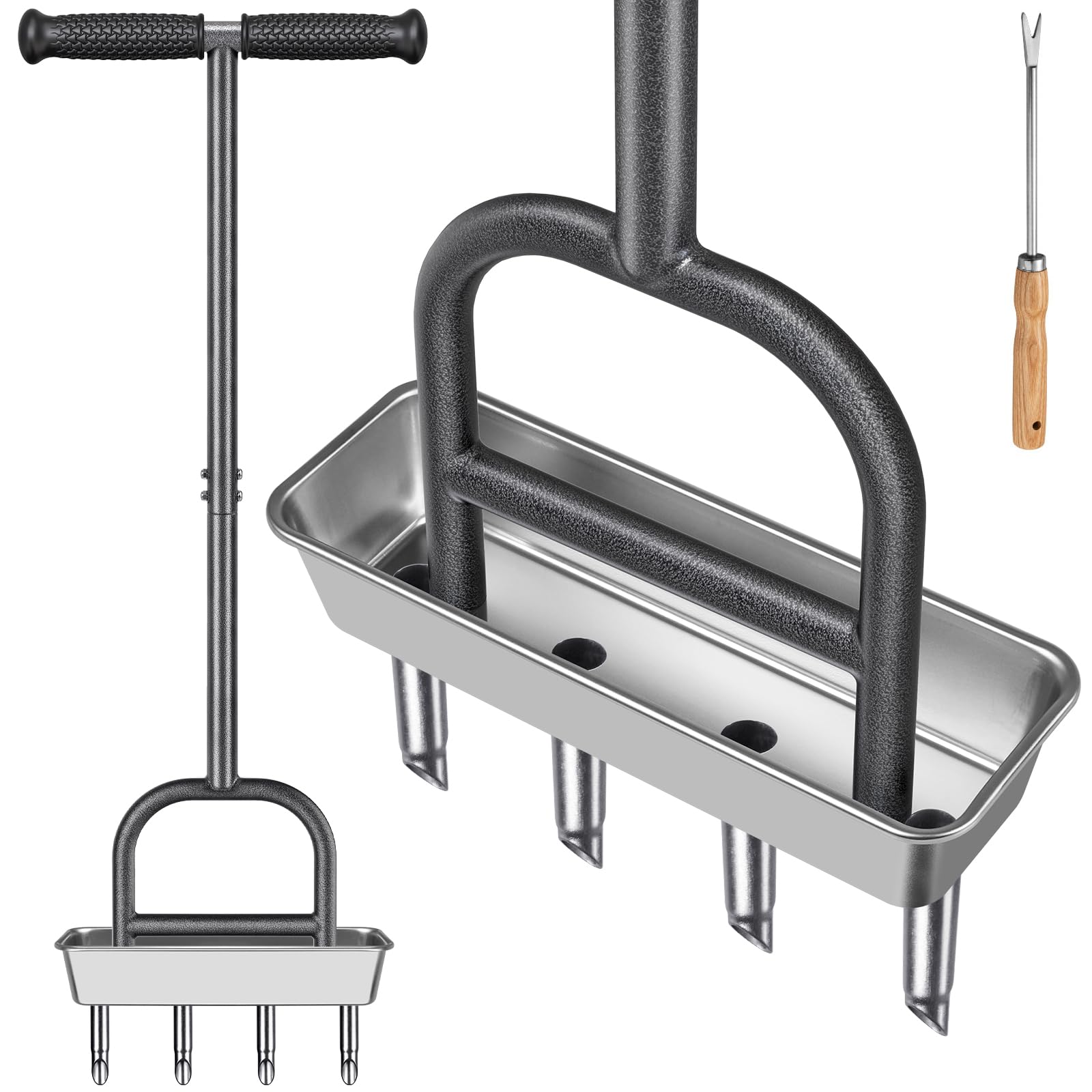
The four-tine aerator that collects its own ejected soil in a stainless tray.
This is the bigger, tray-equipped version of the previous Dolibest tool, and it takes the mess-free idea further. SUS 304 stainless steel is used for both the four coring plugs and the storage tray, so nothing rusts. The improve crossbar keeps your boot from interfering with the soil as it ejects into the tray. Assembly is genuinely simple—three parts, two screws, about two minutes.
Owners say it works well for small areas and is a good height for comfortable use. One reviewer noted it was “about half the price” of a similar tool from a big-box store. The core collection feature gets mixed reactions because the tray can fill up fast, and some owners find the dirt gets packed into the tines themselves, requiring the included weeding tool to clear them out. It is a specialist tool for the person who wants both the four-tine coverage and a cleaner work area, but it is best suited for small to medium lawns where you can manage the tray’s capacity.
What Works
- Stainless steel tray collects soil cores automatically
- Very quick and simple two-minute assembly
- improve crossbar prevents shoe interference with plug ejection
What Does Not
- Soil can clog inside the tines despite the tray
- Tray fills quickly on lawns over a few thousand square feet
Best for: the homeowner who wants a clean, contained aeration experience for a small yard and likes the idea of not having to rake up plugs.
Not for: anyone doing a large lawn where stopping to empty the tray every few minutes kills momentum.
6. Agri-Fab 45-0474 SmartLink Plug Aerator

The entry-level tow-behind that brings 24 rustproof knives to the party.
For anyone with a riding mower and a lawn bigger than half an acre, a tow-behind aerator saves hours of manual labor. The Agri-Fab delivers 24 rustproof aerator knives that pull three-inch soil plugs, and it weighs 29 pounds, making it one of the lighter tow-behind options. The SmartLink system means it attaches to most lawn tractors, and buyers report it is fairly straightforward to assemble—around 30 minutes for most.
It is a no-frills design: add weight (cinder blocks or the included tray) for deeper penetration in hard soil. Owners say it pulls “nice plugs” when the soil is moist and that the performance matches dedicated units costing more. The key limitation is durability—some owners mention weld failures after a few seasons of heavy use, though the 3-year limited warranty offers some protection. For the price, it is the smart way to get into tow-behind aeration without spending Craftsman or Brinly money.
The Upside
- Affordable entry into tow-behind aeration for mid-size lawns
- 24 rustproof knives with a 3-year limited warranty
- SmartLink quick-attach system fits most garden tractors
The Catch
- Some owners experienced weld breaks; durability is mixed
- Packaging is often poor, with damaged boxes and missing hardware
Choose it if: you have a riding mower and want to stop manually aerating, but you are not ready to spend over on a tow-behind unit.
Pass if: you are on very rough or rocky terrain where welds get stressed—step up to the Brinly or Craftsman for heavier steel.
7. Landzie Hollow Tine Lawn Aerator Tool
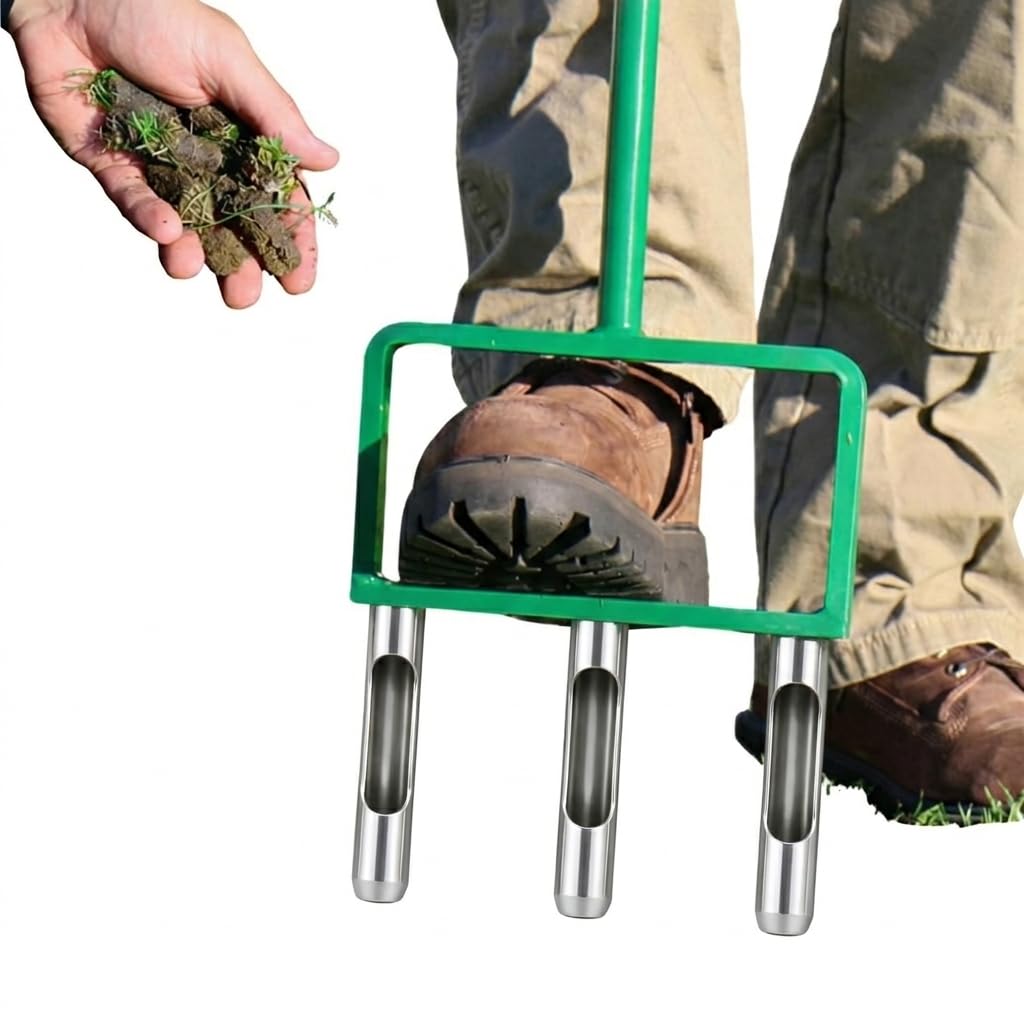
A pre-assembled, 42-inch manual aerator with beveled tines that resist clogging.
The Landzie arrives fully assembled. No screws, no instructions, no hassle. The 42-inch handle is longer than most manual aerators, which reduces back strain for taller users. The three solid stainless steel tines are beveled on the inside to help soil slide through, and the brand claims a clog-free experience—owners tend to agree, with many calling the self-cleaning design effective.
At 5.6 pounds, it is similar in weight to the Xuperace top pick, and it produces plugs around four inches deep in damp soil, which is deeper than most competitors. The tines are replaceable, which extends the tool’s life. On the flip side, it is physically demanding—customers note spending four hours on 2,200 square feet of lawn. The foot bar can feel slippery with wet boots, and the price is higher than many manual options. You pay a premium for the no-assembly build and the longer handle, but the quality is evident in the steel and the replaceable parts.
what separates it
- Comes fully assembled — use it right from the start
- 42-inch handle reduces bending for taller users
- Self-cleaning beveled tines with replaceable parts
What You Give Up
- Manual aeration is still a serious workout on large lawns
- Foot bar can feel slippery with wet or muddy boots
Ideal for: the taller homeowner who wants premium build quality, zero assembly, and a deep four-inch plug from a tool that feels built to last.
Not ideal for: large lawns over a quarter acre—the manual effort at 42 inches of leverage still adds up fast.
8. Craftsman 40 Inch Tow Behind Lawn Plug Aerator

A 78.8-pound tow-behemoth with a built-in weight tray for serious soil penetration.
This is not a tool for small lawns—it is for the person with an acre or more who wants to aerate in a single afternoon without breaking a sweat. The Craftsman uses 24 galvanized steel coring points to pull plugs up to three inches deep, and the wide weight tray supports up to 140 pounds of ballast for extra penetration in hard soil. Flat-free tires mean you never deal with a flat mid-job, and the lift handle system allows vertical storage to save floor space.
Agri-Fab builds this in Sullivan, Illinois, using heavier steel than the budget tow-behind above, and it holds more plugs. Assembly takes a couple of hours and requires patience—the instructions can be confusing, and some owners swap a bolt for a slightly different length. Once assembled, it tows smoothly and pulls good plugs. Owners who used it on 1.5 acres of rocky soil said it held up where a cheaper unit broke on the first use. The 3-year limited warranty covers defects. If you have a large property with tough soil, this is the tow-behind to trust over the budget model.
Why You Would Buy It
- Extra-wide weight tray holds up to 140 lbs for maximum penetration
- 24 galvanized steel points with flat-free tires
- Vertical storage saves garage space when not in use
What To Know
- Assembly takes 2-3 hours and requires some mechanical patience
- Not for small lawns—the size and weight are overkill under an acre
Buy it for: the large-property owner who wants a heavy-duty, American-made tow-behind that handles hard soil with added ballast and stores upright.
Look elsewhere if: your lawn is under half an acre—the manual aerators above are faster to set up and easier to store.
9. Brinly Tow Behind Plug Aerator, 40″

The most-trusted tow-behind aerator on Amazon, built with 63.9 pounds of USA steel.
With over 900+ ratings and a 4.4-star score, the Brinly 40-inch plug aerator is the heavyweight champion of the tow-behind category. It uses 24 heat-treated, 16-gauge steel spoons—narrower than average and sharpened at the ends—so they penetrate compacted soil with less weight ballast than competing designs. The fully enclosed weight tray holds up to 150 pounds of any ballast you choose, from sandbags to cinder blocks. Three independently rotating tine sections reduce turf damage on turns and help maintain even penetration on bumpy ground.
Owners say it creates plugs about 2.5 inches deep and pulls easily behind a 20 HP tractor. The universal single-pin hitch fits nearly every lawn tractor and most zero-turn mowers and ATVs. The transport lever lets you lift the tines out of the ground when crossing a driveway or sidewalk. The honest reality: assembly takes about an hour or two, and the instructions can be confusing because they cover multiple models. Some owners note that the extra hardware included is excessive. But the build quality—heavy-duty steel, made in the USA—is what makes it the most popular tow-behind on the market for a reason.
Why It Dominates
- Heat-treated, sharpened spoons require less ballast for deep plugs
- 150-pound capacity weight tray with fully enclosed design
- Independent rotating tine sections protect turf on turns
What To Expect
- Assembly is time-consuming and the instructions mix multiple models
- Transport wheels are plastic and designed only for moving, not towing at speed
The final word: if you have an acre or more and want the most popular, best-reviewed tow-behind aerator that will last for years of seasonal use, the Brinly is the one to buy.
it’s not for you if: your yard is under half an acre and you cannot justify the storage space or the assembly time—manual is smarter.
Understanding the Specs
Hollow Tines vs. Solid Spikes
A hollow tine is a metal tube that cuts into the soil and lifts a core out. A solid spike just pushes soil aside, which compacts the walls of the hole and works against your goal. Every pick here uses hollow tines — that is the first thing to confirm on any aerator you consider.
Plug Depth and Tine Length
Look at the length of the tines listed on the spec sheet. You want tines that are at least three inches long so they punch through the compacted layer and pull a full plug. Tools with tines under two inches are not doing real aeration — they are just poking the surface.
Weight and Soil Moisture
Manual aerators depend on your body weight to push the tines in. Lighter tools (under 4 lbs) require more effort from you. Heavier tools (5-6 lbs) sink in easier. Either way, the soil must be damp — dry soil turns any manual aerator into a frustration machine. Water the lawn the day before you aerate.
Ejection and Clogging
Clogging is the most common complaint with any core aerator. Tines that are too narrow or too smooth on the inside hold onto wet soil. Features like side-ejection ramps, larger-diameter tines, and included cleaning tools all help. A tool that clogs every few steps will make you stop and clear it — that wasted time adds up fast on a lawn of any size.
FAQ
How often should I aerate my lawn with a core aerator?
What is the difference between a spike aerator and a core aerator?
Will a manual core aerator work in hard clay soil?
How long does a manual core aerator last?
Can I use a tow-behind aerator with a zero-turn mower?
How much weight should I add to a tow-behind aerator?
Do I need to pick up the soil plugs after aerating?
Can I aerate my lawn after it rains?
Is a 3-tine or 4-tine manual aerator better?
Final Thoughts: The Verdict
If you want one dependable pick, the lawn core aerator winner is the Xuperace Core Aerator with Alloy Steel because it combines a knee-friendly design with a genuine side-ejection system that fixes the clogging problem that plagues every other manual tool. If you want a lighter tool that assembles in minutes and has drawn over 900+ ratings, grab the LawnVigor Manual Core Aerator. And for large properties where you want to cover an acre without breaking your back, the Brinly Tow Behind Plug Aerator is the most trusted tow-behind on the market — built with heavy USA steel and backed by a 3-year warranty.
How We Picked
We do not accept paid placement. Every pick is matched to a real buyer and a real use-case; we do not hands-on test units.
Sources & Methodology
Specifications: manufacturer listings and product documentation. Review insights: verified customer reviews, as of July 2026. Pricing: not shown on this page (it changes often); check the current price via the retailer link.
As an Amazon Associate, Lawn Gear Lab earns from qualifying purchases. This does not affect which products we feature.