
Specs are compiled from manufacturer listings and verified buyer reviews and can change over time — please confirm the key details on the product page before buying.
A lawn aerator spreader saves you from making two separate trips across the yard — one to feed the grass, another to punch holes in the soil. The trick is finding a combo that doesn’t jam when you’re spreading seed and doesn’t skip across hard ground when you’re aerating. You need tines that actually penetrate, a hopper that distributes evenly, and assembly that doesn’t eat an entire weekend.
I’m Rikta — the founder and writer behind Lawn Gear Lab. This guide is built by comparing the manufacturers’ published specifications and the patterns across verified customer reviews, so you get each pick’s real strengths and trade-offs instead of marketing spin.
I’ve focused on combo units that pair a spike aerator with a drop or broadcast spreader, looking at hopper capacity, tine depth, and what actual owners say about long-term use. The three contenders below represent the best lawn aerator spreader options you can buy today for covering a medium to large property without a second pass.
Our Picks at a Glance
How To Choose The Best Lawn Aerator Spreader
The real question isn’t whether a combo saves time — it’s whether the combo does both jobs well enough to justify the trade-off in complexity. Here is what separates a unit you will use for years from one that sits behind the shed.
Hopper Capacity and Material
You avoid rust with a plastic hopper, but it can warp under heavy loads or hot sun. A steel hopper keeps its shape and resists twisting — the trade-off is extra weight. A 100 lb. capacity hits the balance: you dump one full bag of seed or fertilizer without stopping mid-lawn, and you can add sand or weight for deeper tine penetration (the tines are the spikes that punch holes in the soil).
Tine Design and Penetration Depth
Star-shaped tines with multiple tips (9 to 11 per star is common) spread the load so each spike punches a clean hole rather than tearing the turf. Look for a claimed penetration depth of at least 2 inches — anything shallower is mostly scratching the surface. Galvanized or high-grade steel resists rust and bending when you hit compacted soil or clay.
Spreader Type: Drop vs. Broadcast
A drop spreader releases material directly below the hopper, giving you a precise row — better for edges and flower beds. A broadcast spreader flings material in a wide arc (a 32-inch width is standard here), covering ground faster but requiring more care near sidewalks. Some combos include a broadcast pattern; others are strictly drop. Match it to how manicured your property is.
Assembly Time and Parts Quality
This is the pain point that every review set mentions. A well-designed unit goes together in under an hour with basic tools. A poorly designed one demands drilling, filing, and hours of frustration. Look for a manufacturer that splits the hardware into labeled bags and provides clear bolt-sequence instructions — and check whether replacement chains and spacers are readily available before you buy.
Quick Comparison
| Model | Best For | Hopper Capacity | Unit Weight | Aeration Depth | Amazon |
|---|---|---|---|---|---|
| Suchtale Upgrade 40-Inch★ Best Overall | Broadcast coverage and deep spikes on a budget | Over 100 lb. | 59.4 lb. | Up to 2 in. | Amazon |
| Brinly AS2-40BH-P | Heavy-duty, deep aeration on large properties | 100 lb. (1.74 cu. ft.) | 77.8 lb. | Up to 2 in. | Amazon |
| Agri-Fab 45-05431 | Budget-friendly, poly hopper, lighter tow | 100 lb. | 45.9 lb. | — | Amazon |
In‑Depth Reviews
1. Suchtale Upgrade 40-Inch Tow Behind Spiker Seeder, Combination Tow Spike Aerator, Broadcast Spreader
A broadcast spreader that covers a 32-inch swath while nine star-shaped tines aerate deep behind it.
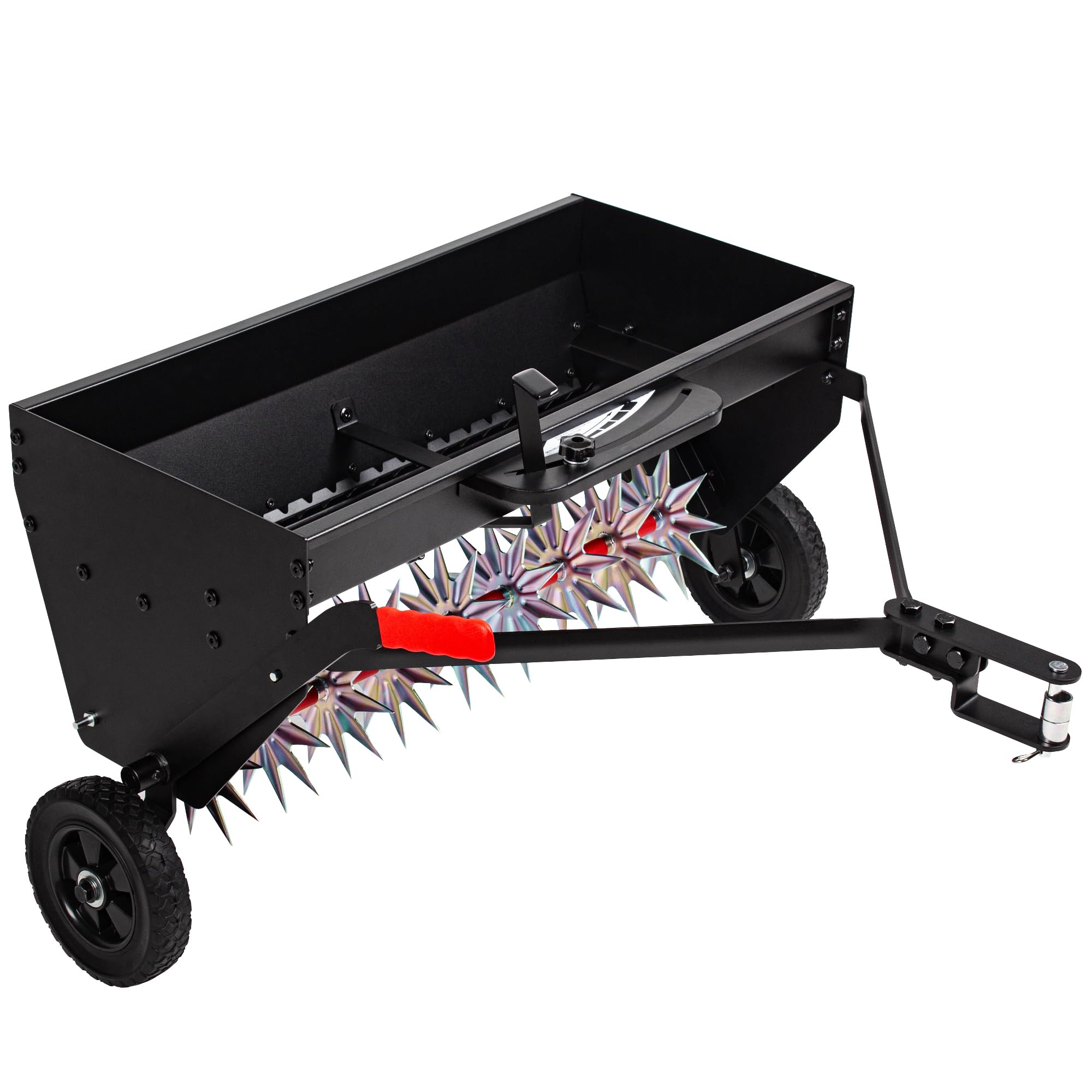
The Suchtale uses a broadcast pattern — flinging seed and fertilizer in a 32-inch arc — which covers ground faster than a drop spreader on open lawn areas. The all-steel hopper holds over 100 lb. so you can dump an entire bag of seed without stopping mid-lawn. Nine star-shaped 3D steel tines, each with 10 curved spikes, rotate independently and can penetrate compacted soil up to 2 inches deep. The high-grade steel is rust-resistant, which matters when the unit lives outdoors between uses.
The biggest complaint across owners is the assembly. Owners mention it takes 2 to 3 hours, with some needing to drill extra holes and manipulate the dispenser to stop a continuous seed drop. The chain is another weak point — it falls off the sprocket on every bump, demanding an hourly re-installation during use. On the positive side, the material quality gets consistent praise, and the company has stepped up with good product support when parts go missing (one owner got a replacement spacer shipped within two weeks).
Compared to the Agri-Fab, the Suchtale offers the same 2-inch aeration depth as the Brinly at 59.4 lb. — a middle weight between the other two. The broadcast pattern gives you speed, but the chain issue and long assembly mean you’ll invest time before you see the payoff. The review pages sum it up: “assembly takes 2-3 hours; requires drilling holes and manipulating dispenser.” Once past that hurdle, the spike/spreader combo works well for large areas.
The Strong Points
- 32-inch broadcast width covers open lawn faster than drop-style spreaders
- Nine 3D steel tines penetrate 2 inches deep with independent rotation
- High-grade steel hopper holds over 100 lb. for fewer refills
The Price of Entry
- Assembly is a 2-to-3-hour project, often requiring drilling
- Chain falls off the sprocket over bumps; expects hourly re-adjustment
- No recommended fertilizer/seed settings — you will need to experiment
Reach for this if: you want a broadcast pattern to cover a large, open lawn quickly and you are willing to spend an afternoon on assembly and fine-tuning the chain.
Look elsewhere if: you want something that runs reliably from the first tow — the chain issue and continuous-seed-drop adjustment are deal-makers for the patient owner only.
2. Brinly Tow Behind Combination Aerator Spreader with Weight Tray, 40-Inch, Flat Black

The heaviest build in the lineup, built to punch deep into hard soil without flexing.
Brinly’s claim of 30-minute assembly is the real standout here — owners confirm you can have this rig together in under a half hour, not the 2-to-3-hour ordeal that plagues other combos. The all-steel hopper holds 100 lb. (1.74 cu. ft.) and resists the twisting and bending that plastic hoppers suffer after a few seasons in the sun. The 8-inch diameter star tines, each with 132 tips total, perforate soil up to 2 inches deep so air and water reach the roots rather than just scratching the surface.
What sets this apart from the lighter Agri-Fab (45.9 lb. vs. 77.8 lb.) is the included rigid steel weight tray that holds an extra 75 lb. For compacted clay or dry summer lawns, that added heft means the spikes actually sink in rather than skipping. The calibrated flow control with an adjustable stop keeps seed and fertilizer from being wasted. A single lever engages the 10-inch pneumatic transport wheels so you can cross a driveway without dragging the tines on pavement.
The honest trade-off is the chain and hardware. A few buyers report the chain breaking within the first 100 feet; the company eventually replaced parts and sent extras free, but the disruption is real. At 77.8 lb. versus the Suchtale at 59.4 lb. — your tractor or ZTR (zero-turn-radius mower) needs enough hitch capacity to handle it. The crowd favorite — rated 4.0 stars across over 500 owners — overwhelmingly finds it durable and effective for larger properties.
What Owners Praise Most
- 132 tine tips punch into hard soil up to 2 inches deep
- 100 lb. steel hopper resists rust and twisting
- Weight tray adds 75 lb. for maximum soil penetration
- 30-minute assembly is a weekend-saver compared to competitors
The Recurring Gripes
- Chain can break early; have a spare link on hand
- At 77.8 lb., it is noticeably heavier than budget units
- Top spreader-speed lever moves freely and may need hand-steadying
Grab it if: you have a medium-to-large lawn with compacted soil and want one pass that both aerates and spreads — the weight tray and 2-inch depth make this the only pick that delivers real aeration on tough ground.
Think twice if: your tractor is small or you want the lightest tow possible; the 77.8-lb. weight plus a full hopper and weight tray adds up fast.
3. Agri-Fab Tow Behind Spiker Seeder Drop Spreader for Seed, Fertilizer, Salt and Ice Melt, 100 lb Capacity

A lighter, poly-hopper alternative for the buyer who values easy towing over deep penetration.
At 45.9 lb. versus the Brinly at 77.8 lb. and the Suchtale at 59.4 lb. — a real advantage if your lawn tractor or ATV has a limited hitch rating. The 100 lb. capacity polypropylene hopper won’t rust, and owners who use it for rural lawn seeding and fertilizing say it handles the job well. The drop spreader pattern puts seed and fertilizer straight down, which helps when you are running along flower beds or driveway edges.
The catch shows up in the assembly and build consistency. Owners say the installation took very long, with one reporting a warped chain spoke that prevented any seed from spreading at all. Others note that only one star wheel actually turns the shaft, so bouncing over uneven ground can cause uneven spreading. The adjustability also gets criticism — the flow-rate arm doesn’t always lock into place, which means the spread rate can change mid-row.
This one trades the deep, 2-inch aeration of the Brinly for lower weight and a price that stays wallet-friendly. The 3-year limited warranty adds some confidence, but the mixed feedback on quality and durability — especially the missing parts and adjustability complaints — means you need some patience for the setup and a willingness to tweak it before it runs smoothly.
Why It Still Works
- Poly hopper won’t rust or dent
- Drop spreader pattern is precise near borders and sidewalks
- 3-Year Limited Warranty backs the purchase
Where It Falls Short
- Assembly instructions are lacking and missing parts are a known risk
- Only one star wheel drives the spreading shaft, causing uneven distribution
- Flow-rate arm lacks a positive lock, so rate drifts as you move
Best suited for: a buyer on a tighter budget who has a smaller lawn tractor and doesn’t need to aerate heavily compacted soil — the low tow weight is the real advantage here.
skip it if: you want a tool that works reliably from day one with zero troubleshooting; the assembly and adjustability issues make this one for the hands-on owner.
Understanding the Specs
Penetration Depth
Measured in inches, this tells you how far the spikes push into the ground. A 2-inch depth is the standard for meaningful aeration — that is deep enough to relieve compaction and let water, air, and nutrients reach the root zone. Anything marked around 1 inch or simply “aeration” without a depth is mostly just marking the surface. The Brinly and Suchtale both claim up to 2 inches; the Agri-Fab does not publish a depth figure, which suggests shallower scoring.
Spreader Pattern (Drop vs. Broadcast)
A drop spreader releases material straight down in a narrow band — the width of the hopper itself. This is ideal for precision near beds, walks, and driveways. A broadcast spreader uses a spinning disc to fling material in a wide arc (32 to 40 inches common here). It covers ground faster but requires you to overlap passes carefully to avoid stripes. The Suchtale is a broadcast unit; the Brinly and Agri-Fab are drop style. Your choice depends on whether speed or accuracy matters more for your lawn layout.
Weight and Towing Load
Unit weight is listed in pounds and directly affects how your tractor or ATV handles the rig. A 77.8-lb. unit plus 100 lb. of seed and 75 lb. of added weight tray ballast equals over 250 lb. total — fine for a garden tractor or ZTR, too much for a small riding mower. A 45.9-lb. poly unit is far easier to pull but won’t drive the spikes into hard soil as effectively. The practical rule: heavier equals deeper holes and more durable steel, but demands a stronger hitch.
Hopper Material and Capacity
Steel hoppers resist warping under heat and heavy loads. Poly hoppers won’t rust but can flex when full, which sometimes causes the spreader gate to bind. Capacity is given in pounds (typically 100 lb. for standard bags of seed or fertilizer) and sometimes in cubic feet for lime or specialty blends. A 100 lb. hopper holds a full bag of most lawn products. For heavier applications like pelletized lime, you may need a larger volume, so check the cubic-foot figure if you use more than a bag per run.
FAQ
Can I use a lawn aerator spreader on wet soil?
Will a tow-behind aerator spreader work with a zero-turn mower?
How deep do the spikes actually go in compacted clay?
How long does assembly take for these combos?
Can I spread ice melt and salt with these units?
What is the difference between a spike aerator and a core aerator?
How do I prevent seed from clogging the spreader?
Does a heavier unit always mean better aeration?
Will the spikes damage my existing sprinkler system or irrigation lines?
How often should I use a spike aerator spreader?
Final Thoughts: The Verdict
For most owners, the best lawn aerator spreader is the Brinly AS2-40BH-P because it combines 30-minute assembly, a 100 lb. steel hopper, 132 tine tips that reach 2 inches deep, and a weight tray for tough soil — all backed by over 500 owners rating it solidly at 4.0 stars. If you want the lowest tow weight and a poly hopper that won’t rust, grab the Agri-Fab 45-05431. And for broadcast coverage across open ground, the Suchtale Upgrade is the one to reach for — just budget an afternoon for assembly.
How We Picked
We do not accept paid placement. Every pick is matched to a real buyer and a real use-case; we do not hands-on test units.
Sources & Methodology
Specifications: manufacturer listings and product documentation. Review insights: verified customer reviews, as of July 2026. Pricing: not shown on this page (it changes often); check the current price via the retailer link.
As an Amazon Associate, Lawn Gear Lab earns from qualifying purchases. This does not affect which products we feature.