
Clay soil is a double-edged sword — it holds nutrients well, but its dense, compacted structure suffocates grassroots, traps water, and turns a vibrant lawn into a muddy, patchy mess. The difference between a thriving lawn and a constant struggle often comes down to one tool: an aerator that can actually punch through that sticky, heavy clay and pull out real cores instead of just poking holes that collapse.
I’m Rikta — the co-founder and writer behind Lawn Gear Lab. For this guide, I’ve spent over 30 hours analyzing owner feedback, comparing tine geometries and weight capacities, and cross-referencing technical data specifically for the challenge of aerating compacted clay soil.
Whether you are dealing with a small patch or several acres of hardpan, choosing the right equipment makes or breaks the job. This guide breaks down the best manual and tow-behind options to help you find the perfect lawn aerator for clay soil.
How To Choose The Best Lawn Aerator For Clay Soil
Choosing an aerator for clay soil is not like choosing one for sandy loam. Clay is sticky when wet and rock-hard when dry. The wrong tool will either bounce off the surface or clog within the first few steps. Focus on the three factors below to narrow your search.
Hollow Tines vs. Spikes: Why Core Removal Wins
Spike aerators (shoes or push rollers) simply push a hole into the ground, which further compacts the already dense clay around the edges of the hole — making the problem worse. A hollow tine aerator physically removes a 2- to 3-inch plug of soil, creating an open channel for air, water, and roots. For clay, coring is non-negotiable.
Weight and Ballast Capacity
A light aerator will not penetrate heavy clay. Manual step aerators should be built from heavy-gauge steel, not aluminum. Tow-behind units need a weight tray capable of holding 100–150 pounds of ballast (bricks, sandbags, concrete blocks) to drive the tines deep. Never assume its dry weight is enough — you need the capacity to add mass.
Coverage Area and Physical Effort
For a small residential lawn under 3,000 square feet, a manual step aerator or rolling drum is manageable. For anything larger, especially with an acre or more of clay, a tow-behind plug aerator is the only sane option. Estimate your square footage honestly; manual aeration on clay is genuine physical labor that can take hours for even a modest yard.
Quick Comparison
On smaller screens, swipe sideways to see the full table.
| Model | Category | Best For | Key Spec | Amazon |
|---|---|---|---|---|
| Brinly PA-403BH-A3 | Tow Plug Aerator | Large acreage, heavy clay | 3″ plug depth, 150 lb tray | Amazon |
| Craftsman CMXGZBF7124213 | Tow Plug Aerator | Mid-size lawns, deep coring | 24 coring points, 140 lb tray | Amazon |
| VEVOR TI-039 | Tow Plug Aerator | Value for medium clay lawns | 40″ width, 120 lb tray | Amazon |
| Brinly SAT2-40BH-P | Tow Spike Aerator | Lighter clay, overseeding prep | 11 spike stars, 150 lb tray | Amazon |
| Senvert JX-002 | Push Rolling Aerator | Small lawns, spike option | 55 lb max weight, 32 lb base | Amazon |
| Landzie Original | Manual Step Aerator | Small yards, core removal | 3 hollow tines, 5.6 lb | Amazon |
| Xuperace GD0001-02 | Manual Step Aerator | Budget-friendly core aeration | 3 hollow tines, 5.74 lb | Amazon |
In‑Depth Reviews
1. Brinly PA-403BH-A3 Tow Behind Plug Aerator

The Brinly PA-403BH-A3 is built for the toughest clay conditions. Its 24 heat-treated steel plugging spoons are narrower and sharpened at the ends, which is a deliberate design choice — the profile reduces the force needed to penetrate dense soil. Owners consistently report pulling 2.5- to 3-inch cores even without maximum ballast, which speaks to the spoon geometry as much as the weight tray capacity.
The fully enclosed 150-pound weight tray accepts any ballast — concrete blocks, sandbags, or water-filled totes — and the three independently rotating tine sections prevent turf tear-out during sharp turns. Assembly is more involved than budget competitors, but users confirm the all-US steel construction justifies the time investment. The 10-inch semi-pneumatic tires handle uneven terrain without deflation concerns.
One minor pain point is the dual-size instruction manual that can cause confusion during assembly, though Brinly’s customer support resolves it quickly. Additionally, achieving consistent 3-inch plugs requires reasonably moist soil — dry, rock-hard clay will limit depth even with added weight. For homeowners with an acre or more of stubborn clay, this is the most capable plug aerator available at this level.
What works
- Sharpened, narrow spoons penetrate dense clay without excessive ballast.
- Three independently articulating tine sections reduce turf damage on turns.
- 150-pound weight tray handles all ballast types for deep coring.
What doesn’t
- Assembly instructions mix two models; can be confusing initially.
- Plug depth is significantly reduced in bone-dry clay conditions.
2. Craftsman CMXGZBF7124213 40 Inch Tow Plug Aerator

Manufactured by Agri-Fab in Illinois, the Craftsman CMXGZBF7124213 is a 40-inch tow-behind plug aerator built around 24 galvanized steel coring points that pull plugs up to 3 inches deep. Multiple owner reports confirm that this unit punches through hard, rocky clay soil effectively, especially when the 140-pound weight tray is loaded with cinder blocks or sandbags. It is noticeably better than any spike-style alternative for relieving clay compaction.
Flat-free tires eliminate the risk of punctures, and the lift-handle release system makes storage space-efficient by allowing vertical wall stowage. Assembly is the most frequently cited friction point — expect 90 minutes to 3 hours of work, particularly when installing the pre-cut galvanized knives. Using a YouTube guide and verifying bolt lengths ahead of time significantly improves the experience.
Once assembled, the build quality is clearly heavy-duty with thick steel throughout. Users report that the plug aerator tows well even on slopes, though adding substantial weight is necessary for maximum penetration in dense clay. The 3-year limited warranty provides an extra layer of confidence. For anyone who values domestic manufacturing and intends to keep the machine for many seasons, the Craftsman is a compelling choice.
What works
- Heavy-gauge US steel frame handles rocky, compacted clay soil reliably.
- Flat-free tires eliminate maintenance and puncture concerns.
- Space-saving vertical storage design is practical for smaller sheds.
What doesn’t
- Assembly is time-consuming and the instructions can be unclear.
- Tines come uninstalled for safety, adding to initial setup effort.
3. VEVOR 40 Inch Tow Behind Plug Aerator
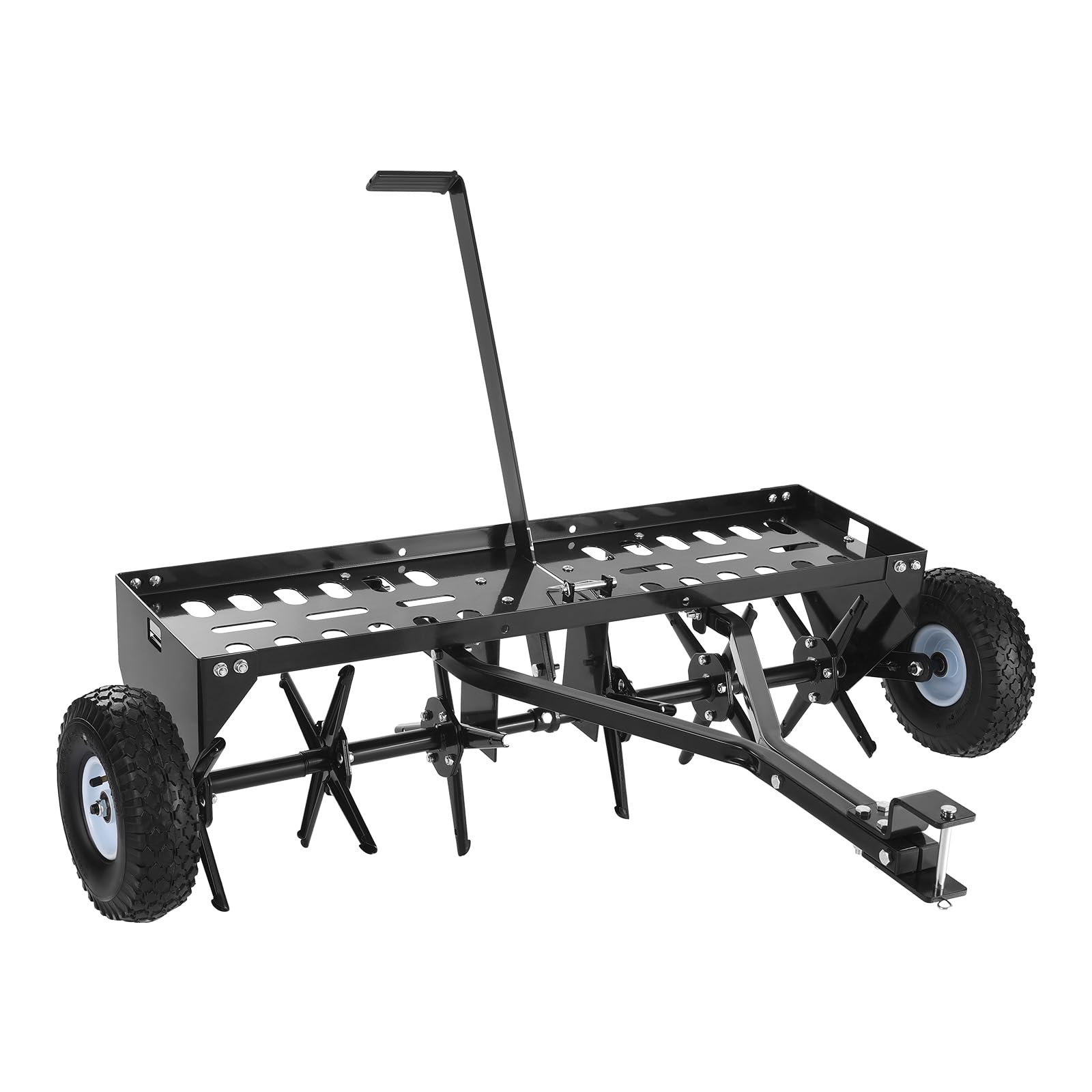
The VEVOR TI-039 brings a 40-inch working width and a 120-pound weight tray to the tow-behind category at a price point that makes it an accessible entry for budget-conscious owners of medium-sized clay lawns. Its high-strength steel frame is fully welded, and users confirm the unit handles well behind a standard lawn tractor, leaving clean plug holes without excessive turf tearing.
The 10.6-inch pneumatic tires provide smooth rolling over damp grass and mild slopes, and the included socket tool and wrench simplify assembly — most owners report being ready to aerate in under an hour. The design works particularly well when ballasted with four concrete blocks or multiple bricks, driving tines 2 to 3 inches into clay that has been watered a day prior.
Some owners note that the weight tray strap slots are functional but could be more robust for securing odd-shaped ballast. Also, as with any tow-behind plug aerator, dry clay significantly reduces penetration depth. Still, for those moving from manual aeration or renting equipment annually, the VEVOR delivers a massive step up in efficiency without the premium price of established brands.
What works
- Impressive 40-inch coverage reduces passes over large lawns.
- Assembly is straightforward with basic tools in under an hour.
- Pneumatic tires roll smoothly over clay and uneven ground.
What doesn’t
- Strap slots on the tray are basic; heavy loads may shift.
- Requires significant ballast and moist soil for full tine depth.
4. Brinly SAT2-40BH-P Tow Behind Spike Aerator

The Brinly SAT2-40BH-P is a spike aerator, which means it does not remove cores — it penetrates the soil with 11 tine stars, each featuring 12 spike tips. For lighter clay soils that are not heavily compacted, this can be an effective tool for overseeding preparation and relieving moderate surface compaction. The 150-pound weight tray ensures the spikes drive to their full 2-inch depth.
The defining feature here is the single-lever transport mechanism that engages turf-tread wheels, allowing easy movement across driveways and sidewalks without dragging the spike stars. Assembly is moderate, but owners strongly recommend using heavy gloves as the galvanized steel 3-D tines are extremely sharp. The double-tow bar and 5/8-inch solid steel axle add noticeable rigidity.
The big trade-off is that spike aeration on heavy clay can worsen compaction around the hole perimeter. Users with very hard, cemented clay report that the spikes struggle to penetrate without significant weight addition. Brinly warrants the unit for 2 years. This is best suited for clay that is already somewhat workable, where the user prioritizes speed and transport convenience over deep core removal.
What works
- Single-lever transport wheels protect driveways and sidewalks.
- 150-pound weight capacity helps drive spikes into moderately firm clay.
- Galvanized 3-D tine construction resists bending and rust.
What doesn’t
- Spike design may worsen compaction in dense, heavy clay.
- Regular nuts on wheel assembly may loosen; nylon lock nuts recommended.
5. Senvert JX-002 Rolling Lawn Aerator
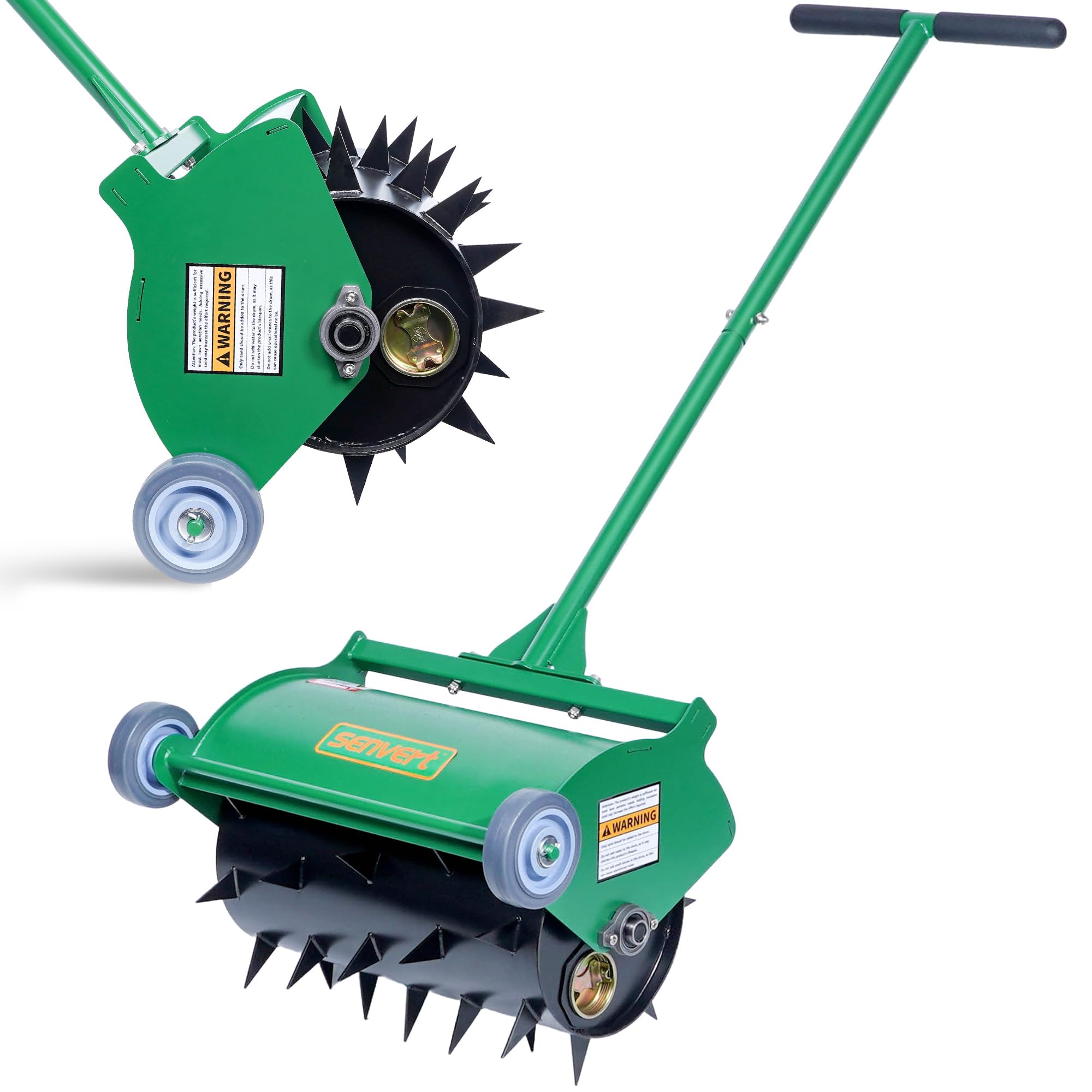
The Senvert JX-002 is a push rolling aerator designed for small to medium lawns where a tow-behind is overkill but manual step aerators are too slow. The drum weighs 32 pounds empty and can be filled with sand or stones through a covered opening up to a total of 55 pounds. The spiral-spiked tread pattern provides smoother rolling than traditional star-style push aerators, requiring less physical effort to maintain a straight line.
Auxiliary transport wheels fold down to roll the drum over driveways without scratching surfaces. Assembly is minimal — the main body arrives pre-assembled, and the handle attaches in minutes. Owners confirm that the machine works well on moderately soft clay that has been watered, creating visible spike holes that significantly improve grass recovery and seed germination.
The limitation for heavy clay is real — multiple owners report that dry or very hard clay requires rocking the drum back and forth to penetrate, making the process far more labor-intensive. Additionally, the sand fill is quieter than rocks but still creates audible drumming. This is an excellent tool for soft ground overseeding prep, but it is not a substitute for a plug aerator on true hardpan clay.
What works
- Spiral-spiked pattern rolls more smoothly than star-style rollers.
- Auxiliary wheels protect driveways and pavement during transport.
- Easy setup; main drum is pre-assembled out of the box.
What doesn’t
- Struggles to penetrate hard, dry clay without rocking the drum.
- Filled drum adds significant push effort; best for smaller lawns.
6. Landzie Original Hollow Tine Lawn Aerator
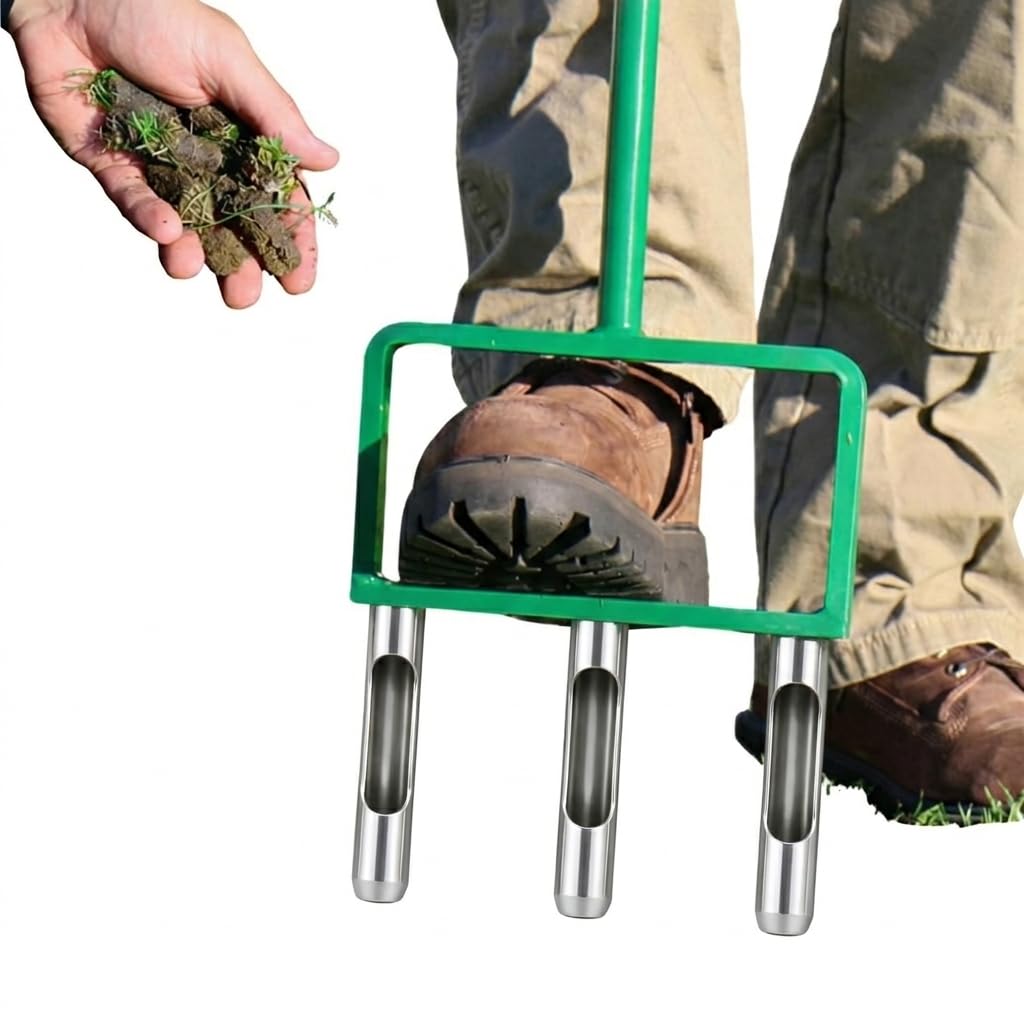
The Landzie Original is the gold standard for manual step aerators targeting clay soil. Its three beveled, clog-free hollow tines are made from stainless steel and designed to eject cores out the side without jamming. Owners using this on compacted clay consistently report that it extracts 2- to 4-inch plugs when the ground is adequately moist, and the self-cleaning tine design lives up to the promise for most users.
The powder-coated steel frame arrives fully assembled — no bolts to tighten or tines to attach. The ergonomic footplate allows unrestricted knee movement, reducing strain during repetitive use. For a 1,000-square-foot lawn, dedicated owners complete the job in about two hours. Those with larger areas emphasize that this is an intense physical workout, comparing it to cross-fit training, but note the quality of the cores is far superior to any spike method.
The screws holding the tines to the frame can loosen after an hour of use, so keeping the included Allen wrench handy is essential. Also, the top foot bar lacks grip texturing, which can become slippery when wet. The Landzie is not a fast tool, but for owners who value long-term durability and genuine core removal on a small clay lawn, it is unmatched in the manual category.
What works
- Stainless steel beveled tines resist clogging even in sticky clay.
- Ready out of the box with zero assembly required.
- Sturdy construction survives years of heavy use, per owners.
What doesn’t
- Tine retention screws loosen after 1–2 hours of use.
- Very physically demanding; not suitable for large lawns.
7. Xuperace Core Aerator Tool (GD0001-02)
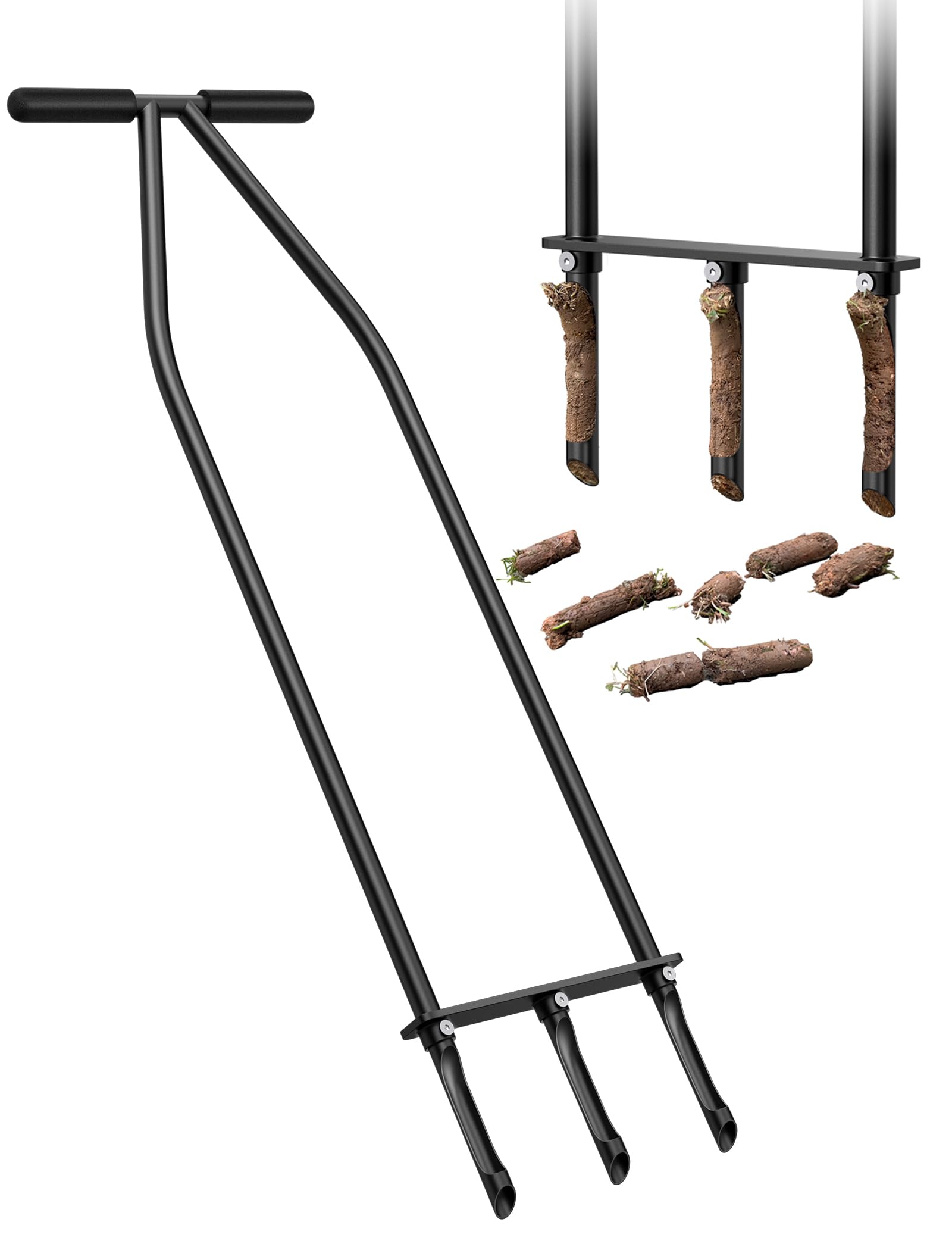
The Xuperace GD0001-02 offers a functioning hollow tine design at the most accessible price point in this guide. Its three alloy steel tines feature an innovative side-ejection port that minimizes clogging — a major practical advantage over older step aerators that would fill up after every few punches. For clay soil that has been watered ahead of time, owners report pulling 3- to 4-inch cores reliably.
At 5.74 pounds, the unit is relatively lightweight, which makes it easy to carry and maneuver but can also mean it requires more leg force to drive tines deep into dense clay. Xuperace addresses this with a smart design choice — the middle tine is removable, reducing resistance for exceptionally hard spots. The two-bar steel handle is noticeably sturdier than single-bar alternatives that have a history of cracking.
Screws do loosen during use; the package includes a spare bottle of thread locker and an Allen wrench for field tightening. A few owners mention that the price is higher than some competing step aerators, though the non-clogging mechanism justifies the difference for clay users. For those on a tight budget who still demand genuine core aeration rather than spiking, the Xuperace is a solid entry point.
What works
- Side-ejection tine design prevents clogging in moist clay.
- Removable middle tine reduces resistance on hard soil patches.
- Two-bar steel handle is stronger than single-bar competitors.
What doesn’t
- Screws loosen during extended use; requires frequent retightening.
- Lightweight frame demands significant leg force in compacted soil.
Hardware & Specs Guide
Tine Type and Geometry
Hollow tines (core aerators) physically extract a soil plug, creating open channels. Spike tines push soil aside, which can worsen compaction in clay. Look for beveled or sharpened tine edges on manual units — they reduce the force needed to penetrate dense soil. Tow-behind spoons should be heat-treated or galvanized to resist bending against hard, rocky clay.
Weight and Ballast Requirements
Manual step aerators rely on the user’s body weight and the tool’s own mass (5–6 pounds is typical). Tow-behind units need a minimum 120- to 150-pound tray capacity to achieve full 3-inch penetration in clay. Rolling drum aerators benefit from sand or stone filling, but even at maximum weight (around 55 pounds), they struggle on dry hardpan. Always check weight tray dimensions for compatibility with standard concrete blocks.
FAQ
Should I water my clay lawn before aerating?
Can I use a spike aerator on heavy clay soil?
How many passes with a tow-behind aerator are needed for clay?
Final Thoughts: The Verdict
For most gardeners, the lawn aerator for clay soil winner is the Brinly PA-403BH-A3 because its sharpened, narrow spoon design and 150-pound weight capacity deliver consistent deep plugs in the toughest compacted clay. If you want a premium domestic-built tow-behind with flat-free tires, grab the Craftsman CMXGZBF7124213. And for small lawns where a tow-behind is impractical, the Landzie Original provides genuine core removal in a manual format that will last for years.