
A lawn aeration roller is the most efficient tool for relieving soil compaction across a standard residential yard, but choosing the wrong one means wasted effort, shallow spike penetration, or a drum that leaks sand across your turf. The market splits sharply between weighted spike drums for shallow aeration and heavy tow-behind units for deep restoration, and picking the right build depends entirely on your soil type, lawn size, and whether you want a push workout or a tractor hitch solution.
I’m Rikta — the co-founder and writer behind Lawn Gear Lab. I’ve spent countless hours comparing steel gauge thicknesses, spike count patterns, drum capacities, and hundreds of verified owner reports to separate the tools that actually sink into compacted clay from those that just roll on top.
After analyzing seven leading models across weight capacities, spike durability, and fill-method practicality, I’ve built this guide to help you navigate the best options. Whether you need a lightweight manual roller for overseeding or a heavy-duty aerator that can handle a 150-pound weight tray, this is your complete resource for selecting a lawn aeration roller that matches your yard.
How To Choose The Best Lawn Aeration Roller
A lawn aeration roller solves soil compaction by punching holes into the turf, allowing air, water, and fertilizer to reach the root zone. But the devil is in the weight distribution — a roller that is too light will skate over hard soil, while one that is too heavy can tear the grass surface. The decision hinges on drum material, fill capacity, spike configuration, and whether you plan to push or tow.
Spike Design and Spike Depth
The spikes on a lawn aeration roller are typically solid steel tines arranged in a star or spiral pattern. Spiral patterns provide smoother rolling with less vertical bounce, while star tines offer aggressive penetration. Look for spikes of at least 2 inches in length; shorter spikes only scratch the surface. Heat-treated tines resist bending when you hit dry or clay-heavy soil, which is the most common failure point on budget rollers.
Fill Method and Total Working Weight
A roller’s empty weight rarely tells the full story. The drum must be filled with sand, stones, or water to generate enough downward force for the spikes to penetrate. Water is convenient but sloshes and adds roughly 8.3 pounds per gallon. Sand or concrete mix provides stable, high-density weight without sloshing, but it makes the roller heavier to transport when empty. A roller that can hold 60+ pounds of added material is generally sufficient for most loamy soils; clay soil often requires over 100 pounds of extra weight to achieve a 2-inch spike depth.
Push vs. Tow-Behind Configuration
Manual push rollers work well on lawns under 3,000 square feet and give you direct control over pressure, but they require significant physical effort, especially on slopes. Tow-behind models attach to a riding mower, ATV, or tractor and can cover an acre in minutes. If you own a lawn tractor, a tow-behind aerator with a weight tray is the fastest path to deep aeration across a large property. Hybrid models with a detachable handle offer push and tow flexibility in one frame.
Drum Width and Rust Resistance
Wider drums cover more ground per pass but require more force to push and are harder to maneuver around obstacles. A 20-inch drum is common for manual rollers, while 36- to 40-inch drums dominate the tow-behind category. Look for galvanized or powder-coated steel to resist rust. Polyethylene drums never rust and are lighter empty, but they cannot hold as much weight as a steel drum without deformation.
Quick Comparison
On smaller screens, swipe sideways to see the full table.
| Model | Category | Best For | Key Spec | Amazon |
|---|---|---|---|---|
| Brinly SAT2-40BH-P | Premium Tow-Behind | Large lawns with tractors | 40″ width, 150-lb weight tray | Amazon |
| Senvert Rolling Aerator | Premium Push Aerator | Deep spike penetration | 55-lb max weight, 2″ spikes | Amazon |
| Landzie 36″ Poly Roller | Mid-Range Tow Hybrid | Seed germination & stripes | 21.1 gal, rust-proof poly drum | Amazon |
| Goplus 17 Gal Tow-Behind | Mid-Range Hybrid | Push/tow versatility | 17 gal, 31 lb empty weight | Amazon |
| VEVOR 61L Roller | Mid-Range Roller | Leveling and seed rolling | 61L fill, double-layer coating | Amazon |
| Goplus 16 Gal Drum Roller | Budget Roller | Small yard seed packing | 16 gal, U-shaped handle | Amazon |
| Walensee Spike Aerator | Budget Spike Aerator | Small lawn aeration | 42 spikes, adjustable handle | Amazon |
In‑Depth Reviews
1. Brinly SAT2-40BH-P Tow Behind Spike Aerator

The Brinly SAT2-40BH-P is a serious tow-behind spike aerator built for homeowners who own a lawn tractor and refuse to spend an afternoon pushing a manual roller across an acre of compacted soil. Its 40-inch working width covers ground rapidly, and the patent-pending 3-D tines in galvanized steel are significantly more resistant to bending than standard flat stamped tines when you hit hard clay. The 5/8-inch solid steel axle and nylon spacers between each tine star reduce lateral wobble, keeping the penetration pattern consistent across the full width.
The most distinctive feature is the rigid weight tray that accepts up to 150 pounds of extra mass — cinder blocks, sandbags, or scrap steel — which transforms this aerator’s penetration depth from surface scratching to a solid 2-inch punch even in dry soil. A single lever engages the turf-tread transport wheels, so you can cross a concrete driveway or sidewalk without dragging the spikes across the hard surface. Assembly requires handling extremely sharp tines, so heavy-duty gloves are mandatory, and some owners report the hex nuts on the wheel assembly loosen during use — a set of 5/8-inch nylon lock nuts solves that immediately.
For owners of 5,000-square-foot lawns and larger, this Brinly unit is the most efficient path to deep aeration. It connects to virtually any standard tractor hitch, and with 150 pounds of ballast it will penetrate soil that defeats 90% of manual push aerators. The all-steel construction carries a two-year warranty, and the transport wheel mechanism means you can store it on a garage wall without spike-damage scratches on the floor.
What works
- 150-lb weight tray for extreme penetration in hard soil
- Galvanized 3-D tines resist bending and rust
- Transport wheels with single-lever engagement
What doesn’t
- Assembly is challenging with razor-sharp tines
- Wheel nuts can loosen; nylon lock nuts recommended
2. Senvert Rolling Lawn Aerator Up to 55 lbs
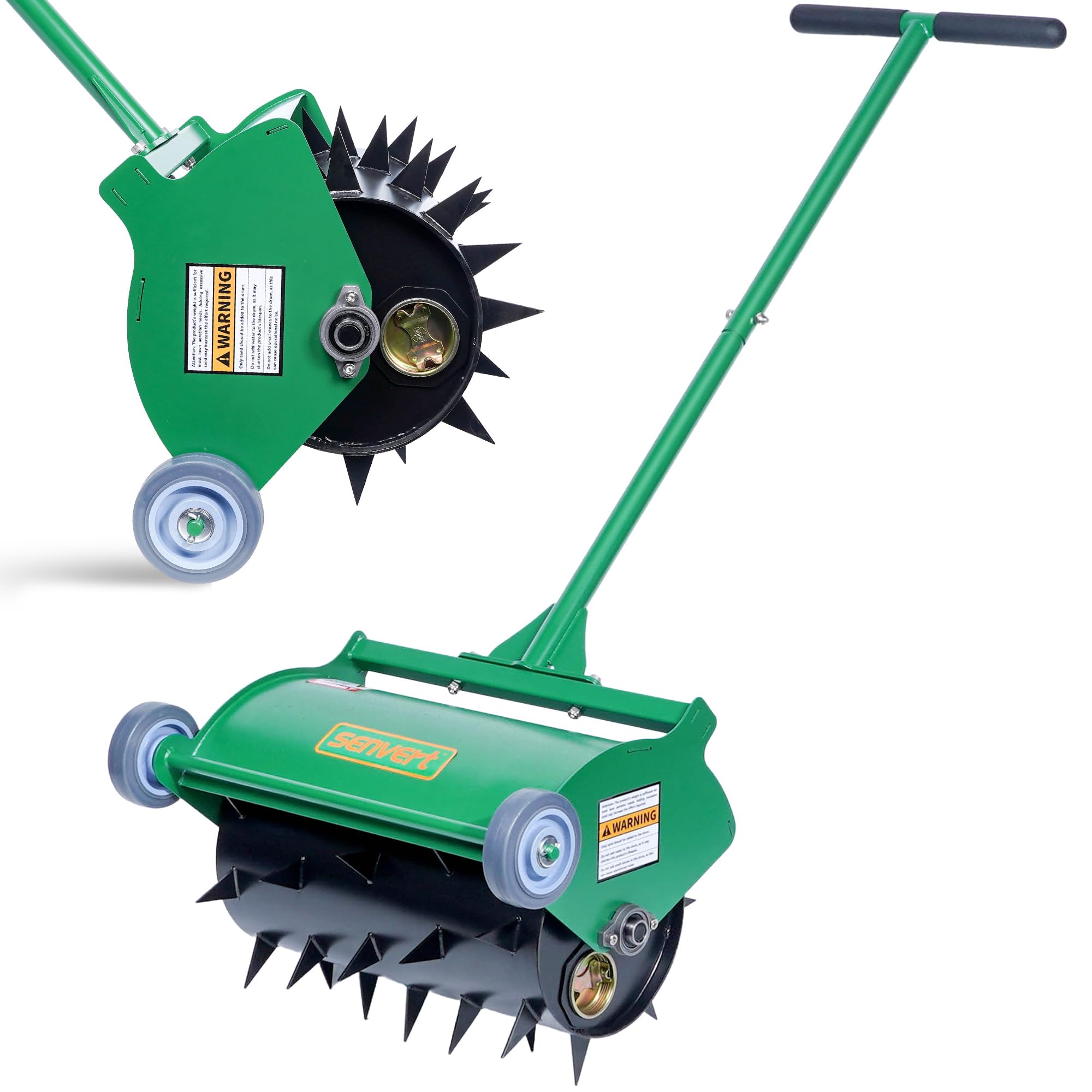
The Senvert Rolling Lawn Aerator is the best manual push spike aerator for the homeowner who wants deep penetration without buying a tow-behind rig. It weighs 32 pounds empty but can be filled with sand or stones through a covered drum opening to reach 55 pounds total, generating enough downward force for the 2-inch heat-treated spikes to sink into moderately compacted loam. The spiral-spiked tread pattern rolls smoother than traditional star-pattern aerators, reducing the vertical bounce that makes some push aerators feel like you’re wrestling a jackhammer.
A pair of auxiliary TPR transport wheels sets this aerator apart from nearly every manual competitor. When you finish aerating, you tip the unit onto the rubber wheels and roll it across the driveway or patio without dragging the spikes across the concrete. The main body arrives fully assembled — you only need to attach the handle, which takes about five minutes. Owners report that the drum is best filled with sand for quiet operation; rocks create significant noise and the drum is not intended for water filling.
For small to medium lawns up to 4,000 square feet, this Senvert unit delivers professional-grade spike depth without requiring a tractor. The transport wheels preserve your hardscaping, and the 55-pound max weight is enough to handle all but the most stubborn clay. It does require a good soaking of the lawn before use for best penetration, and on extremely hard dry clay you may need to rock the roller back and forth to get the spikes to bite.
What works
- TPR transport wheels protect driveways and patios
- Spiral spike pattern rolls smoothly with less bounce
- Pre-assembled drum for quick setup
What doesn’t
- Not suitable for heavy clay without added weight and moisture
- Water filling is not recommended; sand or stones only
3. Landzie 36 Inch Poly Lawn Roller
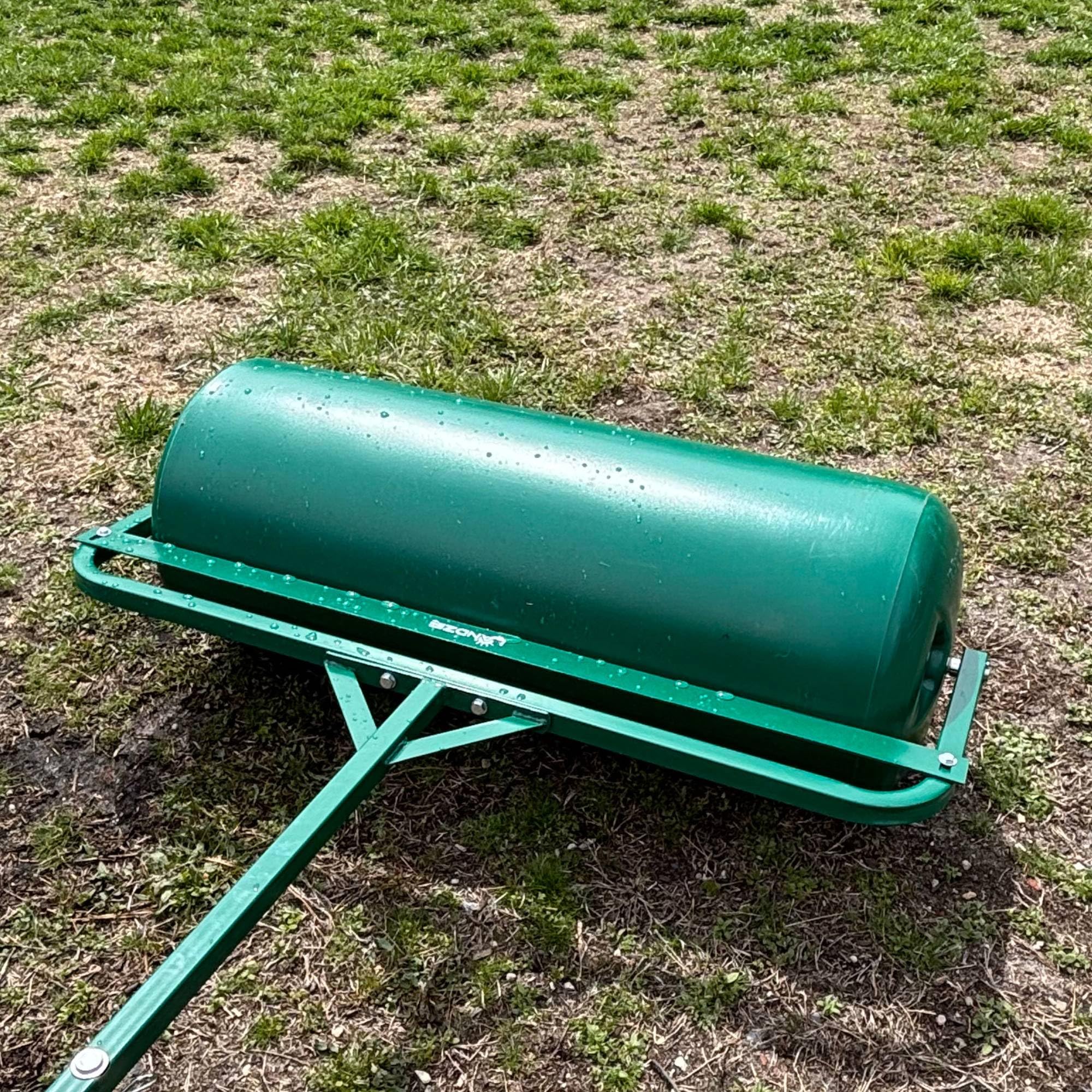
The Landzie 36-inch Poly Lawn Roller is a purpose-built seeding and striping roller that prioritizes rust resistance and weight adjustability over spike aeration. Its 21.1-gallon polyethylene drum will never rust, flake, or corrode, making it the ideal choice for homeowners who store gear outdoors or in damp sheds. When filled with water, the drum delivers roughly 175 pounds of compacting force across a 36-inch path, which is excellent for pressing grass seed into soil contact and creating professional lawn stripes.
The poly drum design has a notable quirk: thermal contraction after emptying can pull the bearing out of the drum wall if the plug is left sealed. Landzie recommends leaving the plug loose to allow air exchange, and owners in cold climates should drain and store the roller with the plug slightly open. The unit can be used as either a push roller or a tow-behind roller, and the handle is pre-attached with the axle and scraper bar, so assembly is genuinely tool-free beyond filling the drum.
This is not a spike aerator — it produces no holes — but it is the best tool for the overseeding workflow: aerate first with a spike tool, then roll with this Landzie to press the seed into the spike holes. The 36-inch width covers a 3,000-square-foot lawn in about 15 passes, and the rounded drum edges prevent turf tearing during turns. If your primary goal is seed germination and lawn flattening rather than aeration, this poly roller outperforms steel drums that eventually rust from the inside out.
What works
- Rust-proof polyethylene drum for indefinite outdoor storage
- 36-inch wide coverage for efficient seed pressing
- Can be used as push or tow-behind
What doesn’t
- Not a spike aerator; does not relieve soil compaction
- Drum can shrink and dislodge bearing if plug is sealed after draining
4. Goplus 17 Gallon Push/Tow-Behind Lawn Roller

The Goplus 17-gallon lawn roller strikes an impressive balance between versatility and affordability, functioning as both a manual push roller and a tow-behind unit for small tractors. The detachable gripping handle secures to a trailer hitch with a pin and latch, letting you switch from compacting a garden bed by hand to rolling a half-acre lawn behind a riding mower in under a minute. The 17-gallon steel drum holds sand or water, and the powder-coated finish provides adequate rust resistance for seasonal outdoor use.
Assembly is straightforward, but the snap-in drain plug is a weak point — several owners report leaks around the plug because it uses a snap closure rather than a threaded screw-in design. A bead of silicone caulk around the plug rim solves the issue permanently. The roller weighs 31 pounds empty and becomes significantly heavier when filled, so the included scraper bar is essential for keeping wet soil from building up on the drum surface during operation. The rounded drum corners protect grass during turns, which is a thoughtful detail for a unit in this price tier.
For the homeowner juggling a small vegetable garden, a new sod patch, and a medium-sized lawn, this Goplus roller adapts to each task without requiring multiple tools. It is not heavy-duty enough for extreme compaction work like preparing a bocce court, but it handles seed rolling, sod pressing, and minor leveling with ease. The detachable hitch makes it uniquely flexible among sub- rollers, and the 17-gallon capacity delivers enough weight for most residential seeding projects.
What works
- Detachable handle allows push and tow-behind use
- Powder-coated steel resists rust well for the price
- Rounded drum edges prevent lawn damage on turns
What doesn’t
- Snap-in drain plug leaks; silicone sealant recommended
- Not heavy enough for major soil leveling projects
5. VEVOR 61L Lawn Roller
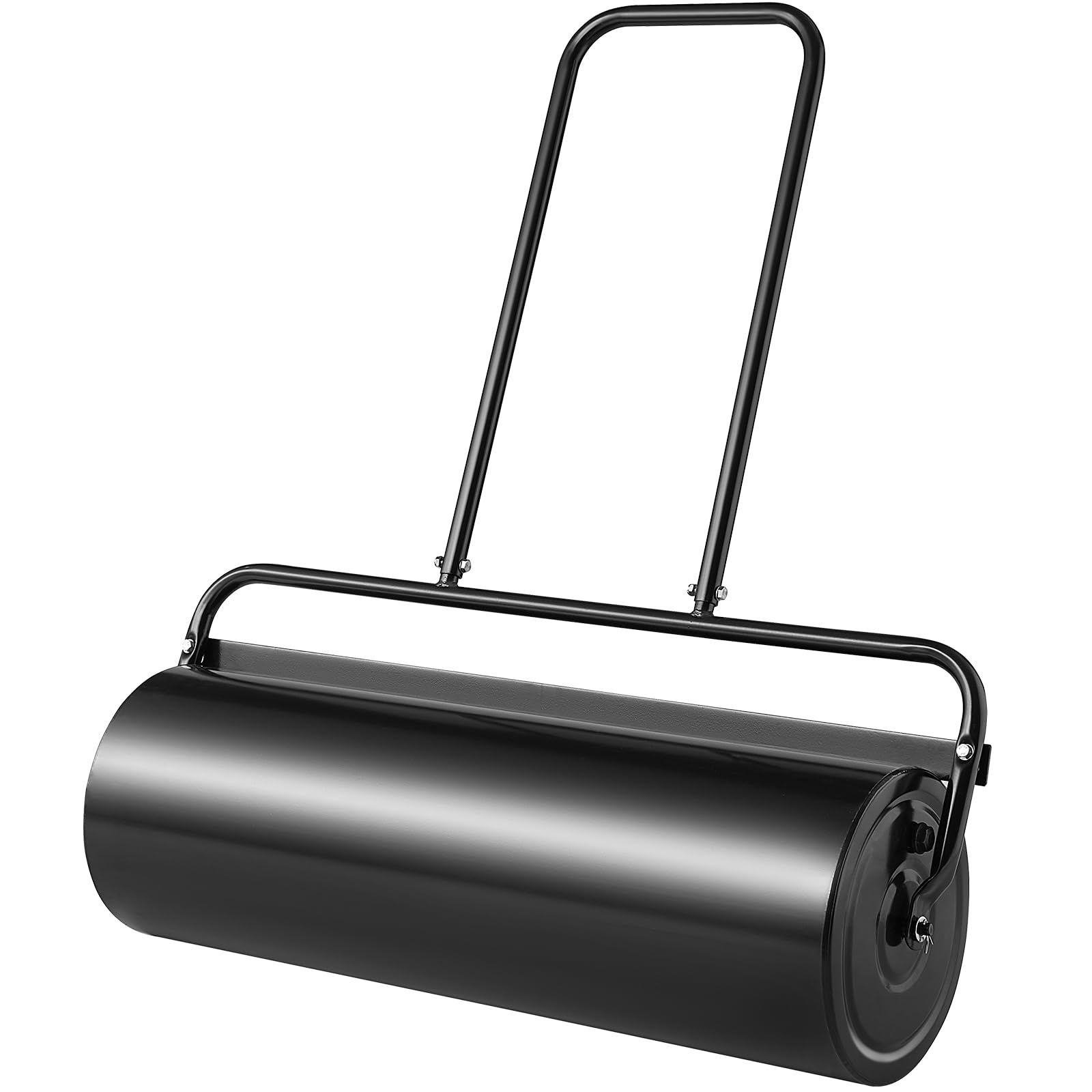
The VEVOR 61L lawn roller is a straightforward, no-frills drum roller built for seed-to-soil contact and light leveling on residential lawns. Its 61-liter drum (roughly 16 gallons) can be filled with sand or water, and the double-layer rust-resistant coating on the high-carbon steel drum gives it better corrosion protection than many similarly priced rollers. The sealed bearing system keeps dust and water out of the axle joints, which reduces maintenance and extends the roller’s usable life in humid environments.
The ergonomic U-shaped handle is comfortable for push operation across flat terrain, and the metal scraper bar effectively removes dirt clumps during rolling. The fill port uses a high-quality sealing ring and an iron plug that does not leak, which is a meaningful upgrade over the snap-plug designs found on cheaper rollers. Owners note that the roller is light when empty and requires water or sand filling to generate meaningful compaction force — without fill, it simply skims the grass surface. Draining water for storage requires a manual pump to remove the last bits, which is a minor inconvenience compared to rollers with a bottom drain.
This VEVOR unit is best suited for the homeowner who needs a reliable drum roller for pressing seed into freshly aerated soil or flattening frost-heaved patches. It will not perform deep soil compaction or aerate, but as a dedicated seed roller and leveling tool it is well-constructed for the price. The 32.9-pound empty weight is manageable for one person to move between storage and the yard, and the compact 35-inch drum width navigates garden gates easily.
What works
- Double-layer rust-resistant coating on steel drum
- Sealed bearing system reduces axle maintenance
- Leak-proof iron fill plug with quality sealing ring
What doesn’t
- Draining water completely is difficult without a pump
- Too light empty; requires fill for effective compaction
6. Goplus 16 Gallon Drum Roller
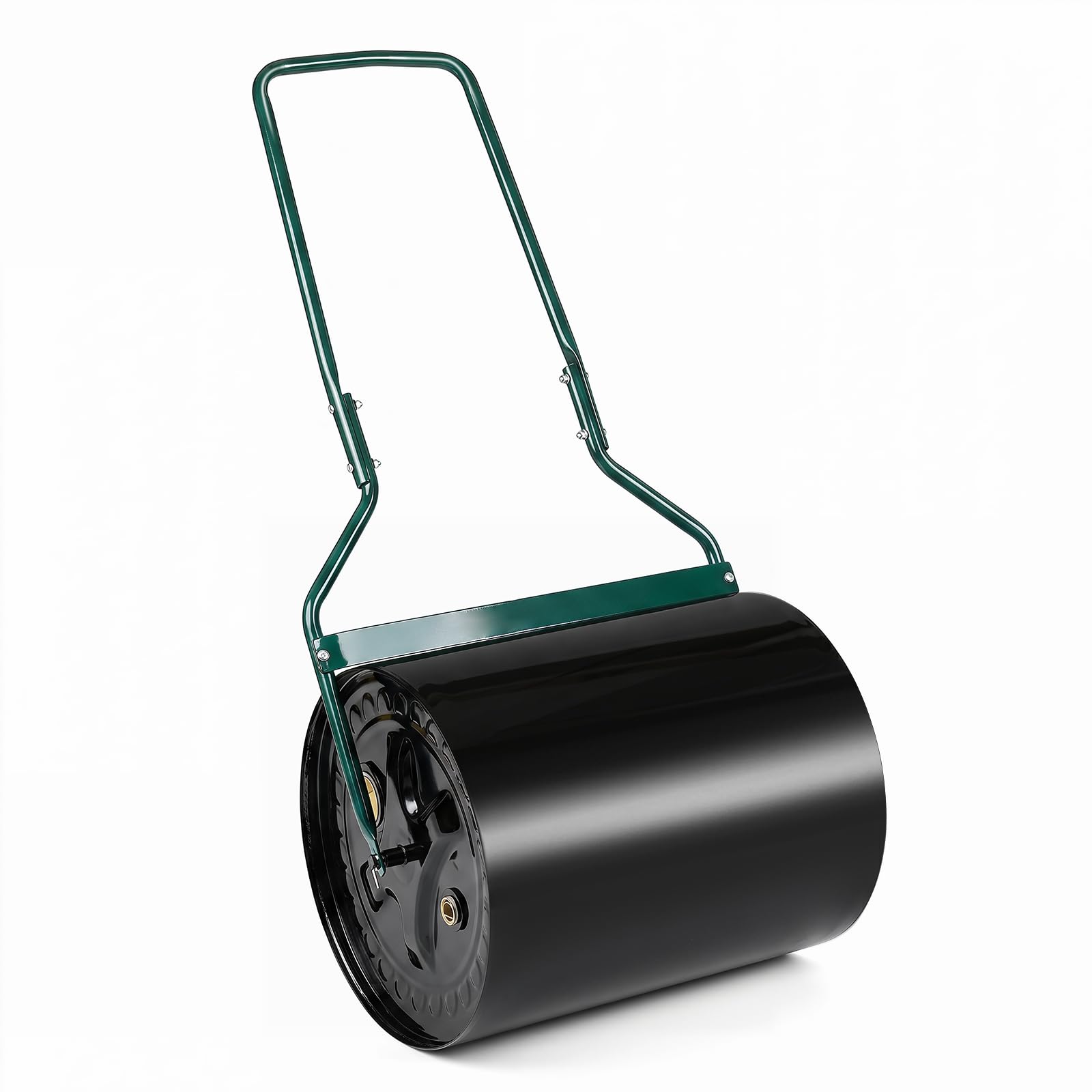
The Goplus 16-gallon drum roller is an entry-level tool for homeowners who need a basic lawn roller at the lowest possible entry point. The 16-gallon steel drum fills with water or sand, and the tightly sealed inlet prevents leakage during operation — a common failure point on budget rollers that this model handles well. The U-shaped ergonomic handle reduces wrist strain compared to straight T-handles, and the handle doubles as a wall-mount hook for garage storage.
The build quality matches expectations for this tier: the frame is sturdy enough for regular light use, but the handle bolts can arrive slightly misaligned, requiring a few extra minutes of adjustment during assembly. The rubber drain plug can weep a tiny drip when the drum is completely full, but a half-turn on the plug usually stops it. Some units arrive with minor cosmetic dents from shipping, which do not affect functionality. Owners consistently note that water filling is adequate for seed rolling on soft soil, but sand filling provides noticeably better compaction on harder ground.
For the budget-conscious homeowner with a lawn under 2,000 square feet, this Goplus roller is a functional tool that gets the job done without breaking the budget. It is not built for heavy clay compaction or large-acreage work, but for flattening topsoil, pressing seed, and rolling sod it performs reliably. The metal frame handles repeated seasonal use, and the scraper bar keeps the drum clean during operation — a surprising detail at this price point.
What works
- Sealed inlet prevents leaks during use
- U-shaped handle reduces wrist fatigue
- Can be hung on a wall for compact storage
What doesn’t
- Handle bolts may need realignment out of the box
- Rubber drain plug can weep a small drip
7. Walensee Rolling Lawn Aerator
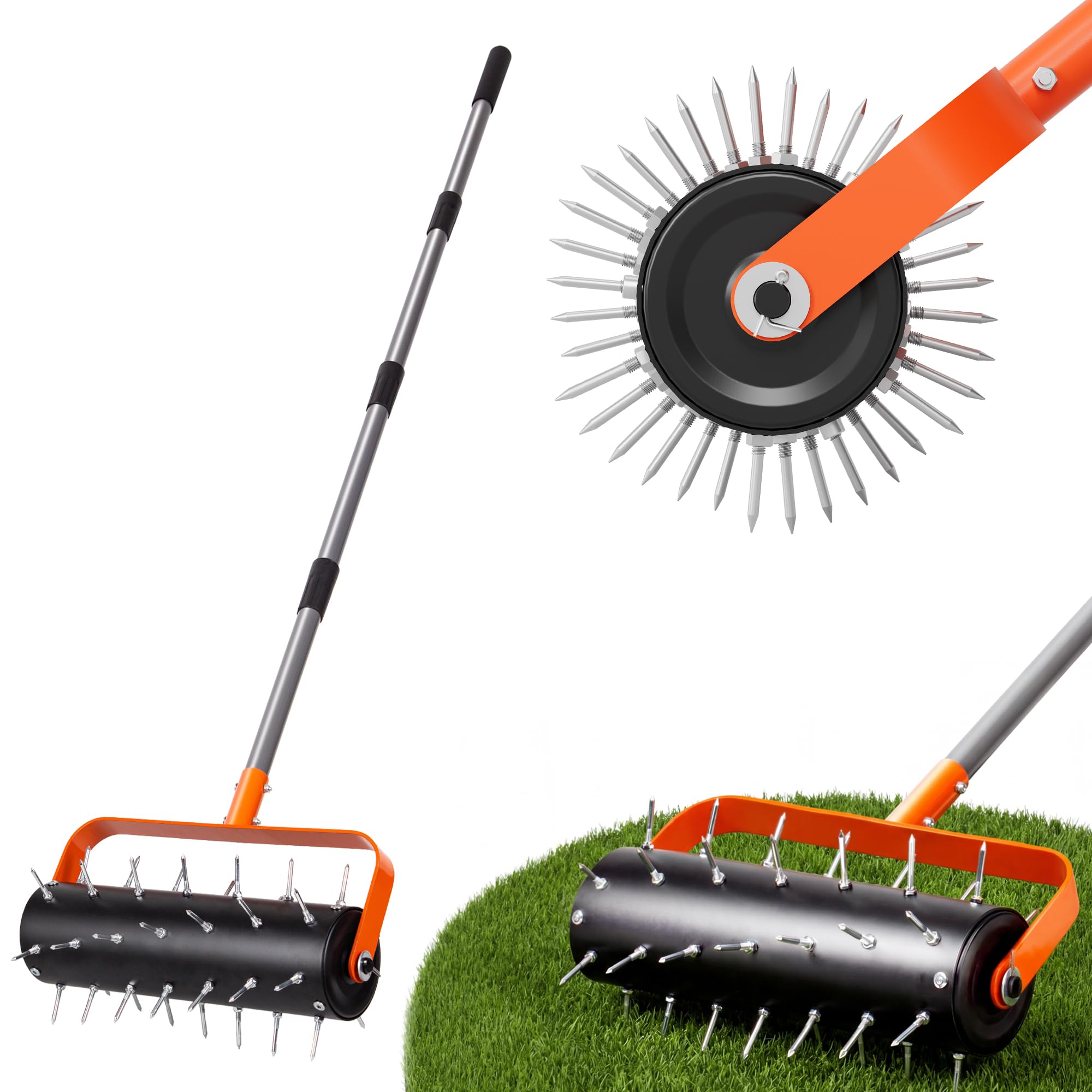
The Walensee Rolling Lawn Aerator is the most affordable dedicated spike aerator in this comparison, designed for small lawns where soil compaction is moderate and the budget is tight. The drum carries 42 reinforced 2-inch spikes arranged in a spiral pattern that reduces vertical jumping during rolling, providing a smoother push feel than cheaper star-pattern designs. The spikes are heat-treated for increased hardness, which helps prevent bending when you hit small rocks or dry soil patches.
The 71-inch handle adjusts in height to accommodate different user statures, and the four-section design collapses for compact storage, though it introduces slight flex under heavy pushing force. The drum can be filled with sand or stones through the end caps, but some owners report that the gap between the drum and the end caps allows sand to spill out during operation — a bead of silicone caulk around the seam solves this. The included cotter pins are a nice spare-part inclusion, and the pre-installed spikes save significant assembly time compared to competing spike aerators that require you to screw in each tine individually.
This Walensee aerator is best suited for lawns under 2,000 square feet where the soil is not heavily compacted clay. It aerates effectively after a good soaking, and the adjustable handle is genuinely comfortable for taller users who would otherwise stoop. It does not replace a core plug aerator for seriously compacted ground, but as a lightweight spike tool for regular maintenance aeration between deeper treatments, it delivers solid value at the entry level.
What works
- Heat-treated spikes resist bending in moderately hard soil
- Adjustable handle fits taller users without stooping
- Spiral spike pattern rolls smoother than star designs
What doesn’t
- End cap gap can leak sand fill; silicone sealant needed
- Four-section handle has slight flex under load
Hardware & Specs Guide
Spike Count and Spike Material
The number of spikes on an aeration roller directly influences the density of holes per square foot. A roller with 42 spikes on a standard 20-inch drum will produce a hole pattern roughly every 4 to 5 inches, which is sufficient for most residential lawns. Heat-treated galvanized steel spikes resist bending and rust far better than untreated mild steel. Brinly’s 3-D stamped tines offer twice the bending resistance of flat tines because the raised center rib acts as a structural beam — this matters most when pulling a heavy weight tray through dry clay soil.
Weight Capacity and Working Weight
Empty weight is almost irrelevant for a lawn aeration roller; what counts is the maximum fill weight the drum or weight tray can handle. A push aerator that reaches 55 pounds total is adequate for loamy soil. A tow-behind with a weight tray rated for 150 pounds can tackle the toughest clay. The fill medium also matters: sand adds dense, stable weight; water is convenient but 8.3 pounds per gallon; concrete mix provides the highest density but is semi-permanent once set. Choose a fill method that matches your soil type and how often you want to empty the drum for storage.
Handle Configuration and Transport Wheels
A fixed handle is simpler and stronger, but an adjustable height handle prevents back strain for taller users — the Walensee roller offers a 71-inch adjustable handle that accommodates users over 6 feet. Transport wheels are a critical upgrade: the Senvert aerator includes TPR wheels that lift the spikes off the ground for driveway crossings, protecting both the spikes and the hardscape. Tow-behind units should feature a single-lever transport wheel engagement system, like the Brinly model, to switch between aeration and transport without tools.
Drum Durability and Rust Prevention
Steel drums should have a powder-coated or galvanized finish to resist moisture. VEVOR uses a double-layer coating on its high-carbon steel drum, while the Landzie poly drum eliminates rust entirely. Rust on the inside of a steel drum is often more damaging than exterior rust because trapped moisture accelerates corrosion from within. For long-term outdoor storage, a poly drum or a galvanized steel unit with sealed bearings is the safest choice. The scraper bar, which cleans soil from the drum during operation, should be standard on any roller used in wet soil conditions.
FAQ
What is the difference between a spike aerator and a core aerator?
How much weight do I need to add to a lawn aeration roller?
Can I use a lawn rolling aerator on a Bermuda grass lawn?
How often should I use a lawn aeration roller?
What should I do after rolling the lawn with an aerator?
Final Thoughts: The Verdict
For most gardeners with a tractor and a lawn over 5,000 square feet, the lawn aeration roller winner is the Brinly SAT2-40BH-P because its 150-pound weight tray and 40-inch width turn aeration from a weekend chore into a quick lap around the yard. If you want spike aeration without a tractor, grab the Senvert Rolling Aerator for its transport wheels and 55-pound maximum weight. And for pure seed-to-soil contact and lawn striping, nothing beats the Landzie 36-inch Poly Roller and its rust-proof drum.