
Specs are compiled from manufacturer listings and verified buyer reviews and can change over time — please confirm the key details on the product page before buying.
You want a greenhouse that actually keeps your plants alive through winter, not a flimsy tent that shreds in the first storm. A large greenhouse kit is a serious investment in your growing season, but the difference between a structure that thrives and one that collapses depends on three things: the frame, the glazing, and how it handles wind and snow. In this guide, we break down the best options so you can pick the one that matches your climate, your ambition, and your willingness to assemble.
I’m Rikta — the founder and writer behind Lawn Gear Lab. This guide is built by comparing the manufacturers’ published specifications and the patterns across verified customer reviews, so you get each pick’s real strengths and trade-offs instead of marketing spin.
if you need a walk-in starter greenhouse for under or a cedar-and-polycarbonate fortress that laughs at 100 mph winds, you will find your match here. This is your guide to picking the best large greenhouse kit for your backyard and budget.
Our Picks at a Glance

How To Choose The Best Large Greenhouse Kit
A large greenhouse is a structure you will live with for years, so the right choice starts with matching the build to your local weather and your long-term plans. Here are the three details that separate a smart buy from a regret.
Frame Material: The Backbone of Your Greenhouse
Wood frames, like cedar, offer natural rot resistance and a classic look, and they handle heavy snow loads better than thin aluminum when properly built. Aluminum frames are lighter, rust-proof, and easier to assemble, but cheaper aluminum kits can flex in strong winds. Steel frames, often found in hoop-style tunnel greenhouses, are the most cost-effective way to get a very large footprint, but the cover is typically polyethylene (PE) rather than rigid panels, which affects longevity.
Cover or Panel: Polycarbonate vs. Polyethylene
Polycarbonate panels (often 4mm to 6mm thick, measured in grams per square meter like 720g or 1100g) provide superior insulation, diffused light, and resistance to hail and wind. They are the gold standard for serious year-round growing. Polyethylene (PE) covers are lighter and cheaper, making large tunnel greenhouses affordable, but they tear more easily and degrade from UV exposure over a few seasons. For a permanent large greenhouse, polycarbonate is almost always the better investment.
Ventilation and Anchoring: The Unsung Heroes
Even a well-insulated greenhouse becomes an oven without airflow. Look for roof vents (adjustable is best), roll-up side panels, or mesh windows. Equally critical is how you anchor it — kits often include ground stakes, but for a large structure in a windy area, you will want to use ratchet straps, cinder blocks, or even concrete footings. A buyer report on the Backyard Discovery Willow notes it withstood heavy storms when properly anchored, which is the real secret to longevity.
Quick Comparison
| Model | Best For | Frame Material | Cover Material | Dimensions | Amazon |
|---|---|---|---|---|---|
| Backyard Discovery Willow 9×6★ Best Overall | Ultimate Premium Year-Round | Cedar Wood | Polycarbonate (4-wall) | 114″ x 73″ x 94″ | Amazon |
| Yardenaler 8×16Largest Wood Frame | Large Wood Frame Value | Wood (Light Mocha) | Polycarbonate (6mm) | 190″ x 96″ x 91″ | Amazon |
| Quictent 25x10x6.6Giant Tunnel | Massive Tunnel Garden | Galvanized Steel | Polyethylene (150GSM) | 295″ x 118″ x 79″ | Amazon |
| ShelterLogic 10×20 | Large Budget Hoop House | Alloy Steel | Polyethylene (UV-treated) | 240″ x 120″ x 96″ | Amazon |
| Sylviera 12×12 T-Shape | Square Polycarbonate Rig | Aluminum Alloy | Polycarbonate (6mm, 1100g) | 143″ x 143″ x 84″ | Amazon |
| FLY BY YAN 8×12 | Mid-Size Premium Build | Aluminum (Reinforced) | Polycarbonate (720g/m²) | 143″ x 97″ x 77″ | Amazon |
| WUKHG 8×10 | Compact Aluminum Frame | Aluminum Alloy | Polycarbonate (4mm) | 119″ x 97″ x 81″ | Amazon |
| HOOYEAH 6×8 | Budget Polycarbonate Starter | Aluminum | Polycarbonate (UV-blocking) | 71″ x 96″ x 77″ | Amazon |
| Outsunny 6×8 | Entry-Level Sliding Door | Aluminum (Powder-coated) | Polycarbonate | 99″ x 75″ x 79″ | Amazon |
| CROWN SHADES 8×6 Pop-Up | Instant Budget Setup | Steel | Polyethylene (PE) | 96″ x 72″ (8×6 ft) | Amazon |
In‑Depth Reviews
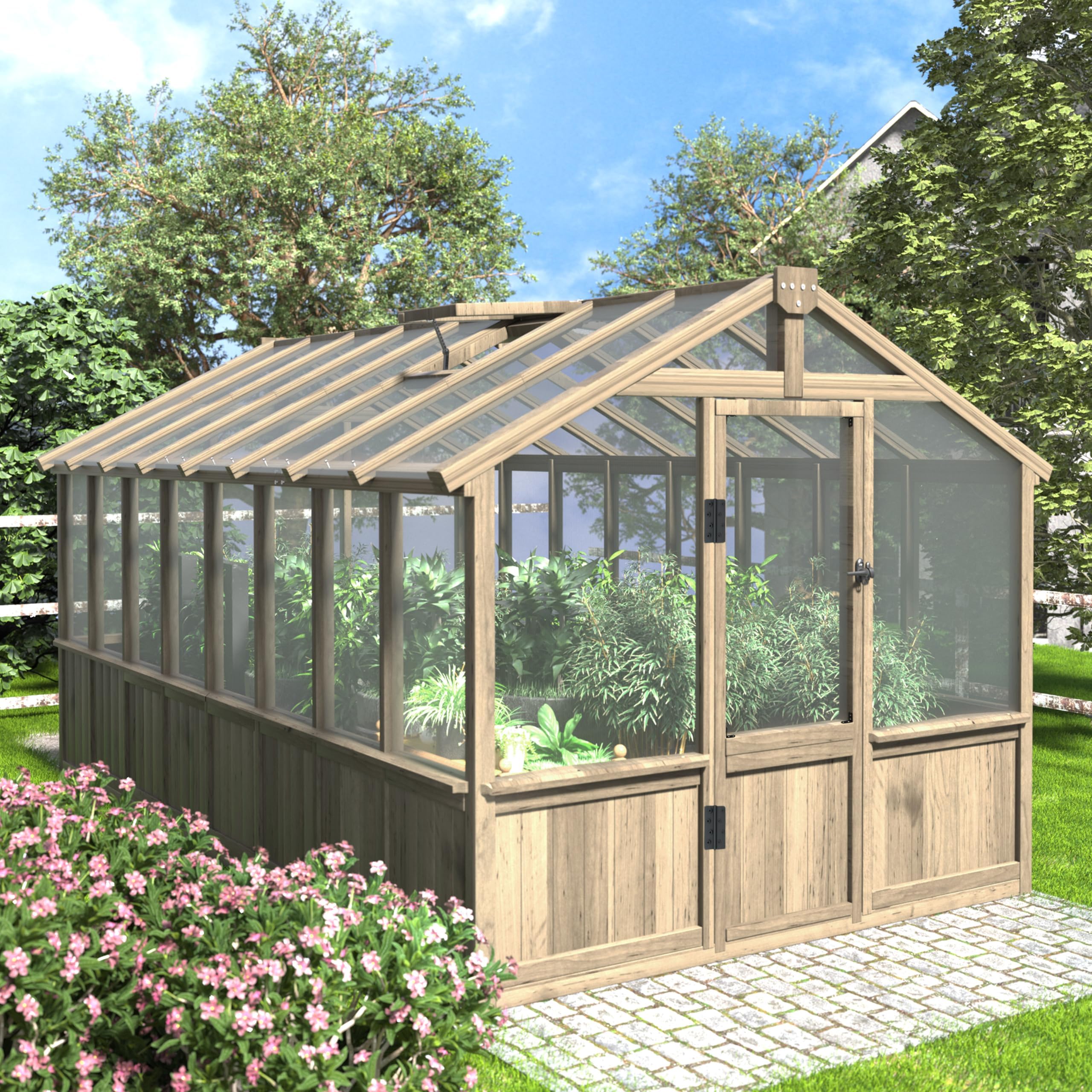
1. Backyard Discovery Willow 9′ x 6′ Cedar Wood and Polycarbonate Walk-in Greenhouse
Our pick — over 4.5★ from 100+ verified ratings; the strongest balance of quality and price.
The cedar fortress that takes snow and wind without flinching.
This is the premium pick for a good reason. The frame is made from real cedar, a naturally decay-resistant wood that is both strong and beautiful. It covers just over 54 square feet of interior space, and the commercial-grade 4-wall polycarbonate roof and window panels improve heat retention by 30% compared to standard double-wall polycarbonate, according to the manufacturer. You also get a built-in workstation with 13 linear feet of fixed staging shelves, a patented PowerPort that provides 3 electrical outlets and 3 USB ports, and both an exterior and interior hose hook-up for easy watering. The temperature-activated exhaust fan works alongside an easy-open window to manage airflow automatically.
What wins people over is the build quality — it is the most-discussed positive aspect from owners. The pre-cut, pre-drilled, and pre-stained pieces fit together with remarkable accuracy, and the interactive BILT app guides you through assembly. One owner summed it up perfectly: “That first heavy storm and wind came through and it stood solid.” The 5-year warranty adds further confidence for a structure tested to withstand up to 2,800 pounds or 30 inches of snow load and winds up to 100 mph when properly anchored.
The honest trade-off is assembly time. It takes a real weekend (or two) to put together, and with 8 shipping boxes, you need to organize parts carefully. A few buyers have also noted that the door panel can arrive damaged in shipping, though the manufacturer and Amazon reportedly resolve that quickly. This is not a weekend-afternoon project — it is a labor of love that rewards you with a greenhouse that, as buyers report, “fits walkers and wheelchairs” and looks like a permanent part of the landscape.
What You Gain
- Cedar is naturally rot-resistant and handles extreme weather — rated for 30 inches of snow and 100 mph winds.
- Integrated power, watering, and ventilation (temperature-activated exhaust fan plus PowerPort with USB ports).
- 5-year warranty and a high-quality feel that owners describe as “amazing” in pre-drilling accuracy.
What To Know
- Assembly is a multi-day project best tackled with 2-3 people.
- Door panels have occasionally arrived damaged in shipping, though replacements are provided.
Reach for this if: you want a permanent, premium structure that is the last greenhouse you will ever buy for your backyard.
Think twice if: you cannot commit to a full weekend of assembly or you need something you can take down and move each year.
2. Yardenaler 8×16 FT Wooden Walk-in Greenhouse
A roomy 128 square feet of wood-framed polycarbonate growing space.
If the Backyard Discovery is the dream garage, this Yardenaler is the spacious workshop. At 8×16 feet, it offers a much larger footprint than most wooden kits, and it uses 6mm thick polycarbonate panels — notably thicker than the 4mm panels found on many budget polycarbonate greenhouses. The frame is a light mocha brown wood that owners often describe as sturdy and attractive, with two adjustable roof vents that open up to 45 degrees for temperature balance. The dimensions measure 96 inches wide by 190.2 inches deep by 90.6 inches high, with a door size of 29.1 inches wide by 71.4 inches high.
Owners consistently praise the quality and the ease of assembly when following the numbered parts and clear directions. One buyer who built it mostly solo said assembly was straightforward, while another noted it survived 60-70 mph winds across all four seasons when secured to a 4×4 foundation. The 427-pound weight of the kit tells you this is not a lightweight; you are getting a substantial structure that feels planted.
The catch here is the frosted film applied to some of the polycarbonate panels. Multiple owners mention that the film does not stay adhered well and can peel off over time. It is a cosmetic issue rather than a structural one, but it is worth knowing before you buy. Assembly is also labor-intensive — bring a powered caulk gun and expect a two-day build if you are working solo.
Who it fits: Gardeners who want a huge, wood-framed space with thick 6mm polycarbonate panels for better insulation without jumping to the premium price of the Backyard Discovery.
Fair warning: the decorative frosted film on panels has adhesion issues for some owners, so it is not a set-and-forget cosmetic finish.
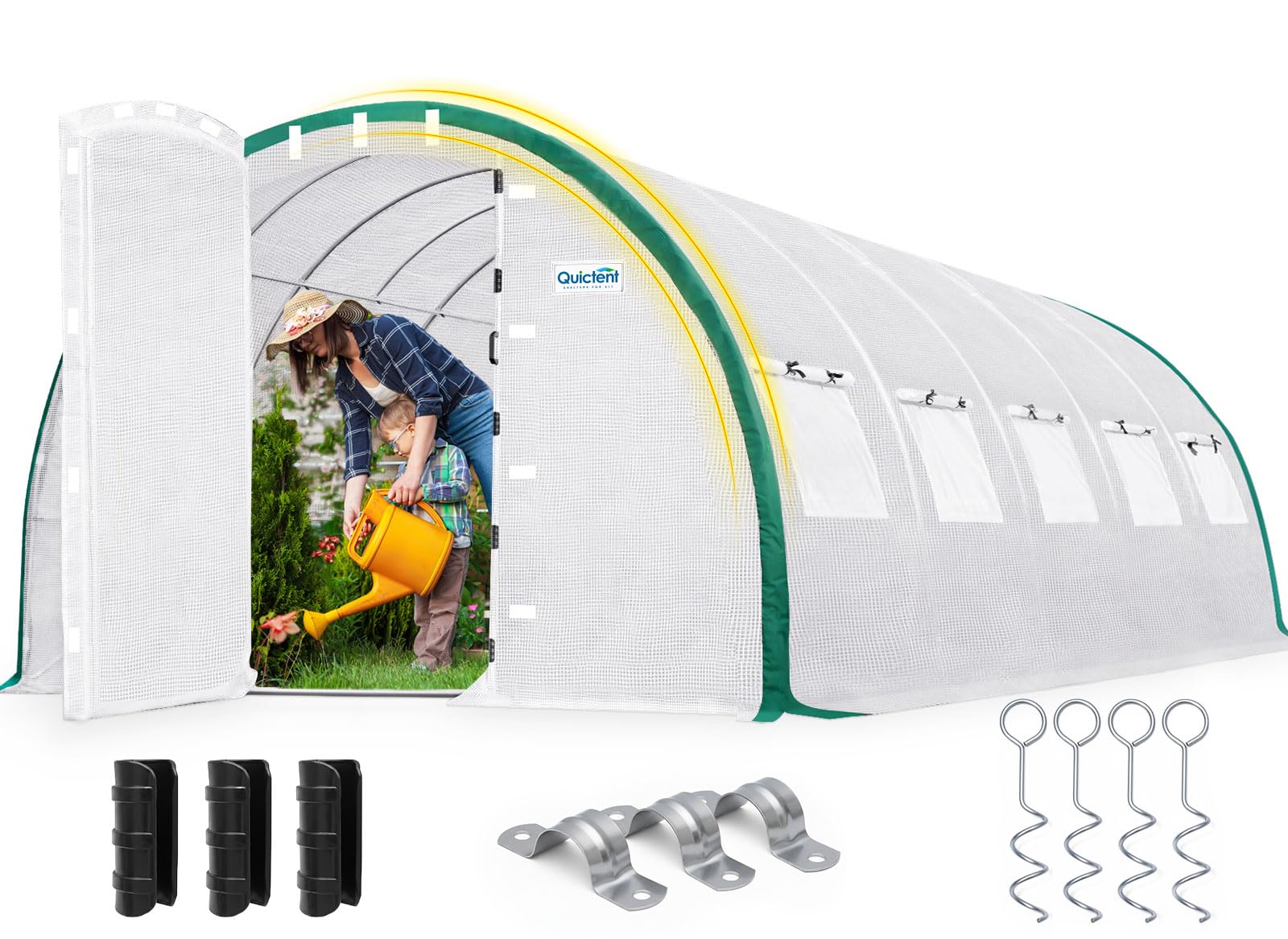
3. Quictent 25x10x6.6 FT Premium Tunnel Greenhouse
A massive 250-square-foot tunnel built for serious winter growing.
This is the behemoth of the list — a full 25 feet long by 10 feet wide, with a peak height of 6.6 feet. The frame is made from 0.7mm thickened galvanized steel, which resists rust far better than standard steel. It features a patented dual swing-door frame (Patent No. US 214173563) that opens 180 degrees for easy access with a wheelbarrow or tools. The reinforced top structure includes extra crossbars to prevent snow or water pooling, and the cover is a premium 150GSM tear-resistant polyethylene mesh treated with a UV inhibitor, allowing 85% sunlight transmission.
Customers note that the kit is straightforward to assemble, especially when compared to other tunnel models, and the quality of the fabric and frame is described as “very sturdy.” The 8 mesh screen windows (the exact count varies by size) provide exceptional airflow. A buyer who set it up solo shared that the interior temperature hit 140°F in direct sun but dropped to 90°F once ventilation was adjusted — a reminder that you need good airflow here.
The main trade-off is that this is a covered tunnel, not a rigid polycarbonate structure. The PE cover will degrade over time, with some owners getting a few years before needing a replacement. Quictent does offer a 365-day complimentary parts service and lifetime replacement on connectors and stakes, which softens the risk. For the sheer square footage, it is a superb value if you are okay with the maintenance profile of a fabric cover.
Why It Stands Out
- Massive 25×10 footprint — the largest growing area in this guide.
- 0.7mm galvanized steel frame and reinforced top for snow resistance.
- Dual swing-door frames that lock and open 180 degrees.
Keep In Mind
- Polyethylene cover is durable but not permanent — expect a few years before replacement.
- Interior temps can spike to 140°F in full sun; active ventilation or shade management is needed.
Best for: Market gardeners or serious hobbyists who need a huge, affordable growing tunnel and don’t mind a fabric cover.
Not ideal if: you want a rigid polycarbonate structure that requires less long-term cover maintenance.
4. ShelterLogic 70658 Greenhouse-in-a-Box 10′ x 20′

The crowd-favorite budget tunnel with proven wind chops.
With a 10×20 foot footprint and 8-foot peak height, this ShelterLogic model is among the most popular large greenhouse kits on the market, and it has the review volume to prove it. The patented ShelterLock 3X stabilizers deliver rock-solid stability for the alloy steel frame. The translucent cover is UV-treated and uses ClearView technology for enhanced light diffusion, which reduces harsh shadows and scorching on your plants. Roll-up side panels and half-moon screen vents at each end let you control airflow effectively.
The thing owners praise most is the frame. The 1-3/8 inch steel tubing is genuinely sturdy, and the 18-inch ground stakes with ratchet straps keep it planted. Reviewers point out it surviving 40 mph gusts with no rips when properly staked and supplemented with cinder blocks. The cover material is described as tough — roughly 6mil and UV-blocking — though it is less clear than some expect. A long-term owner notes the cover lasts about 3 years if left up over winter and 5 years if stored seasonally. ShelterLogic sells exact replacement covers, which is a nice feature for longevity.
The honest downside: assembly can be confusing. The parts are similar and stamped with unclear 6-digit codes, so you will want to organize and mark everything before you start. Plan on needing 2-3 people and a full day. Also, some shoppers say that the cover seams can tear after a year or two in harsh sun, though the frame itself keeps holding strong.
The bottom line: A well-proven, large hoop house that offers excellent structural stability for the price, as long as you are ready for a full-day assembly and understand the cover is a consumable part.
Who it’s for: Anyone who wants a massive covered growing area on a budget and is comfortable with a PE cover that needs periodic replacement.
5. Sylviera 12×12 FT T-Shape Polycarbonate Greenhouse
A square 144-square-foot polycarbonate room with thick panels.
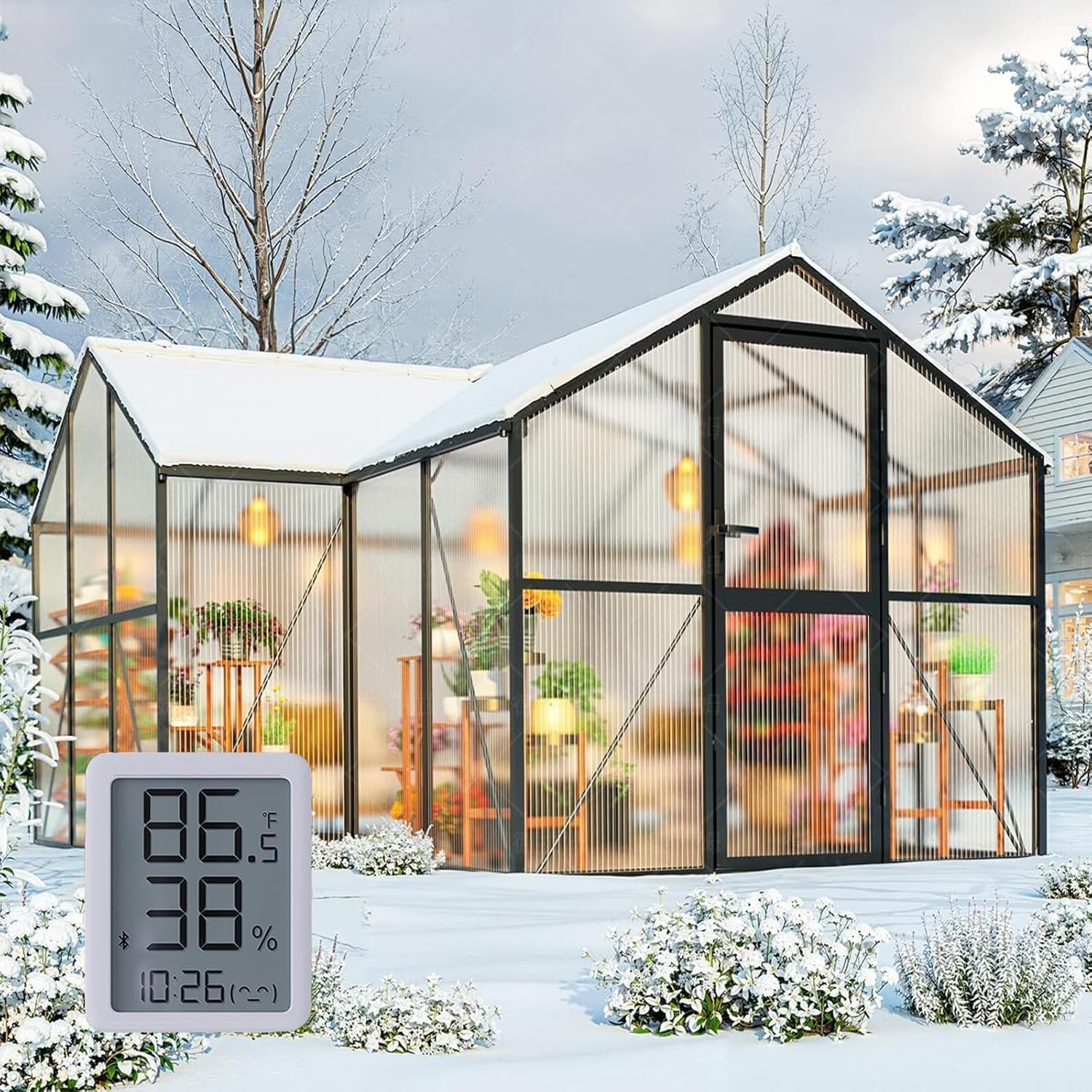
If you prefer a square layout to a long rectangle, this Sylviera model gives you 12×12 feet of interior space, which is 144 square feet — a very generous growing area. The key spec here is the panel thickness: 6mm double-wall polycarbonate weighing 1100 grams per square meter. That is significantly heavier and more insulating than the 720g panels found on many mid-range kits. The frame is a high-quality reinforced aluminum alloy with strengthened corners, and the kit includes adjustable roof vents and a lockable door.
Buyers who managed assembly successfully say the frame is “sturdy” and “spacious,” and the polycarbonate panels retain heat well. It also includes a hygrometer (a device that measures humidity) to help you monitor internal conditions. The square shape also feels more like a garden room than a tunnel, which some find more pleasant to work in. A few owners note the panels feel cheaper than expected despite the 1100g spec, but the overall insulation performance is solid.
The assembly experience is where opinions split. The parts are labeled, but some instructions are missing steps or contain errors. You will need a full day and at least two people. Critical details like removing the protective film from both sides of the polycarbonate panels are easy to miss. Also, the roof vents can be loose — some owners use rubber bands to keep them open. It is a good value for the size and panel thickness if you are comfortable with a moderate assembly challenge.
What You Get
- Square 12×12 footprint with substantial 6mm, 1100g polycarbonate panels for great insulation.
- Sturdy aluminum alloy frame with strengthened corners.
- Includes a hygrometer for monitoring humidity and temperature.
Watch Out For
- Assembly instructions have known errors and omissions; expect a learning curve.
- Roof vents may not stay open without a DIY fix (rubber bands mentioned by owners).
Grab it for: The unique square shape and thick 6mm panels, which offer a better insulation-to-price ratio than most rectangular kits.
Pass if: You want a beginner-friendly assembly with crisp instructions.
6. FLY BY YAN 8×12 FT Outdoor Polycarbonate Greenhouse
A smart 8×12 design with a unique quick-install system.
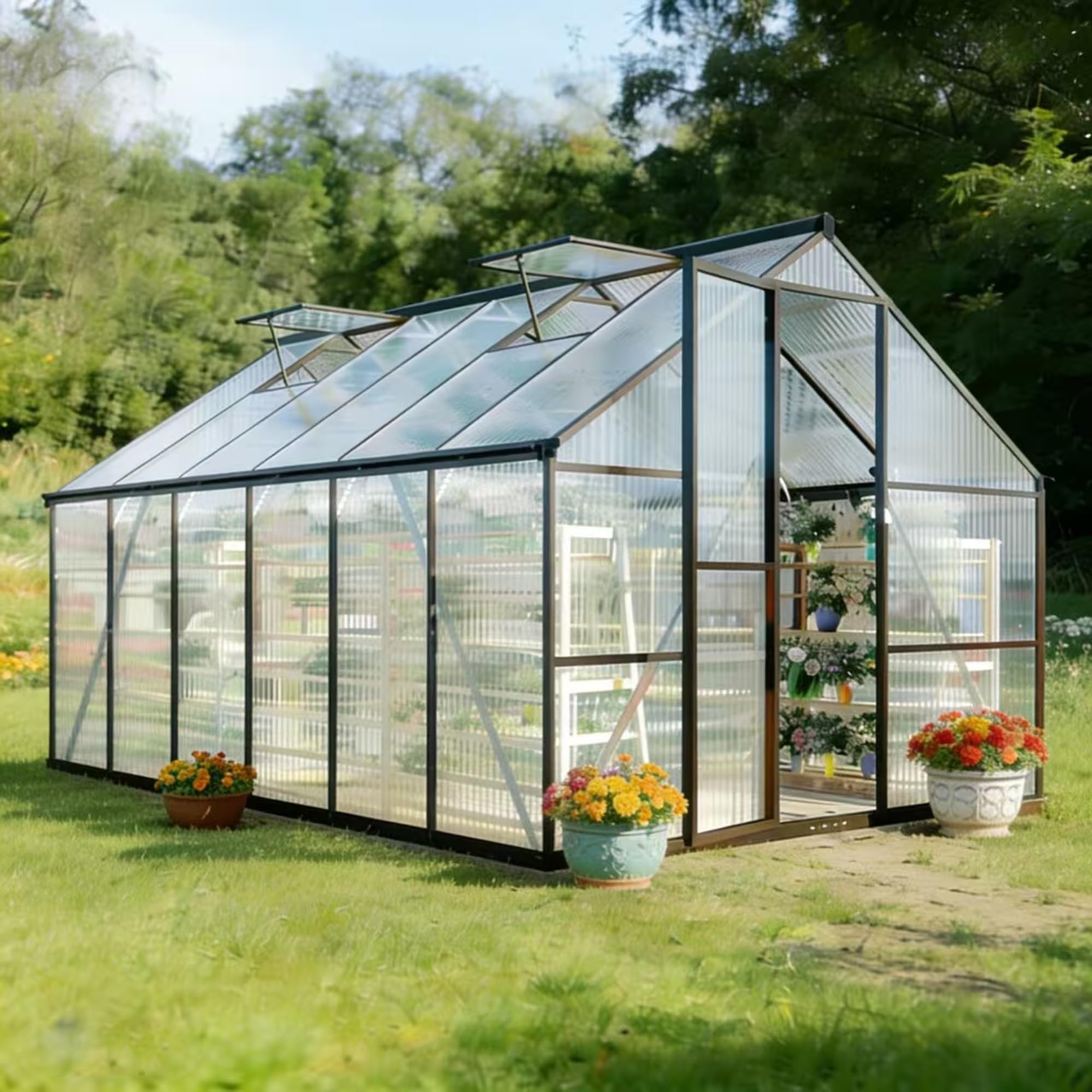
This FLY BY YAN greenhouse covers 96 square feet with an 8×12 footprint, and it stands out for its claim of a 40% faster installation and 35% better stability thanks to a quick-install system that was perfected through over 500 tests. The panels are 720g/m² polycarbonate, and the frame is a charcoal black reinforced aluminum that is scratch-resistant and rust-free. It comes with a wrench and gloves included, and the manufacturer says no cutting or drilling is required — just three steps for the slide-in panels.
Buyers report that the greenhouse is spacious, heats up quickly, and feels very sturdy once assembled. A buyer who put it together said it withstood a violent storm with “winds, rain, snow” and remained intact. The true interior dimensions are reported as 7’8″ by 13′ by 8′ tall, which is accurate to the listed 143″ x 97″ x 77″ dimensions. It features lockable doors, adjustable ventilation windows, and a rain gutter system.
The caveat is that despite the “quick-install” claims, assembly is still a major project. Owners mention needing 4-5 people and 6+ hours for this size. The instructions have been called unclear, and one buyer had a terrible experience with parts not aligning. A smaller subset of owners had great experiences, so a lot depends on your skill level. It is a solid mid-range option if you have a solid crew to help build it.
Who it works for: Experienced DIYers who want an 8×12 polycarbonate greenhouse with a rain gutter and a stylish charcoal black frame.
The reality check: The assembly is still a multi-person, multi-hour job despite the “quick-install” marketing — plan accordingly.
7. WUKHG 8X10FT Enhanced Aluminum Walk-in Greenhouse
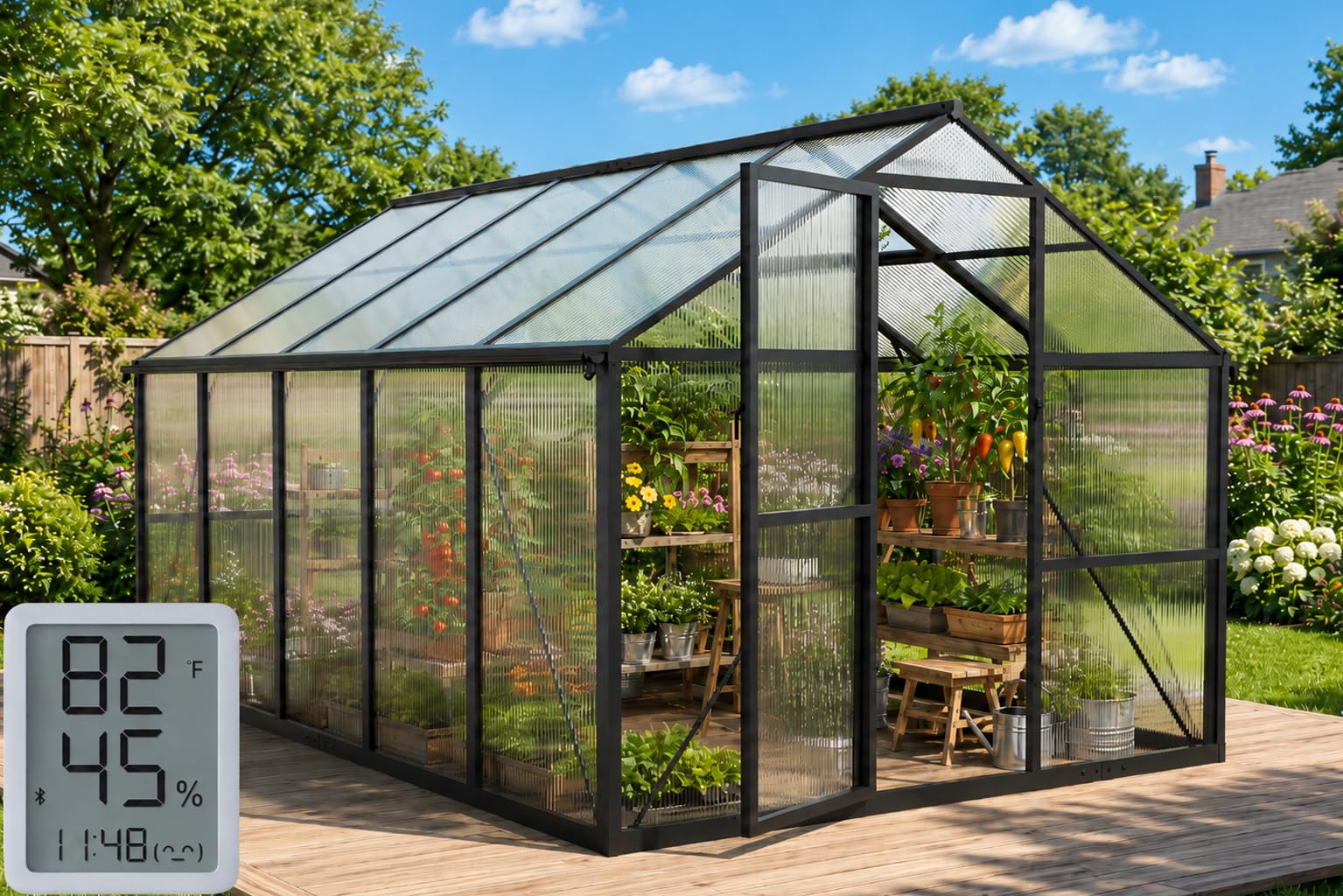
An 80-square-foot walk-in with a smart thermometer built in.
The WUKHG greenhouse gives you 8×10 feet of growing space with a high-quality aluminum alloy frame and heavy-duty 4mm thick twin-wall polycarbonate panels. A standout feature here is the included thermometer hygrometer that connects to an app for remote monitoring — it offers ±0.54°F temperature accuracy and ±3%RH humidity accuracy, refreshing every 2 seconds. You can access 14-day data graphs and half-year data export from the app. The frame has adjustable ventilation windows, a lockable sliding door, and a built-in rain gutter system on the roof for drainage.
Owners appreciate how sturdy the aluminum frame feels, with many noting it holds up well against rain and wind. They consistently say it is a great value for the price and that the compact but roomy design fits shelves and pots without feeling cramped. The heat retention is effective — one owner noted the greenhouse reached 100°F on a 40°F day outside, which shows good insulation but also means you need to use the vents.
The biggest gap is that the roof window can blow out on the first night if not very securely installed, a specific complaint from a few owners. The assembly also requires 3 people to do smoothly, and the instructions are not the clearest. For the price and feature set, these are manageable trade-offs, but be prepared to reinforce the roof vent and use silicone sealant at the gaps for best results.
Best Features
- App-connected thermometer with ±0.54°F accuracy and 14-day data graphs.
- Sturdy aluminum frame with reinforced corners and rain gutter.
- 4mm twin-wall polycarbonate panels retain heat well.
Potential Issues
- Roof vent can detach if not perfectly secured; consider reinforcing.
- Assembly is tricky and best done with 3 people.
Reach for this if: You want an app-connected greenhouse that you can monitor remotely for temperature and humidity.
skip it if: You want a no-hassle, single-person assembly or need a larger footprint than 80 square feet.
8. HOOYEAH 6×8 FT Polycarbonate Greenhouse
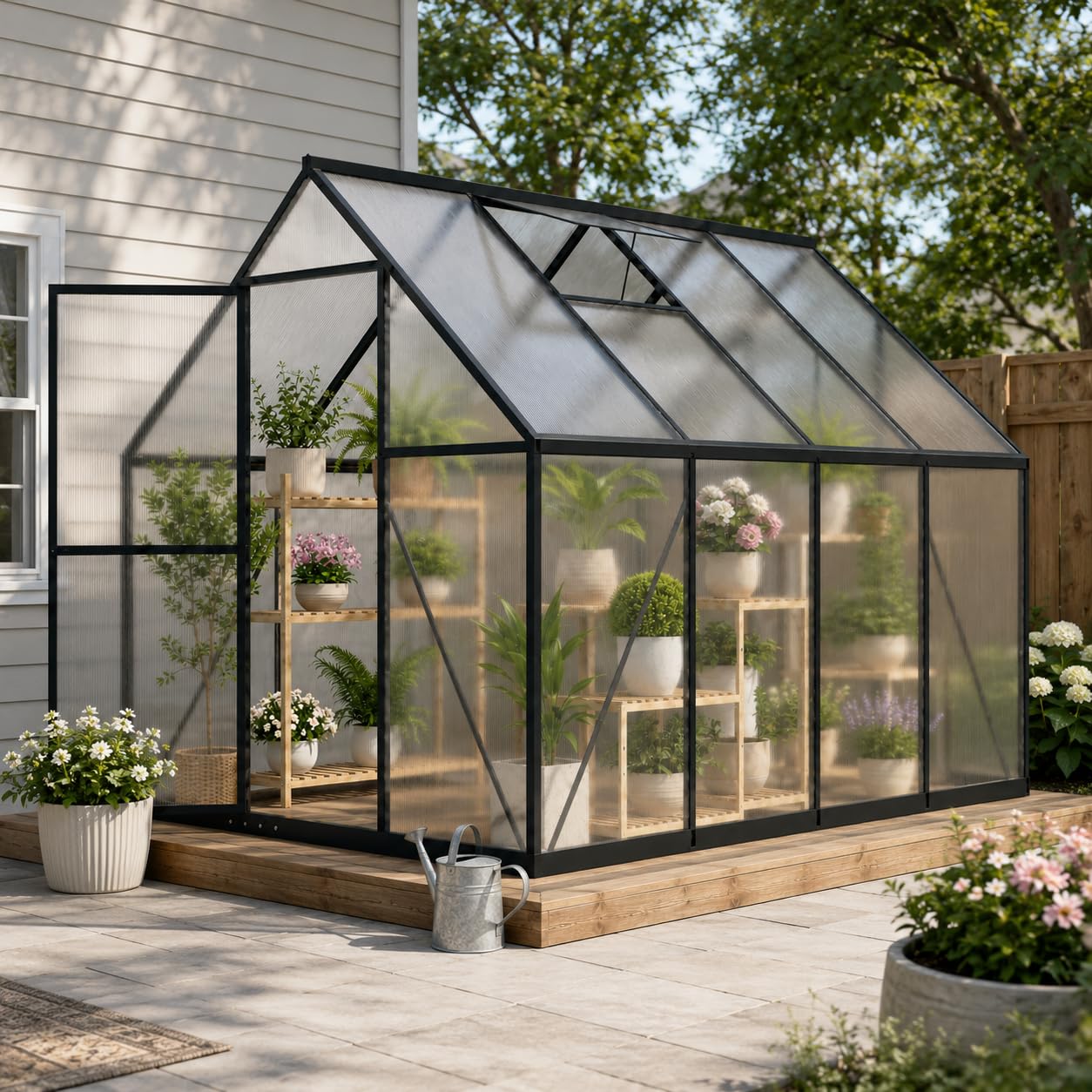
An entry-level polycarbonate walk-in that punches above its price.
At 6×8 feet, the HOOYEAH is the smallest polycarbonate walk-in on this list, but it covers 48 square feet — still plenty for a dedicated hobby grower. The frame is built from upgraded aluminum components with a reinforced structure, and the semi-translucent, milky white polycarbonate panels block harmful UV rays while diffusing sunlight. It features an adjustable roof vent and a lockable door. At under 80 pounds, two people can easily move it once built.
What owners praise most is the build quality. The panels fit snugly, the parts are well-packaged and numbered, and one 70-year-old owner reported assembling it solo. The “sturdy” feedback is common, though the sturdiness is rated as mixed by the broader pool — some find it perfectly solid for the price while others note the cage feels less rigid than heavy-duty counterparts. The instructions are not the best; one reviewer described the experience as “frustrating” due to unclear diagrams and misnumbered parts.
Truthfully, the value proposition here is straightforward: you get a real polycarbonate walk-in greenhouse for a budget-tier price. That means thinner panels than premium kits and a frame that is best placed near a windbreak like a fence or wall. Buyers recommend caulking the glazing (the panel edges) for extra wind resistance. It is a solid “starter polycarbonate” greenhouse that you can upgrade from later without having wasted your money.
The quick take: A well-engineered, budget-friendly polycarbonate greenhouse that is best for beginners on a budget, but plan on sealing the panels and anchoring it well.
Who it’s not for: anyone in an exposed, high-wind area who needs a bombproof structure without extra reinforcement.
9. Outsunny 6′ x 8′ Polycarbonate Greenhouse with Sliding Door
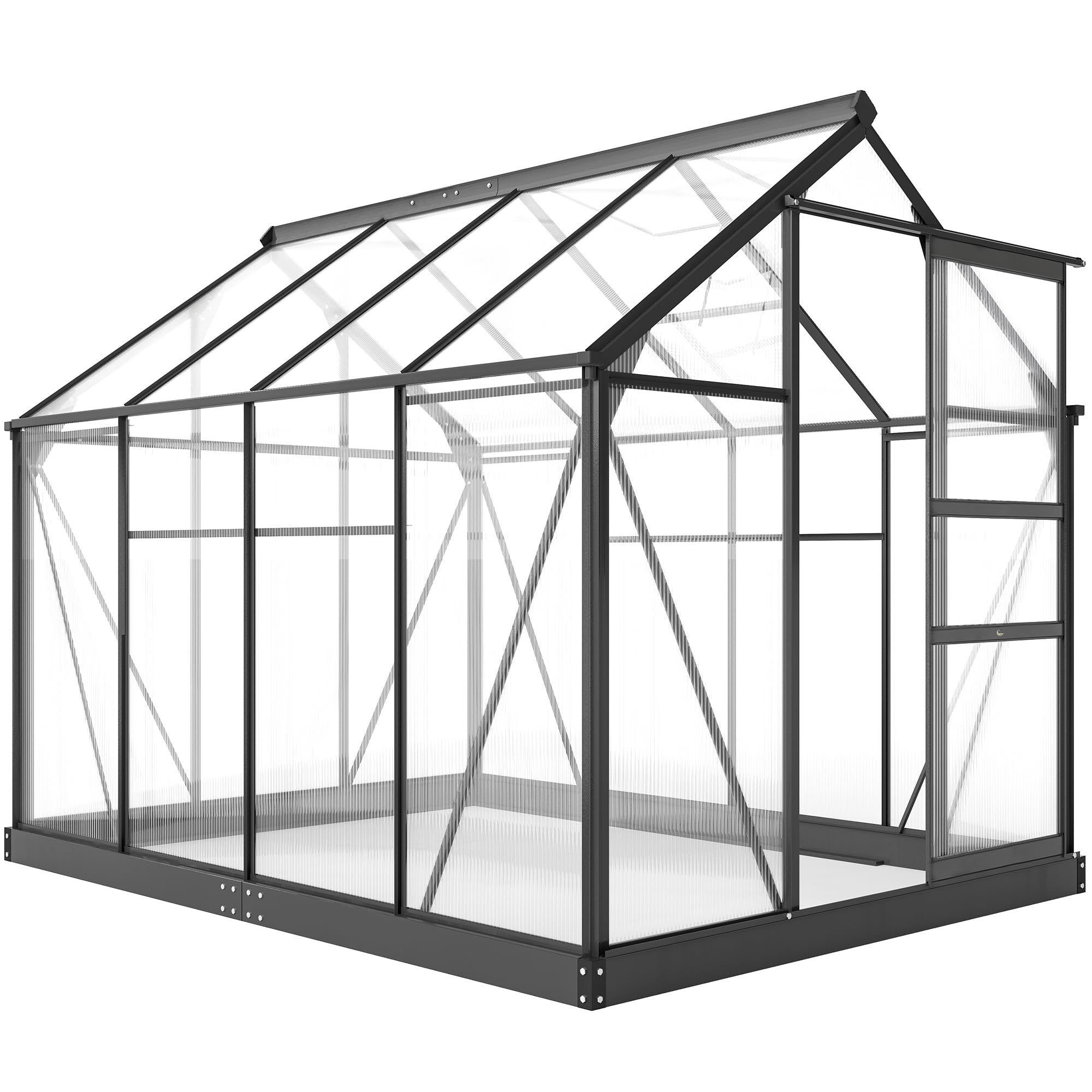
Sliding-door access meets a budget polycarbonate build.
The Outsunny greenhouse has a 6×8 footprint with a sliding door, which is more convenient for moving plants and tools in and out than a hinged door in tight spaces. The frame is powder-coated aluminum to resist water, with a galvanized steel base for extra strength. It includes a roof vent and rain gutters to collect natural rainwater. The polycarbonate panels are designed to allow nourishing sunlight while blocking UV rays, and the “house of cards” assembly process is something you need to be mentally and logistically prepared for.
Honestly, this greenhouse has the most polarized reviews on the list. Some owners love the value and find the final product attractive and functional — one reviewer called it “Fantastic. Great product for the money!” after a full day of assembly. Others had a terrible experience, with reports of flimsy panels that tore loose in breezes over 10 mph and window panels falling out. The instructions are picture-only with no written steps, and there is a critical need to square the base diagonally during assembly or everything goes wrong.
This is a greenhouse for someone who enjoys a challenge and is comfortable with DIY modifications. Owners who succeeded added weather stripping to seal gaps, used extra braces, and built it in warm weather. It is not a kit you can open on a Saturday morning and be planting by Sunday afternoon. The appearance is the most praised aspect, but sturdiness and durability are genuine concerns that the mixed feedback makes clear.
Why It Appeals
- Sliding door is genuinely convenient for moving equipment and plants.
- Powder-coated aluminum and galvanized steel base offer good corrosion resistance.
- Surprising value when assembled carefully by a confident DIYer.
Common Frustrations
- Assembly is a “house of cards” until complete — confusing picture-only instructions.
- Panels are thin and can blow out in moderate wind if not perfectly installed and anchored.
Best suited for: A confident DIYer who wants a budget polycarbonate greenhouse with a sliding door and is willing to do extra sealing and bracing.
Not recommended for: first-time greenhouse buyers who just want something to assemble quickly and rely on for a few seasons.
10. CROWN SHADES 8×6 Pop Up Greenhouse, Walk-in Greenhouse
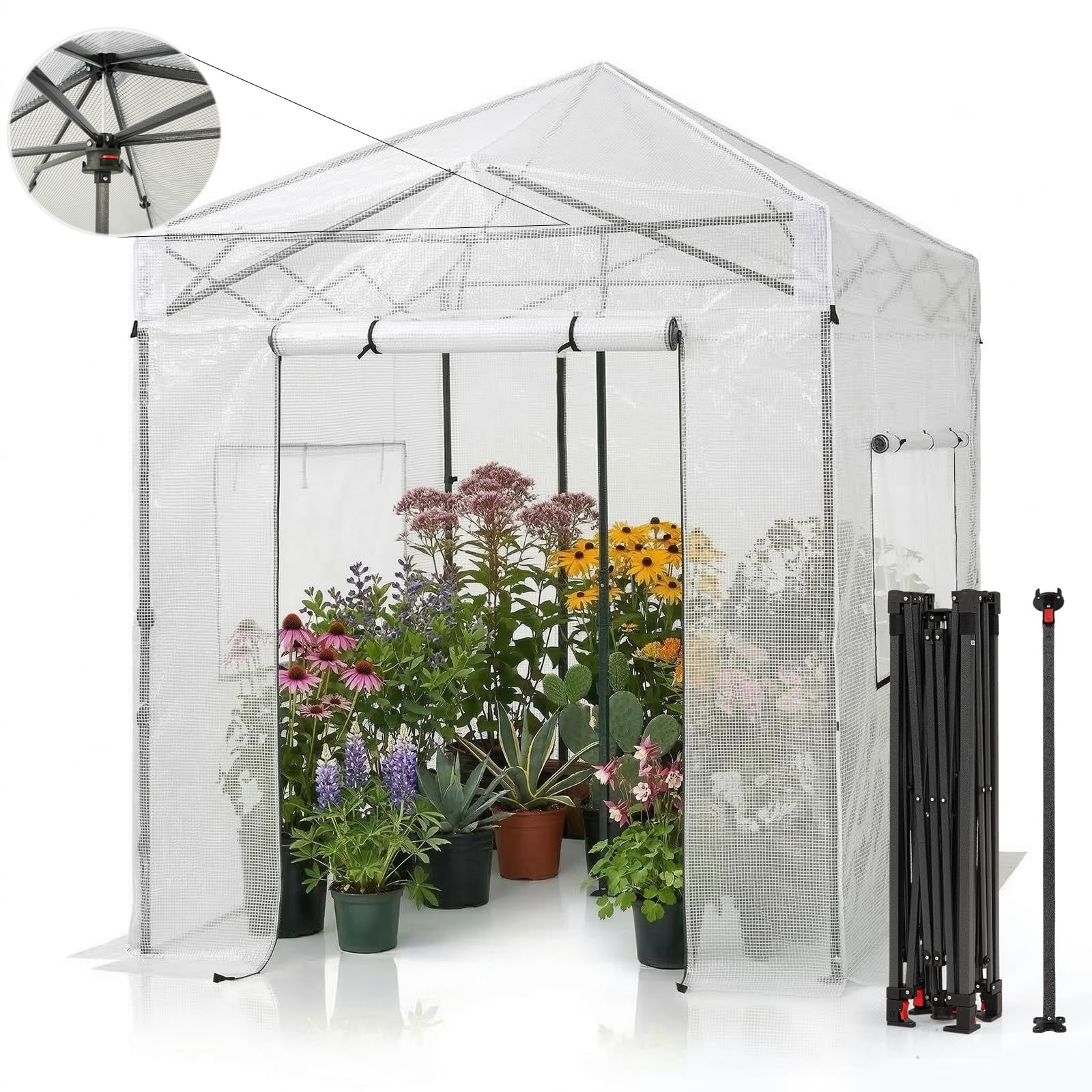
Sets up in seconds with no tools — but needs serious anchoring.
The CROWN SHADES pop-up greenhouse takes a completely different approach from the rest. It is a pop-up tent-style structure with a steel frame and a patented one-push center lock system that sets up in seconds with no assembly. The polyethylene cover is treated with an anti-aging formula, and the 8×6 foot size gives you 48 square feet of walk-in space. It has two mesh windows and a roll-up zippered door for ventilation, plus 2 vents. The height is adjustable to three levels.
The review pages sum it up: “Withstood 60mph storms when secured.” Several customers note it surviving 50-60 mph winds when they used the safety straps, sand bags, and ground stakes correctly. For the price, the size and the instant setup are class-leading. Many growers use it as a season extender, starting seedlings in early spring and protecting tender plants from frost. The adjustable height is a genuinely nice feature for tall plants like tomatoes and peppers.
The honesty is in the cover material. The PE fabric is not as durable as polycarbonate. Some reviewers point out small tears from where the poles rub against the fabric, usually fixed with a patch of duct tape. It is a greenhouse designed for mild weather and seasonal use, not a permanent year-round structure. You also need to properly anchor it — owners who failed to do so had it blown around. For the budget and convenience, it is a great tool to have in your arsenal, but treat it as a heavy-duty temporary shelter.
Who should buy: Anyone who wants an instant, portable greenhouse for seasonal use or as a starter kit to see if they enjoy greenhouse gardening.
The honest limit: The PE cover will eventually tear and is not built for permanent year-round exposure — consider it a 1-3 season tool depending on your climate and care.
Understanding the Specs
Frame Material
The frame is the skeleton that determines how much wind and snow your greenhouse can handle. Wood frames, like cedar, are naturally strong and rot-resistant but require more maintenance and are permanently installed. Aluminum frames are lightweight, rust-proof, and easier to assemble, but lower-gauge aluminum can flex. Steel frames, usually galvanized to prevent rust, are the most durable for the cost but are heavier and are often used in tunnel-style greenhouses.
Polycarbonate Panel Weight (g/m²)
Polycarbonate panels are measured by their weight in grams per square meter. A panel rated 720g/m² is a standard mid-range option that provides good insulation for most climates. A panel rated 1100g/m² is thicker and more insulating, retaining heat better in winter and resisting impact more in hail. The heavier the panel, the better the insulation and durability, but the more the entire structure will weigh and cost.
Snow Load Rating
This spec tells you how much weight the roof can handle before collapsing. It is usually expressed in pounds of snow load or inches of snow depth. A kit rated for 30 inches of snow is built for northern climates, while a budget pop-up with no rating should be cleared after every snowfall. Always match the snow load rating to your local winter averages — a greenhouse that collapses under snow is a total loss of your plants and investment.
Ventilation Features
Without airflow, a greenhouse turns into an oven on warm days. Roof vents are the most effective type because hot air rises and escapes out the top. Roll-up side panels on tunnel greenhouses also work well. Mesh windows can allow airflow while keeping pests out. The best kits include adjustable vents that you can open and close based on the weather, giving you precise control over temperature and humidity.
FAQ
Do I need a building permit for a large greenhouse kit?
What is the best foundation for a large greenhouse?
Can I leave my large greenhouse up year-round?
How many people do I need for assembly?
How do I anchor a large greenhouse in high winds?
What is the difference between twin-wall and multi-wall polycarbonate?
Can I heat a large greenhouse in winter?
How do I prevent my greenhouse from overheating in summer?
Is a wooden or aluminum frame better?
What size greenhouse do I actually need for my garden?
Final Thoughts: The Verdict
For the majority of shoppers, the large greenhouse kit winner is the Backyard Discovery Willow 9×6 because it combines a beautiful cedar frame with commercial-grade 4-wall polycarbonate panels, an integrated exhaust fan and PowerPort, and a tested ability to handle 30 inches of snow and 100 mph winds. If you want the maximum growing space for the best price per square foot, grab the Quictent 25×10 tunnel greenhouse for its massive 250-square-foot footprint and galvanized steel frame. And for an instant, no-tools-needed option that is perfect for seasonal use, the CROWN SHADES 8×6 pop-up is the one to reach for — just make sure you anchor it well.
How We Picked
We do not accept paid placement. Every pick is matched to a real buyer and a real use-case; we do not hands-on test units.
Sources & Methodology
Specifications: manufacturer listings and product documentation. Review insights: verified customer reviews, as of July 2026. Pricing: not shown on this page (it changes often); check the current price via the retailer link.
As an Amazon Associate, Lawn Gear Lab earns from qualifying purchases. This does not affect which products we feature.