
Specs are compiled from manufacturer listings and verified buyer reviews and can change over time — please confirm the key details on the product page before buying.
Most large planters look cheap, crack in bad weather, or cost a lot for real stone. But some of the best options now hide impressive toughness inside a surprisingly light frame.
I’m Rikta — the founder and writer behind Lawn Gear Lab. This guide is built by comparing the manufacturers’ published specifications and the patterns across verified customer reviews, so you get each pick’s real strengths and trade-offs instead of marketing spin.
Understanding the material and true size is everything — if you need a wide, shallow bowl for succulents or a deep vessel for a small tree. Here is the breakdown of the best large bowl planter picks that actually perform and look good doing it.
Our Picks at a Glance
How To Choose The Best Large Bowl Planter
A large bowl planter is a simple purchase until you read specs. The wrong material can crack in winter. Someone might not be able to lift a 50-pound pot. And a lack of drainage will kill your favorite plant. Focus on these three areas to get a planter that lasts.
Material: The Real Battle Is Between Weight and Toughness
Concrete looks authentic and stays heavy, which helps resist wind. But genuine concrete also chips and can crack if water freezes inside it — a process called freeze-thaw damage. A plastic-stone composite (a blend of plastic and stone powder) or fiberstone (fiberglass, stone powder, and resin) offers the same matte, stone-like finish without the weight or frost-shattering risk. Polyresin (a rigid plastic) and polyethylene (PE — a flexible, durable plastic) are lighter still and UV-resistant, though they can feel hollow if you tap them. For a bowl you’ll move around or use in a climate with freeze-thaw cycles, a composite or fiberstone is the smarter choice over pure concrete.
Drainage and Depth: The Difference Between Thriving and Drowning
A bowl planter can be shallow — good for succulents and bonsai that hate wet roots — or deeper for small trees and shrubs. Look at the planter’s height, not just its diameter. And always check for a drainage hole. Some planters come with a pre-drilled hole, others mark a spot for you to drill, and a few offer a rubber plug that you can remove for outdoor use or keep in for indoor use or a water feature.
Size vs. Portability: Matching the Real Use
A 24-inch diameter bowl looks stunning by an entryway, but you or someone else will have to carry it there. Concrete models often weigh over 10 pounds even at 16 inches. Composite and resin versions weigh half that and still stand up to weather. If the planter goes on a balcony or rooftop, or if you like to swap greenery seasonally, lightweight construction is the priority. On a ground-level patio, extra weight from concrete or sand-filled double walls actually helps keep the planter steady in the wind.
Quick Comparison
| Model | Best For | Diameter | Material | Weight | Amazon |
|---|---|---|---|---|---|
| Veradek Mason Series Lane Bowl★ Best Overall | Premium all-weather durability | 24 in | Plastic-stone composite | 7 lb | Amazon |
| SQOWL Succulent Planter 12 InchCompact Beauty | Shallow ceramic bonsai and succulents | 12.4 in | Ceramic | 3.82 kg | Amazon |
| Kante Accent Round Bowl 16″ | Concrete look with real heft | 16 in | Concrete | 9.9 lb | Amazon |
| ARBORA 21″ Santorini Bowl | Ultralight stone-like bowl | 21 in | Resin | Very light | Amazon |
| Sunnydaze Anjelica 24” | Deep pot for small trees | 24 in | Resin | 6.4 lb | Amazon |
| DTY Mt Sherman Fiberstone Sphere | High-end indoor olive tree stand | 21.1 in | Fiberstone | 18.4 lb | Amazon |
| Mayne Modesto 30in | Massive architectural statement piece | 30 in | Polyethylene | Light | Amazon |
In‑Depth Reviews
1. Veradek Mason Series Lane Bowl
Our pick — over 4.5★ from 800+ verified ratings; the strongest balance of quality and price.
The bowl that looks like carved stone yet weighs only 7 pounds and withstands frost.
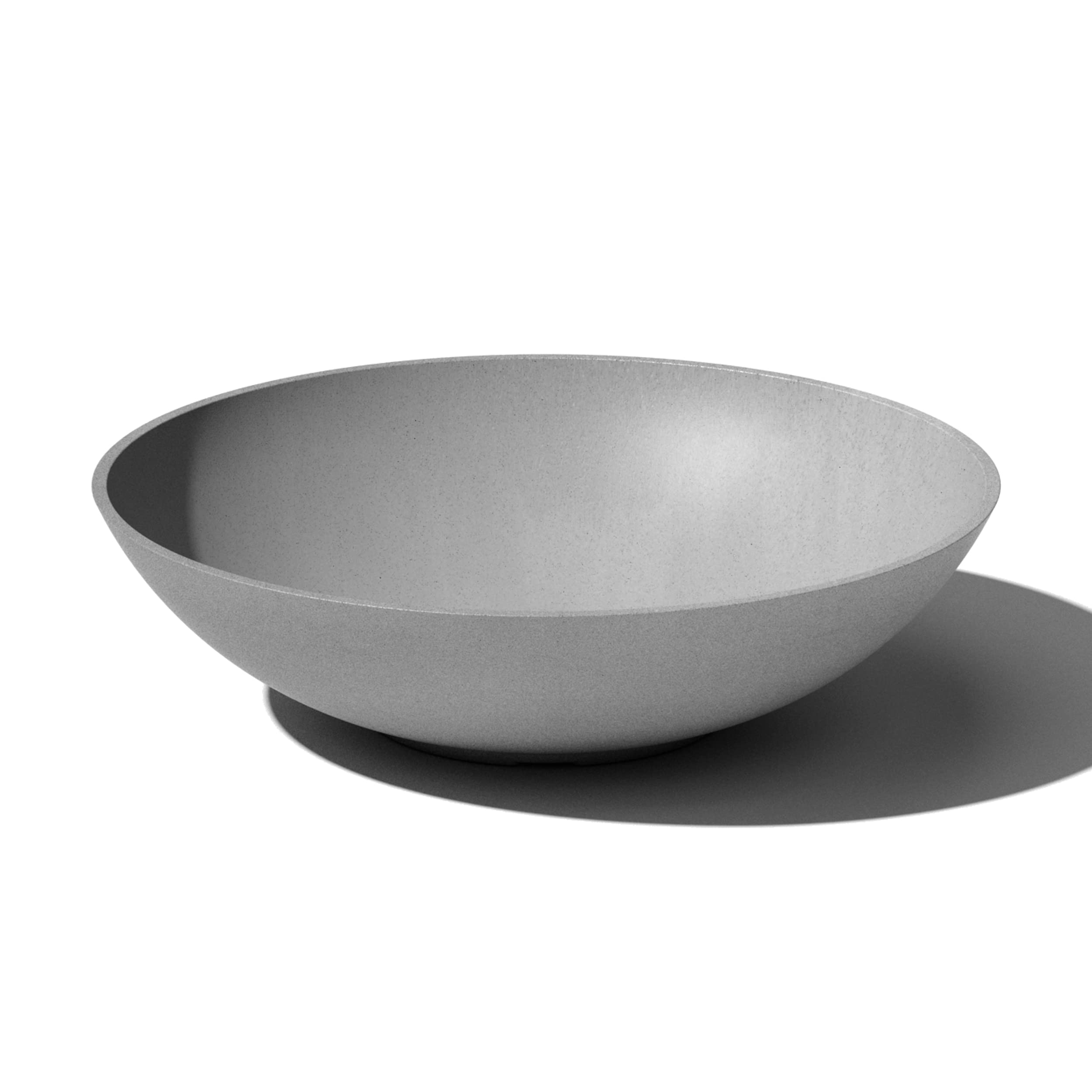
This is the crowd-favorite pick for a reason. The Veradek Lane Bowl uses a plastic-stone composite (a blend of plastic and stone powder) that gives it the texture of cement without the fragility. It is rated for temperatures from -20 to +120 degrees Fahrenheit, so it handles scorching desert heat and freezing winters without cracking — so number plates stay readable at night and the planter itself stays intact. At 24 inches in diameter and 6.5 inches tall, it has a 25.2-liter capacity — shallow enough for succulents but broad enough to anchor a row of planters along a walkway.
The quality is what wins people over. Over a thousand buyers highlight how sturdy and well-made it feels, and the pre-drilled drainage holes mean you do not have to drill on day one. Owners often use it as a fountain base, noting it comes with water plugs for a simple fountain conversion. It is also easy to clean and the gray color looks sophisticated in any landscape. The trade-off is that at roughly 7 pounds, it is lighter than a concrete pot of the same size — a few owners wished it had more heft if they are using it in an exposed, very windy spot. But for 99% of uses, it holds its ground.
Compared to the SQOWL ceramic bowl below, the Veradek is 24 inches versus 12.4 inches for a similar price, giving you much more scale.
Why owners pick this
- Stands up to extreme weather without cracking or fading — built for -20 to +120 °F.
- Weighs just 7 pounds — easy to reposition even when filled with soil.
- Looks convincingly like stone but costs less than carved concrete.
- Comes with drainage holes and water plugs ready for a fountain conversion.
The honest trade-off
- Lighter than concrete, so strong winds could tip it if left empty.
- Shallow 6.5-inch height limits root depth for larger shrubs or trees.
The right pick if: you want a large, weatherproof bowl that looks expensive, stays movable, and resists cracking across all seasons.
Think twice if: you need a deep pot for a small tree or are planting in an extremely windy zone with no filler at the base.
2. SQOWL Succulent Planter 12 Inch
A glazed ceramic dish that turns a succulent or bonsai into a living centerpiece.
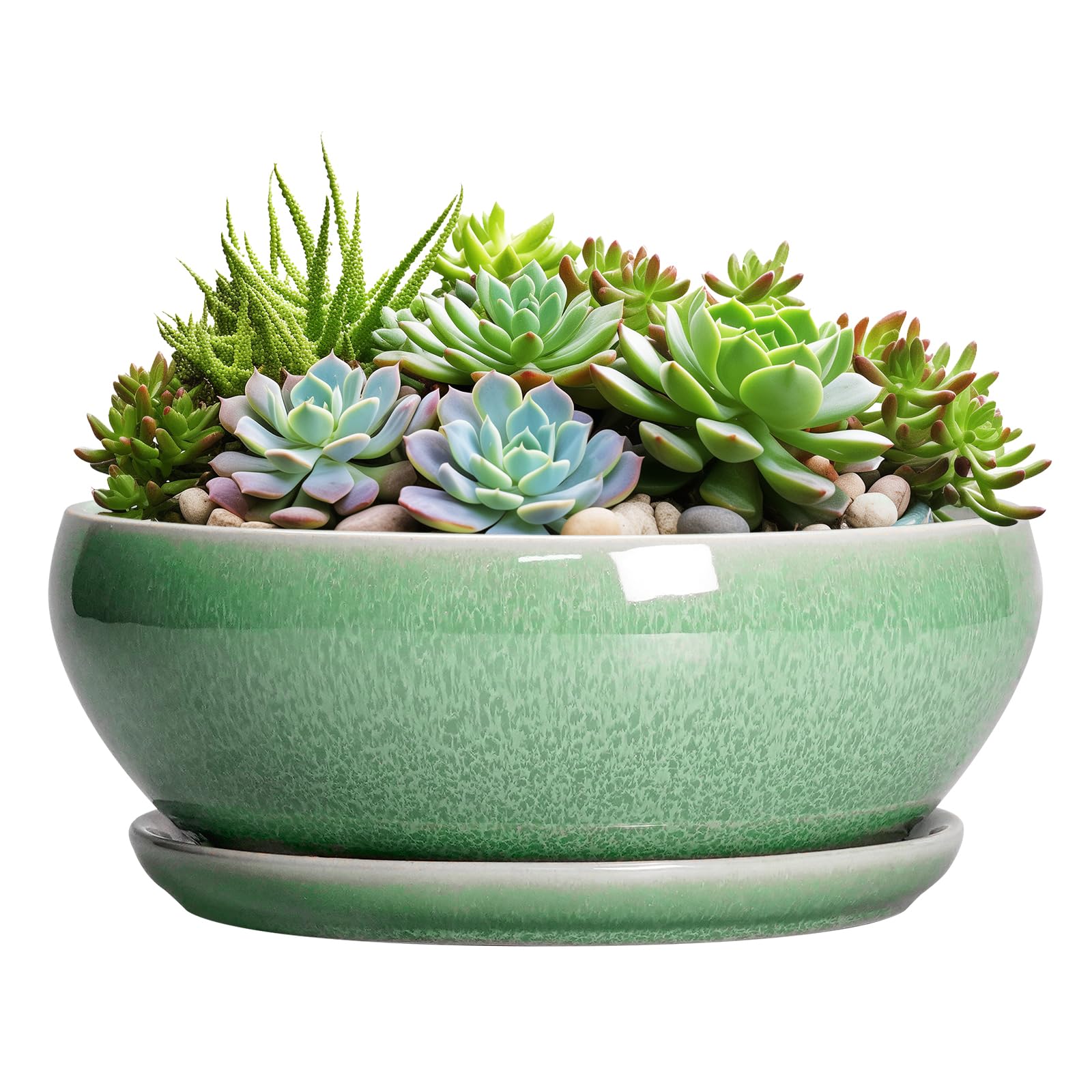
If you prefer the smooth feel and rich color of ceramic, this is the bowl to beat. The SQOWL planter measures 12.4 inches in diameter and stands 4.7 inches tall including the matching ceramic saucer. The glazed finish comes in several colors — the green option earned praise from buyers for matching product photos exactly. A mesh pad is included to cover the drainage hole and keep soil from washing out while still letting water flow.
Bonsai growers and succulent enthusiasts are the core audience here. The shallow bowl shape is perfect for root systems that spread sideways rather than deep. The included ceramic saucer catches runoff so your table or shelf stays dry. One detail to know: the saucer is glazed only on the edge. As buyers report, “water seeps through bare clay,” so placing it on a wood surface without a protective mat could leave a damp ring. Beyond that, the craftsmanship is consistently praised as high-quality, and for the price, it delivers a decorative look that fits both indoor and covered outdoor spaces.
The Veradek bowl dwarfs this one in scale, but the SQOWL offers a finished glazed ceramic look that the composite Veradek simply cannot match.
What stands out
- Glazed finish looks elegant and cleans easily.
- Matching ceramic saucer keeps indoor surfaces clean.
- Mesh pad prevents soil loss through the drainage hole.
Before you buy
- Saucer is not fully glazed — bare clay underneath may weep water onto surfaces.
- Shorter than typical bowl planters; not suited for tall plants or trees.
Grab it for: a fancy bonsai, succulent arrangement, or orchid display where the pot itself is part of the decor.
Pass if: you need a large-scale bowl for the patio or you cannot use a protective mat under the saucer on an indoor wood table.
3. Kante Accent Round Bowl 16″

Real concrete heft that stays put on the windiest porch and deepens its character over time.
For buyers who want genuine concrete — with visible pores and a natural, matte finish — the Kante delivers. It measures 16 inches in diameter and 8 inches deep, deeper than the Veradek bowl, giving roots more room. It weighs 9.9 pounds, which feels reassuring under a large echeveria or a compact shrub. The drainage hole is fitted with a rubber plug, so you can keep it sealed for a water feature or indoor use, or pop it out for standard drainage outside.
The concrete-and-fiberglass blend makes this more durable than pure cement. Owners note its color stays true through seasons of sun and rain without fading. The appearance is the most-praised aspect — over 100 buyers mention the look. The catch is that a handful of owners expected a denser concrete product and found the bottom thinner than anticipated. For a decorative bowl used on a patio or steps, it is a strong performer. But if you plan to drill extra drainage or use it as a heavy water basin, inspect the base thickness first.
Compared to the Veradek above, the Kante is at 9.9 lb versus 7 lb and 16 inches diameter versus 24 inches, so it is more of a personal-sized concrete bowl. It does not have the frost-proof temperature range of the composite Veradek, but for mild climates or covered outdoor use, it is a handsome, authentic choice.
Strengths
- Real concrete surface with visible pores — an authentic stone look and feel.
- Heavy enough to resist wind without needing sand inside.
- Rubber plug gives you indoor/outdoor drainage flexibility.
Heads-up
- Bottom is thinner than some expected — not ideal for heavy water features.
- Concrete can crack in hard freeze cycles without proper sealing.
Choose this if: you want a medium-sized bowl with real concrete texture that looks natural and will not blow over.
skip it if: you live where temperatures drop well below freezing regularly, or you need a planter thin enough to drill extra drainage holes.
4. ARBORA 21″ Santorini Bowl
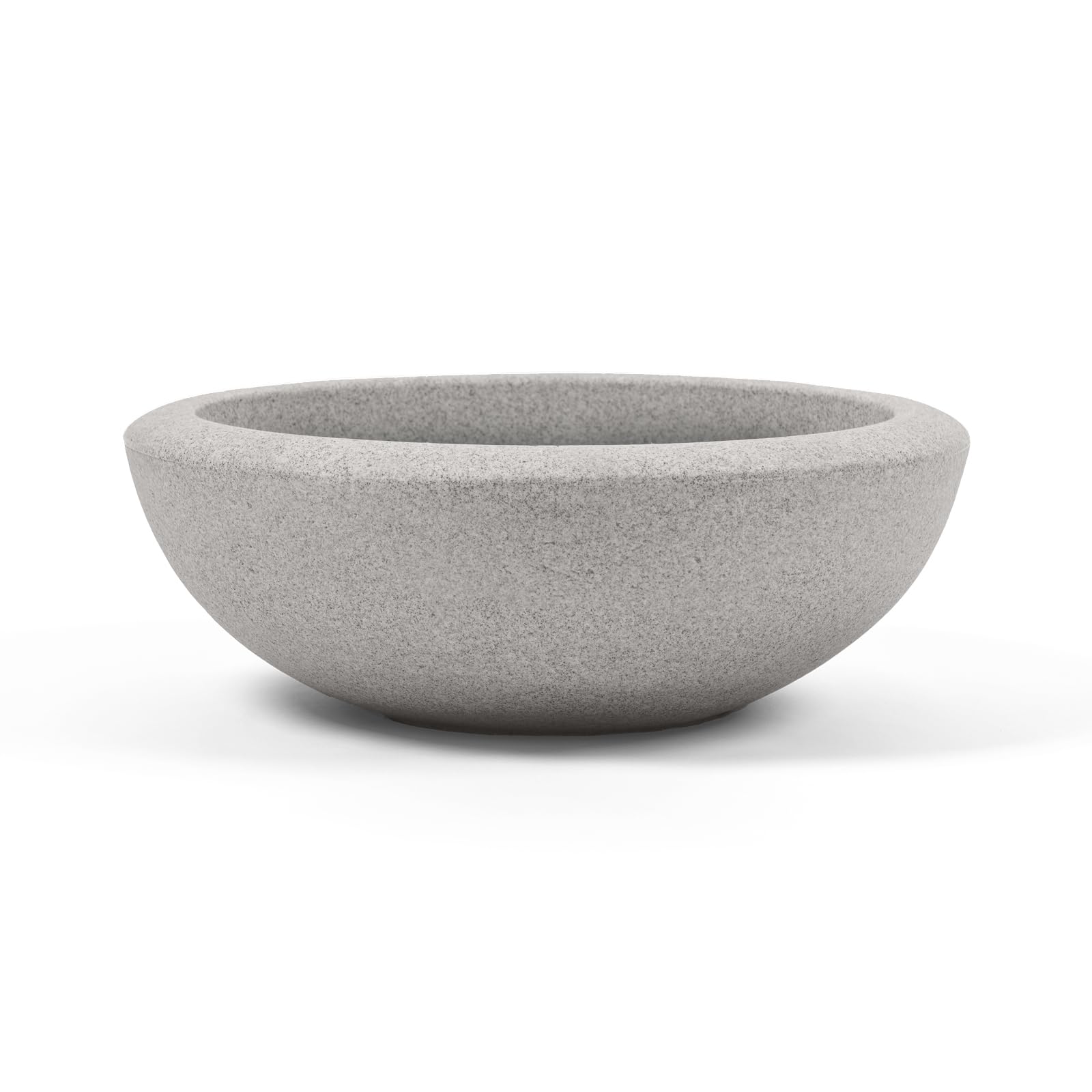
A 21-inch bowl you can lift with one hand — and it passes for cast stone.
The Arbora Santorini is built for the gardener who wants a big planter without the backache. It spans 21 inches in diameter with a 15-quart capacity, yet it is made of lightweight resin (a rigid plastic) that you can easily reposition mid-season. The concrete gray finish has a stone blend texture that fools the eye — owners consistently remark that it looks like molded concrete or aged iron until they try to pick it up. Double-walled construction (an inner and outer layer with an air gap) insulates roots from temperature swings and makes the planter safe for growing food, since the materials are, according to the maker, recyclable and food-safe.
A drillable drainage hole location is marked in the bottom, so you decide whether to open it up or leave it sealed for a fountain or indoor bowl. The appearance and light weight are the top praises from buyers: the bowl earns over 50 mentions for its look and over 40 for being easy to carry. The main downside is a price that a few owners call high for a resin pot — though they also note there is little on the market that combines this scale and lightness so convincingly.
Bests the Veradek where: it is far lighter at the same rough diameter and uses double-wall insulation to protect roots from temperature swings. Falls short of the Veradek on extreme-temperature rating (Arbora does not claim the -20°F range) and on number of pre-drilled drainage holes.
Perfect for: a balcony or rooftop gardener who wants a big bowl but has to haul it up stairs or swap plants each season.
Not ideal for: budget-focused buyers who prefer pre-drilled drainage over deciding where to drill themselves.
5. Sunnydaze Anjelica 24”

The deep 24-inch pot that holds 19 gallons of soil yet weighs only 6.4 pounds empty.
Most bowl planters are shallow by design. The Sunnydaze Anjelica is the exception: it stands 20 inches tall with an 18-inch inner height, giving a small tree like a dwarf citrus or a rose bush real root depth. The outer diameter is 24 inches, but the inner planting surface is 21 inches across, and the pot holds 19 gallons of soil. That is enough for a substantial plant. Despite that size, the polyresin (a rigid plastic) construction keeps the empty weight at just 6.4 pounds.
The double-walled build is a clever feature. The outer wall has a fill port — add sand or gravel between the walls to weigh the planter down in windy conditions, then replace the plug to seal it. The trade-off is that the included drainage setup is a single small central hole. One experienced owner notes it could raise the risk of root rot. They drilled extra holes and used tubing to channel water through the cavity. The finish is hand-painted, giving it a weathered terra-cotta look that earns high marks for appearance — over 70 owners call out the quality, and over 70 also praise its looks. The manufacturer backs it with a 1-year warranty.
Key advantages
- Real depth for trees — 18 inches of inner height, 19-gallon capacity.
- Double-walled insulation protects roots and lets you add sand for stability.
- Remarkably lightweight for a pot this capacity.
Know before planting
- Only one small central drainage hole; some owners modified it for better flow.
- Hand-painted finish can vary slightly between units.
Best for: planting a small tree or large shrub in a bowl shape without needing a forklift to move it.
Not for: succulents or shallow-root plants — the depth is overkill and the drainage setup needs attention before you pot a sensitive plant.
6. DTY Mt Sherman Fiberstone Sphere
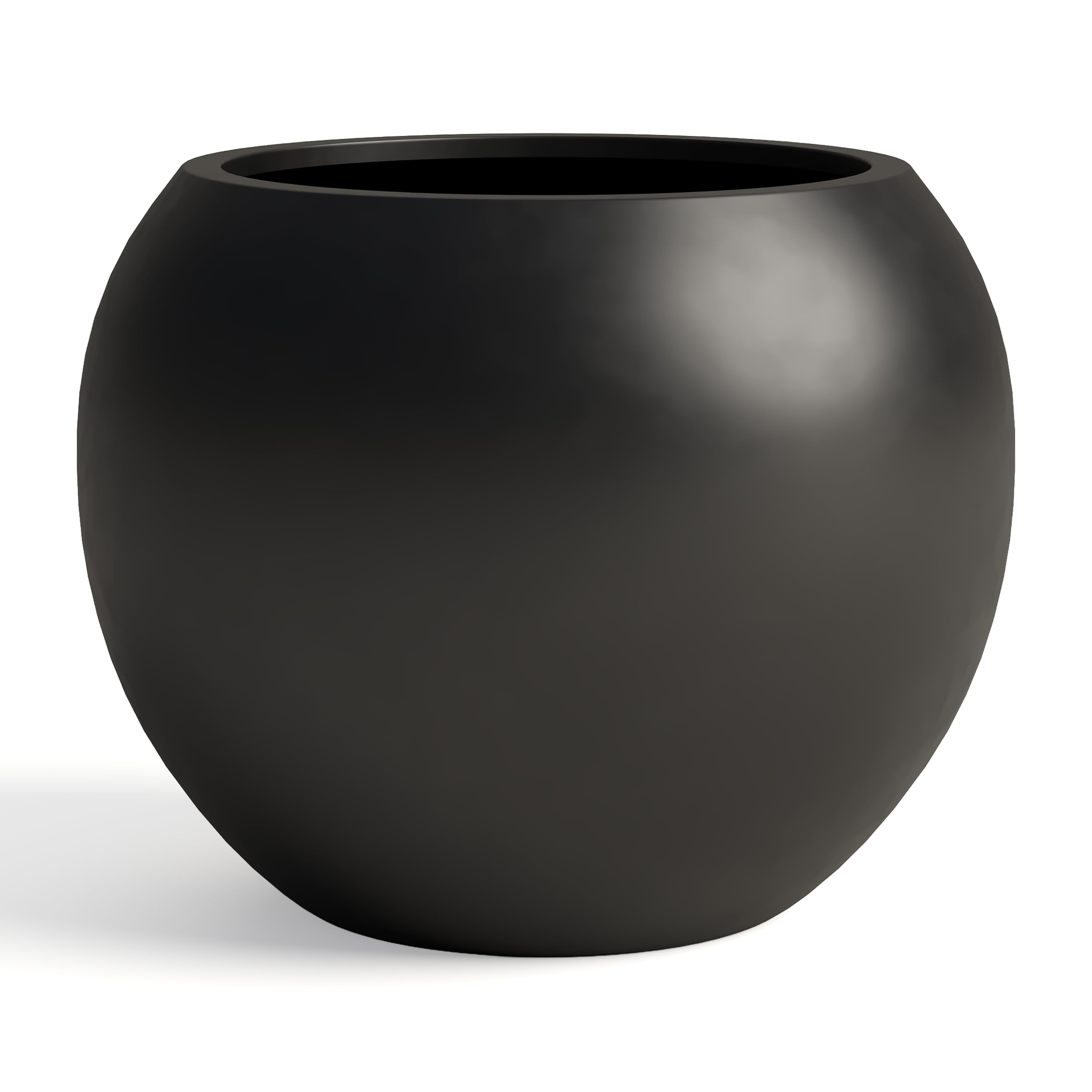
A sphere that manages to look like carved stone, hold an olive tree, and still be light enough for a floor.
The DTY Mt Sherman uses fiberstone — a blend of fiberglass, stone powder, and resin — to create a rigid, smooth-walled sphere that feels expensive and looks modern. The large size measures 21.1 inches in diameter and 16.7 inches tall, with a 14.3-inch pot opening. That opening is wide enough for a tall olive tree or a fiddle-leaf fig. Two extra coco mats (fiber pads that help with moisture) come in the box, which you can place at the bottom to improve moisture balance and keep soil from washing through the drainage hole.
The built-in drainage hole uses a removable rubber plug, so you can use this indoors on a wood floor without worry. The matte black finish is the most popular color — over 80 buyers single out the planter’s appearance as a highlight. At 18.4 pounds it has a solid, premium feel, but that weight is still lower than a concrete pot of the same size would be. The honest downside is the price: it sits at the premium end of this list, and some owners note it is expensive for what it is. But for a pot that improve a room’s decor as much as the plant inside it, the quality is hard to argue with.
The Mayne Modesto below is larger at 30 inches, but the DTY’s fiberstone surface has a finer, more furniture-like finish that suits an indoor living room or a boutique commercial space.
Buy it for: a statement indoor tree — olive, fiddle leaf, or palm — where the pot itself is a design feature.
Pass if: your budget is tighter or you need a deeper bowl that holds more than 18 pounds of soil mass.
7. Mayne Modesto 30in Round Modern Planter
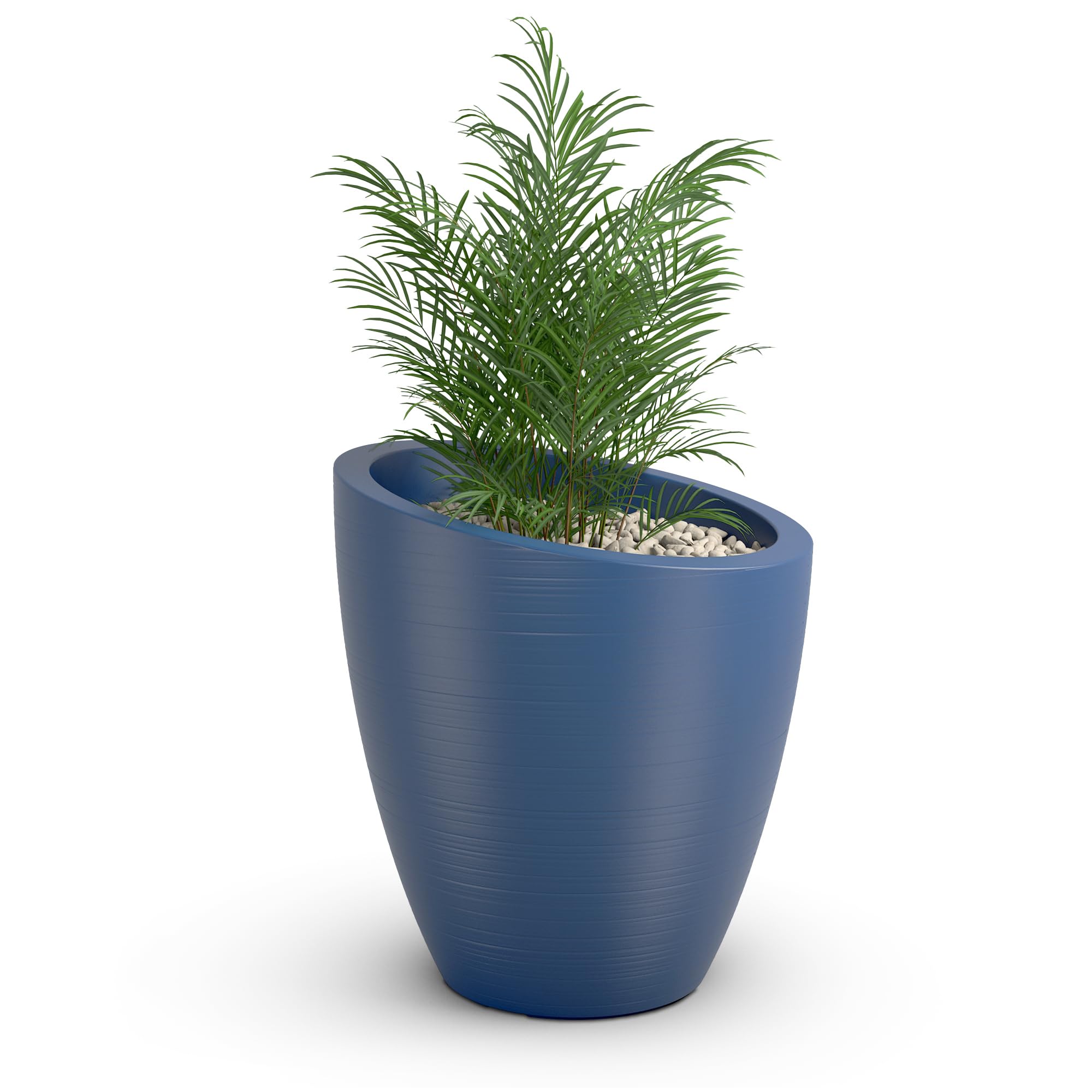
The 30-inch giant that turns a corner of the patio into a bold, architectural anchor.
Nothing else on this list approaches the Mayne Modesto in sheer scale. It measures 30 inches in diameter and 34 inches tall, with a 22-gallon capacity. This is tree territory — a 6-foot specimen fits comfortably. The polyethylene (a flexible, durable plastic) construction is rotationally molded (a process that spins the mold for strength) and is UV-fade resistant, so the Neptune Blue color stays vibrant for years. The double-wall design insulates roots and allows you to remove a plug and fill the base cavity with sand or gravel for extra weight and stability.
Owners describe it as “stoic” and “architectural,” noting it instantly upgrades the look of a yard. It is also lightweight relative to its size — the material is plastic, so one person can maneuver it into position. The built-in overflow drainage system protects roots from overwatering. The price is the highest on this list by a wide margin, and a small number of owners caution that the return shipping cost on something this large can be a real issue if you change your mind. Backed by a 15-year limited residential warranty, the Mayne is an investment piece for the long haul.
Why go this big
- Massive 30-inch diameter with 22-gallon capacity supports a full-sized tree.
- Double-walled insulation protects roots in extreme temperatures.
- 15-year warranty — among the longest in the planter category.
Consider carefully
- Premium price point is a real commitment.
- Return shipping on a planter this large can be costly if you are not satisfied.
Invest if: you need true tree-sized scale, want a planter that can last over a decade, and have the outdoor space to fill.
Skip if: your budget is moderate, or you just need a simple bowl for succulents or small flowers.
Understanding the Specs
Plastic-Stone Composite vs. Concrete vs. Fiberstone
The material determines the planter’s weight, frost resistance, and longevity. Concrete is authentic and heavy but can crack when water freezes inside it — a process called freeze-thaw damage. Plastic-stone composite (a blend of plastic and stone powder) mimics the look of concrete while staying lighter and surviving freeze-thaw cycles down to -20°F. Fiberstone (fiberglass, stone powder, and resin) creates a rigid, smooth wall that is lighter than concrete but heavier than resin — a middle ground for premium indoor-outdoor use.
Double-Walled Construction
A double wall means the planter has an inner and outer layer separated by an air gap. That gap insulates plant roots from sudden temperature changes, keeping soil cooler in summer and warmer in winter. Some double-walled planters also include a fill port so you can add sand or gravel between the walls, increasing the pot’s weight and wind stability without taking up soil space.
FAQ
Do I need drainage holes in a bowl planter?
What size bowl planter do I need for a small tree?
Will a plastic-stone composite planter crack in winter?
Can I use a large bowl planter indoors?
How much does a 24-inch bowl planter weigh when filled with soil?
Are bowl planters good for succulents?
What is the difference between polyresin and polyethylene planters?
How do I prevent a lightweight planter from tipping in the wind?
Final Thoughts: The Verdict
For most buyers, the best large bowl planter to buy is the Veradek Mason Series Lane Bowl because it combines a 24-inch diameter, authentic stone texture, and a plastic-stone composite that withstands extreme temperatures without cracking — all at a weight you can actually manage. If your space needs a deeper pot for a small tree, grab the Sunnydaze Anjelica for its 19-gallon capacity and double-walled insulation. And for an indoor olive tree or palm that lives in a high-design space, the DTY Mt Sherman Fiberstone Sphere delivers a smooth, premium finish that improve the whole room.
How We Picked
We do not accept paid placement. Every pick is matched to a real buyer and a real use-case; we do not hands-on test units.
Sources & Methodology
Specifications: manufacturer listings and product documentation. Review insights: verified customer reviews, as of July 2026. Pricing: not shown on this page (it changes often); check the current price via the retailer link.
As an Amazon Associate, Lawn Gear Lab earns from qualifying purchases. This does not affect which products we feature.