
Specs are compiled from manufacturer listings and verified buyer reviews and can change over time — please confirm the key details on the product page before buying.
The wrong landscape lighting wire doesn’t just fail—it crumbles to dust in the ground, corroding away while you dig up dead fixtures. You need a cable that maintains full brightness and bends easily in cold weather, not one that turns brittle after a single season. This guide cuts straight to what matters: pure copper, correct gauge, and direct burial certification, so you wire your yard once and never think about it again.
I’m Rikta — the founder and writer behind Lawn Gear Lab. This guide is built by comparing the manufacturers’ published specifications and the patterns across verified customer reviews, so you get each pick’s real strengths and trade-offs instead of marketing spin.
You’ll walk away knowing exactly which wire won’t rob your lights of power and won’t fail when you backfill the trench — essentially, a confident command of the best landscape lighting wire for your specific project scope.
Our Picks at a Glance

How To Choose The Best Landscape Lighting Wire
Landscape lighting wire is the artery of your low-voltage system. Pick a conductor that can’t handle the current load or the elements, and your beautiful path lights will fade into dim, flickering embarrassments. Here is what separates a long-term install from a dig-it-up-again headache.
Pure Copper vs. Copper-Clad Aluminum (CCA)
CCA wire uses an aluminum core with a thin copper coating. It costs less upfront, but it resists electricity far more than pure copper does, meaning more voltage drop and dimmer lights at the end of the run. Worse, moisture can creep into the exposed aluminum ends and turn the conductor into a white, non-conductive dust. Any quality landscape wire you buy should say “pure bare copper” or “100% copper,” not “copper clad.”
Gauge (AWG) and Voltage Drop
Lower AWG numbers mean thicker wire. For a typical residential landscape lighting run under 100 feet with less than 150 watts of fixtures, 14-gauge will do the job cleanly. For longer runs, higher wattage, or if you want a safety margin for future additions, step up to 12-gauge. The 18-gauge wire you see in some budget reels is only for short, low-wattage spur lines—it will cause noticeable dimming over any real distance.
Direct Burial and Weather Resistance
Not all outdoor wire is rated to go straight into the ground. A direct burial cable has a thicker, UV-resistant PVC jacket that keeps moisture and soil acids off the copper conductors. Running a non-rated cable underground is asking for a short circuit when the first heavy rain saturates your soil.
Quick Comparison
| Model | Best For | Gauge (AWG) | Length | Conductor Type | Amazon |
|---|---|---|---|---|---|
| Lightkiwi 12/2★ Best Overall | Overall Reliability | 12 | 50 ft | Bare Copper | Amazon |
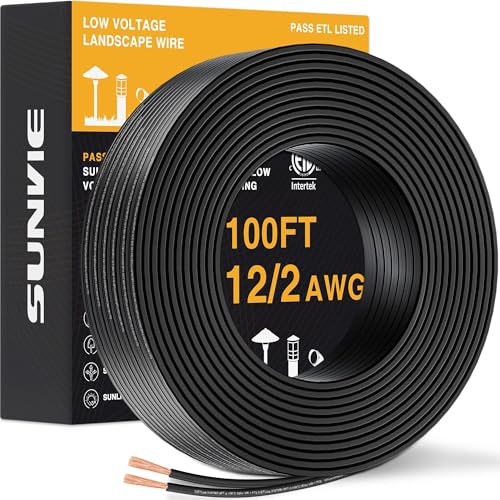
| SUNVIE 12/2Top Performer | Flexible, High-Capacity | 12 | 100 ft | Bare Copper | Amazon |
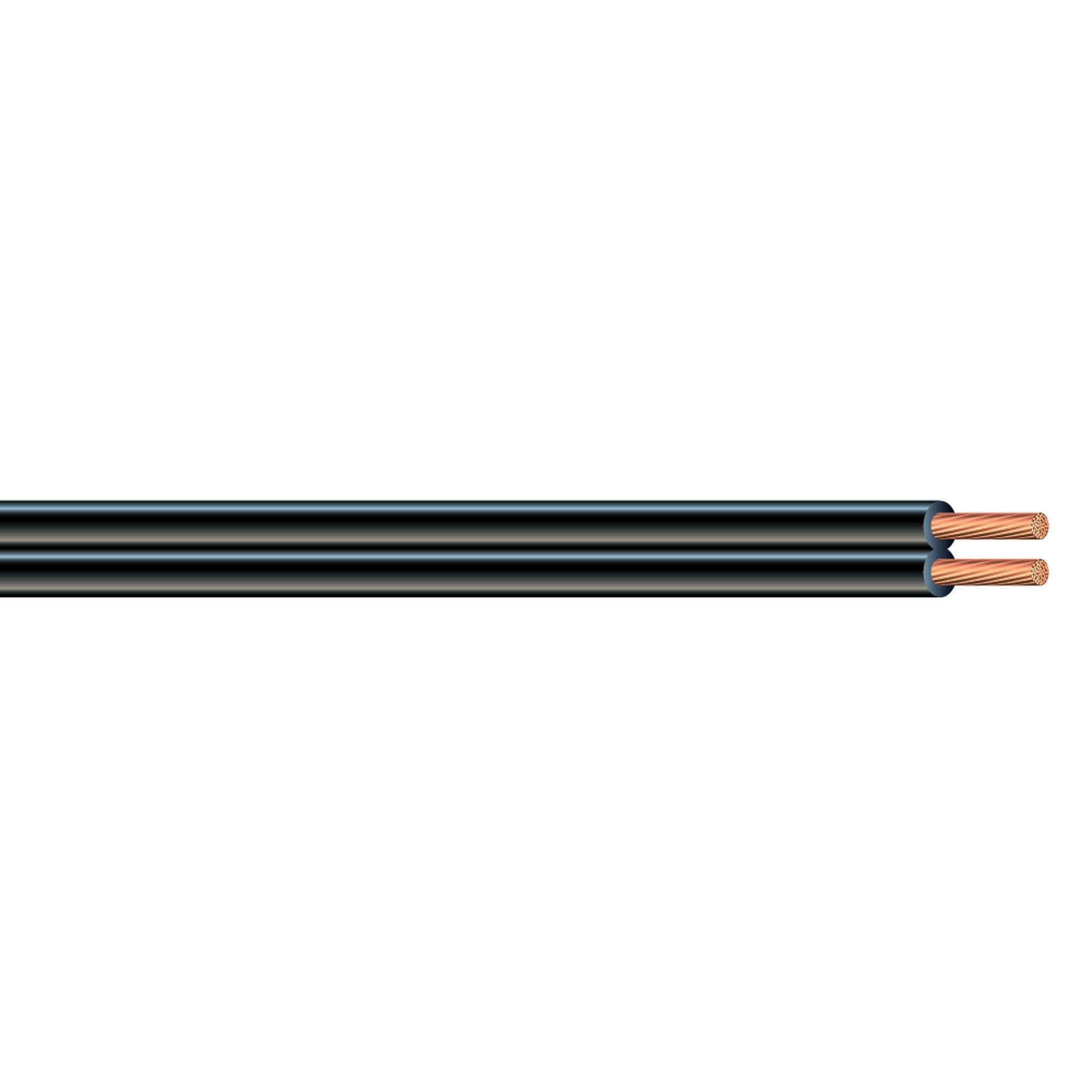
| Southwire 12/2Premium Build | Big-Brand Confidence | 12 | 100 ft | Copper (PVC) | Amazon |
| Zonegrace 12/2 | Extra-Long Spread | 12 | 265 ft | Bare Copper | Amazon |
| Wirefy 14/2 | Long 14-Gauge Runs | 14 | 250 ft | Pure Copper | Amazon |
| EP 14/2 | Value 14-Gauge | 14 | 100 ft | Pure Copper | Amazon |
| uboory 14/2 | Easy-Install 14-Gauge | 14 | 100 ft | Pure Copper | Amazon |
| FIRMERST 18/2 | Budget Short Runs | 18 | 200 ft | Pure Copper | Amazon |
In‑Depth Reviews
1. Lightkiwi 12/2 Landscape Wire 50ft
Our pick — over 4.5★ from 950+ verified ratings; the strongest balance of quality and price.
The 12-gauge benchmark that professional landscapers trust by the ton.
You don’t want to wonder whether your underground cable is silently corroding. The Lightkiwi 12/2 uses 100% stranded bare copper (65 strands per conductor) and carries a 30-volt rating with a 2.05 mm wire diameter that delivers noticeably better conductivity than thinner offerings. It is ETL listed for direct burial, so you drop it straight into the trench without conduit—saving time and materials.
What wins people over is the build quality (the most frequently praised aspect), followed closely by the value for the money. Buyers report it holds up to direct-burial abuse and “will last decades underground.” The only real trade-off is the 50-foot length, which is a bit short for a sprawling full-yard circuit. If your run is modest or you are wiring a contained zone, this is the one.
The Strength You Get
- Pure copper with 65 strands—flexes easily around tight corner beds
- Rated for direct burial with a UV-resistant jacket that won’t crack
- Lifetime warranty backs a small-business brand that contractors and electricians trust
The Only Hitch
- 50 ft is enough for small-to-medium yards but not a full perimeter
Best for: The homeowner who wants pro-grade, low-maintenance installation on a modest run.
Think twice if: Your fixture line spans more than 80 feet—you will want a longer coil or a step up in gauge.
2. SUNVIE 12/2 Low Voltage Landscape Wire 100 FT
A flexible 12-gauge coil that doesn’t fight your trench layout.
Thick gauge often means stiff wire, but the SUNVIE 12/2 is different. It uses 65 strands of pure copper inside an improved PVC insulation that stays pliable even as you bend it around retaining walls and planter corners. At 100 feet, it covers most residential jobs without splicing, and its 2.05 mm wire diameter is the same heavy spec as the Lightkiwi, but with double the length.
Everything here is made for direct burial—the jacket shrugs off sunlight, abrasion, and moisture. Reviewers confirm it “worked great in our landscaping” and note the 12-gauge construction significantly reduces voltage drop over distance so your farthest spotlight keeps full punch. If you need the flexibility of 12-gauge at a useful length, this is the better bet than the 50-foot coil above.
Standout strength: The PVC jacket is notably easy to strip with standard electrician tools, saving time on each splice.
Who should look elsewhere: If you only need a short lead to a transformer, the Lightkiwi 50-footer is a tidier spend.
3. Southwire 55213443 12/2 Landscape Lighting Cable
The name that electricians grab by instinct for thick-jacket reliability.
Southwire is a wire-house institution, and this 12/2 cable shows why. Its PVC jacket rates for temperatures from -40°F to 140°F, so it won’t stiffen into a frozen rod in winter or soften under a hot summer sun. The 12-strand construction feels sturdy in hand, and the jacket is thick enough to shrug off a glancing shovel strike.
There is a trade-off here that the reviews make plain: 12-gauge this thick is stiff. Some owners find it hard to jam into cheap plastic light connectors that are molded for 14-gauge. Buyers recommend it for “a great brand” and note it weathers beautifully for “3+ years,” but they also advise separating the two conductors along the middle seam before connecting to fixtures. For a pure workhorse spool where you prioritize durability over ease of routing, this is the cable.
Why Choose It
- Extreme temperature tolerance (-40°F to 140°F) for four-season climates
- UL listed and CSA certified, not just generic ETL
- Thick jacket gives confidence against rocks and roots
What Slows You Down
- Notably stiffer than the SUNVIE—harder to route around tight corners
Choose this if: You are burying wire in extreme cold or heat and want the most trusted name in cable manufacturing on the jacket.
Pass it by if: You need maximum flexibility for curving around flower beds without fighting the spool.
4. Zonegrace 12AWG Direct Burial Wire 265ft

A single spool that runs lights across a full acre without a splice.
When your transformer sits at the garage and the farthest light is 200 feet away, you need 12-gauge wire in serious quantity. The Zonegrace 265-foot reel delivers that, with 100% pure bare copper conductors and a sturdy PVC jacket. One buyer tested it with an ohmmeter and got 0.91 ohms, confirming genuine #12 gauge and full length without copper fudging.
Owners consistently praise its durability and minimal voltage drop, noting that the insulation prevents moisture ingress and corrosion. The long length is the headline, but the value proposition is real: you get a premium gauge at a per-foot rate that undercuts most 100-foot spools when scaled. The caveat is that the spool is heavy and awkward to handle solo—unspool carefully to avoid tangles that eat time on a big project.
The big advantage: You run one continuous line without connectors or splices, which is a major reliability upgrade for large properties.
One drawback: The packaging can make the first 20 feet prone to kinking if you simply pull from the center.
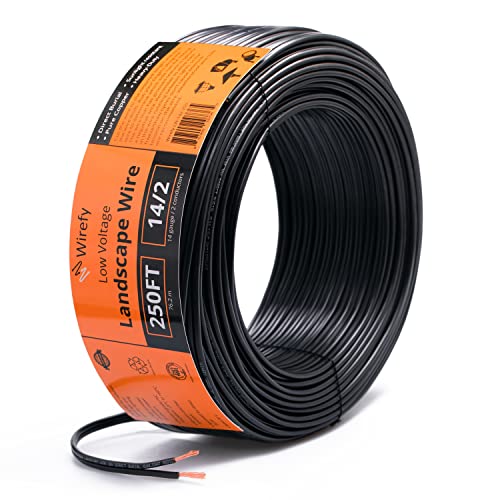
5. Wirefy 14/2 Low Voltage Landscape Wire 250 ft
250 feet of 14-gauge that lays flat with just a soft pull.
If your total wattage sits under 150 watts and your wire runs won’t push past 150 feet, 14-gauge saves you money and makes splicing easier—thinner wire is dramatically easier to fit into small light-fixture connectors. The Wirefy 14/2 gives you 250 feet of pure copper with a grooved design on one conductor, so you always know which is which without marking tape.
Owners say it “unrolled nicely and laid flat with just a soft pull,” which matters when you are crouched in a flower bed on a Saturday afternoon. It holds up to direct burial conditions, though the PVC jacket is a bit thinner than a premium 12-gauge; keep that in mind if your soil is rocky or you have burrowing critters. The per-foot cost is tough to top for a mid-length install.
What You’ll Love
- 250 ft of pure copper at a price that undercuts box-store equivalents
- Lifetime warranty on a spool that will outlast most fixture upgrades
- Plastic spool helps control unspooling without tangles
What Could Be Better
- Some owners found the plastic wrap packaging made the first pull snag-prone
Reach for this when: You are lighting a big area with efficient LED fixtures and want to keep the wire cost sensible.
Look elsewhere if: You plan to expand the system later—12-gauge gives you more headroom for adding fixtures.
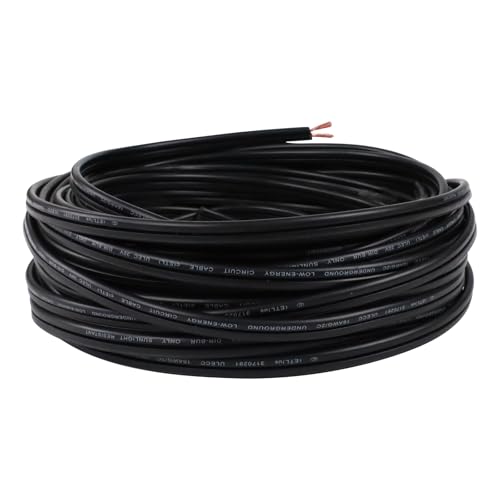
6. EP 14/2 Low Voltage Landscape Lighting Wire 100 ft
Entry-level price with heavy-duty build that passes the shovel test.
The EP 14/2 is the budget-friendly pick that punches above its weight. It carries a 300-volt rating, uses 30 strands of pure copper (no CCA), and is ETL listed for direct burial. The jacket handles temperatures from -40°F to 140°F without cracking or stiffening, so it stays workable whether you are installing in the fall chill or late spring.
Owners mention it is “heavy-duty wire but easy to work with” and report “zero issues” after a full year in the ground. The 100-foot length is ideal for a typical backyard layout—path lights around a patio, spotlights up a fence line. It also works neatly for above-ground applications like outdoor speakers and solar panel wiring. The trade-off is that at higher total wattage (over 150W), the 14-gauge will drop more voltage than a 12-gauge over the same 100-foot run.
Best fit: First-time installer who wants 100% copper and direct burial certification without over-spending.
Limit to note: 14-gauge is not ideal for runs over 120 feet with heavy fixture loads—stick to 12-gauge for those.
7. uboory 14/2 Low Voltage Landscape Wire 100 ft
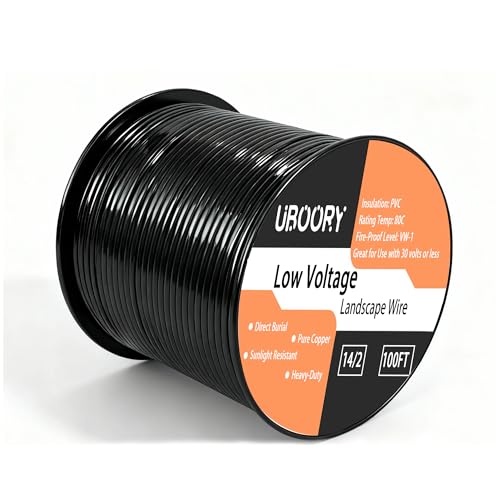
Flexible enough to add a spotlight mid-project without breaking the run.
The uboory 14/2 comes with a 300-volt maximum working voltage and a 1.63 mm wire diameter that feels familiar to anyone who has installed basic low-voltage lighting. Owners find it “perfect easy to use,” with one buyer noting they were able to add on a spotlight after the initial install thanks to the cable’s forgiving flexibility. Pure copper construction means reliable conductivity compared to CCA alternatives.
It is backed by a lifetime warranty, which is rare at this price point. The only nuanced note from the data is that material quality gets a mixed response from a small subset of buyers—a handful would like a slightly thicker jacket feel. For most DIY installers running path lights and garden accents, however, this cable performs without complaint and strips easily with standard wire strippers.
Why It Works
- Very easy to work with—strips cleanly and pulls around obstacles well
- Lifetime warranty removes the risk of a bad spool
The Fine Print
- Jacket feels a touch thinner than higher-end cables—use care around sharp rocks
Your pick if: You are new to wiring and want a forgiving, easy-to-strip cable that won’t eat up your weekend.
Consider upgrading if: You have rocky soil where a thicker jacket gives extra protection.
8. FIRMERST 18/2 Low Voltage Landscape Wire 200 ft
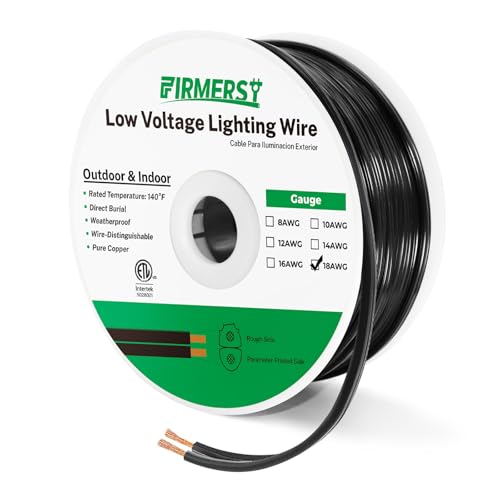
200 feet of lightweight pure copper for small accent zones.
You will sometimes need a thin, manageable wire for short stub lines or low-power accent fixtures. The FIRMERST 18/2 gives you 200 feet of 41-strand pure copper with 300-volt rating and ETL listing, all at a price that leaves room in the budget for more fixtures. The thin 18-gauge wire makes it the easiest to route of any cable here.
Where does it shine? Short runs under 50 feet, path lights on a low-wattage transformer, or as a pigtail. The data warns that using this for a long main trunk line is a mistake—voltage drop will be noticeable. One owner sums it up well: “Stay away from CCA outdoor cable” and this is a pure copper solution that earns its keep for contained tasks. The 200-foot length is generous for its class.
the balance: Tucked under a deck for a few accent lights or running a short line to a single spotlight.
Know the limit: 18-gauge is not a substitute for 14 or 12 on main runs—plan accordingly.
Understanding the Specs
AWG (American Wire Gauge) and Current Capacity
AWG is the standard for wire thickness. A lower AWG number means a thicker, less resistive conductor. For landscape lighting, 12-gauge carries more current over longer distances with less voltage drop than 14-gauge. The jump from 18 to 12 is massive—the 12-gauge wire has roughly 1.6 times the cross-sectional area of 14-gauge and about 4 times that of 18-gauge. This directly affects how bright your farthest light remains.
Direct Burial Rating and Jacket Material
A direct burial cable has a thicker PVC jacket that passes specific tests for UV resistance, water ingress, and ground pressure. Wire without this rating will let moisture seep into the conductors over time, leading to corrosion and shorts. Even if you plan to run the wire inside conduit, direct burial cable gives you a thicker skin that resists cuts from the pulling friction.
FAQ
Can I use regular speaker wire for outdoor landscape lighting?
What does 12/2 or 14/2 mean on a landscape wire?
How do I know if I need 12-gauge or 14-gauge wire?
Is costlier wire always better for landscape lighting?
Can I connect two lengths of low voltage wire together?
What is the difference between CCA and pure copper wire?
Do I need conduit for direct burial landscape wire?
Can I leave landscape wire exposed above ground?
Final Thoughts: The Verdict
For most buyers, the best landscape lighting wire to build your system around is the Lightkiwi 12/2 for its pure copper build, ideal short-run balance, and broad owner satisfaction. If you need a longer single run of 12-gauge without a splice, the SUNVIE 12/2 is the smarter buy. And for a budget-conscious entry into 14-gauge, the EP 14/2 gives you honest pure copper at a price that keeps your overall project affordable.
How We Picked
We do not accept paid placement. Every pick is matched to a real buyer and a real use-case; we do not hands-on test units.
Sources & Methodology
Specifications: manufacturer listings and product documentation. Review insights: verified customer reviews, as of July 2026. Pricing: not shown on this page (it changes often); check the current price via the retailer link.
As an Amazon Associate, Lawn Gear Lab earns from qualifying purchases. This does not affect which products we feature.