
Specs are compiled from manufacturer listings and verified buyer reviews and can change over time — please confirm the key details on the product page before buying.
You want a landscape lighting timer that works reliably day after day without needing constant resets. Cheap plug-in timers drift by ten minutes a week, and complex digital panels demand more setup than a new smartphone. the balance is a timer that handles power cuts and seasonal changes on its own. This guide focuses on timers that actually deliver on that promise.
I’m Rikta — the founder and writer behind Lawn Gear Lab. This guide is built by comparing the manufacturers’ published specifications and the patterns across verified customer reviews, so you get each pick’s real strengths and trade-offs instead of marketing spin.
You need the best landscape lighting timer for your specific setup — and that depends on whether you’re running a single string of path lights or a multi-zone low-voltage system with a transformer.
Our Picks at a Glance


How To Choose The Best Landscape Lighting Timer
First, figure out what type of landscape lighting you have. Most outdoor lights run on low voltage (12V or 14V) through a transformer. Others plug directly into a standard 120V outlet. Each setup needs a different kind of timer — get the wrong one and you can end up with dim lights or a fried transformer.
Single Zone vs. Dual Zone vs. Multi-Outlet
A single-zone timer controls everything on one circuit — that is fine if you have one set of path lights. A dual-zone transformer, like the SUNVIE or WILAWELS picks, lets you run spotlights and path lights on different schedules. Multi-outlet plug-in timers work best for string lights and seasonal decorations that do not need a transformer.
Astronomic vs. Mechanical vs. Photocell
An astronomic timer calculates exactly when sunset and sunrise happen at your precise location and adjusts itself daily — you set it once and it tracks the changing seasons. A mechanical timer uses a simple dial with push-pins and repeats a 24-hour cycle; it is cheap and reliable but drifts if the power blinks. A photocell sensor (a light-sensitive eye) turns lights on when it gets dark and off when the sun comes up — it is dead simple but can be tripped by a neighbor’s floodlight.
Quick Comparison
| Model | Best For | Wattage / Load | Control Zones | Timer Type | Outdoor Rating | Amazon |
|---|---|---|---|---|---|---|
| SUNVIE 300W Transformer★ Best Overall | Full low-voltage system with dual zones | 300W | 2 | Digital + Photocell | Weatherproof | Amazon |
| Woods Southwire Dusk to Dawn TimerBest Value | Plug-in simplicity with twist dial | 1 outlet (15A) | 1 | Photocell + Timer | Waterproof | Amazon |
| GE Outdoor 6-Outlet Stake TimerMulti-Outlet King | Heavy-duty multi-outlet for plug-in lights | 1875W (15A) | 6 outlets | Mechanical 30-min | Weather-resistant | Amazon |
| TiFFCOFiO Power Strip Timer | 6-outlet strip with dusk-to-dawn + countdown | 1875W (15A) | 6 outlets | Digital + Photocell | Waterproof covers | Amazon |
| Intermatic HB11K Mechanical Timer | High-load devices like pool pumps | 1800W / 1 HP | 1 outlet | Mechanical 30-min | Weatherproof flip cover | Amazon |
| DEWENWILS 200W Transformer | Small low-voltage system with 5 modes | 200W | 1 | Digital + Photocell | Weather-resistant PC | Amazon |
| Intermatic DT200LT Astronomic | Precision astronomic for low-voltage systems | 1200W (low-voltage) | 1 | Digital Astronomic | -40°F to 122°F | Amazon |
| DEWENWILS 150W Stainless Steel Transformer | Rust-proof metal housing for coastal areas | 150W | 1 | Digital + Photocell | Stainless steel | Amazon |
| WILAWELS 300W Dual-Zone Transformer | Budget dual-zone with 5 modes | 300W | 2 | Digital + Photocell | Weather-resistant acrylic | Amazon |
In‑Depth Reviews
1. SUNVIE 300W Low Voltage Landscape Transformer
Our pick — over 4.5★ from 700+ verified ratings; the strongest balance of quality and price.
The dual-zone transformer that lets path lights and spotlights run on their own schedules.
You get two individually controlled terminal outputs so zone 1 can be “on at dusk, off at dawn” while zone 2 runs “on for four hours then off.” That is the core reason the SUNVIE wins the top spot. It is a 300W transformer that converts your home’s 120V AC to a safe 12V or 14V AC, compatible with both LED and halogen fixtures. Unlike the simpler WILAWELS, the SUNVIE’s dual zones are fully independent for truly separate schedules.
The unit offers five setting modes: Manual On/Off, Auto On/Off (dusk-to-dawn), Countdown (dusk on then off after 4/6/8 hours), Timer (set specific on/off times), and Photocell On / Timer Off. Owners rave about the zone flexibility — “you don’t even need the manual” to operate it, according to buyer reports. That said, a small number of buyers report the 300W transformer failing after 9-15 months; SUNVIE’s customer service replaced the unit quickly in those cases.
What Wins People Over
- Two fully independent zones with separate schedules
- Five timer modes cover any lighting need
- Removable photocell sensor with a 6.8ft cord for flexible placement
- Owners mention controls are intuitive enough that you “don’t even need the manual”
The Honest Trade-Off
- An occasional unit fails within the first year — though customer service replaces it
- Total load across both zones should not exceed 80% of 300W (240W) for safe operation
Your best bet if: You have a medium-to-large low-voltage landscape lighting setup with lights that need different on/off schedules.
Think twice if: You only have one string of lights — a simpler plug-in timer would work fine and cost less.
2. Southwire Woods Outdoor Dusk to Dawn Lighting Timer
The simplest dusk-to-dawn timer you can plug in and trust for years.
This is the “set it and trust it” option. You plug the Woods timer into any outdoor outlet, set the twist dial to your desired on/off window, and the built-in photocell sensor (a light-sensitive eye) handles the rest. Buyers who have used this for several years say it still works great — the build quality is high, and the heavy-duty cord feels substantial. It is a single grounded outlet, so it is best for one lighting circuit.
The dusk-to-dawn setting turns the timer on within 15 minutes of the desired time and off in the morning. Owners note that the photocell is very sensitive — if you place it near bright string lights or indoor windows, it can flicker. The fix is easy: move it to where it sees only natural outdoor light. It works reliably every night, making it a favorite for seasonal lights and bug zappers.
The low-maintenance move: If you just need one outlet of lights to turn on at dark and off at dawn, this is the most reliable, simplest option. The trade-off is that it is not smart-home compatible and only has one outlet — no multi-zone or astronomic features here.
Reach for this if: You want a no-fuss, durable timer that does one job well — turn lights on at dusk and off at dawn — without any programming headaches.
Look elsewhere if: You need separate schedules for multiple light strings or want astronomic daily adjustments.
3. GE Outdoor 24-Hour Mechanical Stake Timer
Six outlets, a stake, and a mechanical dial that never forgets its schedule.
When you have multiple plug-in lights — string lights, a fountain pump, and holiday decorations — you need more than one outlet. This GE timer gives you six grounded outlets (three on each side) rated for up to 1875W total, so you can run a ton of lights from a single timer. The 18-inch heavy-duty cord and included yard stakes let you secure it right into the ground near your garden bed or walkway.
It is a mechanical timer, not digital, which is both a strength and a limitation. You set the 24-hour schedule by pushing pins or tabs down in 30-minute intervals — very simple, no programming. The weather-resistant construction includes self-closing rain covers and protective outlet covers. Owners rely on it for Christmas lights, fountains, and landscape lights, and many say it outperforms hardware-store timers. One catch: the timer function gets mixed reviews because a mechanical unit can drift if the power blinks.
Best for seasonal and heavy-duty use: If you need to control multiple outdoor devices on one schedule, this stake timer is built to last. Just know that a mechanical timer won’t track the changing sunset like the Intermatic DT200LT astronomic model does.
Who it fits: Homeowners with several plug-in landscape lights, fountains, or holiday decorations who want a tough timer that stakes into the ground.
Who it does not: Anyone who needs dusk-to-dawn or astronomic precision — this is strictly a 24-hour mechanical cycle.
4. TiFFCOFiO Outdoor Power Strip Timer
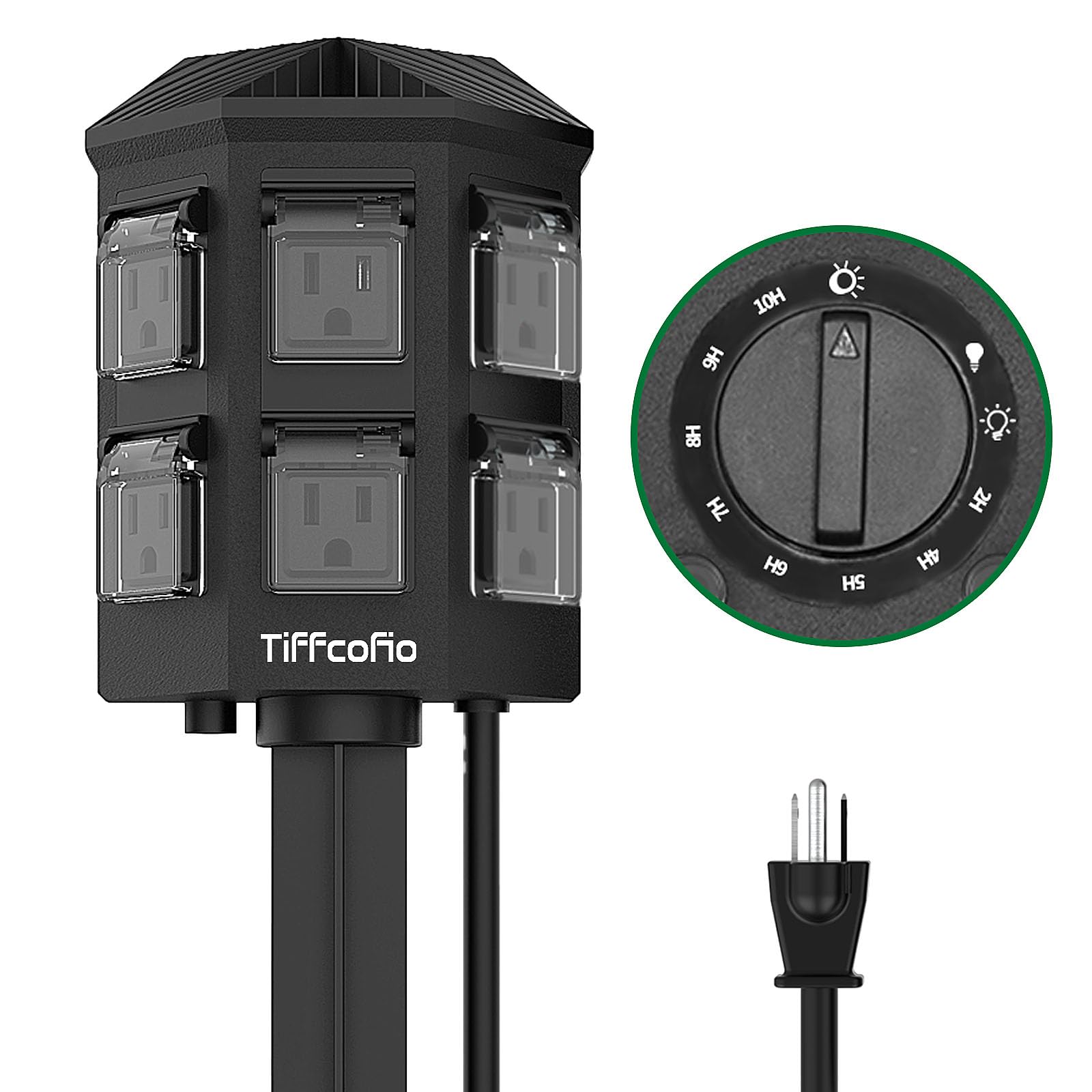
A power strip and timer fused into one — with 11 functions and no programming fuss.
The TiFFCOFiO is not just a timer — it is a 6-outlet power strip with a 6-foot extension cord and a built-in dusk-to-dawn sensor plus countdown timer. You can choose from 11 timer functions, including On/Off, Dusk-Only, and 2/4/5/6/8-hour countdown modes. The dial is purely mechanical: you turn it clockwise to select the function, and it repeats daily. Owners say it is perfect for Christmas lights and seasonal decorations because you can set it to “dusk on, 4 hours off” and walk away.
Each outlet also has a separate waterproof cover, which helps it resist rain and splashing from sprinklers. Buyers praise its versatility but note mixed durability — some reported units breaking after a day, and the stake could be sturdier. The manufacturer backs it with a 2-year warranty and a 6-hour customer service response promise.
The Upsides
- 11 timer functions from a simple twist dial
- 6 outlets with individual waterproof covers
- 2-year warranty with unconditional return policy
- Angled plugs accommodate large adapter blocks
The Downsides
- Weather resistance is mixed — not designed for permanent outdoor installation in harsh climates
- Stake is flimsy; one user called the build quality “mixed”
Best for short-term setups: Seasonal lights and holiday decorations where you want easy dusk-to-dawn control across multiple plugs. Not the one for a permanent in-ground landscape system.
5. Intermatic HB11K Heavy-Duty Outdoor Plug-in Timer
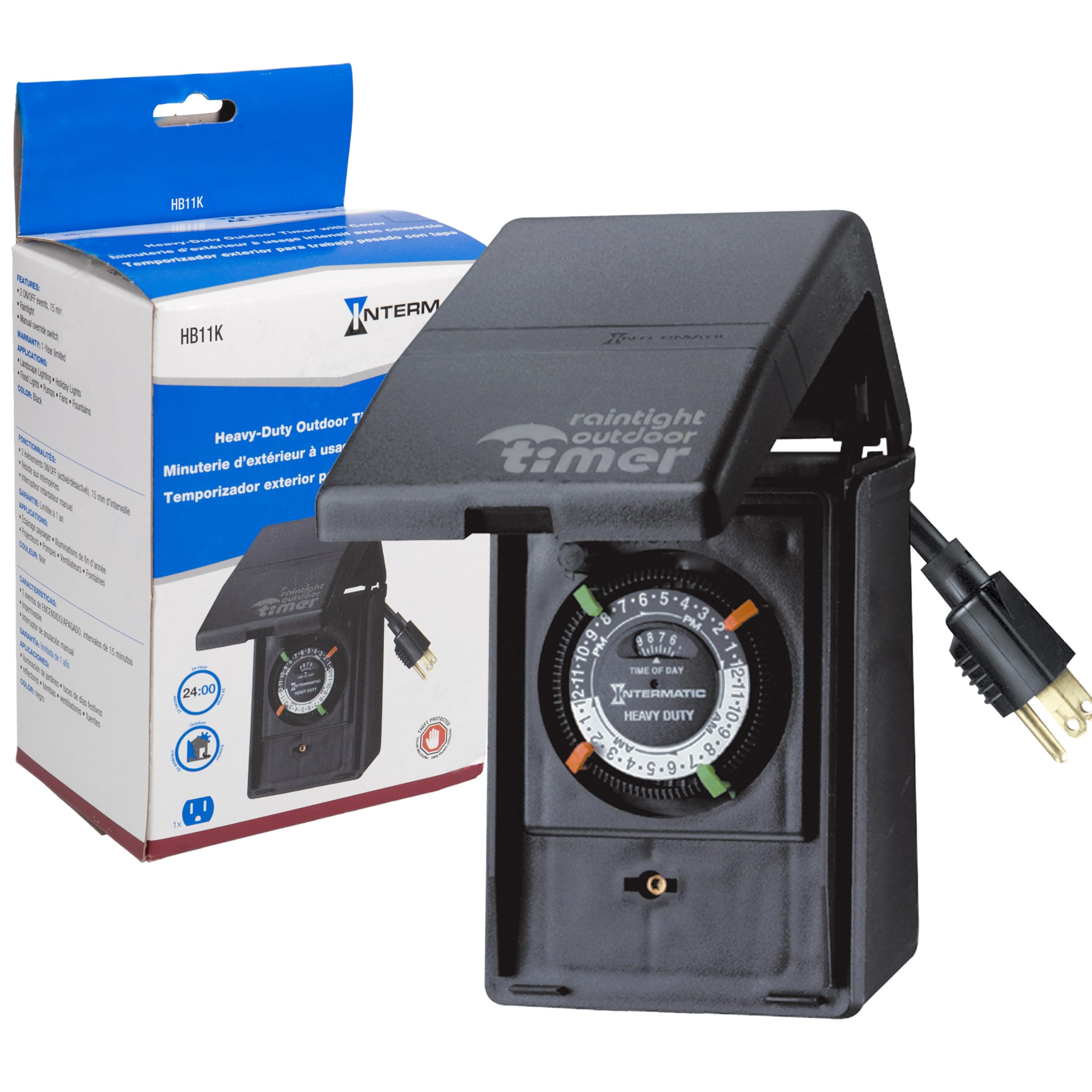
Built for pool pumps and heavy loads where cheap timers burn out.
Most plug-in timers can handle a few hundred watts of LED lights, but when you need to switch a 1 HP pool pump or fountain, you need something tougher. The Intermatic HB11K is rated for 15 amps, 1800 watts resistive/tungsten, and 1 HP motor loads — that is serious capacity. It uses removable trippers for a simple mechanical schedule: you get two ON and two OFF settings per day with a 30-minute minimum interval.
The heavy-duty flip-open cover and sealed enclosure are weatherproof, protecting the timer from rain, snow, and debris. Owners praise its reliability for pool pumps, with one buyer saying it easily runs their pool pump where a more expensive digital timer failed. Durability is mixed — some last 4 years on a pool pump, others fail sooner — but it consistently outlasts the cheapest mechanical timers that die after a month.
The heavy-duty specialist: If you are running an outdoor motor or pump, this Intermatic timer is the right tool. For just landscape path lights, you do not need this level of capacity.
Perfect for: Pool pumps, pond filters, fountain pumps, and any high-wattage outdoor device that needs a simple daily schedule.
Not the right fit for: Low-voltage landscape lighting systems — you want a transformer-based timer for those.
6. DEWENWILS 200W Low Voltage Landscape Transformer
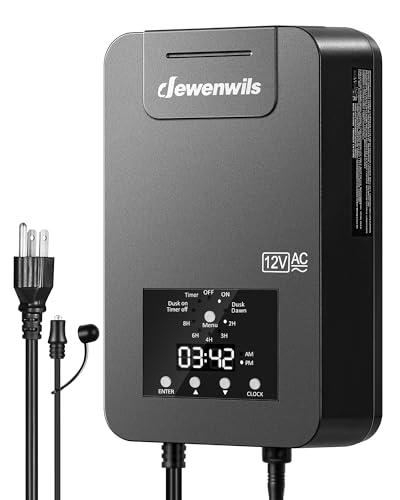
A straightforward 200W transformer with easy button controls and a clear LED screen.
For a smaller low-voltage system — say, a dozen path lights and a couple of spotlights — the DEWENWILS 200W transformer hits a balance. It converts 120V AC to 12V/14V AC and includes five modes: Manual On/Off, Dusk to Dawn, Dusk ON with Countdown Off (2/3/4/6/8 hours), Dusk ON / Timer Off, and Timer On/Off. The LED screen and simple button operation make it easy to navigate without reading a dense manual.
The removable photocell sensor (a light-sensitive eye) has a 6.8-foot cord, giving you flexibility to mount the transformer indoors or outdoors and position the sensor where it sees true darkness. Owners say it is reliable — several have run it for nearly a year without issue, and it holds up to weather and sprinklers. The complaint? Instructions could be clearer, and the unit is “very heavy” per one buyer, so plan for solid wall mounting.
Solid for small-to-medium systems: This transformer gives you lots of timing options without the complexity of dual-zone control. The weight is a sign of quality materials but means you need a sturdy mount.
Choose this if: Your landscape lighting uses under 200W total and you want a dependable transformer with a photocell and countdown timer in one unit.
7. Intermatic DT200LT Digital Astronomic Landscape Timer

The timer that knows when the sun sets without you telling it.
An astronomic timer (a specialized digital timer that calculates sunset and sunrise at your exact location) is the gold standard for landscape lighting. The Intermatic DT200LT does exactly that — and it is rated for low-voltage transformers up to 1200W, making it perfect as the brains behind a larger lighting system. It includes a factory-set auto DST (Daylight Saving Time) adjustment, so you never have to touch it in March or November. This is far more precise than the GE or Woods mechanical timers that cannot adjust for seasonal changes.
With two LR44 batteries included, the DT200LT retains its settings for up to three months without power — so a power outage won’t scramble your schedule. Owners consistently highlight its reliability and ease of programming: “astronomic feature was easy to program and eliminates changing the off-time of my previous timer.” It works across extreme temperatures from -40°F to 122°F, which covers most climates. The trade-off is that it controls only a single on/off event per day (dusk/dawn or a specific time) — if you need multiple cycles, look at the dual-zone SUNVIE above.
What Makes It Superior
- Astronomic auto-adjustment for sunrise/sunset — no seasonal resetting
- Battery backup holds settings for 3 months without power
- Extreme temperature range: -40°F to 122°F
- One-push programming override for quick changes
The Limitation
- Single on/off event per day — not for lights that need different schedules on weekdays vs. weekends
- Designed as a companion to a low-voltage transformer, not a standalone plug-in timer
Best for precision-focused owners: If you want your landscape lights to track the actual sunset year-round without manual fiddling, this is the timer. Pair it with a quality transformer for the full system.
8. DEWENWILS 150W Stainless Steel Low Voltage Transformer
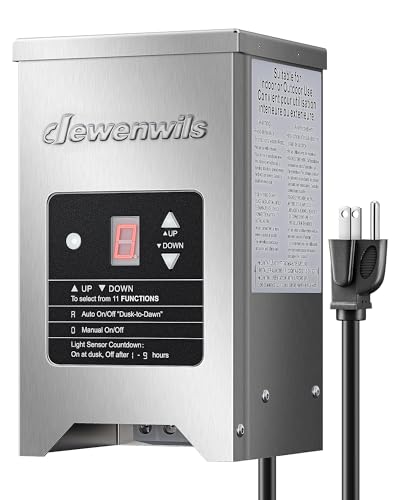
The stainless steel case that shrugs off coastal humidity and rain.
If you live near the ocean or in a region with heavy rain and snow, a painted steel transformer can rust within a season. The DEWENWILS 150W unit uses heavy-duty stainless steel housing that is waterproof and corrosion-resistant, designed to “withstand years of use” per the manufacturer. It is ETL listed (a safety certification from Intertek) and converts 120V AC to 12V/15V AC, feeding your low-voltage landscape lights with a safe 10-amp output.
The controls are refreshingly simple: two buttons (▲ and ▼) cycle through modes: A (dusk-to-dawn), 0 (always on), and 1-9 (dusk on plus hours of countdown). Owners praise the easy 10-minute installation and the fact that it works immediately from the start. The LED display is bright during the day but some find it too bright at night — a minor trade-off for the build quality. It is on the heavier side at 7.7 pounds, reflecting the stainless steel construction.
Built for tough climates: The metal housing and simple controls make this a reliable transformer for year-round outdoor use. The 150W capacity is suitable for smaller lighting systems.
Reach for this if: Your transformer will be mounted outdoors in a wet or coastal environment where rust is a real concern.
skip it if: You need dual-zone control or more than 150W of lighting power — step up to the SUNVIE or WILAWELS 300W.
9. WILAWELS 300W Low Voltage Landscape Transformer

A dual-zone 300W unit that delivers the features at a friendlier price point.
The WILAWELS transformer is virtually a spec-sheet twin to the SUNVIE: 300W power, two independent control zones, a detachable photocell sensor with a 6-foot cord, and five same timer modes (Manual, Auto, Countdown, Timer, Dusk on Timer Off). It is ETL certified and converts 120V AC to 12V/14V AC for LED and halogen landscape lights. The casing is weather-resistant acrylic that stands up to rain, snow, and dust. For the cost, it gives you the same dual-zone flexibility as the SUNVIE, but with a less refined user experience.
Buyers appreciate the easy installation, consistent performance, and water resistance even in Florida rains. Some complain that the timer feature forces a 24-hour delay before the first activation — meaning if you set it at 6 PM, it won’t actually turn on until 6 PM the next day. Other owners simply find it “works well, no issues.” There are a few durability concerns: one report of a unit failing after one season, producing no output voltage. The bracket and manual were missing from one unit, though the seller refunded it.
The Appeal
- Dual-zone independent control at a lower cost than the SUNVIE
- Weather-resistant acrylic casing holds up in rain
- Five timer modes provide real flexibility
The Drawback
- Some users report a 24-hour delay before the timer activates
- Occasional units fail early — quality control seems less consistent than the top pick
Best for budget-minded buyers: If you need dual-zone control but want to save a bit, the WILAWELS delivers the same core specs. Just be aware of the 24-hour timer quirk and the batch-level reliability variance.
Understanding the Specs
Timer Type: Mechanical vs. Digital vs. Astronomic
The timer type decides how hands-on you need to be. A mechanical timer uses a simple dial with push-pins or trippers — you push them down for ON and pull them up for OFF in 30-minute increments. It is cheap and easy, but if the power goes out, it stops running until you reset it. A digital timer uses an electronic clock and usually has a battery backup, so your schedule survives a power cut. An astronomic timer is a specialized digital timer that knows when sunset and sunrise happen at your location and adjusts the schedule every single day — you set it once and it tracks the seasons for you.
Photocell Sensor (Dusk-to-Dawn)
A photocell sensor is a light-sensitive eye that tells the timer when it is dark. When the sensor detects ambient light dropping below a certain level, it activates the timer to turn your lights on. In the morning, it does the reverse. The catch is that the sensor needs to be placed where it sees only the natural sky — if it sits too close to a bright porch light, a neighbor’s floodlight, or even indoor light through a window, it can flicker or fail to turn on. Many transformers now use a remote photocell on a long cord (6-9 feet) so you can mount the transformer inside a garage and run the sensor outside.
FAQ
Can I use a regular plug-in timer with a low-voltage landscape lighting transformer?
What is the difference between a single-zone and a dual-zone transformer?
How do I know what wattage transformer I need for my landscape lighting?
Will an astronomic timer work if I live far north where sunset shifts dramatically?
Can I use a landscape lighting timer with smart home systems like Alexa or Google Home?
What happens to my timer settings during a power outage?
How do I stop the photocell sensor from being triggered by my own house lights?
Is a mechanical timer or a digital timer more reliable for outdoor use?
Final Thoughts: The Verdict
For the majority of shoppers, the SUNVIE 300W Dual-Zone Transformer is the pick to beat because its two independent schedules and five modes cover nearly every landscape lighting scenario. If you prefer a simpler plug-in timer for a single lighting circuit, the Woods Southwire Dusk to Dawn is the most reliable twist-dial option. And for those who want precision astronomic control that adjusts for the season, the Intermatic DT200LT paired with a quality low-voltage transformer is the set-and-forget solution.
How We Picked
We do not accept paid placement. Every pick is matched to a real buyer and a real use-case; we do not hands-on test units.
Sources & Methodology
Specifications: manufacturer listings and product documentation. Review insights: verified customer reviews, as of July 2026. Pricing: not shown on this page (it changes often); check the current price via the retailer link.
As an Amazon Associate, Lawn Gear Lab earns from qualifying purchases. This does not affect which products we feature.