
Specs are compiled from manufacturer listings and verified buyer reviews and can change over time — please confirm the key details on the product page before buying.
Laying gravel without the right underlayment underneath is a shortcut to a lumpy, weedy mess within a year. The fabric’s job is to separate the sharp stones from the soil, letting rainwater drain through while blocking sunlight so nothing sprouts up through your driveway or path. The real challenge is picking a fabric tough enough to handle the weight of gravel without tearing under pressure.
I’m Rikta — the founder and writer behind Lawn Gear Lab. This guide is built by comparing the manufacturers’ published specifications and the patterns across verified customer reviews, so you get each pick’s real strengths and trade-offs instead of marketing spin.
The five fabrics below were chosen specifically because they are built for the weight and abrasion of gravel — not flimsy weed mats. Read on to find the best landscape fabric for under gravel for your project size and budget.
Quick Picks
- VEVOR 6FTx100FT Non-Woven Geotextile Heavy Duty 8oz — Best Overall
- Super Geotextile Woven Geotextile Fabric 4×100 — Best Value
- VIVOSUN Premium Weed Barrier Landscape Fabric 3ftx100ft 5oz — Smart Hybrid
- Driveway Landscaping Fabric and Underlayment 12.5 x 50 ft — Wide Coverage
- Groweco Driveway Fabric 13FT x115FT 3.5OZ Commercial — Budget Champion
How To Choose The Best Landscape Fabric For Under Gravel
Gravel is heavy and sharp. It presses down on the fabric and can push abrasive edges against it with every footstep or tire roll. You need more than a basic weed mat — you need a geotextile built for stabilization and separation. Here are the three specs that separate a one-season fabric from a permanent base layer.
Fabric Weight and Tensile Strength
Fabric weight is measured in ounces per square yard (oz). For gravel projects, look for at least 4 oz — and ideally 5 oz or higher — to resist punctures from jagged stone edges. VEVOR’s non-woven fabric is an 8 oz density with a 350N tensile strength (a measure of how much pull the fabric can handle before tearing). That is the kind of spec that tells you the fabric can survive being walked on and driven over.
Woven vs. Non-Woven Geotextile
Woven fabric (like the Super Geotextile pick) has a tight grid structure that excels at separation and stabilization under heavy loads, making it a solid choice for driveways. Non-woven fabric (like the VEVOR pick) uses a needle-punched, felt-like construction that drains water faster and filters soil better, which is ideal for French drains and areas with high rainfall. For gravel that needs to stay clean and dry on top, woven tends to hold up better to traffic — but non-woven wins on permeability.
Roll Dimensions and Coverage
Measure your project area before buying. Rolls come in widths from 3 feet up to 13 feet and lengths from 50 feet to 115 feet. Choosing a roll that is wider than your path (so you can overlap seams by at least 6 inches) saves you from buying a second roll. The Driveway Landscaping Fabric review below, for instance, comes in a 12.5 x 50 foot size which can handle a large single section without joins.
Quick Comparison
| Model | Best For | Weight | Weave Type | Dimensions | Amazon |
|---|---|---|---|---|---|
| VEVOR Non-Woven Geotextile | Heavy-Duty Drainage & Gravel Base | 8 oz | Non-Woven | 6ft x 100ft | Amazon |
| VIVOSUN Premium Weed Barrier | Dual-Layer Weed Control & Garden Beds | 5 oz | Woven / Non-Woven Hybrid | 3ft x 100ft | Amazon |
| Super Geotextile Woven Fabric | Long-Term Road & Driveway Stabilization | 4 oz | Woven | 4ft x 100ft | Amazon |
| Driveway Landscaping Fabric | Large-Area Coverage Kit with Staples | — | Woven | 12.5ft x 50ft | Amazon |
| Groweco Driveway Fabric | Wide Single-Sheet Underlayment | 3.5 oz | Woven | 13ft x 115ft | Amazon |
In‑Depth Reviews
1. VEVOR 6FTx100FT Non-Woven Geotextile Heavy Duty 8oz

The heavy lifter that shrugs off gravel weight without tearing or shifting.
This VEVOR roll is a non-woven fabric, which means it is needle-punched into a felt-like mat that drains water rapidly while filtering out soil particles. Its big draw is the 8 oz density with a 350N tensile strength (the force it can take before ripping), so you can dump a load of sharp ¾-inch gravel directly on top without the fabric shredding underneath. Unlike the woven options below, the non-woven construction lets water cut through like there is nothing there — buyers report it works perfectly for drainage ditches and retaining wall backfill.
The roll is 6 feet wide by 100 feet long, giving you a generous 600 square feet of coverage in a single layer. At 27 pounds, compared to the VIVOSUN 3ft x 100ft roll at 10.3 pounds — that weight comes from the thick 8 oz material. The 6-foot width means fewer seams to worry about on a standard driveway, but if you need to cut it, a utility knife goes through it cleanly. Buyers specifically note it performs exactly as expected for drainage and landscaping, and that it is “much better than the thinner woven plastic type material.”
One catch: because it is non-woven, it is not quite as strong for pure load-bearing separation as a heavy woven geotextile would be. For very heavy vehicle traffic on a gravel driveway, you might want a woven fabric instead. But for most home landscaping — French drains, garden paths, flower beds, and light gravel drives — the drainage advantage is worth it.
What Stands Out
- 8 oz density with 350N tensile strength resists punctures from jagged gravel.
- Non-woven construction provides excellent water drainage for French drains and wet areas.
- 6-foot wide roll minimizes the number of seams in large installations.
Worth Noting
- Non-woven fabric is less ideal for supporting pure weight on roads than the woven alternative.
- At 27 pounds the roll is heavy to maneuver solo.
Who this fits: Anyone laying a gravel French drain, pathway, or base layer who wants maximum drainage without sacrificing tear strength.
Who might want woven instead: Builders needing a rigid separation layer under a heavily trafficked gravel driveway — a woven pick may serve better for pure load support.
2. Super Geotextile Woven Geotextile Fabric 4×100

A woven workhorse built for decades of driveway and road duty.
This fabric is woven polypropylene, giving it a tight, grid-like structure that is dimensionally stable under load — exactly what you want under a gravel driveway that will see cars or trucks. The manufacturer states it is built to last up to 50 years if properly buried, which signals serious UV resistance and long-term soil separation performance. Buyers confirm it acts as a “thick, durable weed barrier” that effectively reduces weeds in garden beds topped with wood chips.
The 4-foot width by 100-foot length is a good middle ground for driveways and paths — wide enough to reduce seams but still manageable for one person to unroll. Unlike the 8 oz VEVOR, this is a lighter 4 oz woven, but woven geotextiles generally offer better puncture resistance at equal weight compared to non-woven because the threads distribute load across a wider area. Owners mention it “withstands the toughest conditions” and that cutting it with scissors and sealing the frayed ends with a torch leaves a clean edge that does not unravel.
One reviewer noted the fabric is “substantial and long-lasting” and best laid by two people, which makes sense for a 100-foot roll. The trade-off against the VEVOR is that woven fabric does not drain water as fast as the needle-punched non-woven — so in very wet areas or French drains, the VEVOR might still be a better fit.
Long-haul build: A woven fabric rated for 50 years of buried life is tough to beat for a permanent gravel driveway.
Install tip: Two people make unrolling this 100-foot length much easier than going solo.
Grab it if: You need a woven geotextile for stabilizing a driveway or road base and want 50-year durability without spending premium money.
Look elsewhere if: Drainage speed is your top priority — the non-woven VEVOR drains faster for wet-area projects.
3. VIVOSUN Premium Weed Barrier Landscape Fabric 3ftx100ft 5oz
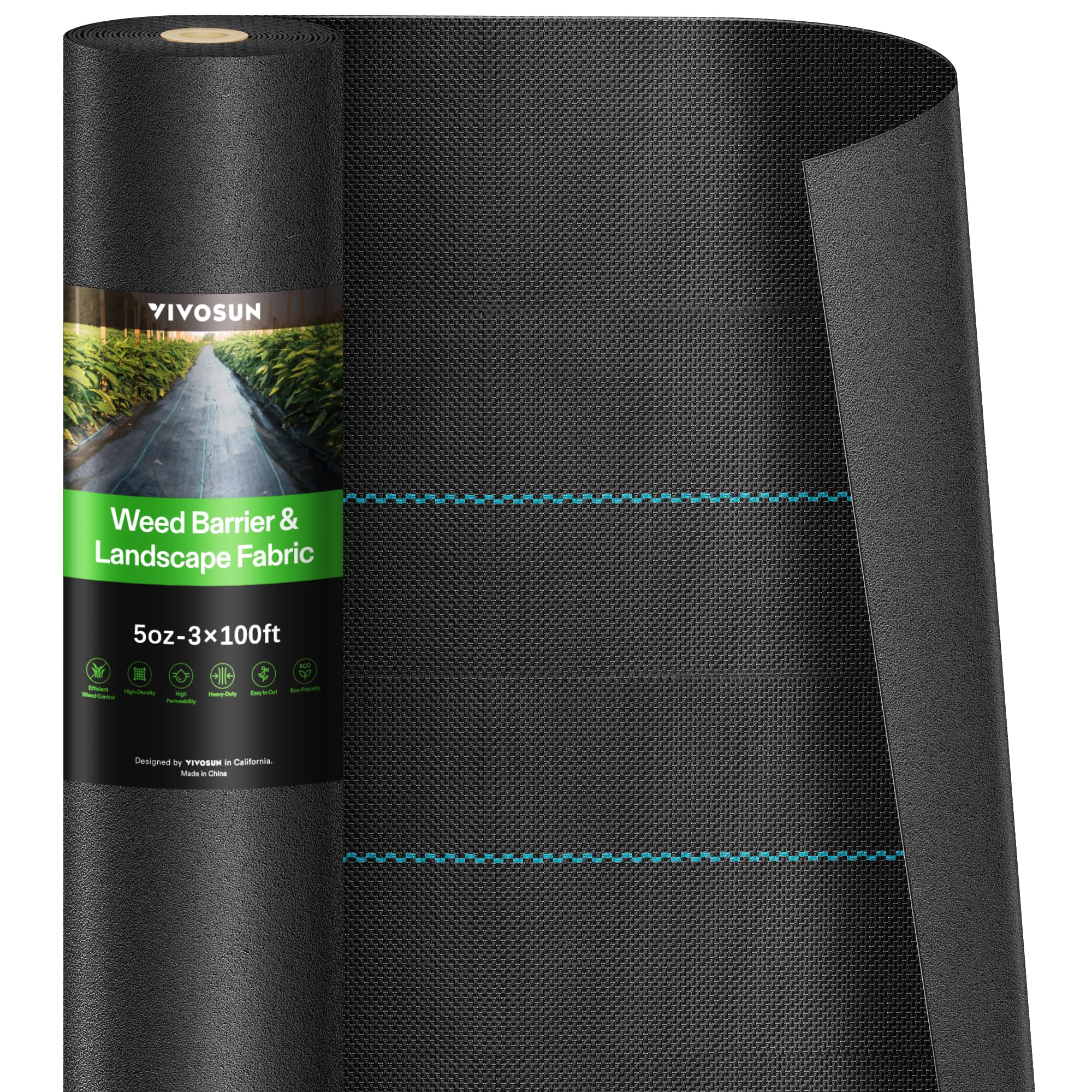
A dual-layer hybrid that balances weed blocking with root-friendly drainage.
VIVOSUN uses an unusual construction: a non-woven layer needle-punched to a woven base. The woven layer provides the structural strength, while the non-woven fibers theoretically pull water downward through molecular attraction. The result is a 5 oz fabric that the maker claims offers high water permeability compared to traditional woven ground covers — a real advantage if you are laying gravel over garden soil that still needs to breathe and drain.
The roll is 3 feet wide by 100 feet long, and at 10.3 pounds it is light enough to carry in one hand. Customers note it is “thick” compared to big-box store options, and that they walk on it every day in garden beds without it failing. One buyer did note that the cut edges fray and unravel more than they would like — the dual-layer construction has a fuzzy back side that grips the ground but does not hold its cuts as cleanly as a single-layer woven.
The included green line guides every foot help you align plants if you are cutting slits for planting. For strictly a gravel underlayment, you may not need those guides, but they do not get in the way. This fabric sits between the VEVOR (pure non-woven, heavy drainage) and the Super Geotextile (pure woven, load bearing) — a versatile mid-range option.
Hybrid Advantage
- Dual-layer woven/non-woven design for both strength and high water permeability.
- Light 10.3-pound roll is easier to move and install alone.
- Green guide lines help with plant spacing if used in garden beds.
Cut Quality
- Cut edges may fray and unravel more than a pure woven fabric.
- 3-foot width means more seams for wide driveway coverage.
Reach for this if: You want a fabric that handles both gravel underlayment and garden bed weed control in a single roll — the hybrid construction covers both roles.
Consider the trade-off: The fraying edges are a minor frustration during installation, but do not affect long-term performance once covered.
4. Driveway Landscaping Fabric and Underlayment 12.5 x 50 ft

A single-roll approach for covering wide areas without endless seams.
This woven geotextile fabric measures 12.5 feet wide by 50 feet long, making it the widest roll in this lineup — meaning you can cover a 10-foot-wide driveway in a single pass with no central seam. That matters because every seam is a potential weak point where gravel can push through over time. The fabric is a heavy-duty woven polypropylene designed for soil separation and stabilization, helping prevent ruts and erosion under gravel or pavers.
The 17.93-pound weight is moderate for a 625-square-foot roll. It comes with 50 six-inch U-pins (landscape staples) included, so you do not need to buy fasteners separately. Reviewers point out it is “very heavy duty” and “tightly woven” enough that weeds will not penetrate — one buyer mentioned it held up against rain, heat, and cows walking over exposed parts. Another reviewer said it served as a strong underlayment for a shed foundation under tamped gravel.
The product dimensions list 600 x 150 x 0.04 inches, compared to the VEVOR 1200 x 72 x 0.01 inches — meaning this fabric is at 0.04 inches thickness versus 0.01 inches. That thickness gives it a rigid, tarp-like feel that resists tearing from crushed stone. The downside is that 12.5-foot width can be awkward to handle if you are working alone; the 50-foot length is short enough that a single person can manage it, but the width makes it bulky.
Seam-busting width: A 12.5-foot width lets you cover most residential driveways in one run — no overlapping strips needed.
Bulk factor: That same width makes it cumbersome for one person to unroll on a windy day. Enlist a helper.
Choose this for: A driveway or patio that is 10-12 feet wide — the single-sheet coverage eliminates seam failures.
skip it if: You are working on narrow garden paths under 4 feet wide. A narrower roll will be less wasteful and easier to handle.
5. Groweco Driveway Fabric 13FT x115FT 3.5OZ Commercial
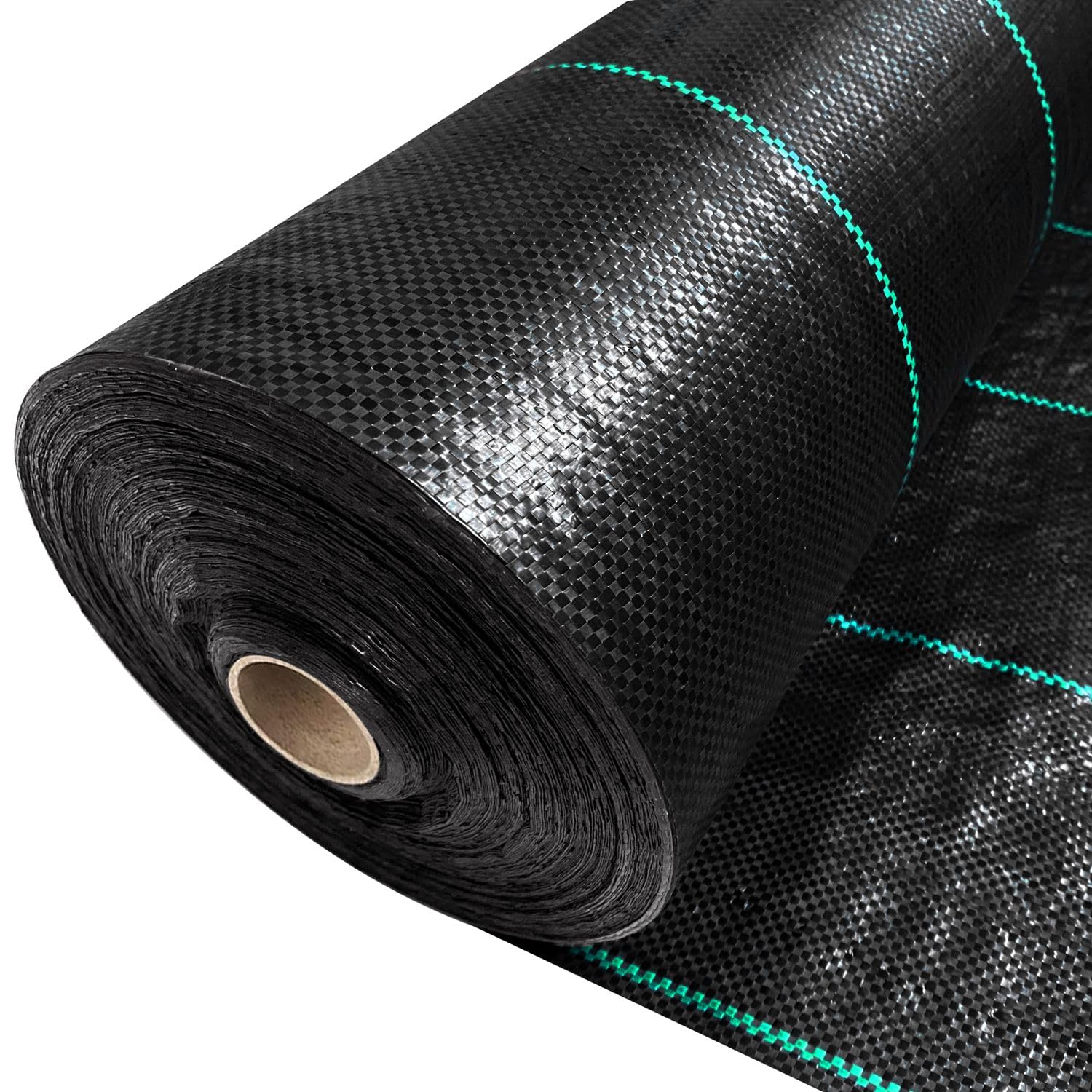
The budget-friendly giant that covers huge areas in one go.
At 13 feet wide and 115 feet long, this Groweco roll provides a massive 1,495 square feet of woven geotextile fabric — the most coverage per roll in this roundup. If you have a long driveway or a large construction project, you can lay one continuous sheet without splicing multiple rolls together. The fabric is a 3.5 oz commercial-grade woven polypropylene, which is lighter than the 5 oz VIVOSUN or the 8 oz VEVOR, but the woven structure still provides solid tear resistance for gravel underlayment.
At 31.7 pounds, this is the heaviest roll here, and the 13-foot width makes it a two-person job to unroll. Shoppers say it is “super sturdy” and performs as expected for a gravel pad and drainage fabric, with “good water drainage” that blocks weeds while letting water pass. One reviewer specifically noted it worked well as a “plastic barrier” that stopped breakthrough from aggressive plants — a common failure point for lighter fabrics. The wide width also means you can use it as a single-sheet ground cover for a farm greenhouse or large vegetable garden path.
The trade-off is that at 3.5 oz, it is the lightest fabric here by weight. For a standard residential gravel path or light-traffic area, it will hold up fine. But for a driveway that sees a heavy truck or tractor regularly, the 8 oz VEVOR or the thick woven Driveway Landscaping Fabric (0.04 inches) would be more puncture-resistant. The Groweco is ideal for covering big areas on a budget where daily heavy traffic is not a factor.
Coverage King
- 13ft x 115ft covers over 1,400 square feet in one roll — minimal wasted overlap.
- Woven structure provides solid tear resistance for gravel and light foot traffic.
- Buyers report it drains well and stops weed breakthrough effectively.
Weight Trade-Off
- 3.5 oz is the lightest in this lineup — not ideal for heavy vehicle traffic.
- 31.7 pounds and 13-foot width require at least two people to handle.
Best for: Large-scale projects like long gravel paths, farm access roads, or greenhouse bases where cost per square foot matters most.
Not for: Driveways that will carry heavy trucks or frequent vehicle traffic — step up to the 8 oz VEVOR for that job.
Understanding the Specs
Fabric Weight (oz)
The weight of the fabric in ounces per square yard is the single most important spec for gravel. Heavier fabric (like 8 oz in the VEVOR) means thicker material that is harder for sharp gravel edges to puncture. Lighter fabric (like 3.5 oz in the Groweco) covers more area for less money but will not hold up to repeated heavy loads. For driveways, aim for 5 oz or higher.
Woven vs Non-Woven Weave
Woven fabric has a grid pattern of threads that gives it high tensile strength for load-bearing stabilization — good under driveways and pavers. Non-woven fabric looks and feels like felt, with fibers randomly bonded together — it drains water much faster, making it ideal for French drains and areas with poor drainage. Some fabrics (like the VIVOSUN) combine both layers.
FAQ
Can I use any landscape fabric under gravel or does it need to be geotextile grade?
How do I stop the fabric from showing through the gravel?
Will water pool on top of the fabric under my gravel?
How long does landscape fabric last under gravel if installed correctly?
Should I overlap the fabric seams when laying it?
Is woven or non-woven geotextile better for a gravel driveway?
What does a 5 oz fabric weight actually mean in real terms?
Can I install landscape fabric under gravel myself?
Final Thoughts: The Verdict
If you want one dependable pick, the landscape fabric for under gravel winner is the VEVOR 6FTx100FT Non-Woven Geotextile because its 8 oz density and 350N tensile strength handle gravel weight without tearing while draining water faster than any woven alternative. If you need a woven fabric rated for 50 years of driveway and road stabilization, grab the Super Geotextile Woven Fabric. And for covering a massive area in one smooth sheet on a budget, the Groweco Driveway Fabric at 13ft x 115ft is the most coverage per dollar.
How We Picked
We do not accept paid placement. Every pick is matched to a real buyer and a real use-case; we do not hands-on test units.
Sources & Methodology
Specifications: manufacturer listings and product documentation. Review insights: verified customer reviews, as of July 2026. Pricing: not shown on this page (it changes often); check the current price via the retailer link.
As an Amazon Associate, Lawn Gear Lab earns from qualifying purchases. This does not affect which products we feature.