
Specs are compiled from manufacturer listings and verified buyer reviews and can change over time — please confirm the key details on the product page before buying.
The line between a manicured lawn and a messy one is a straight, sharp edge where the grass stops and the flower bed begins. Fighting that line with a string trimmer, a shovel, or your back is why most people give up halfway through the season. A dedicated landscape bed edger turns that chore into a single, satisfying step — you place the blade, press down, and walk forward.
I’m Rikta — the founder and writer behind Lawn Gear Lab. This guide is built by comparing the manufacturers’ published specifications and the patterns across verified customer reviews, so you get each pick’s real strengths and trade-offs instead of marketing spin.
Whether you are carving a new flower bed, tidying up a sidewalk, or redefining an overgrown border, the right one makes the job faster and cleaner. Here is everything you need to choose your next best landscape bed edger.
Our Picks at a Glance


How To Choose The Best Landscape Bed Edger
Most people grab the cheapest half-moon edger and hope for the best. That is usually when they discover a blade too dull to cut through roots, a handle that blisters their hands, and a foot tread that barely fits a work boot. A few key specs separate a tool you will reach for from one you will leave in the shed.
Blade Material and Sharpness
The blade does all the work, so its material matters. Stainless steel resists rust and stays sharp longer, but it can be harder to sharpen at home. Carbon steel holds a razor edge well but needs to be wiped clean and dried after each use to prevent rust. Serrated or saw-tooth edges bite into tough sod and roots better than a smooth blade — they grab rather than slide.
Handle Length and Grip Comfort
A longer handle (around 40 inches or more) means less bending, which saves your lower back during extended use. The grip shape matters just as much: a T-grip or an O-handle gives you more leverage and control than a skinny D-handle, and a padded or ergonomic grip reduces hand fatigue. If you have arthritis or weak wrists, look for a handle that lets you rock the blade side to side without twisting your arm.
Blade Depth and Foot Tread
Standard blades cut about 2 to 4 inches deep, but deeper blades (like 5.5 inches) can slice through thicker turf and roots in one pass. The foot tread is where you apply your body weight — a wide, improve tread (around 6 inches or more) fits all shoe sizes and transfers your weight directly into the cut, making the job feel much lighter.
Weight and One-Piece vs. Multi-Piece Construction
A heavier tool (4 to 5 pounds) drives through hard soil more easily but tires you out faster on long jobs. A lighter tool is easier to carry and control but may bounce off compacted ground. One-piece construction means no assembly and no loose bolts, while multi-piece tools often let you adjust the handle height or replace the blade, which adds long-term value.
Quick Comparison
| Model | Best For | Blade | Weight | Handle | Amazon |
|---|---|---|---|---|---|
| Radius Garden 206 PRO★ Best Overall | Overall comfort + long sessions | Stainless Steel | 3.5 lb | Natural Radius O-Handle | Amazon |
| Root Slayer 22611Root Terminator | Tough roots and heavy turf | Carbon Steel | 4.8 lb | Fiberglass + Ergo Grip | Amazon |
| Radius Garden 25602 Pro-LiteBack Saver | No-bend comfort + durability | Carbon Steel | 4 lb | Fiberglass + Doughnut Grip | Amazon |
| BULLY TOOLS 12-Gauge Edger | Heavy-duty / commercial use | 12-Gauge Steel | 3.69 lb | Steel T-Style Grip | Amazon |
| CKLT 40in Manual Edger | One-piece / no assembly | Spring Steel | 5.24 lb | Blue Rubber Grip | Amazon |
| Colwelt 40-inch Edger | Deep cuts for new beds | Solid Steel, V-Shape | 4.38 lb | Soft T-Grip | Amazon |
| BARAYSTUS Height Adjustable | Adjustable height for families | Saw-Tooth Cast Iron | 3 lb | T-Grip, 2 heights | Amazon |
| Byhagern Professional Edge | Budget-friendly starter | Saw-Tooth Carbon Steel | — | Ergonomic / Padded | Amazon |
| Edge Right Hammer-In Strips | Permanent steel edging | COR-TEN Steel | — | Hammer-in (no handle) | Amazon |
In‑Depth Reviews
1. Radius Garden 206 PRO Garden Stainless Steel Edger, Green
Our pick — over 4.5★ from 700+ verified ratings; the strongest balance of quality and price.
The ergonomic star that makes an afternoon of edging feel like 20 minutes.
The first thing you notice is the handle. This Natural Radius O-Handle grip gives you four times the surface area of a standard D-handle, which the crowd of owners — and there are a lot of them — praise most. That extra grip area lets you rock the tool side to side without wrenching your wrist, and the comfortable non-latex material means you can skip gloves on a warm day. The super-strong stainless steel blade stays sharp through tough sod and dense soil, and the resin-encased carbon steel shaft keeps the whole tool rigid without adding unnecessary heft.
One owner who is over 6’2″ noted the shaft length is perfectly adequate, and buyers consistently call it “great quality” and “very functional.” The extra-wide, improve forward step gives you a solid platform to drive the blade with your full body weight, which is exactly what you want when cutting a clean line through crabgrass or redefining a bed edge. The general consensus is that it beats a shovel in every way — it cuts cleaner and requires less effort. Buyers put it this way: “Works great on tough sod and dense soil.” The rust reports are rare but do appear — a few owners noticed surface rust despite the stainless steel label, so a quick wipe after use is wise.
What wins people over
- O-handle provides four times the grip surface of a traditional D-handle, reducing hand and wrist stress dramatically.
- Stainless steel blade stays sharp and cuts through tough sod, dense clay, and roots with ease.
- Extra-wide improve forward step transfers body weight efficiently for cleaner cuts.
The honest trade-off
- Some buyers report surface rust despite the stainless steel blade — a dry wipe after each use helps.
- Not the best choice for extremely compacted, dry clay in a single pass; a little moisture in the soil makes it easier.
Reach for this if: you want the most comfortable manual edger available — the handle alone is worth the upgrade if you have hand pain or plan to edge for more than 15 minutes at a time.
Look elsewhere if: you need a deeper cut than the standard half-moon depth or prefer a heavier tool for hard-packed earth; the 3.5-pound weight is light enough for comfort but may bounce off very hard soil.
2. Root Slayer 22611 Serrated Garden Edger, Red
The aggressive V-tip and serrated teeth that chew through buried roots without drama.
When a straight blade just slides over thick turf, the Root Slayer does the opposite. Its half-moon blade has an inverted V cutting tip and aggressive serrated teeth that bite into compact soil, shallow roots, and overgrown edges. The powder-coated carbon steel blade is built to last, and at 4.8 pounds it carries enough heft to drive itself through tough ground without you throwing your full weight into it. The fiberglass shaft with a comfortable grip keeps the tool stable and controlled as you work along driveways and flower beds. One reviewer noted it stands up to serious abuse: “cuts right through the ground to define your landscape beds.”
The weight is excellent for root cutting, but it is the most-discussed trade-off. Some owners find it noticeably heavier than cheaper models — a few petite users borrowed it and said it was too heavy for them. If you are looking for a lightweight tool for quick touch-ups, this is not it. But if you need to carve a new border through established grass and tree roots, the weight works in your favor. Buyers consistently call it “well built” and “very useful,” and one noted it “likely lasts a lifetime for intermittent use.”
Best for heavy jobs: The serrated V-tip punches through compacted soil and roots that would defeat a smooth blade. It is the go-to if you are reclaiming an overgrown border or edging along a curb where the grass has years of growth.
Not for light users: At 4.8 pounds and with that heavy blade, it is the kind of tool that makes you work up a sweat. If you have limited upper body strength or want something for quick weekly trimming, a lighter pick like the Radius Garden 206 PRO will serve you better.
3. Radius Garden 25602 Pro-Lite Carbon Steel Edger, Green
The lightweight carbon-steel edger with the doughnut handle that pros love.
Radius Garden does the ergonomic thing twice in this list, and the 25602 Pro-Lite proves why. The doughnut-shaped handle (the brand calls it a Natural Radius O-Handle) gives you a full, comfortable grip that lets you twist and rock the tool without straining your wrist. At just 4 pounds and with a fiberglass shaft, it is noticeably lighter than many steel-shaft competitors, making it easy to carry from the driveway to the back flower bed. The heat-treated carbon steel blade measures approximately 9 x 5 inches and cuts crisp, clean edges with a satisfying step.
The carbon steel blade is razor-sharp from the start, but it does require care. Owners confirm it cuts clean and deep, removing roots and creating a professional-looking edge along garden beds and sidewalks. The tool is also long enough (about 40.25 inches) to let you stand upright while working, which saves your back on long projects. The honest caveat is the blade needs to be wiped clean after each use to prevent rust, and some owners wished the edge came slightly sharper from the factory. But as one owner put it: “It is so much better than trying to use a shovel.” Think of it as the lighter, more nimble sibling to the 206 PRO — better for detail work and smaller properties.
Best for: the gardener who wants a lightweight, ergonomic tool for frequent edging around flower beds, trees, and patios — the doughnut handle is a genuine comfort upgrade over straight T-grips.
Consider skipping if: you only edge once a year through neglected, root-heavy turf; the lighter weight means you may have to work harder in compacted clay, where the heavier Root Slayer would punch through faster.
4. BULLY TOOLS 12-Gauge Manual Lawn Edger, 61.5″ Steel T-Style Grip

An all-steel American-made brute that trenches and edges without bending.
Bully Tools does not mess around. This edger is built from 12-gauge extra-thick steel — that is thicker than most lawn edger blades on the market — and it is designed to cut through soil, roots, and ground cover without warping or bending. The 61.5-inch overall length (with a detachable 36-inch head) is the longest in this roundup, which means almost zero bending for taller users. The steel T-style grip gives you a secure hold and excellent leverage for steady, smooth movement. One owner compared it directly to a Husky brand tool from a big-box store: “I had to get it replaced twice in 3 days of use… I advise anyone to purchase this bully.”
The all-steel construction is 100% Made in the USA in Steubenville, Ohio, and it comes with a limited lifetime warranty. That is a powerful combination for anyone who wants a tool that will last decades. The caveat: some owners find the blade too blunt from the start (around 50-55 degrees) and recommend sharpening it to 25-30 degrees for better performance in clay. The footrest is also a little small for large work boots, and the steel handle can feel slippery with sweaty hands. But for trenching, sod cutting, and commercial-grade edging, this is a crowd favorite with serious staying power. It is lighter than the Root Slayer at 3.69 pounds, but the extra length gives you leverage that makes up for the weight.
Built to last: The 12-gauge steel and all-metal construction mean this tool is unlikely to break under normal use, and the detachable blade extends its life. It is the clear choice for anyone who edges large properties or uses the tool for trenching light irrigation lines.
The practical limit: The blunt factory edge means you may need to sharpen it immediately for heavy clay. And if you are shorter than average, the 61.5-inch length may feel unwieldy.
5. CKLT 40in Manual Edger Lawn Tool with Spring Steel Blade

A one-piece spring-steel edger that arrives ready to work — no bolts, no fuss.
If you hate assembly, the CKLT is your dream tool. It has a sturdy one-piece construction with a 1.18-inch diameter manganese steel tube and a 40-inch length that comes fully assembled from the start. The standout feature is the high-quality serrated spring steel blade. Spring steel is known for resisting deformation and staying sharp even in tough conditions, which is exactly what you want when cutting through sod and roots. Owners rave about its sharpness — one buyer says it “cuts through sod and roots like butter.” At 5.24 pounds, it is the heaviest manual edger here, and that weight drives the blade deep with minimal effort from your foot.
The CKLT comes with a protective strip for the blade when not in use, which is a thoughtful safety touch. The signature blue rubber handle provides a comfortable, secure grip. The crowd consensus is that this tool outperforms expensive electric models and is easy enough for seniors to use effectively — one 70-year-old owner found it straightforward in damp soil. The main downside is the sheer weight: at over 5 pounds, it is tiring for long sessions or for anyone with limited upper body strength. But if you want a tool that is ready to edge the moment it arrives and has a blade that holds its edge, this one is tough to top. Try finding another one-piece tool with a spring steel blade at this price point — you will not.
Reasons it stands out
- No assembly required — the one-piece manganese steel construction means it is ready to use in seconds.
- Spring steel blade resists deformation and stays sharp even after repeated use in tough conditions.
- Includes a protective blade strip for safe storage, a rare and practical bonus.
The honest drawback
- At 5.24 pounds, it is the heaviest pick in this guide — fine for short jobs but fatiguing for long sessions.
- The heavier weight makes it less ideal for small, detail-oriented work around delicate plants.
Best for: buyers who want a tough, ready-to-use tool for cutting deep edges and trenches — the spring steel blade is a real asset for durability.
Consider passing if: you prioritize lightweight portability or need a tool for quick, frequent touch-ups; the 5.24 pounds will wear you out faster than a 3.5-pound edger.
6. Colwelt Manual Edger Lawn Tool 40-inch, Half Moon Edger

The V-shaped blade that cuts 5.5 inches deep — half again deeper than most.
Most half-moon edgers stop at 2 to 4 inches of cutting depth. The Colwelt goes a full 5.5 inches down, which makes it a different kind of tool entirely. That deeper V-shape serrated blade is designed for more than just edging — it can break through deeper roots and is excellent for making new flower beds, trenching around a pool deck, or even digging topsoil for planting. The solid steel construction weighs in at 4.38 pounds, giving it enough heft to drive that deep blade home. Buyers call it “essential for planting” and say it “works better than a shovel for clean edges.”
The cushioned T-handle is easy to grip, and the anti-slip foot tread is wide (6.3 inches) and tall (6.7 inches) enough to fit any shoe. That foot tread is the biggest in this guide, which means less slippage and better weight transfer. The honest feedback points to two issues: the blade may not be sharp enough from the start for sod cutting, and the handle bolts can stick out and catch on things. Several owners recommend a quick touch-up with a file. But for the price, this is a capable, deep-cutting tool that handles both edge maintenance and garden bed creation with equal ease. It is a functional standout for anyone expanding their flower beds.
Depth champion: The 5.5-inch cutting depth beats every other manual edger here by a noticeable margin. If you are digging out a new bed or trenching for landscape fabric, this is the one.
File the edge first: Several owners noted the blade arrives too thick for clean sod cutting — a quick grind or file session solves it. The protruding handle bolts are a minor annoyance but do not affect performance.
7. BARAYSTUS Height Adjustable Garden Edger Tool

A lightweight, height-adjustable tool that grows with every gardener in the family.
The standout feature here is the adjustable height — two precise settings at 37 inches and 41 inches. That means a tall partner and a shorter one can both use the same edger without hunching or stretching. The half-moon saw-tooth blade combines a sharp smooth edge with serrated teeth for clean cuts, and the 7.9-inch wide head covers more ground per step than narrower blades. At just 3 pounds, it is the lightest edger in this guide by a significant margin (46% lighter than the Colwelt). Buyers call it “very well constructed” and “an excellent value,” with one 70-year-old owner sharing: “I’m seventy years old and appreciate how well it works to maintain clean edging without a weed wacker.”
The soft, non-slip T-shaped handle reduces hand fatigue, and the reinforced wide foot platform transfers your body weight directly to the blade. The heat-treated cast iron construction is rustproof and stays sharp without bending. The upside is obvious: it is light, it fits everyone, and it is easy to use. The trade-off is that at 3 pounds, it does not have the momentum of heavier tools — you will need to apply more foot pressure in hard, compacted soil. The saw-tooth blade also works best with a rocking motion rather than a straight stomp. But for a family with varying heights, or for anyone who wants a truly lightweight tool for quick edges along sidewalks and patios, the BARAYSTUS is a smart pick.
Why it stands out
- Two height settings (37 and 41 inches) mean it adjusts to fit different users — rare in this category.
- At 3 pounds, it is the lightest pick, ideal for quick jobs and gardeners who prefer minimal fatigue.
- The 7.9-inch wide head covers more ground per step, making edging faster.
What to know
- Light weight means it requires more foot force in hard, compacted clay — not a one-stomp tool.
- Cast iron construction is durable but can chip if struck against concrete repeatedly.
Best for: households where multiple people edge the yard, or anyone who needs a very lightweight tool for quick maintenance edges along driveways and patios.
skip it if: you work in heavy clay soil and prefer a heavier tool that sinks in with its own weight; the 3-pound frame will leave you stomping harder.
8. Byhagern Professional Edge Lawn Tool, Heavy Duty Steel Half Moon
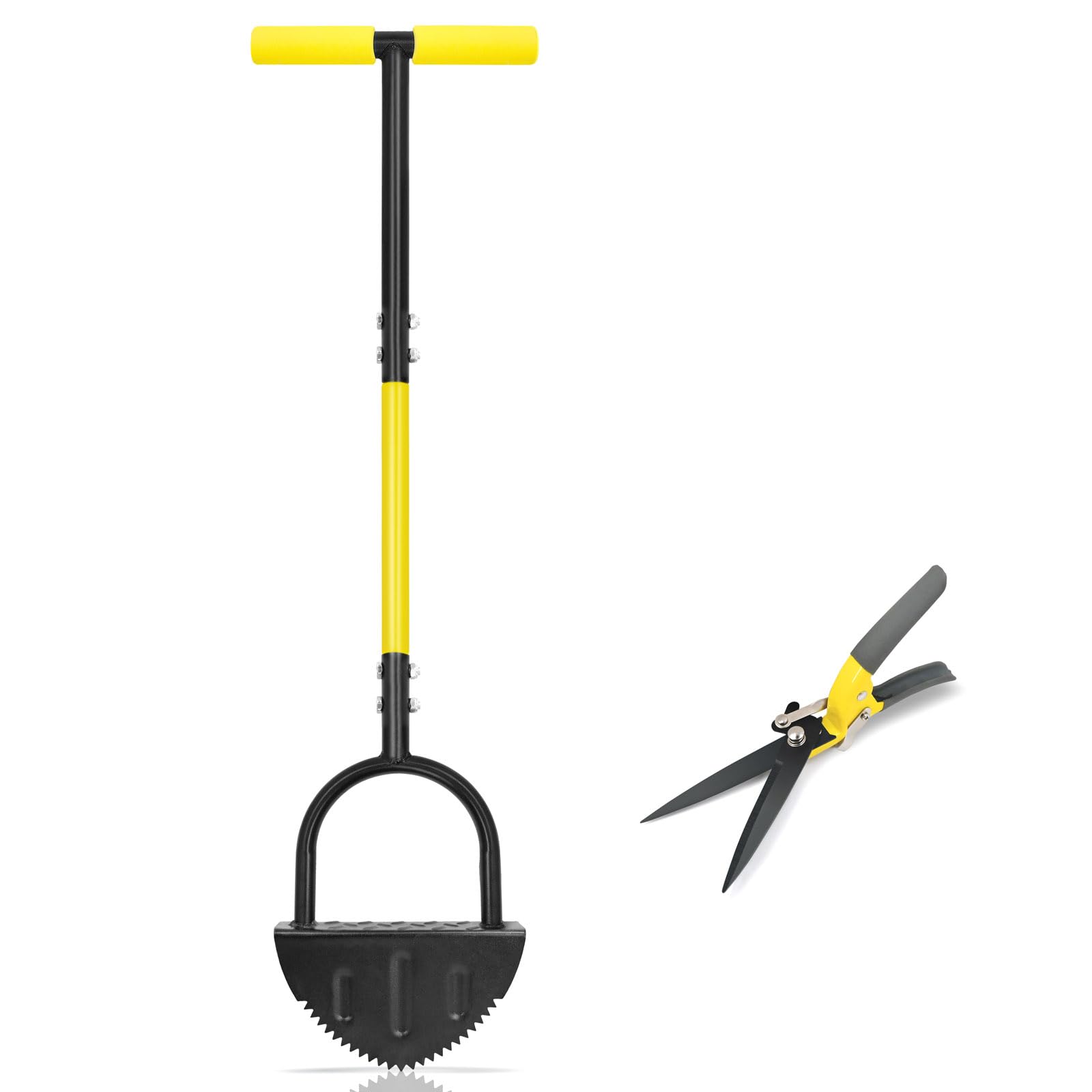
An entry-level half-moon edger that delivers professional-looking results for the price.
The Byhagern is the budget-friendly option that does not feel cheap. The saw-tooth design on the curved half-moon blade bites into grass, roots, and soil rather than just pushing down like a straight blade — a genuine advantage when you are working in turf with a heavy thatch layer. The long handle reduces bending and strain on your back, and the non-slip padded grip ensures secure operation even with wet hands. The wide footplate provides excellent leverage and accommodates all shoe sizes. Owners mention that it “creates clean, professional edges without noise” and is “easy to assemble and delivers professional results.”
The honest catch is the blade thickness. Several owners found the almost 1/8-inch-thick blade too dull for clean sod cutting from the start and took a grinder or file to it. The carbon steel is weather-resistant but not rust-proof — dirt sticking is a common note. If you are willing to spend five minutes sharpening the edge before your first use, this edger performs well above its price point. It is also note that some owners felt the plastic head components may not survive years of heavy use, though most find the steel blade itself quite durable. Think of it as a great starter tool or a secondary edger for smaller jobs.
Best value move: The saw-tooth blade design is a genuine feature at this price, and the ergonomic handle and wide footplate add comfort. A quick file job turns it into a very capable tool.
The reality check: The blade is thick and may not cut cleanly from the start — budget the five minutes to sharpen it. Plastic components in the head may wear faster than all-metal competitors.
9. Edge Right – Hammer-in Landscape Edging – 48-inch Strips – COR-Ten Steel (5 Pack)

The hammer-in steel strips that create a permanent, weed-eater-proof border.
This is not a manual edger in the traditional sense — it is permanent steel landscape edging. But for readers who want a low-maintenance solution, the Edge Right system is the gold standard. Each strip is made from heavy-duty 16-gauge COR-TEN steel (weathering steel that develops a rust patina over time) and measures 48 inches long with a 6-inch depth. That 6-inch depth is serious: it keeps grass roots from creeping into your flower beds and prevents mulch from washing out. The 1/4-inch rounded top is designed to handle unlimited abuse from a weed eater — the manufacturer says you do not need to worry about damage. One owner described it as “the best edging I’ve used,” noting it was “so much easier to install, and looks so much better” than plastic.
COR-TEN steel is chosen for its malleability, so you can bend these strips gently to follow curves in your landscape. The manufacturer claims it can last well over 100 years, and while that is a long claim, buyers confirm it holds up beautifully. The strips hammer into the ground easily, and you can cut them with a circular saw if needed. The 5-pack covers 20 linear feet. The catch is that installation takes effort — you need a hammer and a block of wood to protect the rolled top from dents — and the natural rust patina is an intentional aesthetic that not everyone loves. Also, it is the most expensive entry in this guide, but for permanent bed separation, it outlasts every manual edger here. Think of it as the endpoint: when you are tired of re-edging every spring, this is what you install.
The permanence advantage
- 16-gauge COR-TEN steel is thick, heavy, and abuse-resistant — weed eaters cannot damage the rolled top edge.
- 6-inch depth prevents grass root invasion and contains mulch effectively, unlike shallow plastic edging.
- Develops a natural rust patina that many buyers find attractive, or can be sealed for a different look.
The practical hurdles
- Installation takes effort — hammering each strip requires care to avoid denting the top edge.
- Bending it for curves is possible but not easy; the 4-foot strips are stiff and may resist tight radii.
- The intentional rust look is a design choice — if you want a pristine painted edge, this is not it.
Buy this if: you are done with annual re-edging and want a steel border that will contain your flower beds for decades — the COR-TEN steel is genuinely in a different league from plastic or aluminum edging.
Choose a manual edger instead if: you want to define flexible, temporary edges or are not ready to commit to a permanent installation; the Edge Right strips are a final, not a first, solution.
Understanding the Specs
Blade Material: Stainless vs. Carbon Steel vs. Spring Steel
Each blade material has a real trade-off you will feel in the yard. Stainless steel resists rust best — it can sit in a damp garage all winter and still look clean — and it stays sharp for a long time, but it is harder to sharpen by hand when it finally dulls. Carbon steel takes a razor edge easily and cuts through roots with less effort, but you must wipe it dry after every use or it will rust. Spring steel is a happy middle ground: it resists deformation (it springs back into shape rather than bending permanently) and holds its edge well, but it is often heavier and can be harder to find. For most home gardeners, stainless is the low-maintenance winner. For those who edge weekly and are diligent about cleaning, carbon steel delivers the sharpest cuts.
Cutting Depth: Why 5 Inches Matters
Standard half-moon edgers cut 2 to 4 inches deep. That is fine for maintaining an existing edge, but it often leaves roots alive below the cut, so the grass grows back quickly. A blade that cuts 5.5 inches deep (like the Colwelt) severs roots deeper, meaning your edge stays clean for weeks longer. Deeper cuts are also essential for creating new flower beds or trenching for landscape fabric. The trade-off is that deeper blades require more force to push into the ground — you will need good soil moisture and a sharp blade to make the depth work in your favor. If you only edge a few times a year and the soil is usually dry, stick with a shallower cut. If you are reclaiming overgrown borders, go deep.
FAQ
How often should I sharpen my manual bed edger?
Is a manual edger better than a gas or electric edger for flower beds?
What is the difference between a half-moon edger and a saw-tooth edger?
How do I prevent my carbon steel edger from rusting?
Can a manual edger cut through tree roots?
What handle length should I choose for my height?
How deep should landscape bed edging be?
Will a manual edger work in clay soil?
Can I use a manual edger to create a new flower bed from scratch?
How do I maintain a manual edger for long-term use?
Final Thoughts: The Verdict
For most buyers, the best landscape bed edger winner is the Radius Garden 206 PRO because it combines the most comfortable handle on the market with a sharp stainless steel blade and a design that reduces fatigue — the crowd favorite by any measure. If you want to cut through thick roots and heavy turf without breaking a sweat, grab the Root Slayer 22611; its aggressive serrated V-tip chews through compacted soil that stops other edgers cold. And for a permanent, no-maintenance border solution, the Edge Right COR-TEN Steel Strips are the ultimate upgrade — install them once and stop re-edging forever.
How We Picked
We do not accept paid placement. Every pick is matched to a real buyer and a real use-case; we do not hands-on test units.
Sources & Methodology
Specifications: manufacturer listings and product documentation. Review insights: verified customer reviews, as of July 2026. Pricing: not shown on this page (it changes often); check the current price via the retailer link.
As an Amazon Associate, Lawn Gear Lab earns from qualifying purchases. This does not affect which products we feature.