
That half-full container of vegetable peels and coffee grounds sitting on your counter shouldn’t announce its presence the moment you walk into the kitchen. A well-sealed compost bin keeps food scraps contained without letting odors escape, fruit flies circle, or counter space disappear. The key is finding a bin that balances capacity with a truly airtight lid — because a bin that smells is a bin that won’t get used.
I’m Rikta — the co-founder and writer behind Lawn Gear Lab. I spend my time comparing the sealing mechanisms, filter technologies, material durability, and ease-of-cleaning features that separate a functional kitchen compost bin from a countertop nuisance.
My goal is to help you find a best kitchen compost bin that fits your workflow, contains odors, and won’t have you holding your breath every time you lift the lid.
How To Choose The Best Kitchen Compost Bin
Not every bin is built to handle the daily grind of coffee grounds, onion skins, and eggshells. The right choice depends on your counter space, emptying schedule, and tolerance for maintenance. Here are the four factors that matter most.
Material and Odor Lock
Stainless steel resists rust and stains but can dent and usually relies on a tight gasket and a charcoal filter to seal smells. Powder-coated carbon steel offers similar durability with a softer feel but requires care to avoid chipping. High-grade ABS plastic is lighter and less expensive, but its odor-sealing ability depends entirely on the lid’s gasket design — a soft silicone seal matters more than the plastic itself. If you skip filters, look for a bin with a mechanical seal that traps air inside the container.
Capacity and Countertop Footprint
A 1.3-gallon bin holds roughly two to three days of scraps for a family of four, while a 0.85-gallon bin requires daily emptying for the same household. Bigger isn’t always better — a large bin that sits half-full for a week will create more odor than a smaller bin emptied frequently. Measure your available counter space before buying, and note that square bins fit tighter into corners than round cylinders of the same volume.
Cleaning and Maintenance
Bins with removable inner buckets are significantly easier to clean than monolithic containers. A smooth, non-porous interior — whether stainless steel, carbon steel, or plastic — prevents food particles from sticking and reduces the need for scrubbing. Dishwasher-safe components save time, but check whether the filter compartment and lid gasket survive high heat. Bins that allow liner bags to tuck neatly under the lid reduce contact with the bin itself.
Filter Types and Replacement Schedule
Activated charcoal filters absorb odors but need replacement every four to six months depending on humidity and load. Some bins rely solely on a tight lid seal and require no filters at all — these cost less to maintain but demand more frequent cleaning. If you compost meat scraps or fish, a filter-based bin is almost mandatory. For vegetable scraps alone, a sealed plastic or stainless bin without a filter can work perfectly well.
Quick Comparison
On smaller screens, swipe sideways to see the full table.
| Model | Category | Best For | Key Spec | Amazon |
|---|---|---|---|---|
| OXO Good Grips Easy-Clean | Plastic | Busy kitchens needing daily dumping | 1.75 gal capacity / soft-close lid | Amazon |
| EPICA Countertop Compost Bin | Stainless Steel | Durable, rust-free daily use | 1.3 gal capacity / replaceable filter | Amazon |
| KIBAGA Smell Proof Bin | Carbon Steel | Style-focused eco-chic kitchens | 1.1 gal capacity / wooden handle | Amazon |
| Dullrout Compost Bin | Hybrid | Push-button convenience with style | 1.13 gal capacity / pop-up lid | Amazon |
| Blue Ginkgo Compost Bin | Plastic | Filter-free odor containment | 1.32 gal capacity / inner colander | Amazon |
| Chef’n Compost Bin | Plastic | One-handed operation during cooking | 0.85 gal capacity / dual-bin design | Amazon |
| Minky Homecare Compost Bin | Plastic | Compact spaces and smaller households | 0.9 gal capacity / bag retention ring | Amazon |
In‑Depth Reviews
1. OXO Good Grips Easy-Clean Compost Bin

The OXO Good Grips Easy-Clean is the most thoughtfully engineered plastic bin in this lineup. Its 1.75-gallon capacity is the largest of the group, yet the oval footprint keeps it compact on the counter. The soft-close lid moves slowly and quietly, and it stays open when flipped back — essential when you’re chopping vegetables and need to toss scraps with one hand. The lid also removes completely for dumping and bag replacement.
What sets it apart is the interior design. Every surface is smooth and crevice-free, so food residue wipes out in seconds. The lid’s gasket creates an effective odor seal without requiring a charcoal filter, though the bin relies on oxygen flow through the soft-close mechanism to reduce moisture buildup. The carry handle is sturdy enough for a full load, and the bag tucks neatly under the lid without sliding down.
After two years of daily use, some users report the silicone gasket allowing minor moisture seepage, and the interior plastic can stain from coffee grounds and tomato scraps. That said, the bin’s overall build quality and ease of cleaning make it the most practical choice for a busy kitchen that generates a full bin every one to two days.
What works
- Smooth crevice-free interior wipes clean instantly
- Soft-close lid stays open for one-handed use
- Large 1.75-gallon capacity in a compact footprint
What doesn’t
- Gasket may allow minor moisture seepage over time
- Interior plastic can stain from acidic food scraps
2. EPICA Countertop Compost Bin

The EPICA has been a staple in the kitchen composting space for years, and for good reason. Its one-piece molded stainless steel body eliminates the welded seams that rust and leak on cheaper metal bins. The 1.3-gallon capacity hits the sweet spot for a family of three to four, holding roughly two days of scraps before needing emptying. The cylindrical shape with a handle on top makes it easy to carry to the outdoor pile.
Odor control comes from a replaceable activated charcoal filter embedded in the lid. Users report the bin stays smell-free for the full six-month filter lifespan when they remember to change it. The lid seals with a snug fit, and the brushed silver finish resists fingerprints and scratches surprisingly well. A few users noted that the bin arrived with minor scratches, but overall build quality is consistent and reliable.
The handle hinges at a single point, which means the bin requires two hands to open — one to hold the base and one to flip the lid. That’s a minor inconvenience during busy cooking, but the trade-off is a sturdy lid that doesn’t warp over time. The interior is easy to hand wash but not dishwasher safe, and the narrow opening makes scrubbing the bottom a tight squeeze.
What works
- Seamless stainless steel body resists rust and leaks
- Replaceable charcoal filter keeps odors contained
- Right-sized 1.3-gallon capacity for small families
What doesn’t
- Requires two hands to open the lid
- Not dishwasher safe; narrow opening hard to scrub
3. KIBAGA Smell Proof Compost Bin
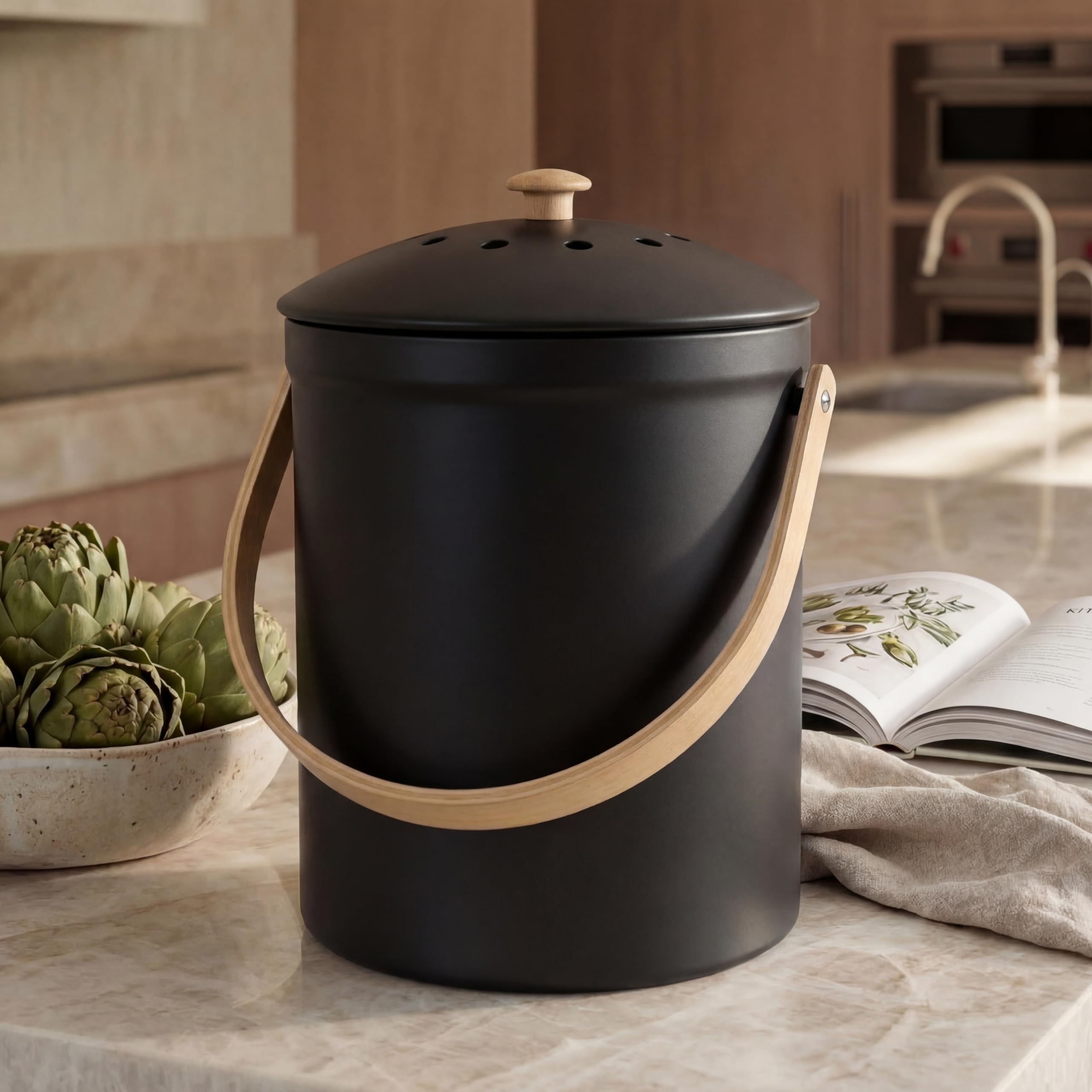
KIBAGA’s bin proves that a compost pail doesn’t have to look utilitarian. The powder-coated carbon steel body in matte black with a wooden handle and knob fits seamlessly into a modern kitchen aesthetic. At 1.1 gallons, it’s slightly smaller than the EPICA but still holds enough scraps for a couple of days. The charcoal filter compartment sits in the lid and uses two included replacement filters to neutralize odors.
The odor seal is effective — multiple users report no detectable smells even after a week of accumulation. The wooden handle stays comfortable during transport, and the powder coating resists rust as long as you don’t scrub it with abrasive pads. Cleaning involves removing the filter from the lid, rinsing the bin, and letting the filter dry upright before reinstalling. The lid itself is not removable, which makes thorough cleaning slightly more tedious than a fully detachable design.
Some users initially struggled with the filter installation because the included instructions lacked detail, and the lid’s non-removable nature means you have to wash the bin as a single unit. But for a bin that prioritizes aesthetic appeal without sacrificing function, the KIBAGA delivers reliable performance that looks good doing it.
What works
- Powder-coated carbon steel resists rust and looks great
- Wooden handle stays durable and comfortable
- Two charcoal filters included for odor control
What doesn’t
- Non-removable lid is harder to clean thoroughly
- Filter installation instructions are vague
4. Dullrout Compost Bin

Dullrout’s bin stands out for its push-button mechanism that pops the lid open with one press — ideal when your hands are full of food scraps. The rectangular shape with a matte black finish keeps it stable on the counter, and the non-slip base prevents sliding during use. The 1.13-gallon capacity sits between the KIBAGA and EPICA, making it suitable for a couple of days of scraps from a small to medium household.
The bin uses a hybrid construction of stainless steel and plastic, with a removable inner bucket for easy dumping and cleaning. The lid seals tightly when closed, and users consistently report zero odor leakage even without a charcoal filter. The pop-up lid stays open without needing to be held, which is a significant convenience during meal prep. The removable bucket is top-rack dishwasher safe, though the outer bin requires hand washing.
One recurring issue is the outer bin’s lip, which can trap water and food particles if not dried carefully, leading to minor grime buildup. The bin also lacks a handle on the outer body — you lift the entire bin by gripping the base. For a kitchen that values quick, hands-free access over traditional flip lids, this design is hard to beat.
What works
- Push-button pop-up lid opens with one hand
- Removable inner bucket is dishwasher safe
- Seals odors completely without a filter
What doesn’t
- Outer bin lip can trap moisture if not dried
- No outer handle; must grip the base to carry
5. Blue Ginkgo Kitchen Compost Bin

Blue Ginkgo takes a different approach to odor control — instead of a filter, it relies on a tight-sealing lid to trap smells inside. The bin is made from polypropylene plastic with a smooth interior that resists sticking, and the inner colander lifts out for easy emptying. The colander sits above the bottom of the bin, allowing liquid to drain and collect separately, which prevents the soggy bottom that plagues many plastic bins.
The 1.32-gallon capacity in a square shape fits neatly into corner counter spaces where round bins waste room. Two handles — one on the outer bin and one on the inner colander — make it easy to carry to the compost pile without touching the contents. Users consistently report no odor leakage and no fruit flies, which is impressive for a filter-free design. The lid opens with a single pull tab and seals securely when closed.
The main caveat is that the inner colander’s holes mean you need to carry the whole bin to avoid dripping liquid through the basket — you can’t lift the colander separately without some mess. The plastic material is durable but can scratch over time, and the bright green color may not suit every kitchen aesthetic. For a low-maintenance bin that never needs filter replacements, this is a smart choice.
What works
- Filter-free design eliminates ongoing costs
- Inner colander drains liquid to prevent sogginess
- Square shape fits efficiently into corner counter spaces
What doesn’t
- Lifting inner colander alone can cause drips
- Plastic may scratch with regular cleaning
6. Chef’n Compost Bin
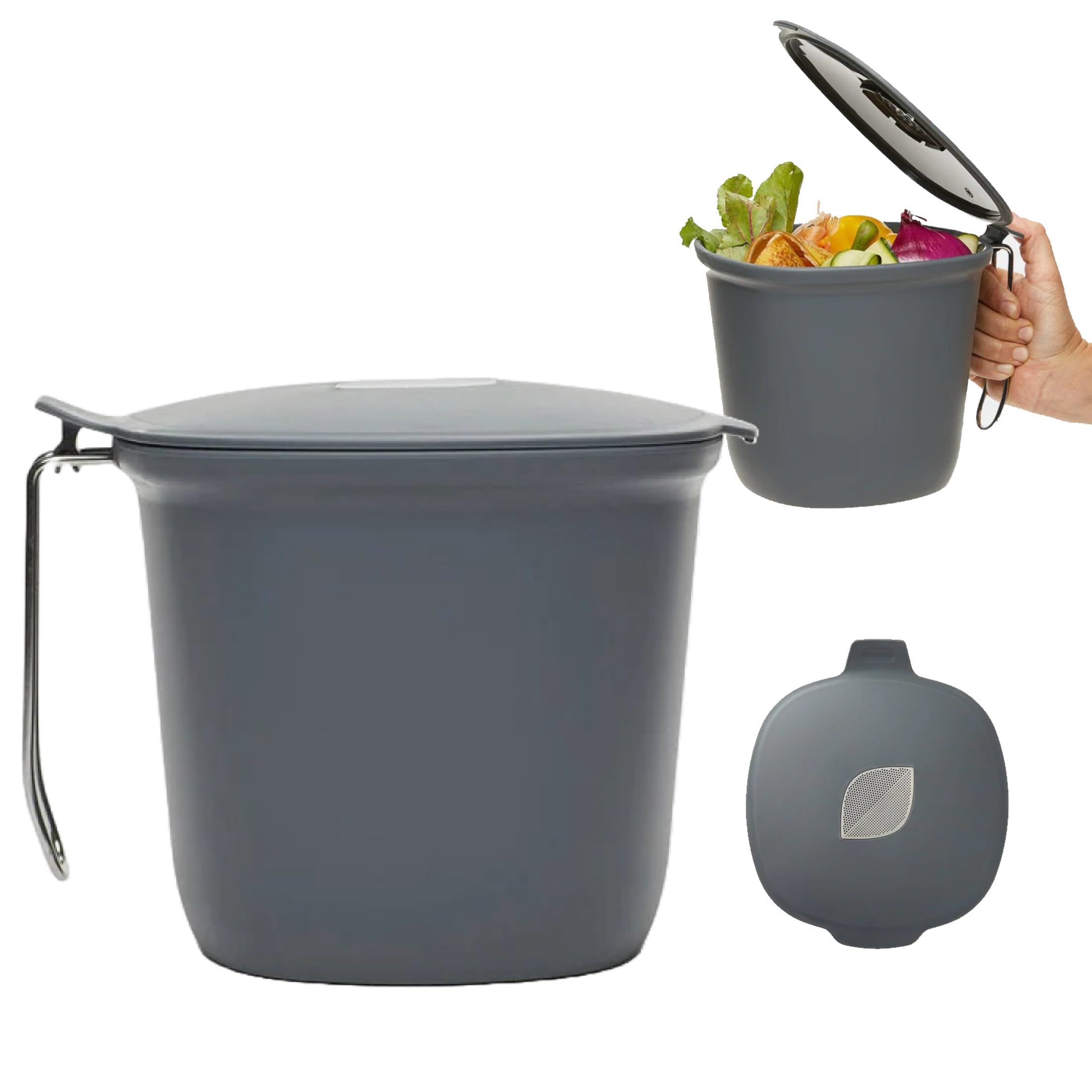
The Chef’n bin is designed for the cook who needs to open, carry, and empty the bin with one hand while holding a knife or ingredient in the other. The handle doubles as a carry grip and the lid release, so you can flip it open and dump scraps without shifting your grip. The 0.85-gallon capacity is the smallest full-sized bin here, which means more frequent emptying — but also less chance of odors developing from accumulation.
The bin’s dual-bin design includes an inner removable bucket that lifts out for washing. The activated charcoal leaf filter sits in the lid and absorbs odors effectively; the company includes an extra filter in the box. The plastic body is lightweight and the gray color blends into most kitchens. Users highlight the removable liner as the standout feature because it makes cleaning quick and prevents the inner bucket from absorbing smells.
The small size is the limiting factor — a family of four will fill this bin in under a day, making it more suitable for singles, couples, or as a secondary bin for coffee grounds. The plastic construction, while sturdy, doesn’t match the premium feel of stainless steel or carbon steel options. For a compact bin that prioritizes convenience and easy cleaning at the cost of capacity, the Chef’n delivers.
What works
- One-hand operation for opening, carrying, and emptying
- Removable inner bucket is fully washable
- Includes extra charcoal filter for extended use
What doesn’t
- Small capacity requires daily emptying for families
- Plastic body doesn’t feel as premium as metal bins
7. Minky Homecare Kitchen Compost Bin

Minky’s bin is the entry-level option that doesn’t compromise on essential function. The 0.9-gallon cube shape takes up minimal counter space, and the integrated bag retention ring lets you use standard compostable liners without them slipping into the bin. The stay-open lid allows for quick scrap dumping during meal prep, and the non-slip feet keep the bin stable on smooth countertops.
The ABS plastic body is lightweight and easy to wipe clean, though the material is more prone to scratching than stainless steel or carbon steel. The lid doesn’t have a latch closure, which means it seals through friction alone — users report that it keeps odors contained effectively as long as the bin isn’t overfilled. The carry handle is sturdy and positioned for comfortable one-hand transport.
The compact size is ideal for small households, singles, or as a secondary bin for specific waste like coffee grounds or eggshells. Some users found the lack of a charcoal filter meant the bin needed more frequent cleaning to prevent odor buildup. For a no-frills, functional bin that fits tight spaces, the Minky offers solid value without the bells and whistles.
What works
- Compact cube shape fits small counter spaces
- Bag retention ring keeps liners from slipping
- Stay-open lid for convenient one-handed use
What doesn’t
- ABS plastic scratches more easily than metal
- No filter; requires frequent cleaning for odor control
Hardware & Specs Guide
Capacity (Gallons vs. Liters)
A bin’s capacity directly controls how often you empty it. A 1.75-gallon bin like the OXO holds 6.62 liters — enough for two to three days of scraps for a family of four. Smaller 0.85-gallon bins require daily emptying for the same household. If you generate mostly vegetable peels and coffee grounds, you can stretch capacity further than if you compost meat or fish scraps, which need more frequent disposal. Always match capacity to your household’s food waste volume and emptying schedule.
Lid Mechanisms
Lid design determines daily usability. Flip lids with a single hinge require a hand to hold them open. Stay-open lids (OXO) automatically lock in the open position, freeing both hands. Pop-up lids (Dullrout) use a spring-loaded button for quick access. Soft-close lids (OXO) lower slowly and quietly, reducing noise and preventing slamming. Removable lids simplify emptying and deep cleaning but risk misalignment if not reattached correctly. Choose based on whether you need one-handed operation or prefer a simpler mechanical seal.
Material Properties
Stainless steel (EPICA) resists rust, stains, and odors but can dent and is heavier. Powder-coated carbon steel (KIBAGA) offers similar durability with a softer visual feel but can chip if dropped. High-grade ABS plastic (Minky, Chef’n) is lightweight and impact-resistant but scratches more easily and may absorb odors over time if not cleaned regularly. Hybrid bins (Dullrout) combine stainless steel accents with plastic bodies for a balance of durability and ease of cleaning. The interior surface smoothness matters more than the exterior material for cleaning convenience.
Charcoal Filters vs. Mechanical Seals
Charcoal filter bins (EPICA, KIBAGA) rely on activated carbon to absorb odor molecules. Filters typically last four to six months before needing replacement, adding a small ongoing cost. Mechanical seal bins (OXO, Blue Ginkgo, Dullrout) trap odors using a tight-fitting gasket or lid without any consumable parts. These require more diligent cleaning to prevent odor buildup but have zero recurring costs. For households that produce wet, pungent waste like fish or meat scraps, a filter bin is almost essential. For primarily vegetable scraps, a mechanical seal works flawlessly.
FAQ
How often should I empty my kitchen compost bin?
Can I put compostable bags in any kitchen compost bin?
How do I clean a kitchen compost bin without damaging the filter?
Will a kitchen compost bin attract fruit flies in the summer?
Is stainless steel or plastic better for a kitchen compost bin?
Final Thoughts: The Verdict
For most gardeners, the best kitchen compost bin winner is the OXO Good Grips Easy-Clean because it combines a large 1.75-gallon capacity with a smooth, crevice-free interior that cleans in seconds, a soft-close lid that stays open when needed, and effective odor containment without requiring consumable filters. If you want durable stainless steel construction with a replaceable charcoal filter, grab the EPICA Countertop Compost Bin. And for a stylish bin that looks like a countertop appliance while keeping smells locked away, nothing beats the KIBAGA Smell Proof Bin.