
Specs are compiled from manufacturer listings and verified buyer reviews and can change over time — please confirm the key details on the product page before buying.
A pruning saw that fights you on every branch is a tool you will start avoiding. The secret to a clean, easy cut is the pull stroke, which is the defining difference in a Japanese pruning saw. You pull the blade toward you, which keeps the thin, razor-sharp teeth tracking straight and leaves a cut so smooth it often needs no sanding. The right one makes you wonder why you ever pushed a saw through wood.
I’m Rikta — the founder and writer behind Lawn Gear Lab. This guide is built by comparing the manufacturers’ published specifications and the patterns across verified customer reviews, so you get each pick’s real strengths and trade-offs instead of marketing spin.
The question is which blade length, tooth pattern, and handle material match the work you actually do. Here is what matters when you are choosing the best japanese pruning saw for your yard, workshop, or trail.
Our Picks at a Glance


How To Choose The Best Japanese Pruning Saw
Japanese saws cut on the pull stroke, which lets the blade be much thinner than a Western push saw. A thin blade means a narrow kerf (the width of the cut) and less wasted wood, but it also demands a different technique. Here are the three decisions that matter most.
Blade Length and Tooth Pitch
Blade length dictates how large a branch or piece of lumber you can comfortably cut in one stroke. A 170mm (6.7-inch) blade is excellent for one-handed pruning and packability. A 330mm (13-inch) blade gives you reach for thicker limbs. Tooth pitch, measured in teeth per inch (TPI), controls speed versus finish. Lower TPI (around 6-8) cuts fast and is ideal for green wood. Higher TPI (14-18) leaves a smoother surface for joinery and finish work. Many double-edged ryoba saws give you both on one blade.
Ryoba Versus Kataba
A ryoba saw has two cutting edges on one blade: one side with rip teeth (for cutting along the grain) and the other with crosscut teeth (for cutting across the grain). This makes it the most versatile choice for general woodworking and pruning. A kataba saw has teeth on only one edge, which makes the blade stiffer and better for deep, straight cuts in thicker material. For most homeowners doing a mix of pruning and trimming, a ryoba is the practical pick.
Handle Material and Grip
The handle is where you transfer force, so it matters more than you might think. Wood handles (beech, walnut) look beautiful and absorb vibration, but they can become slippery when wet. Rubber or elastomer handles offer a positive grip in wet, cold, or game-processing conditions. An arbor composite handle, like the one used by Silky, is engineered for grip when wet and cold. For a pruning saw that sees rain or dew, a non-slip handle is a genuine advantage.
Quick Comparison
| Model | Best For | Blade Length | Teeth Per Inch | Handle Material | Amazon |
|---|---|---|---|---|---|
| Silky Pocketboy 170mm★ Best Overall | Pro-grade portability | 6.7″ | 8.5 TPI | Arbor Composite | Amazon |
| Temple Tool F-6 Flush CutBest for Flush Cuts | Flush cutting dowels | 6″ | — | Beechwood | Amazon |
| RUITOOL 10″ RyobaBudget Champion | Budget-friendly ryoba | 10″ | 10 & 18 TPI | Plastic | Amazon |
| JORGENSEN 10″ Ryoba | Replaceable blade value | 10″ | 7-12 & 18 TPI | Thermoplastic Elastomers | Amazon |
| Samurai KISI FC-240-LH | Camp and trail pruning | 9.5″ | ~6.4 TPI | Rubber | Amazon |
| SUIZAN Ryoba 8″ | Entry-level Japanese steel | 8″ | 14 TPI | Elastomer | Amazon |
| Kanzawa Ichigeki C-330-LH | Heavy arboreal pruning | 13″ | — | Rubber | Amazon |
| Samurai 8230620 Curved | Long-life garden saw | 13″ | — | Wood | Amazon |
| Temple Tool R-240 Ryoba | Fine woodworking ryoba | 9.5″ | — | Wingnut Wood | Amazon |
In‑Depth Reviews
1. Silky Professional Pocketboy Folding Saw 170mm Outback Edition (750-17)
Our pick — over 4.5★ from 550+ verified ratings; the strongest balance of quality and price.
The folding saw that arborists and hunters trust when a tough branch is on the line.
Speed and stiffness define this saw. It is built around a 170mm (6.7-inch) blade made of steel that is 1.4 mm thick with teeth that are taper-ground and impulse-hardened. That hardening is a big deal: the manufacturer says it lets the teeth last up to three times longer than non-hardened teeth. The blade folds into an arbor composite handle, which owners consistently praise for staying grippy even when wet, cold, or covered in sap.
The cutting performance here is legendary. The blade uses four distinct cutting angles along its length — a feature called Mirai-Me technology — so it manages rip-cutting, cross-cutting, and slant cutting in a single pull. Buyers report it cuts through large limbs “like a hot knife through butter,” and the 8.5-inch tooth pitch (10 teeth per 30mm) means each stroke removes material fast. At 8.8 ounces, it is also light enough for a day pack.
The trade-off is the included plastic storage case. Several owners find it flimsy and prefer a belt sheath for daily carry. A small number also report durability issues with the blade tip under extreme prying, though quality is the single most-praised aspect across the reviews. This is the crowd favorite for a reason — 4.8 stars across more than 500 owners — and it earns that reputation on the first cut.
Why it leads
- Impulse-hardened teeth last up to 3x longer than untreated teeth
- Arbor composite handle stays grippy in wet, cold conditions
- Folds to a compact, pack-friendly size
- Four-angle blade geometry handles rip, cross, and slant cuts
What to note
- Plastic storage case feels less durable than the saw itself
- A few owners have experienced blade-tip breakage under heavy use
Grab it for: Anyone who needs a pro-grade pruning saw that disappears into a pack and cuts fast without fatigue.
Think twice if: You are strictly trimming small indoor plants — this much blade is overkill for light snipping.
2. Temple Tool Co. Japanese Flush Cut Saw – 6 Inch Double Edge Pull Saw
The saw that vanishes proud dowels and tenons flush to the surface without a scratch.
This is a specialist tool for a specific job. The 6-inch blade is designed to cut a dowel, peg, or tenon flush against an adjacent surface, leaving no nub to sand down. The blade is made from high-carbon Japanese steel, and the kerf is a thin 17 thousandths of an inch. That thinness is the secret: it lets you slip between the workpiece and the surface without marring the surrounding material.
The handle is made of beechwood with brass fittings, which gives it a traditional, comfortable feel. It cuts on the pull stroke, which means the thin blade stays under tension and tracks straight. Owners say it cuts hardwoods like ebony easily, and they call the flush cut truly flush when the saw is used correctly. It is handcrafted in Japan by skilled artisans, which is a reassuring detail given the 742 owners who have rated it 4.7 stars.
The only note of caution is blade stability. A few owners mention the blade can shift slightly in the handle during aggressive cuts, and the durability rating among reviewers is mixed — a handful report the blade feeling flimsy. For its intended job (flush-cutting pegs and tenons), it is excellent. For heavy demolition pruning, look to a stiffer blade.
Where it shines
- Thin 17 thou kerf slides between workpieces without scratching
- Cuts hardwoods like ebony with clean, flush results
- Comfortable beechwood handle with brass accents
A word of caution
- Blade can feel flexible in the handle under heavy pressure
- Not designed for large branches or demolition work
Reach for this if: You are a woodworker who needs precise flush cuts on dowels, tenons, and trim pieces without sanding afterward.
Skip it for: General yard pruning or cutting thick branches — the slim blade is made for precision, not power.
3. RUITOOL Japanese Pull Saw 10 Inch Double Edge Sided Hand Saw Ryoba
A capable ryoba saw that brings the pull-stroke experience to a shoestring budget.
At this price point, you get a 10-inch blade made from flexible SK-5 carbon steel with a double-edged ryoba design. The coarse side features teeth that gradually shift from 6 TPI to 10 TPI for fast rip cuts. The fine side is a consistent 18 TPI for precise crosscutting and joinery. The blade is ultra-thin at 1/50 of an inch, which means a narrow kerf and very little waste.
The handle is plastic with a rubberized grip, and it includes a metal knob that can be swapped out depending on your grip preference. Owners mention it cuts one-handed with surprising ease. One used it to shorten chair legs and got smooth, level results. Another noted it stayed sharp after six months of heavy use on hardwoods like red oak and walnut, which is impressive at this price. The pre-drilled hole in the blade for hanging storage is a nice daily-use touch.
The recurring complaint is blade flexibility. A few owners find the blade too flexible, which can lead to drift on longer cuts if you do not start with perfect alignment. Durability also gets mixed marks, with occasional reports of the blade breaking under side pressure. For the price, however, it delivers a genuine Japanese pull-saw experience that surprises owners.
The upside
- Two distinct tooth pitches (6-10 TPI coarse, 18 TPI fine) for rip and crosscut
- Rubberized grip handle for one-handed control
- Blade holds sharpness over months of use on hardwoods
The downside
- Flexible blade can drift on long cuts without perfect form
- Durability is mixed — occasional breakage reports
Best for: The DIY woodworker who wants to try a Japanese pull saw without spending much — it cuts well enough to impress.
Not ideal for: Heavy-duty framing or cutting wet, knotty branches where blade stiffness matters.
4. JORGENSEN Japanese Pull Saw, 10 Inch Pro Double Edge Hand Saw
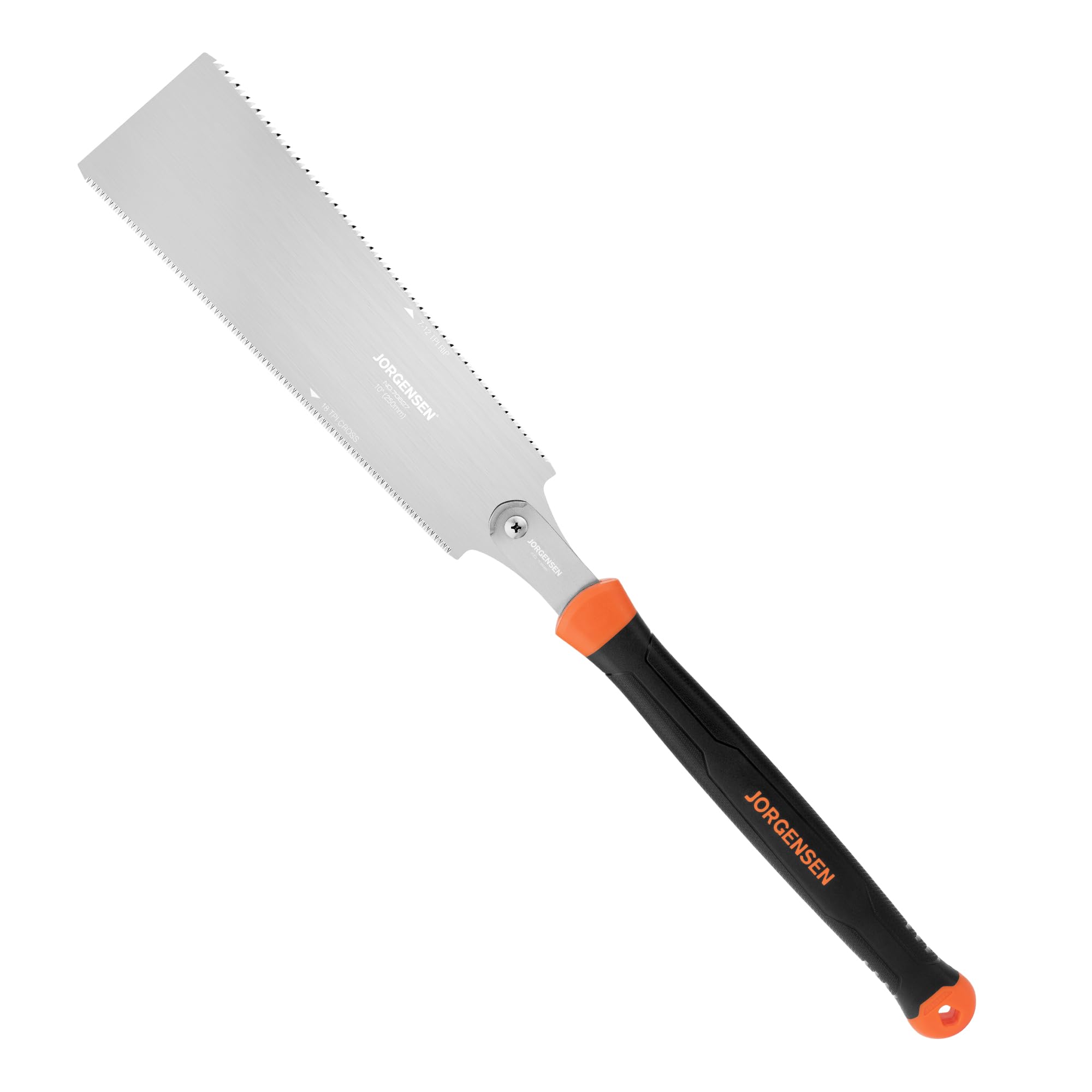
A ryoba that delivers cut quality comparable to saws costing twice as much.
The Jorgensen brings a thoughtful feature to the budget conversation: a replaceable blade. The SK5 Japanese steel blade is induction-hardened for wear resistance, and when it dulls, you loosen one screw, slide the old blade out, and install a new one. That extends the life of the tool well beyond a fixed-blade saw. The blade is 10 inches long and offers coarse teeth at 7-12 TPI on one side and fine 18 TPI on the other.
The handle is made from thermoplastic elastomers with a non-slip surface. Owners say it reduces fatigue during long sessions, and the triple-grind tooth geometry delivers cuts that are both fast and smooth. One buyer used it on white oak trim and casing and described the cuts as “clean fast cuts.” Another owner compared it directly to the Temple Tool ryoba and found the Jorgensen delivered comparable speed and cut quality at roughly half the price.
The one persistent gripe: the screw that holds the blade in place can come loose during use, no matter how tightly you turn it. A dab of thread-locker solves the problem for most, but it is something to be aware of straight from the start. Quality is the top-rated aspect across the reviews, and at 4.6 stars with more than 300 ratings, this is a solid mid-range pick.
What stands out
- Replaceable SK5 blade extends the saw’s useful life
- Triple-ground teeth deliver fast, smooth cuts in hardwood
- Ergonomic, non-slip handle reduces hand fatigue
What to watch
- Blade-retaining screw can loosen during cutting
- Durability has mixed reviews overall
Choose this for: The woodworker who wants a versatile ryoba and values the ability to swap a dull blade instead of buying a whole new saw.
skip it if: You prefer a one-piece traditional design with no mechanical joints to loosen.
5. Samurai KISI FC-240-LH / 9 1/2″ (24cm) Folding Curved Blade Saw

A curved folding saw that chews through 6-inch logs in about two minutes.
This saw is built for outdoor work where weight and packability matter. The blade is 240mm (9.5 inches) long and curved, which is a shape that naturally pulls the saw deeper into the cut with each stroke. The tooth pitch is 4mm — roughly 6.4 TPI — which is aggressive enough to clear thick, dead wood fast. The handle is rubber, which gives you a secure grip even when your hands are sweaty or the wood is wet.
Owners are consistent in their praise: this saw cuts dried hardwood limbs extremely fast. One buyer measured a 6-inch diameter piece and was through it in about two minutes. Another called it “better than a gas chainsaw” for the work it did on campfire wood. It folds up and is light enough (8 ounces) to toss into a backpack or survival kit without noticing the weight.
The honest trade-off is durability. A smaller number of customers note the blade tip breaking off over time, and the rubber handle feels slightly less premium than a wood or composite grip. The quality and cutting performance are the top-rated aspects, with 216 ratings holding a 4.7-star average. It is a fantastic companion for the trail as long as you are not prying or twisting the blade.
Why it works
- Curved blade pulls itself through cuts rapidly
- Folds compact for belt or pack carry
- Aggressive 4mm tooth pitch clears thick dead wood fast
Consider this
- Blade tip is vulnerable to breakage if abused or pried
- Handle materials feel less durable than premium picks
Ideal for: Campers, hikers, and hunters who need a compact saw for cutting firewood and clearing deadfall.
Less suited for: Daily pruning of live, wet branches in a garden setting — the aggressive teeth leave a rougher surface.
6. SUIZAN Ryoba Double Edge Saw 8″ – Japanese Pullsaw

Japanese steel and traditional craftsmanship that make precision woodworking accessible.
This is a genuine Japanese-manufactured saw, made in a region with over a century of saw-making history. The blade is 8 inches long with a thickness of 0.02 inches (0.5mm) and a kerf of 0.03 inches (0.8mm). That is a very thin blade, which translates to extremely clean cuts with very little sawdust waste. The 14 TPI teeth are designed for both ripping and crosscutting, and the blade is replaceable.
The handle is elastomer, which gives a comfortable, slightly soft grip that absorbs vibration. Owners say it is very sharp and easy to use, and that it requires no downward pressure because it cuts on the pull stroke. One reviewer noted that rip cutting white oak was no problem, and crosscuts came out “extremely fast and smooth.” The price is right for someone who wants to move beyond a budget saw into Japanese-quality steel without jumping to the premium tier.
The blade is flexible, which is good for thin-kerf precision but requires care when starting a cut. A few owners found the blade shorter than expected, and the included blade cover is very light duty. The most common advice: take your time on the first few strokes to establish the kerf line, and this saw will reward you with smooth, accurate cuts.
Highlights
- Genuine Japanese steel from a region with 100+ years of saw-making history
- Very thin blade (0.5mm) produces clean, waste-free cuts
- Replaceable blade design extends the saw’s life
Limitations
- Flexible blade requires precise start to avoid drift
- Blade cover is light-duty, shipping-only quality
Pick this for: The hobbyist woodworker who wants authentic Japanese steel and a traditional pull-saw feel while staying affordable.
Pass on this for: Heavy outdoor pruning of large, knotty branches where a stiffer blade and longer length are better.
7. Kanzawa Samurai Ichigeki Pruning Saw 330mm C-330-LH with Ergo Grip

A 13-inch pruning blade so sharp you will look for excuses to use it.
This is a specialist pruning saw with a 13-inch blade made of high-speed steel and tri-cut teeth. That combination produces an aggressive cutting action that clears through branches with almost no effort. Owners who have used it to remove 18-foot plum trees and 10-inch diameter trunks report that the cuts were easy and the saw stayed sharp through the entire job. It is a straight blade, not curved, which gives you more control on straight, vertical cuts.
It comes with a sheath that has a belt clip and an easy-release mechanism. That easy-release refers to the belt clip, not the saw itself — a handful of owners note the saw fits very snugly into the sheath and can be difficult to extract at first. The ergonomic rubber handle is another strong point; owners say the grip feels great and the saw is lightweight despite its 13-inch length.
At 14 ounces, it is heavier than the folding saws, but that weight translates to cutting power. The quality is the most-praised aspect, followed closely by cutting performance and sharpness. A few owners mention the sheath could use a locking cover, and there is no excess blade protection — it is ready to cut the minute you remove it from the package.
What it does best
- 13-inch tri-cut teeth clear large branches and small trunks in seconds
- Lightweight ergonomic rubber handle reduces fatigue on long jobs
- Sheath with belt clip keeps it accessible during yard work
Small annoyances
- Saw can be very tight in the sheath, making removal difficult
- No locking mechanism on the sheath cover
Best suited for: The professional arborist or dedicated homeowner who regularly deals with large pruning jobs and needs a razor-sharp, non-folding blade.
Not for: Casual trimmers or those who need a compact, packable saw — the 13-inch straight blade is purpose-built for reach and power.
8. Samurai 8230620 Samurai Curved Wooden Handle Saw 330 mm
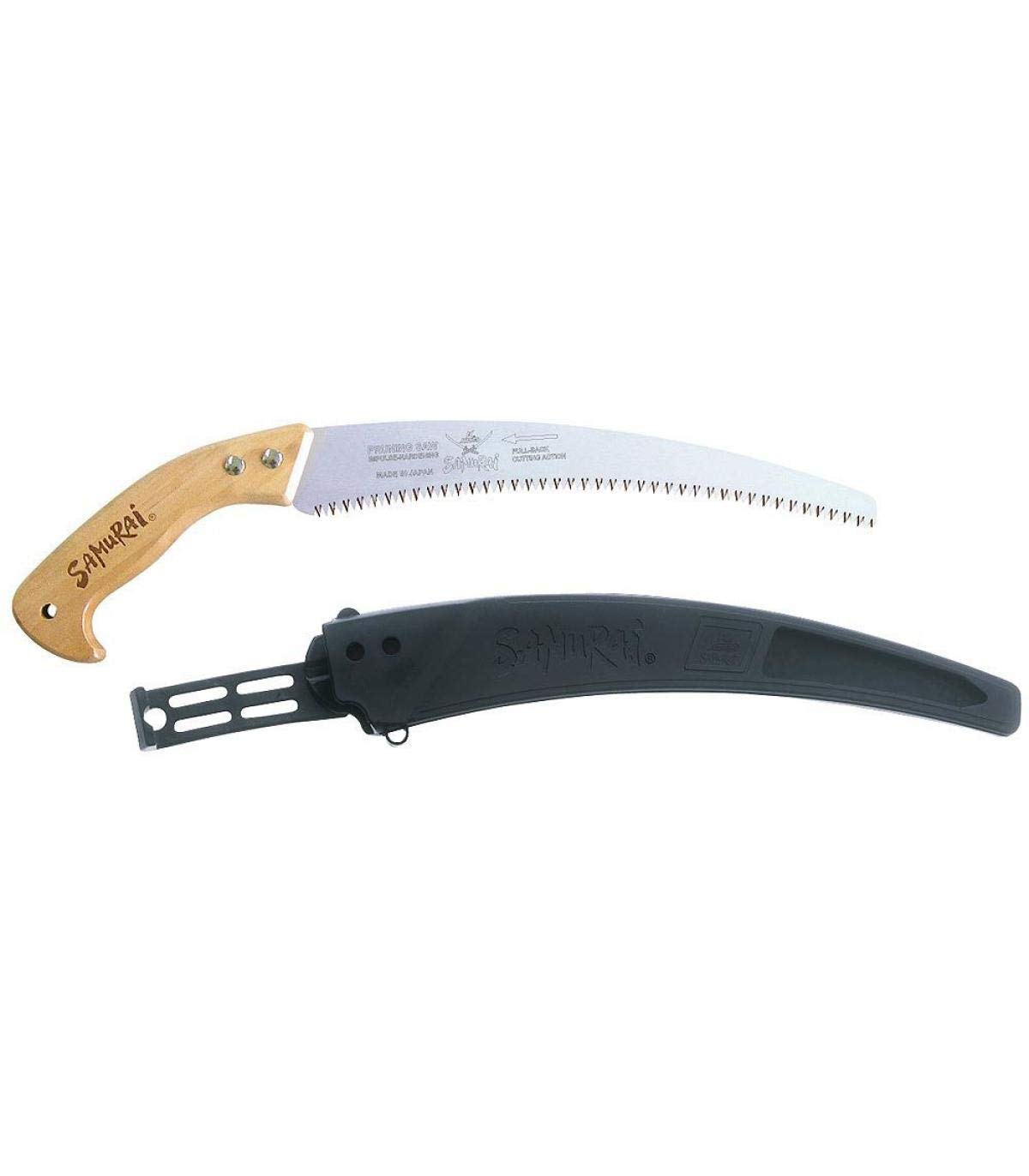
A curved blade and wooden grip honed over a career of garden pruning.
This saw is a longer-term investment in garden maintenance. The 330mm (13-inch) curved blade is made from alloy steel and uses a patented production process to create teeth that stay sharp for years. One owner reported using it regularly for four and a half years for home tree pruning and still found it cut 10cm thick branches quickly and easily. Another review mentioned a 13-plus year lifespan with frequent use, which is exceptional for any hand tool.
The handle is wood, which provides a traditional feel and excellent vibration dampening. The curved blade geometry is designed to pull itself through the cut, making it particularly effective on 3-8 cm thick branches. Owners with arthritic hands note the pull-stroke design and light weight (310 grams, or about 11 ounces) make it much easier to use than a push saw. It cuts quickly, but the surface of the cut is described as slightly rough — fine for pruning where you just want the branch gone.
A note on storage: this model lacks a sheath, which is a meaningful omission given how sharp the blade is. You will need to store it carefully or buy a blade guard separately. The plastic-handled version also lacks a sheath, so check the variant you order. Despite that, the cutting performance and longevity are what owners rave about most.
What stands out
- Proven longevity — reviewers point out 4+ years of regular use
- Curved blade pulls through cuts, requiring less effort
- Lightweight at 310g (11 oz) despite the long 13-inch blade
What to prepare for
- No sheath included — you must store it carefully
- Cut surface is slightly rough compared to fine-tooth finish saws
Grab it for: The gardener who wants a long-lasting, no-fuss pruning saw that handles medium-to-thick branches year after year.
Look elsewhere if: You need a sheath for safe belt carry or a fine finish cut for woodworking projects.
9. Japanese Pull Saw – 9.5 Ryoba Hand Saw with Rip-cut and Crosscut – Temple Tool Co.

A ryoba saw from Temple Tool that feels like an extension of your hand — sharp, large, and precise.
This is the largest ryoba in the Temple Tool lineup, about 50 percent bigger than their other models, which makes it suitable for timber framing and sizing large stock. The rip teeth gradually decrease in size from one end of the blade to the other, which creates a smoother pull and reduces the chatter that can happen with uniform tooth pitch. The crosscut side handles cuts across the grain with equal authority.
The handle is made of wingnut wood (in the walnut family) with brass components. It feels substantial and warm, and owners consistently describe it as comfortable. One owner called it the best ryoba saw they have ever owned, and another noted it cuts 1/2-inch wood in 30 seconds with zero effort. It is handcrafted in Japan by skilled artisans, which is a clear selling point for serious woodworkers. Quality is the top-praised aspect across the reviews, with 42 owners mentioning it positively.
The thin blade and pull-stroke design require a mental shift from push-saw habits. If you are used to a Western saw, you will need to let the teeth do the work without forcing it. A few owners note the long blade can be tricky to manage on smaller workpieces. At 4.8 stars with nearly 400 ratings, this is a crowd favorite for woodworkers who want a beautiful, functional ryoba.
Why it is special
- Large 9.5-inch blade (50% larger than standard) suited for timber framing
- Graduated rip teeth deliver a smooth, chatter-free pull
- Beautiful wingnut wood handle with brass fittings
What to adapt to
- Pull-stroke technique takes adjustment for push-saw users
- Large size can feel unwieldy on small joinery workpieces
Choose this for: The serious woodworker who wants a premium, large-format ryoba for joinery, timber framing, and sizing lumber with a beautiful finish.
Not the best fit for: Light trimming or one-handed pruning — this saw is built for the bench and the workbench, not the yard.
Understanding the Specs
Ryoba vs Kataba
These are the two main blade types. A ryoba saw has two separate cutting edges on one blade: one side for ripping (cutting along the wood grain) and one side for crosscutting (cutting across the grain). A kataba saw has teeth on only one edge, which makes the blade stiffer and better for deep, straight cuts in thick material. For general pruning and woodworking, a ryoba is the most versatile starting point.
TPI (Teeth Per Inch)
Tooth pitch controls the speed and finish of your cut. A lower TPI (6-10) eats through wood fast, making it ideal for green pruning wood where you just want the branch gone. A higher TPI (14-18) leaves a smoother surface, which is preferred for joinery and finish work where you will not sand the surface afterward. Double-edged ryoba saws often offer both, giving you one blade for both rough and fine cuts.
FAQ
How is a Japanese pruning saw different from a Western saw?
Do I need a specific technique to use a Japanese pull saw?
Can I use a Japanese pruning saw for dry, dead wood?
How long does a Japanese pruning saw blade stay sharp?
Can I sharpen a Japanese pruning saw?
Is a curved blade or a straight blade better for pruning?
What is the best blade length for a pruning saw?
How do I maintain a Japanese pruning saw?
Final Thoughts: The Verdict
For most people, the japanese pruning saw winner is the Silky Pocketboy 170mm Outback Edition because it combines pro-grade impulse-hardened teeth, a grippy arbor composite handle, and a folding design in a package that cuts through large limbs like nothing else in its class. If you want a dedicated flush-cut saw for woodworking, grab the Temple Tool Flush Cut Saw. And for a budget-friendly ryoba that introduces the pull-saw experience at a minimal cost, the RUITOOL 10-inch Ryoba is the one to reach for.
How We Picked
We do not accept paid placement. Every pick is matched to a real buyer and a real use-case; we do not hands-on test units.
Sources & Methodology
Specifications: manufacturer listings and product documentation. Review insights: verified customer reviews, as of July 2026. Pricing: not shown on this page (it changes often); check the current price via the retailer link.
As an Amazon Associate, Lawn Gear Lab earns from qualifying purchases. This does not affect which products we feature.