
Specs are compiled from manufacturer listings and verified buyer reviews and can change over time — please confirm the key details on the product page before buying.
If your Japanese maple’s leaves look washed out, scorched at the edges, or just not putting on the show you expected, the issue is almost certainly hiding underground. These trees are famously fussy about soil pH (a measure of acidity or alkalinity) — feed them the wrong thing and they let you know with drooping, discolored foliage. The good news is that the right fertilizer does not just fix the look; it builds the root strength and branch structure that keeps your tree thriving for years. This guide matches the specific formulation to your tree’s needs — whether you are battling pests, dealing with container restrictions, or just want that deep burgundy color your neighbor brags about.
I’m Rikta — the founder and writer behind Lawn Gear Lab. This guide is built by comparing the manufacturers’ published specifications and the patterns across verified customer reviews, so you get each pick’s real strengths and trade-offs instead of marketing spin.
You want the specifics on what actually works, which is exactly what this roundup of the best japanese maple tree fertilizer delivers — covering slow-release granules (pellets that break down over weeks), liquid concentrates, and all-in-one pest control options so you can match your routine and your budget.
Our Picks at a Glance

How To Choose The Best Japanese Maple Tree Fertilizer
Picking the wrong bag off the shelf can set your tree back a whole season. You need a formula designed for acid-loving plants that won’t scorch delicate feeder roots (thin roots near the surface that absorb water and nutrients).
Match the N-P-K Ratio to Your Goal
The three numbers on the bag tell you the ratio of nitrogen (N), phosphorus (P), and potassium (K). A higher middle number (phosphorus) encourages stronger roots and branch development, which is what most Japanese maples need. A very high first number (nitrogen) pushes green leaf growth, which can actually weaken a mature tree.
Choose Your Application Method
Granules are set-and-forget — you sprinkle them around the base and water them in once or twice a year. Liquids give you more control, letting you feed every two weeks through the growing season, and they are often the better choice for container trees where granules can build up.
Look for Mycorrhizal Fungi or Beneficial Microbes
These living organisms live in the soil and help the roots absorb more water and nutrients. A fertilizer that includes them can dramatically boost the results you see without requiring your tree to eat more food.
Quick Comparison
| Model | Best For | Formulation | Size | N-P-K Ratio | Amazon |
|---|---|---|---|---|---|
| BioAdvanced 12 Month★ Best Overall | Pest Control + Feeding | Granules | 64 Ounce | — | Amazon |
| TreeHelp PremiumJapanese Maple Specialist | Japanese Maple Focus | Granules | 52.9 Ounce | — | Amazon |
| FoxFarm Happy FrogSoil Booster | Low pH Feeders | Powder | 4 lb | 4-3-4 | Amazon |
| TPS Nutrients Liquid | Liquid for Roots | Liquid | 32 oz | — | Amazon |
| Bloom City Liquid | Gentle Liquid Feed | Liquid | 32 oz | — | Amazon |
| Miracle-Gro Spikes | Set & Forget | Sticks | 24 Count | — | Amazon |
| TPS Japanese Maple | Large Liquid Volume | Liquid | 1 Gallon | — | Amazon |
| Down To Earth Acid Mix | Organic Acid Lovers | Granules | 25 lb | 4-3-6 | Amazon |
In‑Depth Reviews
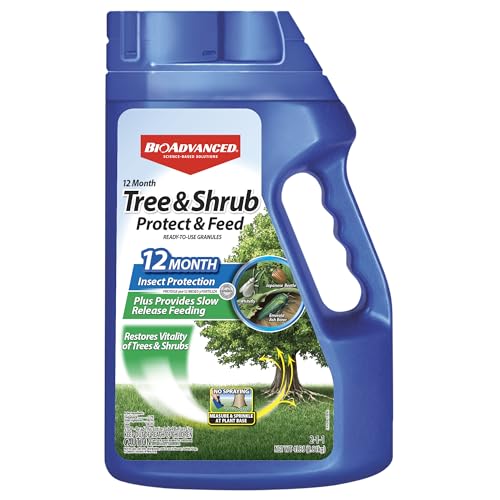
1. BioAdvanced 12 Month Tree and Shrub Protect and Feed
Our pick — over 4.5★ from 5,000+ verified ratings; the strongest balance of quality and price.
The one product that feeds the tree and kills bugs in one single application.
This is the crowd favorite for a clear reason — it solves two problems at once. The granules, which come in a 64-ounce bottle, contain a systemic insecticide (a chemical that moves through the tree’s sap to kill pests from the inside) that targets Japanese Beetles, Emerald Ash Borers, and aphids, along with a slow-release plant food. That means a single treatment around the base of the tree handles feeding for the season and stops insects that chew through your leaves. Buyers report that even a tree suffering severe scale bounced back with “lush growth and abundant blooms.”
The biggest draw is the simplicity: you measure with the built-in cup, sprinkle it on the soil, and water it in. No spraying, no mixing, no repeat visits. One owner described a massive turnaround in just 25 days, noting a huge improvement in foliage color. The protection lasts up to 12 months, so you are not re-applying mid-summer when pests are at their worst.
The only real drawback is that an occasional unit arrives with a damaged or missing measuring cup. Also, because this is a chemical pesticide, you cannot use it on any edible plants you might be growing near your maple. The value perception is mixed among buyers, with some finding the price a bit high for a single-season product.
Two-in-One Power
- Fertilizer and insecticide in one simple granular application
- Lasts an entire year with no re-application needed
- Owners mention visible results in as little as 25 days
Real Trade-offs
- Not safe for use near edible fruits or vegetables
- Occasional reports of the measuring cup arriving damaged or missing
Reach for this if: you have Japanese beetles, aphids, or scale attacking your tree and you want a single annual treatment that also feeds the roots.
Look elsewhere if: you grow vegetables close to your maple or prefer a completely organic approach to pest management.
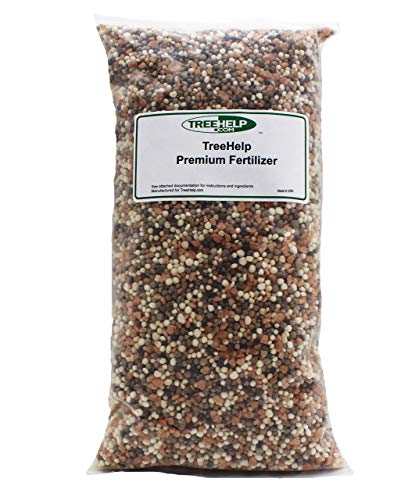
2. TreeHelp Premium Fertilizer for Japanese Maple
The exact formula engineered for Japanese maples with slow-release nitrogen for steady growth.
Unlike a general tree food, this granular blend (small pellets) was built specifically for Japanese maple physiology. The 52.9-ounce bag covers one large tree or two to three smaller or newly planted specimens. The key here is the slow-release nitrogen, which feeds the tree throughout the entire growing season without causing a sudden growth spurt that can weaken branches. Customers note a huge difference in foliage density, with one owner noting “more foliage than any year since I’ve owned it” on a 5-year-old tree.
The application method is a bit different from standard sprinkle-and-go products. The instructions recommend drilling holes into the soil around the tree and placing the granules inside. Some buyers were surprised by this, as it requires a tool like an auger (a spiral drill bit) for a drill to create the holes. That extra step, while slightly inconvenient, delivers the fertilizer directly to the root zone where the tree can actually use it.
The company also gets high marks for customer service. Several owners mentioned that TreeHelp responded quickly and helpfully when they emailed with questions about fertilizing maples in containers. On the downside, this product is not available for sale in Washington state, so it is worth checking the restrictions.
Designed for the Tree
- Specifically formulated for Japanese maple physiology
- Slow-release nitrogen feeds the tree all season
- Excellent customer support from the manufacturer
Consider This
- Requires drilling holes into the soil for best results, which means you need an auger
- Not available for sale in Washington state
Perfect for: the dedicated gardener who wants a species-specific formula and is willing to put in a little extra installation effort for superior root delivery.
skip it if: you want a simple sprinkle-and-water product or you live in Washington state.
3. FoxFarm Happy Frog Japanese Maple Fertilizer
The soil-building formula that turned a one-foot stick into a seven-foot tree in two years.
FoxFarm’s Happy Frog line has a cult following for a good reason: it feeds the soil as much as it feeds the tree. This 4-3-4 blend (meaning 4 parts nitrogen, 3 parts phosphorus, 4 parts potassium) is specially formulated for Japanese maples, hydrangeas, and other low pH feeders (plants that prefer slightly acidic soil). what separates it is the inclusion of beneficial microorganisms and mycorrhizal fungi — living organisms that team up with the roots to increase nutrient uptake and water absorption. The result is stronger branches and deeper foliage color.
One owner’s story captures the potential: two years ago they planted a 1-foot tall Japanese maple, fed it this product as directed, and today it stands over 7 feet tall and 5 feet wide with “amazing beautiful color.” The powder form is easy to apply — you mix 2 tablespoons per 1 gallon of water or simply top-dress the soil (sprinkle on top) and water it in. The recommended schedule is a monthly feeding throughout the growing period.
Because it is a powder rather than a pellet, it can drift in the wind on a breezy day if you do not work it into the soil immediately. A couple of buyers also noted that it is too early to see results after just three weeks, so patience is required. Still, with an effectiveness count that leads all feedback, this is the pick for gardeners who want to build long-term soil health.
Living Soil Formula
- Contains mycorrhizal fungi and beneficial microbes for root efficiency
- Specific 4-3-4 blend designed for acid-loving plants
- Buyer reports of extraordinary growth — from 1 foot to over 7 feet tall
One Watch-Out
- Powder form can blow away in the wind if not watered in promptly
Best for: anyone who sees their Japanese maple as a long-term investment and wants to build the soil biology as much as feed the tree.
Think twice if: you want a one-and-done annual application and prefer pellets that won’t drift.
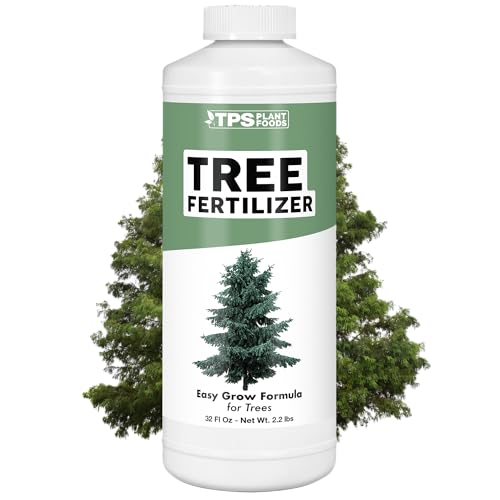
4. TPS Nutrients Tree Fertilizer – Liquid Plant Food
A liquid concentrate that soaked life back into a pine tree everyone thought was dead.
If your tree is looking weak and you want to see quick results, a liquid feed gives you more control than granules. This 32-ounce bottle from TPS Nutrients mixes at a 1:64 ratio (1 part concentrate to 64 parts water), meaning a single bottle goes a long way. It is designed to promote deep root systems and strong structure, making it a solid choice for young or stressed trees. One buyer described bringing a pine tree “almost dead, brown all around” back to full health after feeding it every other week through one season — a more dramatic turnaround than the TreeHelp granules, which is better for steady maintenance.
The biggest advantage of a liquid is the speed of uptake. The roots can access the nutrients almost immediately after watering, which is why many owners mention seeing greener leaves within days. The formula is made in the USA and works for shade trees, ornamental trees, and general yard plantings.
On the downside, a liquid routine requires more frequent application than a granular — feeding every other week during the growing season is the schedule most users follow. If you prefer a hands-off approach, the simplicity of a spike or one-time granule might suit you better.
Fast-Acting Formula
- Liquid concentrate delivers nutrients immediately to roots
- High 1:64 mixing ratio makes the bottle economical
- Reviewers point out reviving trees that were nearly dead
Requires Consistency
- Needs to be applied every other week during the growing season
- Not a “set and forget” solution like granules
Ideal for: container trees, young plantings, or any maple that looks stressed and needs a rapid boost.
Consider a granule instead if: you travel frequently or prefer to feed your trees just once or twice a year.
5. Bloom City Tree & Shrub Fertilizer – Liquid Plant Food

The gentle liquid that won’t scorch leaves, even on sensitive ornamentals.
Bloom City made a name for itself by focusing on formulations that are strong enough to drive growth but mild enough to avoid burning roots and foliage. This 32-ounce liquid is designed for landscape trees and ornamental shrubs, and shoppers say seeing visible improvement within the first two months. It supports root strength and dense foliage, and it works on trees ranging from olive trees to blue spruce to redbuds. One buyer specifically noted that it “didn’t cause leaf burn like some others I tried before.”
The bottle is made in the USA and is suitable for hedges, foundation plantings, and backyard trees. Because it is liquid, you can control the dosage more precisely than with a granular, which is helpful if you are treating a small or container-grown maple. The biggest complaint is the smell — one owner described it as “liquid fish” that absolutely wreaks, so you will want to mix it outdoors.
While many users praise its effectiveness, the feedback volume is lower than the top picks, meaning the long-term track record is less established. It is still a very solid choice, especially for anyone who has burned a plant with a too-strong chemical feed in the past.
Leaf-Safe Formula
- Gentle enough not to cause leaf burn, even on sensitive ornamentals
- Works on a wide range of trees and shrubs including blue spruce and redbuds
- Made in the USA
A Note on Aroma
- Odor is strong and fish-like — best mixed and stored outdoors
Grab this if: you have burned a plant with a harsh synthetic feed before and want a formula that builds roots without risk of scorching.
Probably not for you if: you are sensitive to strong smells or keep your fertilizer supplies inside a garage or shed.
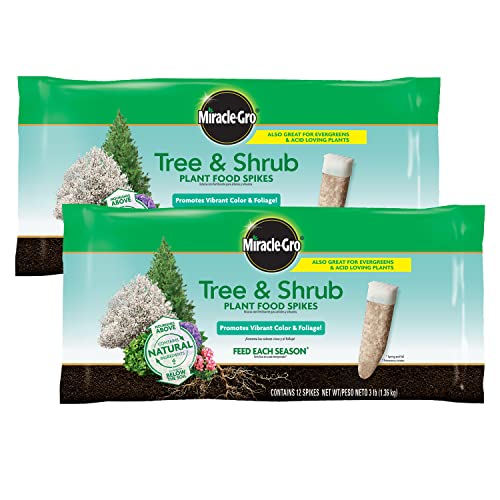
6. Miracle-Gro Tree & Shrub Plant Food Spikes, 24 Count
Just hammer them into the ground twice a year and forget about feeding until the next season.
If you are the kind of gardener who wants the highest results with the lowest effort, spikes are your answer. This 24-count pack from Miracle-Gro covers multiple trees: you simply push the spike into the soil around the drip line (the outer edge of the tree’s canopy), and it releases nutrients directly into the root zone. The formula contains natural ingredients and is designed for deciduous (trees that lose leaves in fall), flowering, and evergreen trees, including acid-loving plants like maples and hydrangeas. The feeding schedule is simple — once in spring, once in fall.
Buyers report that their trees and shrubs are thriving with this routine, and many note how easy the spikes are to use. One owner called it “a must have for your trees.” The spikes come with a rubber cap to protect your hand while hammering them into the ground, though a few buyers noted their package arrived without the cap, requiring them to dig a hole instead.
The main limitation is that spikes deliver nutrients only to the immediate area around each spike, whereas granules spread across a wider root zone. For a large, established Japanese maple, you might need several spikes to cover the full root system, which raises the cost per feeding compared to a bag of granules.
Minimal Effort
- Pre-measured spikes with no mixing, measuring, or guessing
- Twice-yearly schedule — spring and fall
- Contains natural ingredients
One Concern
- Occasional packages arrive without the plastic driving cap
- Coverage may be less uniform than granular or liquid applications
Ideal for: the low-maintenance gardener who has multiple trees and wants a predictable, no-mess feeding routine.
pass on it if: you have a very large mature maple with an extensive root system that needs even coverage.
7. TPS Nutrients Japanese Maple Fertilizer – 1 Gallon
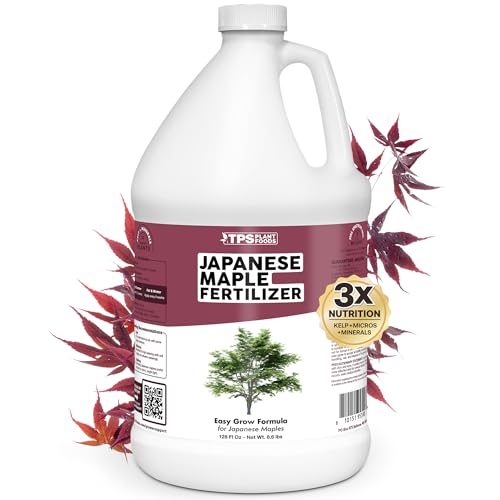
The big bottle that brought a 30-year-old dying maple back to life.
When your tree has been in the ground for decades and suddenly starts declining, you need a powerful intervention. This 1-gallon liquid (128 fluid ounces) from TPS Nutrients is specifically formulated for Japanese maples, and the reviews are remarkable. One owner described a 20+ year-old dwarf maple that was suffering from leaf burn and poor coloring making a full recovery after following the instructions. Another reported that their 30-year-old tree, which had “started to die,” responded with new vigor. The formula is designed to support vibrant leaf color, root strength, and steady new growth.
At 128 fluid ounces, this is the largest liquid volume in the lineup, making it the economical choice if you have multiple trees or a very large specimen — far more than the 32-ounce TPS bottle above. The liquid form allows you to treat the entire root zone evenly, and the results are visible quickly — users report noticing a difference in leaf vibrancy within just two weeks. It is also made in the USA.
The only recurring complaint is about packaging, not the product itself. A couple of buyers received their bottle with a missing or broken lid, which makes sealing the container for the next use impossible. That is a shipping quality issue rather than a formula problem, but it is note so you inspect the package on arrival.
High-Volume Rescue
- 1-gallon bottle offers the most liquid per purchase in this roundup
- Owners mention reviving 20+ and 30-year-old trees that were in decline
- Visible results in leaf color and density within two weeks
Shipping Watch
- Some bottles arrive with a missing or broken lid due to shipping handling
Reach for this if: you have a mature Japanese maple that has lost its color or vigor and you need a large-volume, targeted liquid feed.
Look elsewhere if: you only have a single small tree and a gallon would take years to use up.
8. Down To Earth All Natural Fertilizers Organic Acid Mix – 25 lb
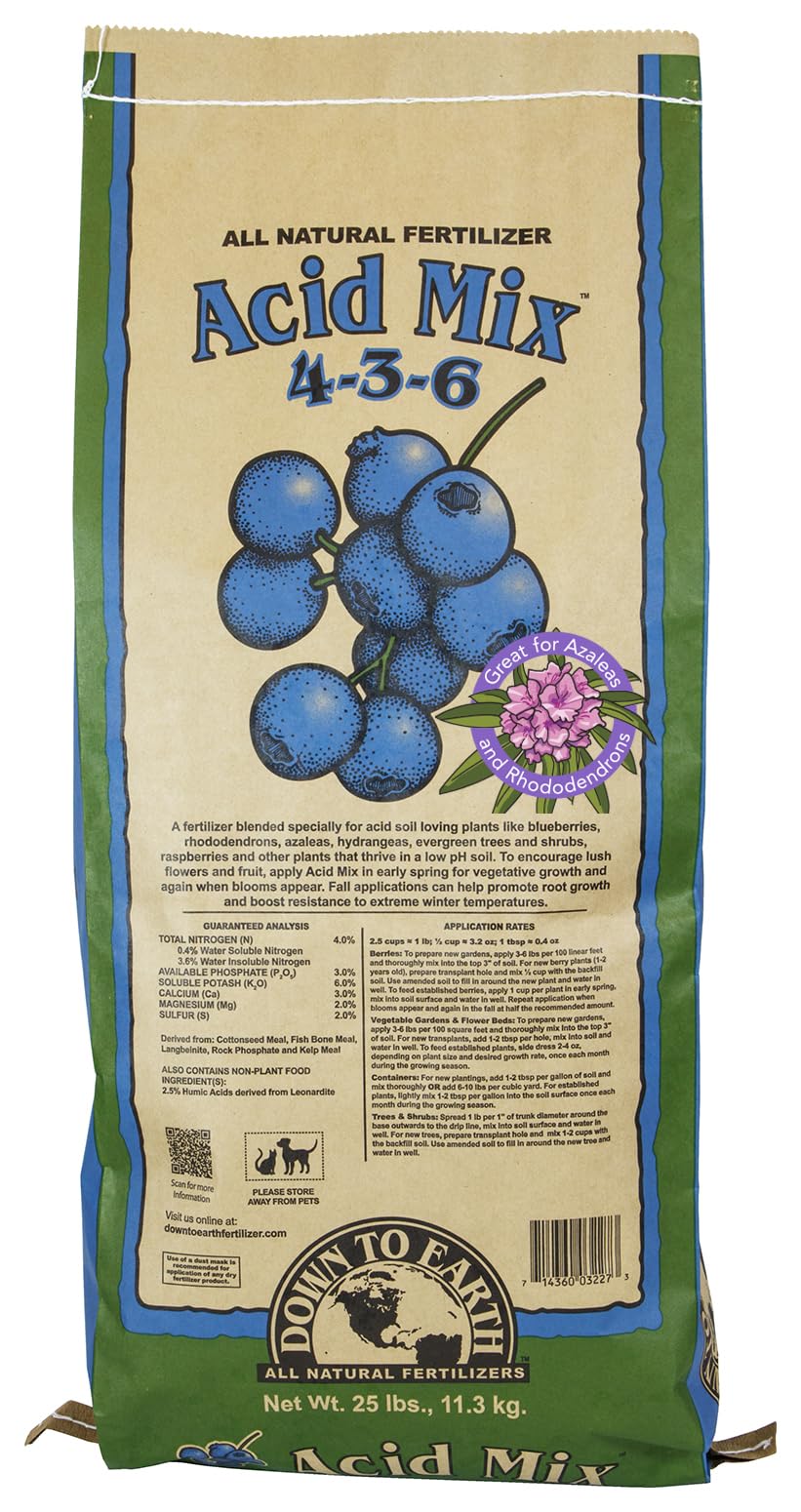
The organic 25-pound bag that keeps an entire garden of acid-lovers fed for seasons.
Down To Earth built its reputation on all-natural ingredients, and this Acid Mix is no exception — a 4-3-6 formulation (4 parts nitrogen, 3 parts phosphorus, 6 parts potassium) made from cottonseed meal, langbeinite (a natural mineral), fish bone meal, rock phosphate, humates (organic soil compounds), and kelp meal. It is designed for any plant that needs a low pH: blueberries, raspberries, azaleas, camellias, rhododendrons, hydrangeas, evergreens, and, of course, Japanese maples. If you have a mixed bed of acid-loving plants, this single bag covers them all. At 25 pounds, it offers the lowest cost per feeding of any pick here.
The application is straightforward: spread it in early spring for vegetative growth, again when blooms appear, or in the fall to support root growth and winter hardiness. Customers note that their rhododendrons are “growing like crazy” and that their blueberry bushes produce significantly more fruit after using this mix. It is also perfect for maintaining the slightly acidic soil that maples demand.
The only real consideration is the size. A 25-pound bag is heavy and requires storage space. If you only have a single small maple in a container, you will be working from this bag for years. It is best suited to the home gardener with multiple beds and a shed to keep the bag dry.
Natural & Economical
- Certifiable all-natural ingredients with a clean 4-3-6 formulation
- Covers a wide range of acid-loving plants beyond just maples
- Lowest per-feeding cost of any product in this roundup
Storage Note
- 25-pound bag is bulky and needs a dry storage area
- Excessive for a single small or container-grown maple
Ideal for: the gardener with a full landscape of acid-loving trees and shrubs who wants one organic product that does it all.
Not the best fit if: you have a single Japanese maple in a pot and don’t want a massive bag sitting around.
Understanding the Specs
N-P-K Ratio (Nitrogen-Phosphorus-Potassium)
This is the three-number code on the bag, and it tells you exactly what the fertilizer prioritizes. The first number is nitrogen, which pushes leaf growth and green color — useful in spring but excessive nitrogen late in the season can cause weak, floppy growth. The middle number is phosphorus, which drives root development and strong branches. The third number is potassium, which supports overall plant health and disease resistance. For Japanese maples, a balanced ratio with a slightly higher middle number, like a 4-3-4, is the balance.
Slow-Release vs. Quick-Release
A slow-release fertilizer breaks down gradually over weeks or months, feeding the tree steadily without overwhelming it. This is safer for delicate maple roots because it reduces the risk of salt burn (damage from too much mineral salt in the soil). Quick-release liquids give you a fast green-up but require more frequent application — every week or two — and the risk of burning the plant is higher if you overdo the concentration. Most experts recommend slow-release granules for in-ground trees and liquid for container trees where you need more control.
FAQ
Can I use a regular all-purpose fertilizer on my Japanese maple?
When is the best time to fertilize a Japanese maple?
Should I fertilize a Japanese maple in a container differently?
How do I know if my Japanese maple is getting too much fertilizer?
Can I use a fertilizer that also kills bugs?
What does a 4-3-4 N-P-K ratio mean for my maple?
Is organic or synthetic fertilizer better for Japanese maples?
How long does it take to see results from a new fertilizer?
Will these fertilizers work on other trees in my yard?
Can I overfeed a Japanese maple in a single application?
Final Thoughts: The Verdict
For most people, the best japanese maple tree fertilizer winner is the BioAdvanced 12 Month Tree and Shrub Protect and Feed because it solves the two biggest threats to a maple’s health — nutrient starvation and pest damage — in a single, simple annual application. If you want a species-specific formula that puts all its energy into root and branch development, grab the TreeHelp Premium Fertilizer. And for the organic gardener who wants to build living soil and has multiple acid-loving plants around the yard, the Down To Earth Acid Mix is the one to reach for.
How We Picked
We do not accept paid placement. Every pick is matched to a real buyer and a real use-case; we do not hands-on test units.
Sources & Methodology
Specifications: manufacturer listings and product documentation. Review insights: verified customer reviews, as of July 2026. Pricing: not shown on this page (it changes often); check the current price via the retailer link.
As an Amazon Associate, Lawn Gear Lab earns from qualifying purchases. This does not affect which products we feature.