
Specs are compiled from manufacturer listings and verified buyer reviews and can change over time — please confirm the key details on the product page before buying.
You have likely wrestled with a flimsy trowel that bends on the first rock or a weeder that leaves the root behind. A Japanese garden knife — the hori hori — changes that entirely. It digs, slices through roots, measures planting depth, and pries open soil, all with one solid piece of steel. The trick is knowing which steel and handle shape actually hold up in real dirt.
I’m Rikta — the founder and writer behind Lawn Gear Lab. This guide is built by comparing the manufacturers’ published specifications and the patterns across verified customer reviews, so you get each pick’s real strengths and trade-offs instead of marketing spin.
Whether you are a weekend planter or a seasoned landscaper, choosing the right japanese garden knife means the difference between a tool that fights you and one that makes every task feel easy.
Our Picks at a Glance

How To Choose The Best Japanese Garden Knife
A hori hori is a single blade that replaces a trowel, a weeder, a saw, and a measuring stick. But not every steel is the same, and not every handle fits your grip. Focus on these three things and you will walk away with a tool you reach for every time you step outside.
Full Tang Construction
The blade should extend in one solid piece all the way through the handle. A full tang knife does not snap at the handle joint when you pry out a stubborn root or lever up a rock. If the metal stops inside the handle, that is a weak point waiting to bend or break under pressure.
Dual-Edge Blade: Serrated vs. Straight
A real hori hori gives you two edges in one knife. The serrated side saws through thick roots, tough vines, and compacted soil. The straight, sharp side slices cleanly through stems, twine, and soft plant matter. A single edge limits you to one job, so a dual-edge knife is the only type worth considering.
Handle Material & Grip
Wood handles (walnut, rosewood, Pakkawood) feel classic in the hand and absorb shock well, but they need to be dried after wet use. Synthetic handles like TRP and composite plastic stay grippy when wet and never crack, but they lack that traditional warmth. Choose wood for the look and feel of a heirloom tool; choose synthetic for zero-maintenance grip in mud and rain.
Quick Comparison
| Model | Best For | Blade Length | Edge Type | Handle Material | Amazon |
|---|---|---|---|---|---|
| WORKPRO Hori Hori★ Best Overall | Best Overall | 7 inches | Dual (Serrated + Plain) | TRP | Amazon |
| ROYTOA Hori HoriClassic Walnut | Best Walnut Wood Handle | 7 inches | Dual (Serrated + Plain) | Walnut Wood | Amazon |
| Zenport K245Budget Champion | Budget-Friendly Workhorse | 6 inches | Dual (Serrated + Plain) | Plastic | Amazon |
| RiverView Hori Hori | Heirloom Quality with Sheath | 7 inches | Dual (Serrated + Plain) | African Rosewood | Amazon |
| Nisaku NJP651 | Hardened Japanese Steel | 7.25 inches | Dual (Serrated + Plain) | Wood | Amazon |
| Nisaku NJP6510 | Rust-Proof Premium Build | 7.25 inches | Dual (Serrated + Plain) | Wood | Amazon |
| A.M. Leonard Deluxe | Pro-Grade Durability | 6 inches | Dual (Serrated + Plain) | Stainless Steel | Amazon |
| TONMA Hori Hori | Japanese AUS-8 Steel | 7.2 inches | Dual (Serrated + Plain) | Pakkawood | Amazon |
| Barebones Hori Hori Classic | Vintage Design & Styling | 6.75 inches | Dual (Serrated + Plain) | Walnut | Amazon |
In‑Depth Reviews
1. WORKPRO Hori Hori Garden Knife
Our pick — over 4.5★ from 950+ verified ratings; the strongest balance of quality and price.
A 7-inch stainless steel blade that does not quit on the toughest roots.
This is the one you buy when you want a single tool that replaces your trowel, weeder, and saw. The 7-inch stainless steel blade gives you two distinct edges: a serrated side that chews through large roots and wood, and a straight sharp side that glides through vegetables, ropes, and twigs. The blade also carries easy-to-read depth markings in inches and millimeters, so you can plant bulbs or seedlings at exactly the right depth without a separate ruler.
The TRP handle is what sets this apart from cheaper knives. It is ergonomically shaped and stays non-slip even when your hands are muddy or wet. Buyers report it feels “strong and sturdy,” with one describing it as the best gardening hand tool they have purchased in years. It digs through hard ground, saws off stray roots, and scoops up dirt — all without the handle slipping. The included Oxford sheath clips to your belt, so the knife stays at your side and the blade stays covered when not in use.
The main trade-off is that the edges are not razor-sharp straight from the box for woody branches. Some owners note it handles non-woody suckers fine but may need a touch-up for thicker pruning. Still, at this price and with this build quality, it is the crowd favorite for a reason.
What wins people over
- Full-tang construction prevents handle snapping under heavy prying
- TRP handle stays comfortable and non-slip in wet conditions
- Depth markings on blade save time when planting bulbs
The honest caveat
- Edges may not be sharp enough from the start for thick woody branches
- Minor oily residue on arrival, per a few owners
Reach for this if: you want one affordable knife that digs, cuts, measures, and lasts — without fussing over maintenance.
Look elsewhere if: you need a blade that slices through thick woody branches straight from the package, or you want a traditional wood handle.
2. ROYTOA Hori Hori Garden Knife
A full-tang walnut wood handle that feels solid from the first grip.
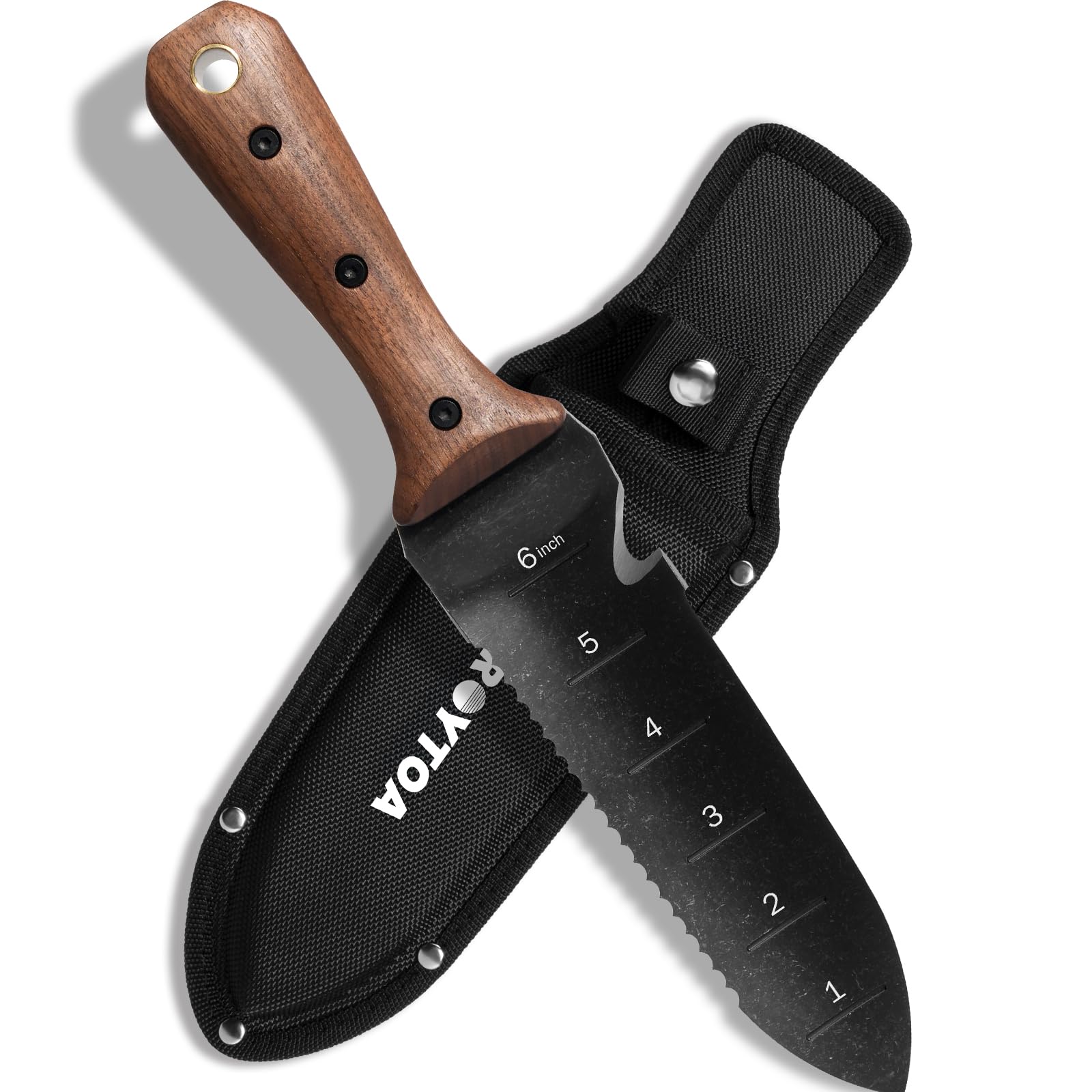
This knife brings traditional craftsmanship to the front. The full-length 12.1-inch tool has a 7-inch blade made of high-grade stainless steel that extends into a full tang, meaning one continuous piece of metal runs from the tip to the base of the handle. Three metal rivets lock the blade securely into the walnut wood, so you never worry about bending or breaking while prying out deep taproots.
The dual-edge blade has a sharp straight side and a serrated side that cuts through tough roots. The curved blade shape and depth markings in inches make planting a breeze. What owners praise most is the quality and durability — this is a knife that feels “heavy and solid” in the hand, with one homesteader calling it the best they have ever bought by far. The protective sheath includes a belt loop, and the top of the handle has a hanging hole for garage storage.
The catch is that this knife is extremely sharp right out of the package. A few owners mention it requires caution because it caused a finger cut. That is less a flaw and more a reminder to use the included sheath and handle it with respect. The wood handle also needs to be dried after wet use to prevent cracking over time.
Sharp and sturdy: The quality (34 owner mentions) and durability (28 mentions) lead the positive feedback, and the knife works equally well in pots, raised beds, and ground soil.
Best for: gardeners who want a traditional wood-handled knife that feels like it was built to last decades — and can handle both tender transplants and tough root systems.
Think twice if: you prefer a synthetic handle that never needs drying, or you want a lighter tool for extended one-handed weeding sessions.
3. Zenport K245 ZenBori Soil Knife
A bright orange handle that you will never lose in the garden bed.
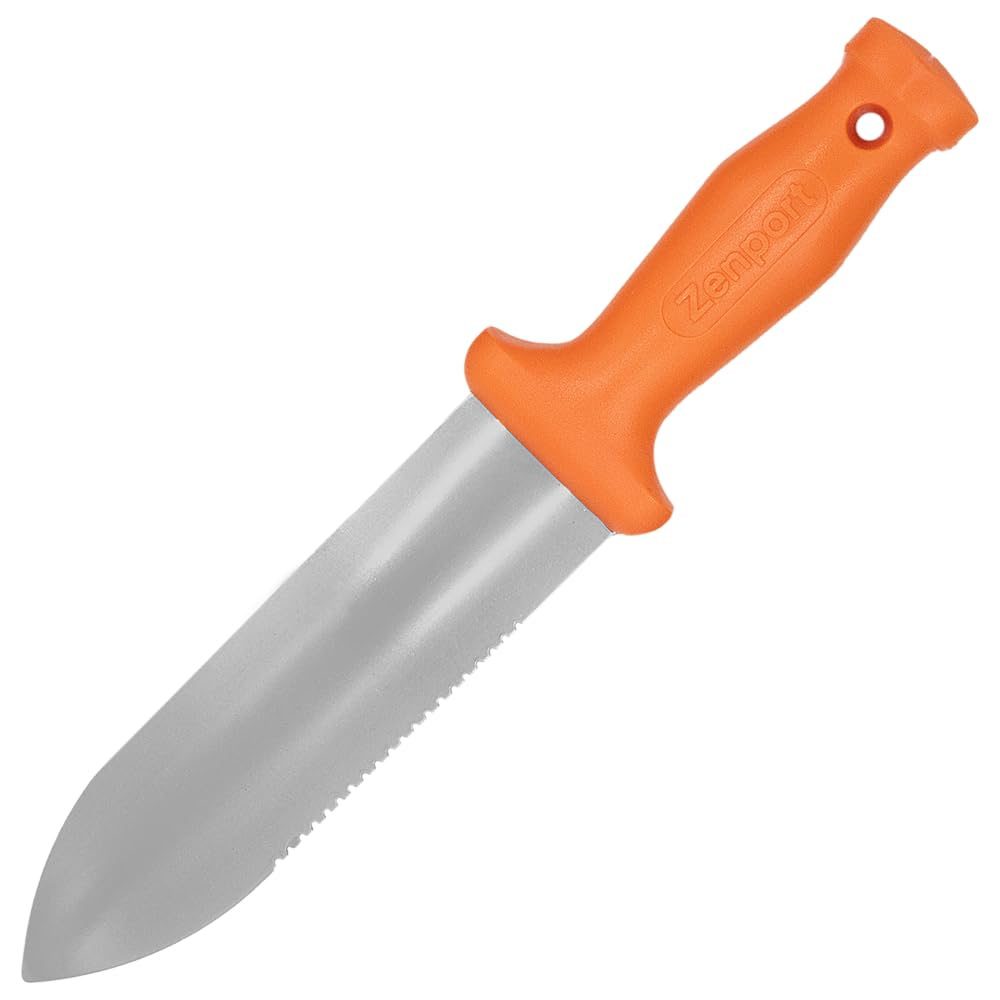
This is the budget-friendly pick that does not cut corners on the fundamental spec: full tang construction. A single piece of stainless steel runs from the blade tip to the handle base, eliminating flex and weak joints. The result is a knife that delivers the same structural integrity found in professional cutlery but at an entry-level price. The orange handle is not just for looks — it gives you a secure, non-slip grip even in wet, muddy conditions, and it stays visible when you drop it among leaves or soil.
The 6-inch stainless steel blade is shorter than the WORKPRO and ROYTOA, but it combines a serrated edge for sawing through roots and compacted soil with a straight edge for clean cuts. Owners mention it goes “through sod like butter” and makes digging holes for planting noticeably easier. The quality is the most-praised aspect by a wide margin, and owners consistently say it is well worth the money.
The honest trade-off: this knife does not come with a sheath or depth markings on the blade. If you need to measure planting depth precisely or want a protective cover for storage, you will need to buy those separately. The plastic handle is durable but does not have the warm feel of wood.
Grab this for: gardeners on a budget who want a tough, no-frills knife that prioritizes full-tang strength and high visibility over extras like a sheath or depth gauge.
Pass if: you need built-in depth measurements, a protective sheath, or a wood handle.
4. RiverView Enterprise Hori Hori Garden Knife

Comes with a thick leather sheath and a sharpening stone — everything you need.
This is the knife for the gardener who wants everything in one box. The 7-inch concave blade is made of stainless steel with a sharp pointed tip for easy soil penetration. One side is serrated for cutting roots and small branches; the other is straight and sharp for slicing vines, cord, and dividing perennials. Engraved ruler markings in inches and millimeters let you plant at exact depths. The blade is full tang — one continuous piece of steel — with an African Rosewood handle that is hard, smooth, and water-resistant, held by three rivets.
What improve this package is the thick leather sheath, stitched and riveted, with a belt loop so the knife is always at your side. It also includes a whetstone for keeping the blade sharp. Buyers consistently praise the quality, with many calling it a “beautiful tool” that handles hard clay soil better than any trowel. The hand guard is a critical safety feature that prevents your hand from slipping forward onto the blade during deep digging.
The main caveat is that this knife is heavy — it has a substantial feel that some owners love and others find tiring during long sessions. The walnut-colored handle can also be hard to spot if you set it down in the garden. A few owners suggest a brighter handle color, but that is a minor quibble given the lifetime product guarantee and included accessories.
Quality-focused build: Quality (110 owner mentions) and sturdiness (46 mentions) are the top aspects, and the knife is described as an “excellent durable craftsmanship” that stays sharp through months of heavy use.
Ideal for: the gardener who values a complete kit — knife, leather sheath, and sharpening stone — and wants a heavy-duty tool that feels like an heirloom.
Not for: those who prefer a lighter, less ornate knife, or anyone who does not want to maintain a wood handle.
5. Nisaku NJP651 Hori Weeding & Digging Knife

Japanese stainless steel hardened to HRC58 for a blade that barely dulls.
This is the specialized pick for buyers who obsess over steel quality. The HRC58 Special Edition blade is the hardest in the Nisaku Hori line. It uses a concave design with one side beveled sharp for slicing and the other serrated for cutting. The 7.25-inch blade carries engraved inch markers, and the tool is made by Japanese artisans who have devoted a lifetime to perfecting these knives. Traditionally, this style was used by Matagi (traditional Japanese hunters) to excavate wild vegetables in the mountains.
Customers note that this knife slices right through the top of weed roots for minimal soil disturbance, saws through small branches and tree suckers, and stays sharp through extended use. The quality is the most-praised aspect, and many owners say it is incredibly well-balanced. The wooden handle provides a secure grip during extended use, and the leather sheath ensures safe storage.
The durability aspect is mixed — while some find it solid in the hands, a smaller number report it breaking. This knife requires care: owners recommend cleaning and drying it after use to prevent rust and wood cracks, and mineral oil for winter storage. It is not a low-maintenance tool, but for those who maintain it, it delivers performance that cheaper knives cannot match.
Who it suits: gardeners who appreciate fine Japanese steel and are willing to maintain the blade for a tool that cuts easily and stays sharp for years.
skip it if: you want a low-maintenance knife that can handle neglect, or you need a blade that resists rust without special care.
6. Nisaku NJP6510 Namibagata Hori Knife

A rust-proof blade that takes on hard clay without bending.
This is the Nisaku model for buyers who want the same Japanese craftsmanship but with a rust-proof, scratch-resistant blade. The 7.25-inch concave blade is made by Japanese artisans and features a beveled sharp edge plus a serrated opposite edge. The blade is designed to be corrosion-resistant, which is a major advantage if you garden in wet conditions or tend to leave your tools out. The inch markers engraved on the blade let you plant at precise depths.
Owners consistently praise the knife for its ability to penetrate heavy, dry clay soil and pry out deep taproots of stubborn desert weeds. It has a hefty feel that inspires confidence — reviewers point out it saves time and effort. The complete package includes a weather-resistant hard plastic sheath for safe storage. The quality is the most-praised aspect, and the knife is described as “very solid” with wood grips that are sturdier than what you find on comparable brands.
The scabbard is very tight, which some owners find difficult to remove from a belt, and many end up using the tool without the sheath during active work. This is a minor inconvenience for a blade that performs so well in tough soil.
Top-tier performance: The sharpness (19 mentions) and sturdiness (16 mentions) are frequently praised, and the knife is described as “easily penetrating heavy clay soil” — a defining advantage over lighter tools.
Reach for this if: you garden in heavy clay or rocky soil and need a blade that resists corrosion even when left in damp conditions.
Consider another option if: you prefer a leather sheath or want a lighter, more compact tool for raised-bed gardening.
7. A.M. Leonard Deluxe Soil Knife

The professional landscaper’s favorite that withstands 300 pounds of pressure.
This knife is built for the daily grind. The 6-inch stainless steel blade is rated to withstand 300 lbs of pressure, so you can lean into it without worrying about a snap. It features a deep serrated edge on one side and a tapered slicing edge on the other, giving you both toughness and precision. The bright orange handle has a wide safety guard that prevents hand slippage, and the handle itself is made of stainless steel for durability. A twine cutting notch and depth gauge markings mean you never have to switch tools mid-task.
Professional landscapers and master gardeners consistently choose this as their go-to tool. The quality is the standout feature, with buyers praising its ability to cut through crabgrass, burdock, dandelion, and creeping Charlie. It is described as “extremely sturdy” for digging, removing stones, cutting roots, and breaking dry dirt. The spear point blade shape makes it effective for prying, and the orange handle makes it easy to spot in the garden bed. As one buyer put it: “this two cuts the work in half.”
The main limitation is the lack of a sheath — the knife comes alone, without a protective cover. Many owners recommend buying a leather sheath separately. The stainless steel handle, while durable, may feel cold and less ergonomic than wood or composite grips during long sessions.
Who it is for: serious gardeners and pros who want a knife that can handle 300 lbs of pressure and is built to a lifetime standard of performance.
Not ideal if: you need a sheath included in the package or prefer a wood handle for comfort during extended use.
8. TONMA Hori Hori Garden Knife [Made in Japan]
Japanese AUS-8 steel with a quenching process that delivers HRC 58 hardness.
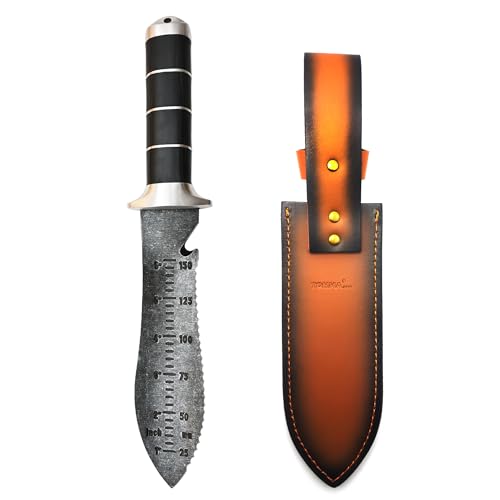
This is the steel purist’s choice. The TONMA uses Japanese AUS-8 stainless steel, hardened to HRC 58±1 through a traditional quenching process. That means this blade has the hardness, wear resistance, and sharpness that serious gardeners look for. The 7.2-inch blade is concave in shape — one side beveled sharp for slicing, the other serrated for cutting. Engraved inch markers let you plant seeds at precise depth. It is designed for the full range of garden tasks: digging, cutting, transplanting, dividing, weeding, sawing, scooping, and splitting.
The handle is Pakkawood, a high-strength composite material that has permanent corrosion resistance. It feels beautiful and solid in the hand, and it comes with a premium cowhide leather sheath. Owners describe it as “hefty and solid” — one cleared an entire raised bed of deep-rooted weeds and cover crop without the tool losing its edge. The knife is described as “heirloom quality” by multiple buyers, and the made-in-Japan stamp adds a level of trust for those who value traditional craftsmanship.
The weight is a mixed aspect — several owners note its substantial heft, which is excellent for digging but may feel tiring if you use it one-handed for hours. The leather sheath requires a belt to slide on (it has no clip), which is a minor inconvenience for quick access.
Precision tool: The quality (26 mentions) and sturdiness (18 mentions) are the top aspects, and the knife is noted for cutting through weed fabric and deep-rooted weeds without disturbing surrounding soil.
Choose this for: the gardener who wants a made-in-Japan blade with premium AUS-8 steel, Pakkawood handle, and leather sheath in one complete package.
Pass if: you prefer a lighter knife for quick weeding, or you want a sheath with a belt clip instead of a slide-on design.
9. Barebones Hori Hori Classic Garden Knife

Vintage-inspired design with a heat-tempered blade and walnut handle.
The Barebones Hori Hori Classic is as much a statement piece as it is a gardening tool. The heat-tempered 6.75-inch stainless steel blade has a serrated edge and a smooth, sharp edge for versatile cutting. The ergonomic walnut handle features a stylish copper ring accent that gives it a timeless look. It also includes a twine cutter and bottle opener — small touches that expand its usefulness beyond the garden. The 1-inch depth markings on the blade help with precise planting.
Owners consistently say this knife is beautiful, and the durability is top-rated. It survives rocky clay soil where other tools break, and many report leaving it outside year-round with no rust or damage. With a full-tang blade that won’t snap, it is built to last years. The quality is the most-praised aspect, and the walnut handle feels comfortable in the hand.
The sharpness is mixed — some owners find it sharp enough for roots and stems, while others say it is far too dull straight from the box and requires sharpening. The blade tip is also notably blunt and thick, making it harder to initially push into the ground compared to more pointed knives. The gradation marks on the blade are difficult to read for some users.
Beautiful and tough: Quality (110 owner mentions) and durability (75 mentions) lead the praise, and the knife is described as one that “survives rocky clay soil” where lesser tools snap.
Best for: the gardener who values aesthetics and durability equally, and wants a knife that looks as good on the bench as it works in the dirt.
pass on it if: you need a razor-sharp blade from the start, or you require a sharp pointed tip for easy soil penetration.
Understanding the Specs
Full Tang vs. Partial Tang
A full tang blade means the steel extends in one continuous piece through the entire handle. This eliminates the weak joint where the blade meets the handle — the most common failure point in cheaper knives. When you lean your body weight into a hori hori to pry out a deep root, a full tang knife transfers that force safely through the entire tool. A partial tang stops inside the handle and relies on glue or rivets alone, which can snap under heavy pressure.
Blade Length: 6 Inches vs. 7+ Inches
You get a lighter, more nimble blade with a 6-inch length, making it easier to work in tight spots and do precise weeding or transplanting. A 7-inch or longer blade gives you more leverage for deep digging and prying, and the extra length helps you reach further into the soil. The trade-off is weight — a longer blade is heavier and may feel fatiguing during extended one-handed use. For most gardeners, 7 inches is the balance that balances leverage with control.
Dual-Edge Blade: Serrated + Straight
The serrated edge is your saw — it cuts through roots, tough vines, compacted soil, and small branches with a back-and-forth motion. The straight edge is your slicer — it glides cleanly through stems, twine, vegetables, and soft plant matter. A true hori hori always has both edges on the same blade. If a knife only has one edge type, it is not a genuine Japanese garden knife and will limit your versatility.
Handle Material: Wood vs. Synthetic
Wood handles (walnut, rosewood, Pakkawood) offer a warm, ergonomic grip that absorbs shock. They look beautiful and age well, but they require care — drying after wet use and occasional oiling. Synthetic handles (TRP, plastic, composite) are nearly maintenance-free. They stay grippy when wet, never crack, and can handle being left in the rain. Choose wood for the classic feel and aesthetics; choose synthetic for durability in wet conditions.
FAQ
What is a hori hori knife used for?
How long does a Japanese garden knife last?
Which is better, a 6-inch or 7-inch blade?
Do I need a sheath for my hori hori?
Can I use a hori hori for cutting tree branches?
What is the difference between a hori hori and a regular garden knife?
How do I maintain a wood handle on my hori hori?
Is a serrated edge better for weeding or digging?
Final Thoughts: The Verdict
If you want one dependable pick, the japanese garden knife winner is the WORKPRO Hori Hori because it combines a 7-inch full tang blade, a non-slip TRP handle, and included sheath at a price that undercuts the competition without sacrificing quality. If you want a traditional wood handle and the highest-rated craftsmanship, grab the ROYTOA Hori Hori. And for a budget-friendly full tang knife that you will never lose in the garden, the Zenport K245 is the one to reach for.
How We Picked
We do not accept paid placement. Every pick is matched to a real buyer and a real use-case; we do not hands-on test units.
Sources & Methodology
Specifications: manufacturer listings and product documentation. Review insights: verified customer reviews, as of July 2026. Pricing: not shown on this page (it changes often); check the current price via the retailer link.
As an Amazon Associate, Lawn Gear Lab earns from qualifying purchases. This does not affect which products we feature.