
Specs are compiled from manufacturer listings and verified buyer reviews and can change over time — please confirm the key details on the product page before buying.
The problem with most garden hoes is that you push, pull, chip, and still leave the root. A proper Japanese garden hoe solves that — it cuts through clay, hooks under the taproot, and lifts the whole weed in one smooth motion, no stooping or straining required. The secret is a razor-thin blade forged from carbon steel, angled so you slice instead of chop, and a handle designed to put your weight behind the cut rather than your back muscles.
I’m Rikta — the founder and writer behind Lawn Gear Lab. This guide is built by comparing the manufacturers’ published specifications and the patterns across verified customer reviews, so you get each pick’s real strengths and trade-offs instead of marketing spin.
Whether you are battling Bermuda grass in a raised bed or dandelions in heavy clay, knowing which japanese garden hoe actually stays sharp, fits your hand, and survives a season of hard use is the difference between weeding feeling like a chore versus feeling like a small victory every time you pull a full root.
Our Picks at a Glance


How To Choose The Best Japanese Garden Hoe
The crowd favorite — 4.8 stars across 700+ owners — tells you this category is deep with happy buyers, but the wrong shape or steel choice will leave you with a dull blade and a tired wrist. Focus on these three things and you will land the right tool.
Blade Steel and Hardness
Japanese hoes rely on carbon steel that sharpens to a razor edge and holds it. Look for high-carbon tool steel or stainless steel explicitly described as sharp and durable. A blade at HRC58 (Rockwell hardness scale, a measure of steel toughness) gives you edge retention without brittleness — soft enough to sharpen on a stone, hard enough to slice through roots without rolling the edge. Avoid anything that feels like stamped sheet metal; the best tools are hand-forged by a blacksmith.
Handle Length and Grip
Hand hoes (nejiri kama) run 11 to 17 inches total — perfect for kneeling work or raised beds. Semi-long handles around 41 inches let you stand upright, saving your lower back. Long handles (over 4.5 inches) give you full leverage for heavy ground but are harder to store. The wood matters too — Japanese oak, zelkova, or European ash all absorb shock better than paint-sealed pine and resist splitting when wet. Make sure the handle is secured with a wedge or rivets, not glue alone.
Neck Construction
The weakest point on any hoe is where the blade meets the handle. Forged one-piece construction (the shank extends from the blade itself) is far stronger than a welded neck. A twisted or curved shank redistributes force so the blade does not snap under twisting leverage when you pry out a deep root. Look for “forge-welded” or “one-piece” language in the specs. If the listing says “shank forged in one piece to the blade,” that is the gold standard.
Quick Comparison
| Model | Best For | Blade Length | Total Weight | Handle Material | Amazon |
|---|---|---|---|---|---|
| Premium Quality Homi★ Best Overall | Hard clay & all-purpose digging | 11.8 in | 10.7 oz | Real wood | Amazon |
| SUIZAN Nejiri KamaTop Performer | Heavy clay & tight spaces | 13 in | 7.1 oz | Japanese oak/zelkova | Amazon |
| GrowTech Josi Nejiri KamaBest Value | Raised beds & gentle tilling | 12 in | 6.4 oz | Wooden grip | Amazon |
| HACHIEMON Long Type | Stand-up reach & visibility | 4.8 in | 10.2 oz | Hardwood | Amazon |
| Tomerry Craftsmanship Hoe | Commercial landscaping | — | 1.1 lb | Japanese wood | Amazon |
| BlueArrowExpress Kana Hoe 217 | Weeding & cultivating | 2.4 in | 9.1 oz | Steel & wood | Amazon |
| HACHIEMON Craftsmanship Hoe | Hard clay with rocks | 3.2 in | 1.15 lb | Real wood | Amazon |
| DeWit Japanese Hand Hoe | Quality heirloom & lifetime use | 12 in | 8 oz | European Ash | Amazon |
| Nisaku Semi-Long Nejiri Hoe | Standing work & back relief | 45 in | 1.06 lb | Polished wood | Amazon |
In‑Depth Reviews
1. Premium Quality Hand plow Hoe with Safety Cover
Our pick — over 4.5★ from 700+ verified ratings; the strongest balance of quality and price.
The Korean master-smith’s Homi that earned 4.8 stars from over 700 owners.
This is the hoe the reviews keep calling “my favorite new gardening tool” — and with good reason. Forged by a Korean master blacksmith named No-Ki, Seok, who has made Homi tools his entire life, the 10.7-ounce iron head is built for versatility: digging, grounding, removing all kinds of weeds, seeding, and planting. The curved angle digs into hard clay without bending, and the pointy end survives rock contact. Buyers report it is “lightweight, sturdy hand weeder for hard clay” — one 83-year-old gardener with arthritic hands found it comfortable enough to use daily.
Quality is the most-discussed feature, and the real wood handle and synthetic leather safety cover back it up. The thing everyone raves about is how the sharp point unearths roots completely, including wild violets, in one clean pull. It is a right-handed tool (no left-handed version is offered), and an occasional unit may arrive with a slightly loose cover, but the consensus is clear: you get a handmade tool that cuts weeding time in half.
Why owners stay loyal
- Hand-forged by a lifetime blacksmith — real artisan quality
- Sharp pointed tip digs into hard soil and survives rocks
- Versatile: weed, dig, seed, plant, cultivate
- Synthetic leather safety cover included
A real limit to know
- Right-handed only — no left-handed model available
- Production is limited; may require waiting if out of stock
The one to reach for: If you want one tool that does it all — weeding, digging, seeding — and you want it forged by a master who has done nothing else for decades, this is the clear leader.
Think twice if: You are left-handed; you will need a different pick or adapt your grip.
2. SUIZAN Nejiri Kama Weeding Sickle 13″
A sword-making town’s legacy in a weeding sickle that chews through clay.
Born from a town with over 400 years of sword-making heritage, this sickle uses a high-quality two-layer Japanese carbon steel blade honed by artisans. At just 7.1 ounces and 13 inches long, it is the lightest of the premium picks, yet owners mention it “works super well in our heavy clay soil” — the sharpness makes up for the low mass. What wins people over is the quality of the steel: it is razor-sharp from the factory and designed to stay that way through repeated use.
The Japanese oak or zelkova wood handle provides a reliable, comfortable grip, and the compact design is made for precision weeding in tight spaces like flower beds and vegetable gardens. A minority note the included leather pouch is too tight, making removal awkward and risking nicks if you are not careful. Compared to the GrowTech above, the SUIZAN is a touch longer (13 inches vs. 12 inches) but shares the same professional-grade sharpness that makes short work of taproots.
Why it stands out
- Authentic Japanese sword-making heritage — exceptional sharpness
- Lightweight at 7.1 oz — easy to handle for extended sessions
- High-quality two-layer carbon steel blade
- Compact 13-inch design for precision in tight spaces
A small design trade-off
- Safety pouch is very tight — removal can be tricky
- Not ergonomically shaped; some find the handle less contoured
Best pick for: Gardeners who want the sharpest factory edge possible and appreciate the heritage of a real sword-making region’s craftsmanship.
skip it if: You need an ergonomic handle for arthritic hands — the grip is straight, not contoured.
3. GrowTech Josi Nejiri Kama Weeding Sickle
The one-piece forged neck that has been a favorite for five years running.
This is the tool many owners reach for first — one buyer called it their “favorite tool for 5 years.” The defining feature is the twisted shank (the neck is forged in one piece with the blade, not welded), which gives it superior durability when you hook and pry against deep roots. Weighing just 6.4 ounces and measuring 12 inches, it is also the lightest hand-hoe in this lineup. Customers note it is “efficient for breaking up small weed clusters and gentle tilling,” and quality is the most-praised aspect — over 200 owners single it out.
The high carbon tool steel blade stays sharp through rocky soil and can be easily maintained with a whetstone. A plastic sheath is included for safe storage. The catch: it must be used at ground level (no long-handle option), and it is right-handed only, though a left-handed version is available from the manufacturer. At 6.4 oz versus the Premium Homi’s 10.7 oz, making it the go-to if wrist fatigue is your main concern.
The strengths that win
- One-piece forged neck — won’t snap under leverage
- Super light at 6.4 oz — ideal for long sessions
- High carbon steel stays sharp in rocky soil
- Left-handed version available (rare in this category)
What to watch
- Ground-level use only — no standing option
- Requires regular cleaning and oiling to prevent rust
Who it fits: If you want the lightest possible tool that still has a rock-solid forged neck, and you work kneeling or on raised beds, this is the smart value pick.
Not for you if: You prefer a heavier blade that does the work through mass rather than sharpness.
4. HACHIEMON Japanese Weeding Tool Very Sharp Edge Nejiri-Gama Long Type

The long-handled weeder that lets you stand up while getting deep roots.
With a 17.3-inch total length (10.2-inch handle plus 4.8-inch blade), this is the hand-hoe that brings you closest to standing while working — less back strain, more visibility. The specially formulated steel composite blade is forge-welded to a metal stalk and hardwood handle, creating a tool that feels built for a lifetime. Reviewers point out the “long handle and metal stalk aid visibility and reach,” and the blade cuts weeds below the soil surface with a simple wrist turn that lifts the entire root.
Weeding performance is the top-praised aspect — 54 owners call it out. Sharpness comes second, with reviewers noting it is “sharper, more accurate, and lighter than a stirrup hoe.” It weighs 10.2 ounces, which is right in the middle of the pack: not the lightest but not heavy. The only recurring note is that the blade is prone to rust if left dirty — buyers recommend wiping it dry after each use. At 10.2 oz versus the GrowTech’s 6.4 oz, but you trade weight for reach.
The reach-to-power ratio: If you garden in raised beds or want to avoid kneeling, this 17.3-inch tool gives you the best standing geometry in the hand-hoe category. The sharp blade and forge-welded neck mean you are not sacrificing durability for length.
Reach for this if: You want a longer tool that saves your back without graduating to a full long-handled hoe. It splits the difference perfectly.
Consider another if: You prefer stainless steel that never rusts — this one needs drying after use.
5. Japanese Craftsmanship Garden Hoe and Cultivator Hand Tiller (Tomerry)

A dual-purpose hoe and cultivator that a landscaping crew chose as their favorite.
Produced in a classic Japanese blacksmith’s factory, this tool functions as both a hoe and a handheld cultivator — the wedge-shaped head loosens hard clay soil for easy weed removal, while the flat edge cuts small roots. The steel is forged by hammer, making it “tenacious and durable,” according to the manufacturer. The Japanese wood handle is lightweight and well-balanced, and the wedge design prevents the head from slipping off the handle under stress. A commercial landscaping crew picked this as their go-to, saying it “speeds up weeding in beds” and allows hammering to dig deep for roots.
Functionality is the top-praised aspect, with 26 owners highlighting it. Durability runs a close second at 22 mentions, and one owner reported it “survived hitting concrete” without damage. At 1.1 lb (500 grams) — expect more mass to do the work but a slightly more tiring session if you are used to a 6-ounce tool. The cultivator tines on the back edge set it apart: you can scratch the soil surface to disturb weed seedlings without swapping tools.
The versatility edge: If you want one tool that both hoes and cultivates (two separate motions that normally need two tools), this dual-head design is unique in the lineup. The forged steel body and reinforced joint inspire confidence.
Best for: Gardeners who need a heavy-duty tool that can take a beating — even a hit against concrete — and still function. The dual-head design saves tool swaps.
Not ideal if: You want the lightest possible tool for precision weeding between delicate plants — this one’s weight is a feature, not a bug.
6. BlueArrowExpress Kana Hoe 217 Japanese Hand Hoe

A true Japanese hand hoe — the triangular steel head sits crosswise to the handle so you scrape, chop, and cultivate weeds without a knife’s straight blade.
This is the most versatile pick because the Kana Hoe 217 is a genuine hoe rather than a knife: the sharpened triangular blade is set perpendicular to the handle, the classic geometry for standing-and-scraping cultivation. The tip slices under weeds at the root, the flat edge chops through crusted soil, and the point works into tight rows between seedlings. Across more than 1,200 ratings it holds a 4.7-star average, with owners singling out how the edge “stays sharp far longer than expected” and how the light 9.1-ounce head makes long weeding sessions painless.
The steel blade is riveted to a lacquered wooden handle and arrives sharp out of the box. Reviewers use it for weeding beds, edging borders, and loosening soil around established plants, and several note it replaced three separate tools. As with any carbon-steel garden edge, wiping it dry after wet work keeps rust at bay. Unlike the SUIZAN or GrowTech sickles, which pull toward you in a hooking motion, the Kana Hoe’s forward triangular head lets you push, chop, and drag from one comfortable grip.
Why it is a favorite
- True hoe geometry: triangular blade set across the handle
- Sharp out of the box and holds its edge with use
- Light 9.1-ounce head for fatigue-free weeding
- One tool for scraping, chopping, and cultivating
Things to manage
- Carbon-steel blade needs drying to prevent rust
- Short handle is built for kneeling or close work, not standing reach
Who it fits: Gardeners who want an authentic Japanese hoe for weeding and cultivating beds — the crosswise blade does the scraping work a straight digging knife cannot.
pass on it if: You want a long standing-height handle; this is a compact hand hoe for close-in work.
7. HACHIEMON Japanese Craftsmanship Garden Hand Tool Hoe and Cultivator

The 1.3-pound cultivator that became the most-used tool in one owner’s shed.
This is the heaviest hand-hoe in the list at 1.15 pounds (0.52 kg), and that weight is by design — it is meant for hard clay soil with rocks and roots where lighter tools bounce off. The head features a sharp flat cutting edge on one side and tines on the other, making it a hoe-and-cultivator combo similar to the Tomerry but heavier. Shoppers say it is “the best tool in my entire shed” and “most used tool in shed,” particularly praising how the forks catch weed roots while the flat head cuts through. The reinforced head-to-handle joint is built to last, and the manufacturer says the thickness and angles are adjusted through smith forging to prevent fatigue.
Effectiveness is the top-praised aspect (38 owners), tied with “gardening tool.” Sharpness follows at 23. The recurring honest note is that handle durability receives mixed feedback — some buyers report the wooden handle splitting after a few uses, though others praise its strength. At 15.4 inches total, it is shorter than the HACHIEMON Long Type above but 2.6 inches longer than the standard hand hoes, offering a middle-ground reach. The narrow handle fits well in tight spaces between shrubs.
The brute force advantage
- Heavy 1.3 lb head powers through rocky, root-filled clay
- Combination hoe and cultivator in one tool
- Excellent for rolling seat or sit-down cart use
- Hand-forced steel stays sharp after full day of use
Handle watch point
- A few owners mention the wooden handle splitting under heavy use
- Heavier than others — fatigue may set in during long sessions
Reach for this if: Your garden soil is hard-packed clay full of rocks and you want a tool that powers through without bouncing. The tines plus hoe combo is genuinely useful.
Think twice if: You have very small hands — the handle is narrow and may feel less controlled with a full-force grip.
8. DeWit Tierra Garden Right Hand Japanese Hand Hoe
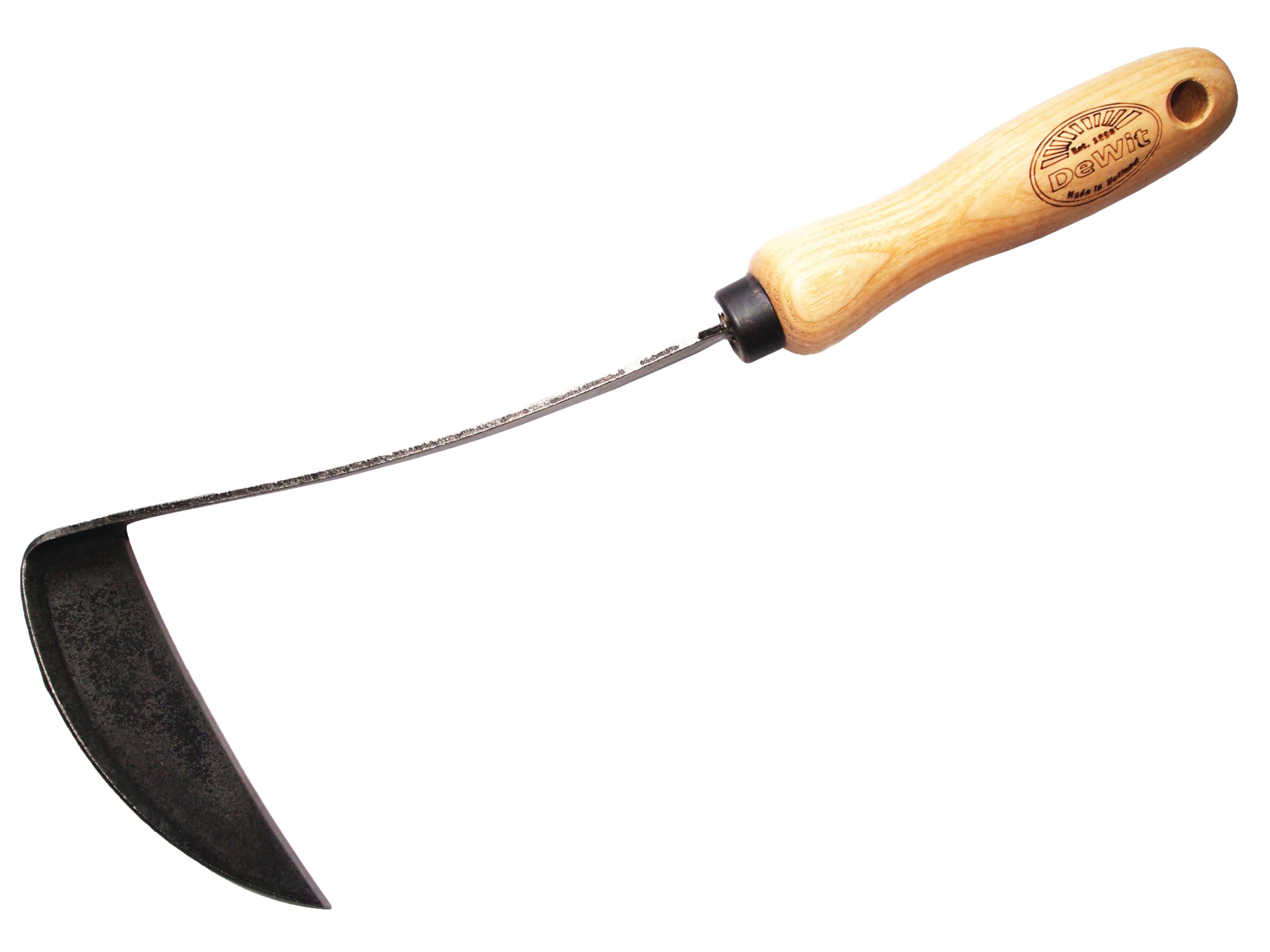
The Dutch-made heirloom with a lifetime guarantee and a European ash handle.
Proudly manufactured in Holland by DeWit since 1898, this tool arrives with a lifetime guarantee — a statement few others in this list make. The head is made of Boron steel, a type of steel alloyed with boron for exceptional abrasion resistance and edge retention. The European Ash hardwood handle is lightweight but strong, with natural elasticity that allows the tool to bend under stress rather than snap. At 8 ounces and 12 inches, it sits in the middle weight class between the 6.4-ounce GrowTech and the 10.7-ounce Homi. Buyers call it “sturdy” and say it “combines hand-hoe, shovel, rake” in one — the sharp point breaks up wet or dry clay, and the steel-to-handle fit provides good leverage.
The unique angle of the blade drew mixed reactions: some found the shape made cutting through dirt and separating roots easy, while one buyer felt the blade was too thick and the angle off. This is a right-handed tool only (there is a separate left-handed model).
The heritage pick: If a lifetime guarantee and 125+ years of tool-making history matter to you, this is the one. The Boron steel head and ash handle are real quality markers, and owners who prefer this shape swear by it as their daily weeder.
Best for: Gardeners who want a single well-crafted tool with a genuine lifetime warranty and are willing to adapt to its specific blade angle.
Consider another if: You need an immediately intuitive blade shape — the angle takes a session or two to get used to.
9. Nisaku NJP1010 Nejiri Hoe Semi-Long Handle

The 41.5-inch semi-long handle that keeps you upright while weeding.
This is the longest tool in the lineup by a significant margin — the 41.5-inch polished wood handle lets you weed while standing, saving your knees and lower back. The 4.5-inch stainless steel blade is forged in one piece with the shank (not welded), then secured to the handle with steel rivets, making it extremely durable and bend-resistant. Customers note it is “sharp, lightweight, easy on back” and allows you to “get under plants to remove weeds against stems” without disturbing the surrounding soil. Sharpness is the most-praised aspect (58 owners), and effectiveness follows at 50 — owners say it “scrapes weeds like a razor” and makes weeding faster than a standard western hoe.
The blade is rust-proof and scratch-resistant stainless steel, and the design allows it to slice woody stems up to 3/8 inch thick. The catch: handle length receives mixed feedback, with several owners finding it too short for tall users (it is a “semi-long” handle, not full-length). At 1.06 pounds, it is heavier than the hand hoes but the standing posture distributes the weight better. At 41.5 inches versus the HACHIEMON’s 17.3 inches, this Nisaku gives you longer reach for full-upright work.
Why it wins standing up
- 41.5-inch handle — no kneeling or bending required
- Forged one-piece shank with rivets — extremely durable
- Stainless steel blade — rust-proof and scratch resistant
- Effective on woody stems up to 3/8 inch thick
What to measure first
- Semi-long handle is too short for some tall users (6 ft+)
- May require a practice session to master the scything motion
Reach for this if: You cannot or do not want to kneel, and you want a genuine Japanese-forged blade on a handle that gives standing leverage. This is the most effective back-saver in the list.
Consider a full-length option if: You are over 6 feet tall and need a handle past your waist for proper ergonomics.
Understanding the Specs
Nejiri Kama vs Hori-Hori
A nejiri kama (twisted sickle) has a curved, sharp blade that hooks under weeds and cuts roots with a pulling motion — it is ideal for removing weeds by the root with minimal soil disturbance. A hori-hori (digging knife) is a straight, dual-edged blade that digs, slices, and saws; it is more versatile but less specialized for quick root removal. Choose a nejiri kama if you spend most of your time weeding; choose a hori-hori if you want one tool that does digging, planting, and cutting too.
Forged Neck vs Welded Neck
The neck (the metal piece connecting the blade to the handle) is the most stressed part of a Japanese hoe. A forged one-piece neck is part of the same piece of steel as the blade — it does not have a weld joint that can snap under twisting leverage. A welded neck is cheaper but can fail when you pry out deep roots sideways. If the listing says “shank forged in one piece to the blade,” that is a durability signal. If it only says “welded,” treat it as a budget tool not meant for heavy levering.
FAQ
Can I sharpen a Japanese garden hoe myself?
Is a Japanese garden hoe better than a standard western hoe?
How do I prevent my Japanese hoe from rusting?
What is the right handle length for my height?
Are Japanese garden hoes made for left-handed people?
Can I use a Japanese hoe on hard clay soil?
How does a nejiri kama differ from a regular hand trowel?
What does “forged by hammer” mean in a garden tool?
Final Thoughts: The Verdict
Across the board, the japanese garden hoe winner is the Premium Quality Hand plow Hoe because a lifetime Korean blacksmith forged it for decades, the iron head repeatedly survives hard clay without bending, and the real wood handle and synthetic leather cover make it a daily tool owners reach for first. If you want the lightest possible forged-neck weeder for raised beds, grab the GrowTech Josi Nejiri Kama. And for standing work without back strain, the Nisaku NJP1010 Semi-Long Handle is the one to reach for.
How We Picked
We do not accept paid placement. Every pick is matched to a real buyer and a real use-case; we do not hands-on test units.
Sources & Methodology
Specifications: manufacturer listings and product documentation. Review insights: verified customer reviews, as of July 2026. Pricing: not shown on this page (it changes often); check the current price via the retailer link.
As an Amazon Associate, Lawn Gear Lab earns from qualifying purchases. This does not affect which products we feature.