
Specs are compiled from manufacturer listings and verified buyer reviews and can change over time — please confirm the key details on the product page before buying.
Japanese beetle grubs ruin a lawn by eating the roots right under your feet, leaving patches of dead, spongy turf that birds and animals tear up looking for a meal. The goal is not just to kill the grubs alive right now but to break the beetle’s return cycle so your grass stays green without you having to reapply every few weeks.
I’m Rikta — the founder and writer behind Lawn Gear Lab. This guide is built by comparing the manufacturers’ published specifications and the patterns across verified customer reviews, so you get each pick’s real strengths and trade-offs instead of marketing spin.
if you want a one-season synthetic knockout or a long-term natural soil builder that keeps working for years, understanding the difference between imidacloprid (a synthetic chemical insecticide) and milky spore (a natural bacterium) is the key to picking the right japanese beetle grub killer for your lawn.
Quick Picks
- Bayer – Merit 0.5 Granular Systemic Insect — Top Performer
- St. Gabriel Organics – 15 Pound Milky Spore — Best Value
- St. Gabriel Organics Milky Spore Powder — Compact Pick
- St. Gabriel Organics Milky Spore — Lawn Powerhouse
How To Choose The Best Japanese Beetle Grub Killer
The two main categories you will find are biological controls (milky spore, based on the bacterium Bacillus popilliae) and synthetic chemical insecticides (usually imidacloprid). Your climate, how fast you need results, and if you want to avoid synthetic chemicals completely will decide the winner for your lawn.
Biological vs. Synthetic: The Core Split
Milky spore is a natural bacterium that infects and kills Japanese beetle grubs in the soil. Once established, the spores multiply and the manufacturer claims they can remain active for up to 15 years. It requires the right soil temperature (above 50°F) and multiple applications over the first year or two to build up a high enough spore count. Synthetic grub killers like imidacloprid (the active ingredient in the Bayer Merit product) act fast — often within days — but they do not reproduce in the soil, so you have to reapply each season.
Coverage and Cost Per Square Foot
Pay attention to the “unit count” and coverage area listed on the bag. A 10-ounce powder covers a smaller area than a 15-pound granular bag. Granules are easier to apply with a standard broadcast spreader, while powder is best for spot-treating smaller patches or garden beds. A larger bag often gives you a better per-square-foot value, but only if you have enough lawn to use it all.
Quick Comparison
| Model | Best For | Active Ingredient | Unit Count / Weight | Coverage Per Bag | Amazon |
|---|---|---|---|---|---|
| Bayer Merit 0.5 Granular | Fast synthetic knockdown | Imidacloprid 0.5% | 30.1 Pounds | Up to 80 lb/acre per year | Amazon |
| St. Gabriel Organics 15lb Granular | Long-term natural control | Bacillus Popilliae | 240.0 Ounces / 15 Pounds | N/A | Amazon |
| St. Gabriel Organics 10oz Powder | Small-area spot treatment | Bacillus Popilliae | 10.0 Ounce | 2,500 sq ft | Amazon |
| St. Gabriel Organics Milky Spore, 15lbs, Pack of 2 | Large-lawn natural setup | Bacillus Popilliae | 30 Pounds (2 x 15lb) | 10,500 sq ft | Amazon |
In‑Depth Reviews
1. Bayer – Merit 0.5 Granular Systemic Insect Control – 30 Pound Bag

Grubs die fast with this synthetic chemical, and trees get protected too.
If your lawn is overrun with grubs right now and you need them dead before the birds dig craters across your yard, this is your pick. The active ingredient is imidacloprid at 0.5%, a systemic insecticide (a chemical the plant absorbs so grubs die when they feed on the roots). Buyers report that it “eliminated grubs, birds, and animal damage (bare spots, eroded soil, mushy ground)” — it tackles the whole chain of damage at once.
At 30.1 pounds, this is a heavy bag built for large properties. The manufacturer specifies that applications of Merit 0.5 G cannot exceed 80 lb per acre per year, so you have plenty for a big lawn. Unlike the milky spore options which need time and soil temperature above 50°F to work, this chemical acts relatively quickly once watered in — owners mention seeing results within weeks. It is also labeled for use on trees and shrubs against emerald ash borer and other pests, adding versatility that the St. Gabriel products do not have.
The catch is that imidacloprid is a synthetic chemical — it does not build a long-term soil colony the way milky spore does. You need to reapply each season for continuous grub control. It is also heavier than the St. Gabriel Organics 15lb granular, with a 30.1 lbs item weight compared to 15 lbs for the single-bag organic option. If staying completely organic matters to you, this is not the route.
Why choose it
- Fast-acting systemic insecticide stops existing grub damage quickly
- Covers a very large area — a 30 lb bag goes far on big lawns
- Also works on tree and shrub pests like emerald ash borer
The trade-offs
- Synthetic chemical — not suitable for organic gardens or food crops
- Must be reapplied every season; no long-term soil buildup
- Heavy bag (30.1 lbs) can be tough to carry and maneuver
Pick this if: You have a large property and need fast, proven control of grubs and tree pests right now.
skip it if: You are committed to organic, natural pest control or prefer a product that builds lasting soil protection.
2. St. Gabriel Organics – 15 Pound Milky Spore Granular Natural Japanese Beetle Grub Control

One application feeds a natural soil army that kills grubs for years without chemicals.
This is the balance for anyone who wants to go organic and get long-term results. The active ingredient is Bacillus popilliae, a naturally occurring bacterium that infects and kills Japanese beetle grubs once the soil temperature is above 50°F. Unlike the synthetic Bayer pick above, the spores multiply inside the grubs and then release back into the soil, building a colony that the manufacturer claims can protect your lawn for up to 15 years. Reviewers report that “Milky Spore granulars are easy to apply; effective against Japanese beetles, with only one seen this season.”
At 15 pounds (240.0 ounces by unit count, compared to the 10 ounce powder), this granular version is much easier to spread with a broadcast or drop spreader than the powder form. Buyers mention it is “easy to spread” and “just follow instructions and the grubs disappear.” The granules are ready to use straight out of the bag — no mixing required. It is also USDA-certified organic, safe for pets, beneficial insects, and food crops, making it a far safer choice around a vegetable garden than the imidacloprid in the Bayer product.
The honest limit is patience. Milky spore is not a quick fix. You need to apply it in spring, summer, and fall for at least the first two years to get the spore population high enough for full control. It also only works on Japanese beetle grubs, not other types of grubs or surface pests. If you have a mole problem that is already destroying your lawn, the Bayer product’s faster knockdown might be more appropriate.
Why choose it
- Natural and organic — safe around pets, kids, and food gardens
- Spores can remain active in soil for up to 15 years
- Granular form is easy to apply with a standard lawn spreader
The trade-offs
- Requires multiple applications over 1-2 years to build full protection
- Only targets Japanese beetle grubs, not other turf pests
- Slower acting than synthetic chemicals; not for immediate rescue
Choose this if: You want a natural, low-maintenance approach and are willing to be patient for long-term results.
pass on it if: You need to kill grubs this week or you have a multi-species grub problem that requires a broader insecticide.
3. St. Gabriel Organics Milky Spore Powder, 10oz Japanese Beetle Grub Killer
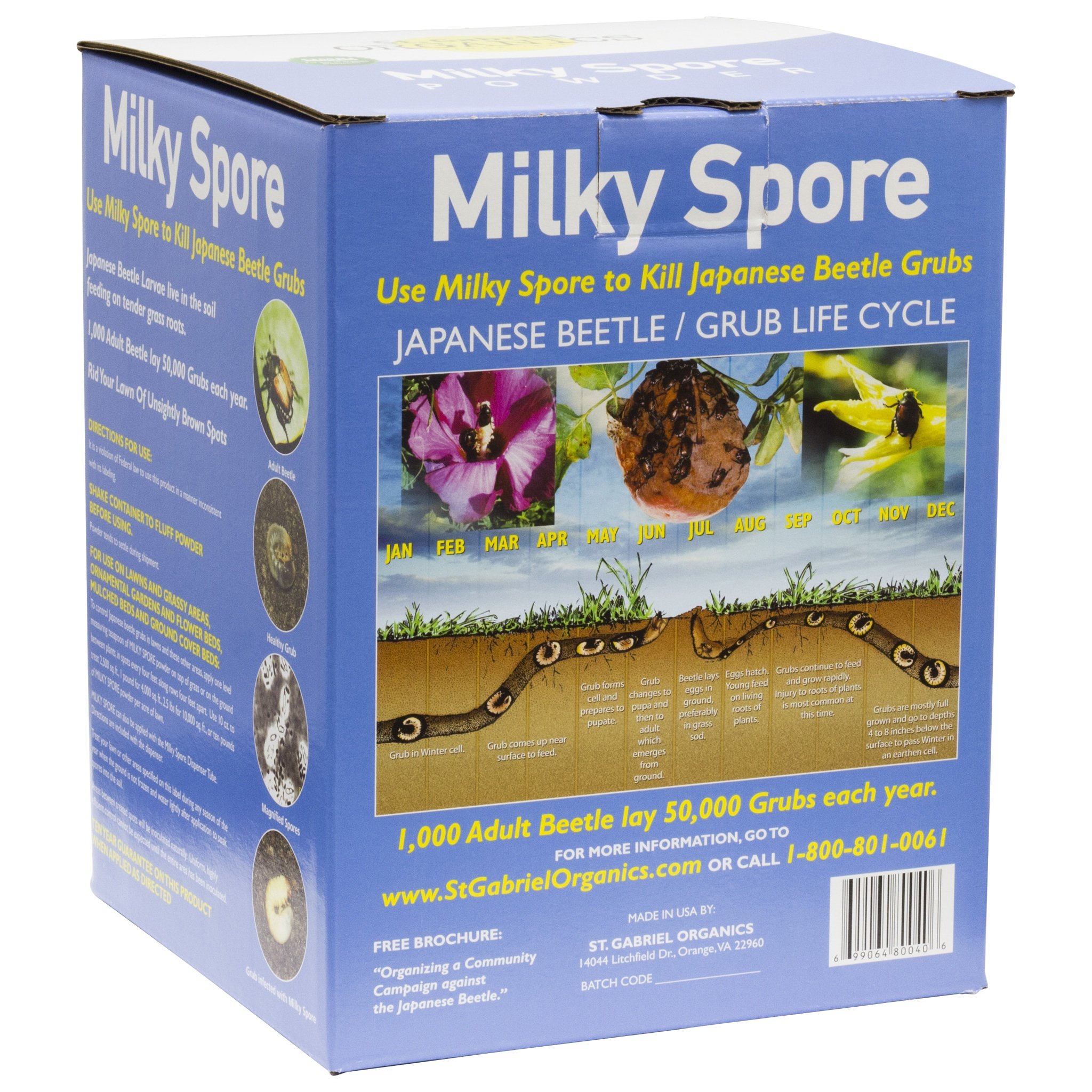
This concentrated powder fits in a cupboard and treats small patches without leftover waste.
If you do not need to treat a whole acre and just want to protect a flower bed or a small patch of lawn from grubs, this 10-ounce powder is a more economical entry point than the large granular bags. Each bag covers up to 2,500 sq ft at a rate of 1 teaspoon every 4 feet along rows. The active ingredient is the same Bacillus popilliae as the larger granular options, so you get the same long-term soil-building benefit — once the spores establish, they can keep working for years.
One thing to note: the powder is very fine. One reviewer helpfully noted to “read the instructions” because the package does not always include clear directions — you need to apply 1 tsp per 4 sq ft and water it in, and the soil temperature must be above 50°F for the spores to activate. That same reviewer reported that a “test patch of damaged grass recovered in ~1 week.” Unlike the 15lb granular bag which is a 15-pound item, this product weighs just 11.2 ounces — 11.2 ounces compared to the 15-pound bag, which makes it far easier to handle and store.
The trade-off is convenience. Powder does not flow through a broadcast spreader the way granules do. You have to apply it by hand or use the Milky Spore dispenser tube (sold separately), which makes it slower for larger areas. And at 10 ounces vs 240.0 ounces for the 15lb granular bag, you get far less product for your money. But for a targeted rescue of a small garden bed, this is the most economical organic option.
Best for small spaces: A precise pick for spot-treating garden beds or small lawns where a 15lb bag would be overkill.
Not ideal for: Large lawns or anyone who wants to use a spreader for fast, even coverage.
Who it suits: Gardeners treating flower beds or small patches who want the organic benefits without buying a huge bag.
Pass on it: If you have to cover more than 2,500 sq ft — a granular option will save you time and effort.
4. St. Gabriel Organics Milky Spore, 15lbs, Pack of 2 – Japanese Beetle Grub Killer
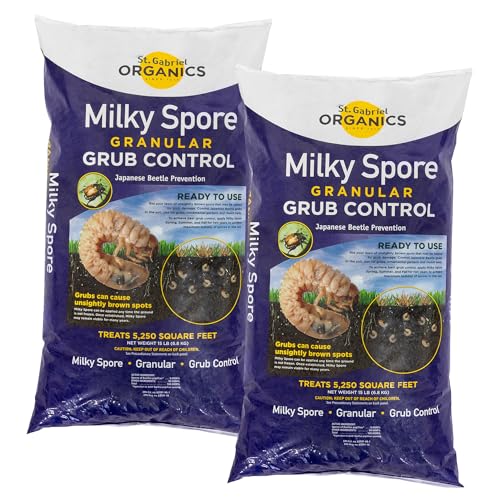
Double the granules for big lawns that need full-season natural protection — same 15lb formula, twice the area.
This is the same 15lb granular product as the “Best Value” pick above, but in a pack of two, giving you a total of 30 pounds of product. At that quantity, you can cover up to 10,500 sq ft, making it the right choice if you have a larger property or want to treat both your front and back yard without buying a refill next season.
Because it is the same Bacillus popilliae formulation, you get the same long-term benefit — one reviewer noted “this is the only thing that gets rid of Japanese Beetles and it is natural” and recommends applying it in spring, summer, and fall for two years. Another buyer reported “noticed only one beetle after spring application, likely from neighbor’s yard,” which mirrors the experience of the single-bag users. Since the granules are ready to use and go through a spreader, covering 10,500 sq ft is still a manageable job.
The obvious catch is that you are buying two bags upfront. If you only have a small lawn, the single 15lb bag is plenty, and the powder option is even more targeted. This pack of two only makes sense if you know you need the volume — or if you want to split the second bag with a neighbor to lower the cost per person. The 30-pound total weight matches the Bayer Merit bag, but this is organic milky spore, so it is a very different long-term strategy.
Why buy two bags
- Covers double the area (10,500 sq ft) — ideal for a large lawn
- Same long-lasting natural control as the single 15lb bag
- Granules are easy to apply with a spreader and safe for pets
Consider first
- Excess product if your lawn is under 5,000 sq ft — the powder or single bag is more efficient
- You still need patience for the spore to establish over multiple seasons
Best for: Homeowners with a large lawn (over 5,000 sq ft) who plan to treat the whole property with natural milky spore.
Not for: Small yards or first-time users who want to test the product before committing to two bags.
Understanding the Specs
Bacillus Popilliae (Milky Spore)
This is a naturally occurring bacterium that specifically infects and kills Japanese beetle grubs. When a grub ingests the spores, they multiply inside it, turning the grub’s internal fluids a milky white color — hence the name. When the grub dies and decomposes, billions of new spores are released into the soil, building a permanent colony that can keep killing grubs for years. The downsides are that it requires the soil temperature to be above 50°F to activate, and it takes multiple applications over 1-2 seasons to reach full strength. It is completely safe for pets, beneficial insects, and vegetable gardens.
Imidacloprid (Systemic Insecticide)
This is a synthetic chemical that belongs to the neonicotinoid class of insecticides. When applied to the soil and watered in, it is absorbed by the grass or plant roots. Grubs feeding on those roots ingest the chemical and die, usually within days. It is fast-acting and broad-spectrum — it kills not just Japanese beetle grubs but many other soil-dwelling pests. The trade-offs are that it does not build up in the soil like milky spore, so you must reapply every year. It can also be harmful to bees and other pollinators if used improperly, so it is not recommended around flowering plants or crops during bloom.
FAQ
Does milky spore work on all types of grubs?
How long does it take for milky spore to work?
Can I apply grub killer in the spring?
Is milky spore safe for vegetable gardens?
How much area does a 15-pound bag of milky spore cover?
Do I need to water in the granules after applying?
Can I use a spreader for milky spore powder?
Will milky spore harm earthworms or fireflies?
How often should I reapply imidacloprid grub control?
Is the Bayer Merit product safe for pets?
Final Thoughts: The Verdict
If you want one dependable pick, the japanese beetle grub killer winner is the St. Gabriel Organics 15lb Milky Spore Granular because it delivers natural, long-term protection without synthetic chemicals and builds soil immunity over time. If you want a fast-acting synthetic that handles an active infestation across a large lawn, grab the Bayer Merit 0.5 Granular. And for small garden patches where a huge bag is wasteful, the St. Gabriel Organics 10oz Powder is the perfect spot-treatment tool.
How We Picked
We do not accept paid placement. Every pick is matched to a real buyer and a real use-case; we do not hands-on test units.
Sources & Methodology
Specifications: manufacturer listings and product documentation. Review insights: verified customer reviews, as of July 2026. Pricing: not shown on this page (it changes often); check the current price via the retailer link.
As an Amazon Associate, Lawn Gear Lab earns from qualifying purchases. This does not affect which products we feature.