
Specs are compiled from manufacturer listings and verified buyer reviews and can change over time — please confirm the key details on the product page before buying.
You want your lawn watered without dragging hoses or soaking the driveway, and you need a system that matches your yard’s size and your home’s water pressure. Pulling a hose around every few days gets old fast. The trick is picking the right setup before you spend money on something that either does not reach the far corner or needs more water than your faucet can deliver.
I’m Rikta — the founder and writer behind Lawn Gear Lab. This guide is built by comparing the manufacturers’ published specifications and the patterns across verified customer reviews, so you get each pick’s real strengths and trade-offs instead of marketing spin.
After looking closely at specs like pressure ratings, flow rates, coverage area, and smart controls, the systems below stand out — here is what you need to know before you buy the best irrigation system for lawns.
Our Picks at a Glance

How To Choose The Best Irrigation System For Lawns
Before you pick a system, you need to know your yard’s size and your faucet’s limits. Flow rate (measured in gallons per minute, or GPM) and water pressure (measured in pounds per square inch, or PSI) determine what will even work at your house. A system built for a large farm, for example, needs a pump that delivers high volume, not just a garden hose.
Know Your Yard Size and Coverage
Small and medium lawns (under 3,000 sq. ft.) work well with in-ground kits or traveling sprinklers. Larger properties or acreage need a unit that pushes water a long distance — look for the coverage diameter in the specs. A system that covers 5,000 sq. ft. might need two units for a full acre.
Understand Flow and Pressure
Two numbers matter most: maximum flow rate (GPM) and maximum pressure (PSI). If your home has standard city water pressure around 50-70 PSI, most mid-range kits will work. If you have a low-pressure well, look for a kit with small nozzles. If you have a pond pump and a large field, you need a unit that can handle 63 GPM and a dedicated large-diameter hose.
Decide Between DIY and Smart
DIY in-ground kits require digging a shallow trench and attaching push-fit connectors, but they hide the plumbing underground. Smart hose-end sprinklers (like those with solar power and a Bluetooth or Wi-Fi app) take 15 minutes to set up and let you schedule watering from your phone, though they sit on top of the grass. The trade-off is installation effort versus features like rain skip and zone mapping.
Quick Comparison
| Model | Best For | Max Flow (GPM) | Max Pressure (PSI) | Coverage | Amazon |
|---|---|---|---|---|---|
| Orbit 58322 Traveling Tractor★ Best Overall | Self-propelled, hands-free watering | 6.1 GPM | 100 PSI | Large yards (hose-path) | Amazon |
| Rain Bird 32ETIAlso Great | DIY in-ground for medium lawns | 12 GPM | 70 PSI | 1,000-3,000 sq ft | Amazon |
| Orbit 50021 2-Zone Kit | Easy push-fit in-ground setup | — | 50 PSI | Large lawns (2-zone) | Amazon |
| Aiper IrriSense 2 | Smart weather-adaptive watering | — | — | Up to 4,800 sq ft | Amazon |
| Rain Bird OtO | Solar-powered app-controlled precision | — | — | Up to 5,000 sq ft | Amazon |
| Gardena AquaPrecise | Solar contour-following irrigation | — | — | Up to 320 m² | Amazon |
| Strongway Wheeled Sprinkler | High-volume acreage watering | 63 GPM | 70 PSI | 150 ft diameter (17,000 sq ft) | Amazon |
In‑Depth Reviews
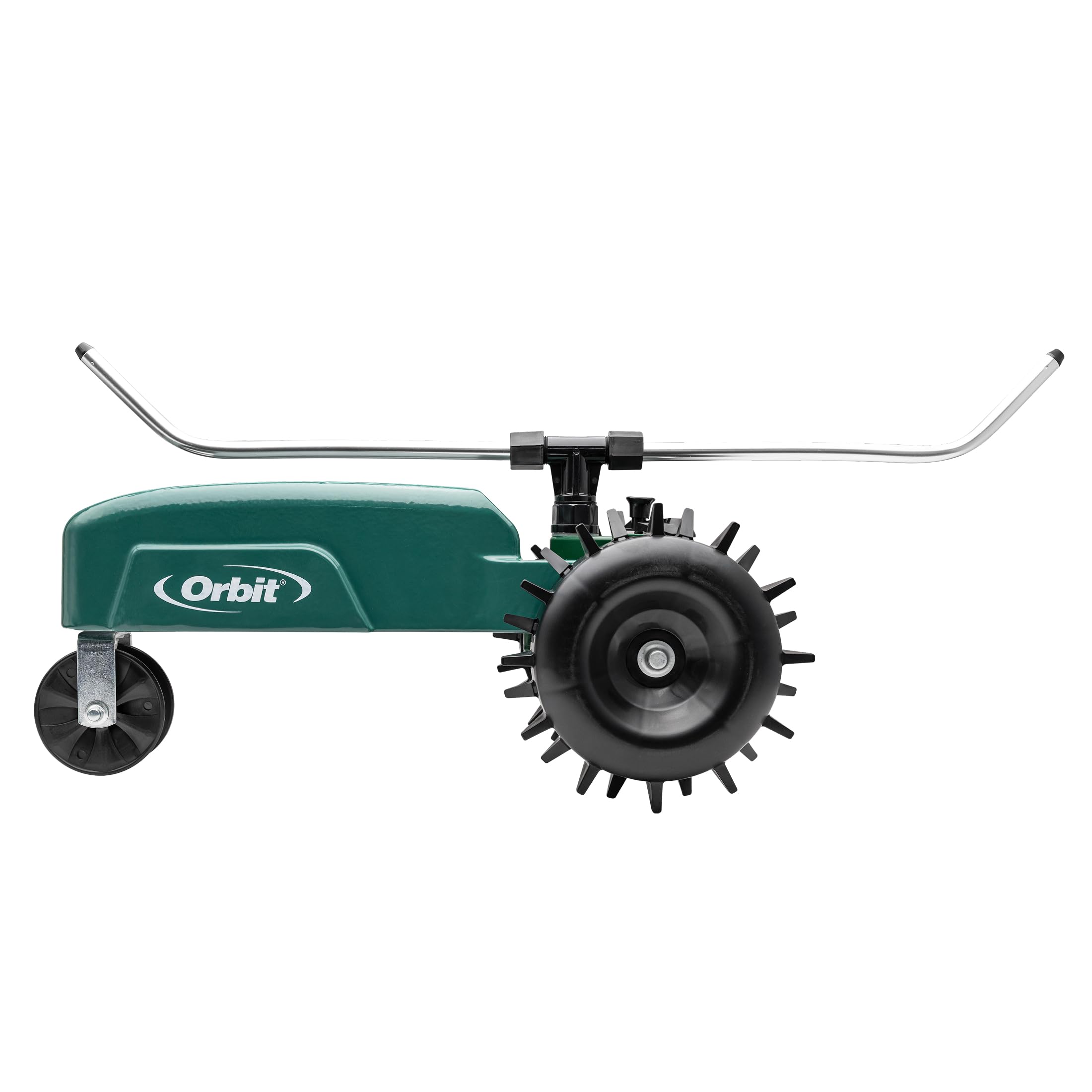
1. Orbit Traveling Tractor Water Sprinkler – Self-Propelled Traveling Sprinkler 58322
Our pick — over 4★ from 7,000+ verified ratings; the strongest balance of quality and price.
A water-powered tractor that crawls along your hose, covering big areas while you sit down — no digging required.
The Orbit Traveling Tractor is a self-propelled sprinkler that pulls itself along the hose path using water pressure. Its cast-iron body and spiked traction wheels keep it stable across the yard, and the three-speed control lets you pick how fast it moves. The spray arms are adjustable so you can fine-tune coverage.
This unit handles a maximum pressure of 100 PSI — compared to the Orbit 50021 2-zone kit’s 50 PSI limit — and delivers up to 6.1 GPM (gallons per minute). Owners mention it is well-built and covers large areas without needing to move a sprinkler by hand, though they note it travels slower than expected and the shutoff valve can be inconsistent. One reviewer noted the drive unit failed at two years but was replaced under the six-year warranty. You will need to avoid tight turns and keep the hose path clear.
This is a strong alternative to an in-ground system for you if you do not want to dig trenches. The trade-off is you have to lay the hose in a path around your yard, and the tractor moves slowly.
What works
- Cast-iron body is built to last a lifetime with replaceable parts
- Adjustable speed and spray arm coverage
- Six-year limited warranty
The drawbacks
- Travels slower than expected
- Shutoff plunger fails to engage for some users
- Needs careful hose placement to avoid obstacles
Who should grab it: Anyone who wants automated, hands-free watering on a large, open lawn without digging up the yard.
skip it if: You have a complex yard with narrow paths, tight corners, or delicate plants you cannot run a hose past.
2. Rain Bird 32ETI DIY Self Install In-Ground Automatic Sprinkler System Kit
A DIY in-ground kit that hides the plumbing and waters up to 3,000 sq. ft. automatically — no hose dragging needed.
This system gives you a permanent underground setup that attaches to an outside faucet, meaning you never have to drag a hose across the yard again. It covers medium lawns from 1,000 to 3,000 sq. ft. and the six pop-up rotary sprinklers retract into the lawn for easy mowing — so you get a clean look with no above-ground equipment.
Installation took about three hours plus head adjustments, according to buyers, and the included timer lets you schedule up to four cycles per day. The maximum flow rate is 12 GPM (gallons per minute) and it works best with average residential water pressure between 45 and 75 PSI (pounds per square inch). Buyers report that the plastic hose may last a few years, but saving thousands compared to a professional install makes it a strong value.
Unlike the Orbit 58322 traveling tractor that moves along a hose, this Rain Bird stays buried and runs on a timer. It does not rely on Bluetooth or an app, so the controls are basic but reliable.
Best fit: The homeowner with a medium-sized yard who wants a permanent underground system without paying for professional installation.
Watch for: Works best if your water pressure is at least 45 PSI; some buyers on well water needed smaller nozzles (included) to get full performance.
Reach for this if: You want set-and-forget automatic watering with sprinklers that disappear into the ground.
Look elsewhere if: Your yard is larger than 3,000 sq. ft. or you want an app to control schedules from your phone.
3. Orbit 2-Zone All-in-One Automatic Watering System 50021
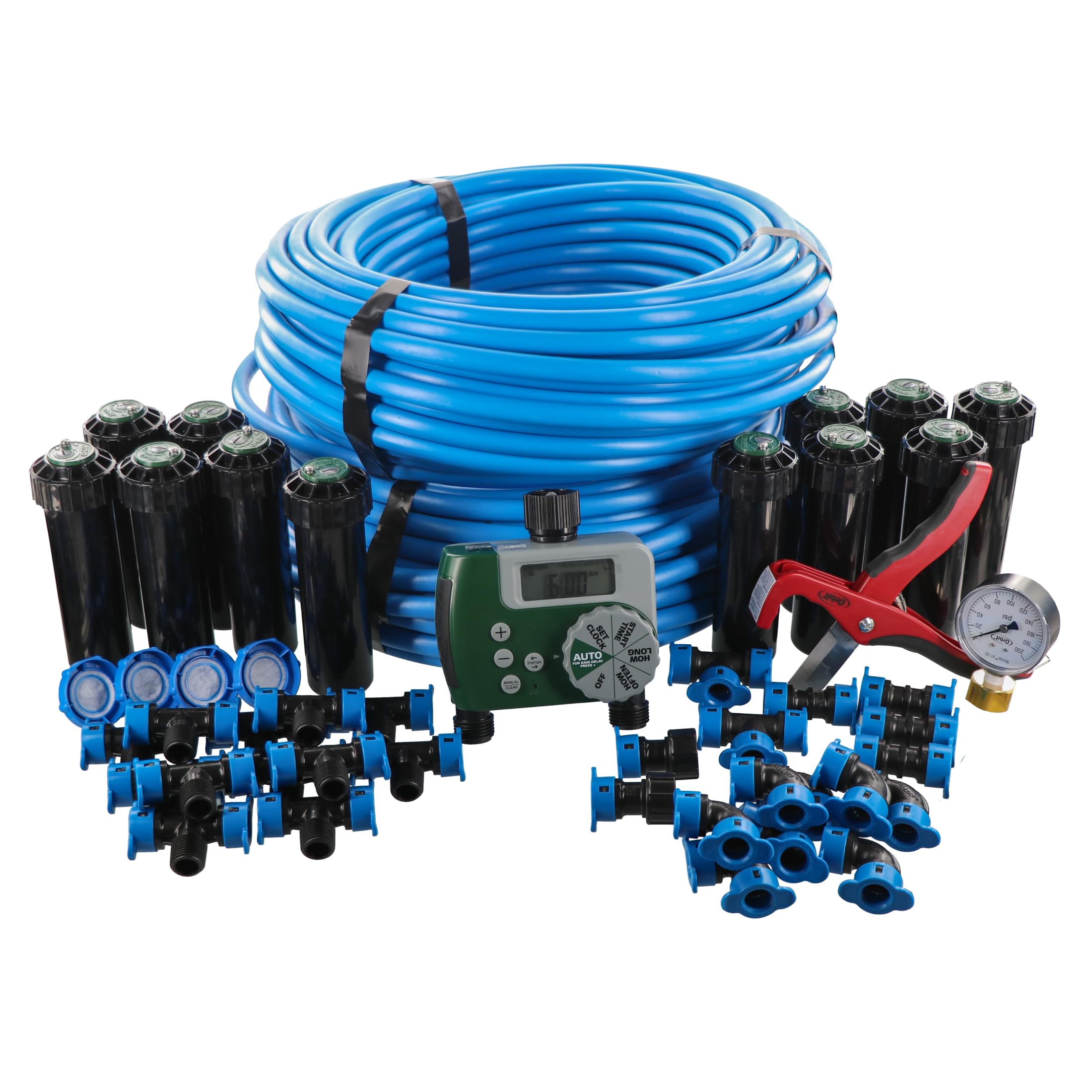
A complete two-zone kit with Blu-Lock push-fit connections that installs in a weekend — no glue or clamps needed.
This kit includes everything you need for a two-zone in-ground system: timer, tubing, gear-drive sprinklers, fittings, a pipe cutter, and a pressure gauge. The patented Blu-Lock push-fit technology creates strong connections without glue or clamps, making installation far simpler than traditional PVC (polyvinyl chloride) pipe.
The system is designed around head-to-head coverage, meaning each sprinkler’s spray reaches the next one to reduce dry spots. It comes with an 18-piece kit and the timer allows adjustable scheduling. One catch is the maximum pressure rating of 50 PSI — lower than the Rain Bird 32ETI’s 70 PSI and half the Orbit Traveling Tractor 58322’s 100 PSI. Customers note that you need enough water pressure for the two zones to perform well. Several buyers mention being quoted thousands for a professional install and building this system themselves in about two days.
Compared to the Rain Bird 32ETI, this kit offers a two-zone timer and a more modern push-fit tubing system, but it relies on a lower pressure ceiling.
Why it works: The Blu-Lock fittings seal without glue and the two zones let you water front and back on separate schedules.
One catch: At a max of 50 PSI, this system works best with better-than-average city water pressure; low-pressure homes may need adjustments.
Use it if: You want a two-zone underground system with easy push-fit connections and a weekend-install timeline.
Pass if: Your water pressure is below 50 PSI or you prefer the proven durability of traditional threaded PVC fittings.
4. Aiper IrriSense 2 Lawn Sprinkler Smart Irrigation System
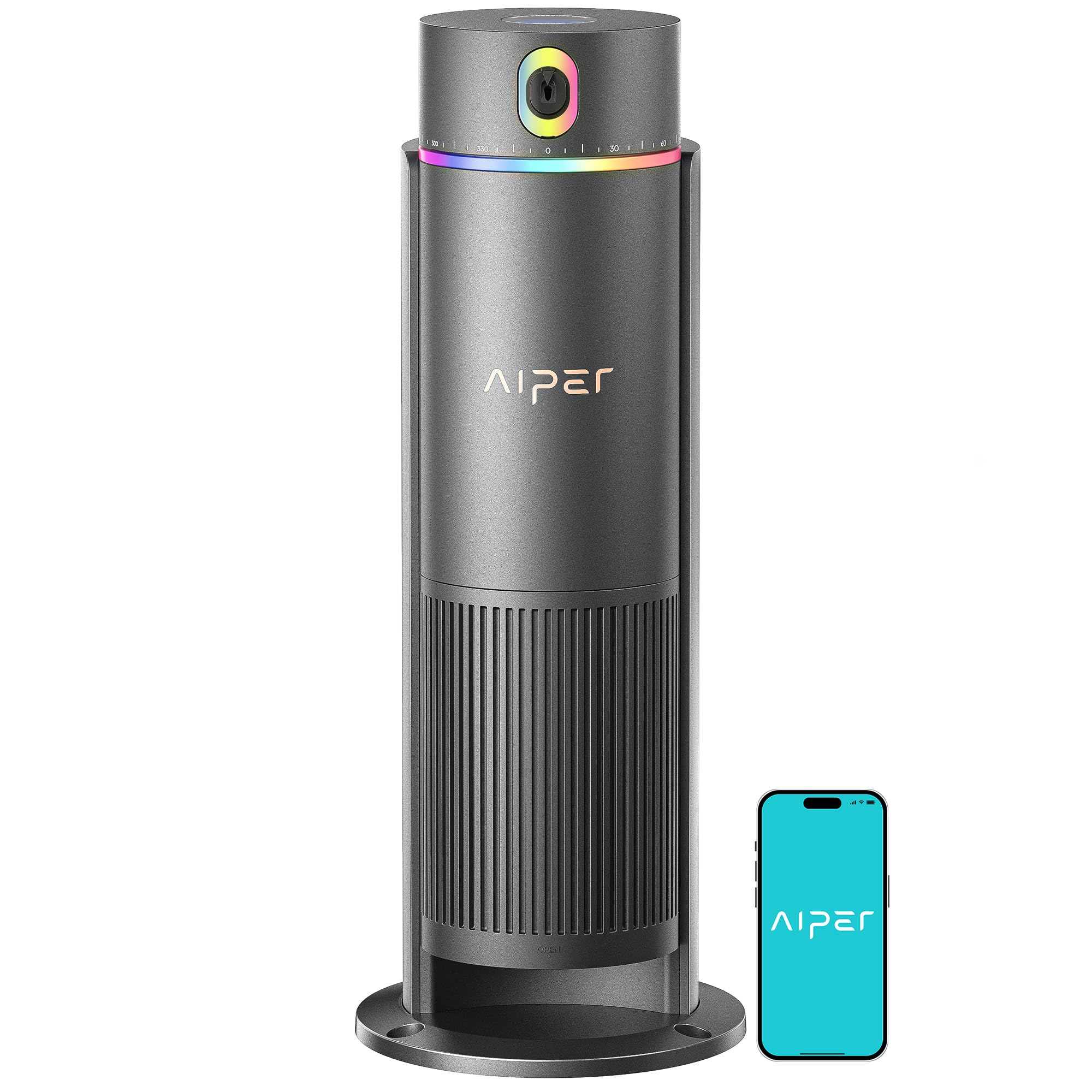
A 4-in-1 smart sprinkler that maps up to 10 zones, adapts to weather, and the brand claims 40% water savings.
The IrriSense 2 combines a controller, sprinkler, electric valve, and nutrient feeder into one unit that sits above ground. It uses TÜV-certified EvenRain Technology, which, according to the manufacturer, delivers gentle, uniform water that improves soil absorption. The built-in rain sensor (a device that detects moisture and pauses watering) automatically suspends cycles when it rains, and the app notifies you of incoming weather so the system skips unnecessary cycles.
You can customize up to ten unique irrigation maps for different plant types — lawns, flowers, shrubs, vegetable gardens — and set separate schedules for each zone. Setup takes about 15 minutes according to the manufacturer, and the unit handles lawns up to 4,800 sq. ft. Buyers praise the solid build quality and the app’s mapping precision. A few note that since the app is Chinese-owned, there is a long-term risk of the service shutting down, which would leave the unit bricked (unusable).
Unlike the Rain Bird OtO that uses solar power, this Aiper unit runs on a mains connection (you plug it into an outlet) but includes the same weather-adaptive smarts. Its 10-zone mapping is more granular than the OtO’s unlimited custom spray areas.
Standout features
- Built-in rain sensor pauses watering automatically
- 10 unique zone maps for different plant needs
- Gentle EvenRain Technology reduces soil erosion, per the maker
Considerations
- App is cloud-dependent and requires an internet connection
- No solar power — needs a nearby outlet
- Premium price tag
Reach for this if: You want a truly smart system that maps zones, detects rain, and adjusts schedules from your phone without any underground digging.
Look elsewhere if: You do not want a cloud-based app controlling your irrigation or your yard is under 1,000 sq. ft.
5. Rain Bird OtO Lawn Smart Sprinkler
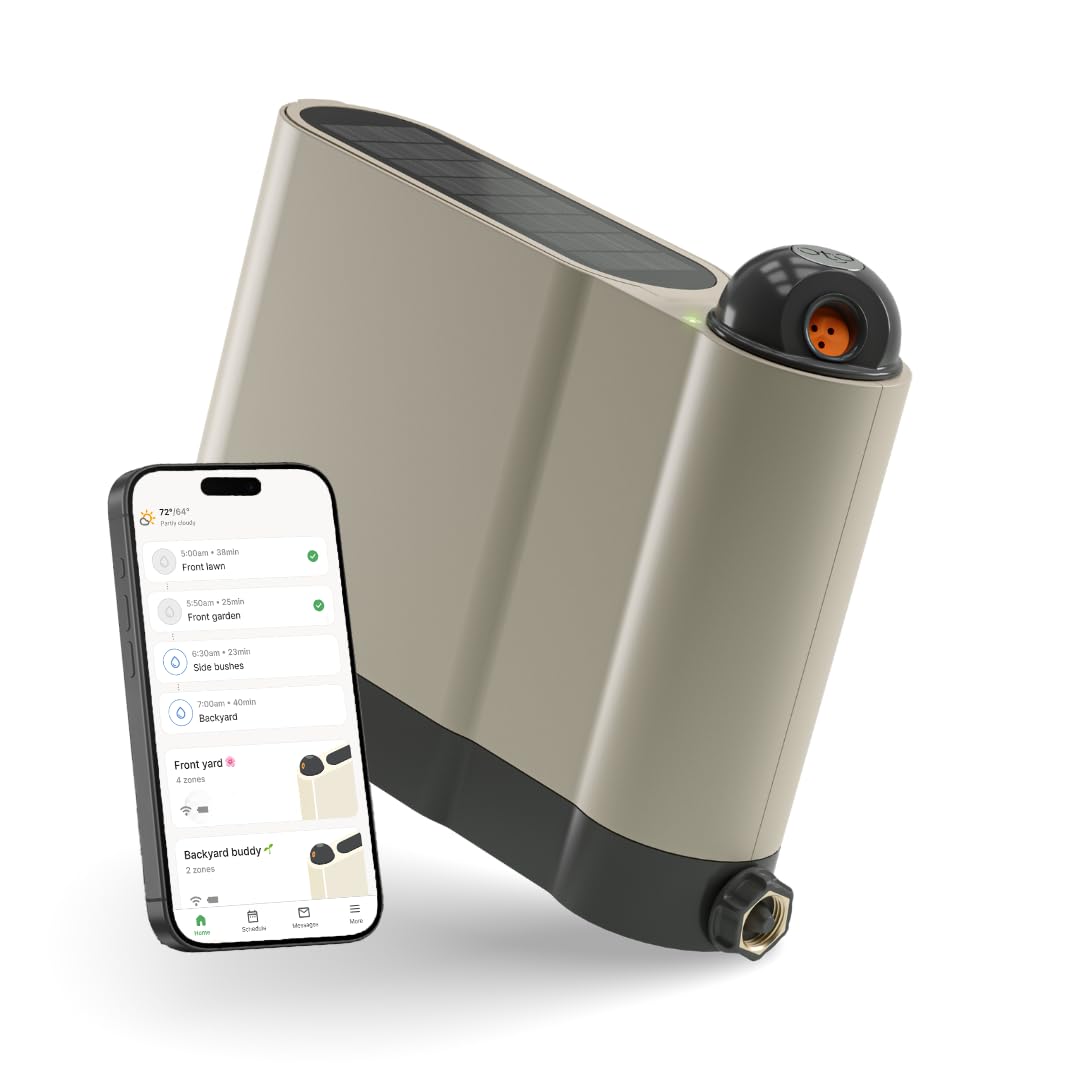
A solar-powered above-ground sprinkler that uses precision streams to water specific zones you draw in the app — no wiring needed.
The OtO runs completely on solar power — no batteries, no wires, no outlet. You just connect it to a hose and Wi-Fi, place it in your yard, and it waters up to 5,000 sq. ft. The unique selling point is precision: the app lets you create unlimited custom spray zones on a map of your yard, so you can water the lawn, a shrub bed, and pots without spraying the sidewalk. The weather-intelligent scheduling checks local forecasts and skips watering if rain or wind is expected.
Build quality includes a UV-resistant body, weatherproof housing rated from 32° to 149°F, and solid brass fittings. It supports daisy-chaining multiple units for larger properties. Reviewers point out that the setup is lightweight and easy, but the app connection can be finicky — one buyer mentioned the unit worked once and then would not connect, and even a replacement had the same issue. Most other reviews are positive, praising its accurate water streams and solar independence.
Unlike the Gardena AquaPrecise that uses Bluetooth for contour mapping, the OtO connects over Wi-Fi for remote control from anywhere.
Best feature: Solar power means zero wiring and zero battery changes; the brass fittings should outlast plastic alternatives.
The risk: The app and Wi-Fi dependence means if your network drops or the app has a bug, the sprinkler may not water until manually reset.
Grab it if: You want a wire-free, solar-powered, app-controlled sprinkler with the ability to draw precise watering zones in your yard.
pass on it if: You need a system that works reliably without a smartphone or a strong Wi-Fi signal near the hose.
6. Gardena AquaPrecise Irrigation System 16000-20

A solar-powered system that maps your garden’s exact shape and waters only that contour — no wires, no outlet.
The Gardena AquaPrecise is an all-in-one irrigation system with a solar panel and battery for wireless, autonomous operation — plus a USB-C charging option. Its defining feature is contour irrigation: you use the Gardena Bluetooth app to set individual contour points around your garden shape, and the sprinkler head follows that path precisely. Watering is even across the entire area because the FlowBalance valve (a device that keeps water pressure steady) maintains constant pressure as the head rotates.
The system covers lawns up to 320 m² (roughly 3,445 sq. ft.) and connects via bayonet-style fittings (a quick-connect system). The app handles programming, watering schedules, and consumption measurement. Some international shoppers say that the Bluetooth connection can be finicky at times and that setting up the contour profile is a bit fiddly. One German-language reviewer noted the area near the sprinkler head is now well-watered — an issue that earlier versions apparently had — meaning the software may have matured. It comes with a mounting plate and three spikes for easy placement.
Compared to the Rain Bird OtO, this Gardena relies on Bluetooth (not Wi-Fi), so you cannot control it from outside your home unless you are within Bluetooth range. It is also one of the few systems that can power itself entirely from a solar panel.
What stands out
- Solar + battery means no outlet needed
- Contour mapping waters only the shape of your lawn
- FlowBalance valve keeps water even across the full arc
What holds it back
- Bluetooth-only (no Wi-Fi) limits remote control range
- Contour setup process is a bit cumbersome, per reviews
- Modest coverage compared to some competitors
Reach for this if: You have an irregularly shaped lawn and want a solar-powered sprinkler that can be programmed to follow its exact contour without digging.
it’s not for you if: Your yard is larger than 3,500 sq. ft. or you need to control the sprinkler from anywhere via Wi-Fi.
7. Strongway Wheeled Sprinkler with Die-Cast Aluminum Head
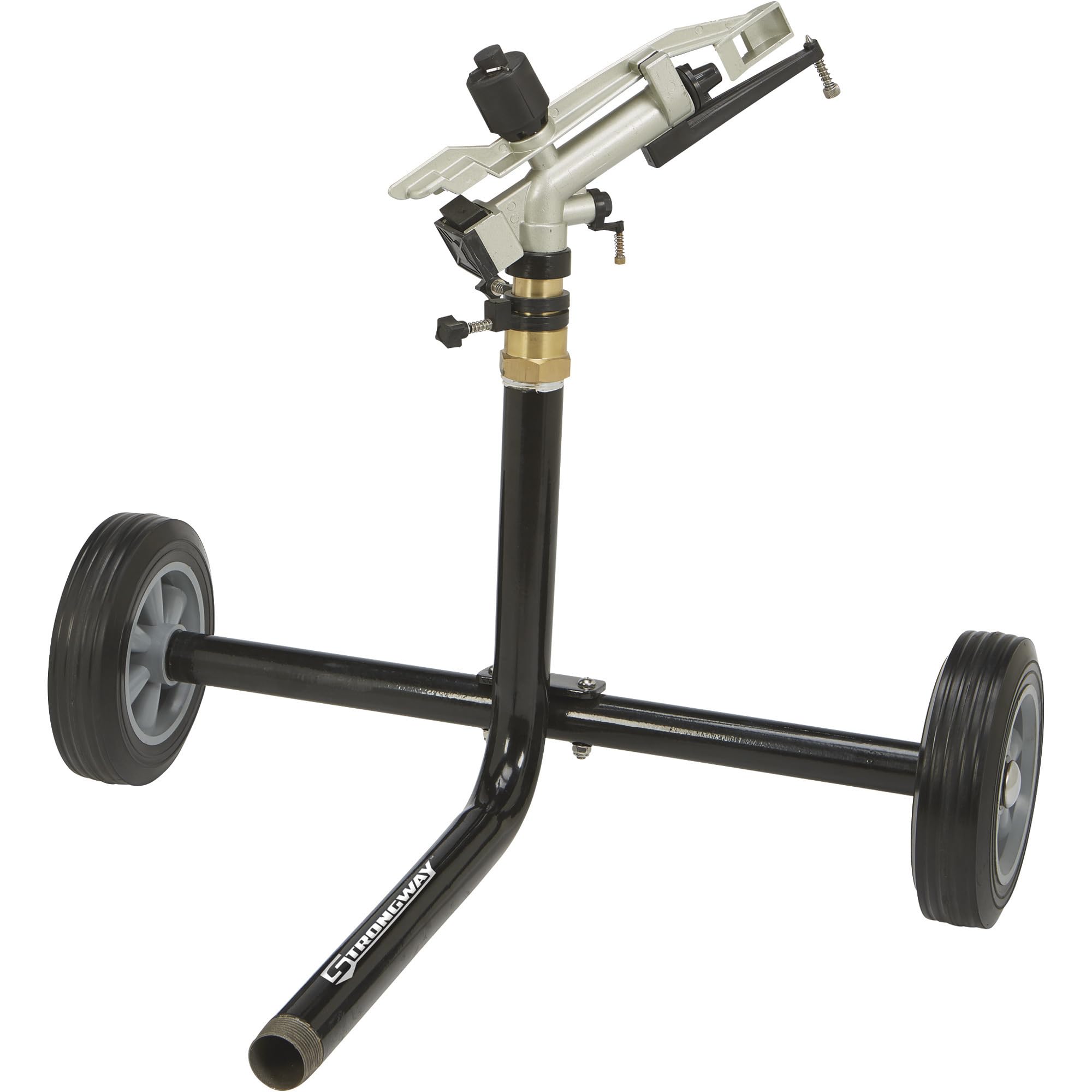
For acreage that moves 63 GPM through a die-cast aluminum head on 8-inch tires — this is a high-volume machine, not a hose-end sprinkler.
This is not a residential sprinkler — it is for large lawns, pastures, and athletic fields. The 1-1/4-inch die-cast aluminum head with a brass union and five nozzles covers up to 150 feet in diameter (17,000 sq. ft.) and delivers water at up to 63 GPM (gallons per minute). The 8-inch solid rubber tires on a weighted 1-1/2-inch steel axle roll smoothly across uneven ground, and the stainless hardware resists rust. You can set it to full 360-degree circle or lock to a partial arc to keep water off structures.
The flow rate is enormous — 63 GPM compared to the Orbit Traveling Tractor 58322’s 6.1 GPM (a 10.3x gap). But this also means it will not work with a standard garden hose. Buyers emphasize you need a high-volume pump — a 2 HP (horsepower) pump with 1.5-inch lay-flat hose, or a gas-powered trash pump. One reviewer says it runs at 22-25 PSI and shoots water 60 feet for a 100-120 foot rotation. Another notes it covers about an acre with three moves per day. The trade-off is you need serious water infrastructure to make it work.
Unlike every other system here that connects to a household faucet, this Strongway demands a dedicated pump setup. It also has mixed reviews on quality control — one owner reported a missing axle upon arrival and poor customer service follow-up.
What it does
- Massive 63 GPM flow for fast saturation of large areas
- Adjustable full or partial circle pattern
- Rugged steel and aluminum build with solid rubber tires
What it needs
- Requires a high-volume pump (not for standard garden hoses)
- Missing parts reported by some buyers
- Heavy at 31 pounds and requires setup effort
Best for: Acreage owners, farmers, and property managers who already have a high-volume pump and large-diameter hose.
Not for: Anyone connecting to a standard residential hose bib — this unit needs serious water supply to function at all.
Understanding the Specs
Flow Rate (GPM)
Gallons per minute (GPM) tells you how much water the sprinkler can push through its head. A higher GPM means faster watering for large areas, but it also demands a bigger water supply. The Strongway delivers 63 GPM for acreage, while the Orbit Traveling Tractor uses 6.1 GPM from a standard hose. If your hose or well only supplies 5 GPM, a high-GPM sprinkler will just dribble — match the number to your actual water source.
Maximum Pressure (PSI)
Pounds per square inch (PSI) is the water pressure the sprinkler can handle before it struggles. The Orbit Traveling Tractor is rated for up to 100 PSI, while the Orbit 2-Zone kit tops out at 50 PSI. If your home has about 45-70 PSI (typical for city water), most mid-range kits work fine. Low-pressure wells may need the smallest nozzles or a booster pump to keep pop-up heads from sticking.
Coverage Area
Coverage tells you the square footage or diameter a single unit can handle. In-ground kits like the Rain Bird 32ETI cover 1,000 to 3,000 sq. ft., while the Aiper IrriSense 2 handles up to 4,800 sq. ft.. For larger properties, the Strongway covers a 150-foot diameter (17,000 sq. ft.). If your yard is bigger than one unit’s coverage, you can daisy-chain multiple units or move the sprinkler to a new spot each cycle.
Smart vs. Manual Controls
A smart system connects to your phone via Bluetooth or Wi-Fi for scheduling, zone mapping, and weather-adaptive skips. The Gardena AquaPrecise uses Bluetooth, so you need to be within range to adjust it. The Rain Bird OtO and Aiper IrriSense 2 use Wi-Fi for remote control from anywhere. Manual timers on kits like the Rain Bird 32ETI let you set an analog schedule without an app — simpler but with no rain-skip ability.
FAQ
Will a traveling tractor sprinkler work on a sloped lawn?
How deep do I need to bury tubing for a DIY in-ground system?
Can I use a smart sprinkler like the Aiper IrriSense 2 without an app?
What does PSI mean and why does it matter for my sprinkler system?
How long do in-ground sprinkler systems typically last?
Is the Strongway wheeled sprinkler suitable for a standard residential lawn?
Will the Gardena AquaPrecise work if my yard is an irregular shape?
How do I know if my water pressure is high enough for a multi-zone system?
What is the difference between a traveling tractor and an in-ground system?
Can the Rain Bird OtO survive winter if left outside?
Final Thoughts: The Verdict
For the majority of shoppers, the best irrigation system for lawns winner is the Rain Bird 32ETI because it delivers a permanent underground setup, covers a useful 1,000 to 3,000 sq. ft., and installs in one afternoon without a pro. If you want self-propelled, hands-free watering that moves along a hose, grab the Orbit Traveling Tractor 58322. And for a true smart system with zone mapping and weather adaptation, the Aiper IrriSense 2 takes the crown for app control without digging.
How We Picked
We do not accept paid placement. Every pick is matched to a real buyer and a real use-case; we do not hands-on test units.
Sources & Methodology
Specifications: manufacturer listings and product documentation. Review insights: verified customer reviews, as of July 2026. Pricing: not shown on this page (it changes often); check the current price via the retailer link.
As an Amazon Associate, Lawn Gear Lab earns from qualifying purchases. This does not affect which products we feature.