
Specs are compiled from manufacturer listings and verified buyer reviews and can change over time — please confirm the key details on the product page before buying.
Yellowing leaves with green veins usually mean your tree can’t pull iron out of the soil — a problem called chlorosis that punishes oaks, maples, and citrus alike. The fix is choosing a chelated iron form—liquid drench, granular feed, or trunk implant—that your tree can actually absorb. This guide compares top liquid concentrates, granules, and implant systems to match treatment to tree size and soil pH.
I’m Rikta — the founder and writer behind Lawn Gear Lab. This guide is built by comparing the manufacturers’ published specifications and the patterns across verified customer reviews, so you get each pick’s real strengths and trade-offs instead of marketing spin.
When a tree’s leaves fade, the right iron for trees restores deep green color and vigor fast, with the strongest options earning 4.6 stars from hundreds of verified owners.
Our Picks at a Glance

How To Choose The Best Iron For Trees
Before you buy anything, look at the leaf pattern. Interveinal chlorosis — yellow leaves with dark green veins — is the classic iron-deficiency signature. If the whole leaf is pale or yellow, the problem might be nitrogen or something else entirely, so a soil test beats a blind purchase.
Liquid, Granular, or Implant?
Liquid chelated iron gives the fastest visible response, often greening leaves within a week or two, and works through either a foliar spray or a root-zone drench. Granular iron like Espoma Iron-Tone is slower but feeds the soil over time and never stains patios — a real bonus near hardscaping. Trunk implants are the specialist’s choice for large trees with thick bark, delivering iron directly into the vascular system where soil chemistry can’t interfere.
What “Chelated” Actually Means
Chelated iron is wrapped in a protective molecule that stops soil particles from locking it away. In alkaline or clay soil — the most common cause of chlorosis — plain iron sulfate binds up fast and never reaches the roots. A chelate keeps the iron soluble and available, which is why nearly every product here leads with that word on the label.
Reading the Mixing Ratio
Concentrates differ wildly in strength. One ounce per 1,000 square feet and one tablespoon per gallon are not the same dilution, so check the label before you spray. A wrong ratio wastes product at best and burns leaves at worst, and the best concentrates make the math easy with a hose-end or backpack sprayer.
Quick Comparison
| Model | Best For | Form | Size | Iron Content | Amazon |
|---|---|---|---|---|---|
| Fertilome Chelated Liquid Iron★ Best Overall | Multi-purpose green-up | Liquid | 1 Gallon | — | Amazon |
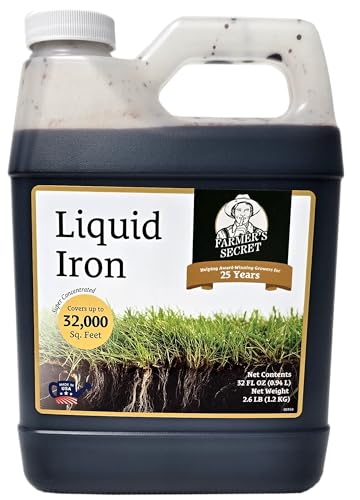
| Farmer’s Secret Liquid IronBest Value | Concentrated maintenance | Liquid | 32 oz | — | Amazon |
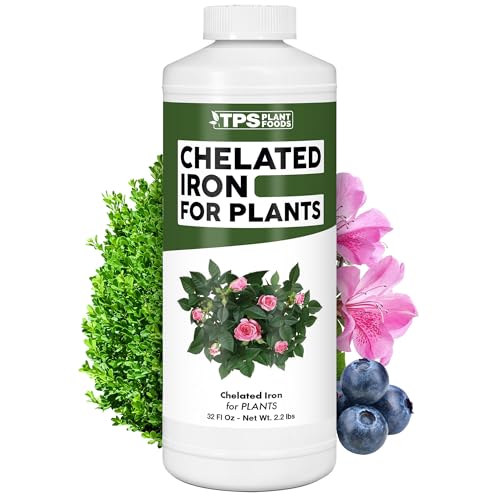
| TPS Nutrients Chelated IronTree Specialist | Fruit & shade trees | Liquid | 32 oz | — | Amazon |
| Opulent Blends Chelated Liquid Iron | Large-area lawn & trees | Liquid | 1 Gallon | 6.5% | Amazon |
| Espoma Organic Iron-Tone | Organic granular feeding | Granules | 20 lb | 6% + 17% Sulfur | Amazon |
| MediCap FE Super Implants | Large trunk chlorosis | Implants | 25-Pack | — | Amazon |
| Covington Chelated Liquid Iron | Fast root-zone green-up | Liquid | 32 oz | 6% + 12% Nitrogen | Amazon |
| LawnStar Liquid Iron | Alkaline soil (pH up to 9.5) | Liquid | 1 Gallon | — | Amazon |
| Gemplers Liquid Iron | Dosing by trunk diameter | Liquid | 1 Gallon | — | Amazon |
In‑Depth Reviews
1. Fertilome Chelated Liquid Iron, 1 Gallon
Our pick — over 4.5★ from 550+ verified ratings; the strongest balance of quality and price.
A 1-gallon chelated liquid that greens trees, shrubs, and lawns with a simple 1-tbsp-per-gallon mix.
Oak trees respond fast to this chelated spray — owners use it on shade trees, citrus, and lawns alike, and the bottle’s 1-gallon size covers a lot of ground before you need a refill. The effectiveness is the headline here, with owners reporting lawns turning deep green within 2 days, and the formula is built for a simple 1 tablespoon per 1 gallon of water dilution that works in a backpack sprayer. It’s also notably easy on the wallet next to one popular Southern brand, delivering the same dark Bermuda-grass green at a lower cost.
Buyers report: “I’m happy with the results I get from using this Chelated iron lawn supplement.” The same owner notes it greens up nicely after application with a backpack sprayer. For trees specifically, the verdict is equally warm — “Excellent product. Use to feed my oak trees.”
The one trade-off is effort: this is a spray you’ll reapply weekly through summer for flowers and beds, not a set-and-forget granular. Value opinions split, with some calling it a great deal and others finding it pricey, but the greening results win the argument for most.
Where it shines
- Deep green color in about 2 days for lawns
- Simple 1 tbsp per gallon mixing ratio
- Works across potted plants, citrus, shade trees, and vegetables
What to know
- Needs weekly attention during summer for flowers
- Value opinions split between bargain and pricey
Reach for this if: you want one bottle that greens up trees, shrubs, and lawn with a fast, visible response.
Look elsewhere if: you want a no-mixing granular that feeds slowly over months.
2. Farmer’s Secret Liquid Iron for Lawns and Gardens (32 oz)
A Kentucky-made 32-oz concentrate covering 1,000 sq ft per ounce for monthly maintenance.
At just 1 oz per 1,000 square feet for monthly maintenance, this 32-fluid-ounce bottle is the definition of “a little goes a long way” — super-concentrated is the maker’s own phrasing, and the math backs it up. It’s the lighter of the two concentrated liquids here at 2.4 pounds versus the Fertilome gallon’s 1.5 pounds per volume, which tells you how much more active material is packed into each ounce. It works as a standalone or mixed with an all-purpose lawn feeder, and any sprayer type — hose-end, backpack, or irrigation — handles it fine.
Owners mention: “I have been applying this product on my lawn once a week for the last three weeks and there is a noticeable difference.” Citrus trees are a common success story too, with lemon and lime trees “doing great” and chili plants “going wild” after feeding.
The honest caveat is that a 5-star owner admitted they “couldn’t tell any difference” — likely because their grass was already too green to notice. So this is a maintenance product for already-healthy lawns, not a rescue for badly yellowed trees. Value for money is the strongest praise here, which fits a concentrate that keeps working for months.
Smart-buyer read: Best for keeping a healthy lawn and trees deep green on a budget, but expect subtle results if your plants aren’t actually iron-starved.
Best for: routine monthly feeding that stretches a small bottle across a large property.
skip it if: your tree is severely yellowed and needs an aggressive rescue dose.
3. TPS Nutrients Chelated Iron for Plants (32 oz)
A 32-oz chelated liquid that reverses interveinal chlorosis on fruit, shade, and ornamental trees within a week.
This 32-ounce liquid is marketed squarely at landscape and orchard trees — shade trees, fruit trees, and ornamentals — with a chelated formula designed for efficient uptake through roots. The response time is the draw: bougainvillea with yellow leaves showed a difference within a week, and a clematis vine’s yellowing leaves returned to “perfectly green” when used as directed. It targets interveinal chlorosis specifically, which is exactly the yellow-leaf-green-vein pattern that signals an iron problem.
It also works on soil application or as a foliar spray, giving you two ways to treat. One citrus owner discovered the product had created so many roots the pot was packed — a sign the tree was redirecting energy into root growth even before the leaves fully recovered. An occasional 3-star review noted the yellowing didn’t reverse in their specific case, so it’s not a universal cure-all.
Compared to the Farmer’s Secret above, TPS is the more targeted choice for ornamental and fruit tree chlorosis, while Farmer’s Secret leans toward broad lawn maintenance. The “Made in USA” label is a nice trust signal for domestic buyers.
Defining trait: Fast leaf-color recovery on trees and vines, with the flexibility of foliar or soil application.
Choose this if: you have specific yellowing fruit or shade trees and want visible results within a week.
Think twice if: your leaves are pale all over — that’s likely a nitrogen issue, not iron.
4. Opulent Blends Chelated Liquid Iron (1 Gallon)
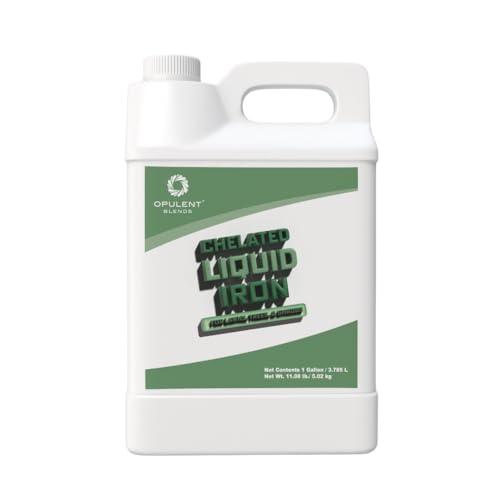
An EDTA-free 6.5% iron gallon covering 40,000 sq ft, ideal for large properties with multiple maples.
The 6.5% iron content here — clearly stated and EDTA-free — makes this a serious dose for trees struggling in low-iron soil. Owners with autumn blaze maples call it “critical to keeping my trees healthy,” spraying the root zone with a hose-end applicator and enjoying “amazing” fall colors in the first year. With 40,000 square feet of coverage from a single gallon, it’s built for the buyer with a large property and multiple trees, not a single potted plant. The formula encourages chlorophyll formation, which is the biological reason leaves go from yellow to deep green.
Results can come fast — one owner noted visible improvement within 24 hours of application. But there’s a recurring packaging gripe: the bottle has a tendency to leak on arrival, with several owners reporting a small leak despite the heavy-duty shipping bag. The product inside works well, but you may want to open it over a sink and store it upright.
This is the heftiest of the liquid gallons at 11.5 pounds, a sign of the concentrated iron load — and it makes the cheap-feeling plastic bottle feel a little mismatched to the premium contents.
Why owners stay
- Fast results, with greening noted within 24 hours
- 6.5% iron in an EDTA-free formula
- 40,000 sq ft coverage stretches a long way
The recurring gripe
- Bottle leaks on arrival for some buyers
- Heavy 11.5 lb jug is awkward to pour
Grab it if: you’re treating multiple large trees and want a concentrated gallon with fast, visible greening.
Handle with care: expect to deal with possible bottle leakage on delivery.
5. Espoma Organic Iron-Tone 3-0-3 (20 lb Bag)

A 20-lb organic granular with 6% iron and 17% sulfur that feeds soil without staining hardscaping.
If you’d rather sprinkle than spray, this 20-pound bag of granules is the standout organic option — a 3-0-3 analysis with 6% iron and 17% sulfur, enhanced with Espoma’s exclusive Bio-tone formula. It’s approved for organic gardening and registered as an Organic Input Material, so it meets the requirements for organic production. The “non-staining iron” claim matters near patios and walkways, where liquid iron can leave rust-colored marks. A single 20 lb bag covered 16 arborvitae trees for one owner, who reversed yellow-green foliage and got thicker, lusher new growth in year two.
It’s ready to use with zero mixing — just spread it at the first sign of yellowing. Florida palm owners reach for it, and hydrangea leaves that were turning yellow returned to deep green after treatment. The trade-off is the smell: it’s a natural organic fertilizer, so it has a noticeable earthy odor right after application, and it’s not ideal for houseplants if you’re scent-sensitive. It’s also slower than a liquid drench — you’re feeding the soil, not the leaves directly.
Compared to the liquid options above, Iron-Tone is the patient, low-effort choice. It won’t green up a tree in two days like a liquid spray, but it builds long-term soil health without staining hardscaping.
What wins people over: Deep green recovery with an organic, non-staining formula that’s ready to use straight from the bag — no sprayer, no mixing.
Pick this if: you garden organically and want a set-and-forget granular that’s safe near patios.
Pass if: you need emergency fast results on a badly yellowed tree — go liquid instead.
6. MediCap FE Super Systemic Iron Tree Implants (25-Pack)

A 25-pack of trunk implants that deliver iron systemically for 2-3 years, bypassing alkaline soil.
When liquid iron fails because your soil binds it up — a common problem in alkaline clay — trunk implants bypass the soil entirely. These 1/2-inch capsules are hammered into drilled holes in the trunk, delivering iron systemically straight into the tree’s vascular system. Cleared for trees with trunks 8 inches in diameter and larger, they’re the definitive fix for stubborn chlorosis. An Austin oak owner who had given up on liquid iron saw leaves green within weeks and a healthy tree by mid-summer, reapplying every 2-3 years. Aspen trees (~25 years old) with yellowing leaves and dead limbs improved dramatically in their second year of use, with visible changes in 3-6 weeks.
The whole job takes about 5 minutes per tree plus drilling time — under 30 minutes for multiple trees — and owners describe the implants as strong and easy to install. They’re also cost-effective versus hiring a pro, which one owner says saved “hundreds.” The key detail: don’t reuse old holes, and use tape on your drill bit to gauge depth.
Durability opinions are mixed, and these won’t fix unrelated health issues — if your tree is struggling from drought or pests, implants won’t help. But for iron chlorosis specifically, this is the most direct, long-lasting delivery method on the list.
Why it’s worth the drill
- Lasts up to 2-3 years per application
- Bypasses alkaline soil that locks up liquid iron
- 5-minute install per tree, no sprayer needed
Before you drill
- Only for trees 8″ trunk diameter and larger
- Won’t fix yellowing from drought, pests, or other issues
Best for: large established trees where soil chemistry keeps defeating liquid iron treatments.
Not for: small saplings, or trees with health problems beyond iron deficiency.
7. Covington Chelated Liquid Iron Concentrate (32 oz)
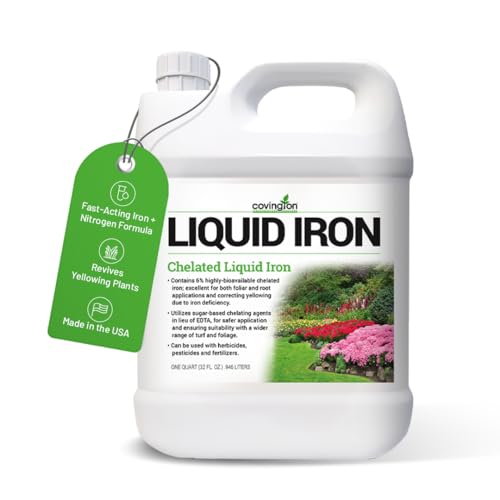
A sugar-based chelate with nitrogen that greens a yellow lawn in under a week.
This 32-ounce concentrate pairs 6% chelated iron with 12% nitrogen, 3.3% sulfur, and 0.05% manganese — a fuller nutrient profile than straight iron products. The sugar-based chelation (no EDTA) delivers iron efficiently, and the added nitrogen supports the strong growth that iron alone can’t. One skeptical owner mixed 8 ounces in a gallon of water, sprayed roughly 1,000 square feet of very yellow lawn, and saw improvement in 3-4 days with full green by the week mark. It also targets the classic symptoms — pale leaves, green veins, weak growth — and helps roots recover from stress like compacted soil.
The catch that shows up in reviews: you must water it in immediately. One owner who delayed watering found the grass turned black and died, and it will stain concrete. Foliar-spray or drench with a hose-end or pump sprayer, then water it down right away for best results.
Versatility is the strength here — lawns, trees, shrubs, and plants all respond, and a 32-ounce bottle covers 3,500 square feet per the specs.
Standout detail: Nitrogen plus iron in one bottle means greener growth, not just greener color — but only if you water it in promptly.
Grab it if: you want the nutrient boost of nitrogen alongside iron correction for a quick lawn and tree response.
Proceed with care if: you might forget to water in — that step is non-negotiable to avoid leaf burn.
8. LawnStar Liquid Iron (1 Gallon)
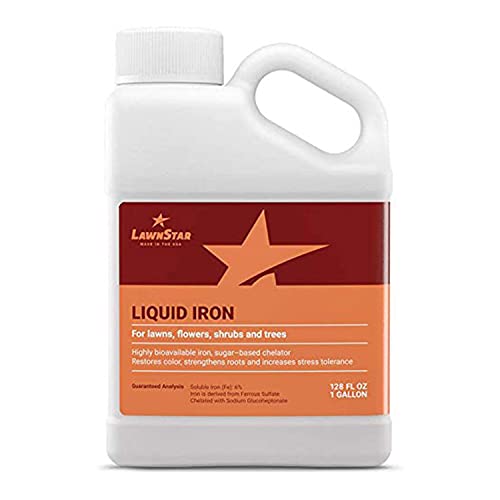
The professional-grade gallon that stays effective even at soil pH up to 9.5.
Most iron products fall apart in alkaline soil, but this sugar-based chelate is formulated to keep delivering where “other solutions fail” — the maker’s own claim for soils up to pH 9.5. That makes it the one to reach for if you’re fighting high-pH, clay-heavy ground that has defeated other treatments. Customers note visible greening of yellow leaves within 48 hours, and the multi-purpose formula works for lawns, ornamentals, flowers, shrubs, and trees — a river birch with chlorosis greened up after a few weeks of treatment. The heavier iron load than competing brands is a frequent point of praise, which is why the gallon (128 fluid ounces) is the cost-effective choice for treating trees.
One real-world warning stands out: do not mix this with liquid fertilizer in the same tank. The two react immediately and form a gelatinous blob that will clog your sprayer — test mixtures separately first, and keep this product solo. Foliar application works fastest, with owners recommending you wait 24-48 hours before irrigating.
It’s the high-volume option for serious property owners who want a full gallon of professional-grade chelate without rebuying small bottles.
The big advantages
- Works in alkaline soil up to pH 9.5
- Visible greening in about 48 hours
- Full gallon stretches across lawns and multiple trees
Handle with care
- Never mix with liquid fertilizer — it gels instantly
- Foliar spray requires 24-48 hr wait before watering
Choose this if: your soil is alkaline and other iron products haven’t worked — this is built for that exact condition.
Skip if: you like to combine treatments in one tank; this product demands to be applied alone.
9. Gemplers Liquid Iron Supplement (1 Gallon)
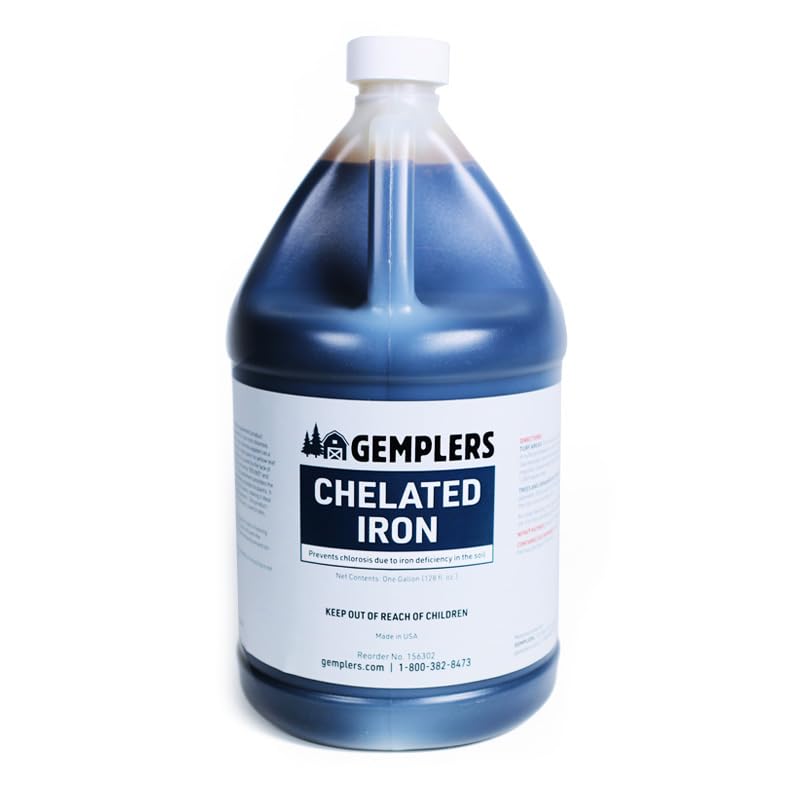
Commercial-grade dosing that scales by trunk diameter, not guesswork.
This gallon is aimed at growers who want precise control — the mixing ratio is 4 ounces per inch of trunk diameter, dissolved in 5 to 10 gallons of water. That trunk-diameter dosing is a meaningful difference from the blanket “oz per 1,000 square feet” instructions on consumer products, giving you a repeatable formula for treating individual trees correctly. The iron stays available in the soil for extended feeding, and it’s compatible with most tank mixes of fertilizers or pesticides, so commercial operators can bundle treatments. Reviewers point out lawns turning a “luscious deep green to blue-green” and strong results on Bermuda grass in the late spring.
The practical crowd loves the efficiency: one owner mixes 3 ounces per gallon of water per 1,000 square feet once a month and calls it “one of the best products” they use. Another owner appreciated having a proper treatment on hand instead of the rusty-nails-in-soil folk method.
With just 82 ratings, it’s a smaller sample than the giants on this list, but the 4.6-star average matches the top picks here — a sign of consistent quality. If you manage a landscape professionally or have a mix of tree sizes, the trunk-diameter dosing makes this the most deliberate choice.
Defining edge: A dosing system tied to trunk diameter, so every tree gets exactly the iron it needs — no more, no less.
Best for: confident growers who want measurable, per-tree dosing and tank-mix compatibility.
Maybe overkill if: you just want a simple spray-and-go for a single front-yard tree.
Understanding the Specs
Iron Content (%)
The percentage tells you how concentrated the iron is. Products like the Opulent Blends and Covington formulas carry 6% or 6.5% iron, meaning a smaller volume delivers a bigger dose. Higher iron percentages typically mean fewer applications and better value for large properties, but also demand careful measuring to avoid over-application.
Chelation Type (EDTA vs. Sugar-Based)
A chelate (a molecule that wraps the iron so soil can’t lock it away) keeps the iron available to your tree’s roots. EDTA is a synthetic chelate; sugar-based chelates are the modern alternative that many brands here (Covington, LawnStar) specifically advertise as “EDTA-free.” Both work, but sugar-based formulas tend to stay effective in a wider pH range, which matters in alkaline soil where chlorosis (yellowing leaves from iron deficiency) is most common.
Mixing Ratio & Coverage
Ratios vary wildly — Farmer’s Secret is 1 oz per 1,000 sq ft, Fertilome is 1 tablespoon per gallon, Gemplers doses by trunk inch. Coverage numbers (like 40,000 sq ft for Opulent) tell you how far the bottle stretches. Always convert the ratio to your sprayer size before you start; a wrong dilution either wastes product or risks leaf burn.
Application Method (Foliar vs. Soil vs. Implant)
Foliar sprays hit the leaves directly for the fastest greening but wash off and need repeating. Soil drenches feed the roots and last longer but fail in alkaline clay where iron binds. Trunk implants bypass both, delivering iron systemically for up to 2-3 years — the most permanent fix, but only practical on trees with trunks 8 inches or larger.
FAQ
What is the fastest way to green up a yellowing tree?
Is liquid iron better than granular iron for trees?
What does “chelated” mean on an iron fertilizer label?
How do I know if my tree actually has an iron deficiency?
Will liquid iron stain my patio or concrete?
How often should I apply iron to my trees?
Can I use lawn iron products on my fruit trees?
What if my soil is very alkaline or clay-heavy?
Why did my grass turn black after I applied liquid iron?
Final Thoughts: The Verdict
If you want one dependable pick, the iron for trees winner is the Fertilome Chelated Liquid Iron because it pairs one-gallon coverage, a simple 1-tablespoon-per-gallon ratio, and fast 2-day lawn greening with proven results on oak trees and citrus. If you want a non-staining, organic granular that feeds slowly and safely near patios, grab the Espoma Iron-Tone. And for large established trees fighting alkaline soil, the MediCap trunk implants are the one to reach for — a 5-minute install that keeps working for years.
How We Picked
We do not accept paid placement. Every pick is matched to a real buyer and a real use-case; we do not hands-on test units.
Sources & Methodology
Specifications: manufacturer listings and product documentation. Review insights: verified customer reviews, as of August 2026. Pricing: not shown on this page (it changes often); check the current price via the retailer link.
As an Amazon Associate, Lawn Gear Lab earns from qualifying purchases. This does not affect which products we feature.