
Specs are compiled from manufacturer listings and verified buyer reviews and can change over time — please confirm the key details on the product page before buying.
That yellow, tired-looking lawn is telling you something — and it’s probably not a lack of water or the wrong grass seed. More often than not, the culprit is iron chlorosis, a condition where your grass can’t get enough iron from the soil. The fix is a chelated iron supplement, which wraps iron molecules in a protective coating so they stay available for roots to absorb. But not all iron products work the same way, and picking the wrong one can leave you with stained concrete and a lawn that still looks pale. This guide breaks down the top iron chelates on the market, what to look for in the ingredients, and which one will actually green up your specific type of grass.
I’m Rikta — the founder and writer behind Lawn Gear Lab. This guide is built by comparing the manufacturers’ published specifications and the patterns across verified customer reviews, so you get each pick’s real strengths and trade-offs instead of marketing spin.
The right iron chelate for lawns turns pale yellow grass into deep, healthy green without burning or staining your hardscaping.
Our Picks at a Glance

How To Choose The Best Iron Chelate For Lawns
Walking down the lawn-care aisle, you see bags of iron sulfate, liquid bottles with “chelated” on the label, and granular products that promise to lower pH. It’s easy to grab the wrong one. Here are the three decisions that matter most.
Choose the right chelate type for your soil pH
The chelate molecule is what keeps iron from locking up in the soil. EDTA is the most common and works up to about pH 6.5. DTPA is the standard choice for slightly alkaline soil, holding iron stable up to pH 7.5. EDDHA is the heavy lifter for high pH soils above 7.5. If you have neutral to slightly alkaline soil, a DTPA-based chelate is usually the best starting point. If you know your pH is above 7.5, look for EDDHA on the label.
Decide between liquid and granular
Liquid iron gives you fast results — you often see a deep green color within a few days. It is easy to mix with a hose-end sprayer and covers a wide area quickly. Granular iron, on the other hand, releases slowly and also contains sulfur to lower soil pH over time. Granules are better for preventive, long-term correction, especially on centipede grass or St. Augustine lawns. Liquid is the go-to for a quick green-up or spot-treating yellow patches.
Watch the iron percentage and coverage
The iron content (listed as a percentage) tells you how concentrated the product is. A 10% or 11% liquid iron is highly concentrated — a little goes a long way. Some products use an amino acid complex for absorption, which works even in cooler weather. Coverage area matters too: a small 8 oz bottle that covers 50,000 sq ft is more concentrated than a 32 oz bottle that covers only 3,500 sq ft. Do the math on cost per square foot, not cost per bottle.
Quick Comparison
| Model | Best For | Form | Iron Content | Coverage | Amazon |
|---|---|---|---|---|---|
| Monterey Dr. Iron★ Best Overall | Large lawns needing soil pH drop | Granule | 22% | 21 lb bag | Check Amazon |
| Farmer’s Secret Liquid IronBest Value | Budget-friendly quick green-up | Liquid | Concentrated | 32 oz | Check Amazon |
| Bloom City Chelated Liquid IronFast Acting | Fast plant recovery in days | Liquid | Chelated | 32 oz | Check Amazon |
| TPS Nutrients Chelated Iron | Ornamental trees and vines | Liquid | Chelated | 32 oz | Check Amazon |
| Opulent Blends Almighty Iron | Massive lawns on a budget | Liquid | 10% | 50,000 sq ft | Check Amazon |
| Covington Chelated Liquid Iron | Fast green-up with extra nitrogen | Liquid | 6% | 3,500 sq ft | Check Amazon |
| Greenway Biotech DTPA 11% | Alkaline soil correction | Powder | 11% | 2 lb | Check Amazon |
| Gemplers Liquid Iron | Large properties and deep watering | Liquid | Concentrated | 1 gallon | Check Amazon |
In‑Depth Reviews
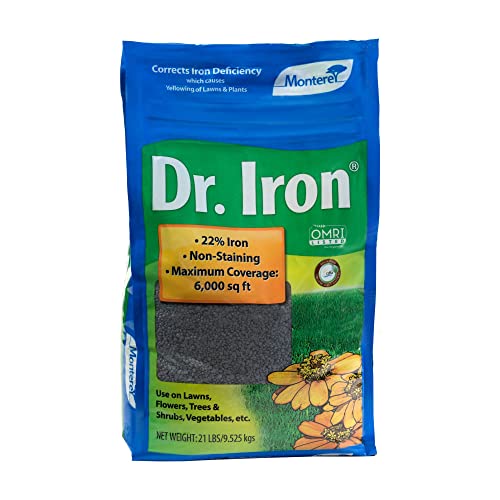
1. Monterey NLG7122 Dr Soil Acidifier Granules Iron and Elemental Sulfur
Our pick — over 4.5★ from 350+ verified ratings; the strongest balance of quality and price.
Non-staining pellet iron that turns yellow St. Augustine deep green without the mess.
This 21-pound bag of granules does double duty: it delivers 22% iron and 55% sulfur to lower soil pH, which makes it a long-term fix for alkaline soil. It is also OMRI listed for organic gardening. The granular form means you apply it with a spreader rather than a sprayer, and it does not stain concrete sidewalks or patios, unlike many other iron products.
The biggest advantage here is the application rate — buyers report using it once a month and seeing consistent greening without burning the grass. It works well on centipede lawns, St. Augustine, and even shrubs and vegetables. A soil test found desert soil at pH 8.2 with low iron, and a quarter of the recommended dose turned crops deep green without root burn.
The downside is the price tag, which is higher than some iron supplements. The crowd is also split on its value, with a few finding it expensive for a 21 lb bag. But the effectiveness and staining resistance are the most praised aspects — something no liquid iron can fully match.
Non-staining powerhouse: The combination of iron and sulfur corrects deficiency while lowering pH, all without leaving orange streaks on your concrete. Best for large lawns that need a slow-release, long-lasting solution.
Best for: Lawns with alkaline soil and iron chlorosis that need a monthly granular treatment without staining. The 21 lb bag covers significant acreage over time.
Who might look elsewhere: If you need immediate green-up in a few days, liquid iron works faster. Also not ideal for very small patches where measuring granules is tricky.
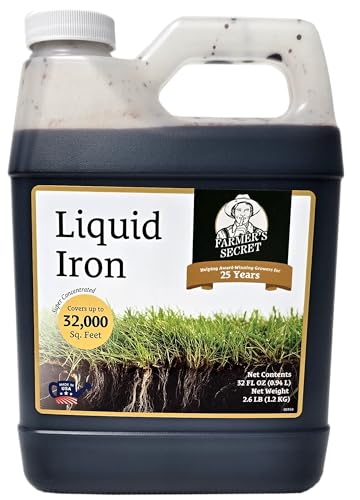
2. Farmer’s Secret Liquid Iron for Lawns and Gardens
Super-concentrated liquid that turns 1 oz per 1,000 sq ft into deep color.
The standout spec is the mixing ratio: 1 oz per 1,000 sq ft for normal maintenance. That means a single 32 oz bottle covers 32,000 sq ft of lawn. The manufacturer recommends applying it monthly, and buyers who followed that schedule reported “noticeable improvement in grass greenness” after three weekly treatments.
One owner sums it up: “Grass has literally never been greener. Took about 8 days but it WORKS.” The concentrated formula also complements all-purpose fertilizers, so you can mix it right into your existing feeding schedule. The value-for-money is the most praised aspect, though some owners found the effectiveness to be mixed — it depends on your soil’s starting pH and the underlying cause of yellowing.
Why it stands out
- 1 oz per 1,000 sq ft makes each bottle last across a large lawn.
- Compatible with hose-end, backpack, and irrigation sprayers.
- Noticeable green-up in about 8 days per buyer feedback.
The honest trade-off
- Effectiveness varies — works best when yellowing is from iron deficiency, not other issues.
- Liquid iron requires more frequent reapplication compared to granules.
Reach for it if: You have a large lawn and want the lowest cost per square foot in liquid form. Easy to apply monthly with any sprayer.
Look elsewhere if: Your soil pH is very high (above 7.5) — you may need a DTPA or EDDHA-based chelate instead of a standard liquid.
3. Chelated Liquid Iron – Bloom City Organic Iron Supplement for Lawns & Plants – 32 oz
“The day after the first treatment, they had already turned bright green.”
This is the iron chelate that produces the fastest visual results among all the picks. The label recommends 1-2 tablespoons per gallon of water, and the formula is designed for both soil drench and foliar application. Owners consistently report seeing color change within 24 hours to a week. One buyer described an azalea bush that went from anemic light green to bright green the very next day. A Gardenia bush with yellow leaves after transplanting “came back to life” with multiple new blooms.
At just 2 pounds for a 32 oz bottle, it is the lightest liquid option relative to the volume, and the mixing ratio makes it easy to work with. The most-discussed aspect is its effectiveness, followed closely by improved plant appearance. The only catch is that some users needed two to three applications to correct severe chlorosis, though the direction-following owners got full results within two weeks.
Overnight green-up: If you want a dramatic, fast visual change, this is the product. Great for azaleas, gardenias, and lawns with mild to moderate chlorosis.
Best for: Homeowners with ornamentals or lawns who want visible results within a day or two. Easy to mix and apply with a hose-end sprayer.
The caveat: Severe iron lockout may require multiple applications. The 32 oz bottle covers a medium-sized lawn — not the most concentrated option for huge acreage.
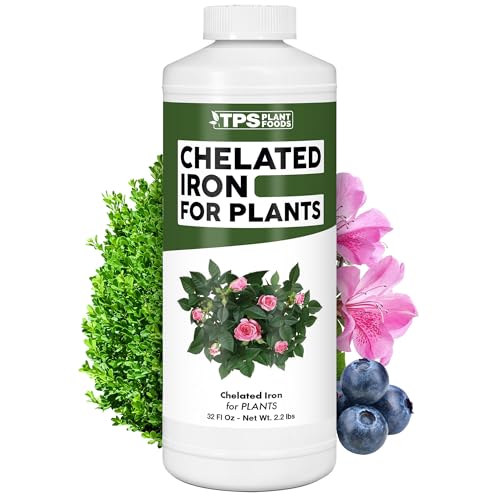
4. TPS Nutrients Chelated Iron for Plants – Liquid Iron Supplement, 32 oz
Corrects chlorosis in ornamentals and fruit trees — with the side effect of vigorous root growth.
This chelated iron is specifically marketed for landscape and orchard trees, including shade trees, fruit trees, and ornamentals. The formula is designed for efficient nutrient uptake through roots, and owners mention it treating bougainvillea, clematis vines, and fruit trees. A clematis with yellowing leaves turned “perfectly green” after a few applications. A bougainvillea with yellow leaves showed improvement within a week.
One reviewer noted the product stimulated heavy root growth — strong enough to cause root girdling in a pot. That same user did not see full yellow-leaf correction, suggesting the tree had other issues. The overall star rating sits slightly lower than the top picks, but every review that matched the right use-case saw positive results.
What works well
- Fast results within a week for many ornamentals and fruit trees.
- Stimulates root development, helping overall plant vigor.
Keep in mind
- Root growth can be too vigorous for container plants — use with caution in pots.
- Yellowness from non-iron causes (disease, overwatering) will not be corrected.
Best for: Trees, shrubs, and vines with confirmed iron chlorosis. The root-stimulation bonus helps transplants establish faster.
Think twice if: You are treating potted plants or containers where extreme root growth might cause girdling. Also not the strongest choice for large lawn-only applications.
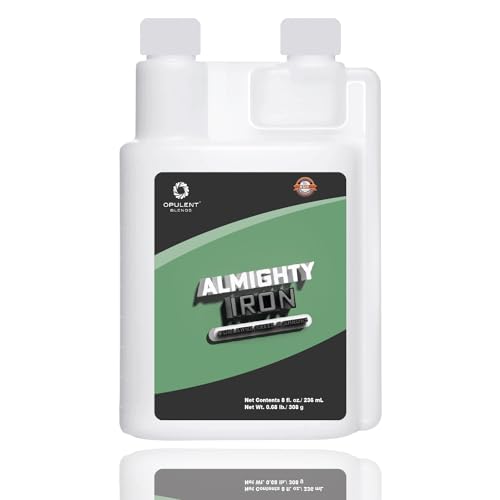
5. Almighty Iron – Opulent Blends – 8 fl. oz. (Covers 50,000 Sq Ft)
An 8 oz bottle covers half a football field — the highest coverage per ounce in the list.
This is the most concentrated liquid iron in the lineup. A single 8 oz bottle makes up to 50 gallons of spray solution and treats up to 50,000 sq ft. The active ingredient is 10% iron derived from an Iron Amino Acid Complex, which is a form of chelation that works well even in cooler temperatures. A lawn care professional reports using it on lawns, flower beds, and landscapes with “deeper, faster, longer-lasting green” than granular iron.
The fastest results come within 24 hours — one owner sprayed yellow edges and saw them disappear the same day, leaving a uniform green lawn. The value equation is outstanding: it is about one-third the cost of granular iron per treatment. The trade-off is the bottle cap, which several owners say does not seal properly and causes leaks during storage.
Coverage champion: You get 50,000 sq ft of coverage per bottle — more than any other liquid option here. That makes it the most economical choice if you have a large property or run a lawn service. Just transfer the product to a sealed bottle when it arrives.
Best for: Professional landscapers or owners of very large properties. The 10% amino-acid complex provides fast, visible results with minimal product.
Who may want a different product: Anyone who needs a bottle that seals securely for storage. The leaky cap is a known issue, so plan to use or transfer the liquid quickly.
6. Covington Chelated Liquid Iron Concentrate (32 oz)
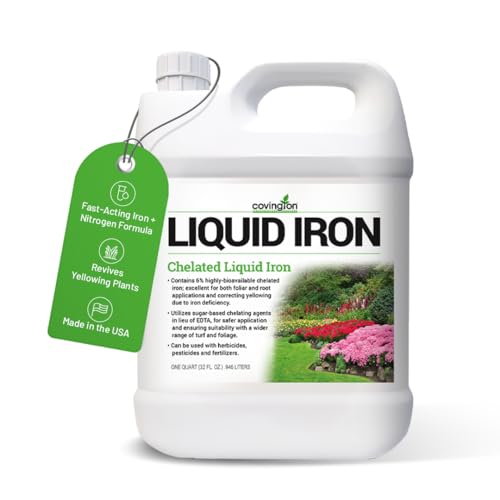
A sugar-based chelate that adds 12% nitrogen and 3.3% sulfur to the iron treatment.
What sets this liquid iron apart is the full nutrient profile: 6% iron from sugar-based chelation (no EDTA), plus 12% nitrogen, 3.3% sulfur, and 0.05% manganese. The nitrogen gives the grass a deep green color from both the iron and the extra feeding. The sugar-based chelation makes it gentler on the environment than EDTA-based products.
One owner mixed 8 oz per gallon of water on a very yellow 1,000 sq ft lawn and reported “improvement started in 3-4 days and after a week, all the grass is green.” Another reviewer said it made their lawn the best out of 250 yards in the neighborhood. But there is a real risk: the product can stain concrete if you do not water it in immediately. One owner skipped watering after application, and the grass turned black, taking a month to recover. The honest advice: water it in right away. Coverage is 3,500 sq ft per bottle — moderate compared to the more concentrated options like the 50,000 sq ft champion above.
Why it stands out
- 12% nitrogen plus chelated iron gives both fast greening and feeding.
- Works well with hand and mechanical sprayers.
- Visible results in 3-4 days per owner reports.
What to watch for
- Will stain concrete if not watered in promptly.
- Only 3,500 sq ft coverage per bottle — less concentrated than some alternatives.
Best for: Homeowners who want a multi-nutrient treatment — iron plus nitrogen for a complete green-up. The sugar chelate is a good pick for environmentally conscious buyers.
Not ideal if: You want maximum coverage from one bottle, or you tend to skip watering after application. The staining risk is real.
7. Greenway Biotech Chelated Iron DTPA 11% – 2 Lb Powder
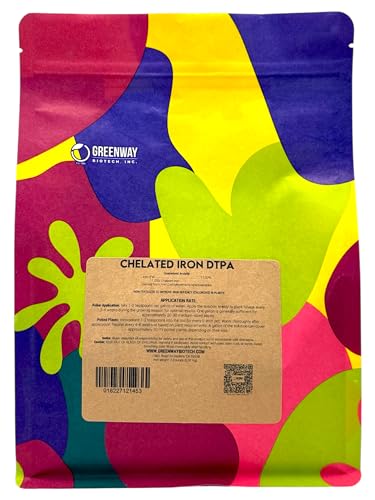
DTPA chelation keeps 11% iron available in alkaline soil where standard EDTA fails.
If your soil pH is between 7.0 and 7.5, this is the right chelate. DTPA stays stable up to pH 7.5, unlike EDTA which begins to lose effectiveness above 6.5. The powder form is 100% water soluble with no residue, making it suitable for foliar spray, soil drench, or fertigation.
Owners in high-desert areas with pH 8.2 soil saw fruit trees recover after using this product — first as a soil application, then as a foliar spray. One buyer used a tablespoon per week in an aquaponic system and reported super-green spinach. The label recommends 1-2 tsp per gallon for foliar spray or 1-2 tbsp per gallon for soil drench. The biggest complaint is the cost — the 2 lb bag is expensive per pound, and some owners found it only lasts a month depending on their setup.
The alkaline fix: DTPA chelation makes this the pick for neutral-to-alkaline soils where other iron form ties up. The 11% concentration means a little powder goes a long way.
Best for: Lawn owners with pH between 6.5 and 7.5, and any grower using hydroponics or fertigation. The DTPA chelate bridges the gap between cheap EDTA and expensive EDDHA.
skip it if: Your soil pH is above 7.5 — you need EDDHA, not DTPA. Also not the most economical option for very large acreage.
8. Gemplers Liquid Iron Supplement for Plants – 1 Gallon
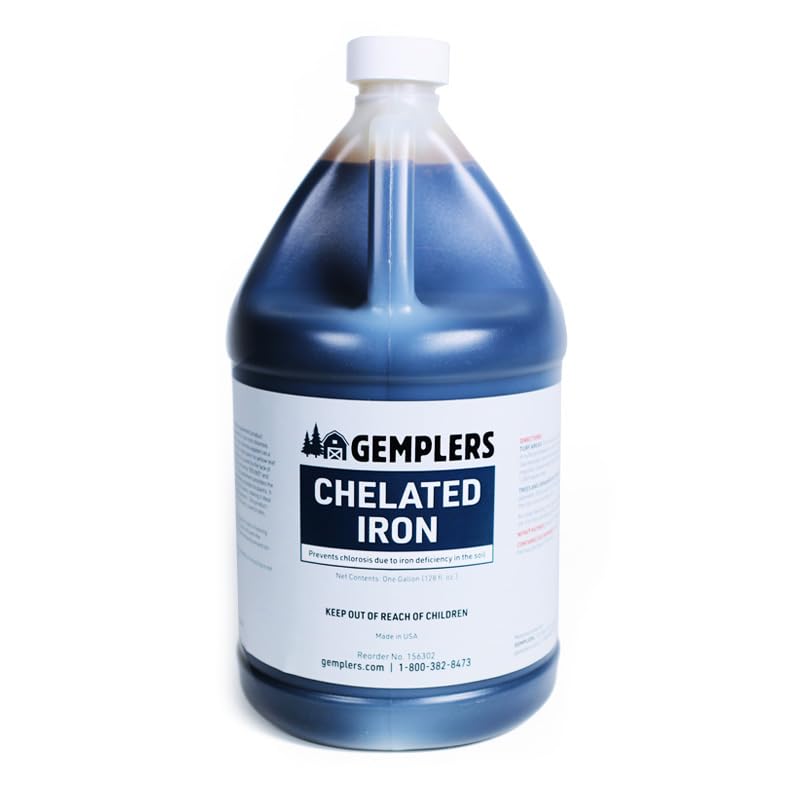
A full gallon of commercial-grade iron that turns Bermuda grass deep blue-green.
Volume matters when you have a large property. This 1-gallon jug provides 128 fluid ounces of liquid iron — more than four times the volume of the standard 32 oz bottles. The mixing ratio is 4 oz of iron per inch of trunk diameter mixed into 5 to 10 gallons of water for trees, or a 3 oz per gallon per 1,000 sq ft monthly application for lawns. One owner from SW Missouri reports it makes Bermuda grass “deep green color pop” even in late May.
Owners use this as a regular monthly supplement: “BAM — it works” is how one describes the results after mixing 3 oz per gallon per 1,000 sq ft. The formula stays available in the soil for extended feeding and is compatible with most tank mixes of fertilizers or pesticides. The full gallon jug is an investment, but the unit cost is lower than buying multiple small bottles.
What makes it worth it
- 128 fluid ounces — the largest single bottle in the comparison.
- Compatible with most tank mixes for combined treatments.
- Consistent monthly use produces “luscious deep green to blue-green” lawns.
Consider this first
- Higher upfront cost compared to smaller bottles.
- Not as concentrated as 10% or 11% liquid options — you use more product per treatment.
Best for: Large lawns or properties with trees where you want to treat everything from a single jug. The gallon size means fewer reordering trips.
Think twice if: You have a very small lawn or only need a one-time spot treatment — a smaller bottle would be more practical.
Understanding the Specs
DTPA vs EDDHA vs EDTA
The chelate molecule (the chemical that keeps iron dissolved in the soil) determines which soil pH the iron stays available at. EDTA (ethylenediaminetetraacetic acid) works up to pH 6.5. DTPA (diethylenetriaminepentaacetic acid) extends to pH 7.5. EDDHA (ethylenediamine-N,N’-bis(2-hydroxyphenylacetic acid)) works up to pH 9.0. If you have neutral soil (pH 7.0), a DTPA-based product like the Greenway Biotech 11% powder is the balance. If your soil is above 7.5, you need EDDHA — though none of the products here use that form, so you would need to search elsewhere.
Granular vs Liquid
Granular products like Monterey Dr. Iron provide a slow release of iron and sulfur to lower pH over time. They are non-staining and better for large lawns but require a spreader. Liquid iron works faster — you see results in days — but needs more frequent application and must be watered in to avoid staining concrete.
FAQ
Can I use iron chelate on my lawn during hot weather?
How long does it take for iron chelate to green up a lawn?
Will chelated iron stain my concrete driveway or sidewalk?
What is the difference between iron sulfate and chelated iron?
How often should I apply iron chelate to my lawn?
Can I mix iron chelate with my regular fertilizer?
Does iron chelate work for all types of grass?
Why is my lawn still yellow after applying liquid iron?
Final Thoughts: The Verdict
For most buyers, the iron chelate for lawns winner is the Monterey Dr. Iron because it combines 22% iron with 55% sulfur in a non-staining granular form that corrects both the deficiency and the alkaline soil that causes it. If you want fast, visible green-up within days, grab the Bloom City Chelated Liquid Iron. And for large lawns where budget matters, the Farmer’s Secret Liquid Iron covers 32,000 sq ft per bottle for less than the cost of a single bag of granular.
How We Picked
We do not accept paid placement. Every pick is matched to a real buyer and a real use-case; we do not hands-on test units.
Sources & Methodology
Specifications: manufacturer listings and product documentation. Review insights: verified customer reviews, as of July 2026. Pricing: not shown on this page (it changes often); check the current price via the retailer link.
As an Amazon Associate, Lawn Gear Lab earns from qualifying purchases. This does not affect which products we feature.