
Specs are compiled from manufacturer listings and verified buyer reviews and can change over time — please confirm the key details on the product page before buying.
Brown patches spreading across your lawn, spongy turf that peels back like carpet, and birds or moles digging for a feast—white grubs are eating your grass roots from underneath. The best insecticide for white grubs stops these C-shaped larvae before they turn into adult beetles and repeat the cycle next season. You need a product that kills the grubs where they feed, and the choice depends on how fast you want results versus how long you want the protection to last.
I’m Rikta, the writer behind Lawn Gear Lab. This guide uses the manufacturers’ published specs and patterns across verified customer reviews, so you get each pick’s real strengths and trade-offs instead of marketing spin.
From fast-acting granules that kill on contact to long-term biological spore treatments that live in the soil for years, these seven proven formulations cover every lawn size and grub pressure level. Read on to find the right insecticide for white grubs for your yard and schedule.
Quick Picks
- Atticus Asenra SRX Liquid Grub Control — Best Overall
- BioAdvanced Complete Brand Insect Killer for Lawns Granules — Big Lawn Hero
- Bonide (BND60360) Insect and Grub Control Granules — Fastest Knockdown
- Quali-Pro Imidacloprid T&O 2F Insecticide — Pro-Size Concentrate
- Atticus Mineiro 2F Imidacloprid Systemic Insecticide — Value Gallon
- St. Gabriel Organics Milky Spore Granular (15 lb) — Long-Term Bio
- St. Gabriel Organics Milky Spore Powder (10 oz) — Starter Bio
How To Choose The Best Insecticide For White Grubs
White grubs are the larval stage of beetles like Japanese beetles, June bugs, and chafers. They feed on grassroots, which causes dead patches that peel up easily. Choosing the right insecticide means matching the active ingredient to the grub’s life cycle and your lawn’s size.
Contact-Kill vs. Systemic vs. Biological Control
Contact-kill granules (like those with lambda-cyhalothrin or bifenthrin) kill grubs on the spot when they crawl through the treated soil. Systemic insecticides (like imidacloprid or chlorantraniliprole) get absorbed into the grass blades and roots so grubs die when they feed. Biological options (like milky spore, which uses Bacillus popilliae bacteria) take longer to establish but can suppress grubs for up to 15 years without re-applying every year.
Application Timing Is Everything
Preventive products—imidacloprid or chlorantraniliprole—work best when applied from mid-June through late July, targeting eggs and young grubs before they start heavy feeding in late summer. Curative products for active infestations (often containing carbaryl or trichlorfon) need to be applied when you see damage, but they need watering-in immediately and work only on small, young grubs.
Coverage Area and Formulation
Granules are easier to spread with a broadcast spreader and work well on large lawns. Liquids need a hose-end sprayer or pump sprayer but let you spot-treat specific areas. Check the bag’s square-foot coverage—a product that treats 25,000 sq ft per bag is very different from one that treats 2,500 sq ft.
Quick Comparison
| Model | Best For | Coverage (sq ft) | Active Ingredient | Form | Amazon |
|---|---|---|---|---|---|
| Atticus Asenra SRX | Season-long liquid prevention | Up to 32,000 sq ft (4oz) | 18.4% Chlorantraniliprole | Liquid Concentrate | Amazon |
| BioAdvanced Complete Insect Killer | Fast, broad-spectrum lawn rescue | 25,000 sq ft | Bifenthrin + Zeta-cypermethrin | Granules | Amazon |
| Bonide Insect & Grub Control | Dual-action for soil & surface pests | — | Imidacloprid + Lambda-Cyhalothrin | Granules | Amazon |
| Quali-Pro Imidacloprid T&O | Large-yard liquid systemic control | Up to 85,000 sq ft (128 oz) | 21.8% Imidacloprid | Liquid Concentrate | Amazon |
| Atticus Mineiro 2F | Generic Merit alternative for large properties | — | 21.4% Imidacloprid | Liquid Concentrate | Amazon |
| St. Gabriel Milky Spore Granular | Long-term organic grub suppression | — | Bacillus Popilliae | Granules | Amazon |
| St. Gabriel Milky Spore Powder | Small-scale biological starter | 2,500 sq ft | Bacillus Popilliae | Powder | Amazon |
In‑Depth Reviews
1. Atticus Asenra SRX Liquid Grub Control
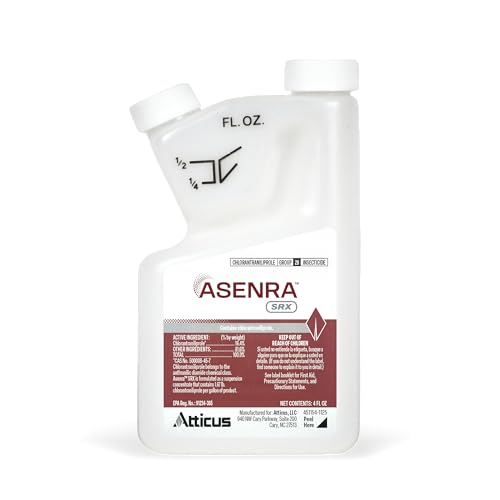
One liquid treatment that defends your turf for four straight months.
Atticus Asenra SRX uses 18.4% chlorantraniliprole—a chemical class (anthranilic diamide) the EPA labels as Reduced Risk—to attack white grubs (Japanese beetle and black turfgrass Ataenius) along with billbugs, caterpillars, and adult beetles. A single 4-ounce bottle lasts up to 120 days and covers up to 32,000 sq ft, so you protect roughly three-quarters of an acre. Unlike many granular products, this liquid does not need immediate watering-in, which is a practical relief if you cannot predict the next rain.
Buyers report that the small bottle “packs a punch” and last two seasons for an 8,000 sq ft lawn. One reviewer noted using Asenra SRX to deter wild pigs by eliminating their grub food source. The key catch: timing matters. For best white grub control, you need to apply in late spring or early summer, aiming at the grub’s vulnerable life stage before they grow large.
Compared to granules like BioAdvanced, Asenra SRX is gentler on honeybees and earthworms, giving you confidence if you manage a garden with beneficial insects. Check state availability—this product cannot ship to Alaska, Arizona, Hawaii, New York, or several other states.
Season-Long Asset
- 120-day residual control with one application
- No immediate watering-in needed
- EPA Reduced Risk; safe for honeybees and earthworms
Know Before You Buy
- Not available in several states (check label)
- Requires precise spring/summer timing for grubs
- Liquid concentrate needs a sprayer
Reach for this if: you want a single-season-long liquid treatment that protects your lawn and landscape while being gentle on beneficial insects.
Look elsewhere if: you need an immediate curative for an active grub infestation today, or you live in a restricted state.
2. BioAdvanced Complete Brand Insect Killer for Lawns Granules
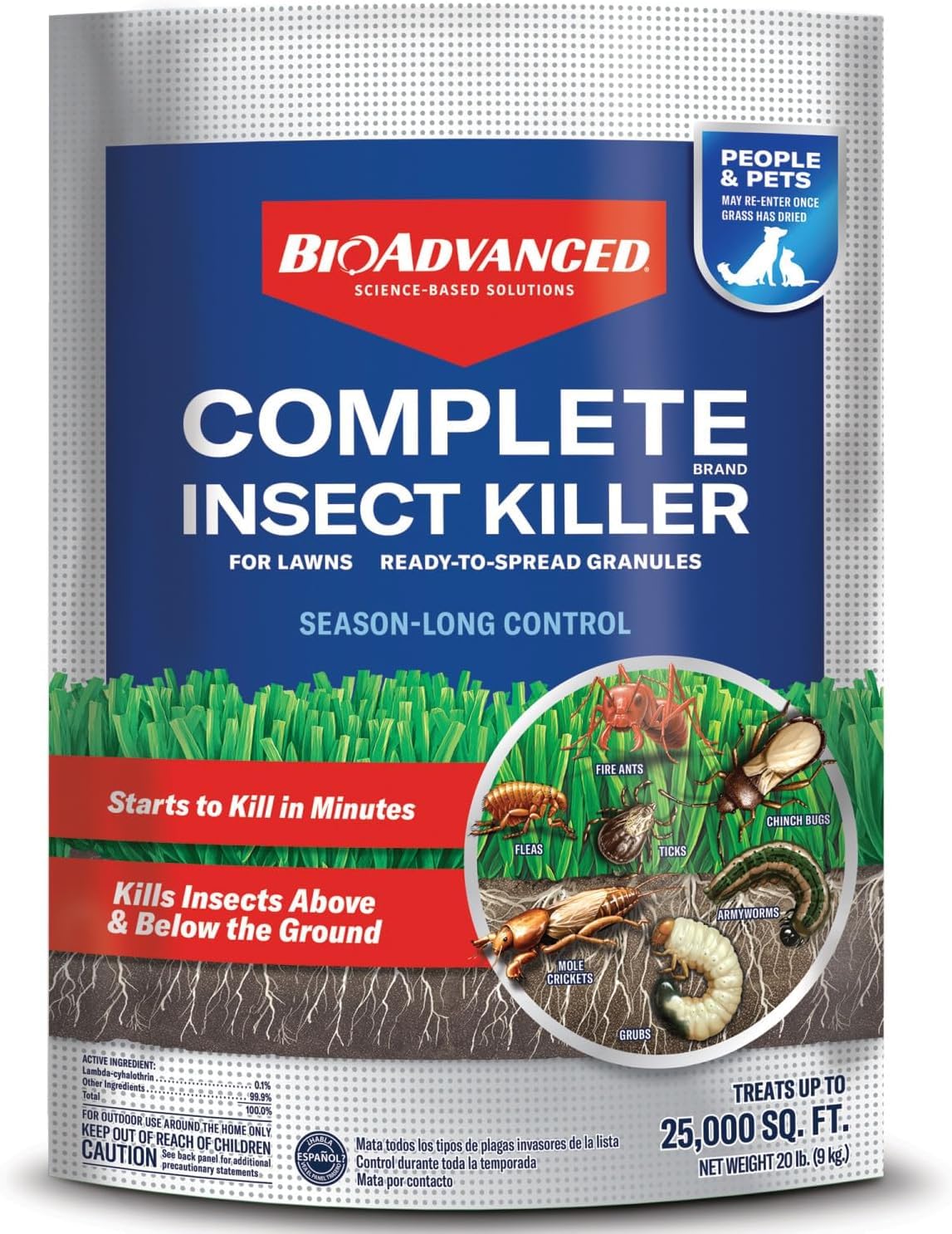
A 20-pound bag covering 25,000 sq ft kills pests above and below the surface.
This is your go-to if grubs, chinch bugs, ticks, fleas, ants, mole crickets, and fire ants are all attacking your lawn at once. The 20-pound bag of granules treats up to 25,000 square feet—over four times the ground of the 6-pound Bonide bag. Owners mention it “provides ~3 months protection in South Florida’s warm climate” and is safe for St. Augustine grass, a relief for Southern growers who need proven St. Augustine-friendly products.
The fast-acting formula kills listed insects on contact, which is critical when you are in rescue mode. One reviewer hit a heavy infestation of ticks in a deep forest campsite and called it “Excellent.” That said, a few owners noted it did not control stink bugs or fully stop moles from hunting insects in the treated zone. Not all moles will pack up immediately—they may just dig elsewhere on your property.
If you weigh the BioAdvanced against the Bonide, the BioAdvanced covers over four times the ground per bag, making it a smarter buy for half-acre-plus lawns. Customers note the 20-pound bag vs. a typical 10-ounce biological product shows the sheer volume advantage for large-scale applications.
Turf-Saving Volume: A 20-pound bag covering 25,000 sq ft is tough to top for sheer value on a large property. Good for home foundations and fire ant mounds too.
Not a Specialty Tool: If your only pest is Japanese beetle grubs and you want biological long-term control, the broad-spectrum nature of this product may feel heavy-handed.
Best for: homeowners with large lawns who need a single granular product to knock down multiple pests at once.
skip it if: you want an organic or biological-only solution, or you are dealing with stink bugs, which seem to walk through it.
3. Bonide (BND60360) Insect and Grub Control Granules

This combo kills visible grubs in 24 hours and keeps working for months.
The Bonide formula combines two active ingredients: imidacloprid for systemic, long-lasting control and lambda-cyhalothrin for rapid surface and soil kill. Buyers confirm it works fast—one reviewer wrote it “KILLED all them Suckers within 24hrs.” If you walk outside, peel back a patch of dead turf, and see grubs wriggling, this product gives you a quick knockdown plus residual protection for up to 3 months.
Designed for lawns and around home foundations, the 6-pound bag is aimed at smaller to mid-sized yards rather than sprawling acreages. Spread it with a fertilizer spreader and water lightly right after—the package says “water lightly immediately after application.” One buyer used it on a community garden plot and found it effective against soil worms and fly larvae that were destroying their raised beds.
On the downside, the bag is compact compared to the 20-pound BioAdvanced, so if your lawn is half an acre or more, you will need multiple bags. Some reviewers reported limited impact on flies and mosquitoes, which makes sense—this product targets soil-dwelling and lawn-surface insects, not airborne ones.
Speed Meets Longevity
- Visible results within 24 hours
- Dual-action: kills on contact + systemic protection
- Works on ants, crickets, ticks, grubs, and more
Consider This
- 6 lb bag is best for small to medium lawns
- Not for indoor use or airborne insects
- Needs immediate watering-in after spreading
Reach for this if: you have an active grub infestation today and want to see dead grubs by tomorrow.
Look elsewhere if: you need to treat more than 10,000 sq ft in one go, or want a chemical-free biological approach.
4. Quali-Pro Imidacloprid T&O 2F Insecticide

It uses 21.8% imidacloprid, the same active ingredient as the industry-standard Merit, in a 128-ounce jug.
Quali-Pro delivers 21.8% imidacloprid—a systemic insecticide that the grass absorbs so grubs die when they feed on roots—in a 128-fluid-ounce jug. The label says it controls southern masked chafer, northern masked chafer, Japanese beetle, European chafer, European crane fly, and green June beetle. One reviewer called it “effective systemic insecticide that works well on lawns and ornamentals” and noted it kills grubs and chinch bugs quickly. Another homeowner used it to save all 13 of their laurel shrubs after trying other products with no success. The consistency is thick like Elmer’s glue, so be ready to wear gloves and shake well before mixing.
One buyer uses 2 ounces per 5 gallons of water around agaves in April and October to stop black beetle larvae. Because you mix your own solution, you can adjust the concentration for spot-treating ornamentals or covering wide turf areas. But you need a pump sprayer or hose-end sprayer, and you must be precise about mixing ratios—more is not better.
Volume Per Dollar: 128 ounces of 21.8% imidacloprid concentrate is a serious value for anyone with a large lawn or multiple properties. One jug can go a very long way.
Not for Edible Gardens: Imidacloprid is systemic, meaning it moves into the plant. This should not be used on food crops or around edible plants.
Best for: large-lot owners and landscape pros who want a concentrated, cost-effective systemic that they mix themselves.
pass on it if: you prefer ready-to-spread granules, need an organic option, or grow vegetables in the treatment zone.
5. Atticus Mineiro 2F Imidacloprid Systemic Insecticide

The gallon jug of 21.4% imidacloprid matches the active ingredient in Bayer Merit 2F—the go-to preventive grub control for over two decades.
Atticus Mineiro 2F contains 21.4% imidacloprid, a systemic chemical that gets absorbed by grass roots. When you apply this from mid-June through late July, it targets summer-hatching grubs before they become destructive. One buyer called it “the real deal imidacloprid in value size you won’t find at big box stores” and uses it as a soil drench for ash trees against emerald ash borers, with 3 years of healthy results.
This gallon (128 fluid ounces) of concentrate can treat lawns, trees, shrubs, flowers, groundcovers, and even residential fruit and pecan trees. Reviewers point out it is highly concentrated: one direction calls for mixing just 1.25 teaspoons with 3 gallons of water for agave snout weevils. For lawn grubs, you would use a hose-end sprayer and follow the rate for your specific turf area. Another buyer found it effective against lawn grubs and moles when used as a soil drench.
The catch: Mineiro 2F cannot be shipped to Alaska, Arizona, Hawaii, California, Connecticut, Colorado, Massachusetts, Maryland, Maine, New Jersey, Nevada, New York, Rhode Island, or Vermont. And like all imidacloprid products, you need to apply it preventively or early in the grub hatch—it won’t rescue a mature grub infestation in September.
Preventive Powerhouse
- 1-gallon jug provides massive value per treatment
- Same active ingredient as industry-standard Merit
- Works on lawns, trees, shrubs, and ornamentals
Restrictions & Timing
- Not available in many states (check the list)
- Must be applied mid-June to late-July for best grub control
- Requires a sprayer and precise mixing
Reach for this if: you need the largest volume of systemic grub prevention at the best per-application cost and you live in an eligible state.
Look elsewhere if: you are in a restricted state, or you need a curative granular that works on sighted grubs today.
6. St. Gabriel Organics Milky Spore Granular (15 lb)

A single granule application keeps killing Japanese beetle grubs for up to 15 years.
This is the biological long game. St. Gabriel’s 15-pound bag of granular milky spore uses Bacillus Popilliae, a naturally occurring bacterium that infects and kills Japanese beetle grubs. Once the spores are in the soil, they multiply and persist for up to 15 years, providing continuous control as grubs ingest the bacteria while feeding. The product is USDA-certified organic and safe around pets, beneficial insects, and food crops.
Customers who stick with the program see results. One reviewer applied it three times per year for two years and found only 5 grubs in 1,026 sq ft. Another saw immediate relief from mole runs—the moles simply left because the grub population collapsed. A buyer specifically recommends the granular form over powder, noting that granules spread more evenly through a spreader without clogging (set your spreader to 4.5, not low).
The trade-off: this is not a quick fix. Milky spore requires two to three years of consistent applications to build up full soil populations, and it only targets Japanese beetle grubs—not other white grub species like chafer or June beetle grubs. It must be applied above 50°F soil temperature and watered in well.
low-maintenance: After the initial multi-year buildup phase, this product works on its own for a decade or more. If you hate reapplying chemicals every season, this is your route.
Patience Required: You will not see dead grubs tomorrow. This is a preventive biological suppressor, not a curative rescue treatment.
Best for: homeowners who want an organic, environmentally responsible solution and are willing to invest several seasons for long-term grub freedom.
it’s not for you if: you have an active grub infestation right now, or you need to control multiple white grub species beyond Japanese beetles.
7. St. Gabriel Organics Milky Spore Powder (10 oz)
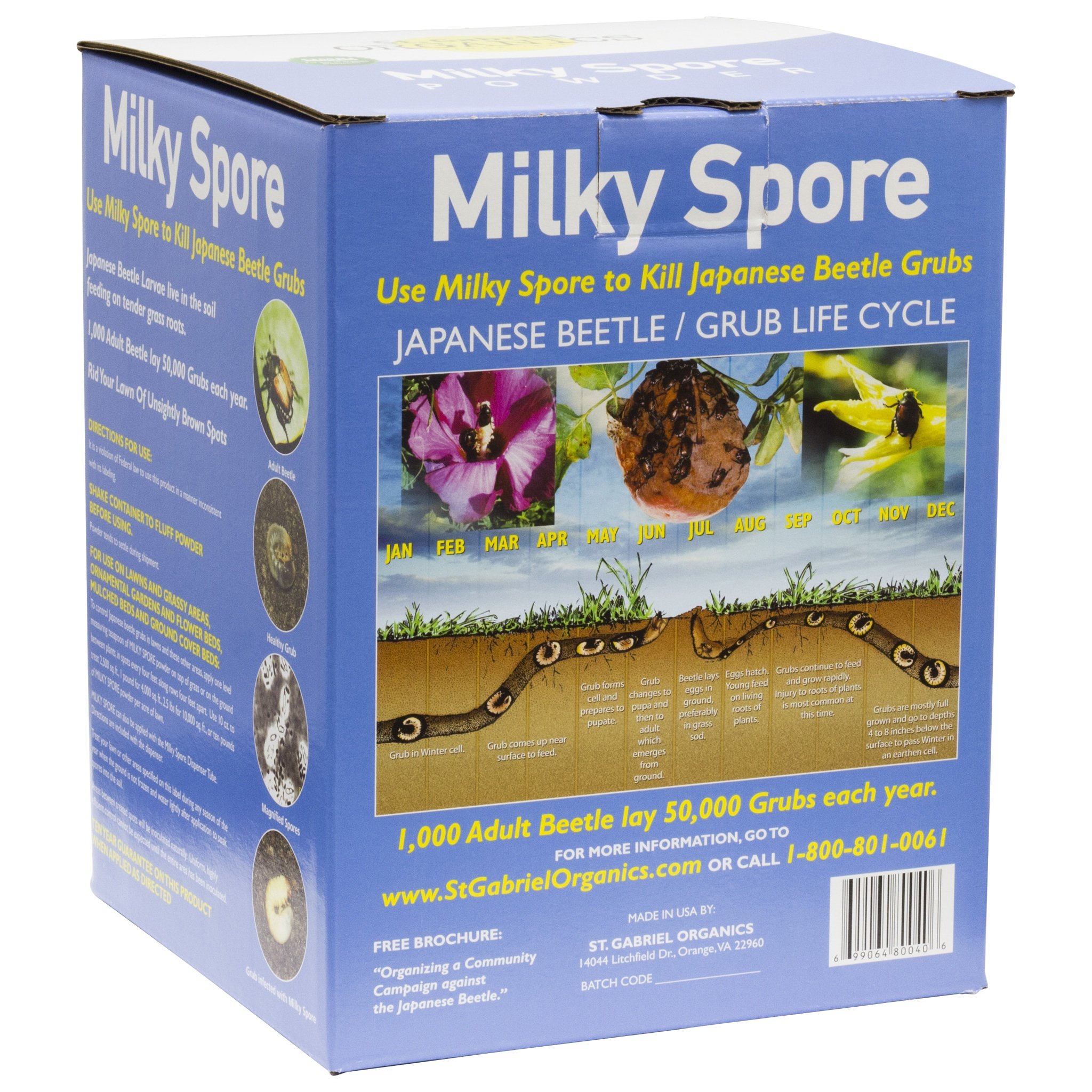
This 10-ounce powder covers up to 2,500 sq ft, making it a small-bag biological entry point for the curious organic gardener.
This 10-ounce powder uses the same Bacillus Popilliae spore as the granular version, just in powder form and a smaller quantity. You apply it at 1 teaspoon every 4 feet along rows. Buyers call it a “natural beetle control” that persists in the soil for seasons. One buyer mentioned that a “test patch of brown grass recovered in a week” after applying the powder and watering it in.
A buyer who mixed it into new soil during reseeding saw no pest issues the following year and appreciated that the small amount was efficient—enough to subscribe for ongoing seasonal applications. Another reviewer who ignored written warnings and bought the powder noted it was “super tiny” for the price, meaning you are paying for the biological technology, not volume. The label lacks printed instructions, so be prepared to look up the application rate online.
The powder is safe for pets, beneficial insects, and the environment—reviewers confirmed it did not harm worms or fireflies. It is the smallest and most affordable way to test whether milky spore works in your soil type before investing in the 15-pound granular.
Low-Barrier Entry
- Safe for pets, worms, and fireflies
- Simple sprinkle application by hand
- Spores persist and multiply in soil for seasons
Volume & Pace
- “Super tiny” 10oz bag for the price
- Only covers 2,500 sq ft (vs. 25,000 sq ft for BioAdvanced)
- Slow buildup—needs 2+ years for full effect
Reach for this if: you want to try a biological, pet-safe grub control on a small lawn or flower bed without a big upfront investment.
Look elsewhere if: you need to cover a large area immediately, or you want a curative treatment that kills active grubs today.
Understanding the Specs
Active Ingredient: Imidacloprid
The most common systemic insecticidal ingredient in grub control. It is absorbed by grass roots and moves through the plant. Grubs die when they feed on treated roots. This is a preventive tool—apply before you see damage, typically from June through July. Imidacloprid is also used on ornamentals, trees, and shrubs.
Active Ingredient: Chlorantraniliprole
A newer chemistry class (anthranilic diamide) classified by the EPA as Reduced Risk. It targets the grub’s muscle system, stopping feeding quickly. It lasts up to 120 days and is gentler on beneficial insects and earthworms than older chemistries. No immediate watering-in is often required, which simplifies application timing.
Biological Control: Milky Spore (Bacillus Popilliae)
This is a naturally occurring soil bacterium that infects Japanese beetle grubs. Once established, spores multiply in the soil and stay active for up to 15 years. It is USDA-certified organic, safe for pets and wildlife, but only targets Japanese beetles and requires multiple seasons to build up full effectiveness.
Formulation: Granules vs. Liquids
Granules are ready to spread with a broadcast or drop spreader—easiest for large lawns and for people who don’t own a sprayer. Liquids need a hose-end sprayer or pump sprayer, but they let you mix to the exact concentration needed for spot treatments, trees, and shrubs. Granules are typically contact-based; liquids are usually systemic.
FAQ
When should I apply insecticide for white grubs?
How long does grub insecticide take to work?
Will these products harm my pets or kids?
Can I use grub killer on a vegetable garden?
What is the difference between milky spore powder and granules?
Do I have to water in grub killer after applying?
How often should I apply grub control?
Will grub killer also control moles and voles?
What does 18.4% chlorantraniliprole mean for coverage?
Why can’t I buy some products in my state?
Final Thoughts: The Verdict
Across the board, the best insecticide for white grubs winner is the Atticus Asenra SRX because a single liquid application provides 120 days of protection without immediate watering-in, working gently on beneficial insects. If you want fast, granular broad-spectrum control across a large lawn, grab the BioAdvanced Complete Insect Killer. And for an organic, pet-safe, long-term biological solution that eventually self-replenishes, the standout is the St. Gabriel Milky Spore Granular if you have the patience for it.
How We Picked
We do not accept paid placement. Every pick is matched to a real buyer and a real use-case; we do not hands-on test units.
Sources & Methodology
Specifications: manufacturer listings and product documentation. Review insights: verified customer reviews, as of July 2026. Pricing: not shown on this page (it changes often); check the current price via the retailer link.
As an Amazon Associate, Lawn Gear Lab earns from qualifying purchases. This does not affect which products we feature.