
Specs are compiled from manufacturer listings and verified buyer reviews and can change over time — please confirm the key details on the product page before buying.
You spot chewed leaves, sticky sap on the trunk, or tiny webs forming in the branches — and you know your tree is under attack. The question is which spray actually stops the damage without harming the tree or the surrounding yard. This guide breaks down the most effective options, from fast-acting contact killers to systemic drenches that protect from the inside out, so you can match the right product to the pest you are fighting.
I’m Rikta — the founder and writer behind Lawn Gear Lab. This guide is built by comparing the manufacturers’ published specifications and the patterns across verified customer reviews, so you get each pick’s real strengths and trade-offs instead of marketing spin.
Whether you are battling bagworms on shrubs, aphids on a crepe myrtle, or grubs under the lawn, the right formula makes the difference between a quick fix and a season-long headache — here is what matters when choosing the best insecticide for trees.
Quick Picks
- Fertilome (16062) Spinosad Insecticide — Best Overall
- BioAdvanced Tree & Shrub Insect Killer Ready-to-Spray — Top Performer
- BioAdvanced 3-in-1 Fruit, Citrus & Nut Tree Spray — Best Value
- Monterey Fruit Tree Spray Plus — Organic Choice
- Pro Grub Control – 32 oz Concentrated Imidacloprid — Heavy Duty
- Vpg Fertilome Gallon Tree & Shrub Systemic Insect Drench — Systemic Power
- Bonide Fruit Tree & Plant Guard, 32 oz Concentrate — Orchard Ready
How To Choose The Best Insecticide For Trees
You do not need a chemistry degree to pick the right spray. Focus on the pest you actually see, how the product gets into the tree, and whether it works on contact or from the inside. Here are the three factors that matter most.
Active Ingredient: Match It to the Pest
Different ingredients target different bugs. Spinosad is great for caterpillars, bagworms, and tent caterpillars — and it is OMRI listed for organic use. Imidacloprid is a systemic (travels through the tree) that works on aphids, Japanese beetles, and grubs. Neem oil plus pyrethrins gives you a knockdown spray that handles both insects and fungal diseases. Always check the label against the bug you are fighting.
Application Method: Spray vs. Drench
Ready-to-spray bottles connect to your garden hose and cover a tree in minutes — ideal for large canopies. Concentrates you mix yourself give you control over dose but take more time. Soil drenches are poured around the base of the trunk and are absorbed by the roots; they protect the whole tree from inside for weeks or months, but do nothing for pests already on the leaves.
Protection Window: Contact vs. Systemic
A contact spray kills bugs it hits, but washes off in rain — some formulas re-apply every two weeks. A systemic product (like those with Imidacloprid) moves through the sap, so a single drench protects for the season but can also affect bees and beneficial insects if applied to flowering trees. Decide based on how long you need coverage and what else lives in your yard.
Quick Comparison
| Model | Best For | Active Ingredient | Size | Application | Amazon |
|---|---|---|---|---|---|
| Fertilome Spinosad | Bagworms & Caterpillars | Spinosad | 16 oz | Concentrate / RTS | Amazon |
| BioAdvanced Tree & Shrub | Aphids & General Pests | Imidacloprid | 32 oz | Ready-to-Spray | Amazon |
| BioAdvanced 3-in-1 Fruit | Fruit Tree Diseases & Insects | Multi (Insect/Fungal/Mite) | 32 oz | Ready-to-Spray | Amazon |
| Monterey Fruit Tree Spray Plus | Organic & Triple Action | Neem Oil + Pyrethrins | 16 oz | Concentrate | Amazon |
| Pro Grub Control (Imidacloprid) | Grubs & Root Feeders | Imidacloprid 21.4% | 32 oz | Concentrate / Soil Drench | Amazon |
| Vpg Fertilome Systemic Drench | Deep Systemic Protection | Imidacloprid | 128 oz | Soil Drench | Amazon |
| Bonide Fruit Tree & Plant Guard | Complete Orchard Care | Multi (Insect/Fungus/Mite) | 32 oz | Concentrate | Amazon |
In‑Depth Reviews
1. Fertilome (16062) Spinosad Insecticide

Organic-certified bagworm killer that covers trees, shrubs, and edibles — one concentrate for the whole yard.
This 16 oz concentrate from Fertilome uses Spinosad (a naturally derived substance approved for organic gardening) to stop leafminers, borers, caterpillars, bagworms, and tent caterpillars. You mix 4 tablespoons per gallon of water, so the bottle goes a long way on trees, shrubs, vegetables, and fruit. Buyers report it cleared up a bagworm problem after just one application — “I’ve checked back several times. All the bagworms are gone.”
Unlike systemic chemicals that linger in the sap, Spinosad works on contact and ingestion but breaks down faster in sunlight, making it safer for beneficial insects once dry. It is also available as a ready-to-spray version if you prefer to skip the measuring. The trade-off is that you may need a second application for heavy infestations, especially on large trees.
At 1 pound, the bottle is notably lighter than the BioAdvanced 3-in-1 at 2.17 pounds — a 20% difference — meaning less weight to carry around the yard during mixing and spraying.
Smart organic pick: If you want an OMRI-listed spray that handles the most common leaf-eating worms and caterpillars without synthetic chemicals, this is the one.
Reach for if: you have bagworms, tent caterpillars, or leafminers on any tree or shrub and want an organic option.
Look elsewhere if: you need a long-lasting systemic that keeps working for months from the inside — Spinosad is contact-only and degrades in sunlight.
2. BioAdvanced Tree & Shrub Insect Killer Ready-to-Spray

Fast-acting contact killer that stays effective for up to two weeks and withstands rain after one hour.
This 32 oz ready-to-spray bottle from Bayer Advanced targets aphids, white flies, and other listed pests on trees and shrubs. You just attach it to your garden hose and spray — the water dilutes it as you go. The key spec here is the rainproof guarantee: once the spray dries for one hour, a downpour will not wash it off, which matters when you cannot control the weather. Owners mention it “eliminated aphids, white flies, and other pests from crepe myrtle trees after other products failed.”
At 2.08 pounds, it is slightly lighter than the BioAdvanced 3-in-1 (2.17 pounds — a 4% gap), but the real difference is purpose: this is a dedicated insecticide, not a 3-in-1, so it hits bugs harder without extra fungicide ingredients. The downside is that it does not control diseases or mites, so if your tree has both bugs and black spot, you will need a separate product.
One-season workhorse: For a straightforward, no-mix bug spray that sticks through weather and works fast, this earns its spot in the shed.
Perfect for: homeowners who want a grab-and-hose solution for aphids, beetles, and general leaf pests on shade trees and ornamentals.
Not ideal for: fruit tree growers who also need disease control — grab the 3-in-1 version instead.
3. BioAdvanced 3-in-1 Fruit, Citrus & Nut Tree Spray

One bottle that kills insects, controls mites, and stops fungal diseases — a true three-in-one for fruit trees.
This 32 oz ready-to-spray product from BioAdvanced does triple duty: it kills caterpillars, aphids, and mites; it controls black spot, powdery mildew, and rust; and it is safe to use up to the day before harvest on fruit and nut trees. For citrus owners, one reviewer noted “BioAdvance 3-in-1 effectively treated leaf miner on lime trees” — visible improvement after a few weeks. The hose-end connection makes it simple to cover a tall canopy, though some reviewers found the spray head finicky and needing proper water pressure.
The big advantage over the standard Tree & Shrub spray is the disease control — if your peach tree has both aphids and rust, this handles both in one pass. The trade-off is that the 3-in-1 formula is slightly less concentrated on the insect side than a dedicated bug spray, so heavy pest pressure may require a follow-up application every 3 to 4 weeks.
Fruit grower’s shortcut: If you manage a home orchard with multiple problems at once, this eliminates the need to buy separate insecticide and fungicide bottles.
Best for: backyard fruit and nut tree growers who want broad protection (insects + fungus + mites) in a single spray.
Skip if: you only have shade trees with no fruit — the Tree & Shrub spray costs less and covers the same bugs without the extra disease ingredients.
4. Monterey Fruit Tree Spray Plus
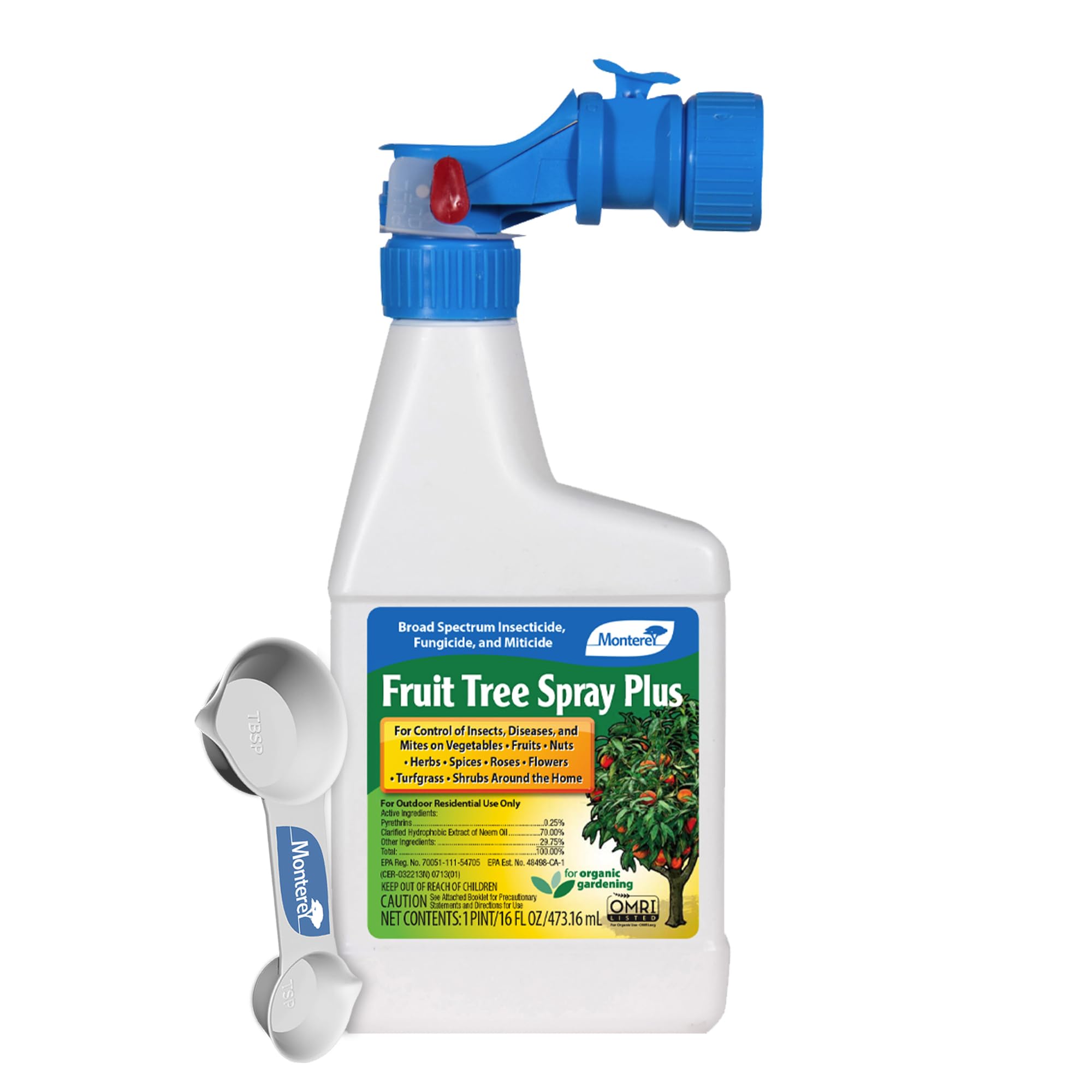
Organic triple-threat of neem oil and natural pyrethrins that knocks down bugs and prevents fungus in one go.
Monterey’s 16 oz concentrate combines 70% neem oil with natural pyrethrins — it works as an insecticide, miticide, and fungicide. The neem smothers eggs and larvae, while the pyrethrins provide quick knockdown of adult aphids, scales, caterpillars, and spider mites. It is OMRI Listed, meaning it meets organic standards under the USDA National Organic Program. One buyer simply reported “it saved my appletree!”
This is the only pick on the list that targets all three life stages (egg, larva, adult) with a natural formula. However, multiple reviewers mentioned leaks during shipping — “the bottle was leaking” appears more than once — so inspect the packaging on arrival. At 16 ounces, it is lighter than the 32-ounce alternatives, but the concentrate mixes with water, so you get many gallons of spray from a single bottle.
What works
- OMRI organic certification
- Controls insects, mites, and fungus with one product
- Affects egg, larval, and adult stages
Watch out for
- Several customers note leaking bottles during shipment
- Hose-attachment design can pop off under water pressure
Grab this if: organic gardening is your priority and you want a single concentrate that fights bugs, mites, and fungal disease on fruit trees and ornamentals.
Consider another if: you need a leak-proof, ready-to-spray bottle — the Monterey concentrate works best with your own sprayer.
5. Pro Grub Control – 32 oz Concentrated Imidacloprid

Professional-strength concentrated Imidacloprid that turns one bottle into a nearly bottomless supply for tree and grub protection.
This 32 oz bottle from Liquid Harvest packs 21.4% Imidacloprid — a high concentration that makes it economical for large properties. Use it as a soil drench (mix 0.4 fl oz per gallon of water per inch of trunk diameter) or as a foliar spray for aphids, Japanese beetles, weevils, and grub larvae on turf. Reviewers point out “this product is much more economical to use than the alternatives available at local retailers” — one reviewer claims a single bottle could provide a “lifetime supply” for treating hemlocks against adelgid.
Unlike contact sprays, Imidacloprid is systemic — the tree absorbs it through roots or leaves, and it travels through the sap to kill feeding insects for weeks. The catch is that it is toxic to bees if applied to flowering plants, and the bottle design received some criticism for being awkward to measure and clean. You will also want to water the ground a few hours before drenching to help the product soak in.
Long-term investment: For the price per application, this concentrate stretches further than any ready-to-spray option — ideal for anyone with many trees or large turf areas.
Best for: serious tree owners who want season-long systemic protection against grubs, adelgid, Japanese beetles, and root feeders at the lowest per-use cost.
Not for: organic gardens or flowering trees where bees are active — Imidacloprid persists in the plant and can harm pollinators.
6. Vpg Fertilome Gallon Tree & Shrub Systemic Insect Drench

A full gallon of systemic drench that protects trees from the roots up — no spraying leaves required.
This 128 fluid ounce jug from Fertilome is a ready-to-mix concentrate you pour around the base of the tree. Mix 1 ounce per gallon of water, and the Imidacloprid is absorbed through the roots into the entire tree system — it stops aphids, bagworms, Emerald Ash Borers, and adelgid from the inside. Shoppers say “this product works great on Emerald Ash Borers” and one owner of 45 hemlocks called it the “best product to deal with bugs.”
At 8.1 pounds, this is the heaviest product on the list by far — but that is because you are buying a gallon of concentrate, which goes further than any 32 oz bottle. The systemic approach means no foliage spraying, no drift, and no need to climb a ladder. The serious downside: it is extremely strong on pollinators. One reviewer warns “will kill bees,” so never apply near flowering plants or during bloom. It also needs moist soil before application to work properly.
Set-and-forget protection: Pour it at the base once a season and the tree defends itself — as long as you keep it away from flowering plants.
Ideal for: large trees, rows of evergreens, or any situation where spraying the canopy is impractical — one drench covers a tall oak or a hedge of hemlocks.
Avoid if: bees frequent your yard or you have flowering shrubs near the target trees — the systemic chemical will spread into blooms and pollen.
7. Bonide Fruit Tree & Plant Guard, 32 oz Concentrate
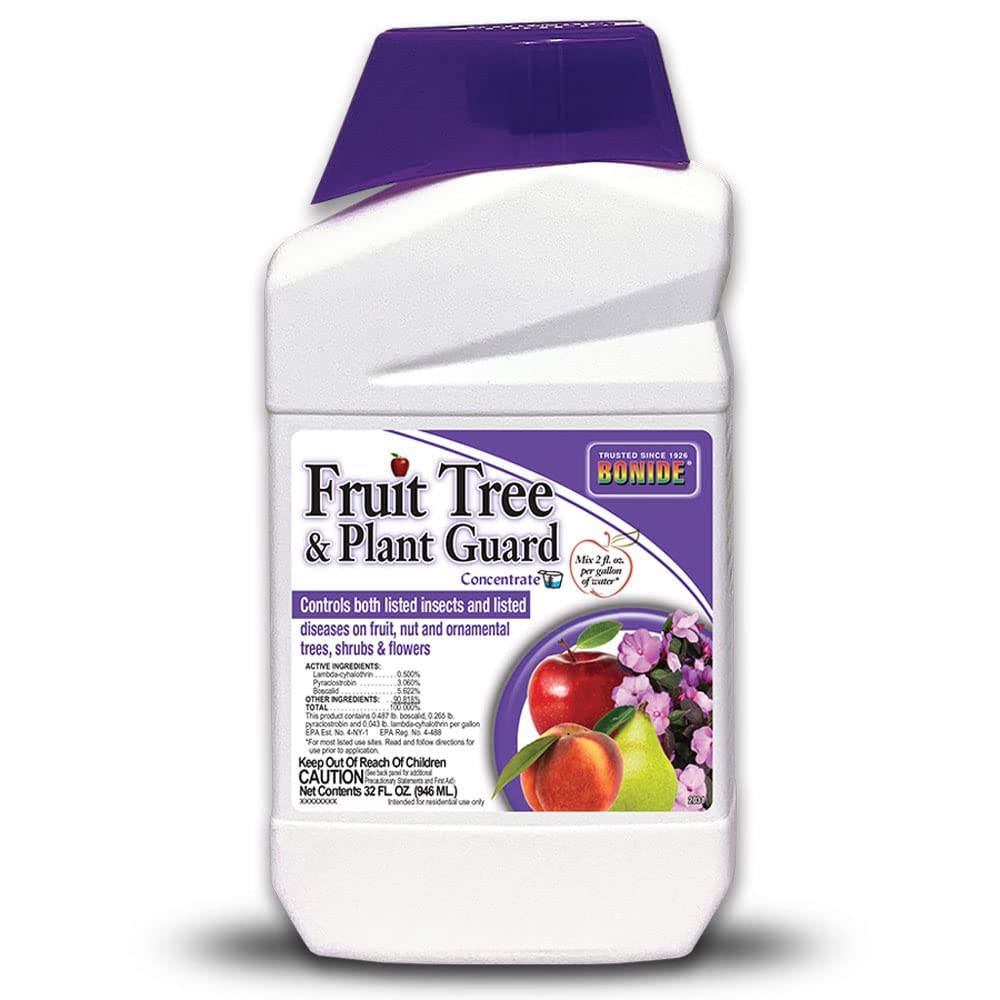
A complete concentrate that acts as insecticide, fungicide, miticide, aphicide, and scalicide — five functions in one jug.
Bonide’s 32 oz concentrate is the most versatile product on this list. It controls aphids, Japanese beetles, powdery mildew, scab, leaf curl, and many other listed insects and diseases on fruits, vegetables, nuts, ornamentals, and trees. The bottle arrives as a concentrate — you shake it, mix with water, and spray. One buyer uses it on apple trees and reports “one spraying after flowering seems to do a great job for the season,” with a second pass only if Japanese beetles show up on plum trees.
The range of functions (insecticide + fungicide + miticide + aphicide + scalicide) makes it a true do-everything product for a home orchard. The trade-off is price and availability — at the highest cost in this list, and one buyer mentioned it is “expensive and hard to find locally.” Some users also found it took two or three treatments to control bugs, and it was only partly effective against leaf rust on figs.
Strengths
- Five-mode protection for insects, fungus, mites, aphids, and scale
- Suitable for fruit, nut, vegetable, and ornamental trees
- One seasonal spray often enough on healthy trees
Weaknesses
- Highest price in this lineup
- Some rust and heavy infestations need multiple applications
- Hard to find in local garden centers
Choose this if: you have a mixed orchard (fruit, nut, citrus) and want one concentrate that covers everything — insects, diseases, mites, aphids, and scale — with minimal bottles in the shed.
Pass on it if: you only need a simple bug killer for a couple of shade trees — the BioAdvanced Tree & Shrub spray costs less and covers the same pests without the extra disease protection you do not need.
Understanding the Specs
Spinosad vs. Imidacloprid
These are the two most common active ingredients in tree insecticides. Spinosad comes from a naturally occurring soil bacterium and is OMRI approved for organic gardening — it kills insects on contact and ingestion but breaks down in sunlight, so you may need to reapply. Imidacloprid is a synthetic systemic that moves through the tree’s sap and stays active for weeks or months; it is highly effective but toxic to bees, so never apply it to flowering trees or plants pollinators visit.
Systemic vs. Contact
A systemic insecticide (like Imidacloprid) is absorbed by the roots or leaves and distributed throughout the tree — it protects every branch from the inside, even new growth. A contact insecticide (like Spinosad or pyrethrins) only kills bugs it directly hits during spraying. Systemics give you longer coverage with less effort, but they cannot reverse damage already done to leaves. Contacts work instantly but wash off and require repeat applications after rain or 2 weeks.
FAQ
Can I use lawn grub killer on my trees?
How often should I spray insecticide on my trees?
Will Imidacloprid kill bees if I spray my tree?
What is the difference between a concentrate and ready-to-spray?
Can I use fruit tree spray on ornamental trees?
How do I apply a soil drench to a large tree?
Will Spinosad wash off in rain?
Is it safe to eat fruit after spraying these products?
Can I mix insecticide with fertilizer in the same sprayer?
Which product works best on Emerald Ash Borer?
Final Thoughts: The Verdict
Across the board, the insecticide for trees winner is the Fertilome Spinosad because it combines OMRI organic certification, effective control of bagworms and caterpillars, and versatile use on trees, shrubs, and edibles — all at a reasonable cost per application. If you want a fast-acting, rainproof hose-end spray for shade trees, grab the BioAdvanced Tree & Shrub Insect Killer. And for deep systemic protection that lasts the whole season without spraying leaves, the standout is the Vpg Fertilome Systemic Insect Drench.
How We Picked
We do not accept paid placement. Every pick is matched to a real buyer and a real use-case; we do not hands-on test units.
Sources & Methodology
Specifications: manufacturer listings and product documentation. Review insights: verified customer reviews, as of July 2026. Pricing: not shown on this page (it changes often); check the current price via the retailer link.
As an Amazon Associate, Lawn Gear Lab earns from qualifying purchases. This does not affect which products we feature.