
Specs are compiled from manufacturer listings and verified buyer reviews and can change over time — please confirm the key details on the product page before buying.
Thrips are the stealth saboteurs of your garden — tiny enough to slip through window screens, fast enough to jump from leaf to leaf, and stubborn enough to survive many common sprays. The real frustration is that by the time you see the silvery streaks and black specks on your plants, they have usually already burrowed inside buds and leaf folds where contact sprays cannot reach. A targeted insecticide that either hits them on contact or works systemically from the inside is the only way to break their life cycle.
I’m Rikta — the founder and writer behind Lawn Gear Lab. This guide is built by comparing the manufacturers’ published specifications and the patterns across verified customer reviews, so you get each pick’s real strengths and trade-offs instead of marketing spin.
To get rid of thrips, you need to match the active ingredient (the chemical that actually kills them) to where you grow and how much time you have to spray. For most people, the Athena IPM — a ready-to-use spray (no mixing required) with EPA 25(b) minimum-risk ingredients — offers the easiest balance of safety and coverage across houseplants, vegetables, and ornamentals.
Quick Picks
- Athena IPM Plant Pest Control Ready-to-Use Spray — Best Overall
- Monterey Spinosad Insecticide Garden Spray — Organic Power
- The Environmental Factor NemaKnights — Living Solution
- Atticus Ascertain TR Greenhouse Fogger — Greenhouse Fogger
- Bonide Systemic Insect Control — Long-Lasting
- Hi-Yield 55% Malathion Spray (32 oz) — Heavy Hitter
- General Hydroponics Azamax GH2007 Antifeedant — Premium Bio
How To Choose The Best Insecticide For Thrips
Thrips spend part of their life cycle inside plant tissue (eggs inside leaves, pupae in the soil), which is why a spray that only hits the surface rarely wipes them out entirely. You need either a contact killer that you apply repeatedly to catch each generation, or a systemic product (one the plant absorbs so thrips die when they feed) that the plant absorbs and turns toxic from the inside. Your choice depends on three factors: where you grow, what you grow, and how much time you have.
Match the Active Ingredient to Your Crop
Spinosad (a naturally occurring bacteria that kills on contact and through ingestion) is OMRI-listed (verified by the Organic Material Review Institute for organic gardening) and works well on vegetables and fruit trees. Bifenthrin (a synthetic pyrethroid, a man-made version of a natural chrysanthemum compound) is a professional greenhouse staple that gives total leaf coverage through fogging. Azadirachtin (the key insecticidal compound from neem seeds) doubles as an insect growth regulator and antifeedant, meaning it stops thrips from eating and maturing, not just killing on contact. Malathion (an organophosphate insecticide) hits hard but requires careful timing around blooming plants and rain forecasts. If you grow edible crops, check the label — Bonide Systemic Insect Control, for instance, is not intended for vegetables or fruit plants.
Application Method: Spray vs Fogger vs Granules
Ready-to-use sprays (like the Athena IPM) require no mixing and are ideal for small indoor setups. Concentrates (Monterey Spinosad, Bonide Systemic, Hi-Yield Malathion) give you more treatments per dollar but need a sprayer — either a trigger, backpack, or hose-end tank sprayer. Total-release foggers (Atticus Ascertain TR) fill entire greenhouse spaces up to 3,000 sq ft (about the size of a small warehouse) with micro-sized particles (billions per can) that reach leaf undersides where thrips hide. Granular nematodes (NemaKnights) are a completely different approach: you shake living organisms (microscopic roundworms that are natural predators) onto the soil, and they hunt thrips larvae in the growing medium — no spraying, no chemicals, no protective gear needed.
Frequency and Persistence
Contact sprays typically require reapplication every 7 to 10 days as long as the infestation lasts, because they only kill what they touch. Systemic products and slow-release nematodes provide longer-lasting protection — nematodes should be reapplied 10 to 14 days after the first use to break the pest life cycle. Bifenthrin foggers are a one-and-done treatment for the space they cover, but any new thrips that fly in after treatment need a fresh application.
Quick Comparison
| Model | Best For | Active Ingredient | Form | Volume | Amazon |
|---|---|---|---|---|---|
| Athena IPM | Indoor ready-to-use | EPA 25(b) oil | Ready-to-use spray | 32 oz | Amazon |
| Monterey Spinosad | Organic vegetables | Spinosad | Concentrate (oil) | 8 oz | Amazon |
| NemaKnights | Soil-dwelling larvae | Beneficial nematodes | Granules | 280 g | Amazon |
| Atticus Ascertain TR | Greenhouse fogging | Bifenthrin 4% | Total release fogger | 2 oz | Amazon |
| Bonide Systemic | Ornamental flowers | Systemic (concentrate) | Spray concentrate | 16 oz | Amazon |
| Hi-Yield 55% Malathion | Heavy outdoor infestations | Malathion 55% | Spray concentrate (oil) | 32 oz | Amazon |
| AzaMax GH2007 | Food-grade organic control | Azadirachtin A & B | Liquid concentrate | 16 oz | Amazon |
In‑Depth Reviews
1. Athena IPM Plant Pest Control Ready-to-Use Spray
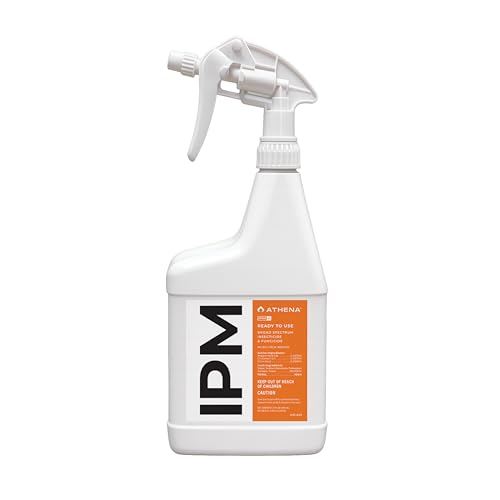
No mixing, no measuring, just shake and spray on thrips inside or out.
If you grow a mix of houseplants, herbs, vegetables, and ornamentals and want one bottle that handles them all, the Athena IPM is the simplest entry point. It comes ready-to-use right from the 32-ounce bottle — you do not need a sprayer, a measuring spoon, or any guesswork. The formula is made with EPA 25(b) minimum risk ingredients, meaning it qualifies as an eco-friendly natural insecticide and fungicide that is safe around pets, people, and children when used as directed. It targets thrips on contact along with spider mites, aphids, and powdery mildew.
It works on everything from hydroponic systems and grow rooms to raised beds and fruit trees, so you only need one product in your cupboard. The trade-off is that as a contact spray it needs thorough coverage on leaf undersides, and you will have to reapply more often than a systemic product like the Bonide concentrate. Buyers report that the spray nozzle produces a fine mist that helps reach between tight leaves, but you still need to get every surface.
Straightforward pick: Perfect for the indoor grower or casual gardener who wants professional-grade pest control out of a single ready-to-use bottle — no mixing, no extra equipment, just one purchase that covers thrips on most plant types.
Reach for this if: you value convenience above all else and need a single spray that works on houseplants, vegetables, and ornamentals without measuring or mixing.
Look elsewhere if: you have a large greenhouse or more than 50 plants — a concentrate will stretch your dollar further.
2. Monterey Spinosad Insecticide Garden Spray Concentrate
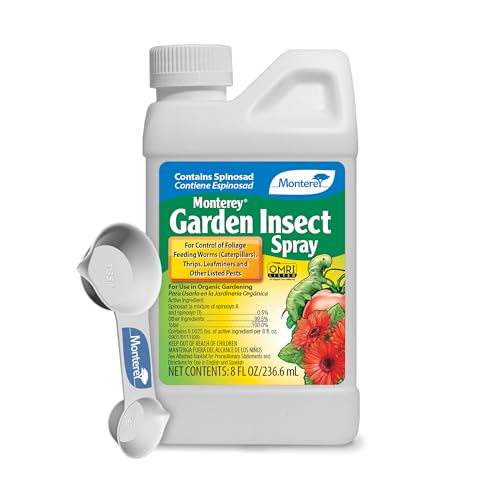
Organic spinosad that takes down thrips on vegetables without chemical odor.
If you grow food crops — tomatoes, peppers, citrus trees — and want an insecticide that fits organic standards, Monterey Spinosad is your target. It is OMRI Listed for Organic Gardening, meaning the Organic Material Review Institute has verified it complies with USDA organic standards. The active ingredient is spinosad, a naturally occurring bacteria produced by fermentation that kills thrips, caterpillars, leafminers, codling moths, and fire ants on contact and through ingestion. It is fast acting and produces no odors, which makes it pleasant to use around the garden even on a hot day.
Unlike the Athena IPM ready-to-use spray, this is an 8-ounce concentrate that you must dilute before applying. The label recommends using a trigger sprayer, hand-held, backpack, or hose-end sprayer, so you need to own at least one of those. The upside is that 8 ounces of concentrate goes much further than 32 ounces of a ready-to-use — you mix only what you need, and the rest stays concentrated on the shelf. Reviewers who grow vegetables consistently report that spinosad is the most reliable organic option for thrips because thrips eat the treated leaf tissue and die, whereas contact-only sprays wash off in rain.
What works
- OMRI-certified organic — suitable for vegetables, fruit trees, and citrus
- Odorless fast-acting formula that treats on contact and through ingestion
- Can be applied with trigger, backpack, or hose-end sprayers
What to know
- Requires dilution and a sprayer — not grab-and-go like the Athena IPM
- As a contact/ingestion killer, you must spray leaf undersides thoroughly
For the organic gardener: This is the most dependable spinosad concentrate for edible crops — the OMRI seal means you can spray your tomatoes right up to harvest day without breaking organic rules.
Not for you if: you want a premixed bottle; this concentrate needs you to own a sprayer and spend a minute mixing each batch.
3. The Environmental Factor NemaKnights Slow-Release Nematodes

Living nematodes you shake onto soil to hunt thrips larvae without poison.
NemaKnights takes a completely different approach from every spray-based insecticide on this list. Instead of killing thrips on contact with a chemical, you shake these granular nematodes (microscopic roundworms that are natural predators of soil-dwelling pests) directly onto the affected area. The nematodes seek out thrips larvae, fungus gnat larvae, and whitefly pupae in the growing medium and kill them from the inside — no mixing, no spraying, no chemical residue. The granules are ready-to-use and safe for pets, plants, and beneficial insects like bees and ladybugs.
One buyer who had a nightmare fungus gnat infestation reported that in 4 weeks, not one gnat remained — an outcome that mirrors how the slow-release nematodes work: they do not kill instantly but break the pest life cycle over two to three weeks. The instructions recommend applying again 10 to 14 days after the first use to catch the next generation. This product treats up to 50 planters, making it a strong value for collectors with many pots. However, it is a living product — some buyers noted that the granules arrived moist and with a slight smell, especially in hot climates, so inspect the package on arrival and use it promptly. The 280-gram container weighs 0.33 kilograms, which is considerably lighter per application than carrying around the 2.5-pound bottle of Hi-Yield Malathion concentrate.
Reach for this if: you want zero chemical exposure indoors — nematodes are a self-spreading biological army that targets larvae in the soil while leaving your leaves and air untouched.
skip it if: you need to kill adult thrips on leaves right now; nematodes only work on soil-stage larvae and take 2 to 4 weeks to show full results.
4. Atticus Ascertain TR Greenhouse Fogger (2 oz Can)
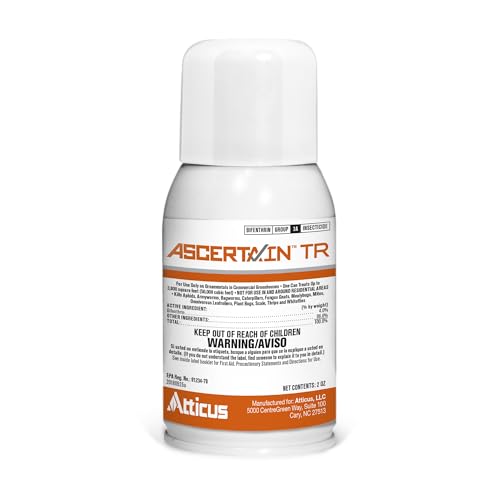
Billions of micro-particles fog the entire greenhouse to hit thrips hiding under leaves.
Thrips love the underside of leaves where sprays rarely reach — that is where the Atticus Ascertain TR fogger earns its place. This 2-ounce can releases a total-release fog of bifenthrin (a synthetic pyrethroid at 4% concentration) that fills your entire greenhouse with billions of micro-sized particles. Those particles coat both the top and underside of every leaf, leaving no place for thrips, mites, aphids, or whiteflies to hide. A single can treats greenhouse spaces up to 3,000 sq ft, which is massive coverage from something that fits in your hand — and without walking each plant like you must with the Monterey Spinosad.
The contrast with the Monterey Spinosad above is sharp: Spinosad requires you to walk every plant and spray each leaf side, while the fogger does the whole space at once. Professionals trust Ascertain TR specifically when the growing season nears its end because it is gentle on open-bloom flowers and in-color poinsettia bracts — you can fog without damaging blooms. The catch is that the 2-ounce can is tiny compared to a 32-ounce bottle of Athena IPM, and you cannot spot-treat with it; the fog fills the whole room, so it is overkill for a single houseplant. Also, this product cannot be shipped to Alaska, Arizona, or Hawaii due to local regulations.
Set-and-forget coverage: If you manage a greenhouse or a large grow tent, this is the single most efficient tool on the list — one can treats up to 3,000 sq ft with zero labor per plant.
Best for greenhouse owners: You fog once and every leaf surface — top and bottom — gets coated with bifenthrin, including hard-to-reach plant canopies.
Not for single plants: The fogger is designed for enclosed spaces; for a few houseplants, the Athena IPM ready-to-use spray makes more sense.
5. Bonide Systemic Insect Control, 16 oz Concentrate
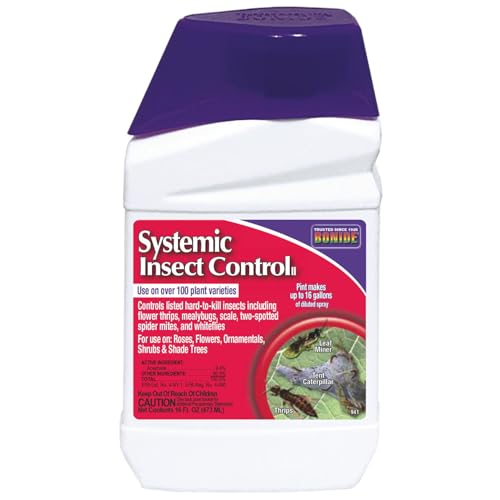
The plant absorbs this systemic to kill thrips from the inside out for weeks.
Bonide Systemic Insect Control works differently from every contact spray on this list. Instead of sitting on the leaf surface, the plant absorbs this concentrate through its roots and leaves, turning the entire plant toxic to thrips that feed on it. That means thrips that hatched after you sprayed still die when they chew into a treated leaf — a huge advantage over the Athena IPM and Monterey Spinosad, which only kill what is alive during the spray. The 16-ounce concentrate makes up to 16 gallons of spray, so one bottle handles an entire season of ornamental flower beds, roses, shrubs, and other listed ornamental plants.
There is an important restriction: this product is not intended for vegetables or fruit plants. It is labeled for use on flower beds, roses, shrubs, and other ornamental plants only. On those plants, however, it is fast acting and labeled to control thrips, mealybugs, scale, 2-spotted spider mites, and whiteflies. You can mix it with certain fungicides or fertilizers for an efficient combination spray, and the manufacturer recommends applying every 7 to 10 days as long as the infestation persists. The model number is 941, and it carries an EPA specification mark. Reviewers who grow roses report that this systemic concentrate provides weeks of protection where contact sprays only lasted days.
Systemic advantage: Once absorbed into the plant, this protects new growth that emerges after application — something no contact spray can claim. Ideal for ornamental collectors who are tired of spraying every few days.
Pick this for flower beds: If you grow roses, shrubs, or ornamental perennials and want weeks-long protection that does not wash off in rain, this systemic concentrate is your best bet — one bottle makes 16 gallons of spray.
Avoid on vegetables: The label explicitly says this is not for vegetable or fruit plants, so keep it to ornamentals only.
6. Hi-Yield 55% Malathion Spray (32 oz)
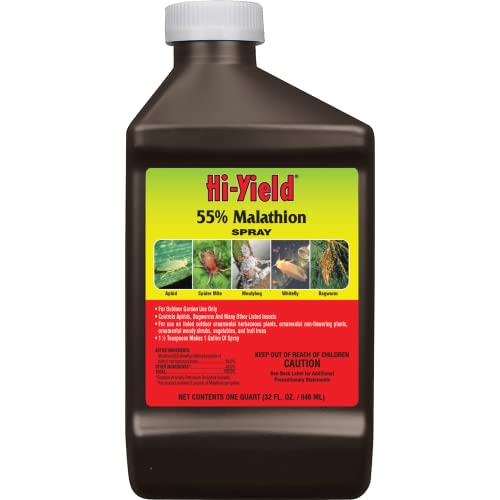
A concentrated malathion punch for tough outdoor thrips outbreaks on fruit trees and shrubs.
When a thrips infestation has gotten out of hand — leaves curling, fruit scarring, black frass everywhere — malathion is the traditional heavy artillery. Hi-Yield packs 55% malathion into this 32-ounce bottle, making it one of the highest-concentration options you can buy for home use. It controls aphids, thrips, spider mites, lace bugs, and more on herbaceous plants, ornamental non-flowering plants, shrubs, vegetables, and fruit trees. You apply it using a hose-end or tank sprayer, and the advice on the label is clear: spray in calm weather when rain is not predicted for the next 24 hours.
At 2.5 pounds, this bottle is more than twice the weight of the General Hydroponics Azamax (1.15 pounds), reflecting the sheer volume of concentrated liquid you get. Unlike the Bonide Systemic which is absorbed into the plant, malathion works on contact, so thorough coverage of every leaf — especially the undersides — is critical. The strong chemical odor and the need to time applications around rain make it less convenient than the Athena IPM for indoor use or the NemaKnights for no-spray application, but for a heavy outdoor infestation on a fruit tree or a large shrub, nothing on this list hits harder per ounce.
Strengths
- 55% malathion — very high active concentration for stubborn outdoor thrips
- Labeled for vegetables and fruit trees, unlike the Bonide Systemic
- Large 32-ounce bottle gives many treatments
Trade-offs
- Requires a hose-end or tank sprayer — not ready-to-use
- Must be applied in calm weather with no rain for 24 hours
- Strong chemical odor compared to the odorless Monterey Spinosad
For major outdoor outbreaks: If thrips are damaging your fruit trees or vegetable patch and milder options have failed, the 55% malathion concentration gives you decisive knockdown power — just check the weather forecast before you spray.
Skip indoors: The odor and the 24-hour rain-free window make this unsuitable for indoor or greenhouse use; look at the Atticus fogger or Athena IPM for those environments.
7. General Hydroponics Azamax GH2007 Antifeedant and Insect Growth Regulator

A food-grade neem extract that stops thrips from eating or maturing without harsh solvents.
AzaMax is a natural pest control concentrate built around azadirachtin A and B — the insecticidal compounds found in neem seeds — plus more than 100 limonoids that work together as an antifeedant (meaning thrips stop eating the treated plant) and an insect growth regulator (meaning larvae cannot mature into breeding adults). Unlike many neem-based products that use hard chemical solvents, AzaMax uses food-grade formulation ingredients throughout, so it is one of the cleanest options on the market for hydroponic systems and indoor gardens where you care about what goes into the water.
The 16-ounce (480-milliliter) bottle weighs 1.15 pounds, which is less than half the weight of the Hi-Yield Malathion bottle (2.5 pounds) yet delivers a broader spectrum of pest control via two modes of action. The trade-off is price — this is the most expensive product in the lineup by a wide margin, reflecting the food-grade manufacturing and the complex limonoid chemistry. For a small indoor grower who has invested heavily in premium genetics and wants zero chemical residue near the harvest, AzaMax is class-leading in safety profile. For the casual outdoor gardener dealing with a one-time thrips flare-up on a few rose bushes, the Bonide Systemic or Monterey Spinosad delivers more value per dollar. Reviewers in hydroponic communities often praise AzaMax for not altering the pH of their reservoir water.
For the indoor precision grower: If you run a hydroponic system or a grow room and want an insecticide with food-grade ingredients that stops thrips without chemical solvents contaminating your water reservoir, AzaMax is the cleanest choice on this list — it is also the priciest by a significant margin.
Overkill for small outdoor patches: For a few vegetable plants or flower beds, the Monterey Spinosad (OMRI-listed at a fraction of the cost) will handle thrips just as effectively.
Understanding the Specs
Active Ingredient & Mode of Action
The active ingredient is the chemical or biological agent that actually kills or repels thrips. Contact killers (malathion, bifenthrin, spinosad) must hit the thrips directly. Systemic products (Bonide Systemic) are absorbed by the plant so thrips die when they feed, even if they hatched after the spray dried. Insect growth regulators (azadirachtin in AzaMax) stop larvae from reaching the breeding stage, breaking the life cycle slowly. Beneficial nematodes are living organisms that hunt thrips larvae in the soil — they do not kill adults but prevent the next generation.
Form: Ready-to-Use vs Concentrate vs Fogger vs Granules
Ready-to-use sprays (Athena IPM) come premixed — shake and spray, no guesswork. Concentrates (Monterey Spinosad, Bonide Systemic, Hi-Yield Malathion, AzaMax) need to be diluted with water in a sprayer, which gives you many more treatments per bottle for the same money. Total-release foggers (Atticus Ascertain TR) are pressurized cans that fill a room with micro-particles — best for greenhouses up to 3,000 sq ft but wasteful for a single plant. Granules (NemaKnights) contain living nematodes that you shake onto soil; they are the only option here that requires no spraying at all.
FAQ
Can I use a spinosad product like Monterey on vegetable plants right up to harvest?
Will a total-release fogger like Atticus Ascertain TR hurt my blooming flowers?
Can I mix Bonide Systemic Insect Control with fertilizer or fungicide?
How long do nematodes take to get rid of thrips after I apply NemaKnights?
Is the Hi-Yield 55% Malathion safe to spray on fruit trees?
What is the difference between azadirachtin (AzaMax) and plain neem oil for thrips?
Can I use the Athena IPM ready-to-use spray in my hydroponic system?
Why does the Bonide Systemic label say it is not for vegetables?
Final Thoughts: The Verdict
If you want one dependable pick, the insecticide for thrips winner is the Athena IPM because its ready-to-use formula eliminates guesswork and covers the widest range of plant types from houseplants to hydroponics with EPA 25(b) minimum risk ingredients. If you grow vegetables and want organic certification, grab the Monterey Spinosad — it is OMRI Listed and odorless. And for a greenhouse where thrips hide under every leaf, the Atticus Ascertain TR Fogger treats up to 3,000 sq ft with a single can, hitting every leaf surface without you lifting a spray wand.
How We Picked
We do not accept paid placement. Every pick is matched to a real buyer and a real use-case; we do not hands-on test units.
Sources & Methodology
Specifications: manufacturer listings and product documentation. Review insights: verified customer reviews, as of July 2026. Pricing: not shown on this page (it changes often); check the current price via the retailer link.
As an Amazon Associate, Lawn Gear Lab earns from qualifying purchases. This does not affect which products we feature.