
Specs are compiled from manufacturer listings and verified buyer reviews and can change over time — please confirm the key details on the product page before buying.
Scale insects are experts at hiding. They attach to stems and leaves, looking like tiny bumps, while slowly sucking the life out of your plants. The sticky honeydew they leave behind attracts ants and grows sooty mold, making the problem worse. To stop them, you need an insecticide that can penetrate their waxy armor — and whether you pick a spray, an oil, or a systemic treatment (a chemical the plant absorbs into its sap) depends on your specific plant and how bad the infestation is.
I’m Rikta, the writer behind Lawn Gear Lab. This guide compares each manufacturer’s published specs and real-world patterns from verified customer reviews, so you get honest strengths and trade-offs, not marketing spin.
After digging into the chemistry and results for seven top options, this guide on the insecticide for scale insects helps you match the right tool to your problem — from armored scale on citrus to soft scale on ornamentals.
Quick Picks
- Valent Safari 20SG Insecticide — Top Performer
- Safari 20SG Sprayable Systemic Insecticide — Professional Grade
- Bonide Systemic Insect Control — Long-Lasting
- Monterey Horticultural Oil RTS Ready to Spray — Best for Edibles
- Bonide All Seasons Horticultural & Dormant — Organic Standard
- Summit Year-Round Spray Oil for Garden Insects — Budget Champ
How To Choose The Best Insecticide For Scale Insects
Before you buy, check if your scale is armored (a hard, separate shell) or soft (a waxy coating fused to the body). Armored scale is tougher to kill with contact sprays because the shell protects the insect. Soft scale is easier to smother with oils. The wrong product just bounces off the shell, and the scale keeps feeding.
Contact vs. Systemic
Contact insecticides, like horticultural oils, must physically touch the scale to kill it. They work by smothering the insect, but you need thorough coverage. Systemic insecticides are absorbed into the plant’s sap. When a scale insect feeds, it ingests the poison and dies. This is a big advantage for scale hidden in bark crevices or under leaves. However, systemics require the plant to be actively growing and taking up water.
Synthetic vs. Natural
Natural options, like mineral oil sprays, are safe for beneficial insects and people once dry. They are a good first line of defense and a great choice for edible crops. Synthetic systemics, like Dinotefuran (a neonicotinoid that attacks the insect’s nervous system), are powerful and long-lasting, but they can harm bees if applied during bloom. Your choice depends on whether you are treating a fruit tree or an ornamental shrub.
Quick Comparison
| Model | Best For | Active Ingredient | Form | Volume | Amazon |
|---|---|---|---|---|---|
| Valent Safari 20SG | Heavy infestations on ornamentals | 20% Dinotefuran | Water-soluble granule | 12 fl oz | Amazon |
| Safari 20SG Sprayable | Professional-grade scale control | Dinotefuran | Water-soluble granule | 12 oz | Amazon |
| Bonide Systemic Insect Control | Long-lasting ornamental protection | — | Concentrate | 16 fl oz | Amazon |
| Monterey Horticultural Oil RTS | Edible crops and organic gardens | Mineral oil | Ready-to-spray | 32 fl oz | Amazon |
| Bonide All Seasons Oil | Year-round organic smothering | Mineral oil | Ready-to-spray | 32 fl oz | Amazon |
| Summit Year-Round Spray Oil | Budget-friendly scale control | — | Concentrate | 32 fl oz | Amazon |
In‑Depth Reviews
1. Valent Safari 20SG Insecticide with 20% Dinotefuran, 12 oz.

The systemic nuke that turns your plant into poison from the inside out.
This is the heavy artillery. Safari 20SG uses 20% Dinotefuran, a systemic insecticide that the plant’s roots and leaves absorb quickly. When a scale insect feeds, it ingests the poison and dies. This makes it incredibly effective against both armored and soft scale, which is notoriously hard to reach with a simple spray. One reviewer called it the “chemical equivalent of calling in an orbital strike,” noting it kills resistant pests like root aphids and thrips.
You apply it as either a foliar spray (on leaves) or a soil drench (poured onto the soil at the base). Buyers report that a “foliar spray and soil drench eliminated persistent scale on King Sago Palms in Florida,” with the scale not returning. It is highly concentrated, making a 12-fluid-ounce bottle last a long time. The trade-off is the price — it is a premium product designed for serious infestations on ornamental plants, and it is not labeled for use on vegetables or fruit you will eat. If you need a systemic that works on edible crops, the Monterey Horticultural Oil is a safer pick.
Why it dominates scale
- 20% Dinotefuran provides fast, systemic action against armored and soft scale
- Works as both a foliar spray and a soil drench for full plant coverage
- Highly concentrated; a 12 fl oz bottle makes many gallons of solution
The few drawbacks
- Expensive compared to contact oils
- Not for use on edible crops like vegetables or fruit trees
- Requires careful timing—apply only during the plant’s vegetative cycle
Get this if: you have a stubborn armored scale problem on ornamental trees or shrubs and want a single, definitive treatment that out-guns contact-only oils.
Skip it for: edible plants, a light infestation a simple oil could fix, or if you are on a strict budget.
2. Safari 20SG Sprayable Systemic Insecticide — 12 Ounce jug

The pros’ choice for saving trees from the worst scale outbreaks.
This version of Safari 20SG is the same powerful systemic but specifically marketed for spray or drench use on ornamental plants in nurseries, greenhouses, and landscapes. It is described as “best in class for control of scales” and is “excellent for Woolly Adelgids on Eastern Hemlocks.” It works like product #1 — the plant absorbs the Dinotefuran, and any insect that feeds on it dies.
The primary trade-off is also its cost. It is a premium, professional-grade product that some owners mention is “terribly expensive.” However, for specific, hard-to-kill pests like woolly adelgids, it is considered the “nuclear option” that works when nothing else does. Another reviewer noted it is “useless for spider mites,” so be sure your target is scale or other listed insects. Unlike the cheaper contact oils, this one requires the plant to be actively growing to work.
What the data shows: This is a targeted, systemic solution for serious, persistent scale and adelgid issues. One reviewer noted they “sprayed for years; only surviving ash trees in neighborhood” using this product. It is a long-term investment for tree health.
One important note: This product is NOT FOR SALE or use in the state of New York, so check your local regulations before buying.
Reach for this if: you have a major infestation of armored scale, woolly adelgids, or emerald ash borer on valuable ornamental trees and are willing to pay for professional-grade results.
skip it if: you are treating a small houseplant or a vegetable garden, or you need a budget-friendly option — the Summit Year-Round Spray Oil costs much less for light jobs.
3. Bonide Systemic Insect Control, 16 oz Concentrate

A solid systemic that keeps your ornamentals scale-free for weeks.
Bonide Systemic Insect Control is another powerful systemic option, but it is labeled specifically for ornamentals like flower beds, roses, and shrubs — not for vegetable or fruit plants. It works by being absorbed into the plant, so it stays effective for a long time, killing scale insects as they feed. This is a mid-range option that offers a good balance of power and price, and it makes up to 16 gallons of finished spray from the 16-fluid-ounce concentrate.
Customers note strong results. One buyer mentioned, “We use this on our arborvitae trees,” and it helped stop a bagworm infestation. The formula is fast-acting, but reviewers warn it “smells like actual poop,” so it is best used outdoors. It comes with a measuring cup for easy mixing, making it simpler than some other concentrates. Just stick to the label and only spray it on the listed ornamental plants. If you need a product for fruit trees, skip this and go for the Monterey Horticultural Oil.
What works well
- Long-lasting systemic action provides extended control for scale and other sap-suckers
- One 16 fl oz bottle makes 16 gallons of spray, offering great value
- Can be mixed with certain fungicides for a combined treatment
Points to consider
- Not for use on vegetables, fruits, or any edible plants
- Has a very strong, unpleasant odor
Choose this for: long-term protection of your roses, shrubs, and flower beds from scale and other listed insects, especially if you want a systemic that costs less than the Safari 20SG.
Avoid this for: any fruit trees, vegetable gardens, or if you cannot tolerate strong chemical smells during mixing.
4. Monterey Horticultural Oil RTS Ready to Spray, 32 oz
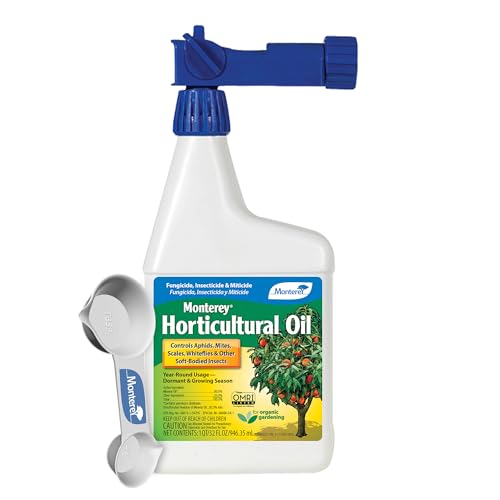
The go-to for organic fruit trees, ready to spray right from the start.
Monterey’s Horticultural Oil is a contact smotherer, using mineral oil to coat and kill scale insects, mites, and their eggs. Unlike the systemics above, this one is OMRI Listed for organic gardening, making it a top pick for edible crops like apples, almonds, avocados, and citrus. It comes in a ready-to-spray bottle that attaches directly to your garden hose, simplifying application. The 32-fluid-ounce bottle is a good value compared to the smaller concentrates.
The trade-off is that it is a contact killer, not a systemic. You must spray every part of the plant, including the undersides of leaves, to ensure coverage. One reviewer with a six-year-old apple tree reported, “This is the first year I’m going to get apples I can eat,” attributing the success to this oil. Another noted the spray pattern is a fan, so you cannot spray upward more than six feet, which is a real limitation for tall trees. For heavy armored scale, the Safari 20SG works better because it gets into the sap.
Why it’s a winner
- OMRI Listed for organic gardening, safe for use on fruit and nut trees
- Ready-to-spray bottle connects directly to a hose for easy application
- Controls scale, mites, and eggs during both dormant and growing seasons
The catch
- Contact-only formula requires thorough coverage of all plant surfaces
- Fan spray pattern limits it to ground-level application (under 6 feet)
Ideal for: organic gardeners treating fruit trees, berry bushes, or ornamentals where you don’t want synthetic chemicals.
Not the best for: tall trees or heavy infestations of armored scale that a systemic could better control.
5. Bonide All Seasons Horticultural & Dormant Spray Oil, 32 oz

The versatile oil that works in every season, from dormant to full bloom.
Like the Monterey oil, this Bonide product is a mineral oil-based contact spray for organic gardening. It is unique because it is labeled for use year-round — at the dormant stage, green tip stage, and during the full growing season. This makes it a flexible option for preventing and treating scale insects, aphids, and even fungal diseases like powdery mildew. It comes in a 32-fluid-ounce ready-to-spray container that connects to a hose.
Buyers see fast results. One verified reviewer said, “I got this product to treat bark scale on my azalea. It worked amazing. I saw results within a few days.” However, several reviews note the hose-end sprayer is poorly designed, with issues around calibration and messiness. Many experienced users recommend bypassing the included sprayer and applying the oil with a standard pump sprayer for better control and less waste. The liquid volume is 32 fluid ounces versus a smaller concentrate. If you want an oil that works on both scale and fungus, this covers both — the Summit concentrate does not.
Key strengths
- Approved for organic gardening and safe around people and pets when dry
- Can be used at different stages (dormant, green tip, growing season) for flexible control
- Controls a broad range of insects, mites, and fungal diseases
Watch out for
- The included hose-end sprayer has poor calibration and is often messy
- Requires thorough coverage, which can be difficult on large or dense plants
Great for: gardeners who want a single, organic product to handle scale, aphids, and powdery mildew across multiple seasons.
pass on it if: you don’t have a spare pump sprayer and rely on hose-end attachments working perfectly from the start.
6. Summit Year-Round Spray Oil for Garden Insects, 32-Ounce Concentrate

The concentrated oil that goes a long way without a big price tag.
If you have a large garden or many plants, the Summit Year-Round Spray Oil concentrate is a smart entry-level purchase. It is a contact oil that kills and repels scale, aphids, spider mites, and whiteflies. Because it is a concentrate, a 32-fluid-ounce bottle makes many gallons of finished spray, giving you more uses for your money compared to ready-to-spray options. It leaves a shiny luster on leaves and helps prevent powdery mildew.
Real-world results are impressive for the price. One buyer dealing with “armoured scale on my lemon trees” stated they “treated them once and that was it.” The product is OMRI-listed for organic gardening and has very little scent. While the price is right, be aware that the packaging from the manufacturer is sometimes poor, and a few reviewers reported leaks during shipping. It is also a concentrate, so you need a separate sprayer to apply it. For the same cost-per-use, you get more coverage than the Bonide All Seasons Oil.
Why it earns a spot: It offers the lowest cost-per-gallon of any product here. For a severe scale problem on a single tree, one treatment can be enough, as one owner reported on their lemon tree.
The trade-off: Like all contact oils, it requires full plant coverage, and the packaging has been a frustration for some buyers receiving a product that has leaked.
Perfect for: budget-conscious gardeners with a large area to treat, or for those who want a highly concentrated, organic solution for light to moderate scale problems. The lowest-cost entry point in this guide.
Not for you if: you hate the hassle of mixing concentrates or need the most powerful, systemic solution for a severe armored scale outbreak — the Safari 20SG is stronger.
Understanding the Specs
Systemic vs. Contact Insecticides
A contact insecticide, like a horticultural oil (mineral oil that smothers pests), must physically touch the scale insect to kill it. This is effective but requires thorough spraying of every leaf and stem. A systemic insecticide is absorbed by the plant and travels through its sap (the fluid inside the plant). When a scale insect feeds, it ingests the chemical and dies. This is a massive advantage for scale hiding in bark crevices, but systemics can be harmful to bees if applied to plants in bloom.
Active Ingredient: What to Look For
The most common effective ingredients for scale are mineral oil (for organic contact control) and Dinotefuran (a neonicotinoid chemical that targets the insect’s nervous system, for powerful systemic control). Mineral oil works by smothering the insect — it coats the scale’s breathing tubes. Dinotefuran is a neonicotinoid that targets the insect’s nervous system, paralyzing and killing it. If you need professional-level results for tough, armored scale on ornamental plants, an active ingredient like 20% Dinotefuran is a clear choice. For edible crops, mineral oil or a lower-toxicity option is safer.
FAQ
How do I know if I have armored or soft scale?
When is the best time to apply horticultural oil for scale?
Will these insecticides hurt bees and other pollinators?
Can I use a systemic insecticide on my vegetable garden?
How often do I need to reapply these products?
What does “makes 16 gallons” on a concentrate mean?
Is it safe to use these sprays on my houseplants?
Can I mix horticultural oil with other fungicides or insecticides?
Why do some products say “not for use in New York”?
How do I apply a soil drench for scale?
Final Thoughts: The Verdict
If you want one dependable pick, the insecticide for scale insects winner is the Valent Safari 20SG because its 20% Dinotefuran formula provides class-leading systemic power against even the toughest armored scale. If you want an organic solution safe for edible fruit trees, grab the Monterey Horticultural Oil RTS. And for a budget-friendly concentrate that goes the distance on a large property, the Summit Year-Round Spray Oil is your best bet.
How We Picked
We do not accept paid placement. Every pick is matched to a real buyer and a real use-case; we do not hands-on test units.
Sources & Methodology
Specifications: manufacturer listings and product documentation. Review insights: verified customer reviews, as of July 2026. Pricing: not shown on this page (it changes often); check the current price via the retailer link.
As an Amazon Associate, Lawn Gear Lab earns from qualifying purchases. This does not affect which products we feature.