
That moment of discovery—the tiny speckles on a Monstera leaf, the telltale webbing under a Fiddle Leaf Fig, or a sudden cloud of fungus gnats rising from the soil—signals an infestation that can spread through your entire indoor garden in days. Choosing the wrong spray can burn delicate leaves, leave toxic residue where pets roam, or simply fail to break the pest life cycle, making the problem worse.
I’m Rikta — the co-founder and writer behind Lawn Gear Lab. I’ve spent countless hours comparing active ingredients, reading through EPA exemption labels, and cross-referencing hundreds of owner reports to isolate which formulas actually stop indoor infestations without damaging your home environment.
Whether you are battling spider mites on a prized Alocasia or treating soil-dwelling fungus gnats across a shelf of succulents, the insecticide for indoor plants you choose must match both the pest type and your comfort with chemical versus organic approaches.
How To Choose The Best Insecticide For Indoor Plants
Indoor pest control differs from outdoor treatment because your home has no rain, no natural predators, and poor air circulation—meaning anything you spray lingers on surfaces and in the air you breathe. The right product balances killing power with safety for humans, pets, and the plant itself. Here are the factors that separate an effective solution from a disappointing one.
Active Ingredient & Pest Target
Cold-pressed neem oil works as a broad-spectrum miticide, fungicide, and insecticide but requires thorough leaf coverage and regular reapplication every 7-14 days. Imidacloprid granules, a systemic neonicotinoid, travel through the plant’s vascular system and kill sap-sucking insects like aphids and mealybugs from the inside—but they are ineffective against spider mites (the mites can actually boom from the absence of predators) and are not OMRI listed. Botanical oils in products like Crop Defender 3 or Athena IPM offer a middle ground: EPA 25(b) exempt, bee-safe when dry, and fast-acting on contact, but they evaporate quickly and need repeat applications for heavy infestations.
Spray Format: Ready-to-Use vs. Concentrate vs. Granules
Ready-to-use (RTU) sprays are the most convenient for a quick spot treatment on a few houseplants—no measuring, no mixing, and the spray nozzle delivers a fine mist that won’t drench your furniture. Concentrates (like the Botanical Tradesman neem oil or the Evergreen Way organic formula) require dilution with water and a mild soap emulsifier, but they yield multiple bottles worth of spray and cost less per application. Granular systemics are the easiest for ongoing prevention: you sprinkle the pellets on the soil surface and water them in; the plant absorbs the chemical and becomes toxic to chewing and sucking insects for up to 8 weeks. The trade-off is that granular systemics do nothing against active flying adults or mites that feed from the leaf surface.
OMRI Listing & EPA Exemptions
OMRI (Organic Materials Review Institute) listed products contain no synthetic pesticides and can be used in certified organic gardening. The EPA’s 25(b) exemption applies to minimum-risk ingredients like rosemary oil, clove oil, and peppermint oil—these products skip full EPA registration because their active ingredients are already considered safe for general use. For indoor plants, 25(b) exempt sprays are the safest bet around children and pets, but they degrade faster under grow lights and may require more frequent application than conventional formulas like imidacloprid. If you are treating edible indoor herbs or vegetables, always confirm the product’s pre-harvest interval (PHI) and OMRI status before spraying.
Quick Comparison
On smaller screens, swipe sideways to see the full table.
| Model | Category | Best For | Key Spec | Amazon |
|---|---|---|---|---|
| Bonide Systemic House Plant Insect Control | Premium | Long-term systemic prevention | 0.22% Imidacloprid granules | Amazon |
| Evergreen Way Organic Insecticide & Fungicide | Premium | Bio-based dual-action control | 16 oz concentrate | Amazon |
| Athena IPM Plant Pest Control | Mid-Range | RTU broad-spectrum relief | 32 oz ready-to-use | Amazon |
| Bonide Captain Jack’s Neem Max | Mid-Range | Hose-end fungal & pest control | 16 oz ready-to-spray | Amazon |
| Grower’s Ally Crop Defender 3 | Mid-Range | Organic mite & mildew spray | 24 oz RTU with botanical oils | Amazon |
| Botanical Tradesman Neem Oil Spray Kit | Mid-Range | DIY concentrated neem treatment | Makes 320 fl oz of spray | Amazon |
| Miracle-Gro Leaf Protect and Shine | Budget | Maintenance & leaf beauty | 8 fl oz (2-pack) RTU | Amazon |
In‑Depth Reviews
1. Bonide Systemic House Plant Insect Control

Bonide’s systemic granules deliver a 0.22% concentration of imidacloprid directly into the plant’s tissue, making every leaf and stem a poison to chewing insects like aphids, thrips, and mealybugs for up to two months. Unlike contact sprays that require full leaf coverage, these odorless pellets work from the inside out—you sprinkle them on the soil surface, water normally, and the plant does the rest. This passive protection is ideal for large collections where spraying every leaf is impractical, especially against pests like fungus gnats whose larvae feed on roots.
Each container holds enough to treat multiple 6-inch pots, and the four-bottle bundle offers strong value-per-gram for serious collectors. The granules are invisible once mixed into the top layer of soil, and they produce no smell, no sticky residue, and no plastic bottle waste from repeated spray purchases. Owners report immediate reductions in gnat populations and complete control of mealybugs on sensitive plants like succulents and ferns without burning foliage.
The significant caveat is that imidacloprid is ineffective against spider mites—the systemic does not reach the leaf surface in high enough concentration to kill them, and some growers report mite population booms after using it because natural predators are eliminated. It is also not OMRI listed, so it is not suitable for edible herbs or certified organic growing. Use it as a targeted preventive for known soil-borne pests only.
What works
- Provides up to 8 weeks of internal protection from a single application
- Completely odorless and invisible—no spraying residue near furniture or pets
- Excellent against thrips, mealybugs, aphids, and fungus gnat larvae
What doesn’t
- Ineffective against spider mites—can actually worsen outbreaks
- Not OMRI listed, unsuitable for edible herbs or organic gardening
- Requires soil moisture to activate; dry soil leaves plants unprotected
2. Evergreen Way Organic Insecticide & Fungicide

This concentrate from Evergreen Way takes a bio-based approach that combines insecticidal and fungicidal action in one bottle, targeting both chewing insects and leaf diseases like powdery mildew simultaneously. A few drops diluted in a standard 32 oz spray bottle produce a solution that kills soft-bodied pests within seconds of contact while coating leaf surfaces with a protective layer that suppresses fungal spore germination. Users report visible shriveling of aphids and caterpillars within 5-10 seconds of spraying, which is unusually fast for a non-synthetic formula.
The 16 oz concentrate yields multiple spray bottles worth of treatment, making it a strong value for anyone treating a dozen or more houseplants or a small raised bed indoors. It mixes easily with water using just a tablespoon per spray bottle and leaves no strong odor or greasy film on foliage. Several reviewers note that it eliminated severe fungus gnat infestations after a single soil drench and kept the gnats away with weekly maintenance sprays. The dual-action formulation also helps plants recover faster from pest damage by preventing secondary fungal infections on wounded tissue.
The concentrate is not quite as convenient as a ready-to-use spray for quick spot treatments, and the insecticidal component is slightly less viscous than the fungicide part, requiring a thorough shake before each use to ensure proper mixing. It is also not ideal for growers who prefer a single-product solution for soil and foliar pests, as heavy root infestations may need a systemic alternative. Keep a dedicated spray bottle for mixing to avoid cross-contamination with other chemicals.
What works
- Kills aphids, gnats, and caterpillars within seconds on contact
- Combined fungicide prevents secondary mildew infections after pest damage
- Concentrate form yields good value per treatment across many plants
What doesn’t
- Requires dilution and a dedicated spray bottle—less grab-and-go than RTU
- Insecticide and fungicide components have different thicknesses, needing vigorous shaking
- Not a systemic treatment; needs reapplication after rain or heavy watering
3. Athena IPM Plant Pest Control Ready-to-Use Spray
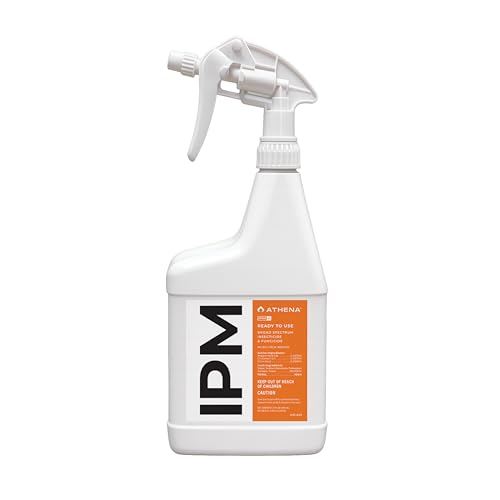
Athena’s IPM spray comes ready to use straight from the bottle, formulated with EPA 25(b) minimum-risk ingredients that kill spider mites, aphids, thrips, and powdery mildew on contact without harsh chemical residue. The 32 oz bottle is the largest ready-to-use volume among our selections, and its fine-mist trigger covers broad leaf surfaces evenly without pooling at the leaf tips—a common problem with cheaper sprayers that leads to burn spots. Professional cultivators frequently recommend this formula for indoor grows because it does not strip the plant’s waxy cuticle or leave visible film under high-intensity grow lights.
The spray is effective throughout the entire plant lifecycle, including the flowering stage, making it a go-to for growers of culinary herbs and ornamentals alike. Users note a pleasant, mild botanical scent that dissipates quickly without lingering in living spaces. The bottle includes a child-resistant lock on the trigger that prevents accidental spraying, which is a thoughtful safety detail for households with small children or curious pets. Many reviewers who tried multiple products for persistent spider mite infestations report that Athena IPM was the only spray that fully cleared them without repeat applications within the same week.
Because it is a contact spray, thorough coverage is essential—any missed underside of a leaf or hidden stem crotch becomes a refuge for surviving pests. The 25(b) exemption means the active ingredients are low-toxicity, but they also degrade faster than synthetic alternatives, so weekly reapplication is necessary during active outbreaks. The price per ounce is higher than concentrates, making it a premium choice for quick-go relief rather than month-long prevention.
What works
- Safe for all plant stages including flowering; no burn on delicate foliage
- Large 32 oz volume eliminates the need for frequent bottle refills
- Child-resistant trigger lock and low toxicity ideal for indoor family use
What doesn’t
- Requires complete leaf coverage—missed spots lead to pest reservoirs
- Higher cost per application compared to concentrate formulas
- Fast degradation under light; needs weekly reapplication for active infestations
4. Bonide Captain Jack’s Neem Max
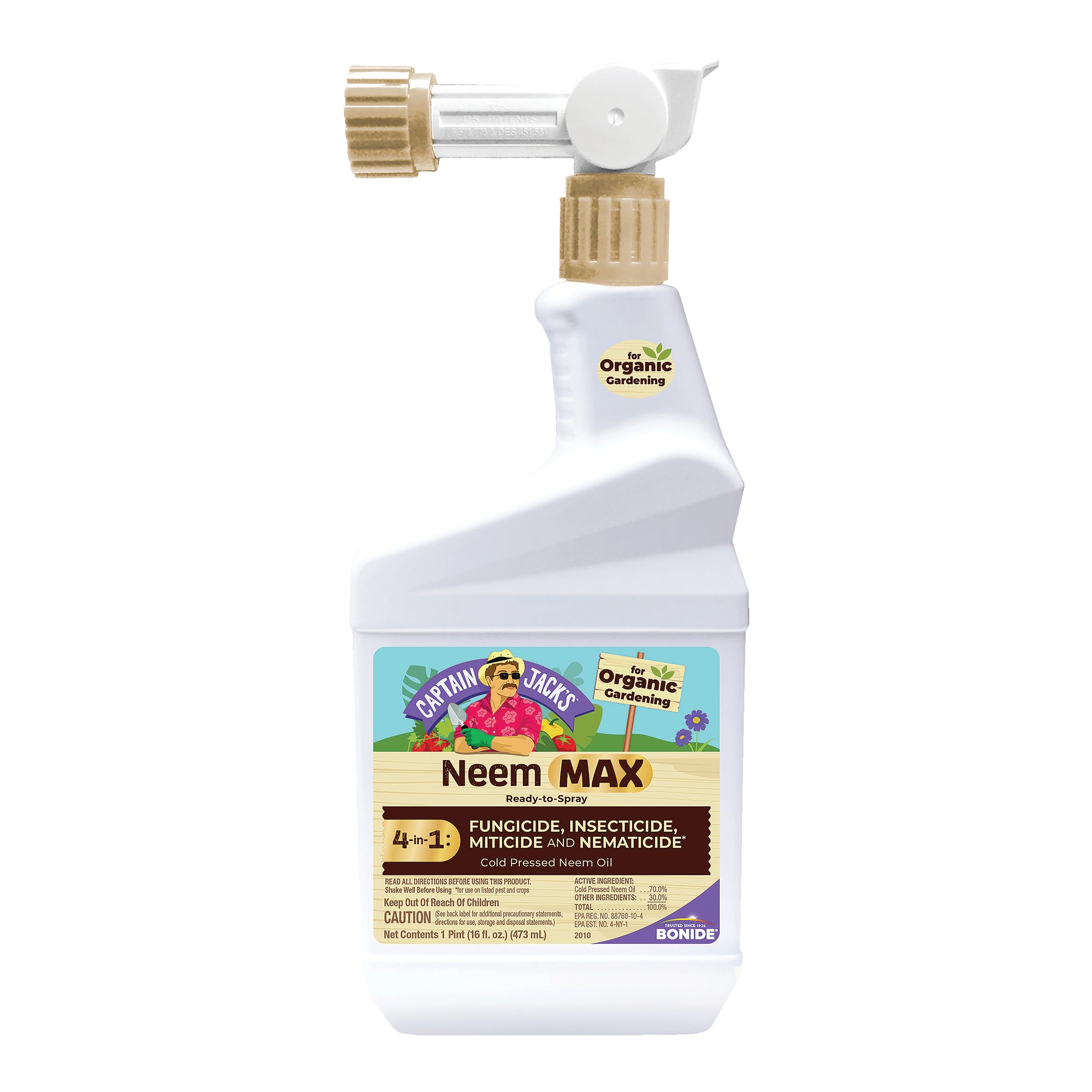
Bonide’s Neem Max takes cold-pressed neem oil and packages it in a unique ready-to-spray format that attaches directly to a standard garden hose—making it the most convenient option for treating large indoor plant collections that can be moved outdoors, or for indoor-outdoor transition plants during pest treatment. The 16 oz container concentrates the neem oil so that when you attach your hose and spray, water automatically dilutes it to the correct concentration. This eliminates the messy step of mixing neem oil with soap and water in a spray bottle, which many home users find frustrating because neem oil is thick and separates easily.
The formula works as a 4-in-1 insecticide, fungicide, miticide, and nematicide, killing egg, larval, and adult stages of common pests like aphids, mites, beetles, and caterpillars. It is OMRI listed for organic gardening, making it safe for treating edible indoor plants like basil, mint, and lettuce up to the day of harvest. The hose-end sprayer reaches every leaf surface evenly and penetrates the dense canopy of bushy plants like dwarf citrus or ficus without you having to turn leaves over manually. Users report that Japanese beetles and lawn grubs are also suppressed when the spray is used on pots moved outdoors.
The main limitation is that this format only works if you have a garden hose connection—apartment dwellers or those watering with a can will find the hose-end system unusable. Some users report difficulty with the aspiration mechanism when the neem oil is cold and thick; warming the bottle in warm water before use helps the concentrate flow properly. Also, because it is a contact spray, it requires thorough coverage and does not provide residual systemic protection, meaning you must repeat applications every 7-14 days during active outbreaks.
What works
- Hose-end system auto-dilutes neem oil—no messy mixing or soap required
- OMRI listed for organic use; safe for edible herbs up to harvest day
- Covers large plants and dense canopies more evenly than trigger sprays
What doesn’t
- Requires a garden hose; not usable for apartment watering setups
- Thick neem oil can clog the aspiration tube in cold conditions
- Contact-only action; needs repeated applications every one to two weeks
5. Grower’s Ally Crop Defender 3
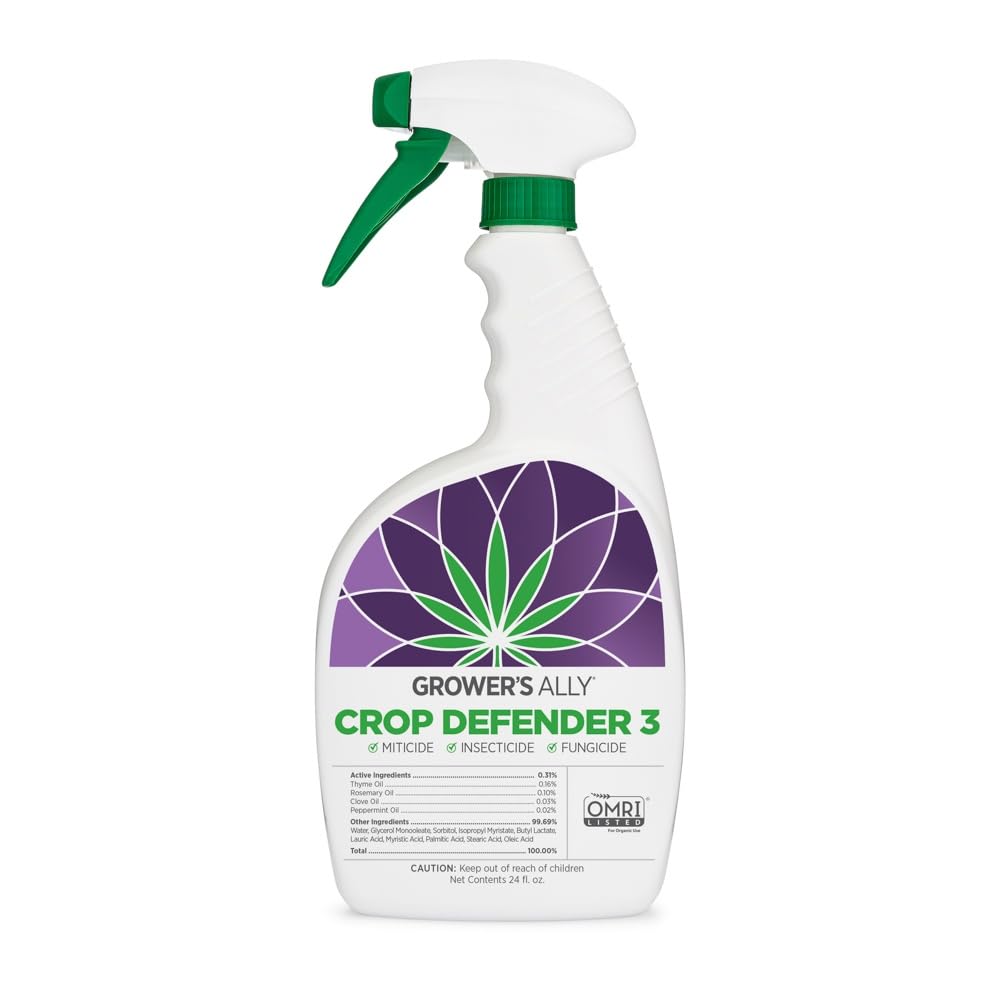
Crop Defender 3 from Grower’s Ally uses a proprietary blend of botanical oils that serve as a miticide, insecticide, and fungicide rolled into a single OMRI-listed formula—one of the few products that carries organic certification while explicitly targeting spider mites, russet mites, thrips, and powdery mildew simultaneously. The 24 oz ready-to-use spray features a fine fan nozzle that coats leaves without heavy runoff, and the formula includes a built-in surfactant that helps the oil spread evenly across waxy leaf surfaces instead of beading up. Many users switching from standard neem oil report that this formulation does not burn seedlings or delicate leaves even when applied weekly.
This spray is FIFRA 25(b) exempt and free of synthetic pesticides, heavy metals, and residual solvents, making it one of the cleanest options for indoor air quality. The scent is noticeably more pleasant than neem—often described as spicy-clove or rosemary-like—and dissipates within a few hours rather than lingering. Owners of sensitive plants like ferns and calatheas find this formula gentle enough for regular preventive spraying without triggering leaf curl or tip burn. The same formula is also bee-safe when dry, so it can be used on plants that will be moved outdoors after treatment.
Because the active ingredients are all volatile botanical oils, the residual effect is short—heavy infestations may require treatment every 3-4 days for two weeks rather than the weekly schedule recommended on the label. The 24 oz bottle is smaller than some competitors, so owners of very large collections may find themselves buying multiple bottles for a single full-house treatment cycle. It is also not a systemic product, so root-dwelling pests like fungus gnat larvae will not be affected.
What works
- OMRI listed and EPA 25(b) exempt—ideal for organic indoor gardens
- Built-in surfactant ensures even leaf coverage without beading
- Gentle on sensitive seedlings and thin-leaved plants like ferns
What doesn’t
- Short residual activity requires frequent reapplication during outbreaks
- 24 oz bottle is smaller than some alternatives; large collections need multiple bottles
- Does not affect root-dwelling pests; soil drenching not effective
6. Botanical Tradesman Neem Oil Spray Kit

The Botanical Tradesman kit is built for the DIY user who wants the purest possible neem oil without paying for water weight in ready-to-use bottles. It includes a 3.4 fl oz bottle of 100% cold-pressed Indian neem oil concentrate plus a 16 oz trigger spray bottle that you fill with water and a few drops of mild soap. The neem is extracted exclusively from Indian neem nut with no added vegetable oils or diluents, so the azadirachtin content is as concentrated as possible.
Users report excellent results against fungus gnats, whiteflies, and general chewing insects after a 4-week cycle of weekly applications, with visible reductions in pest populations after the first two treatments. The included spray bottle has an adjustable nozzle that can deliver a fine mist for foliage or a targeted stream for soil drenching. Because you control the dilution ratio, you can make a stronger 2% solution for heavy outbreaks or a lighter 0.5% mix for weekly maintenance—flexibility that single-strength RTU sprays cannot offer.
The major downside is the mixing process: neem oil is famously thick and separates from water quickly. The instructions call for blending with a mild liquid soap as an emulsifier, but even then, the oil tends to separate within minutes, requiring constant shaking between sprays. The concentrate itself is so thick at room temperature that many users find it necessary to warm the bottle in hot water before measuring. The neem smell is also strong and earthy, lingering on leaves for several hours—some indoor growers find this off-putting in living spaces.
What works
- Exceptional value—concentrate makes over 320 fl oz of spray from a single tiny bottle
- Adjustable dilution ratio lets you customize strength for different infestation levels
- 100% pure cold-pressed neem with no fillers or added water
What doesn’t
- Separates quickly; constant shaking required during application
- Pungent neem odor lingers for hours—unpleasant for indoor living spaces
- Thick concentrate is hard to measure; warming the bottle helps but adds a step
7. Miracle-Gro Leaf Protect and Shine
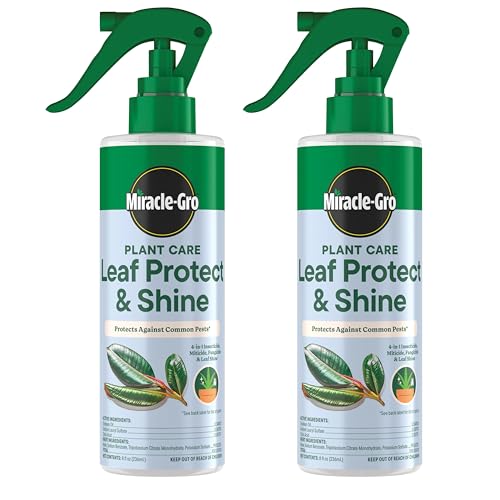
Miracle-Gro’s Leaf Protect and Shine takes a maintenance-focused approach: instead of targeting heavy infestations, it combines a mild insecticide, miticide, and fungicide with a leaf-shine agent that restores natural gloss to foliage. The 2-pack of 8 oz bottles is budget-friendly and designed for weekly preventive application on hard-leaved houseplants like fiddle leaf figs, monsteras, rubber plants, and pothos. The formula kills and prevents common pests like mites, thrips, aphids, and whiteflies while also suppressing powdery mildew, all while leaving leaves looking cleaner without a greasy artificial shine.
Many owners of larger collections appreciate the convenience of a product that handles both pest prevention and cosmetic leaf care in one pass—no need to wipe leaves clean separately after applying insecticide. Users report that leaves look healthier and more vibrant after a few applications, with a natural-looking sheen that does not block stomata or attract dust. The spray is nearly odorless, which is a significant advantage for indoor living spaces where the strong smell of neem or sulfur-based products would be intrusive. The bottle nozzle delivers a moderate mist suitable for medium-sized leaves without excessive dripping.
This is a preventive formula, not a rescue spray—it will not stop an advanced spider mite infestation or eliminate established mealybug colonies. Users with serious pest problems will need to pair it with a stronger knockdown product first. The leaf-shine effect is subtle; some users expecting high-gloss results may find the shine underwhelming compared to dedicated leaf-shine products. Also, the 8 oz bottles are small, so owners of very large collections (20+ plants) will need multiple packs to treat everything.
What works
- Combines pest prevention and leaf shine in a single odorless spray
- Safe for common hard-leaved houseplants; no burn on healthy foliage
- 2-pack value makes it easy to keep one bottle handy in different rooms
What doesn’t
- Too mild for active or heavy infestations; preventive use only
- Small 8 oz bottles require multiple packs for large plant collections
- Leaf shine is subtle—not the high-gloss finish some users expect
Hardware & Specs Guide
Active Ingredient Concentration
The percentage of the active ingredient determines both efficacy and safety margin for indoor use. Imidacloprid granules at 0.22% provide systemic protection at very low concentration, making them safe for soil application but risky if granular dust contacts leaves. Neem oil concentrates at 100% cold-pressed require dilution to 0.5-2% solution—too strong and leaves suffer phototoxic burn under grow lights; too weak and pests survive to reproduce. EPA 25(b) exempt formulas like botanical oils (rosemary, clove, peppermint) are pre-diluted for safety and cannot be “overdosed,” but their lower concentration means shorter residual protection. Always check the label’s active ingredient percentage, not just the brand name, to match the pest pressure level in your collection.
Spray Coverage & Nozzle Type
The nozzle design directly affects whether you reach the undersides of leaves where pests hide. Fine-mist nozzles (found on Athena IPM and Grower’s Ally) create a fog that coats leaf surfaces uniformly but requires close proximity to avoid drift. Fan-spray nozzles (Bonide Neem Max hose-end) cover larger areas quickly but can overspray onto nearby furniture. Trigger sprayers vary widely—the Botanical Tradesman kit includes an adjustable nozzle that switches from stream to mist, giving you soil-drench and foliage-spray mode in one bottle. For indoor use, a nozzle that produces a continuous fine mist without dripping is far more effective than a coarse droplet spray that beads up and rolls off waxy leaves.
FAQ
Can I use the same insecticide for both soil drench and foliar spray?
How often should I reapply insecticide on indoor plants?
Why did my spider mite infestation get worse after using insecticide?
Final Thoughts: The Verdict
For most gardeners, the insecticide for indoor plants winner is the Bonide Systemic House Plant Insect Control because it delivers passive, long-lasting protection against the most common indoor pests without requiring you to spray every leaf. If you need an organic, fast-acting knockdown spray for spider mites and powdery mildew, grab the Athena IPM Plant Pest Control. And for the budget-conscious collector who wants a gentle preventive spray that also beautifies leaves, the Miracle-Gro Leaf Protect and Shine is a solid entry point.