
Specs are compiled from manufacturer listings and verified buyer reviews and can change over time — please confirm the key details on the product page before buying.
Petunias are magnets for aphids, whiteflies, and budworms — soft-bodied pests that can turn a lush basket into a sticky, stunted mess overnight. A targeted insecticidal soap stops them on contact without the harsh chemicals that damage delicate petunia blooms or harm visiting bees.
I’m Rikta — the founder and writer behind Lawn Gear Lab. This guide is built by comparing the manufacturers’ published specifications and the patterns across verified customer reviews, so you get each pick’s real strengths and trade-offs instead of marketing spin.
The guide ahead breaks down the three most effective options for keeping your petunias pest-free, helping you choose the right insecticidal soap for petunias based on how you garden and what bugs you are fighting.
Our Picks at a Glance

How To Choose The Best Insecticidal Soap For Petunias
Petunias have tender, slightly sticky leaves that can scorch under the wrong treatment. The right soap formula kills the bugs without stressing the plant, so you want a product built around potassium salts of fatty acids — the active ingredient that breaks down an insect’s outer shell on contact.
Concentrate vs. Ready-to-Use
A concentrate saves money over the season if you have many baskets or a whole flower bed to treat, because you mix only what you need. A ready-to-use spray is simpler — shake and squirt — and works well for a few pots or quick spot-treatments. The trade-off is cost per ounce and how much you end up storing.
Dilution Discipline
The most common mistake owners make is mixing the concentrate too strong, which burns petunia leaves. Stick to the label’s ratio — typically around 2.5 fluid ounces per gallon of water — and spray in cooler morning or evening hours so the soap dries slowly and stays effective.
Quick Comparison
| Model | Best For | Liquid Volume | Active Ingredient | Item Form | Amazon |
|---|---|---|---|---|---|
| Safer 5118-6★ Best Overall | Large gardens & long-term value | 16 Fluid Ounces | Potassium Salts of Fatty Acids | Concentrate | Amazon |
| NATRIA Insecticidal Soap | Quick, mess-free spot treatments | 48 Fluid Ounces | Potassium salts of fatty acids 1% | Ready-to-Use | Amazon |
| Garden Safe Insecticidal Soap | True fatty-acid contact soap | 32 Fluid Ounces | Potassium salts of fatty acids | Ready-to-Use | Amazon |
In‑Depth Reviews
1. Safer 5118-6 Insect Killing Soap Concentrate
Our pick — over 4★ from 6,000+ verified ratings; the strongest balance of quality and price.
The heavy-hitting concentrate that makes 6 gallons of spray from one bottle.
This is the crowd favorite for a reason — a single 16-ounce bottle of Safer concentrate mixes into roughly 6 gallons of ready spray, giving you enough firepower for a full bed of petunias plus your vegetable patch and rose bushes. The active ingredient is potassium salts of fatty acids, a contact killer that targets soft-bodied pests like aphids, whiteflies, spider mites, and thrips by dehydrating them on contact.
Buyers report it is “effective against severe aphids; 90% dead day 1, all by day 3” — and that it does not harm beneficial insects or pollinators when used correctly. The catch is you have to mix it yourself, and getting the dilution wrong (the label recommends around 2.5 fluid ounces per gallon) can burn petunia leaves if you overdo it. It is also OMRI Listed for organic gardening, so you can spray right up until harvest day without worry.
At 16 fluid ounces, it holds a generous amount of concentrate, meaning more product per purchase. The main trade-off owners mention is the strong smell during mixing, but it fades quickly after drying.
Why it wins
- Effectiveness tops the reviews — over 786 owners praise its bug-killing power, particularly on aphids
- Safe for kids, pets, and pollinators when diluted per instructions
- Concentrate format is the most economical choice for anyone with multiple plants or a large garden
Before you buy
- Must be mixed — not grab-and-go; keep a dedicated spray bottle handy
- Over-application or spraying in hot sun can cause leaf burn on tender petunias
- Solidifies in cold storage; let it warm up and shake well before using
Best for: Gardeners with several petunia baskets, a vegetable patch, or recurring pest problems who want the lowest cost per treatment.
Think twice if: You only have one pot on the patio and want a spray-and-forget solution — the ready-to-use options below are simpler for small jobs.
2. NATRIA Insecticidal Soap, Ready-to-Use Garden Bug Treatment
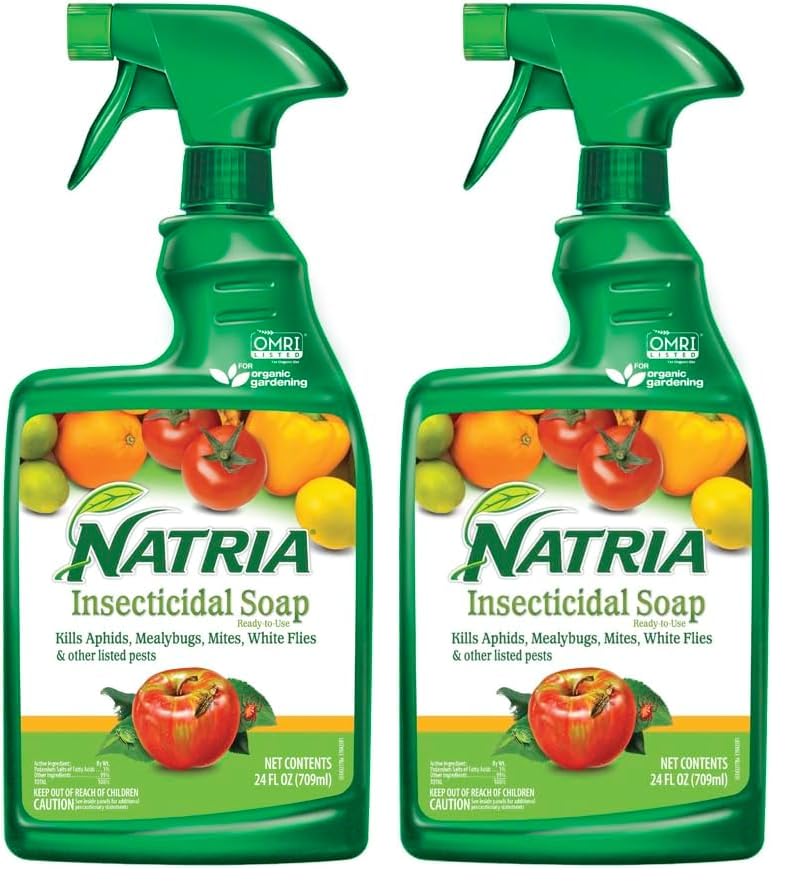
The no-mix, no-mess spray that takes down mealybugs in two weeks.
If convenience matters more than cost per ounce, this NATRIA twin-pack gives you two 24-ounce bottles — 48 fluid ounces total — of pre-mixed insecticidal soap ready to spray straight onto your petunias. The potassium salts of fatty acids formula is the same active chemistry as the Safer concentrate above, so it kills aphids, mealybugs, mites, and whiteflies on contact.
Buyers specifically report it “effectively eliminated severe mealybug infestation after other products failed” — spraying every other day cleared visible bugs in two weeks, with full plant recovery over a couple of months. The ready-to-use nature means zero measuring, making it ideal for quick spot-treatments on a single hanging basket or indoor petunias. The downside cited most often is the sprayer mechanism: several owners found it clogs or fails before the bottle is empty, forcing them to transfer the liquid to a different sprayer.
Note that the NATRIA holds a 4.2-star average across thousands of ratings, while the Safer concentrate above holds a slightly higher 4.4 stars — the Safer is the more proven pick if you want the highest owner satisfaction, but the NATRIA is the easier daily tool.
Who it clicks with: Anyone who hates mixing concentrates — grab the bottle, squeeze the trigger, and the pests are gone. The big volume (48 ounces) means you are not reordering every week.
The honest trade-off: The sprayer build quality is hit-or-miss; keep a backup spray bottle on hand in case the nozzle gives out.
Reach for this if: You want instant action on mealybugs or aphids without reading a dilution label — just shake and spray.
Look elsewhere if: You need a concentrate for volume economics or want the most durable sprayer mechanism.
3. Garden Safe Insecticidal Soap Insect Killer (32 oz)

A true insecticidal soap in a big 32-ounce ready-to-use bottle – potassium salts of fatty acids that kill soft-bodied pests on contact.
Unlike a neem oil blend, this is the real thing the keyword calls for: the active ingredient is potassium salts of fatty acids, the classic insecticidal-soap chemistry that kills aphids, whiteflies, spider mites, and other soft-bodied insects the moment the spray coats them. There is no mixing – the 32-ounce trigger bottle is pre-diluted and ready to spray directly on your petunias, including the leaf undersides where aphids and whiteflies hide.
It is approved for organic gardening and can be used indoors, outdoors, and in greenhouses on vegetables, fruit trees, ornamentals, shrubs, and flowers, right up to the day of harvest. Across more than 2,600 ratings it holds a 4.4-star average, with petunia and container gardeners noting it knocks down aphid clusters without the strong neem smell. Because it works purely on contact with no lasting residue, you spray when you see pests and repeat every few days until the infestation clears.
The standout feature: A genuine fatty-acid insecticidal soap at 32 ready-to-use ounces – enough volume to treat a full bed of petunias, not just a pot or two.
Know before you buy: Contact killers only work on pests they physically hit, so coat every surface, and reapply after rain or as new pests appear.
Grab this for: Petunia beds, baskets, and mixed containers where you want a large, no-mix bottle of true insecticidal soap you can spray up to harvest day.
Pass it up for: Hard-bodied or well-armored pests (like mature scale or beetles) that a contact soap will not reliably kill.
Understanding the Specs
Potassium Salts of Fatty Acids
This is the active ingredient in most true insecticidal soaps. It works by breaking down the waxy outer shell of soft-bodied pests (aphids, whiteflies, mealybugs, spider mites) and dehydrating them on contact. The soap has no residual activity, so it will not harm bees or beneficial insects once it dries, but you do need to spray the pest directly for it to work.
Concentrate vs. Ready-to-Use
A concentrate (like the Safer 5118-6) requires you to mix a small amount with water — typically 2.5 ounces per gallon — which gives you many more treatments per dollar but adds a step and a risk of leaf burn if you overdo it. Ready-to-use sprays (like the NATRIA and Garden Safe) are pre-diluted and safer for beginners, but you pay a premium per ounce and go through the bottle faster.
FAQ
Can I use insecticidal soap on petunias without burning them?
What is the difference between insecticidal soap and neem oil for petunias?
How often should I spray insecticidal soap on my petunias?
Will insecticidal soap kill bees on my petunias?
Can I mix insecticidal soap concentrate with neem oil?
Does insecticidal soap kill aphid eggs?
What pests does insecticidal soap kill on petunias?
Is insecticidal soap safe for organic gardening?
Final Thoughts: The Verdict
Across the board, the insecticidal soap for petunias winner is the Safer 5118-6 Insect Killing Soap Concentrate because it delivers the most proven pest control per dollar and the highest owner satisfaction from thousands of verified buyers. If you want grab-and-go convenience for a single basket, the NATRIA Insecticidal Soap skips the mixing step entirely. And for the largest jobs – full petunia beds and baskets – the Garden Safe Insecticidal Soap gives you a big, no-mix bottle of true fatty-acid soap.
How We Picked
We do not accept paid placement. Every pick is matched to a real buyer and a real use-case; we do not hands-on test units.
Sources & Methodology
Specifications: manufacturer listings and product documentation. Review insights: verified customer reviews, as of July 2026. Pricing: not shown on this page (it changes often); check the current price via the retailer link.
As an Amazon Associate, Lawn Gear Lab earns from qualifying purchases. This does not affect which products we feature.