
Specs are compiled from manufacturer listings and verified buyer reviews and can change over time — please confirm the key details on the product page before buying.
If you grow lemon trees, you know the dread of finding curled, blotched leaves or sticky honeydew on the fruit.
I’m Rikta — the founder and writer behind Lawn Gear Lab. This guide is built by comparing the manufacturers’ published specifications and the patterns across verified customer reviews, so you get each pick’s real strengths and trade-offs instead of marketing spin.
After cross-referencing the data, here is my take on the best insecticidal soap for lemon trees on the market right now.
Our Picks at a Glance
How To Choose The Best Insecticidal Soap For Lemon Trees
You want a product that kills the pest — aphids, scale, whiteflies, leaf miners, spider mites — without harming your lemon tree’s leaves or fruit. Here are the three factors that matter most.
Active Ingredients: Spinosad vs. Potassium Salts
Spinosad is a natural fermentation product that targets caterpillars, leaf miners, and thrips by affecting their nervous system on contact and ingestion. Potassium salts of fatty acids are the classic insecticidal soap — they dissolve the soft-bodied insect’s outer shell on contact. A Spinosad-plus-soap combo gives you both reach and speed, especially against tough pests like leaf miners on citrus.
OMRI Listing and Organic Gardening
An OMRI (Organic Materials Review Institute) listing means the product is allowed for certified organic production. It is a reassurance that no synthetic persistent toxins are in the mix — important if you plan to eat the lemons or spray close to harvest.
Convenience: Ready-to-Use vs. Concentrate
Ready-to-use quarts are grab-and-go for a few small trees — you pull the trigger and spray. Concentrates (32 oz or larger) are more economical for a larger grove but require measuring and mixing. If you have a single lemon tree on a patio, a ready-to-use quart lasts several treatments. If you have multiple trees, a concentrate with a hose-end sprayer saves money and effort.
Quick Comparison
| Model | Best For | Active Ingredient | Volume | Form | Amazon |
|---|---|---|---|---|---|
| Fertilome (16055)★ Best Overall | Broad-spectrum pest control | Spinosad + Potassium Salts | 32 oz | Concentrate | Amazon |
| VPG Fertilome Natural Guard (40704) | Soft-bodied insect control | Potassium Salts of Fatty Acids | 16 oz | Ready-to-Spray | Amazon |
| Bonide Ready-to-Use Insect Soap (3 Pack) | Small area / container trees | Potassium Salts of Fatty Acids | 96 oz (3 qts) | Ready-to-Use | Amazon |
In‑Depth Reviews
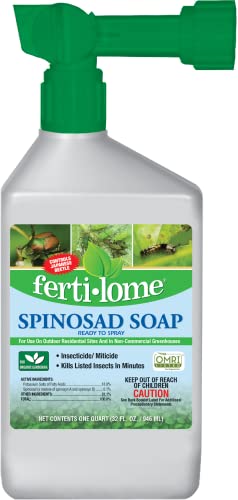
1. Fertilome (16055) Spinosad Soap
Our pick — over 4.5★ from 200+ verified ratings; the strongest balance of quality and price.
This Spinosad-and-soap combo kills leaf miners and caterpillars on contact and through ingestion.
The formulation pairs potassium salts of fatty acids (0.940%) with Spinosad (0.005%) — meaning it kills soft-bodied insects on contact and targets chewing insects like caterpillars and leaf miners through ingestion. Buyers report it eliminated leaf miners on columbine after just one application, and the same contact-kill action works on citrus leaf miners, the tiny larvae that tunnel through lemon leaves leaving silvery trails.
At 32 fluid ounces, this is a concentrate — you mix it with water and a hose-end sprayer. The coverage is impressive: one owner covered two applications for four trees and several plants from a single bottle. It is OMRI Listed for organic gardening. The key trade-off? Buyers warn that alternating with a horticultural oil is essential to prevent pest resistance over time.
What owners love
- Works on contact — “eliminated the orange and black caterpillars from eating my Oleander leaves”
- OMRI Listed for organic use, safe up to harvest day
- Covers 4+ trees per bottle when mixed, outperforming cheaper ready-to-use quarts
The honest caveat
- Requires rotating with oil to stop insect resistance from building
- Not a “spray once and done” solution — follow the 7–10 day reapplication window
Best for: Lemon tree owners dealing with leaf miners, caterpillars, or aphids who want a concentrated solution that stretches across multiple trees.
Think twice if: You prefer a grab-and-spray bottle for a single patio tree — the 32 oz concentrate requires mixing.
2. VPG Fertilome Natural Guard (40704) Insecticidal Soap

This potassium-salt soap smothers aphids and mites on contact but can burn tender new growth.
This spray is all about the direct-contact kill mechanism that insecticidal soap is famous for. Potassium salts of fatty acids dissolve the waxy outer coating of soft-bodied pests (lace bugs, aphids, leafhoppers, spider mites, earwigs) on contact, and the formula is labeled for fruit trees and citrus specifically. It is a contact spray only — meaning the pest must be wet for the soap to work, and there is no residual activity once it dries.
The 16-ounce ready-to-spray bottle is convenient for direct application. But the real-world reports are mixed here. While many owners mention success on gardenias and general garden pests, a verified buyer candidly noted: “Even applying half the recommended dosage, the product severely damaged the crop of spinach.” This sensitivity risk means you want to test-spray a single branch on your lemon tree before going all-in — especially on tender new growth or on a hot, sunny day when the soap can dry too fast and burn leaves.
Perfect for light infestations: If your lemon tree has a small, early-stage aphid or mite issue, this soap knocks them down without introducing a broad-spectrum ingredient like Spinosad. The 16-ounce concentrate is more economical than the 3-pack Bonide — expect roughly 32 gallons of mixed spray per bottle.
Watch the weather: Do not spray in direct sun above 85°F or on drought-stressed trees; the soap can defoliate tender leaves. Always test one branch first.
Reach for this if: You need a targeted, low-residue soap for occasional aphids or mites on a small lemon tree and are willing to do a 24-hour branch test first.
Look elsewhere if: You have leaf miners or caterpillars — this soap will not touch them, and the Spinosad blend in Product 1 is a better fit.
3. Bonide (912102) Ready-to-Use Insect Soap, 3 Pack
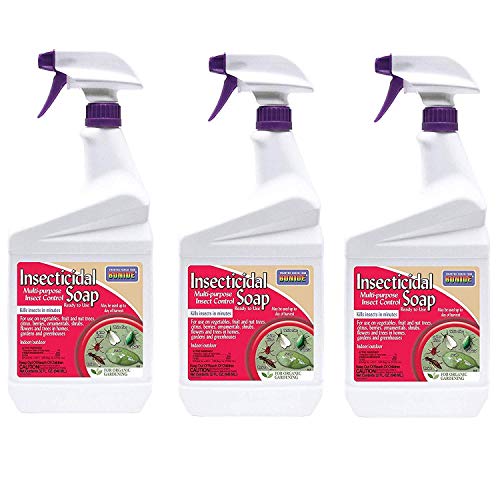
Three ready-to-use quarts of potassium-salt soap for container lemons — no mixing required.
If you have a single lemon tree in a pot on your deck or one small backyard citrus, this 3-pack is the easiest option. Each quart is ready-to-use — no mixing, no hose attachment, just a trigger sprayer. The active ingredient is potassium salts of fatty acids, derived from plants, so it kills aphids, whiteflies, and spider mites on contact without leaving a persistent chemical footprint. It is safe to use right up to the day of harvest, which matters when you are eating fruit straight off the branch.
The volume here is 96 fluid ounces (three quarts) — compared to the Fertilome concentrate at 32 fluid ounces. Customers note it saved flowers from caterpillars with regular sprays every few days. The recurring complaint, however, is packaging: all three bottles leaked in transit for at least one buyer, soaking the box. And the ready-to-use format runs out fast on a larger tree — as one owner put it: “Three bottles is ok for one bush, but not for a extenso garden.” On a single standard lemon tree, expect the three quarts to cover a few weeks of weekly applications. For anything larger, the concentrate in Product 1 is a smarter investment.
What works
- No mixing, no measuring — pull the trigger and spray directly on pests
- Plant-based formula is safe for organic gardens and edible fruit
- Three individual bottles make it easy to stash one in the garden shed, one by the patio
The trade-off
- Run through it quickly on mature trees — “three bottles is ok for one bush”
- Leaking caps during shipping is a known issue; open the outer box with care
Best for: A single container lemon tree or small patio citrus where convenience trumps economy — you grab the bottle and spray without a second thought.
skip it if: You have more than one large tree or a full backyard orchard — the 32 oz concentrate from Fertilome is a better value for large areas than the 96 oz ready-to-use.
Understanding the Specs
Potassium Salts of Fatty Acids
This is the core “soap” ingredient. It is a contact insecticide that dissolves the waxy outer layer of soft-bodied insects (aphids, whiteflies, mites, leafhopper nymphs). Once the soap dries on the leaf, it stops working — there is no residual effect, which is why reapplication every 5–7 days is standard. It is gentle enough for organic gardens and safe to use up to the day of harvest, but it can burn tender new growth if applied in direct sunlight above 85°F.
Spinosad
A natural compound produced by soil bacteria that affects the nervous system of chewing insects (leaf miners, caterpillars, thrips, Colorado potato beetles). Unlike potassium salts, Spinosad is absorbed by the leaf and retains some activity for a day or two. It is OMRI Listed and allowed in organic production. The Fertilome (16055) is the only product on this list that includes Spinosad, which is why it is the best choice for leaf miners on lemon trees.
FAQ
Can I use insecticidal soap on my lemon tree while it has fruit?
Will insecticidal soap kill leaf miners on lemon trees?
How often should I spray insecticidal soap on my citrus tree?
What is the difference between insecticidal soap and neem oil for lemon trees?
Can insecticidal soap burn my lemon tree leaves?
Which is better for a single lemon tree: a concentrate or ready-to-use?
Is OMRI listing important for insecticidal soap?
Can I mix insecticidal soap with other garden sprays?
Final Thoughts: The Verdict
For the majority of shoppers, the insecticidal soap for lemon trees winner is the Fertilome (16055) Spinosad Soap because it marries the fast contact-kill of potassium salts with the systemic reach of Spinosad — critical for leaf miners, the single most common citrus pest. If you need a quick, no-mix solution for one container tree, grab the Bonide 3-Pack Ready-to-Use. And for light aphid or mite control on a small tree where you want the gentlest formula, the VPG Fertilome Natural Guard soap is a fine pick — just test a branch first on a cool day to avoid leaf burn.
How We Picked
We do not accept paid placement. Every pick is matched to a real buyer and a real use-case; we do not hands-on test units.
Sources & Methodology
Specifications: manufacturer listings and product documentation. Review insights: verified customer reviews, as of July 2026. Pricing: not shown on this page (it changes often); check the current price via the retailer link.
As an Amazon Associate, Lawn Gear Lab earns from qualifying purchases. This does not affect which products we feature.