
Specs are compiled from manufacturer listings and verified buyer reviews and can change over time — please confirm the key details on the product page before buying.
Leafhoppers are the jumpers of the garden — you see the speckled, stippled damage on leaves long before you ever spot the tiny wedge-shaped bugs themselves. The fix is a spray that smothers them on contact, and the two options here both list leafhoppers as a target pest, which is the non-negotiable starting point. One is a contact soap that shines on soft-bodied insects; the other pairs that soap with a biological compound that keeps working after the spray dries.
I’m Rikta — the founder and writer behind Lawn Gear Lab. This guide is built by comparing the manufacturers’ published specifications and the patterns across verified customer reviews, so you get each pick’s real strengths and trade-offs instead of marketing spin.
You need a spray that lists leafhoppers on the label, and these two do — here is the honest breakdown of the best insecticidal soap for leafhoppers on the shelf today.
Quick Picks
- Fertilome Spinosad Soap Insecticide (16076) — Best Overall
- VPG Fertilome Natural Guard Insecticidal Soap — Compact Pick
How To Choose The Best Insecticidal Soap For Leafhoppers
Leafhoppers are mobile and quick, so your spray needs to hit them before they hop away. That makes the active ingredients and the spray format the two decisions that matter most, not the brand name on the bottle.
Check the label for “leafhoppers” first
Plenty of soaps kill aphids and mites but say nothing about leafhoppers. If the target pest is not named on the label, the product was not tested or approved for that use, so keep looking until you see the word in writing.
Decide between contact soap and a soap-plus-spinosad combo
You want leafhoppers gone, but you also want to know how long the protection lasts. A pure insecticidal soap kills only what it touches by breaking down the pest’s outer shell on contact. A combo product adds a biological compound that stays active after drying, so it catches leafhoppers you missed on the first pass. Your choice depends on how much residual protection you want.
Match the bottle size to your garden
Ready-to-use sprays come in different volumes, and the size should match your planting area. A small 16-fluid-ounce bottle suits a few potted plants or a single gardenia, while a 32-fluid-ounce bottle covers multiple trees and a full vegetable bed without forcing you to reorder mid-season.
Quick Comparison
| Model | Best For | Active Ingredients | Volume | Format | Amazon |
|---|---|---|---|---|---|
| Fertilome Spinosad Soap (16076) | Residual control across a large garden | Spinosad 0.005% + Potassium Salts of Fatty Acids 0.940% | 32 fl oz | Ready to Use spray bottle | Amazon |
| VPG Fertilome Natural Guard (40704) | Gentle contact treatment for small spaces | Insecticidal soap (potassium salts of fatty acids) | 16 fl oz | Ready to Use spray | Amazon |
In‑Depth Reviews
1. Fertilome Spinosad Soap Insecticide (16076)
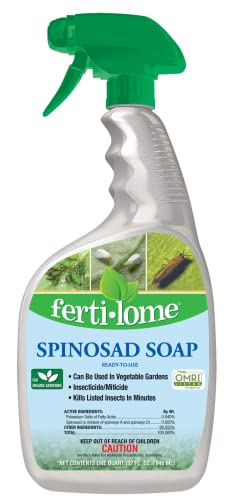
The two-pronged spray that keeps working after the first pass dries
This is the pick for bigger gardens because it blends two active ingredients instead of relying on soap alone. It pairs Spinosad 0.005% — a biological compound that disrupts the pest’s nervous system — with Potassium Salts of Fatty Acids 0.940%, the soap that breaks down soft-bodied insects on contact. That combination means leafhoppers that escape the initial wetting still face a compound that stays active on the leaf surface afterward.
The bottle holds 32 fluid ounces, compared to the Natural Guard’s 16 fluid ounces — enough that one container covered two full applications across four trees and assorted plants in one owner’s yard. It is OMRI Listed for certified organic production, so you can use it in an organic vegetable garden without worrying about breaking your growing standards. The label names leafhoppers explicitly, along with aphids, caterpillars, chinch bugs, and a long list of other chewing and sucking pests, and it is safe on vegetables, trees, shrubs, flowers, fruits, and citrus.
What wins people over is the effectiveness — buyers report bug activity nearly stopping after two applications, and leaf miners on columbine cleared with no recurrence after two weeks. The honest caveat is that it is a contact treatment, not a one-and-done miracle: an owner notes that alternating with a horticultural oil helps delay insect resistance, and reapplication may be needed depending on the infestation. Owners mention that removing badly damaged leaves before spraying, then covering the whole plant on a dry day, gives the strongest result.
What owners rave about
- Works on contact, with owners saying the first use hit pests immediately
- Spinosad adds residual protection that plain soap cannot match
- 32 oz stretches across a full garden — one bottle did four trees twice
What to know before buying
- Alternate with an oil spray to slow insect resistance
- Strip damaged leaves first and spray on a dry day for best results
- You may need to reapply if the infestation is heavy
Reach for this: gardeners with several trees, a vegetable bed, or ornamentals who want a bottle that lasts and a spray that keeps working after it dries.
Think twice if: you only have a single potted plant — 32 oz is more than a small-space gardener will use in a season.
2. VPG Fertilome Natural Guard Insecticidal Soap (40704)

A small-bottle contact soap that is gentle on plants but tough on soft-bodied pests
If you only have a balcony planter or a couple of shrubs, this 16-fluid-ounce bottle is a fraction of the volume of the Spinosad combo above, so it won’t overwhelm your space. It’s a contact insecticidal soap that kills lace bugs, spiders, mites, aphids, leafhoppers, and earwigs by breaking down their outer shells on direct contact. What you see, you spray; what you spray, dies.
The formula is designed to be gentle on the plant itself, and the maker positions it as safe for both indoor and outdoor use across greenhouses, homes, and gardens. You can apply it to fruit trees, vegetables, nut trees, ornamentals, shrubs, berries, flowers, and citrus. Because it is a pure contact spray, it has no residual activity — it only kills what it physically touches, which makes thorough coverage of leaf undersides non-negotiable.
The honest trade-off shows up in the reviews: the recurring gripe is spotting on sensitive crops, with one owner reporting that even half the recommended dosage damaged a crop of spinach severely. That points to a real fit issue — this soap is a better match for tougher ornamentals and fruit trees than for delicate leafy greens. On the other hand, pairing it with neem oil is described as the best solution owners have found for eliminating pests, and it proved useful on a gardenia.
Where it shines
- Compact 16 oz bottle fits a small hand and a small garden
- Gentle on plants by design, targeting soft-bodied insects only
- Works inside greenhouses and outdoors on many plant types
Where to be careful
- Contact-only means zero residual protection after drying
- Delicate crops like spinach can spot or scorch even at half dose
- Small volume runs out fast on anything bigger than a few plants
Pick it for: quick, simple contact control on ornamentals, shrubs, and fruit trees where you want a small, gentle bottle.
Skip it for: leafy vegetable beds with thin, delicate foliage — the stronger Spinosad combo is the safer route there.
Understanding the Specs
Potassium Salts of Fatty Acids
This is the actual insecticidal soap molecule — the part that dissolves the waxy outer layer of soft-bodied insects like leafhopper nymphs. On contact, it causes the pest to dehydrate and die, which is why coverage matters: a soap can only kill what it actually touches.
Spinosad
A biological compound derived from soil bacteria that targets the pest’s nervous system. Unlike plain soap, spinosad keeps working after the spray dries, so leafhoppers that land on treated leaves later still pick up a dose — that is the residual protection the combo product brings.
FAQ
Will insecticidal soap kill leafhoppers on contact?
What is the difference between the Spinosad soap combo and a plain insecticidal soap?
How often should I reapply insecticidal soap for leafhoppers?
Can I use these sprays on vegetables I plan to eat?
Why do my leafhopper-damaged leaves look stippled and pale?
Does insecticidal soap work indoors as well as outdoors?
Should I remove damaged leaves before spraying?
Can I mix insecticidal soap with neem oil for leafhoppers?
Final Thoughts: The Verdict
If you want one dependable pick, the insecticidal soap for leafhoppers winner is the Fertilome Spinosad Soap because its dual action keeps working after the spray dries, and the 32-fluid-ounce bottle covers a real garden. If you want the gentler contact-only approach for a few ornamentals, grab the Natural Guard Soap. And for leafy vegetable beds where spotting is a worry, the Spinosad combo is the one to reach for — its OMRI listing makes it the safer bet on crops you eat.
How We Picked
We do not accept paid placement. Every pick is matched to a real buyer and a real use-case; we do not hands-on test units.
Sources & Methodology
Specifications: manufacturer listings and product documentation. Review insights: verified customer reviews, as of July 2026. Pricing: not shown on this page (it changes often); check the current price via the retailer link.
As an Amazon Associate, Lawn Gear Lab earns from qualifying purchases. This does not affect which products we feature.