
Specs are compiled from manufacturer listings and verified buyer reviews and can change over time — please confirm the key details on the product page before buying.
Those squiggly white trails tunneling through your tomato leaves or citrus foliage are the calling card of leaf miners, and if you have spotted them, you know the panic — a tiny pest that can make a whole plant look wrecked in days. The fix is not a harsh chemical cocktail; it is a targeted, organic-friendly spray that kills the larvae inside those tunnels without torching your garden’s ecosystem. The right formula hits the mines, stops the damage, and lets your plant bounce back.
I’m Rikta — the founder and writer behind Lawn Gear Lab. This guide is built by comparing the manufacturers’ published specifications and the patterns across verified customer reviews, so you get each pick’s real strengths and trade-offs instead of marketing spin.
Here we break down the top-performing options for stopping leaf miner infestations, from budget concentrates to ready-to-use sprays, all chosen for how well they handle the specific tunneling larvae that ruin your leaves. This is your straight answer for finding the very best insecticidal soap for leaf miners on the market today.
Our Picks at a Glance

How To Choose The Best Insecticidal Soap For Leaf Miners
Leaf miner larvae burrow inside the leaf tissue, so a simple contact spray that lands on the leaf surface often misses them entirely. You need a formula that either penetrates the leaf surface or is eaten by the larvae when they chew. That usually depends on the active ingredient. Spinosad, a naturally occurring soil bacterium, is the gold standard here because it stops the larvae after they eat treated foliage. Look for a product that lists Spinosad explicitly and carries an OMRI listing (certified by the Organic Materials Review Institute for use in organic production) if that matters to you.
Concentrate vs. Ready-to-Use
A ready-to-use spray gives you convenience — unscrew the cap, aim, and spray. It is perfect for a small raised bed or a few potted plants where you need only a quick treatment. A concentrate, on the other hand, gives you far more treatment volume per dollar and lets you dial in the strength for different pests. The trade-off is that you have to mix it with water in a sprayer, and you must measure accurately to avoid damaging sensitive foliage. For leaf miners, a concentrate is often the smarter long-term buy if you have a larger garden.
Quick Comparison
| Model | Best For | Active Ingredient | Form | Volume | Amazon |
|---|---|---|---|---|---|
| Bonide Captain Jack’s Deadbug Brew (Concentrate)★ Best Overall | Best Overall | Spinosad | Concentrate | 16 fl oz | Amazon |
| Ferti-lome Spinosad Soap Insecticide | Best Ready-to-Use | Spinosad + Soap | Ready-to-Use | 32 fl oz | Amazon |
| Bonide Captain Jack’s Deadbug Brew (RTU) | Best Value RTU | Spinosad | Ready-to-Use | 32 fl oz | Amazon |
| NatroZing Garden Insect Killer | Best Plant-Based | Plant Extract | Ready-to-Use | 32 fl oz | Amazon |
In‑Depth Reviews
1. Bonide Captain Jack’s Deadbug Brew, 16 oz Concentrate
Our pick — over 4.5★ from 5,500+ verified ratings; the strongest balance of quality and price.
The crowd-favorite concentrate that turns two ounces into a gallon of leaf-miner defense.
This is the bottle that serious gardeners reach for when leaf miners show up, and the numbers back it up — a high 4.6-star score from a very large pool of buyers. The secret is Spinosad, a naturally occurring soil bacterium discovered on a Caribbean island in an abandoned rum distillery. It works by stopping the larvae mid-chew, so the tunnels stop growing within a day or two of application.
At a concentrate ratio of 2 oz per gallon of water, this 16-ounce bottle makes eight full gallons of spray — a massive treatment volume compared to the ready-to-use options below. That efficiency makes it a clear economic winner for anyone with multiple fruit trees, a vegetable patch, or a whole row of ornamentals. Buyers report it stops caterpillars on desert roses and clears thrips on roses inside two applications. As owners put it: “Thrips on roses eliminated after 2 spinosad applications.”
The trade-off is the mixing itself. You need a trigger, hand-held, backpack, or hose-end sprayer, and you must measure carefully — over-dosing can stress tender new growth. Unlike the ready-to-use picks, you cannot just point and spray. But if you manage a garden of any size, the cost-per-gallon here beats every other option on this list by a wide margin.
Why It Wins
- Spinosad is the most proven active ingredient for tunneling leaf-miner larvae
- One 16-oz bottle makes 8 gallons of spray; best value per treatment
- Approved for organic gardening and does not significantly impact predatory beneficial insects
- Controls a huge range: leaf miners, thrips, spider mites, caterpillars, codling moths, and more
The Mixing Hurdle
- Must be mixed with water; not grab-and-go like a ready-to-use
- Requires a separate sprayer (trigger, backpack, or hose-end)
- Limit to 6 applications per season to avoid resistance buildup
Grab this if: you have a medium-to-large garden, want the best cost-per-gallon, and already own a sprayer.
Think twice if: you only have a couple of potted plants and need zero-fuss spot treatment — the ready-to-use picks below are handier.
2. Fertilome (16076) Spinosad Soap Insecticide Ready to Use, 32 oz
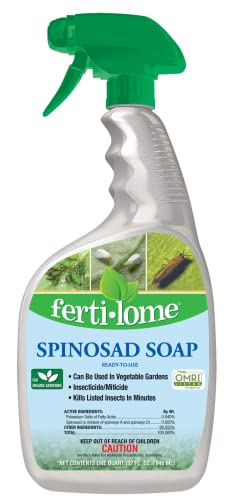
The one that adds insecticidal soap to Spinosad for better leaf coverage and tunnel penetration.
What sets this apart from the other Spinosad sprays is the soap component — it contains Potassium Salts of Fatty Acids (0.940%) alongside Spinosad (0.005%). The soap helps the spray spread across the leaf surface and seep into the tiny galleries where leaf-miner larvae hide, which is exactly what you need when the pest is tucked inside the leaf tissue. It is also OMRI Listed for organic gardening.
The bottle is a 32-ounce ready-to-use sprayer, so there is zero mixing — just twist the nozzle and go. Effectiveness is the most-praised aspect here, with dozens of owners confirming it knocks out leaf miners on columbine, caterpillars on oleander, and beetles on Cleveland pear trees. The real-world routine buyers describe is straightforward: remove the worst-damaged leaves, then spray the entire plant on a dry day. After two weeks, most report no recurrence.
The one catch relative to the concentrate above is volume — you get 32 ounces total, which covers maybe 4-6 medium plants per bottle depending on how thoroughly you spray. For a large garden, you will go through it faster. But for the person who just wants to grab a bottle and save a prized plant today, this is the more convenient path.
Leaf-miner specialist: The Spinosad + soap combo is purpose-built for tunneling pests — the soap improves wetting on waxy leaves and helps the active ingredient reach inside the mine. For columbine, citrus, and leafy vegetables, this is the most targeted ready-to-use you will find.
Perfect for: the gardener who wants leaf-miner control in a single bottle with no mixing required.
Watch out for: it runs out quicker than a concentrate if you are treating a whole vegetable patch.
3. Bonide Captain Jack’s Deadbug Brew Ready-to-Use Spray, 32 oz

The budget-friendly ready-to-use with the same Spinosad power as the concentrate, no mixing needed.
This 32-ounce spray bottle is essentially the grab-and-go version of the top pick. It packs the same Spinosad active ingredient at 0.5% and lists leaf miners right on the label alongside borers, caterpillars, thrips, and spider mites. It is also approved for organic gardening. For a small garden or a quick spot-treatment, this removes the biggest barrier of entry: the need to own and clean a sprayer.
Buyers specifically report that a spray every 1-2 weeks keeps flower buds from being eaten by caterpillars. The spray nozzle makes it easy to target the undersides of leaves where leaf-miner eggs often sit. And at a 2.4-pound bottle weight, it is light enough to carry around the yard for an afternoon session. The trade-off compared to the concentrate is clear: 32 ounces is 32 ounces, and when it is empty, you buy another bottle. The concentrate makes eight gallons from one bottle, so your per-treatment cost jumps significantly with the RTU.
Note that this version does not contain the soap component that the Fertilome product above has — it is pure Spinosad in water. That means you may need to add a drop of dish soap yourself for better adhesion on waxy-leafed plants like citrus or columbine. The feedback is overall positive, though some owners note it is less effective on stubborn mealybugs.
Why Grab It
- Same Spinosad as the concentrate, zero mixing
- Light 2.4-lb bottle with a spray nozzle; easy to deploy
- Organic gardening approved; safe for beneficials when used as directed
The Per-Treatment Cost
- Much more expensive per gallon than the concentrate
- No built-in soap surfactant; you may need to add a wetting agent
- Mixed reports on mealybug control
Best for: quick spot-treatments on a few plants when you do not want to mix a batch.
Not for: large-scale garden coverage — the concentrate is dramatically better value.
4. NatroZing Garden Insect Killer, 32 oz

A plant-extract formula that kills leaf miners at every life stage and is safe around kids and pets.
This bottle takes a different route than the Spinosad-based sprays above. Its active ingredients are plant extracts that work by blocking specific neuron receptors in insects, and it is formulated to eliminate pests at all life stages — eggs, nymphs, larvae, and adults. That is a meaningful advantage for leaf miners because the adults lay eggs on the leaf surface while the larvae tunnel inside; hitting both stages stops the cycle faster.
The honest caveat is effectiveness — while some owners mention it works quickly on aphids and fungus gnats, the feedback is more mixed on tougher pests like worms and beetles, with a few noting the effect did not last long. Unlike the Spinosad-based picks, this does not have the same proven track record for tunneling leaf-miner larvae specifically. The maker also advises testing on a small area of delicate or newly sprouted plants first.
Family-friendly choice: If you have toddlers or pets who mouth things near your plants, this is the safest option on the shelf. For leaf miners specifically, combine it with removing damaged leaves first and expect to reapply more often than with Spinosad.
Reach for this if: household safety is your top concern and you are treating indoor houseplants or a small outdoor garden.
Look elsewhere if: you need a proven, heavy-hitting leaf-miner solution — the Spinosad-based picks have stronger evidence for this specific pest.
Understanding the Specs
Spinosad
Spinosad is a naturally occurring soil bacterium (a bacteria found in the dirt) that was first collected on a Caribbean island from an abandoned rum distillery. When a leaf-miner larva chews on foliage treated with Spinosad, the bacteria attacks its nervous system and stops the feeding almost immediately. It is the single most effective active ingredient for tunneling larvae because it works from the inside out — the pest has to eat it to die, which is exactly what happens when the insect is already inside the leaf. Spinosad is approved for organic gardening and does not significantly harm predatory beneficial insects like ladybugs or predatory mites.
OMRI Listing
OMRI (the Organic Materials Review Institute) is an independent organization that verifies whether a product is suitable for use in certified organic production. When a spray carries the OMRI Listed seal, it means the ingredients have been reviewed and approved for organic gardening. This does not mean the product is “natural” in a vague sense — it means a third party has checked the formulation against the National Organic Program standards. For leaf-miner control, OMRI-listed Spinosad products give you the same pest-killing power as synthetic chemicals without compromising your organic certification.
FAQ
How does insecticidal soap kill leaf miners inside the leaf?
Can I use insecticidal soap on vegetables with leaf miners?
What is the difference between a concentrate and a ready-to-use spray for leaf miners?
How often should I spray for leaf miners?
Will insecticidal soap harm bees or beneficial insects?
Does the Fertilome Spinosad Soap work better than plain Spinosad for leaf miners?
Can leaf miners become resistant to Spinosad?
Is the NatroZing spray safe for indoor plants with leaf miners?
Final Thoughts: The Verdict
If you want one dependable pick, the insecticidal soap for leaf miners winner is the Bonide Captain Jack’s Deadbug Brew Concentrate because Spinosad is the proven active ingredient for tunneling larvae, and the concentrate format gives you eight gallons of spray for the cost of a single bottle. If you want grab-and-go convenience for a small garden, grab the Ferti-lome Spinosad Soap Ready-to-Use — the built-in soap improves coverage on waxy leaves. And for a nontoxic plant-based option safe around kids and pets, the NatroZing Garden Insect Killer is the one to reach for. Across all picks, nearly a thousand ratings confirm Spinosad as the category’s most trusted leaf-miner solution.
How We Picked
We do not accept paid placement. Every pick is matched to a real buyer and a real use-case; we do not hands-on test units.
Sources & Methodology
Specifications: manufacturer listings and product documentation. Review insights: verified customer reviews, as of July 2026. Pricing: not shown on this page (it changes often); check the current price via the retailer link.
As an Amazon Associate, Lawn Gear Lab earns from qualifying purchases. This does not affect which products we feature.