
Specs are compiled from manufacturer listings and verified buyer reviews and can change over time — please confirm the key details on the product page before buying.
Watching your prized tomato plants or rose bushes get skeletonized overnight is a gardener’s nightmare. The culprits are often caterpillars — and you need a solution that stops the destruction without harming your soil, your beneficial insects, or your family. That is exactly what an insecticidal soap designed for caterpillars delivers: a targeted, low-toxicity knockout punch for leaf-chewing worms.
I’m Rikta — the founder and writer behind Lawn Gear Lab. This guide is built by comparing the manufacturers’ published specifications and the patterns across verified customer reviews, so you get each pick’s real strengths and trade-offs instead of marketing spin.
The list below focuses on contact-kill sprays and biological dusts that are specifically rated for caterpillars, bagworms, webworms, and other larvae. We have narrowed the field to the most effective options based on active ingredients, coverage, and real-world owner feedback to help you find the absolute best insecticidal soap for caterpillars for your garden.
Our Picks at a Glance


How To Choose The Best Insecticidal Soap For Caterpillars
The first thing to know is that most “insecticidal soaps” are general-purpose soft-bodied insect killers. For caterpillars — which have tougher exteriors than aphids — you usually need a booster active ingredient like Spinosad or Bacillus thuringiensis (Bt). A plain fatty-acid soap can work on very young, small caterpillars, but if you have an inch-long tomato hornworm, you need a Spinosad-soap combo or a Bt dust.
Active Ingredient: Spinosad vs. Bt
Spinosad is a natural soil bacterium byproduct that kills caterpillars on contact and after they eat treated leaves. It is fast — you often see results within hours to a day. Bt (Bacillus thuringiensis) is a living bacterium that caterpillars must ingest; it paralyzes their gut and they stop eating within hours but die over a few days. Spinosad-based soaps are better for heavy infestations, while Bt is a more targeted, gentler option that leaves most non-caterpillar insects alone.
Form: Ready-to-Use vs. Concentrate vs. Dust
Ready-to-Use (RTU) spray bottles are grab-and-go for a few shrubs or raised beds. Concentrates are more economical for large gardens and orchards. Dusts (like Bt dust) are great for coating the undersides of leaves where caterpillars hide, especially in wet climates where spray might wash off faster.
OMRI Listing and Organic Gardening
If you grow vegetables you eat daily, an OMRI (Organic Materials Review Institute) listing means the product is allowed in certified organic production — so a soap like Spinosad gives you confidence that you aren’t introducing synthetic chemicals to your food chain.
Quick Comparison
| Model | Best For | Active Ingredient | Form | Coverage | Amazon |
|---|---|---|---|---|---|
| Fertilome Spinosad (16063)★ Best Overall | Heavy bagworm & tent caterpillar | Spinosad | Concentrate | 32 fl oz | Amazon |
| Fertilome Spinosad Soap RTU (16076)Top Performer | Instant contact-kill on veggies | Spinosad + Soap | Ready-to-Use | 32 fl oz | Amazon |
| Natural Guard Spinosad SoapBest Value | Versatile garden spray | Spinosad + Soap | Ready-to-Use | 32 fl oz | Amazon |
| Southern Ag Conserve Naturalyte | Foliage feeders & leafminers | Spinosad | Concentrate | 16 fl oz | Amazon |
| Summit Caterpillar & Webworm Control | Human-safe Bt for edible gardens | Bacillus thuringiensis | Concentrate | 32 fl oz | Amazon |
| Bonide Eight Insect Control | Broad yard & garden defense | Lambda-cyhalothrin | Ready-to-Spray | 32 fl oz | Amazon |
| Fertilome Dipel Dust Bt | Targeted dry application | Bacillus thuringiensis | Dust | 16 oz | Amazon |
| Southern Ag Thuricide BT | Long-term bulk supply | Bacillus thuringiensis | Concentrate | 128 fl oz | Amazon |
In‑Depth Reviews
1. Fertilome Spinosad Insecticide (16063), 32 oz
Our pick — over 4.5★ from 200+ verified ratings; the strongest balance of quality and price.
The concentrated arsenal for full-scale caterpillar warfare on trees and vegetables.
This is the highest-rated pick in the category at 4.7 stars out of hundreds of owners, and for one reason: it works with an authority that hobby-grade sprays cannot match. The active ingredient is Spinosad, a natural soil-derived compound that caterpillars cannot ignore. Buyers report a “complete kill of 1/2-inch caterpillars within days on heavily infested 10-foot tree” — and they mean it. The concentrate mixes at 4 tablespoons per gallon of water, so a single 32-ounce bottle goes a long way on orchards and ornamental trees.
Unlike the ready-to-use Spinosad Soap (Product 2), this version lacks the added potassium salts of fatty acids, meaning it relies entirely on Spinosad for its muscle. It is designed for outdoor use on vegetables, trees, shrubs, flowers, fruits, and citrus. The list of target pests is long: armyworms, sod webworms, loopers, bagworms, tent caterpillars, and Colorado potato beetles. Owners who battle bagworms on mature cedar trees swear by two applications in late June and early July.
One grower sums it up: “This stuff keeps the worms from proliferating our apple crop which greatly increases yield.” The trade-off is that you must mix and apply with a sprayer — it is not a grab-and-go bottle. But for the reach and kill power, that small step is worth it.
Real-world voltage: The 32-ounce concentrate stretches further than any RTU on this list, and owners with heavy bagworm pressure confirm it delivers.
The one caution: Dilution is critical — 4 tablespoons per gallon is the rule; over-concentrating can stress plants in direct sun.
Ideal for: Gardeners with mature trees, large shrub borders, or heavy caterpillar infestations who want a concentrated, OMRI-listed solution.
Think twice if: You prefer a ready-to-use bottle or want the added soap action for soft-bodied insects — the Spinosad Soap RTU below covers that niche.
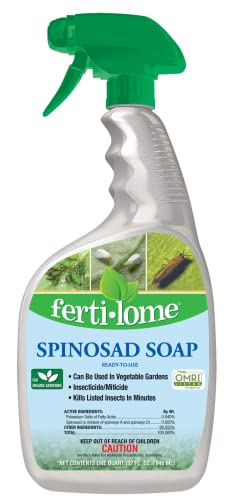
2. Fertilome Spinosad Soap Ready to Use (16076), 32 oz
Instant contact-kill in a bottle, with the bonus of fatty-acid soap action.
This RTU pairs 0.005% Spinosad with 0.940% Potassium Salts of Fatty Acids — so you get the caterpillar-killing power of Spinosad plus the smothering action of a true insecticidal soap. Owners rate it a hair below the concentrate at 4.6 stars, but the feedback is equally passionate. The formula is OMRI listed, making it a safe bet for vegetable gardens. A gardener who battled “orange and black caterpillars” on Oleander leaves says this is “the only thing I’ve found that eliminates them.”
The ready-to-use format means zero mixing — you grab the spray bottle and go. The coverage is thorough enough to handle leaf miners on columbine after removing damaged leaves first. Another owner eliminated caterpillars and beetles on four Cleveland Pear trees after just two applications. Unlike the plain Spinosad concentrate (Product 1), this version is pre-diluted and ready to target soft-bodied insects, aphids, and adelgids alongside caterpillars. The spray nozzle makes it easy to hit the undersides of leaves.
The main drawback is the 32-ounce container will not cover a large orchard — you might find yourself ordering the concentrate refill after a few applications. But for the gardener with a few raised beds or ornamental trees, this is the grab-and-go champion.
Contact burst: The soap component works on contact, which is why buyers see results “right on contact first use.”
Resistance note: Some owners recommend alternating with an oil-based spray to prevent insects from developing resistance over a long season.
Who it fits: Home gardeners who want an instant, no-mix solution for moderate caterpillar infestations on veggies, flowers, and small trees.
The catch: Bottle size is best for spot treatments; large-scale users will burn through it quickly.
3. Natural Guard Spinosad Soap, 32 oz
A budget-friendly Spinosad-soap hybrid that the crowd trusts for general garden bugs.
With a 4.4-star rating and nearly a thousand owners backing it, this is the most-reviewed product on the list. The dual-action formula (Spinosad + potassium salts of fatty acids) tackles caterpillars on contact and provides a residual barrier. It is ready-to-use and designed for outdoor residential areas, vegetable gardens, and non-commercial greenhouses. A gardener with fruit trees reported: “Sprayed fruit trees — after two days sprayed water on trees and no bugs came flying off!”
What wins people over is its versatility. It controls spider mites, aphids, and powdery mildew on contact, making it a multi-purpose tool in a single bottle. The spray starts killing within minutes after application, which is crucial when you catch caterpillars mid-feast. Many owners compare it favorably to neem oil, finding it more effective for heavy infestations. One owner noted that a single spray eliminated a cactus beetle infestation with no reappearance for days.
The weakness reported most often is leakage during shipping, despite a plastic seal on the trigger. Also, a few gardeners mention that it can burn sensitive plants if sprayed in direct midday sun. For most, the value is tough to top: effective, easy, and budget-friendly.
Crowd favorite: Nearly 1,000 owners have rated this, making it the most-tested pick on the list.
Honest limitation: Bottle size is enough for a moderate garden; owners with massive areas should look at the concentrate options.
Reach for it if: You want an all-in-one garden spray that handles caterpillars, aphids, and mites while staying affordable.
Look elsewhere if: You need 5,000+ square feet of coverage or a product with a safer sprayer cap — some units arrive with leaks.
4. Southern Ag Conserve Naturalyte Insect Control, 16 oz

Concentrated Spinosad that protects beneficial bugs while wiping out foliage-feeders.
This 16-ounce concentrate makes up to 8 gallons of spray, which puts it in the value camp despite the smaller bottle size. The active ingredient is Spinosad, and it is OMRI-listed. A 4.5-star rating from over 300 owners confirms its reliability. Gardeners use it for everything from fire ant control in ornamentals to citrus leafminers to spider mites. One long-time user calls it “a great organic solution to get the critters but without hurting the good bugs in your garden.”
Compared to the Fertilome concentrate (Product 1), this one is a smaller volume but mixed at a higher dilution rate, resulting in similar total coverage. It excels on scale insects and aphids as well as caterpillars. A gardener with a Miracle Fruit plant reported that it “excellent for scale after neem oil and other oils failed.” The product has no odor and washes off easily, which appeals to edible-garden growers.
One owner notes a practical catch: it works well but needs reapplication after about a week if the infestation persists. Some gardeners forgot to reapply after two weeks and saw caterpillars return to their potato plants. As long as you stick to a weekly schedule, this concentrate delivers professional-grade results.
Organic edge: Owners mention zero odor and easy wash-off — a big plus for vegetable gardens.
Reapplication rhythm: Plan on a weekly schedule; missing a week can let caterpillars bounce back.
Best for: Gardeners who want an economical, organic concentrate for small to medium gardens and tree care.
Not ideal if: You want a pre-mixed spray or need a multi-month residual — Bt options last longer without reapplication.
5. Summit Caterpillar and Webworm Control, 1 Qt Concentrate

A Bt concentrate that is completely human-safe and pet-friendly, even on harvest day.
This is a Bt (Bacillus thuringiensis, a natural soil bacteria) product, which works differently than Spinosad: caterpillars must eat treated leaves, and the bacteria paralyzes their digestive system. According to owners, it is “perfectly safe to use on veggies up to and including day of harvest” and “only harmful to caterpillars.” With a 4.5-star rating from over 600 owners, it is a trusted choice for edible gardens. The concentrate format uses a hose-end sprayer, covering large areas easily.
What sets Summit apart from other Bt products is its specific targeting of caterpillars and webworms, plus the safety profile that reviewers rave about. It killed army worms on cucumber and zucchini leaves, and stopped bagworms from destroying pine trees. One owner says, “I would give this 10 stars if I could,” after two years of consistent spring application against gypsy moths. The only caution, which honest owners flag, is that Bt can also affect native butterfly and moth larvae if sprayed indiscriminately on plants that host them.
Compared to the concentrated Spinosad options, Summit is slower — the caterpillars stop eating quickly but take a couple of days to die. However, the safety margin for pollinators and pets is tough to top.
Harvest-day safe: Owners confirm it is safe for vegetables even on the day you pick them — a big comfort for organic growers.
Speed reality: The kill is not instant like Spinosad; the caterpillars stop feeding in hours but die over a few days.
Perfect for: Vegetable gardens where you want zero chemical worry, and for butterfly-friendly areas where you must minimize off-target effects.
Skip if: You need an immediate knockdown of a heavy infestation — Spinosad products deliver faster results.
6. Bonide Eight Insect Control Yard & Garden, 32 oz Ready-to-Spray

A fast-acting, long-lasting hose-end spray for the whole yard and garden.
This is the broadest-spectrum product on the list, controlling over 100 insect pests including caterpillars, beetles, fleas, ticks, and mosquitoes. The ready-to-spray formula attaches to a garden hose and one quart treats up to 5,000 square feet — making it the coverage king. The active ingredient provides results that last up to 4 weeks, which is significantly longer than the soap-based options. Japanese beetle victims call it the “best product I have found for combating Japanese beetles,” saving blooms on roses and Rose of Sharon.
Compared to Spinosad or Bt products, Bonide Eight uses a synthetic pyrethroid (lambda-cyhalothrin), so it is not OMRI-listed and should not be the first choice for an organic vegetable grower. But for perimeter pest defense on lawns, shrubs, and building foundations, it excels. It killed box elder bugs and lady beetles after years of the owner struggling with soap water. The trade-off is the sprayer nozzle is a known weak point — several customers note it blowing off or clogging, requiring an old-style garden hose rather than a collapsible pocket hose.
The mix of speed and longevity is what puts this on the list: fast kill on contact and residual protection for weeks.
Coverage giant: 5,000 square feet per quart is class-leading by any RTU (ready-to-use) soap on this list — so you can treat a large vegetable patch without buying multiple bottles.
The nozzle note: The hose-end sprayer needs an old-style hose; pocket hoses may not provide enough pressure.
Best for: Homeowners who need a quick perimeter spray for lawns, patios, and ornamentals against a wide range of bugs — not limited to caterpillars.
Avoid if: You prioritize organic or OMRI-listed methods, or you have a butterfly garden you want to protect.
7. Fertilome Dipel Dust Biological Insecticide Bt, 1 lb
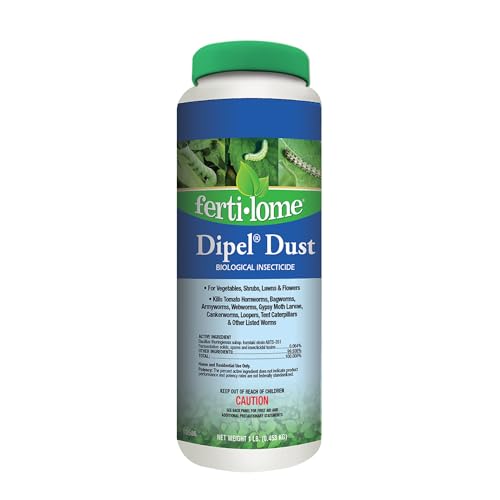
Dust-on, worry-off Bt that coats leaves without mixing or spraying.
Bacillus thuringiensis in dust form — this is for the gardener who wants to skip the mixing and the sprayer. The 1-pound bottle is simply dusted over plants when pest damage first appears. Owners love the simplicity: “I applied this to an ancient currant bush that was attacked by caterpillars… a few days later I couldn’t find a trace.” It controls bagworms, armyworms, tent caterpillars, and tomato hornworms. A gardener saved his sweet potato and pepper plants from hornworms and said, “everything grew back beautifully.”
Unlike the liquid Bt concentrate (Summit), the dust format coats leaf surfaces thoroughly and sticks well in dry conditions. Some owners use a parmesan cheese shaker for even application — a clever hack. The dust kills caterpillars biologically by stopping them from feeding. It does not affect pollinators, making it a safe choice for flowering gardens. The main limitation is that rain can wash it off, requiring reapplication after a heavy downpour.
A 4.4-star rating from hundreds of owners confirms its reliability. The dust format is especially good for curly or hairy leaves where liquid sprays might bead up and run off.
Granular simplicity: “Parmesan shaker application” is a real owner trick that proves how easy this is to apply.
Weather factor: The dust needs dry conditions to work; heavy rain washes it off, so plan applications around the forecast.
Ideal for: Gardeners who hate mixing chemicals and want a targeted, pollinator-safe biological dust for vegetable and flower beds.
Think twice if: You live in a rainy climate or need a product that works on contact — this requires ingestion by the caterpillar.
8. Southern Ag Thuricide BT For Control of Caterpillars & Worms, 1 Gallon

A full gallon of Bt concentrate that will outlast most gardeners’ summer seasons.
This is the volume play: a full 128-ounce jug of Bacillus thuringiensis concentrate. The use rate is just 1 to 4 ounces per gallon of water, meaning this jug makes a massive 32 to 128 gallons of spray. A 4.6-star rating from over 300 owners validates its performance. Owners call it “100% natural, zero human effect, organic certified” and note that a single gallon treats the same property for several growing seasons. “Since you only need like 3 teaspoons per gallon of water, this jug will probably outlast me!” one gardener writes.
Compared to the Summit Bt concentrate (Product 5), this is a much larger volume at a significantly lower per-ounce cost. It controls tomato worms, squash borers, cabbage worms, bagworms, and all leaf-eating caterpillars. An owner who sprayed once reported all caterpillars gone, saying it “will last me for several growing seasons — worth the price!” Another killed bagworms by the next morning by thoroughly covering entire trees.
The only real downside is the initial cost is higher, but the per-season cost is the lowest of any Bt option here. If you have a large garden, orchard, or multiple properties, this is the most economical buy.
Generations worth: One gallon of concentrate yields up to 128 gallons of ready-to-use spray — enough for multiple seasons of treatment.
Storage note: Bt concentrates have a shelf life; a full gallon may last 2-3 seasons when stored in a cool, dark place.
Reach for it if: You have a large garden, an orchard, or multiple properties and want the lowest per-gallon cost for Bt caterpillar control.
skip it if: You only have a few potted plants or a small raised bed — the 32-ounce version of this product is a more practical size.
Understanding the Specs
Spinosad vs. Bt (Bacillus thuringiensis)
These are the two pillars of caterpillar control. Spinosad is a natural soil bacterium byproduct that kills on contact and after ingestion — you see dead caterpillars within hours to a day. Bt is a living bacterium that caterpillars must eat; it paralyzes their gut so they stop feeding quickly but take a couple of days to die. Spinosad is broader (it also kills thrips, leafminers, and beetles), while Bt is more targeted (it only affects caterpillars and some moth larvae). For a heavy, sudden infestation, Spinosad wins. For a preventive or pollinator-friendly approach, Bt is gentler.
OMRI Listing
OMRI (Organic Materials Review Institute) assures that a product’s ingredients are allowed for use in certified organic production and handling. A product labeled OMRI has been vetted for compliance with the USDA National Organic Program. If you are growing food crops and plan to eat them, an OMRI-listed product gives you confidence you are not introducing prohibited synthetic chemicals. Every Spinosad and Bt product on this list is OMRI-listed, meaning they are suitable for organic vegetable gardens.
FAQ
Can I use insecticidal soap on edible vegetables like tomatoes and peppers?
Will insecticidal soap harm honeybees and other pollinators?
How quickly will I see dead caterpillars after spraying?
What is the difference between a concentrate and a ready-to-use spray?
Can I use Spinosad soap on my lawn for armyworms?
Will the soap burn my plants if I spray in direct sunlight?
How often should I reapply an insecticidal soap?
Is Bt or Spinosad more effective for tomato hornworms?
What does “OMRI Listed” actually mean?
Final Thoughts: The Verdict
For the majority of shoppers, the best insecticidal soap for caterpillars winner is the Fertilome Spinosad (16063) because it combines a powerful, OMRI-listed concentrate with proven results against bagworms, tent caterpillars, and heavy infestations on trees and vegetables. If you want a grab-and-go contact-killer for small to medium gardens, grab the Fertilome Spinosad Soap RTU. And for the budget-conscious organic gardener who wants the most economical Bt supply, the Southern Ag Thuricide BT gallon is the one to reach for.
How We Picked
We do not accept paid placement. Every pick is matched to a real buyer and a real use-case; we do not hands-on test units.
Sources & Methodology
Specifications: manufacturer listings and product documentation. Review insights: verified customer reviews, as of July 2026. Pricing: not shown on this page (it changes often); check the current price via the retailer link.
As an Amazon Associate, Lawn Gear Lab earns from qualifying purchases. This does not affect which products we feature.