
Specs are compiled from manufacturer listings and verified buyer reviews and can change over time — please confirm the key details on the product page before buying.
Standing ten feet from a nest while angry wasps buzz around your head is a specific kind of backyard terror. The right spray changes that — it lets you stand at a safe distance, hit the nest, and watch the problem disappear without ever getting close enough to get stung.
I’m Rikta — the founder and writer behind Lawn Gear Lab. This guide is built by comparing the manufacturers’ published specifications and the patterns across verified customer reviews, so you get each pick’s real strengths and trade-offs instead of marketing spin.
Every spray here is chosen for its ability to handle wasps, hornets, and yellow jackets while keeping you out of harm’s way. This is your complete breakdown of the best insect repellent for wasps you can buy right now, ranked by real-world effectiveness and owner satisfaction.
Our Picks at a Glance

How To Choose The Best Insect Repellent For Wasps
Not all wasp sprays work the same way. The wrong choice can leave you standing too close to a nest with a can that barely reaches it. Here is what actually matters when you are shopping.
Spray Distance Is Your First Safety Layer
Every foot of reach means you stand farther from the danger. A 20-foot spray keeps you on the ground for most eaves and porch overhangs. A 27-foot spray handles higher nests in trees or rooflines without a ladder. Never buy anything under 15 feet — that puts you too close to agitated wasps.
Foam vs. Jet Spray — Different Tools for Different Jobs
Foam sprays expand and cling to the nest, trapping wasps as they emerge. This works well for nests inside wall voids (the hollow space between walls), soffits (the enclosed underside of an eave), or gaps where a liquid stream would just drip out. Jet sprays cover distance better and are ideal for exposed hanging nests where you want a direct soak. Some sprays now blend both — a long-range stream that foams on contact.
Contact Kill Speed vs. Residual Protection
Sprays that kill on contact drop wasps instantly, which stops them from releasing alarm pheromones (chemical signals that call more wasps to the fight) that call more wasps to the fight. Residual activity means the spray keeps working for days after application — returning wasps that touch the treated area also die. For a single nest, contact kill is enough. For recurring problems, residual protection prevents re-infestation.
Non-Conductive Sprays for Electrical Areas
If you have nests near outdoor outlets, light fixtures, or meter boxes (the metal box housing your home’s main electrical panel), a non-conductive spray is mandatory. A standard spray hitting a live wire can cause a flashover (an arc of electricity that jumps between conductors) or shock. These sprays are rated to withstand voltage up to a specific level, letting you treat nests safely around electricity without turning off power.
Quick Comparison
| Model | Best For | Spray Distance | Volume | Foam or Jet | Amazon |
|---|---|---|---|---|---|
| Spectracide 3-Pack★ Best Overall | Best Overall | 27 ft | 20 fl oz (3 cans) | Foam | Amazon |
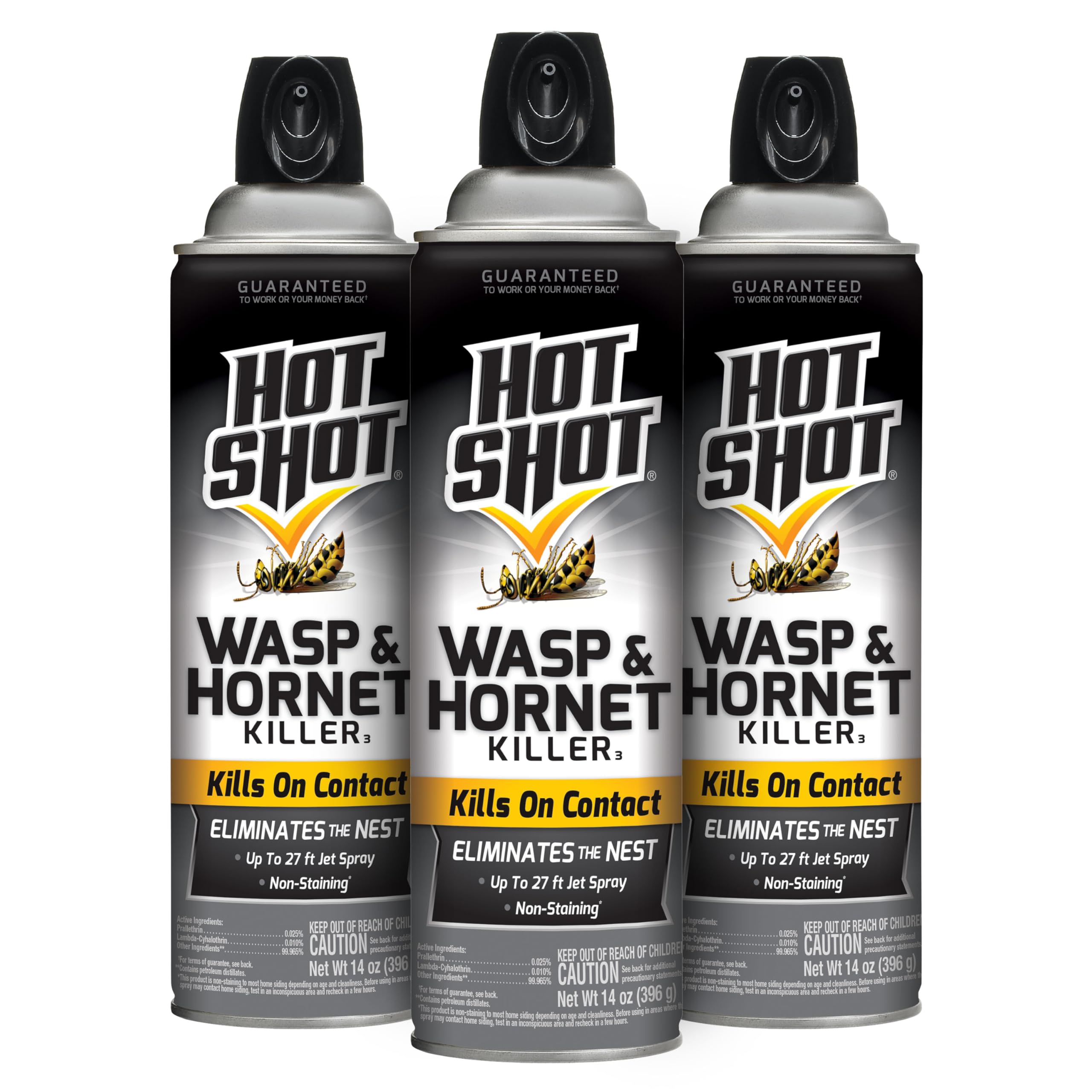
| Hot Shot 3-PackBest Value | Budget Value | 27 ft | 14 fl oz (3 cans) | Foam | Amazon |
| Bengal Foaming | Foam Trapping | 25 ft | 18 fl oz | Foam | Amazon |
| Black Flag 2-Pack | Value 2-Pack | 20 ft | 14 fl oz (2 cans) | Foam | Amazon |
| Bengal Non-Conductive | Electrical Areas | 20 ft | 15 fl oz | Jet | Amazon |
| STEM Plant-Based | Pet-Friendly | — | 10 fl oz | Jet | Amazon |
| BASF Wasp-Freeze 2-Pack | Instant Knockdown | 15 ft | 14 fl oz (2 cans) | Foam | Amazon |
In‑Depth Reviews
1. Spectracide Wasp and Hornet Killer, 20-Ounce, 3-Pack
Our pick — over 4.5★ from 950+ verified ratings; the strongest balance of quality and price.
The three-pack that ends wasp problems before they start, season after season.
The overwhelming reason owners choose this one is simple: it works. The spray reaches up to 27 feet, so you stay well clear of the nest while soaking it in a foam that kills on contact. Buyers report effectiveness is its standout feature, and one described how “instantly it killed them as I stood far away and sprayed.”
This is a three-pack of 20-ounce cans, which means you get 60 ounces total — the largest volume here by a wide margin. For seasonal use around the house, that is enough to treat multiple nests across an entire summer without reordering. Owners say the multipack saves them compared to single cans. The foam action means the spray clings to the nest and keeps killing wasps as they emerge. As with any chemical insecticide, store it away from kids and pets.
Why it wins: The most volume, the longest reach at 27 feet, and foam that sticks to the nest so you get every last wasp. If you only buy one wasp spray this year, this is the one.
Buy this for: Anyone who wants a season’s worth of wasp control in one purchase — the three 20-ounce cans cover eaves, porches, trees, and sheds without buying again.
Think twice if: You need a non-conductive formula for nests near electrical outlets — this is a standard foam spray, not rated for that use.
2. Hot Shot Wasp and Hornet Killer, 14 Ounces, 3 Pack
The affordable three-pack that shoots as far as the top pick for less.
Hot Shot matches the Spectracide’s 27-foot spray distance but comes in 14-ounce cans — smaller, but the three-pack still gives you three full cans for budget-friendly coverage. Owners say it foams up and sticks to everything, with one buyer noting it “shoots a stream very far and it’s foamy and sticks on everything.” Another reported it “completely killed a wasps nest near my shed.” The water-based formula is non-staining to most siding, which matters when spraying near the house.
At 14 fluid ounces per can (compared to 20 ounces on the Spectracide), you get 14 fluid ounces per can compared to 20 ounces, but the per-can cost is lower. The real trade-off is that the smaller cans empty faster on large nests. Owners who treat multiple nests in a single afternoon sometimes run through a can, but most agree it keeps pace with pricier brands for day-to-day wasp control. The jet stream reaches the same 27 feet as the top pick, giving you the same safety distance.
The crowd agrees: “Works on contact with massive shot range” — buyers consistently praise the distance and the value for money, making this the best option for budget-conscious shoppers who still want a 27-foot reach.
Reach for this: If you want three cans for light to moderate wasp duty around the yard and a spray distance that matches sprays costing more.
Look elsewhere if: You regularly face large nests — the 14-ounce cans empty faster than the 20-ounce options for heavy infestations.
3. Bengal Foaming Wasp and Hornet Killer, 18 oz

Thick foam that clings to wood and crevices, trapping wasps long after the spray hits.
Bengal’s foaming action is the standout feature here. The active foam expands after it lands, encapsulating the nest and any wasps that try to escape. One owner with a tough soffit infestation wrote that after four years of failed sprays, this foam “killed hundreds of wasps from large nests in soffits within minutes” and that the foam “clings to wood, no nest activity since.” The spray reaches 25 feet, very close to the 27-foot leaders, and the foam performance gets consistent positive feedback in customer reviews.
The 18-ounce can is larger than the standard 14-ounce size, giving you a bit more coverage per can. The water-based formula is safe around ornamental plants and shrubs and non-staining to most siding. Owners who have used it for consecutive summers say it “kills them in seconds” and repurchase it year after year. The trade-off mentioned most often is spray accuracy — the foam stream can be harder to aim at distance, so you might use more of the can per nest than with a focused jet spray.
What wins people over
- Foam clings to vertical surfaces and soffits, trapping wasps as they emerge
- Kills within a minute — owners confirm it drops wasps fast
- Non-staining and plant-safe formula for use around landscaping
The honest trade-off
- Aiming the foam at distance takes practice; expect to use more product per nest
- Some cans sold may have nozzle issues that affect the spray pattern
This is the foam pick for a reason: the Spectracide foams too, but Bengal’s formula is thicker and stays stuck better on vertical wood. If you have a nest in a soffit or wall gap, you will use less of this per job than the Black Flag foam that tends to drip.
The fit: Ideal for nests tucked into soffits, eaves, wall gaps, or any crevice where a jet spray would drip away. The foam stays put and keeps killing.
4. Black Flag Foaming Wasp and Hornet Killer, 14 Ounces, 2 Pack

The twin-pack that makes short work of nests under eaves with blanket foaming coverage.
Black Flag uses a blanketing foam that expands on contact, and owners single out its ability to cover nests in tight spots. One described it as “the absolute best spray” and noted “the way it foams up, it keeps getting the wasps which coming out.” The 20-foot spray distance is shorter than the 27-foot leaders — 20 feet versus 27 feet — but for most eaves and single-story porches, 20 feet is enough to keep you safe. The two-pack gives you a spare can, which matters more than you expect when a second nest appears mid-treatment.
At 14 fluid ounces per can, the volume matches the Hot Shot but comes in a two-pack instead of three. Owners praise the value for money consistently. The main point of mixed feedback is the foam itself — some find it too foamy and messy, while others say it does not foam enough. The reality is that the foam level works well for nests in crevices and eaves, but it can leave a visible residue on painted surfaces near entryways. Buyers recommend using this on yard structures, sheds, and eaves rather than directly over door frames.
The honest take: A solid mid-range option with good foam coverage and a spare can included. The distance is shorter than the top picks, but for ground-level nests it handles the job without complaint.
Best if: You are treating eaves, fence lines, and sheds where foam residue is not a concern — the two-pack gives you backup.
Skip it for: High rooflines over 20 feet or nests near entrances where visible foam residue is a problem.
5. Bengal Non-Conductive Wasp and Hornet Killer, 15 oz

The only spray on this list safe to use around live electrical equipment.
This is a solvent-based spray rated non-conductive up to 38,800 volts, which means you can spray nests around outdoor outlets, junction boxes (the plastic or metal box where wires connect), light fixtures, and meter boxes without the risk of electrical flashover. It reaches 20 feet with a wide shotgun blast pattern, so you cover more surface area with each pull of the trigger — perfect for hitting a moving target. Owners mention it drops yellow jackets mid-air, with one describing it as “the best wasp spray I ever used” and another confirming it “instantly killed a mass of yellow jackets” with no lingering odor.
The 15-ounce can is a jet spray, not foam, so it does not expand or cling the way foaming sprays do. That makes it better for open, exposed nests where you want a direct hit rather than cavity treatment. Some owners note the wide blast pattern uses product faster than a focused stream. But for anyone with electrical equipment near nests, the non-conductive rating is a non-negotiable safety feature — none of the other sprays here offer it.
Standout features
- Non-conductive up to 38,800V — safe near live electrical equipment
- Instant knockdown on contact — owners say it drops wasps mid-air
- No strong odor compared to solvent-based competitors
Know before you buy
- Wide shotgun spread uses product faster than a focused stream
- Jet spray does not cling to surfaces like a foam does
Who needs this: Anyone with wasp nests near outdoor electrical boxes, light fixtures, or meter panels. Do not risk a standard spray here — this is the safe choice.
6. STEM Kills Wasps, Hornets and Yellow Jackets, 10 fl oz

Plant-based wasp control that works fast without harsh chemical odors around your family.
STEM is the outlier on this list — a botanical insecticide (an insect killer made from plant extracts) that kills wasps, hornets, and yellow jackets using a plant-based active ingredient. It is entomologist-tested (tested by a scientist who studies insects) and safe for use around people and pets when used as directed. That matters a lot if you have toddlers playing in the yard or dogs that sniff everything. Owners say they feel “safe around my toddler” using this spray, and that it takes “only a few secs for it to kill them.” The scent is mild and botanical rather than the sharp chemical smell of most wasp sprays.
The 10-ounce can is the smallest here, and that is the biggest practical trade-off. Owners note it empties quickly — one reported using most of a can on three medium nests. It also leaves an oily residue that can stain surfaces, and the spray range is not specified in feet in the product data, though customers note it shoots far. If you have a serious infestation with multiple large nests, a single can will not go far. But for a single nest near a patio, play area, or pet zone, the plant-based formula makes this the smartest choice for confidence.
The real story: 82 positive mentions of effectiveness, and owners call it fast and easy to use. The catch is the small can — buy it for the safety profile, not the volume.
Reach for this: If you want the safest option around kids, pets, and gardens and have a manageable number of nests to treat.
Look elsewhere if: You need to cover a large infestation — the 10-ounce can runs out fast, and the oily residue can stain surfaces like siding or fencing.
7. BASF PT Wasp-Freeze Insecticide, 14 oz, 2 Pack

The fastest knockdown spray you can buy — wasps freeze mid-flight in seconds.
BASF calls this Wasp-Freeze, and owners say it lives up to the name. One buyer who tried every spray on the market said this is “the fastest wasp killer I’ve tried and I have tried them all.” It kills wasps in 5 to 10 seconds, even while they are flying. The foam formula includes residual activity, meaning it keeps killing returning insects for days after application — preventing re-infestation without reapplying. A critical feature: it prevents the release of stinging pheromones (alarm chemicals that signal danger to other wasps), so dying wasps do not call reinforcements while you are still standing nearby.
The spray reaches up to 15 feet, noticeably shorter than the 27-foot leaders. Owners treating high nests up to 12 feet said it still works well but requires getting closer than with a 27-foot spray. The two-pack of 14-ounce cans is priced higher per ounce than the budget options, and owners are split on value — some call it expensive but worth it given the speed, while others wish it cost less. The foam may stain asphalt shingles, so avoid overspray on roofing. For speed of elimination and residual prevention, this is the most advanced formula here.
What makes it special
- Instant knockdown in 5-10 seconds — the fastest of any spray on this list
- Residual activity prevents returning wasps from rebuilding
- Pheromone-blocking formula stops alarm signals that attract more wasps
The honest limits
- 15-foot range is the shortest here — you need to get closer to reach high nests
- Higher price per can than budget multipacks
- May stain asphalt shingles on contact
The verdict: If speed matters most — you are allergic, you are scared, or you just want the nest gone now — this is the fastest option. Accept the shorter range and higher cost for instant results.
Understanding the Specs
Spray Distance
This is the safety gap between you and the nest. A spray labeled 27 feet lets you stand over 25 feet away while the stream reaches the target. A 15-foot spray means you must get closer. For nests on second-story rooflines, 27 feet is essential. For ground-level eaves and bushes, 20 feet is enough. Always buy the longest distance your budget allows — it is the only spec that directly prevents stings.
Foam vs. Jet Stream
Foam sprays expand on contact and cling to the nest, which makes them ideal for crevices, soffits, wall voids (hollow spaces inside walls), and gaps where liquid would drip away. Jet streams fly farther and are easier to aim at hanging nests but do not stick as well. Some sprays combine both — a jet stream that foams on contact. For most homeowners, a foaming spray is more versatile because it handles both exposed nests and hidden cavities.
Contact Kill vs. Residual Activity
Contact kill means the spray drops wasps the instant it touches them. That stops the immediate threat. Residual activity means the dried spray remains toxic to insects for days or weeks, so any wasp that lands on the treated area later also dies. If you have nests that keep returning to the same spot, residual protection saves you from reapplying. If you just need one nest gone, contact kill alone is sufficient.
Non-Conductive Rating
A non-conductive spray does not conduct electricity, which lets you safely treat nests around outdoor outlets, junction boxes, light fixtures, and meter panels. Standard sprays can cause a flashover or shock if they hit a live wire. The Bengal Non-Conductive spray is rated to withstand up to 38,800 volts. If you have nests near any electrical equipment, this is a safety requirement, not a nice-to-have.
FAQ
Can I use these sprays indoors?
What is the safest time of day to spray a wasp nest?
How long does it take for wasp spray to kill the nest?
Is foam or jet spray better for wasp nests?
Can I use a standard bug spray on wasps?
Will wasp spray stain my house siding?
How close do I need to stand to the nest?
Are plant-based wasp sprays as effective as chemical ones?
Does wasp spray kill on contact or just repel?
Can I spray a wasp nest with water?
Final Thoughts: The Verdict
For most people, the best insect repellent for wasps is the Spectracide Wasp and Hornet Killer 3-Pack — it has the longest 27-foot reach, the most total volume at 60 ounces, and foam action that clings to nests. If you want a budget-friendly alternative with the same 27-foot range, grab the Hot Shot 3-Pack. For nests around electrical equipment, the Bengal Non-Conductive is the only safe choice. For instant knockdown that leaves nothing alive in seconds, the BASF Wasp-Freeze is the fastest tool on the shelf.
How We Picked
We do not accept paid placement. Every pick is matched to a real buyer and a real use-case; we do not hands-on test units.
Sources & Methodology
Specifications: manufacturer listings and product documentation. Review insights: verified customer reviews, as of July 2026. Pricing: not shown on this page (it changes often); check the current price via the retailer link.
As an Amazon Associate, Lawn Gear Lab earns from qualifying purchases. This does not affect which products we feature.