
Specs are compiled from manufacturer listings and verified buyer reviews and can change over time — please confirm the key details on the product page before buying.
You want a mower that pulls itself up your slope without making you pay extra for the privilege. But when you search for a cheap gas self-propelled mower, it is tough to tell which one will actually start and which one will sit in the garage. You need a machine that climbs hills, starts on the first pull, and cuts clean — all without a big price tag.
I’m Rikta — the founder and writer behind Lawn Gear Lab. This guide is built by comparing the manufacturers’ published specifications and the patterns across verified customer reviews, so you get each pick’s real strengths and trade-offs instead of marketing spin.
If your lot is flat or hilly, small or a solid half-acre, here is how to spot a genuine workhorse — the guide to the best inexpensive self-propelled lawn mowers.
Our Picks at a Glance
How To Choose The Best Inexpensive Self-Propelled Lawn Mowers
A cheap self-propelled mower is only a bargain if it actually moves itself when you need it. These three factors separate the daily drivers from the headache.
Engine Power and Displacement
The number that matters most is the cc rating (cubic centimeters of engine displacement). A 170cc 4-stroke OHV engine (an overhead-valve design that burns fuel more efficiently) is the balance for affordable mowers at this tier. It gives you enough torque to push through thick or damp grass without bogging down, while keeping the weight manageable. Engines below 140cc tend to struggle on uneven ground or with tall grass, so watch for that.
Drive System: Front-Wheel vs. Rear-Wheel Drive
This is the feature that makes the “self-propelled” label real or meaningless. Rear-wheel drive (RWD) pushes the mower from behind, giving you traction on slopes and hills. Front-wheel drive (FWD) pulls the mower from the front, which works fine on flat lawns but loses grip on inclines and in wet conditions. If your yard has any grade at all, steer toward a rear-wheel drive model.
Quick Comparison
| Model | Best For | Engine | Drive | Cutting Width | Amazon |
|---|---|---|---|---|---|
| PowerSmart DB8621PRX★ Best Overall | Best Overall Value | 170cc OHV | Rear-Wheel | 21 in. | Amazon |
| SENIX A025054-AWider Cut | Best For Flat Yards | 170cc OHV | Front-Wheel | 21 in. | Amazon |
| Ezasin EAWBLM01 | Budget Entry | 170cc 4-Stroke | Self-Propelled | 21 in. | Amazon |
| PowerSmart DB8622S | 22-inch Premium | 170cc OHV | Rear-Wheel | 22 in. | Amazon |
| YARDMAX YG2860 | CVT Speed Control | 201cc OHV | Front-Wheel | 22 in. | Amazon |
In‑Depth Reviews
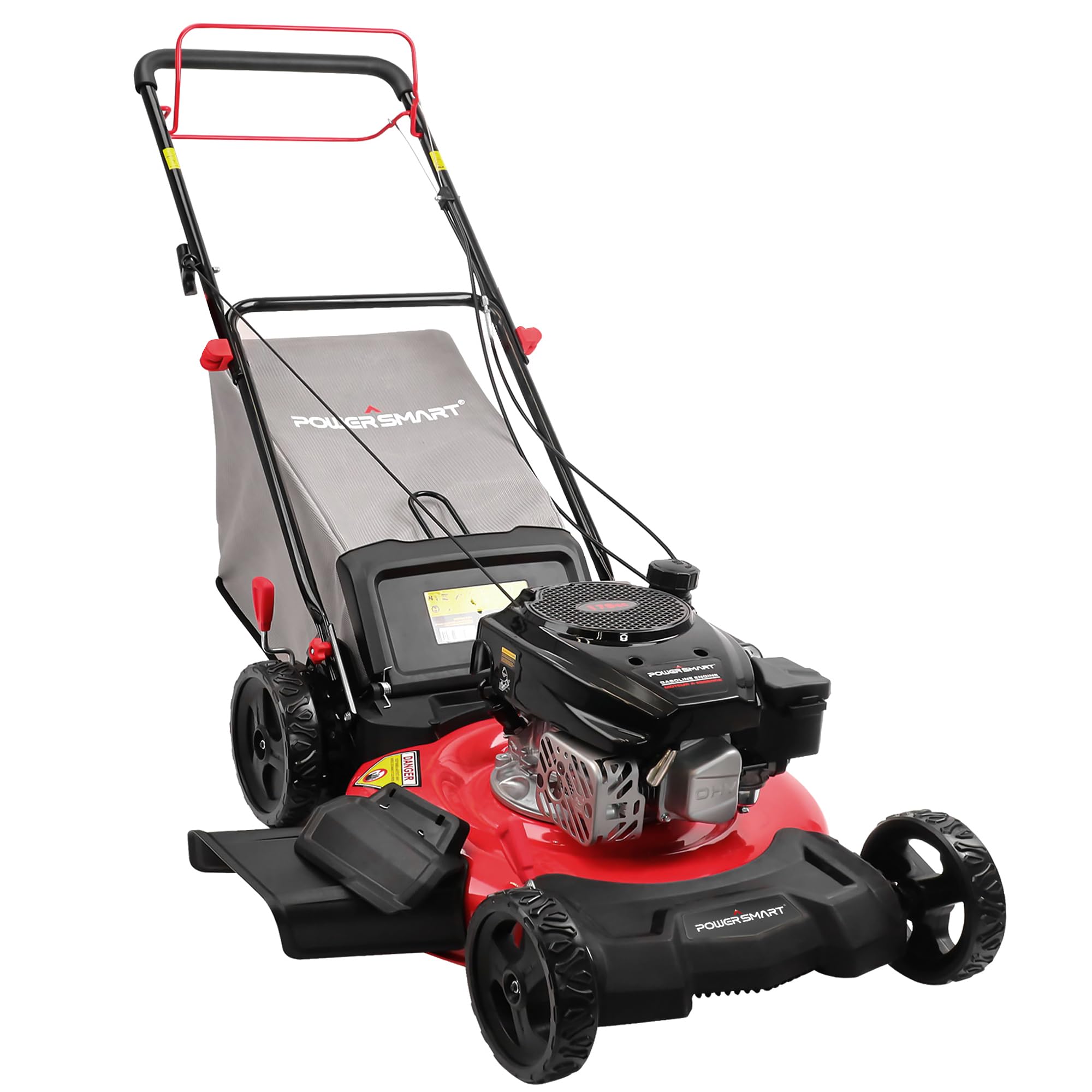
1. PowerSmart 21-Inch Self Propelled Gas Lawn Mower, 170cc OHV Engine
The rear-drive bargain that pushes back against slopes without pushing back on you.
The headline here is the drive system. Rear-wheel drive (the mower’s back wheels power the motion) is what you want on any lawn with a hill, and this PowerSmart delivers it at a price where most brands offer only front-wheel drive. The 170cc OHV engine (an overhead-valve design for cleaner, more efficient combustion) gives you the grunt to chomp through thick or even damp grass without the blade bogging down. And the steel deck — not plastic — means this thing is built to survive a few seasons of knocks against rocks and roots.
The cutting-height range is generous: you can drop it as low as 1.5 inches for a close buzz-cut or raise it to 3.9 inches for the taller summer grass that helps your lawn stay healthy. The 3-in-1 system (mulch, side discharge, or rear bag) lets you adapt to whatever the weather throws at your grass. Owners consistently highlight the strong power output and the easy one-pull start as the two things that make this mower feel more expensive than it is. At 59 pounds versus the 75-pound 22-inch PowerSmart sibling, it is noticeably lighter — a real advantage when you need to lift it over a garden edge or into a shed.
The honest trade-off? This is the crowd favorite — nearly 400 owners agree — but a small number of units arrived with starter-cord issues. The consensus is that when this mower works (and most do right from the start), it outperforms the price tag. Buyers sum it up: “Lightweight and MIGHTY!”
What Wins People Over
- Rear-wheel drive provides actual traction on slopes — it powers the mower up without you pushing.
- 6-position height adjustment ranges from 1.5″ to 3.9″ so you can dial in the exact cut for the season.
- Lightest in its class at 59 lbs — easy to maneuver and store.
The Honest Caveat
- Front wheels are not independently height-adjustable — the dual-lever system controls only the rear.
- A small batch of units has reported starter-cord issues; buy from a seller with a good return policy.
First Pick For: Anyone with a sloped or uneven yard who wants rear-wheel-drive traction without spending over.
Think Twice If: You need a truly durable, long-term investment — a few reviews mention durability concerns after heavy use.
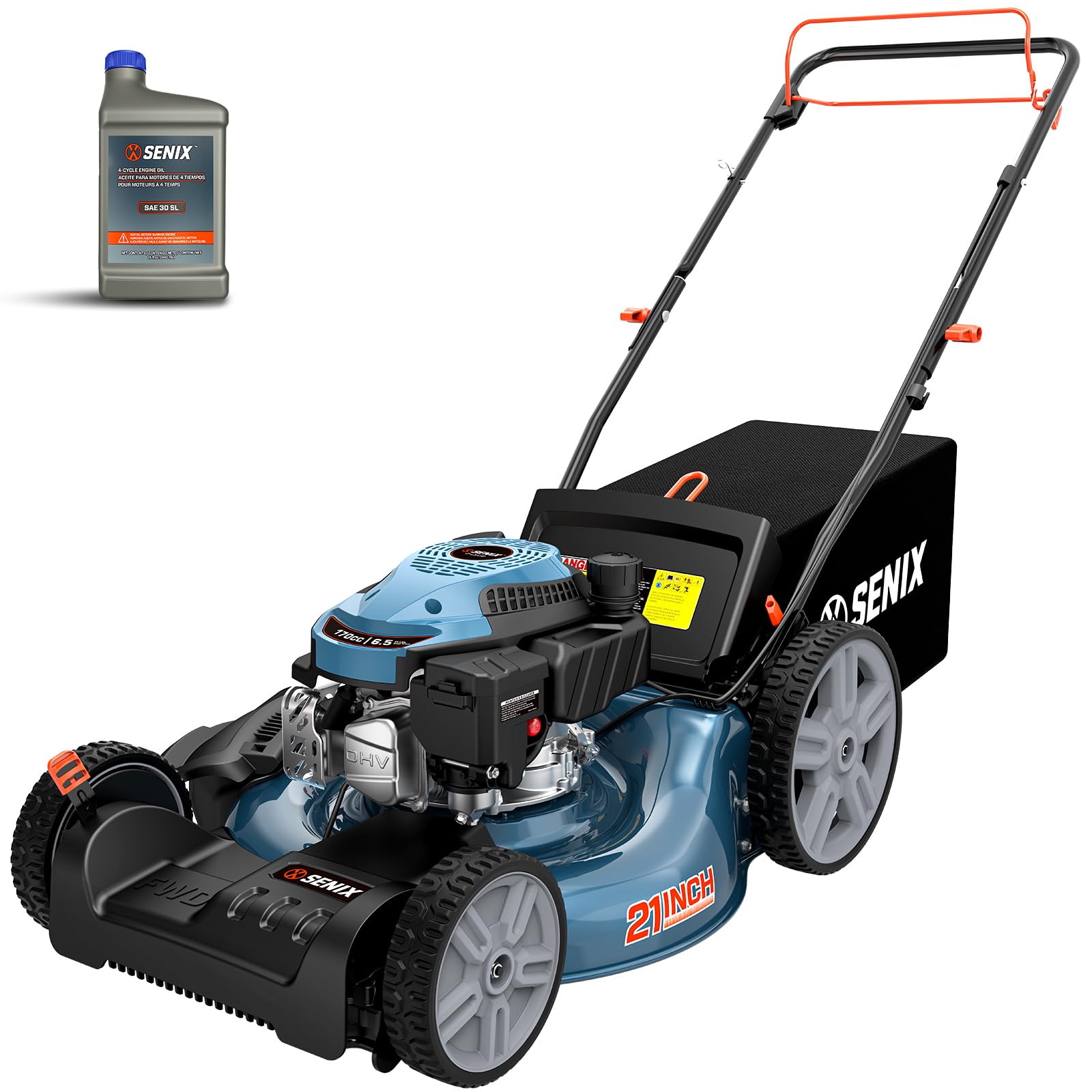
2. SENIX 21-Inch Self Propelled Gas Lawn Mower
The front-driver that zips around flower beds but wants a flat stage to perform.
This SENIX is tuned for the flat-yard owner who prizes maneuverability over hill-climbing. The front-wheel-drive system (the front wheels pull the mower) makes it easy to lift and pivot around trees and garden beds — ideal for a yard with obstacles. The 170cc OHV engine delivers 3.8 HP and 6.5 ft-lb of torque, which is solid for the price tier, and the 3.8 horsepower rating gives it enough pull to handle thick grass without the blade shuddering.
The 6-position cutting-height adjustment ranges from 1.25 to 3.75 inches, and the unique vortex tunnel design (a shaped channel under the deck) reduces grass buildup so you do not have to scrape the underside mid-mow. The 10-inch rear wheels and 8-inch front wheels roll over uneven patches better than most at this price. Over 400 owners rate it, and the repeat praise is about starting performance: the engine fires on the first pull after priming, which is the single biggest relief in this category. Customers note it handles “overgrown grass easily without bogging down.”
The honest catch is durability. Some reviewers point out bolts loosening and needing replacement within a few weeks of use. This is a seasonal mower, not a multi-year heirloom. The belt-driven front-wheel drive also loses traction on wet grass or any incline. Who it is for: a flat suburban lot under a third of an acre where you need to weave between planters and want a reliable first pull.
Maneuver Champion: The front-wheel-drive system and 61.7-lb weight make this the easiest to steer around landscaping obstacles in its price tier.
Flat-Only Rule: The same front-wheel drive that makes it nimble on pavement will slip on a damp slope — stick to level ground.
Reach For: Flat, obstacle-heavy yards where tight turns matter more than raw slope traction.
Look Elsewhere: If your lawn has a grade or you want a deck taller than 3.75 inches for deep summer grass.
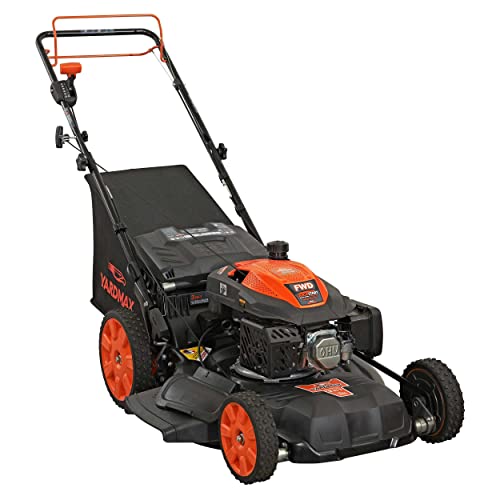
3. YARDMAX 22 in. 201cc Select PACE 6 Speed CVT High Wheel FWD Mower
The only mower in this price bracket that lets you dial your walking pace into transmission gears.
The YARDMAX stands out for one spec: a CVT (continuously variable transmission) with a 6-speed shift lever. That means you can actually match the mower’s forward speed to your stride — slow down around obstacles, speed up on straight stretches — without jamming a lever or fighting the drive. The 201cc engine is the biggest displacement here, giving you a torque advantage when the grass is tall and thick.
Other thoughtful touches include a single-lever deck adjustment that sets all four wheels at once (no crouching to each corner), and a deck cleanout port so you can spray the underside clean without tilting the mower onto its side. The automatic choke system (no priming or choking) means it starts on the second pull for most owners. Buyers with a 3/4-acre lot report it handles the whole yard on a tank, and the spiked-tread tires provide extra traction on soft ground.
The limitation is the drive layout. Front-wheel drive on a machine that weighs 84.9 pounds means the front wheels can struggle for grip on wet grass or any incline, leaving you pushing a heavy mower. The speed lever also has a reputation for not staying in place during use. This mower is best if you have a large flat lot and you value the ability to fine-tune your walking speed.
Transmission Advantage: The 6-speed CVT gearbox is a genuine innovation at this price — no other mower here lets you shift speeds so precisely.
Heavy and FWD: At 84.9 pounds, this is the heaviest mower on this list, and the front-wheel drive can spin out on damp inclines, defeating the self-propelled purpose.
Best For: Large, flat lawns where a fast walking pace and a big engine matter more than slope performance.
Not Ideal: Hilly lots or wet grass — the FWD system and the weight combine poorly on grade.
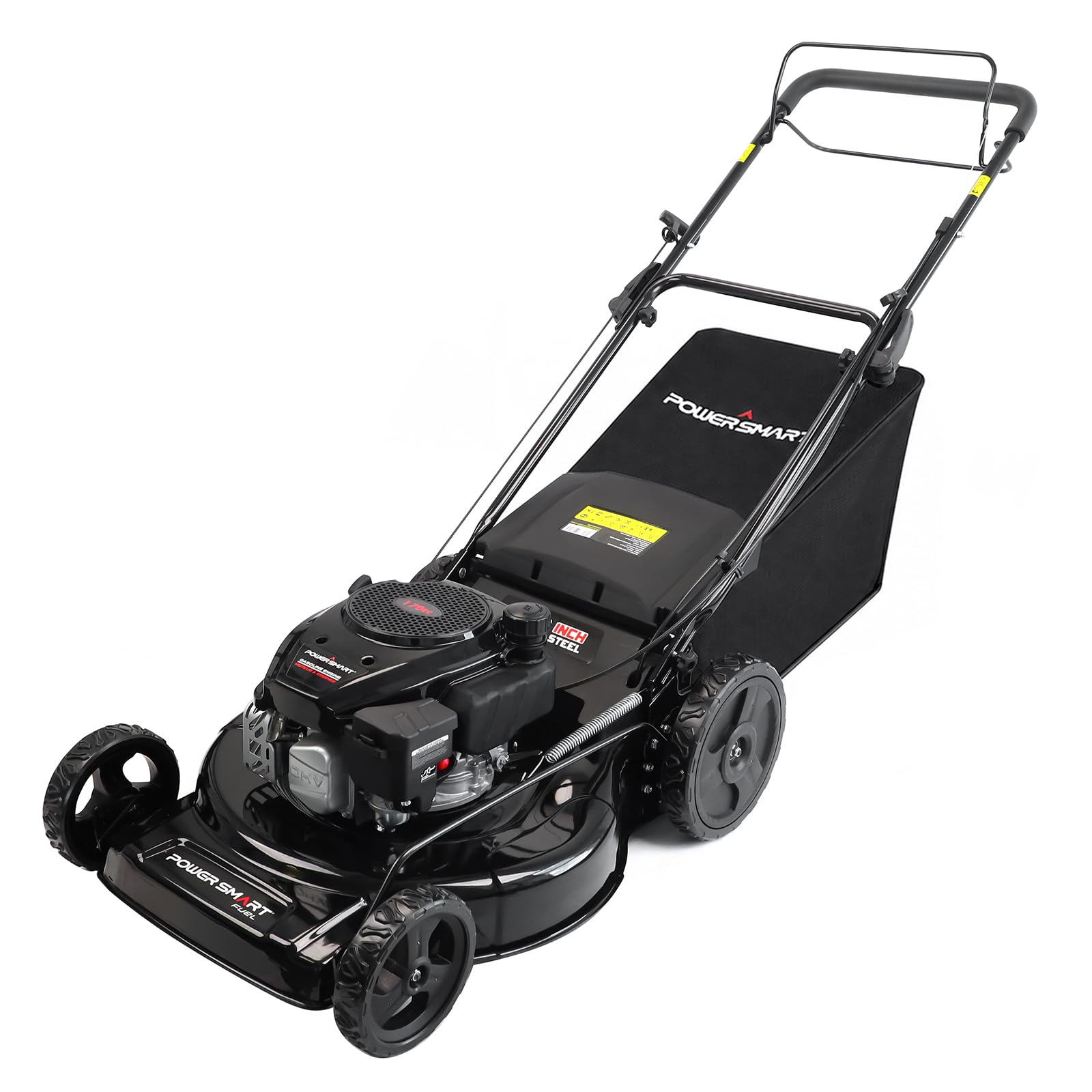
4. PowerSmart 22-Inch Self Propelled Gas Lawn Mower, 170cc 4-Cycle OHV Engine
A rear-drive 22-inch deck that skips the weight penalty of the sibling model.
At 68 pounds, this 22-inch PowerSmart splits the difference between the lighter 21-inch model (59 pounds) and the heavier gray 22-inch version (75 pounds). The 6-position height adjustment covers the same 1.5-to-3.9-inch range, and the 3-in-1 system (mulch, rear bag, rear discharge) gives you flexible options.
The assembly is tool-free: unfold the handle, add oil and gas, and it starts. More than 250 owners rate it, and the feedback skews positive for value — one buyer traded down from a Troy-Bilt and called this mower “good quality” at the lower price. The rear-discharge option is a nice touch for blowing clippings onto garden beds without stopping to empty a bag.
The risk is that a small number of units have reported the motor seizing during the first or second use, especially when mulching thick grass. The consensus advice: check the oil level before the first start (some units ship dry) and avoid bogging the engine in deep grass. If you get a good unit — and most do — this is a solid mid-range 22-inch mower.
Mid-Weight balance: At 68 pounds, this is 7 lbs lighter than the other 22-inch PowerSmart — you keep the wider cut without the back strain.
Quality-Control Lottery: A small portion of units arrive with locked engines; check oil immediately and return at the first sign of trouble.
Reach For: A 22-inch cut with rear-wheel drive if you want the wider deck but need to keep the weight below 70 pounds for lifting.
Skip If: You cannot afford the risk of a defective unit — buy from a retailer with a generous return window.
5. 21″ Self-Propelled Gas Lawn Mower – 170CC 4-Stroke Engine, 7 Cutting Heights (Ezasin)
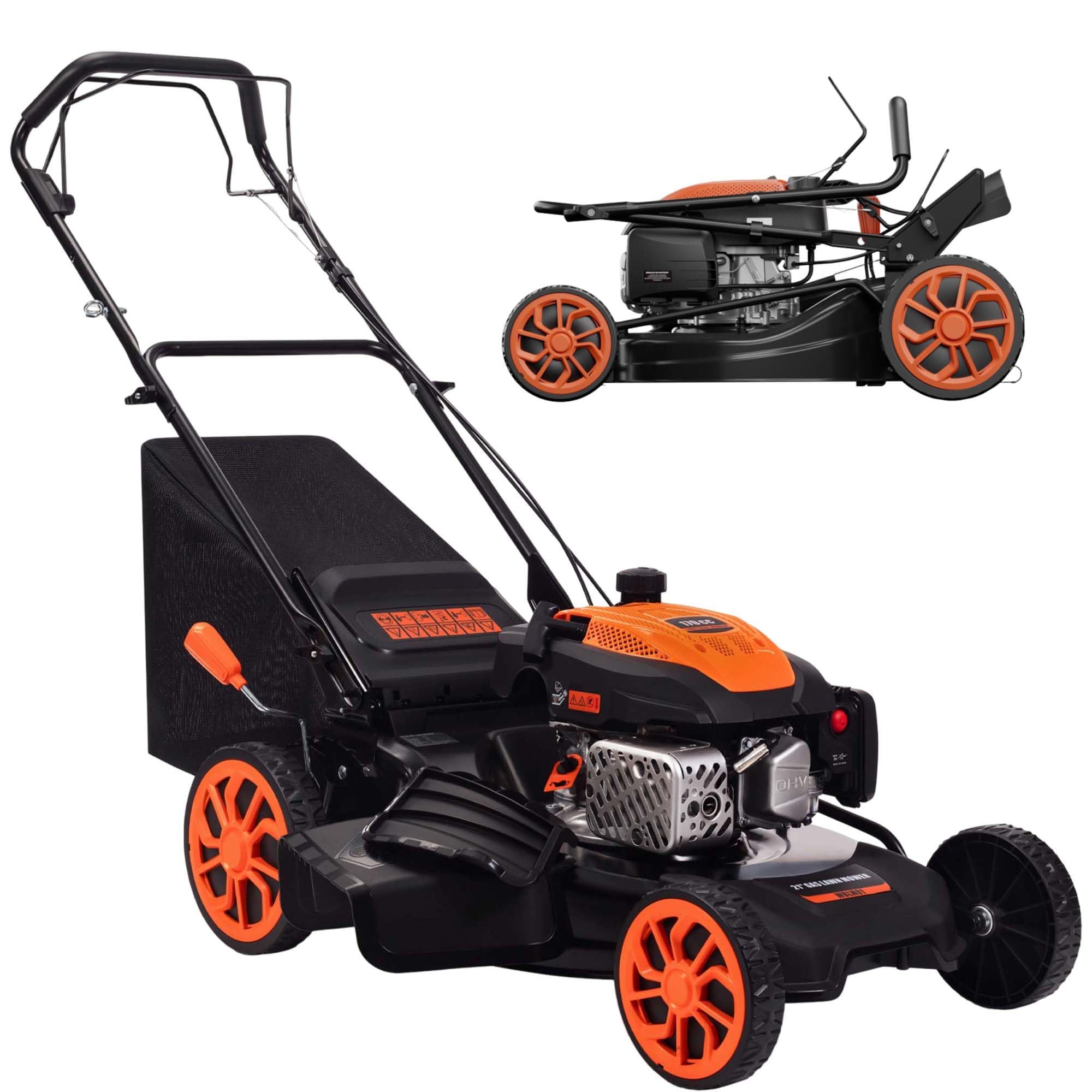
The cheapest self-propelled 170cc mower that cuts 7 ways — if you are handy enough to tune it.
This Ezasin mower enters the conversation purely on price and features-per-dollar. The 170cc 4-stroke OHV engine (a similar basic block to the PowerSmart) spins the 21-inch steel deck at 2900 RPM for a clean cut. The 7-position single-lever height adjustment is the widest range in this price tier — from 1 inch to 3 inches — giving you more fine-tuning than the usual 6 positions. The 1.9-bushel grass collector is also the largest capacity bag here.
The value proposition is clear on paper, but the owner experience is less consistent. Shoppers say it “starts on the first pull” and that the self-propel is a “workhorse” on flat ground. Assembly is straightforward for most. The engine comes with an automatic choke, which removes the guesswork for cold starts.
The flip side is that some units arrive with the self-propelled cable detached, the engine smoking, or both. The review count is only around 36, which is low enough that one bad batch can skew the average. The honest reading: this mower is a gamble that can pay off if you get a good unit, but you may be troubleshooting a cable or a carburetor within the first few weeks. Who it fits: a DIY owner on a strict budget who is comfortable with basic small-engine work.
7-Position Precision: The single-lever height system gives you the most cutting-height options here — 1 to 3 inches — which helps you find the exact grass length your lawn prefers.
Quality Rollercoaster: The self-propelled cable and engine assembly have a higher-than-average defect rate; factor in the cost of your time for fixes.
Best For: Strict budget buyers who have small-engine knowledge and want the cheapest 170cc self-propelled entry point.
Not For: Anyone who wants a guaranteed trouble-free season — the defect rate is significant at this price floor.
Understanding the Specs
Engine Displacement (cc)
This is the most important number on an inexpensive gas mower. The cc rating (cubic centimeters) measures the engine’s internal volume. More cc means more torque — the twisting force that pushes the blade through thick grass without stalling. Most budget self-propelled mowers use a 170cc engine, which is the balance: cheap enough to keep the price down, powerful enough to handle a typical suburban lawn. A 140cc engine like the Briggs & Stratton in Pick 7 will work fine for thin, dry grass but struggles when the growth is dense or damp.
Drive System: Rear-Wheel vs. Front-Wheel
This decides whether the mower actually helps you on a hill. Rear-wheel drive (RWD) pushes the mower from the back, so the weight of the engine sits over the driving wheels — this gives you traction on slopes. Front-wheel drive (FWD) pulls from the front, which makes the mower easy to pivot around trees but causes the front wheels to spin on wet grass or an incline. For any yard with a grade, RWD is the right choice. For a pancake-flat lot with lots of landscaping obstacles, FWD can work fine. The YARDMAX CVT system is a different animal — it gives you variable speed control, but the FWD layout still limits its hill performance.
FAQ
Will a 170cc mower handle a half-acre lawn?
What is the difference between a 4-stroke and a 2-stroke engine in a mower?
How often should I change the oil in a budget self-propelled mower?
Can I use a self-propelled mower on steep hills?
Is a steel deck better than a plastic deck on an inexpensive mower?
Do these mowers come with oil and gas included?
What is the ideal cutting height for a lawn in summer?
How do I store a gas mower for the winter?
Final Thoughts: The Verdict
For most buyers, the best inexpensive self-propelled lawn mowers winner is the PowerSmart 21-inch 170cc because it balances rear-wheel drive, a light 59-lb frame, a generous 1.5-to-3.9-inch cutting range, and the strongest owner-consensus at this price point — it genuinely mows better than its price tag suggests. If you want a wider 22-inch path to finish faster, grab the 22-inch PowerSmart. And for a flat yard where you need to weave around landscaping, the SENIX front-drive mower is the one to reach for.
How We Picked
We do not accept paid placement. Every pick is matched to a real buyer and a real use-case; we do not hands-on test units.
Sources & Methodology
Specifications: manufacturer listings and product documentation. Review insights: verified customer reviews, as of July 2026. Pricing: not shown on this page (it changes often); check the current price via the retailer link.
As an Amazon Associate, Lawn Gear Lab earns from qualifying purchases. This does not affect which products we feature.