
Specs are compiled from manufacturer listings and verified buyer reviews and can change over time — please confirm the key details on the product page before buying.
When a few weeds turn into a field-wide takeover, a standard garden sprayer and a bottle from the hardware store won’t cut it. You need a concentrate that hits hard, covers acres, and doesn’t quit after the first rain. The problem is that “industrial” labels get slapped on everything from mild mixes to genuine heavy artillery, making it nearly impossible to know which jug actually delivers the scorched-earth result you’re paying for.
I’m Rikta — the founder and writer behind Lawn Gear Lab. This guide is built by comparing the manufacturers’ published specifications and the patterns across verified customer reviews, so you get each pick’s real strengths and trade-offs instead of marketing spin.
We dug through the active-ingredient percentages, coverage claims, and hundreds of real user experiences to find the handful of concentrates that can handle an acre or more without needing a re-spray the next week, which is the true test of a great industrial weed killer.
Quick Picks
- Albaugh Gly Star Plus Herbicide — Best Value
- Roundup Pro Concentrate Herbicide — Top Performer
- Roundup Pro Herbicide Industrial Weed Control — Most Potent
- Control Solutions Eraser A/P Weed & Grass — Budget Champion
- Target 6 Plus (MSMA 48.2%) Turf Herbicide — Best Overall
- Dow AgroSciences Grazon Next HL 2 Gallon — Premium Pick
- Ranger Pro — Double the Load
How To Choose The Best Industrial Weed Killer
Picking the right concentrate starts with knowing what you are fighting and where. A pasture with horses needs a different chemistry than a gravel driveway or a fenceline choked with poison ivy. Here is what matters most.
Active Ingredient and Concentration
The active ingredient is the chemical that does the killing. Glyphosate (usually at 41% or 50.2%) is the most common non-selective option — it kills almost every plant it touches by blocking a key enzyme. MSMA (48.2%) is a selective killer used mainly on turf and sod farms for specific grassy weeds like dallisgrass and nutsedge. Higher percentage means you use less product per gallon of water, which stretches your jug further.
Selective vs Non-Selective
A non-selective weed killer (most glyphosate concentrates) will kill any green plant it lands on, including your lawn or pasture grass. A selective one, like the MSMA-based products, targets specific weeds while leaving grass like zoysia or bermudagrass unharmed. If you are spraying a whole field of hay or grass you want to keep, selective is the safer bet.
Surfactant — Built-in or Separate
A surfactant is a wetting agent that helps the spray droplet spread out and stick to the leaf surface instead of beading up and rolling off. Some concentrates come with a surfactant already mixed in (look for “with surfactant” on the label), which saves you from buying and measuring an extra additive. Without it, you may need to add one yourself, especially on waxy or hairy-leaf weeds.
Coverage and Jug Size
Industrial jugs typically come in 2 or 2.5 gallons. The coverage varies wildly by mix rate — a single gallon of concentrate might make anywhere from 30 to 150 gallons of spray solution depending on the weed and the label instructions. Look for the “square feet” or “acres” coverage number on the product specs to match the jug to your total area.
Quick Comparison
| Model | Best For | Active Ingredient | Liquid Volume | Coverage | Amazon |
|---|---|---|---|---|---|
| Target 6 Plus (MSMA 48.2%) | Selective turf and sod farm weed control | MSMA 48.2% | 2.5 Gallons | Selective (Crabgrass, Dallisgrass) | Amazon |
| Dow AgroSciences Grazon Next HL | Pasture and rangeland (horse-safe) | Herbicide (proprietary blend) | 2 Gallons | Annual | Amazon |
| Roundup Pro Concentrate | Large-area non-selective control | Herbicide (glyphosate) | 2.5 Gallons | Up to 435,600 sq. ft | Amazon |
| Roundup Pro Super Concentrate | Industrial, roadside, and right-of-way | 50.2% Glyphosate | 2.5 Gallons | 435,600 square feet | Amazon |
| Control Solutions Eraser A/P | General residential/commercial & farmstead | 41% Glyphosate | 2.5 Gallons | Up to 5040 sq. ft (gallon) | Amazon |
| Albaugh Gly Star Plus | Non-selective with built-in surfactant | 41% Glyphosate with Surfactant | 2.5 Gallons | Refer to label | Amazon |
| Ranger Pro Glyphosate | Value pack for large acreage | 41% Glyphosate | 2.5 Gallons (Pack of 2) | 2-10 quarts per acre | Amazon |
In‑Depth Reviews
1. Albaugh Gly Star Plus Herbicide (2.5 Gallons) Glyphosate Concentrate (41%) with Surfactant

A no-frills glyphosate concentrate that brings the same active ingredient as the big brand for a lower cost.
This 2.5-gallon jug holds 41% glyphosate with a surfactant already mixed in, so you save both the upfront cost and the hassle of buying a separate wetting agent. That built-in surfactant is a real convenience — it helps the spray stick to leaves instead of running off, which matters on waxy weeds like poison ivy or mature brush.
Buyers report it takes about 10 days to two weeks to see everything dead, but for the price it’s worth it. One reviewer who has used it for years notes the instruction booklet covers specific mix rates for many different plants, making it easy to dial in the right dose. Unlike the Roundup Pro Concentrate, this one comes with the surfactant included at no extra cost, and at 320 fluid ounces it holds 7% more per jug than the Roundup Pro’s 300 fluid ounces.
Note that this product is not labeled for residential use and cannot be shipped to several western states including California and Oregon, so check your location before buying.
Built-In Advantage
- Surfactant is already mixed in the jug, saving a step and improving stickiness on leaves.
- One of the largest liquid volumes available at 320 fluid ounces in a single jug.
- Reviewers consistently say it works as well as name brands at a lower price point.
Regional & Use Limits
- Not for sale to CA, MT, NV, OR, WA, and WY — a significant restriction for buyers in those states.
- This product is not labeled for residential use, only commercial agricultural applications.
- Visible results are slower than higher-concentration options, taking up to two weeks.
Smart starting point: If you need a glyphosate concentrate with surfactant that works reliably and the long wait doesn’t bother you, this is the most efficient value in the lineup.
Check your address: The sale restriction covers seven western states, so verify your location before ordering if you live out west.
2. Roundup Pro Concentrate Herbicide – 1 jug (2.5 gal.)
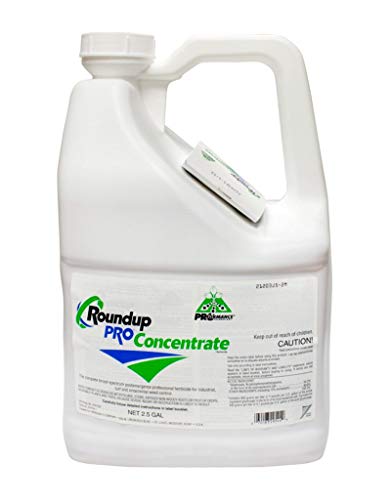
The name-brand super concentrate that delivers the highest coverage of any single jug on this list.
At 300 fluid ounces per 2.5-gallon jug, this Roundup Pro Concentrate covers up to 435,600 square feet — roughly ten full acres — making it the champion for sheer acreage per jug. Buyers confirm it kills tough weeds in 3-4 days when mixed at 2.5 to 3 ounces per gallon of water, which is noticeably faster than the 41% concentrates that take a week or more. One reviewer who manages several miles of fencelines says it acts quickly and uses it exclusively.
The trade-off is that it lacks a built-in surfactant — you will need to add a separate wetting agent if you are spraying waxy weeds or want maximum rainfastness. Also, this jug uses a 63mm threaded opening that needs a specific pump (several buyers recommend the Flying Skull Plant Products mi254 hand pump), so do not assume your standard sprayer cap fits. It is not sold to Wisconsin or New Jersey.
Coverage Champ
- Class-leading coverage of 435,600 square feet per jug, enough for ten acres of clean-up.
- Fast action — weeds are typically dead within 3 to 4 days per buyer reports.
- Makes about 150 gallons of regular-strength mix or 30 gallons of super-strength, giving you flexible application options.
Bits to Budget For
- No built-in surfactant, so effective spraying on waxy weeds requires a separate additive purchase.
- Heavy jug with a 63mm threaded cap that needs a specific hand pump, not a standard sprayer adapter.
- Only available in 300 fluid ounces, so you get 7% less liquid per jug compared to the 320-ounce competitors.
For the acreage crowd: If you have miles of fence lines or several acres of open land and want the fastest knock-down from a single jug, this is the most efficient coverage you can buy.
Plan the extras: You will need to buy a surfactant and a 63mm pump separately before the first spray session.
3. Roundup Pro Herbicide Industrial Weed Control, 2.5 Gal.

The highest-concentration glyphosate in the lineup, built for woody brush and deep-rooted perennials.
At 50.2% glyphosate, this is the most potent active-ingredient percentage of any product here, and it shows in the results. One reviewer noted that it effectively killed persistent Cottonwood root shoots growing under asphalt — the kind of deep, woody growth that weaker concentrates only nip the leaves on. The same reviewer noted that leaves browned in just one day and no re-treatment was needed, which is a huge time saver on a large property. The formula is water-soluble and designed for industrial applications like roadside management, utility rights-of-way, and forestry.
Unlike the 41% options, this one works on a percentage-of-volume basis rather than a simple ounces-per-gallon rule, so you need to read the label carefully. A buyer also warned to check the expiration date on the bottle, as one arrived with only 60 days of shelf life left. It covers the same 435,600 square feet as the Roundup Pro Concentrate above, but does so at a much higher concentration, meaning you use less product per tankful for the same kill power.
Deep Root Authority
- Highest glyphosate concentration at 50.2%, providing superior control on woody brush, trees, and vines.
- Browns most annual weeds within 2-4 days and perennials in 7 days or more, with buyers seeing leaf damage as soon as one day.
- Approved for industrial, turf, ornamental, roadside, utility rights-of-way, and railroad uses.
Mixing Shelf Life
- Dilution instructions are based on percentage-of-volume rather than a simple recipe, requiring more careful measurement.
- No built-in surfactant — you need to add a wetting agent for maximum effectiveness on waxy leaves.
- Buyers have received bottles with short shelf life remaining, so always check the expiration date upon arrival.
Heaviest hitter for tough jobs: If you are battling tree stumps, asphalt-cracking roots, or deep-rooted perennials, this is the concentrate that gets to the root system fast and stays active.
Read before you pour: The percentage-based mixing system and the potential for an old bottle mean you need to be more meticulous than with simpler concentrates.
4. Control Solutions Eraser A/P Weed & Grass Killer 41% Concentrate 2.5gal

A veteran formulation that a dedicated set of buyers has trusted for a quarter-century of fence-line work.
This is a 41% glyphosate concentrate with a loyal following — one reviewer notes they have been using Eraser for the last 25 yrs as it works well. The main use case for these long-time buyers is killing vegetation under fence lines, where it performs effectively, especially when applied in warm weather and sunshine during late spring and summer. It is labeled for residential and commercial areas including parks and recreational spaces, making it one of the more versatile options here.
The coverage numbers are a bit unusual: the label says up to 630 square feet per pint, up to 1260 per quart, and up to 5040 per gallon, which seems very low compared to the 435,600 square foot ratings of the Roundup products. This may reflect a different measurement standard or a very heavy mix rate. At 320 fluid ounces per 2.5-gallon jug, it matches the volume of the Albaugh Gly Star Plus and the Roundup Industrial above, but the price point is closer to the budget end of the range, making it an entry-level pick for buyers who do not need massive acreage coverage.
Decades of Trust
- Proven long-term reliability — owners mention using it for 25 years with consistent results.
- Works fast in warm, sunny weather, especially during late spring and summer applications.
- Approved for both residential and commercial use, covering parks, farmsteads, and turf areas.
Coverage Confusion
- The listed coverage of 5040 square feet per gallon is dramatically lower than competing 41% concentrates.
- No surfactant is included, requiring a separate additive for best performance on tougher weeds.
- Shelf life is not listed on the product data, so long-term storage expectations are unclear.
For the fence-line battler: If you have a known set of fence lines or pathways you spray every season and want a product with a proven 25-year track record, this is the safe bet.
Check the mix math: The coverage numbers suggest you may need more product per area than the Roundup concentrates, so calculate your total area carefully before buying.
5. Target 6 Plus (MSMA 48.2%) Turf Herbicide – (2.5 Gallon jugs)

The selective specialist that wipes out dallisgrass without touching your zoysia or bermuda lawn.
This is the only selective killer in the lineup, using MSMA at 48.2% active ingredient to target specific grassy weeds like crabgrass, dallisgrass, johnsongrass, nutsedge, pigweed, and chickweed while leaving desirable turf grasses unharmed. One buyer who was very infected with dallisgrass on their Japanese zoysia lawn reports it knocked it out quite impressively — something a glyphosate product would never do without killing the lawn too. It mixes at a rate of 2 ounces per gallon of water for general applications, and customers note it works really well on sand burs too.
The catch is that MSMA is a selective herbicide for turf and sod farms, not a total-vegetation killer. If you spray it on a pasture mixed with broadleaf plants, it will only hit the grassy weeds. One buyer warns that it will brown your grass really bad if it is not mixed correctly, so measuring accurately is critical. Made in Israel, the product is noticeably thick and high quality upon opening per one long-time buyer who purchased it five years ago and is still using it — proof of its potency and value.
Selective Advantage
- 48.2% MSMA targets grassy weeds without harming desirable turf grasses like zoysia and bermuda.
- One jug lasts years — a buyer who bought it five years ago is still using the same bottle.
- Highly effective on tough weeds like dallisgrass, nutsedge, and sand burs that glyphosate would not selectively treat.
Not a Blanket Killer
- Selective action only — it will not kill broadleaf weeds or woody brush the way glyphosate does.
- Requires precise mixing; too strong will brown your grass badly per buyer warnings.
- At 2.5 gallons, it holds the same volume as the Gly Star Plus (320 fluid ounces) but costs more, with the 25% volume gap vs the Dow AgroSciences Grazon Next HL (2 gallons vs 2.5 gallons) making it a premium option.
Lawn-saver for turf lovers: If you have a prized zoysia or bermuda lawn overrun with dallisgrass or nutsedge, this is the only product here that can fix it without torching your grass.
Measure twice: The margin for error on mixing is smaller than with glyphosate, and getting it wrong means a brown lawn rather than just slow results.
6. Dow AgroSciences Grazon Next HL 2 Gallon

A pasture-safe herbicide that targets broadleaf weeds without harming horses or hay fields.
Grazon Next HL is the go-to choice for anyone managing pasture or rangeland where livestock grazes. One buyer confirmed it is not harmful to pasture or horses and reports it killed stink net effectively — a key concern for horse owners who cannot use standard glyphosate near sensitive animals. It holds 2 gallons (256 fluid ounces) per jug, which is a full 25% less volume than the 2.5-gallon jugs like the Target 6 Plus, but its proprietary blend is designed specifically for broadleaf control in grass pastures, not total vegetation kill.
The practical reality, however, is that the results are not as dramatic as the glyphosate concentrates. One buyer treating 4 acres with 40 gallons of water and two mason jars of the product reported it was only working on about 85 to 90 percent of the weeds, calling it “weed fatigue” and giving it a 4-star review. For a premium-priced product, that partial kill rate is worth noting. Also, several buyers have warned that if you order from a specific seller (ePest), you risk non-delivery and a frustrating refund process through Amazon.
Pasture’s Best Friend
- Safe for use around horses and livestock, a critical feature for pasture managers.
- Targets broadleaf weeds without killing the grass, preserving hay fields and grazing land.
- Effective on tough pasture weeds like stink net and other broadleaf invaders.
Incomplete Coverage
- At 2 gallons (256 fluid ounces), it holds 25% less volume than the 2.5-gallon competitors.
- One buyer mentioned only 85-90% effectiveness on a 4-acre treatment, leaving some weeds alive.
- Known seller issues with ePest — several reviewers point out non-delivery and slow Amazon refunds.
For the horse-friendly farm: If livestock safety is your number one concern and you need a broadleaf-specific solution for your pasture, this is the only option here that fits that bill.
Expect gaps: The data suggests you may need to spot-treat survivors after the initial application, which adds time and product cost.
7. Ranger Pro Ranger++Ranger+Pro+Glyphosate++Herbicide++Concentrate++2.5+gal. (Pack of 2)

Two 2.5-gallon jugs of 41% glyphosate in one box, giving you the most total concentrate in a single purchase.
At 640 total fluid ounces (2 jugs x 320 ounces each), this pack of two delivers the highest volume of any product here, beating the single-jug options by a wide margin. It uses 41% glyphosate, the same active ingredient as Roundup, and is approved for use in residential areas, parks, and recreational areas. The mix rate is simple: 2-3 ounces per gallon of water. One buyer who used 1.5 quarts mixed with 15 gallons of water to spray several acres reports the weeds dried up in just two weeks, though another cautions it is not fast acting and requires patience.
The obvious advantage is that buying the two-pack saves you from having to re-order mid-season, especially if you are managing several acres. A reviewer also noted that the product retains its potency after years of storage, which is useful if you want to stock up for multiple seasons. The trade-off is that at 41% glyphosate with no surfactant and no higher-concentration option, it is a volume play rather than a performance upgrade — you get more liquid, not a stronger mix, compared to the 50.2% Roundup Industrial above.
Bulk Advantage
- Highest total concentrate volume at 640 fluid ounces, enough for multiple seasons on a large property.
- Stores well — shoppers say it retains potency after years of storage in the original jugs.
- Simple, standard mix rate of 2-3 ounces per gallon of water with no complicated percentage calculations.
Performance Reality
- At 41% glyphosate, it lacks the potency of the 50.2% concentrates, so woody brush takes more product and time.
- No built-in surfactant, so separate additive is recommended for waxy-leaf weeds.
- It is not fast acting — one buyer warns you need to be patient, as visible results take two weeks or more.
Stock-up specialists: If you know you will be spraying the same area year after year and want to buy once and forget about it, the two-pack gives you the most liquid concentrate for the money.
Patience required: The 41% concentration means slower results than the premium options, so do not expect overnight brown-out on established weeds.
Understanding the Specs
Glyphosate Percentage (41% vs 50.2%)
The percentage number tells you how much of the liquid in that jug is the actual killing chemical. A 50.2% glyphosate concentrate is about 22% stronger than a 41% one, meaning you use less of it per gallon of water to get the same kill power. For a 4-acre field, the higher percentage jug will last noticeably longer. The trade-off is that stronger concentrates are usually pricier and can require more careful measuring to avoid waste.
Surfactant — What It Does
A surfactant lowers the surface tension of the spray droplets so they spread out and stick to the leaf instead of beading up and rolling off onto the ground. On waxy weeds like poison ivy, a good surfactant is the difference between a kill and a waste of product. Some jugs come with it pre-mixed (look for “with surfactant” on the label), while others require you to buy a separate bottle and add it to the tank yourself.
Selective vs Non-Selective
A non-selective weed killer (most glyphosate products) kills every green plant it touches. That is what you want for a gravel driveway, fence line, or spot-treating invasive brush. A selective killer (like MSMA) only kills certain types of weeds while leaving grass unharmed. That is what you need if you are spraying a lawn infested with dallisgrass or a pasture where you want to keep the hay growing.
Coverage (Square Feet vs Ounces Per Gallon)
Coverage numbers tell you how much area a full jug can treat when mixed correctly. A product rated for 435,600 square feet can cover about 10 acres at the standard rate. Always check the “mix rate” on the label — a 2-ounce-per-gallon mix yields far more spray solution than a 4-ounce mix, so a single jug can cover double the area on light weeds compared to heavy brush applications.
FAQ
Can I use an industrial weed killer concentrate near my garden vegetables?
How long does it take for industrial weed killer to show results?
Is it safe to spray industrial weed killer around horses or cattle?
What is the difference between MSMA and glyphosate?
How many gallons of spray solution does a 2.5-gallon jug make?
Can I mix two different industrial weed killers together?
Why is some industrial weed killer not for sale in my state?
Does rain wash off industrial weed killer after application?
How do I store an opened jug of concentrate for next season?
What protective gear do I need to use industrial weed killer?
Final Thoughts: The Verdict
For most people, the industrial weed killer winner is the Roundup Pro Super Concentrate (50.2%) because its higher glyphosate concentration kills faster and deeper than the 41% options, and it covers a full 435,600 square feet per jug. If you want a selective killer that saves your lawn while wiping out dallisgrass, grab the Target 6 Plus (MSMA 48.2%). And for cost-conscious buyers who need the most liquid volume per purchase, the standout is the Ranger Pro (Pack of 2) for stocking up across multiple seasons.
How We Picked
We do not accept paid placement. Every pick is matched to a real buyer and a real use-case; we do not hands-on test units.
Sources & Methodology
Specifications: manufacturer listings and product documentation. Review insights: verified customer reviews, as of July 2026. Pricing: not shown on this page (it changes often); check the current price via the retailer link.
As an Amazon Associate, Lawn Gear Lab earns from qualifying purchases. This does not affect which products we feature.