
Specs are compiled from manufacturer listings and verified buyer reviews and can change over time — please confirm the key details on the product page before buying.
Indoor vegetable garden systems solve that by combining a grow light, a water pump, and a set of pods into one self-contained machine that sits on your counter and does most of the work for you. The trick is picking one that actually grows full-size vegetables rather than just a few sprigs of garnish.
I’m Rikta — the founder and writer behind Lawn Gear Lab. This guide is built by comparing the manufacturers’ published specifications and the patterns across verified customer reviews, so you get each pick’s real strengths and trade-offs instead of marketing spin.
Below you will find a head-to-head comparison of the seven most capable indoor vegetable garden system models available right now, ranked by capacity, light power, and real-world growing results from buyers who have already harvested from them.
Our Picks at a Glance


How To Choose The Best Indoor Vegetable Garden System
Every indoor garden system does the same basic job — it circulates water and nutrients past the roots of plants that sit in little baskets under an LED light. But the differences in pod count, light power, water tank size, and pump behavior separate a machine that grows real vegetables from one that mostly grows frustration. Here is exactly what to check before you buy.
Pod count and spacing
The number of planting spots tells you how many plants you can start at once. A 12-pod system fits lettuce, basil, and a few herbs. A 16-pod or 17-pod system lets you stack multiple varieties or double-seed lettuce for a heavier harvest. But pod count alone is not enough — the spacing between pods matters. When pods are packed too tightly, leaves from neighboring plants block light from each other. Some makers space their pods with extra room, which buyers report leads to noticeably fuller plants.
Light power and adjustable height
The grow light is the engine of the whole system. Look for a full-spectrum LED with a wattage between 24W and 28W for standard countertop units. A 28W light with red, blue, white, and far-red wavelengths mimics sunlight closely enough to push growth up to 5x faster than soil, according to the makers. The height adjustment range is just as important — a light that extends to at least 15 inches gives tall crops like tomatoes and peppers room to grow without being scorched. Systems with a fixed low light cap force you to harvest early or lose the top of the plant.
Water tank capacity and pump behavior
A bigger water tank means less frequent refilling and more stable root conditions. Tanks of 5 liters to 5.5 liters are common on 12-pod units and need topping up every one to two weeks. An 8-liter or 10-liter tank can stretch to four weeks between refills, which is a meaningful difference if you travel or tend to forget. The pump should be quiet — buyers consistently name “silent pump” or “whisper-quiet” as a top satisfaction point — and should run in cycles (typically 30 minutes on, then off) to keep water oxygenated without noise or energy waste. A transparent water-level window lets you check at a glance without opening the system.
Extra features that actually matter
A built-in fan that mimics natural air currents strengthens plant stems and helps with pollination for fruiting crops like strawberries. Some premium systems include a child lock mode to prevent accidental setting changes. An LCD touchscreen or large control screen makes mode switching easy. A few models now offer a translucent water tank so you can watch root growth — which is both useful for troubleshooting and genuinely satisfying. Skip features like Bluetooth app control if they add cost without improving growth outcomes.
Quick Comparison
| Model | Best For | Pods | Water Tank | Light Power | Amazon |
|---|---|---|---|---|---|
| Ahopegarden 12 Pod★ Best Overall | Best Value | 12 | 5 L | Integrated Full Spectrum | Amazon |
| Growell 16 PodAlso Great | Best Overall | 16 | 8 L | 28 W | Amazon |
| Growell 17 Pod | Highest Capacity | 17 | 10 L | 28 W | Amazon |
| LETPOT 12 Pod | Fast Growth | 12 | 5.5 L | 24 W | Amazon |
| inbloom 12 Pod | Wider Spacing | 12 | 4.2 L | Full Spectrum | Amazon |
| iDOO 12 Pod | Root Viewing | 12 | 5 L | Full Spectrum | Amazon |
| KUCKGO Vertical Tower 30 Pod | Max Yield | 30 | 2.6 gal | N/A (Tower) | Amazon |
In‑Depth Reviews
1. Ahopegarden Hydroponics Growing System Kit 12 Pods
Our pick — over 4.5★ from 950+ verified ratings; the strongest balance of quality and price.
The budget-friendly 12-pod system that buyers call “better than Aerogarden and cheaper.”
This is the entry point that proves you do not need to spend premium money to get real results. The Ahopegarden holds 12 pods in a compact 18 x 9 x 6-inch frame with a 5-liter water tank and an LCD touchscreen for one-touch control. The 17-inch adjustable light height is slightly taller than many competitors in this size class, giving you room for larger vegetables like tomatoes and bell peppers without light burn. Buyers describe it as “easy setup, quiet pump, affordable, compact, durable” — and one reviewer who owned three different hydroponic units called this one their favorite because the tall light accommodates bigger veggies and the 5L tank resists algae buildup.
The pump runs on a 30-minute cycle and is genuinely quiet according to buyer reports. The included kit comes with nutrient solution, planting baskets, sponges, and seedling covers — though it does not include seeds, so you will need to supply your own.
The main caveat from buyers is that some seeds failed to germinate — roughly 50% germination with three-year-old lettuce seeds in one case — and a few users noted that plants can lean slightly because the pods may be too shallow for some root structures. Compared to the LETPOT or inbloom 12-pod units, the Ahopegarden’s 5L tank is slightly smaller than the LETPOT’s 5.5L, but the 17-inch light height is taller than the LETPOT’s 16-inch range. For the price, this is the best value in the 12-pod category.
What you get
- 12 pods with a 17-inch adjustable light height for taller crops.
- 5L water tank with quiet 30-minute pump cycle.
- LCD touchscreen for easy mode switching.
- Buyers report it is durable and compact.
What to know
- No seeds included — you must buy your own.
- Some seeds may fail to germinate, especially older ones.
- Plants may lean if roots outgrow the pods.
Ideal for: Budget-minded growers who want a proven 12-pod system with a tall light and quiet operation.
Not for: Anyone who wants a larger water tank or built-in fan — step up to the Growell 16-pod.
2. Growell Hydroponics Growing System Kit, 16 Pods
The 16-pod workhorse that grows real lettuce in 30 days without breaking a sweat.
With 16 pods, an 8-liter water tank, and a 28W full-spectrum LED that includes red, blue, white, and far-red wavelengths, it has the capacity and light power to grow actual vegetables — not just microgreens. The 15.4-inch adjustable light height gives tall crops like peppers room to stretch, and owners mention that lettuce goes from seed to harvest in just 30 days. That is noticeably faster than the 12-pod units below, which top out at 5 liters of water and need more frequent refills. The 8L tank means you refill roughly once a month, and a transparent window lets you check the water level without lifting the lid.
The three preset light modes — Vegetables, Flowers & Fruits, and Herbs — let you tailor the spectrum to what you are growing, and the 22-hour-on mode is designed to accelerate flowering for fruiting plants. Reviewers consistently mention that almost every seed germinates and that the system works great for leafy greens, though spinach and kale have a harder time indoors compared to an outdoor raised bed. One owner was so pleased they bought a second unit for a family member.
The pump runs at under 40 decibels on a 30-minute cycle, which buyers call genuinely quiet. At 2.55 kilograms it is the heaviest of the countertop units, but that weight reflects the larger tank and stainless steel construction. If you want one machine that can handle lettuce, herbs, and the occasional tomato without feeling cramped, this is the one.
What stands out
- 16 pods versus 12 pods on rivals like the Ahopegarden.
- 8L water tank versus the Ahopegarden’s 5L, meaning fewer refills.
- 28W full-spectrum LED with four wavelength colors drives 5x faster growth than soil, per the maker.
- Transparent water-level window for quick checks.
What to watch
- Spinach and kale did not perform as well as lettuce in real buyer use.
- No built-in fan for airflow or pollination assistance.
The right pick if: You want the best balance of pod count, tank size, and light power for growing multiple vegetables year-round on a standard countertop.
Look elsewhere if: You need a built-in fan for air circulation or a larger 10-liter tank — the 17-pod Growell below covers those.
3. Growell Hydroponics Growing System Kit, 17 Pods

The flagship model with 17 pods, a 10-liter tank, and two fans — built to produce serious harvests.
This is the most feature-packed countertop system in the lineup. That extra capacity means you can go up to four weeks between refills. Customers note that the fans strengthen stems and help with pollination for fruiting plants like strawberries and peppers — a feature missing from every other unit on this list.
The light pole adjusts from 7.6 inches to 23.8 inches, giving you nearly 24 inches of vertical clearance for tall crops. The large 5.4-inch screen shows system data clearly, and a child lock mode prevents accidental button presses — a thoughtful touch if you have curious kids. Reviewers point out that lettuce and dill grow spectacularly even in poor spring weather, and one reviewer was 51 days in with outstanding results. The unit is not small — the dimensions are 9.45 x 17.7 x 29.92 inches — so measure your counter space before buying.
The trade-off is that the fans add a small amount of noise, though buyers describe it as not bothersome. Some seeds did not germinate in one reviewer’s experience, which is common across all hydroponic systems and usually depends on seed age rather than the machine. If you want maximum yield from a single countertop footprint, this is the unit to beat.
Why it leads
- 17 pods and a 10L tank — highest capacity among countertop models.
- Two adjustable three-speed fans for airflow and pollination.
- Light adjusts up to 23.8 inches for tall crops.
- Child lock mode and large 5.4-inch control screen.
Before you buy
- Larger footprint than 12-pod units — confirm your counter space.
- Fans produce slight noise, though shoppers say it is low.
Grab this for: The biggest possible harvest from a countertop garden, with fans that help fruiting crops and a tank that needs filling only once a month.
Pass if: You need something compact — the 17-pod unit is the largest countertop system here.
4. LETPOT Hydroponics Growing System, 12 Pods

A 24W full-spectrum LED and a 5.5-liter tank that owners mention delivers three rounds of herbs with four harvests each.
The LETPOT stands out among 12-pod systems for its patented 24W full-spectrum LED, which the maker claims accelerates growth 3x faster than soil. In practice, buyers confirm the speed — one reviewer noted harvesting basil, cilantro, and dill four separate times from a single planting. The 16-inch adjustable lamp arm gives tall plants like basil room to grow without light burn.
The dual-mode light system lets you toggle between Veggie Mode (blue, red, and white light for leafy greens) and Fruit & Flower Mode (red and white light for tomatoes and strawberries). That flexibility makes it a better choice than the single-mode inbloom for growers who want to cycle between crops. The pump is described as whisper-quiet, and buyers consistently mention the compact oval shape fits well on a kitchen counter. One reviewer bought a second unit after getting one as a gift.
The catch is that some buyers experienced poor seed germination and algae growth on the sponges compared to the iDOO system, and one noted the system felt underwhelming versus a competitor until the plants were established. At 1.94 kilograms (versus 2.55 kg for the Growell 16-pod unit), it is easier to move around. If fast growth and frequent harvest cycles are your priority, this is the 12-pod unit to choose.
Strengths
- 24W patented LED claims 3x faster growth vs soil.
- 5.5L tank (versus 5L on many 12-pod competitors).
- Dual light modes for leafy greens vs fruiting crops.
- Customers note four harvests from one planting.
Weaknesses
- Some seeds may not germinate well.
- Algae can grow on the sponges over time.
Choose this if: You want fast, repeatable harvests from a compact 12-pod system with a slightly larger tank.
skip it if: You need a built-in fan or a transparent tank for root viewing — the iDOO or 17-pod Growell are better fits.
5. inbloom Hydroponics Growing System, 12 Pods
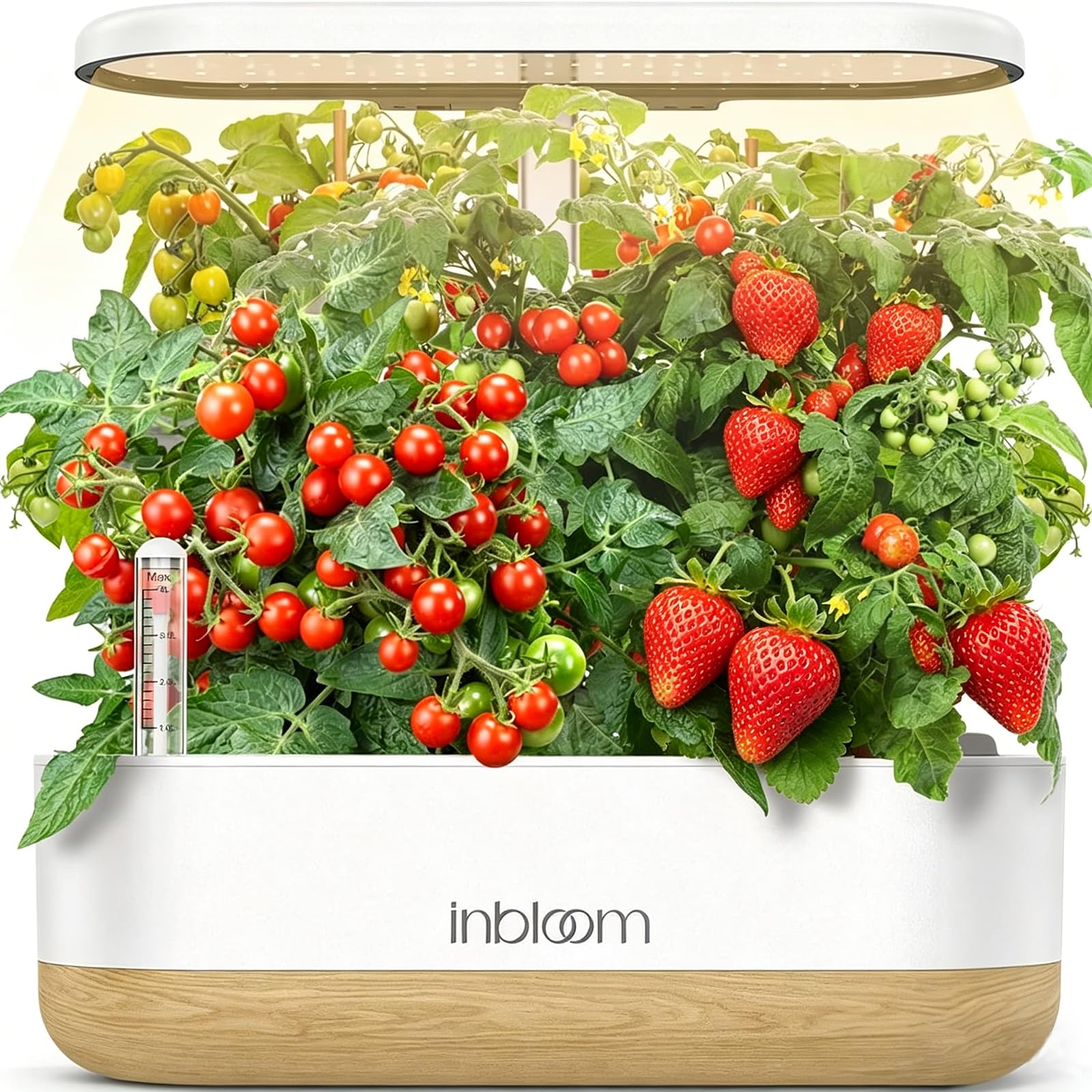
The 12-pod system with wide pod spacing so leaves get more light.
Most 12-pod units pack their baskets close together, which leads to leaf overlap and shadowing as plants grow. Inbloom specifically designed this unit with wide pod spacing, giving each plant more room to absorb light and grow larger. The trade-off is a smaller 4.2-liter water tank — the smallest in this lineup — which means you will refill every 10 to 14 days rather than every two to four weeks. The pump runs on a 30-minute cycle and is described as quiet, though buyers with sensitive hearing say it is audible at night.
The full-spectrum LED does not have a published wattage, but reviewers point out fast growth — one buyer mentioned lettuce and basil grew noticeably in a few months. The system includes a water shortage alarm that beeps loudly when the tank runs low, which shoppers say is both helpful for preventing pump damage and annoying because it is not subtle. The adjustable light height goes up to 17 inches on the 5-pod version or 21 inches on the 10-pod version, giving you flexibility for tall crops.
Buyers consistently praise the easy assembly, silent pump, and excellent customer service — one owner reported seeds sprouted within days. The main complaint beyond the frequent refills is that the system lacks active oxygenation beyond the pump stirring water, so root development is not as aggressive as in more expensive units. If space on your counter is tight and you want the widest possible leaf spread, this is the most space-efficient choice in the 12-pod class.
What works
- Pods with wide spacing for better leaf light exposure.
- Water shortage alarm prevents pump damage.
- Silent pump and easy assembly per buyer reviews.
What does not
- 4.2L tank is the smallest in this guide — expect weekly refills.
- No active oxygenation beyond water circulation.
- Loud alarm beep when water runs low.
Pick this for: Growers who want the widest leaf spread and roomiest pod layout in a 12-pod footprint.
Skip if: You want to refill less than once a week — the 5.5L or larger tanks are better.
6. iDOO 12 Pods Indoor LED Hydroponic System

The 12-pod system with a translucent water tank so you can watch roots grow and spot problems early.
iDOO’s signature feature is a translucent water tank that lets you see root development, water quality, and pump operation without opening the lid. That is genuinely useful — you can catch algae before it spreads, see if roots are healthy, and know exactly when the tank needs cleaning. The 5-liter capacity is standard for a 12-pod system, and the full-spectrum LED runs for 16 hours per cycle with three modes: Vegetable Mode (blue, red, far red, and white light), Flower/Fruit Mode (red, far red, and white light), and a general mode. The tank is made from food-grade ABS material, which buyers report feels durable and safe for edibles.
Owners mention that scallions, basil, and parsley grow perfectly in this system, with no leakage and no noise. One customer observed that plants grow so fast that the tight pod spacing requires metal shaping wire to keep stems from tangling — a minor inconvenience for the growth speed. The system includes everything except seeds, and users consistently say it is easy to assemble and use for beginners. The compact dimensions — 15.16 x 7.8 x 9.65 inches — make it one of the smaller 12-pod units, so it fits easily on a narrow counter.
The main durability concern from buyers is that the cover no longer fits snugly after about a week of use, suggesting the tub may expand slightly with water contact. That is a minor fit issue rather than a functional failure. At 2.2 kilograms, it is lighter than the Ahopegarden by 0.3 kilograms but heavier than the LETPOT. If watching your plants grow from root to tip sounds satisfying, this is the only system in the guide that delivers that experience.
Why it stands out
- Translucent tank lets you see roots, water quality, and pump in action.
- Food-grade ABS material for safe edible growing.
- Compact footprint for tight counter spaces.
- Three full-spectrum light modes for different crop types.
Potential issues
- Cover may stop fitting snugly after a week.
- Pod spacing is tight — larger plants may need support wire.
Best for: Curious growers who want to monitor root health and water quality at a glance through the translucent tank.
Not for: Anyone who needs maximum height clearance — the 23.8-inch adjustment on the 17-pod Growell is far taller.
7. KUCKGO Vertical Hydroponic Tower Garden, 30 Pods
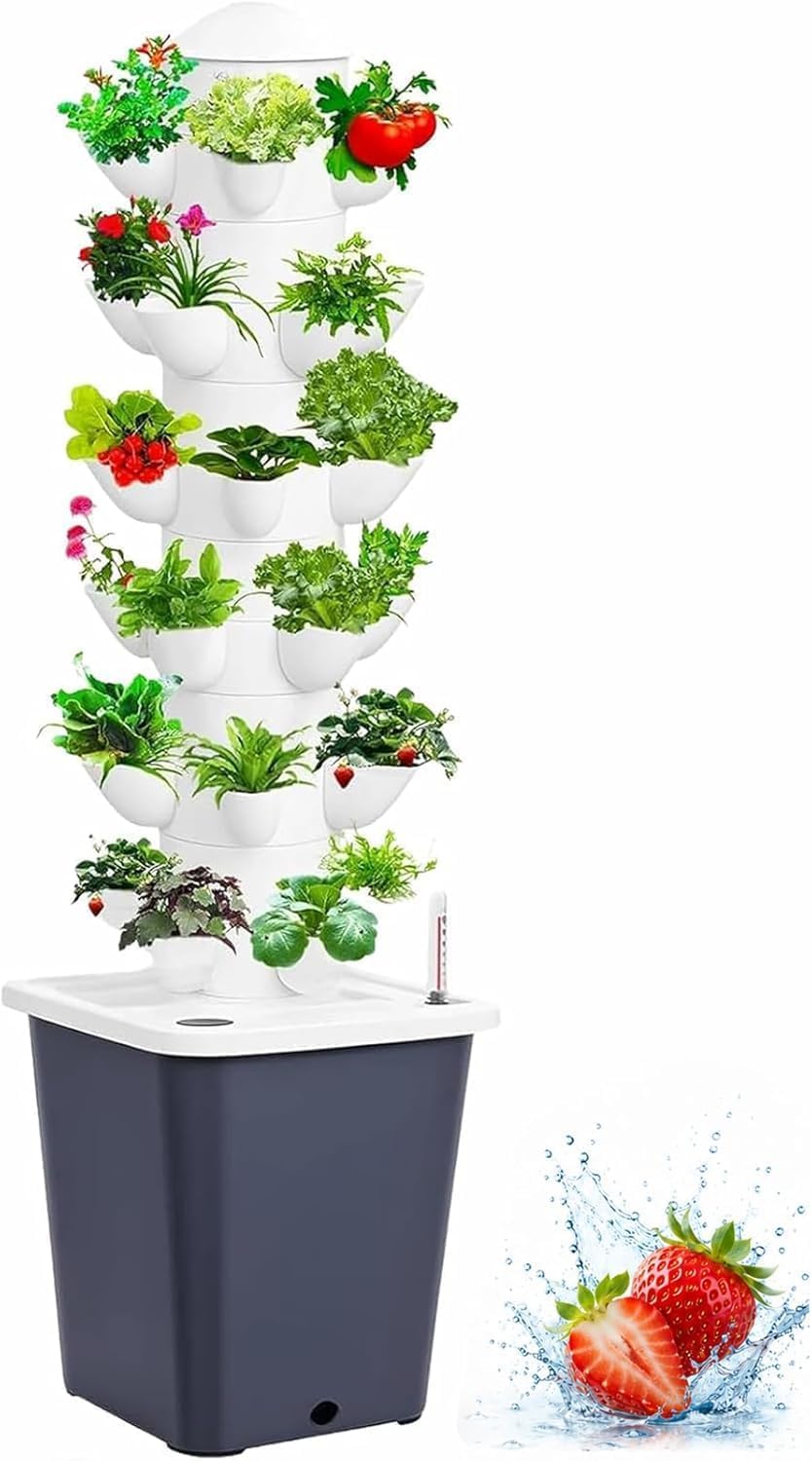
The floor-standing 30-pod tower that grows more plants than any counter unit in a vertical column.
If counter space is the limit, not your ambition, this 6-tier vertical tower changes the game entirely. It holds 30 plants — nearly double the 17 pods of the largest countertop unit — in a floor-standing footprint of just 9.8 x 9.8 inches. The 34.6-inch tower uses an aeroponic design with a built-in 63GPH pump and a water recycling system that the maker claims saves 40% of water compared to traditional hydroponics. Unlike the countertop systems that rely on integrated LED panels, this tower uses natural light or your own supplemental lighting, so you need a bright room or a separate grow light setup.
The modular BPA-free towers are expandable and compatible with additional sections, so you can grow the system as your needs grow. The included pump has a timer for automated cycling, and the kit is designed to be ready within 15 minutes of opening the box. This is the only system in the guide rated for both indoor and outdoor use, with a UV-resistant white base. Buyers describe it as minimalist and functional, and several reviewers use it for propagating plants as well as growing vegetables.
The key trade-off is that there is no built-in light — you are relying on ambient room light or your own grow lamp, which makes this less turnkey than the countertop units. It also has a smaller “tank” (2.6 gallons) relative to the number of plants, so water and nutrient management requires more attention. If you have floor space and want the highest possible plant count, this tower delivers more growing capacity per square inch than any countertop system on this list.
What it offers
- 30 plants in 6 tiers — highest yield of any system here.
- Compact 9.8 x 9.8-inch floor footprint.
- Built-in 63GPH pump with timer and water recycling.
- Modular and expandable; works indoors or outdoors.
Real trade-offs
- No built-in grow light — needs bright room or separate lamp.
- 2.6-gallon tank requires more frequent nutrient management for 30 plants.
Ideal for: Growers with floor space who want the highest plant count and are comfortable managing their own lighting.
Skip if: You need a self-contained all-in-one unit with an integrated grow light — stick with the countertop models.
Understanding the Specs
Full-Spectrum LED Grow Light
This is the light that replaces the sun for your plants. A full-spectrum LED emits wavelengths across the visible range — red, blue, white, and sometimes far-red — to mimic natural sunlight. The wattage (usually 24W or 28W on countertop units) tells you how much energy the light delivers. Higher wattage means more photosynthesis, which means faster growth. The height adjustment range is also critical: a light that rises from roughly 7 to 24 inches lets you start seedlings close to the light and raise it as they grow, preventing “light burn” on tall plants like tomatoes.
Water Tank Capacity
Measured in liters, the tank holds the water and nutrient solution that feeds your plants. A 5-liter tank is standard on 12-pod systems and requires refilling every one to two weeks. An 8-liter or 10-liter tank on a 16-pod or 17-pod system can go four weeks between refills. Bigger tanks also mean more stable water temperature and nutrient concentration, which leads to healthier roots. A transparent water-level window lets you check without lifting the lid.
Pump Cycle and Noise
The water pump circulates the nutrient solution past the roots to deliver oxygen and food. Most systems run the pump for 30 minutes at a time, then pause. This cycle keeps water fresh without running the pump constantly. Decibel ratings matter here — pumps rated under 40 decibels are described as whisper-quiet, while louder ones can be audible in a quiet room. Buyers consistently rank pump noise as a top satisfaction factor, especially for bedroom or office placement.
Pod Count and Spacing
The number of planting pods determines how many plants you can grow simultaneously. A 12-pod system fits a mix of herbs and a few leafy greens. Sixteen or 17 pods let you run multiple varieties or double-seed lettuce for a bigger harvest. Spacing between pods is equally important — wider spacing prevents leaves from blocking each other’s light, leading to fuller plants. Some makers design 20% wider spacing as a deliberate feature.
FAQ
Can I grow tomatoes and peppers in a 12-pod countertop system?
How often do I need to change the water in an indoor vegetable garden system?
Do indoor garden systems use a lot of electricity?
What is the difference between a hydroponic system and an aeroponic tower?
How long does it take to grow lettuce from seed to harvest in these systems?
Can I use tap water in my indoor garden system?
Do I need to buy special seeds for hydroponic systems?
What happens if the power goes out?
How do I clean the system between plantings?
Which system is best for growing strawberries indoors?
Final Thoughts: The Verdict
For most people, the indoor vegetable garden system winner is the Growell 16 Pod because it delivers the best balance of pod count (16), water capacity (8 liters), and light power (28W) at a price that undercuts premium competitors. If you want the highest possible harvest from a single counter