
Forgetting to water your basil, fighting fungus gnats in your tomato soil, or watching lettuce bolt the second it gets warm — indoor vegetable gardening is often a battle against space, light, and mess. A dedicated hydroponic system eliminates the soil, automates the watering, and uses targeted LED spectrums to drive leafy greens, herbs, and compact vegetables from seed to harvest in a fraction of the time it takes outdoors.
I’m Rikta — the co-founder and writer behind Lawn Gear Lab. I’ve spent hundreds of hours cross-referencing LED wattage, pod capacities, pump noise levels, and water tank volumes, and analyzing owner feedback across dozens of kits to separate the setups that actually grow vegetables from those that just look good on a countertop.
After weeks of spec-level research, one system consistently outperformed its peers in both germination reliability and long-term durability: the hydroponic system for vegetables from Growell, whose 28W full-spectrum light and 8-liter reservoir offer the best balance of power and low-maintenance operation for serious home growers.
How To Choose The Best Hydroponic System For Vegetables
Not every countertop garden is built to grow actual vegetables. Many entry-level kits are designed for herbs and will leave your peppers and tomatoes starved for light and root space. To pick a system that delivers real harvests, you need to prioritize three core specs.
LED Wattage and Spectrum Depth
A system with anything less than a 20W LED panel will struggle to push enough light through leafy greens beyond the seedling stage. Vegetables like lettuce, kale, and spinach need at least 20-30W of full-spectrum light — including red and blue wavelengths — to photosynthesize efficiently. The AeroGarden Harvest Elite runs a 20W panel, while the Growell system packs a beefier 28W panel that drives noticeably faster leaf production.
Water Tank Volume and Circulation
Small 3-liter tanks require weekly top-offs and become nutrient-imbalanced faster. For vegetables, look for a reservoir of at least 4 liters. The 8-liter tank on the Growell or the 10-liter tank on the SUNCOZE allow the roots to develop without hitting the bottom of the reservoir, and the larger water volume buffers pH and nutrient swings, reducing your maintenance from twice a week to once every two to three weeks.
Adjustable Light Height and Pod Capacity
Vegetables grow vertically. A fixed-height light panel that sits only 6 inches above the deck will block tall plants and cause leggy seedlings. Systems with extendable poles — like the SUNCOZE (up to 25 inches) or the owltron (up to 30 inches) — can accommodate everything from low-growing lettuce to full-size cherry tomato plants. Pod count matters, but quality per pod matters more: a 6-pod AeroGarden will out-harvest a 52-pod system if its light is stronger and its spacing is wider.
Quick Comparison
On smaller screens, swipe sideways to see the full table.
| Model | Category | Best For | Key Spec | Amazon |
|---|---|---|---|---|
| Growell 16-Pod | Mid-Range | Vegetable growers wanting the best light | 28W full-spectrum LED, 8L tank | Amazon |
| owltron 15-Pod | Premium | Tall-plant cultivation with app control | 36W LED, 30 inch max height | Amazon |
| SUNCOZE 20-Pod | Mid-Range | High capacity with large water volume | 30W LED, 10L tank, 25 inch height | Amazon |
| AeroGarden Harvest Elite | Premium | Compact spaces needing proven reliability | 20W LED, 6 pods, 12 inch height | Amazon |
| 52-Pod High Capacity | Budget | Seed starting in bulk | 24W LED, 4L tank, 52 pods | Amazon |
| NEEWER Basics HGS01 | Budget | Entry-level buyers on a strict budget | 19.8W LED, 3.8L tank, 12 pods | Amazon |
In‑Depth Reviews
1. Growell 16-Pod Hydroponics Growing System Kit

The Growell 16-Pod kit delivers the most complete feature set for vegetable growers at a mid-range price point, centering on a 28W full-spectrum LED panel that includes red, blue, white, and far-red diodes. That wattage is higher than most competitors in its tier, and it shows in germination speed — reviewers consistently report lettuce ready to harvest in roughly 30 days. The 8-liter reservoir is another standout: it reduces top-off frequency to roughly once every three to four weeks, and the transparent water window makes checking levels effortless.
Three dedicated light modes (Vegetables, Flowers & Fruits, Herbs) take the guesswork out of spectrum selection, and the dual timer options — 16-hour and a faster 22-hour cycle — let you accelerate growth for particular crops. The included 16 grow domes, sponges, plant food A&B, and labeling stickers mean you have everything except seeds to start your first harvest out of the box. The pump runs below 40 decibels and circulates water every 30 minutes, keeping roots oxygenated without audible distraction.
One nuance: the 16-pod capacity is generous for leafy greens, but the spacing between baskets is tight. If you plan to grow large fruiting plants like bell peppers, expect to leave empty pods between them for airflow. Also, the kit ships with enough fertilizer for about four full grow cycles, after which you will need to purchase refill sponges and nutrients separately. These are minor trade-offs for a unit that, at its sale price, pays for itself in homegrown produce within a few harvests.
What works
- 28W LED is the most powerful panel among mid-range kits, driving fast vegetative growth
- 8L water tank allows weeks of low-maintenance operation without pH fluctuations
- Three dedicated grow modes matched to vegetable, fruit, and herb stages
What doesn’t
- Pod spacing is tight — large plants need skipped slots for airflow
- Sponges and fertilizer are one-time consumables that require periodic restocking
2. owltron Smart 15-Pod Hydroponics Growing System
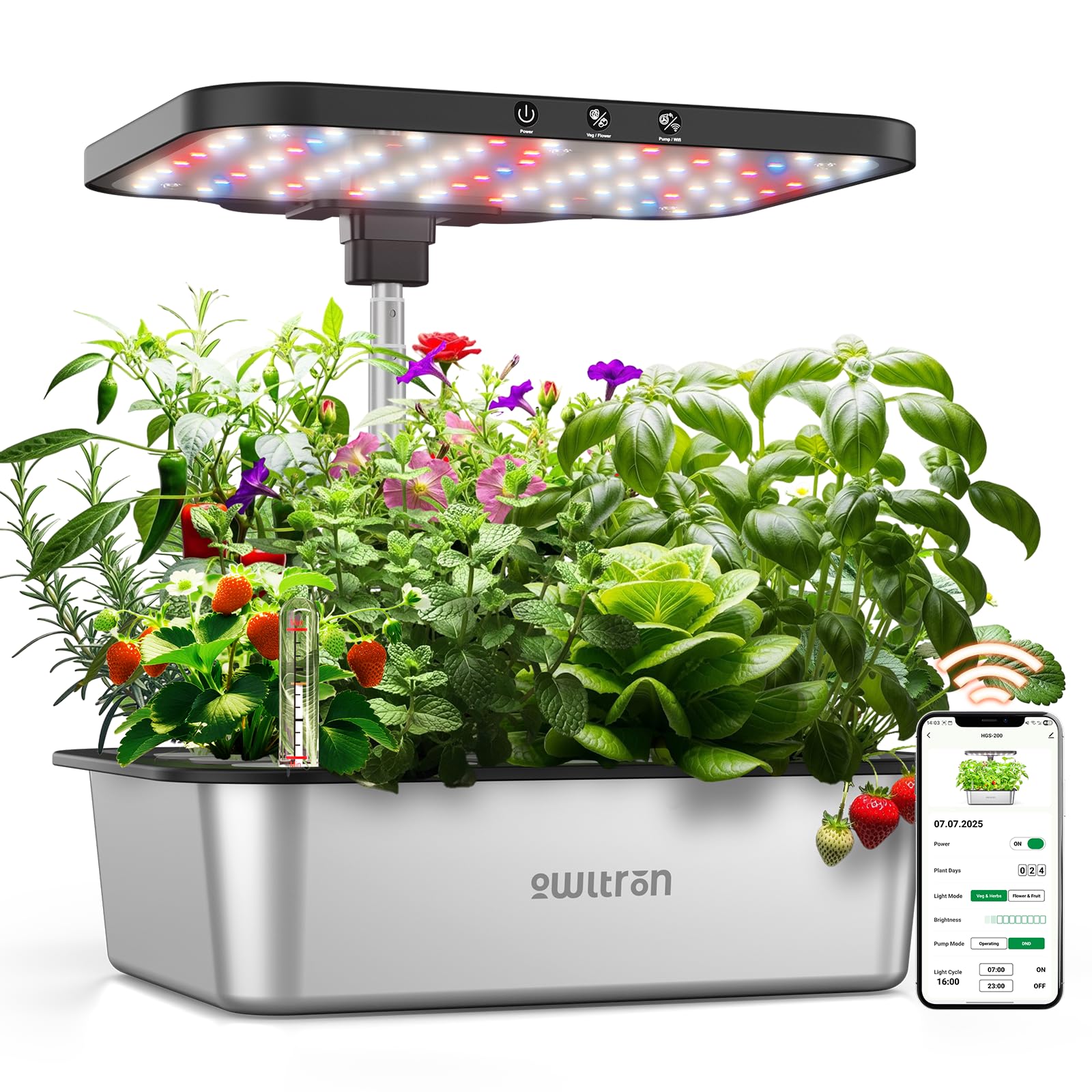
The owltron system pushes into premium territory with a 36W full-spectrum LED panel — the highest wattage of any unit in this lineup — and a 30-inch extendable pole that accommodates tall, fruiting vegetables like cherry tomatoes and dwarf peppers from seedling through harvest. The Smart Life app integration lets you adjust the 0-24 hour day-night cycle, switch between dedicated Vegetable and Flower/Fruit modes, and dim the light across 10 brightness levels, all without touching the physical control panel.
The 5.5-liter tank is smaller than the SUNCOZE or Growell reservoirs, but the pump cycle — running every 30 minutes — keeps the water well-oxygenated. The stainless steel construction gives the unit a sleek, kitchen-friendly appearance, and the noise level is rated under 20 dB, making it genuinely silent during operation. The kit includes 15 grow domes, support sticks, anti-algae covers, and a nutrient set, so you can start planting immediately.
However, reliability concerns appear in customer feedback: multiple buyers reported that the glue holding the pump and light assembly failed within the first few days, requiring DIY reinforcement with epoxy. The app, while convenient, has been described as unintuitive for first-time users. Despite these QC hiccups, the hardware potential here is unmatched for anyone who needs to grow tall vegetables indoors and values remote control over their light schedule.
What works
- 36W LED is the most powerful panel in this comparison, ideal for fruiting vegetables
- 30-inch adjustable height grows peppers and tomatoes without bending leaves
- Smart Life app enables remote dimming and custom light cycle programming
What doesn’t
- Loose pump and light glue joint reported by several owners as an early failure point
- Smart Life app interface can feel clunky for users preferring physical buttons
3. SUNCOZE 20-Pod Hydroponics Growing System Kit
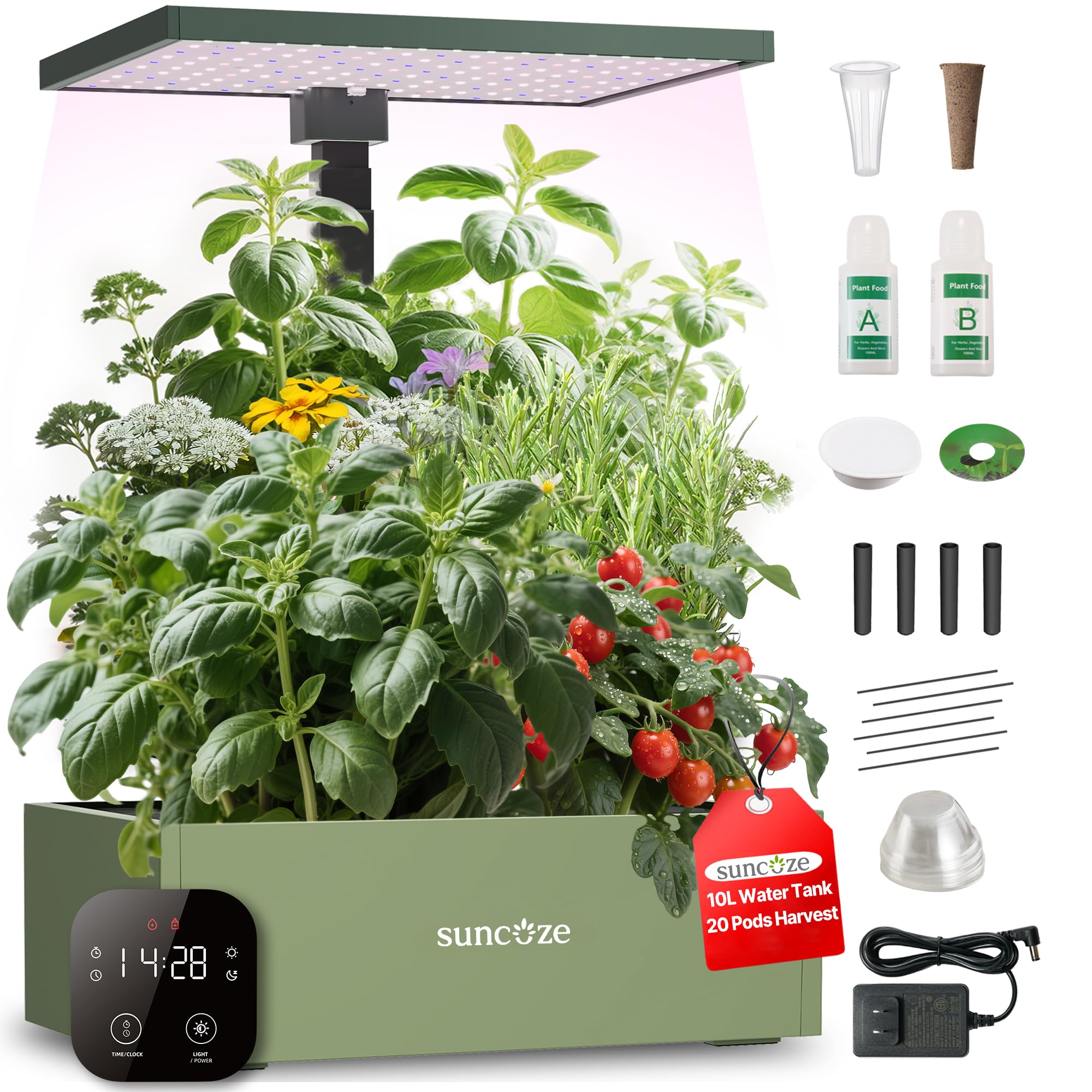
The SUNCOZE 20-Pod system earns its spot by offering the largest water reservoir — a full 10 liters — in the mid-range segment. Combined with a 30W full-spectrum LED light that adjusts from 8.6 to 25 inches in height, this kit is built to sustain deep-rooted lettuce, kale, and Swiss chard through multiple consecutive harvests without needing weekly attention. The pump runs a 15-minute cycle every two hours, striking a balance between constant oxygenation and energy efficiency.
The 20-pod capacity is flexible: you can use only 6, 8, or 12 pods if you prefer spacing, and the included 12 support sticks keep top-heavy plants from tipping over as they mature. The 4-level brightness adjustment and a 16-hour-on/8-hour-off automatic timer make it easy to dial in light intensity for different growth stages. Reviewers consistently mention that lettuce varieties — especially oak leaf and arugula — perform exceptionally well, with many enjoying multiple cut-and-come-again harvests.
Reliability is a concern with this unit. A small but notable number of buyers reported that the pump or light failed entirely after 9-14 days of use. While customer support appears responsive in replacing defective units, the failure rate is higher than average for this price bracket. If you get a unit that works, the 10L tank and 30W light are unbeatable for growing leafy greens at scale, but the QC variance makes it a slightly riskier buy.
What works
- 10L water tank is the largest in this comparison, reducing maintenance to every 2-3 weeks
- 30W LED with 4 brightness levels adapts to seedling and vegetative stages
- 20 pod positions with flexible fill options suit high-volume leafy green growers
What doesn’t
- Early pump or light failure reported on a subset of units, raising QC red flags
- Height-adjustable pole can be finicky to lock at the desired elevation
4. AeroGarden Harvest Elite Indoor Garden

The AeroGarden Harvest Elite is the benchmark that many other countertop systems are measured against, and for good reason. The stainless steel chassis and touch-sensitive illuminated panel give it a polished aesthetic that blends into a modern kitchen, while the 20W full-spectrum LED has been fine-tuned over years of iteration to germinate seeds up to five times faster than soil. The 6-pod capacity is intentionally limited — AeroGarden prioritizes robust single-plant growth over cramming in more pods.
The user experience is where this system shines. The digital display reminds you when to add water and plant food, and the Vacation Mode keeps the pump cycling on a minimal schedule when you are away for up to two weeks. The included seed pod kit with pre-seeded pods removes all guesswork for first-time hydroponic growers. You can also use your own seeds with AeroGarden-compatible grow baskets and sponges after the initial kit is exhausted.
The downside is the 12-inch maximum plant height. You cannot grow cherry tomatoes, bell peppers, or any tall vegetable in this unit — the light panel is fixed. The 6-pod deck also means you will run out of space quickly if you want a continuous supply of lettuce for daily salads. For herb gardens, microgreens, and small leafy greens grown one batch at a time, this is the most polished, reliable system available.
What works
- Refined user interface with water and nutrient reminders for error-free operation
- Vacation Mode keeps plants alive during absences without manual intervention
- Proven track record of reliability and customer support from a market-leading brand
What doesn’t
- Fixed 12-inch height limits you to low-growing herbs and lettuce only
- 6-pod capacity feels restrictive for families wanting high-volume vegetable harvests
5. 52-Pod High Capacity Hydroponics Growing System Kit
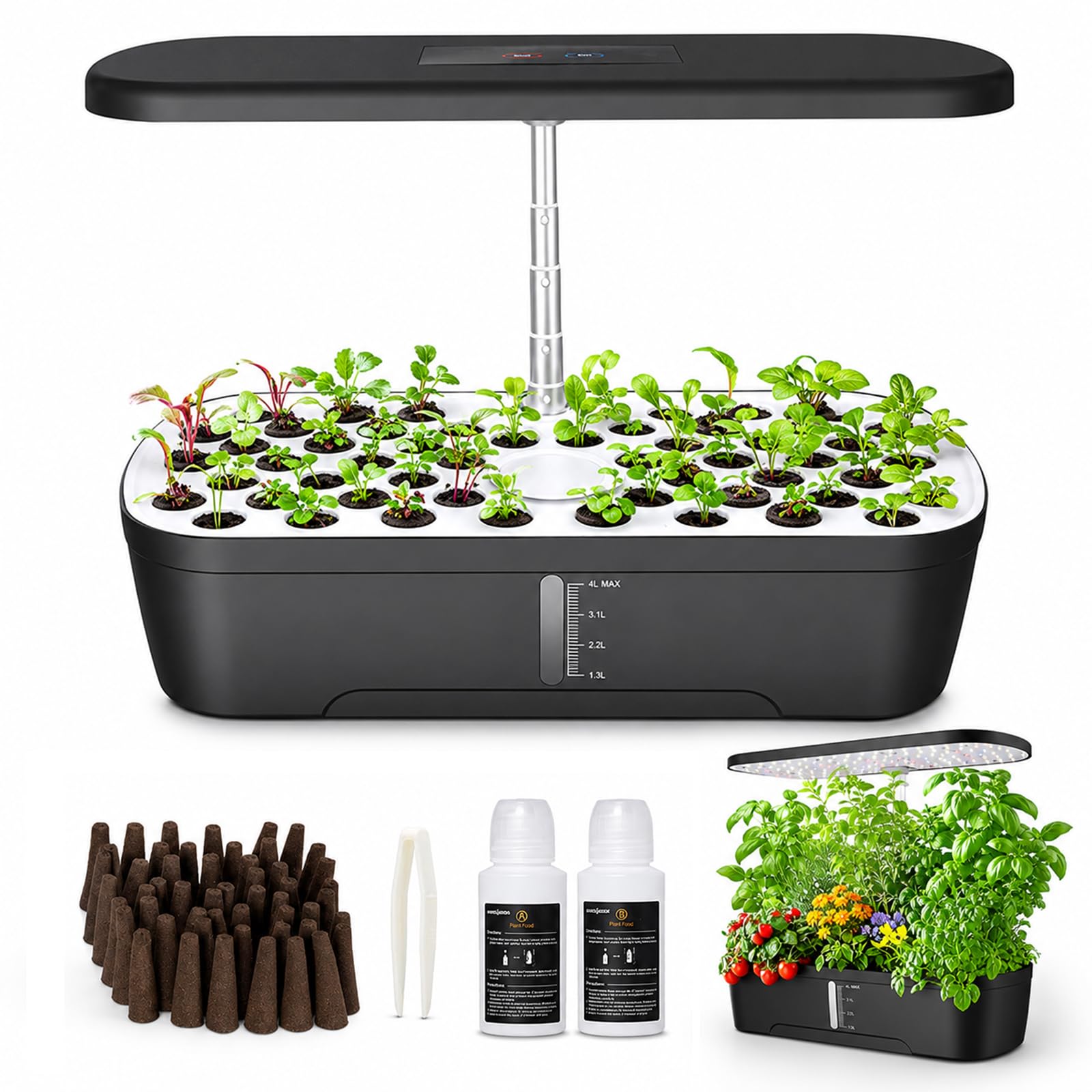
When your primary goal is starting dozens of seedlings for transplanting outdoors or growing a massive batch of microgreens simultaneously, the 52-pod system from PARAQUIP delivers the highest pod-per-dollar ratio on the market. The 24W full-spectrum LED is adequate — not powerful — but the real draw is the sheer capacity. Reviewers report germinating 52 seeds at once and then moving the strongest plants to larger systems or garden beds after three to four weeks.
The 4-liter water tank is on the smaller side given the pod count, meaning you will need to monitor water levels more frequently as the plants mature. The 5 customizable light modes (germination, vegetative, flowering, etc.) provide some spectrum flexibility, and the built-in digital timer keeps the light cycle consistent. The ultra-quiet pump includes a sleep mode that keeps noise levels low enough for bedroom use.
The biggest physical drawback is pod spacing. With 52 baskets packed into a unit that measures 15.6 by 7.1 inches, the plants crowd each other quickly. This unit is best approached as a high-density seed starter or microgreen factory, not a long-term fruiting vegetable system.
What works
- 52-pod capacity is unmatched for mass seedling propagation and microgreen production
- 5 dedicated light modes cover germination through flowering for different crops
- Sleep mode pump is genuinely quiet, suitable for bedroom or nursery placement
What doesn’t
- Extreme pod density causes shading and stunting if all slots are used for full-size plants
- 4L water tank requires frequent refills when growing beyond the seedling stage
6. NEEWER Basics HGS01 Hydroponics Growing System
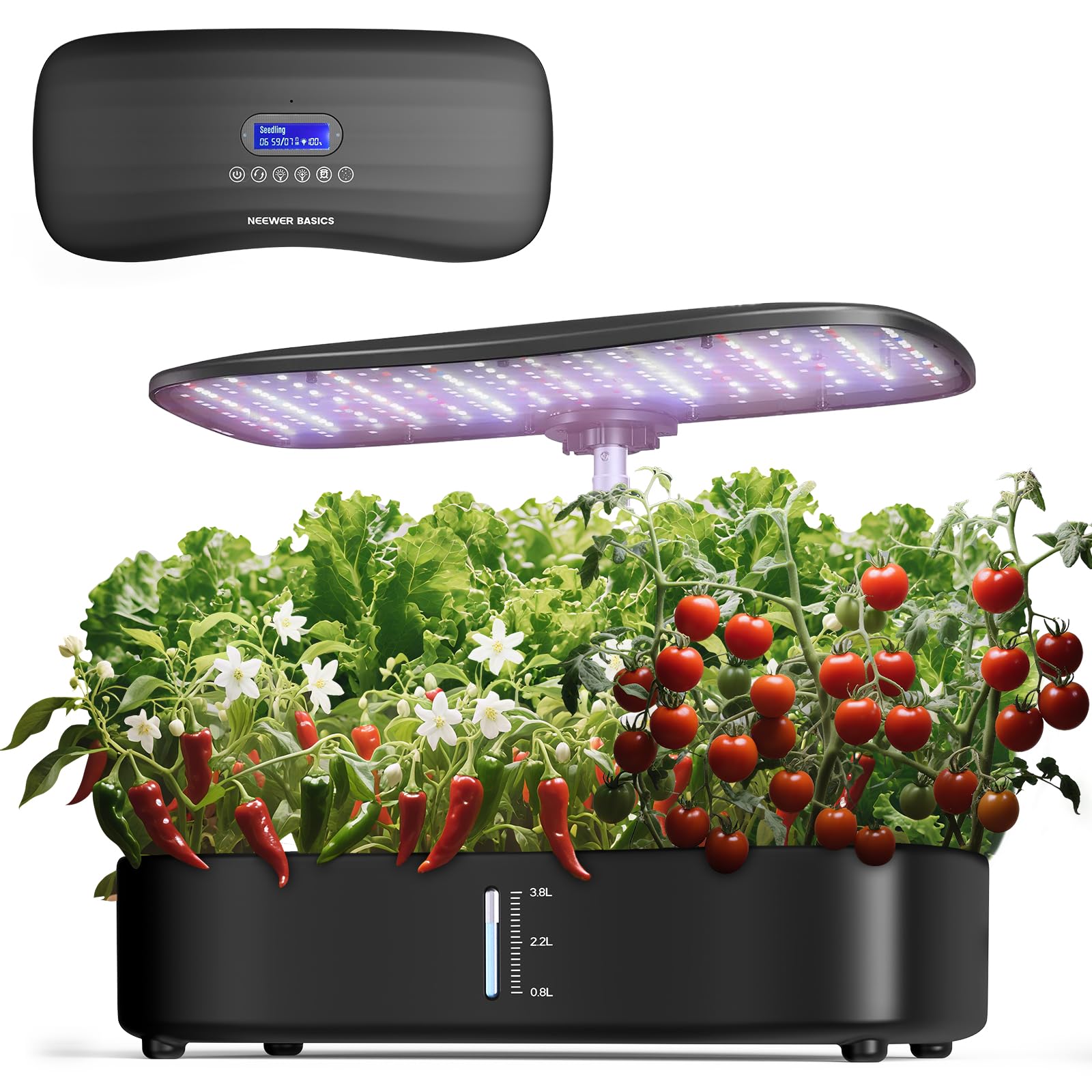
The NEEWER Basics HGS01 is designed for the budget-conscious first-time grower who wants to test hydroponic vegetable cultivation without a large upfront investment. The 19.8W LED panel provides three growing modes — Seedling, Vegetative, and Bloom — with 10 brightness levels, and the telescopic arm adjusts up to 17.7 inches to accommodate moderate plant height. The 12-pod capacity is generous for the price point, and the 3.8L tank with a clear water level gauge makes visual monitoring simple.
Control is handled through a single touch panel with an integrated LCD screen, allowing one-tap switching of modes and light timers (adjustable from 1 to 23 hours). The whisper-quiet pump auto-starts when powered on and runs for one hour every 24-hour cycle, which is conservative compared to competitors that cycle every 30 minutes. Owners report that tomato and lettuce seeds sprout within days, though the listed 52% faster growth rate vs. soil depends heavily on using the correct water level — reviewers caution against filling the tank above the 3-liter optimal mark.
The main compromises are build quality and feature depth. The aluminum and painted finish looks clean but feels less substantial than ABS plastic housing on other units. The lack of included instructions has been noted by multiple buyers. And while 12 pods sound like enough for a small household, the 19.8W light must cover the whole deck, which means outer pods receive slightly less PAR intensity than the center. For a test run or a herb-focused first garden, this system is hard to beat on cost.
What works
- 12-pod capacity at an entry-level price point makes hydroponics accessible for beginners
- Intuitive LCD touch control with 3 light modes and 10 brightness levels
- Compact footprint and telescopic arm fit on narrow kitchen counters and windowsills
What doesn’t
- 19.8W LED struggles to provide uniform coverage across the full 12-pod deck
- No printed manual included — setup requires some trial and error with water levels
Hardware & Specs Guide
LED Wattage and Spectrum
Wattage is the single most important electrical spec for a hydroponic vegetable system because it directly determines the photosynthetically active radiation (PAR) your plants receive. A 20W panel is the minimum threshold to grow leafy greens like lettuce successfully. Systems with 28-36W panels (Growell, owltron) can support faster growth and even compact fruiting vegetables. Look for full-spectrum panels that include both red (660nm) and blue (450nm) diodes — this combination drives both vegetative leaf production and flowering/fruiting stages.
Water Tank Volume and Circulation Cycles
Reservoir size dictates your maintenance schedule and root development space. A 3-4 liter tank works for seed starting and herbs but requires weekly attention when growing vegetables. An 8-10 liter tank buffers pH and nutrient concentration swings, allowing you to go two to four weeks between water changes. Circulation frequency matters: pumps that run every 30-60 minutes keep dissolved oxygen levels higher than pumps cycling only once or twice per day. The pump should also be rated below 40 dB for comfortable indoor placement.
FAQ
What vegetables can I actually grow in a countertop hydroponic system?
How often do I need to change the water and add nutrients?
Can I use tap water in my hydroponic system for vegetables?
Final Thoughts: The Verdict
For most gardeners, the hydroponic system for vegetables winner is the Growell 16-Pod kit because it pairs a 28W LED with an 8-liter reservoir at a price that undercuts less capable rivals. If you want to grow tall fruiting vegetables like cherry tomatoes indoors, grab the owltron 15-Pod system for its 36W light and 30-inch adjustable pole. And for seed starting in bulk at the lowest cost per pod, nothing beats the 52-Pod High Capacity system from PARAQUIP.