
Specs are compiled from manufacturer listings and verified buyer reviews and can change over time — please confirm the key details on the product page before buying.
Overwatering kills more houseplants than anything else — but you can’t see what is happening an inch below the surface. You stick a finger into the soil, guess it feels dry, pour more water, and hope. A houseplant moisture meter replaces that guesswork with an immediate reading from deep inside the pot, so you know exactly when to water and when to wait.
I’m Rikta, the founder of Lawn Gear Lab. This guide compares published specifications from the manufacturers alongside patterns in verified customer reviews, so you get each pick’s real strengths and trade-offs.
The houseplant moisture meter that fits your collection gives you healthier roots, happier leaves, and far less second-guessing. If you own a single succulent or a windowsill full of ferns, the right meter pays off fast.
Our Picks at a Glance

How To Choose The Best Houseplant Moisture Meter
Not all moisture meters work the same way. Picking the wrong type can give you frustrating readings or even damage your roots. Below are the three decisions that matter most.
Analog vs. Digital Readouts
Analog meters (the kind with a dial and a needle) are simple, battery-free, and durable. They give you a clear zone — dry, moist, wet — which is all most houseplant owners ever need. Digital meters display exact numbers on a screen, often alongside temperature, pH, or light readings. The trade-off: digital units need batteries and cost more, but they offer precision for tracking specific soil conditions across different plants.
Single Probe vs. Leave-in Sensor
A handheld single-probe meter goes into the soil for a few seconds, gives a reading, and comes back out. It is the standard choice for checking several pots in one pass. A leave-in sensor, like the Sustee Aquameter, stays in the pot at all times and changes color to signal dry versus wet. That is ideal for forgetful owners or anyone who wants a constant visual reminder — but each pot needs its own sensor, so the cost adds up fast.
Probe Length and Build Quality
Deeper pots need longer probes to reach the root zone. A probe around 6 to 8 inches works for most medium houseplants, while shallow-rooted succulents get by with a shorter one. The most common durability issue across all price tiers is a bent or broken probe, especially when owners push the meter into hard, dry soil. Buying a meter with a sturdy metal shaft and moistening dry soil before inserting it makes a real difference in how long the tool lasts.
Quick Comparison
| Model | Best For | Readout Type | Probe Length | Measurements | Amazon |
|---|---|---|---|---|---|
| XLUX Soil Moisture Sensor 2-Pack★ Best Overall | Everyday reliability at a fair price | Analog dial | Standard | Moisture only | Amazon |
| Dr.meter S10PlusBest Value | Budget-friendly single-probe testing | Analog dial | Long probe | Moisture only | Amazon |
| AiGerdinn 4-in-1 Soil TesterMost Versatile | All-in-one soil analysis on a budget | Analog dial (large) | Standard | Moisture / pH / Fertility / Sunlight | Amazon |
| Sustee Aquameter (Medium, 2-Pack) | Leave-in monitoring for medium pots | Color-change indicator | Leave-in (standard) | Moisture only | Amazon |
| HSLGOVE 7-in-1 Soil Tester | Dual-screen precision for serious growers | Analog dial + LCD | 6.8 inches | Moisture / pH / Fertility / Temp / Light / Air Temp / Humidity | Amazon |
| Fiddle Leaf Fig Plant Food Health Meter | Species-specific care for fiddle leaf figs | Analog dial (toggle switch) | Long probe | Moisture / Light / pH | Amazon |
| iPower 3-in-1 Meter | Entry-level multi-function testing | Analog dial | Standard | Moisture / Light / pH | Amazon |
| IPPINKA Sustee Aquameter (Medium, 4-Pack) | Whole-houseplant-collection leave-in monitoring | Color-change indicator | Leave-in (standard) | Moisture only | Amazon |
| Buladeke 7-in-1 Digital Soil Tester | Digital precision with backlit screen | Digital LCD (backlit) | Standard | Moisture / pH / Temp / Light / Fertility / EC / TDS | Amazon |
In-Depth Reviews
1. XLUX Soil Moisture Sensor 2-Pack
Our pick — over 4★ from 70,500+ verified ratings; the strongest balance of quality and price.
The crowd-favorite earns its spot with fast, simple, battery-free operation and near-indestructible build.
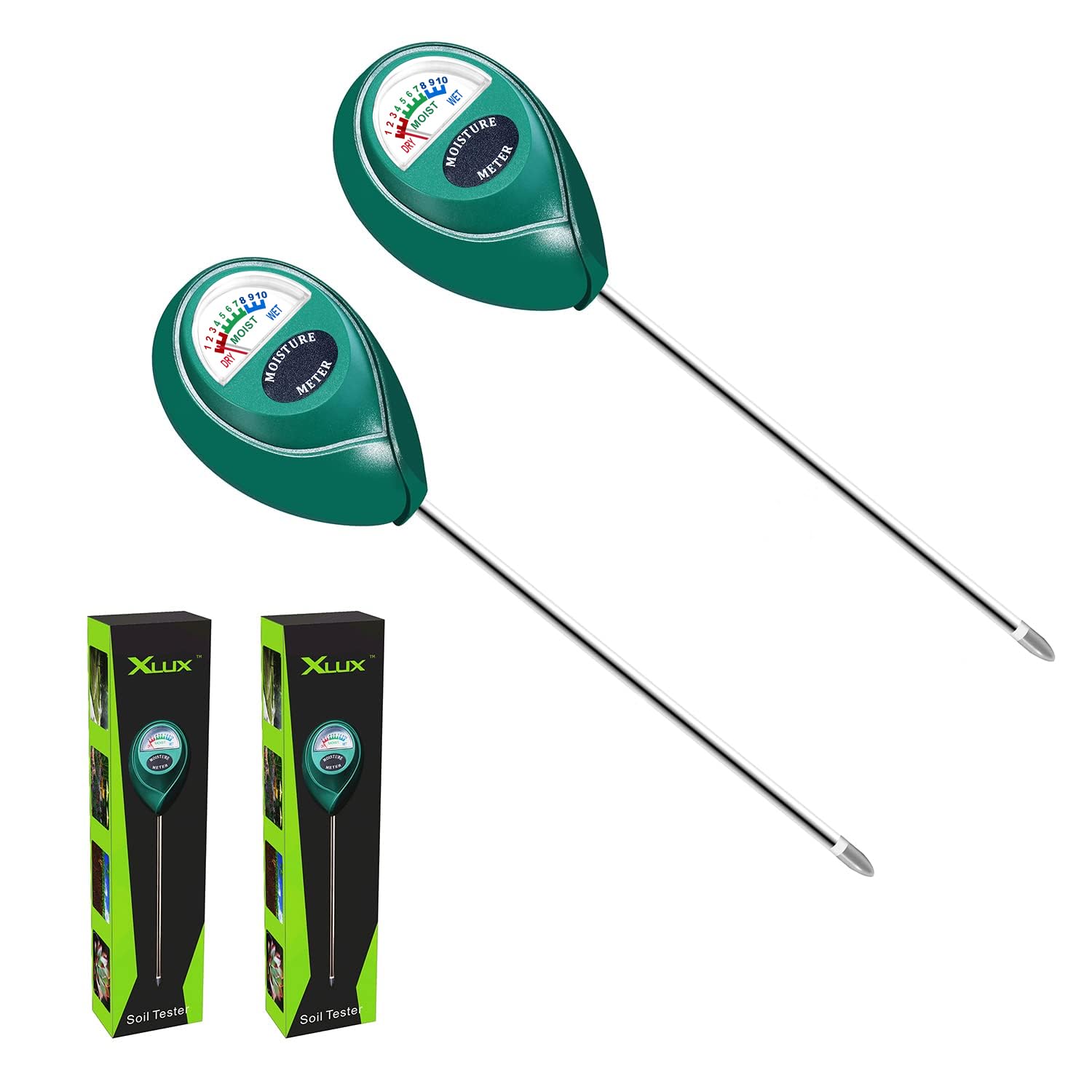
The XLUX gives you your moisture zone almost instantly after you insert the probe. It runs on no batteries at all, which means zero maintenance and zero surprises when you go to use it. One buyer reports: “It literally takes 1 second to read the moisture in the soil!” The instant readout encourages more frequent checks, so you water based on actual soil moisture rather than a calendar. A single probe disturbs less soil than a dual-prong design, and at 3.5 ounces the meter is barely heavier than a pen.
The main caveat: the metal tip will corrode if left in the soil for more than five minutes, so this is strictly a quick-test tool, not a leave-in monitor. The two-pack means you can keep one by the kitchen sink and one in the potting shed, or gift the second to a fellow plant parent.
What wins people over
- Reads moisture in about one second — no waiting around
- Runs on zero batteries; nothing to charge or replace
- Two meters in the box for the price of one competitor
Honest trade-off
- Must be removed after each test or the probe tip will corrode
- No pH, light, or fertility readings — moisture only
Your best bet if: you want the most straightforward, well-reviewed moisture meter that performs quickly across every pot in your home.
Look elsewhere if: you prefer a permanent in-soil sensor that you never have to pull out for a reading.
2. Dr.meter S10Plus
A slim, budget-friendly meter with a long probe that reaches deep into tall pots without disturbing roots.
The Dr.meter S10Plus stands out for its long single probe, which owners of deep planters and tall houseplants consistently praise. The analog dial uses a color-coded system (red for dry, green for moist, blue for wet) that makes the reading obvious at a glance. As buyers put it: “thin & long probe good for house plants. seems accurate.” That reach and lightness is tough to top at this price point. The real-world feedback points to one issue: the probe can bend if you push too hard into compacted or dry soil. For basic moisture checking — especially for cactus owners and deep-pot growers — the value is excellent.
Why it earns its spot
- Long probe reaches deep without bringing up much soil
- Color-coded dial makes moisture zones instantly readable
- among the most affordable single-probe meters available
The main caution
- Probe is vulnerable to bending in hard or very dry soil
Reach for this if: you need a long probe for tall pots and you are comfortable handling the meter gently.
skip it if: you tend to push straight into dry-packed soil — a sturdier shaft would suit your habits better.
3. AiGerdinn 4-in-1 Soil Tester
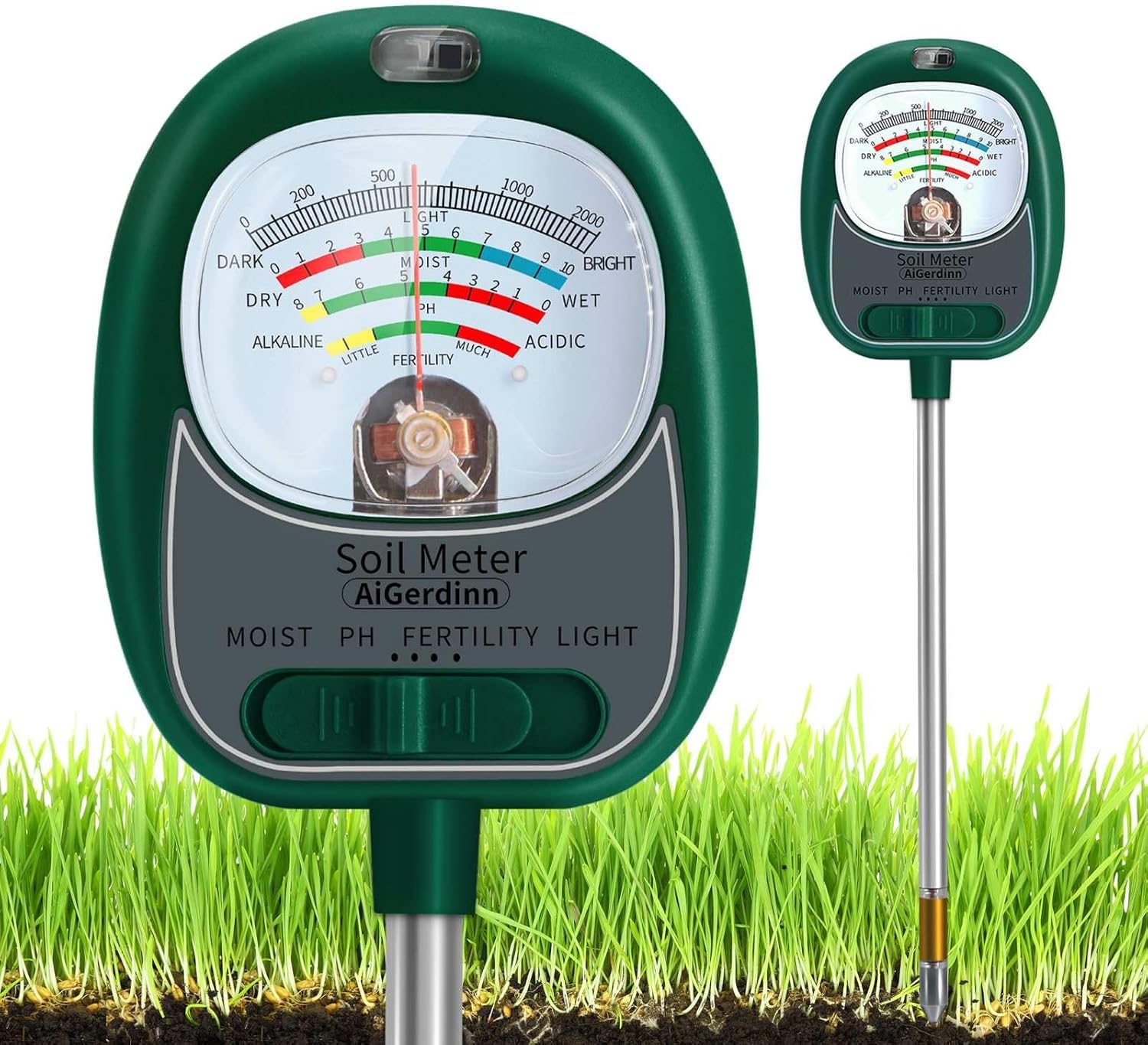
Four analog dials on one probe measure moisture, pH, fertility, and sunlight — no batteries required.
This tester gives you a serious amount of data for the money. Beyond the standard moisture reading, you get soil pH, a fertility scale (which measures nutrient levels), and a sunlight meter that tells you whether the spot is getting enough light. The oversized dial is 1.95 inches, a meaningful upgrade over cramped scales on cheaper meters, especially if your eyes struggle with tiny print. At 3.84 ounces, it is a touch heavier than the XLUX, but the extra weight comes from the multi-sensor head. Owners consistently call it a “must-have tool” for anyone tending both indoor pots and outdoor garden beds. The instructions ask you to moisten the soil before testing, which is standard for meters that measure fertility — bone-dry soil won’t conduct well. It also cannot be used in liquids or hard clay.
What makes it a standout
- Measures four soil conditions from a single probe
- Large 1.95-inch dial for easy reading
- No batteries required
Things to know
- Fertility and pH readings need slightly damp soil to work properly
- Not suitable for liquid testing or hard-packed clay
Grab this if: you want a single tool that covers moisture, pH, and fertility for a mix of indoor and outdoor plants.
Think twice if: you only need a moisture check — the extra features add complexity you may never use.
4. Sustee Aquameter (Medium, 2-Pack)
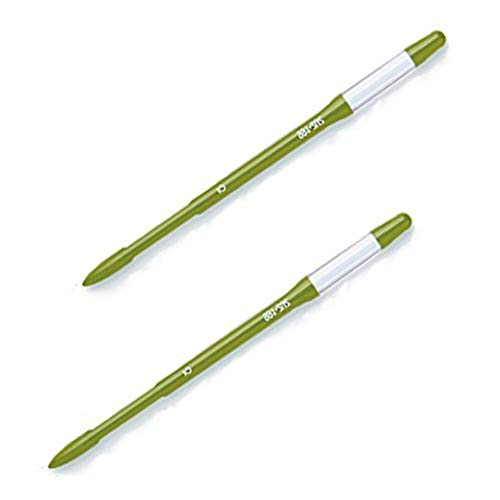
A Japanese-made leave-in sensor that turns white when the soil is dry, so you water without ever poking the dirt.
The Sustee Aquameter is for the owner who wants a permanent, low-effort watering cue. Unlike every other meter on this list, it stays in the soil. A porous ceramic core draws moisture from the surrounding dirt, and a color window on top shifts from blue to white as the soil dries out. Blue means the plant is fine; white means it needs water. You scan your collection in seconds without taking a single reading. Each stick lasts about 6 to 9 months before the core needs replacing. It works best in pots sized 3.5, 4, 5, and 6 inches — smaller or larger pots can give off readings. The recurring feedback is that the color indicator can be “mixed” in accuracy — some owners see blue in the morning despite dry soil — so treat it as a strong guide rather than a precision instrument.
what separates it
- Stays in the pot permanently — no insertion or removal needed
- Color-change signal (blue/wet, white/dry) is visible from across the room
- Refillable core reduces long-term waste
The honest trade-off
- Color accuracy can be inconsistent across different soil types
- Core lasts only 6 to 9 months before a replacement is needed
Ideal for: the hands-off plant owner who wants a constant visual check and owns medium-sized pots.
Less ideal for: anyone who needs exact numeric moisture data — the Sustee gives a yes/no signal, not a scale.
5. HSLGOVE 7-in-1 Soil Tester
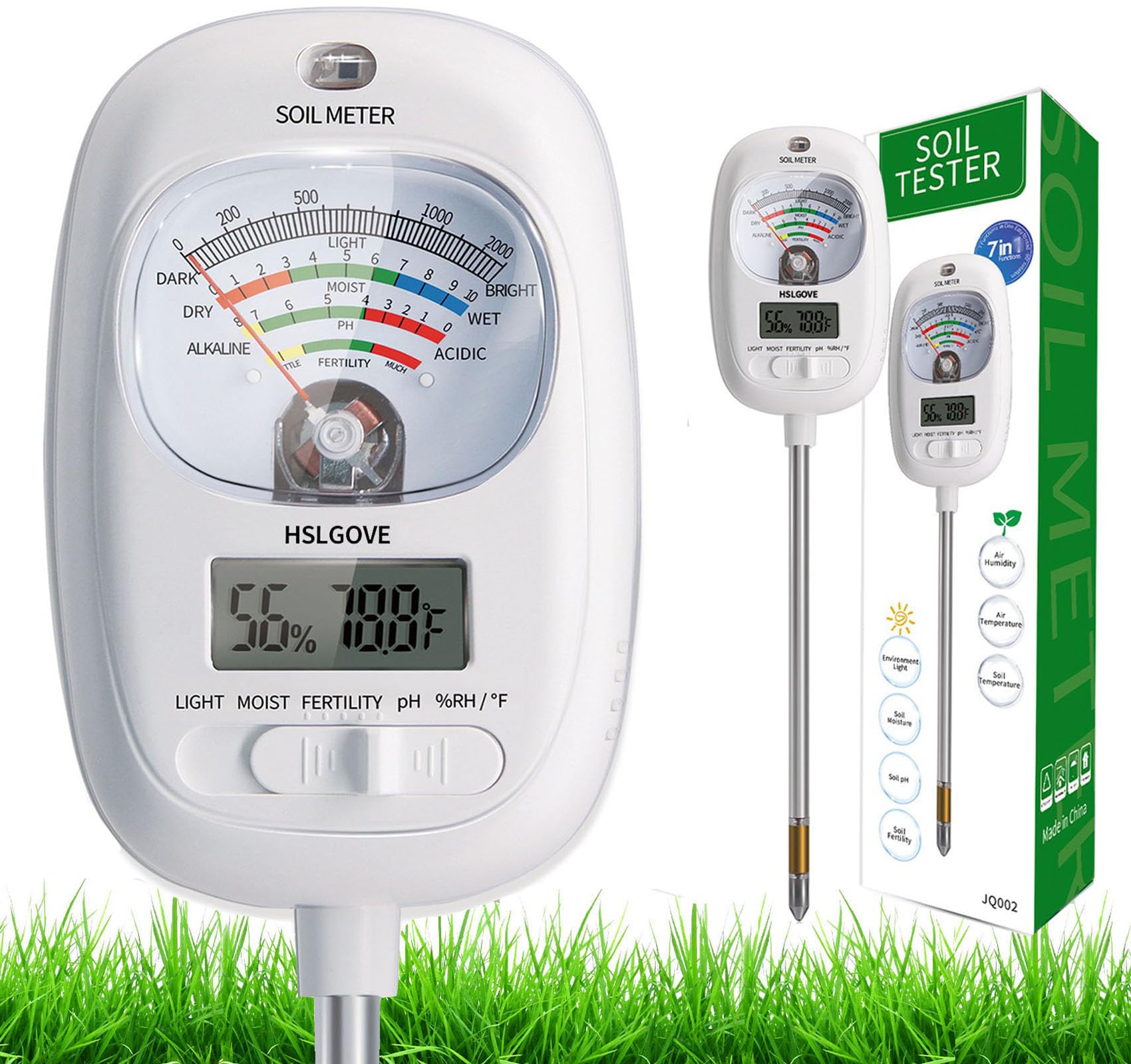
An analog-digital hybrid that tracks everything from soil temperature to air humidity on a single screen.
The HSLGOVE is the most complete meter for anyone who treats plant care as a data-driven practice. It uses a traditional analog dial for moisture, pH, fertility, and sunlight — the four readings you get from a standard multi-meter — and then adds a separate LCD screen that displays soil temperature, air temperature, and air humidity. That combination matters when you adjust watering around seasonal shifts or try to mimic a specific microclimate for a tropical plant. The probe is 6.8 inches long and built from three types of metal for conducting accuracy. The whole unit weighs 4.8 ounces. Owners highlight the dual-screen design: “helped adjust watering/fertilizer. Quick results, well-made.” The catch is that the LCD section runs on three small batteries (button cells), so you will need to replace those every so often.
Why it stands out
- Dual-screen layout shows analog soil data and digital air readings at once
- 6.8-inch probe reaches deep into large pots and garden beds
- Measures seven parameters including air temperature and humidity
What to watch for
- LCD portion requires small batteries (button cells) that need periodic replacement
- Wait 3 to 5 minutes for the air readings to stabilize
Pick this if: you want a single tool that covers both soil chemistry and ambient climate data for serious plant monitoring.
Pass if: you prefer battery-free operation — the digital screen adds ongoing power maintenance.
6. Fiddle Leaf Fig Plant Food Health Meter
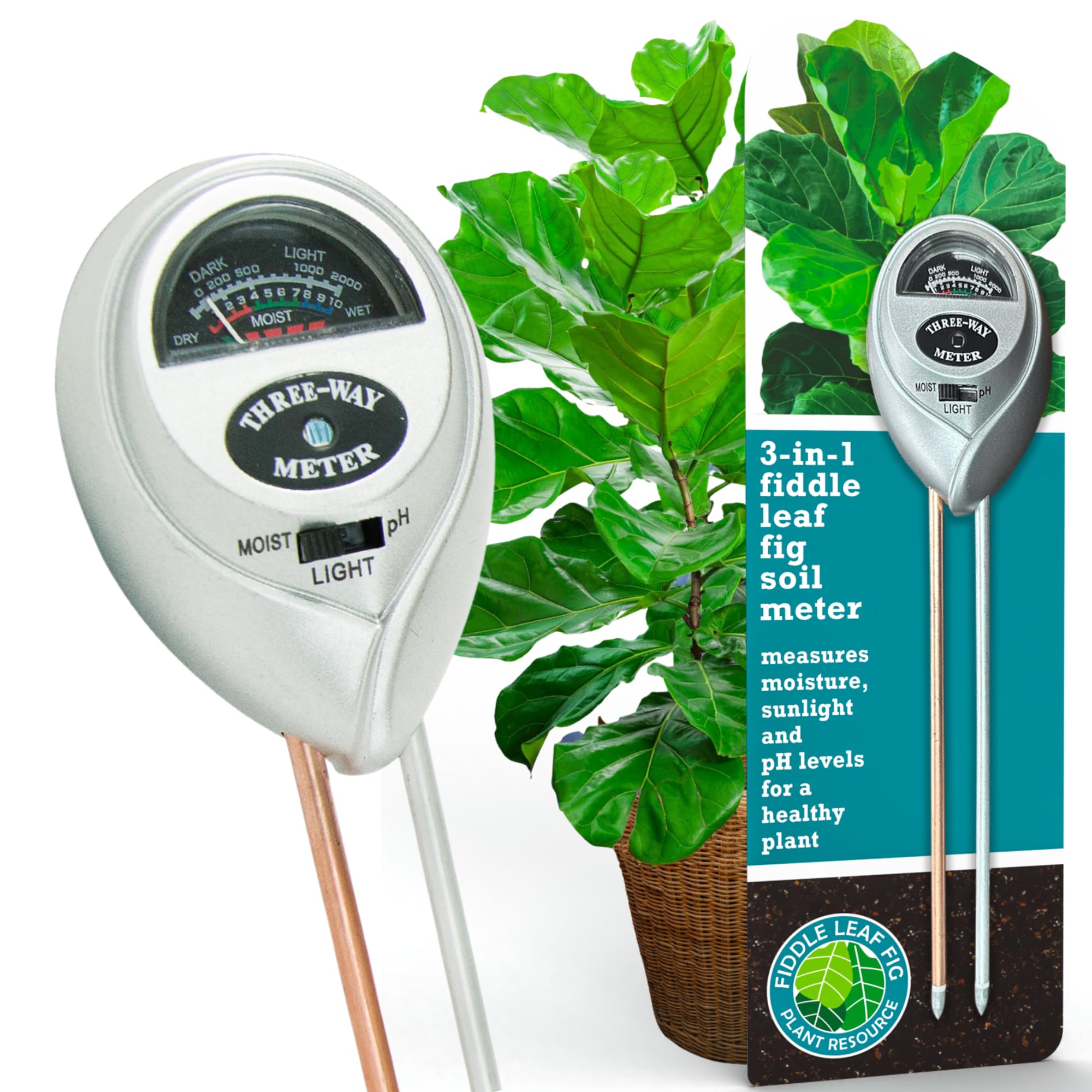
Built specifically for fiddle leaf fig owners, with a three-position toggle for moisture, light, and pH.
This meter comes from a brand that focuses exclusively on fiddle leaf fig care, so the design is tuned for that finicky tree’s specific soil conditions and watering needs. The 3-in-1 toggle switch cycles between moisture, light, and pH readings. The long probe reaches down through loose, well-draining soil that fiddles prefer. At just 2.1 ounces, it is among the lightest multi-function meters here. Several owners with 7-foot fiddle leaf figs report that the moisture meter helped them nail their watering schedule and prevent root rot. However, the light sensor tends to read “good” even under direct sunlight, so treat that scale as a rough guide. A small number of units arrive defective, so test yours right away against a known wet and dry pot.
Its best qualities
- Specifically designed for fiddle leaf fig soil and root depth
- Three measurements from a single toggle switch — no removing the probe between readings
- Very lightweight at 2.1 ounces
Consider this
- Light sensor can be inaccurate, especially indoors
- A handful of owners received defective units — test immediately on arrival
Made for: dedicated fiddle leaf fig owners who want a tool tuned to their plant’s specific needs.
Not for: mixed plant collections or anyone who needs a reliable light measurement — the sensor is the weak link here.
7. iPower 3-in-1 Meter
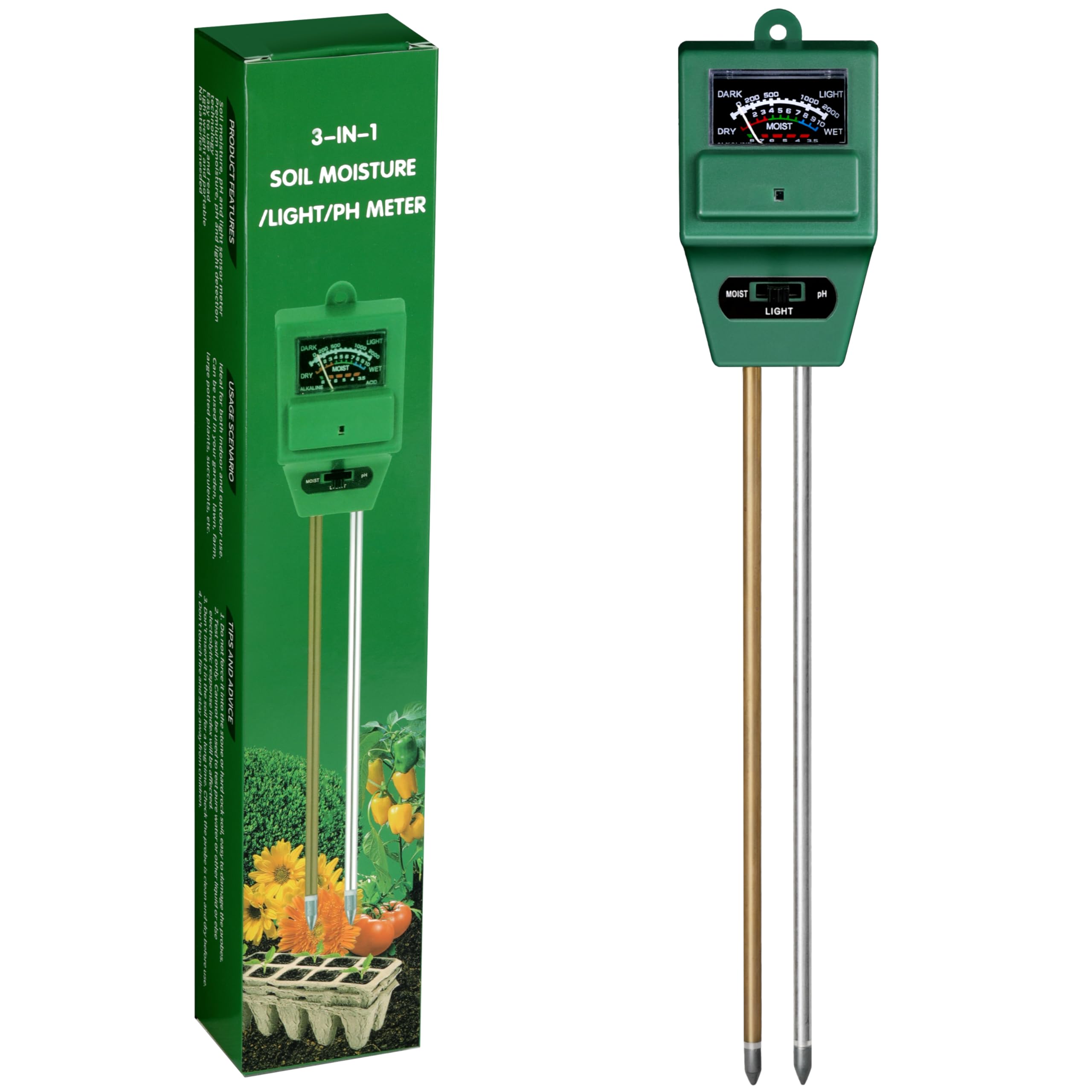
A straightforward three-way tester that covers the basics without asking for a battery or a big spend.
The iPower 3-in-1 is the definition of no-frills: you get moisture, pH, and light readings from a single analog dial, and the unit works immediately with no power source or calibration. It is designed for the gardener who wants to confirm a hunch — is the soil still damp two inches down, or is the pH drifting off — without paying for features they will never use. The large dial is easy to scan even in low light, and the whole meter is light enough to carry between pots without fatigue. Owner reports are generally positive — “I have a lot of plants, this helps to make watering accurate and easy” — though a subset of buyers found the pH readings inconsistent between units. For moisture checking, the consensus is solid. For pH precision, some owners suggest moving up to a dedicated pH probe if acidity levels are critical. The three-in-one design also lacks a fertility scale, so if nutrient monitoring matters, the AiGerdinn or HSLGOVE would be a better fit.
Why it makes the list
- Three measurements from a single, battery-free dial
- Lightweight and portable for quick checks across multiple pots
- Budget-friendly entry into multi-function testing
Honest note
- pH readings can vary between individual units — not a lab-grade measurement
- No fertility or temperature readings
Best for: casual plant owners who need moisture and a quick pH check without spending for extras.
Pass if: you need reliable pH accuracy — spend a bit more on a single-parameter pH tester.
8. IPPINKA Sustee Aquameter (Medium, 4-Pack)

The same color-change sensor as the two-pack, scaled up to cover your whole windowsill at once.
If the two-pack Sustee works well for a couple of key plants, the four-pack turns your entire collection into a self-monitoring display. Each stick lives permanently in a medium pot (sized 3.5 through 6 inches) and indicates watering needs through the same blue-for-wet, white-for-dry window. Each core lasts about 6 to 9 months before a refill is needed. Buyers report strongly positive feedback on the leave-in convenience — “works great for cactuses, tropical plants, every plant!!” — and you can spot a dry plant from across the room without touching any soil. The downside: color change is not perfectly consistent across all potting mixes, and the ongoing cost of replacement cores adds up over time, especially across four sticks. Some owners also find the “value for money” rating mixed, given that a single handheld meter is cheaper.
Why it stands apart
- Four sensors let you monitor the majority of your indoor pots at a glance
- Permanent in-soil design means no insertion/removal cycle
- Collaboration with Tokyo University of Agriculture adds design credibility
The trade-off
- Replacement cores every 6-9 months are a recurring expense across four units
- Color accuracy can be inconsistent depending on soil type
Best fit: plant owners with a moderate-to-large indoor collection who prefer visual cues over manual testing.
pass on it if: you are budget-sensitive — a single handheld meter costs less and can check unlimited pots.
9. Buladeke 7-in-1 Digital Soil Tester
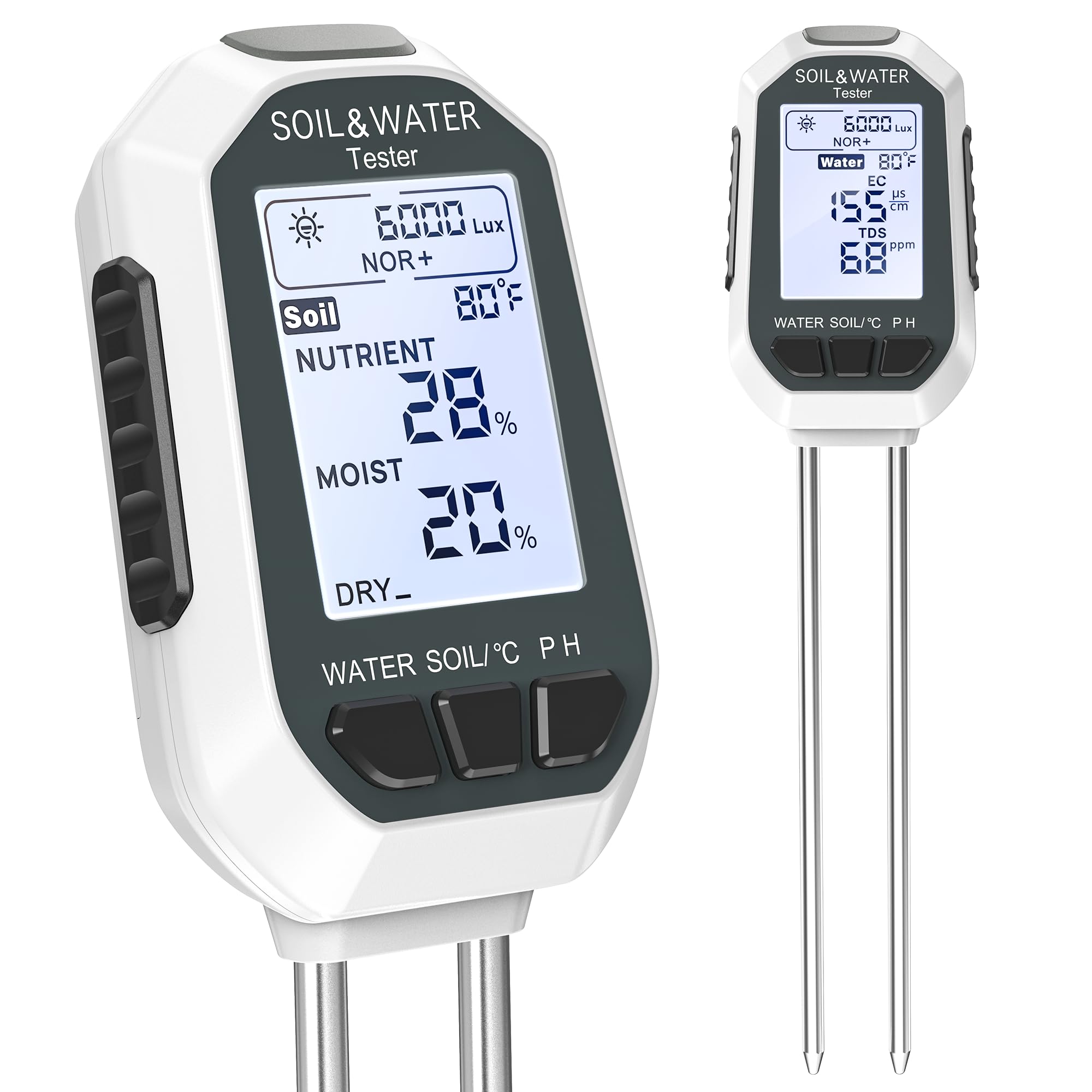
A full digital dashboard for your soil — with a backlit screen and seven parameters — but it needs AAA batteries.
The Buladeke brings the most specs into a single handheld device: moisture, pH, temperature, light intensity, fertility, EC (electrical conductivity, which measures dissolved salts), and TDS (total dissolved solids). The large LCD screen uses a white backlight so you can read numerical values in a dim corner or outdoors at dusk. The unit runs on four AAA batteries (not included) and warns you when power is low. Owners praise the screen quality — “much easier to read than my old plant tester” — and appreciate that the same probe measures so many conditions. It is the only meter on this list that gives you EC and TDS, which matters if you are tracking fertilizer concentration in hydroponic or semi-hydro setups. One review calls it “not a precision instrument but provides useful ballpark values.” For hobby-level care and quick checks, that is exactly what most growers need.
Its biggest strengths
- Seven parameters including EC and TDS — the widest range on the list
- Backlit LCD makes reading easy in any lighting condition
- Fast results — insert the probe 10 cm deep and wait about 10 seconds
What to consider
- Requires four AAA batteries (not included) and adds ongoing power cost
- Readings are ballpark-level — not suited for scientific-grade accuracy
Choose this if: you love data and want the broadest possible digital readout of your soil’s condition.
Look elsewhere if: you want battery-free simplicity — the analog meters above cost less and need no power.
Understanding the Specs
Probe Length and Design
Most handheld meters have a probe between 5 and 8 inches. A longer probe reaches the root zone of deep pots, which is where moisture behavior differs from the surface. Single-probe designs disturb less soil and are gentler on roots than dual-prong meters, but they are also narrower and more prone to bending if you push into hard, dry dirt.
Analog vs. Digital Readout
Analog meters use a needle on a printed scale — simple, battery-free, and durable. They tell you a zone (dry/moist/wet) rather than an exact number. Digital meters show precise values on an LCD screen and can include extra functions like temperature, pH, and EC, but they require batteries and are more sensitive to damage. Pick analog for reliability; pick digital for data depth.
Leave-In vs. Handheld Design
Handheld meters are inserted, read, and removed — one tool checks every pot you own. Leave-in sensors stay in a single pot permanently and change color or show a reading at all times. Leave-in designs are convenient for forgetful owners but cost more per pot, and the sensor cores eventually need replacing. Handheld meters are the better value if you have more than a few plants.
Extra Measurements (pH, Light, Fertility, EC, TDS)
Many meters include pH, light, and fertility scales on the same probe. These provide directional guidance rather than lab accuracy, which is useful for catching problems early. EC and TDS are more advanced parameters that measure dissolved salts and nutrients in the soil or water — relevant for growers using liquid fertilizers, semi-hydro setups, or trying to dial in a precise feeding schedule.
FAQ
Can I leave a moisture meter in the soil permanently?
Why does my meter give different readings in the same pot?
Do I need a meter that measures pH, light, and fertility as well?
How deep should I insert the probe?
What does the color blue or white mean on a leave-in sensor?
Can I use a moisture meter in liquids or very hard soil?
How often should I replace the batteries in my digital meter?
Is a single-probe meter better than a dual-probe meter?
What is the difference between an analog dial meter and a digital LCD meter?
How do I keep my moisture meter working for years?
Final Thoughts: The Verdict
Across the board, the houseplant moisture meter winner is the XLUX Soil Moisture Sensor 2-Pack because it delivers an instant, battery-free reading at a fair price with enough reliability that over 70,000 owners have backed