
Specs are compiled from manufacturer listings and verified buyer reviews and can change over time — please confirm the key details on the product page before buying.
Waking up to find your peach tree leaves curling or your citrus branches covered in a sticky mess is a gut punch. You need a solution that smothers pests without nuking your soil or your fruit. That is exactly what the right spray oil does — it coats and suffocates the bugs you cannot see and the fungal spores waiting to spread, all while being safe enough for organic gardening.
I’m Rikta — the founder and writer behind Lawn Gear Lab. This guide is built by comparing the manufacturers’ published specifications and the patterns across verified customer reviews, so you get each pick’s real strengths and trade-offs instead of marketing spin.
Choosing the wrong oil can waste your season, so we have done the digging to find the best horticultural oil for fruit trees that actually works on everything from aphids to powdery mildew without harsh residues.
Our Picks at a Glance


How To Choose The Best Horticultural Oil For Fruit Trees
Horticultural oil comes in two main forms that match your tree’s annual cycle — dormant oil for winter and all-season oil for the growing months. The ingredient list matters just as much as the timing. A 98% parafinic oil with an emulsifier is a different beast than a 75% mineral oil mixed with a pesticide like malathion. You decide based on what your specific infestation is and how close you are to harvest. Look for the OMRI label if you are growing organic, and always check the label for specific fruit trees — apples, citrus, peaches, and avocados each have their own mixing instructions.
Dormant vs. Growing Season Application
Dormant season spraying means applying the oil in late winter or very early spring before buds break, when insects and their eggs are overwintering on the bark. This smothers them before they ever get a chance to feed on new growth. Growing season oils are lighter and refined so they do not burn the leaves while still coating and killing active pests like aphids, scale, and whiteflies. Some products, like the Bonide All Seasons, are formulated for both windows — you just adjust the dilution ratio based on the season.
Concentration and Coverage
Concentrates give you far more value per bottle and let you dial in the strength per application, but they require a separate sprayer and careful measuring. Ready-to-spray bottles attach to your garden hose, making the job fast and simple, though you get fewer applications per bottle. The coverage also depends on how fine the oil droplets are. Finer droplets coat the leaf surfaces more evenly, which prevents leaf burn and ensures scale insects and mites are properly smothered. If you have more than a couple of trees, a concentrate will save you money and trips to the store.
Quick Comparison
| Model | Best For | Oil Type | Active Ingredient | Size | Amazon |
|---|---|---|---|---|---|
| Bonide All Seasons★ Best Overall | Year-round all-rounder | Mineral Oil | Mineral Oil | 32 oz | Amazon |
| Southern Ag Parafine 32 ozPremium Pick | Citrus leafminers | Parafinic Oil | 98% Parafinic Oil | 32 oz | Amazon |
| Southern Ag Parafine 16 ozBest Value | Refined precision | Parafinic Oil | 98% Parafinic Oil | 16 oz | Amazon |
| Summit Year-Round Spray Oil | Concentrated value | Oil Concentrate | Oil | 32 oz | Amazon |
| Southern Ag Malathion-Oil | Heavy pest pressure | Oil + Malathion | 5% Malathion, 75% Mineral Oil | 16 oz | Amazon |
| Monterey Horticultural Oil RTS | Ready-to-spray convenience | Mineral Oil | Oil | 32 oz | Amazon |
| VPG DPD Dormant Spray Oil | Dormant season bulk spraying | Oil Spray | Oil | 1 gallon | Amazon |
| Bonide Captain Jack’s Fruit Tree | Fungal + insect control | Cold Pressed Neem Oil | Cold Pressed Neem Oil | 64 oz | Amazon |
In‑Depth Reviews
1. Bonide All Seasons Horticultural & Dormant Spray Oil, 32 oz Ready-to-Spray
Our pick — 4.5★ from 800+ verified ratings; the strongest balance of quality and price.
Year-round pest and disease coverage you attach to a hose and spray.
This is the one-bottle solution for the grower who does not want to track a dormant oil and a separate summer spray. The active ingredient is mineral oil, and it works from the dormant stage right through the growing season — smothering adelgids, aphids, scale, mites, mealybugs, and certain moth species, plus helping control powdery mildew and rust. You use it on pears, cherries, peaches, and a long list of vegetables and ornamentals. Because it is mineral-oil based, it leaves no toxic residues and is approved for organic gardening, so people and pets can be around the treated area safely.
What really sets this bottle apart is the convenience. You screw it onto a standard garden hose and spray. Several owners found that the hose-end sprayer itself can be finicky — it may empty faster than expected or be poorly calibrated — so many experienced users recommend a pump sprayer for better control and value. The mixture itself drew praise for working fast: as one owner put it, “took care of the black cherry aphids overnight.” Another saw results on azalea bark scale within days. The single recurring heads-up is to avoid the hose sprayer if you have a lot of trees; use it with your own pump rig and you get excellent coverage per dollar.
What wins people over
- Works all year — dormant, delayed dormant, and growing season — no second bottle needed
- Smothers insects and controls fungal diseases like powdery mildew and rust
- Mineral oil formula is OMRI-compatible for organic gardening and safe around people and pets
The honest trade-off
- The included hose-end sprayer is poorly calibrated and empties too fast for larger jobs
- Best results come from using your own pump sprayer for even coverage and cost control
Grab it if: you want a single ready-to-spray oil that covers the entire calendar — from winter dormant spray to summer foliar protection — and you have a pump sprayer handy.
Think twice if: you need the absolute lowest cost per gallon; a concentrate will stretch further for a multi-tree orchard.
2. Southern Ag Parafine Horticultural Oil, 32oz
Year-after-year go-to for aphids and citrus leafminers.
This is a 98% parafinic oil with just 2% emulsifier, and the purity makes it both a dormant oil and a summer oil depending on how you mix it. The label puts apples, citrus, and avocados front and center, and the target list is scale, whitefly, mealybugs, and spider mites. One long-time buyer stated they have used Parafine for years and when they tried another brand, the aphids persisted — switching back to Southern Ag solved it. Another citrus grower called it the best treatment for leafminers while keeping things organic.
You get more concentrate for your money with the 32-ounce size than with the 16-ounce pint of the same formula, making it the balance for a medium orchard. Buyers report it is easy to mix and apply, and that it cleans sticky, dirty foliage in the process. The only thing to watch is you need to be comfortable reading a label — the back provides specific mixing ratios for each type of tree, and the correct ratio varies from summer to dormant applications. This is not a ready-to-spray bottle; you supply the tank.
Why it stands out
- 98% pure parafinic oil — lightweight enough for summer use, strong enough for dormant season
- Proven track against aphids, scale, spider mites, and citrus leafminers
- Better value than most competing brands of the same concentration
Know before you buy
- Concentrate only — requires your own sprayer and careful measuring per tree type
- Not formulated for fungal diseases; you would need a separate fungicide
Ideal for: the experienced fruit tree grower who wants a refined, high-purity oil that works across seasons and trusts the same brand year after year.
Not for: anyone looking for a hose-end sprayer or a product that also treats powdery mildew in one bottle.
3. Southern Ag Parafine Horticultural Oil, 16 Ounces
Small bottle with big results on scale and mealybugs.
Do not let the 16-ounce size fool you — this is a concentrate, and each pint makes several gallons of finished spray. The formula is identical to the 32-ounce version: 98% parafinic oil with 2% emulsifier, safe for apples, citrus, avocados, and ornamentals. One owner described using it on king sagol palms that had a white coating of scale on stems and fronds, plus mealybugs. Two applications two weeks apart, and two months later the palms were growing healthy again. Another grower found it effective on Ficus benjamina scale where their neem oil had failed.
Buyers consistently highlight the price as a major reason to choose this over other brands. The pint is budget-friendly for someone with just a couple of trees or limited storage. The trade-off is simply volume — if you have a full home orchard of half a dozen trees or more, you will need the quart or gallon size to avoid running out mid-season. The label on the back is dense but thorough, giving specific mixing ratios for each plant type, which a few first-timers noted makes the bottle look smaller than expected in hand.
What buyers love
- Smallest, cheapest entry point into premium 98% parafinic oil for a few trees
- Kills scale, mealybugs, and aphids faster than many systemic options
- Cleans sticky, dirty foliage and leaves a healthy sheen
The catch
- 16 oz of concentrate only goes so far for multiple large trees or a full orchard
- Needs a separate sprayer; not ready-to-use
Reach for this if: you have one or two citrus or avocado trees and want the same quality formula as the bigger bottles without the upfront cost.
Look elsewhere if: you are spraying a dozen trees each season — you will save money buying the 32 oz or gallon.
4. Southern Ag Malathion-Oil Citrus and Ornamental Spray, 16 Ounce

Heavy artillery for scale and citrus mealybug outbreaks.
This is a different category from the pure parafinic oils above — it combines 75% mineral oil with 5% malathion (a conventional insecticide), plus 20% other ingredients. The label is written for citrus, avocados, palms, and outdoor ornamentals, targeting scale, whiteflies, spider mites, and citrus mealybug. Because it contains malathion, it works faster and on larger insects than oil alone, but it also carries more precautions: you absolutely avoid spraying during bloom to protect bees, and the odor is noticeably stronger, making indoor use a bad idea. One owner used it for scale on plants and reported most were gone within two weeks; a second spray after a month cleared everything.
Where this product shines is the crawler stage of scale insects. The manufacturer notes that better scale control is achieved when applications happen during that mobile crawler phase, and the oil covers eggs while the malathion hits the active bugs. The pint bottle is compact — 6 inches tall by 4 inches wide — but again, it is a concentrate, so a little goes a long way. A buyer described the smell as “a little strong” and recommended keeping it outdoors. For someone growing organic fruit, this is not the route. But for a grove with a stubborn scale infestation that pure oil has not knocked down, this gives you a second, more potent tool.
The advantage
- Dual-action formula — mineral oil smothers eggs, malathion kills active insects quickly
- Specifically formulated for citrus, avocado, and palms with heavy scale pressure
- Very effective on scale crawler stage, which is the hardest to control
The trade-off
- Contains malathion — toxic to bees during bloom, requires careful timing
- Strong odor compared to pure horticultural oils; use outdoors only
- Not suitable for organic gardening programs
Choose this when: you have a persistent scale or mealybug infestation on citrus that pure oils have not resolved and you are comfortable with conventional insecticide timing.
skip it if: you grow organic fruit, have bees nearby, or simply want a gentle all-season oil without chemical additives.
5. Summit Year-Round Spray Oil for Garden Insects Concentrate, 32-Ounce

A tiny bit of concentrate goes a long way against a wide pest list.
Summit markets this as a year-round spray concentrate, and it works on a broad range: aphids, spider mites, fungus gnats, scale, whitefly, and more. It also claims to prevent and cure powdery mildew, which puts it a step ahead of pure smothering oils. One owner with lemon trees had armored scale and treated them once — that was it. They thought a second treatment would be needed but the single application resolved it. Another user killed a whitefly infestation in one spraying and noted the concentrate is highly effective, making several gallons from the 32-ounce bottle.
An OMRI listing confirms it meets organic standards, and buyers appreciate that it has no harsh odor and adds a shiny luster to leaves. The catch is the packaging. Several deliveries have arrived in a simple plastic bag, not a box, and roughly a tenth of the product leaked out in transit. The residue is oil, so it creates a messy cleanup and means you might be short on your first batch. The formula itself earns strong praise across the board, but be prepared to wipe down the bottle — and consider decanting it into a more secure container before storing it in your shed.
What makes it great
- Highly concentrated — just a tiny bit per gallon stretches the bottle across many applications
- Controls both insects (scale, mites, whitefly) and powdery mildew in one product
- OMRI listed for organic gardening with no synthetic toxins and very little scent
What to watch
- Fragile packaging — bottles are shipped in bags and can leak, losing some product
- Leaves an oil residue on soil surface that some gardeners dislike
Best for: the budget-conscious organic grower who wants a single concentrate that handles bugs and powdery mildew, and who decants into a different bottle.
Maybe not if: you prefer a ready-to-spray hose attachment and do not want to handle concentrate spills.
6. Monterey Horticultural Oil RTS Ready to Spray, 32 oz
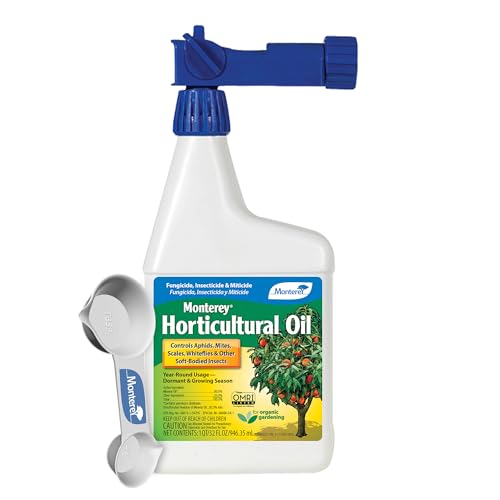
Hose-and-spray simplicity for quick pest knockdown.
This Monterey product is ready to spray right out of the bottle — you connect it to a standard garden hose and pull the trigger. It targets aphids, leaf miners, thrips, leafhoppers, spider mites, scales, whiteflies, and mealybugs, and the label notes it gives poor control for caterpillars and worms but does control the eggs of all insects. It is OMRI listed for organic gardening and can be used as both a dormant spray and a growing season spray on apples, almonds, avocados, citrus, peaches, pecans, blackberries, figs, and pineapple.
The convenience drew a lot of positive feedback. Buyers used it to save a small kaffir lime tree, eliminated worms on a weeping Ruby Falls tree in one application, and found it easy to use. The spray pattern, however, is a fixed fan — not a stream — which means the effective range is limited to about six feet. For tall fruit trees or high egg masses, you either need a ladder or a different tool. A few also mentioned the on/off valve requires two hands and offers no partial flow control. If your trees are bush-height or you grow vine crops, this is enormously convenient. For full-size peach or apple trees, the limited reach is a real headwind.
Pros
- No mixing, no measuring — screws onto the hose and sprays immediately
- Controls a broad spectrum of pests including leafminers, thrips, and scale
- OMRI listed for organic gardening; safe for use up to day of harvest
Cons
- Fixed fan spray pattern limits reach to about 6 feet; not ideal for tall trees
- Overspray can leave oil marks on painted surfaces (removable with effort)
- Does not control caterpillars or worms effectively
Grab this for: small fruit trees, bushes, and vegetable gardens where you want the fastest possible setup and do not want to handle concentrate.
Pass on it if: you have full-size fruit trees that require reaching high into the canopy — the fan spray cannot make that shot.
7. VPG DPD Dormant Spray Oil – Hi-Yield, Gallon
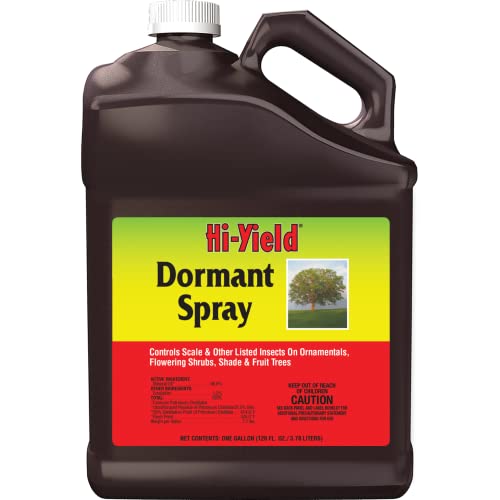
One gallon of winter insurance for your entire orchard.
If you spray a collection of fruit trees every late winter, this one-gallon jug of dormant oil is the most cost-effective way to get the job done. The Hi-Yield formulation is designed for the dormant season — you apply it after pruning in late February on a day above 60 degrees to smother overwintering scale, mites, fruit tree leaf rollers, pear psylla, fall armyworms, and whiteflies. One fig grower uses it on their entire fig collection and reports never having issues so long as they apply this in the off season. Another described it as the best way to prevent bugs from eating the fruit later in the year.
The gallon size means you are not buying a new bottle every spring. You can also mix it with other insecticides or fungicides if your dormant routine includes a copper spray, though the label says to check compatibility. A few owners noted it did not clear black sooty mold on crape myrtles, but that is a fungal issue beyond dormant oil’s scope. The one recurring gripe is that the bottle is a simple jug, so you need your own sprayer and careful measuring. The delivery is generally secure, and the brand is known for reliability. For the dedicated orchardist who wants to protect a dozen trees with one purchase, this gallon delivers.
Why it is a smart buy
- Full gallon of concentrate — the lowest cost per ounce for serious multi-tree growers
- Smothers scale, mites, leaf rollers, pear psylla, and armyworms in dormant season
- Can be tank-mixed with other fungicides or insecticides for a comprehensive dormant spray
The fine print
- Dormant use only — not formulated for summer foliar application on growing leaves
- Does not fix existing fungal issues like sooty mold; you need a separate treatment for that
- Requires a separate sprayer; no hose-end option
Made for: the serious fruit tree grower with multiple trees who wants a single, affordable gallon to knock out overwintering pests before spring.
Not for: summer spraying on active foliage or someone who only needs a small bottle for one tree.
8. Bonide Captain Jack’s Fruit Tree Spray, 64 oz Concentrate

Cold-pressed neem oil that fights bugs and fungal blights in one mix.
Buyers with citrus trees and apple trees have used it for two years running and note their trees look healthier and are finally starting to produce fruit. One owner with a small orchard of apples and pears saw bugs tearing up the leaves; after two seasons of this spray, the trees rebounded. The one notable warning from the reviews is a specific caution: do not use this on pear trees. A few pear tree owners experienced issues, so if pears are your main crop, read the label carefully. For apple, citrus, and stone fruit growers, this is a powerful all-in-one concentrate that covers both the insect and disease side of tree care.
The big plus
- Cold pressed neem oil tackles insects AND fungal diseases (blight, black spot, powdery mildew) in one mix
- Approved for organic gardening and can be used up to the day of harvest
- Large 64 oz concentrate makes gallons of spray, ideal for a multi-tree home orchard
Heads up
- Reported by multiple buyers to cause issues on pear trees — check compatibility before spraying
- Needs to be mixed and shaken well before each use; requires a dedicated sprayer
Pick this if: you want a neem-based, dual-action concentrate that protects apples and citrus from both chewing insects and common fungal blights, and you are okay with mixing your own spray.
Pass if: pears are your main fruit tree, or if you prefer the quick coverage of a ready-to-spray mineral oil.
Understanding the Specs
Parafinic Oil vs. Mineral Oil
Parafinic oil is a highly refined mineral oil that is lighter and less likely to burn leaves during summer application. The label “98% Parafinic Oil, 2% Emulsifier” means you get a very pure, clean-burning oil that mixes easily with water. Standard mineral oil is the same broad category but may have a different distillation range; the key difference is the purity grade. For fruit trees, the higher refinement means you can spray closer to bud break and during the growing season with less risk of phytotoxicity (leaf burn).
Dormant Oil vs. Growing Season Oil
A dormant oil is thicker and meant for application when the tree is fully leafless in late winter. It smothers overwintering insect eggs and fungal spores on the bark. A growing season (or summer) oil is lighter and more refined so it can be sprayed on green leaves without burning them. Some products, like the Bonide All Seasons, use a single oil formulation for both windows by instructing you to change the dilution rate. Always follow the seasonal dilution instructions on the label — using the wrong concentration during active growth can damage foliage.
OMRI Listing
OMRI stands for the Organic Materials Review Institute. Products with the OMRI seal have been reviewed and meet the USDA National Organic Program standards for use in organic production. That means no synthetic pesticides, no persistent toxins. If you are growing fruit trees for your family and want to avoid chemical residues, an OMRI-listed oil is the right choice. Note that OMRI listing covers the product’s ingredients, not its effectiveness — you still need to apply it correctly.
Concentrate vs. Ready-to-Spray
A concentrate requires you to mix the oil with water in a pump sprayer at the ratio specified on the label. You get far more applications per bottle and you control the strength. Ready-to-spray (RTS) bottles screw directly onto a garden hose and automatically mix the oil with water as you spray. RTS is much more convenient for quick jobs on a few trees, but the spray pattern is often fixed (typically a fan) and the total number of gallons you can make is limited by the bottle’s pre-measured concentrate. For a small yard with a couple of dwarf trees, RTS is plenty. For an orchard, a concentrate will save you money and give you more control.
FAQ
Can I use horticultural oil during the summer on my fruit trees?
What is the difference between horticultural oil and neem oil for fruit trees?
How often should I spray dormant oil on my fruit trees?
Will horticultural oil hurt my fruit?
What fruit trees are safe to spray with these oils?
Do I need a special sprayer for horticultural oil?
Will the oil burn my trees if I spray in the heat of the day?
Can I mix horticultural oil with other fungicides or insecticides?
What is the shelf life of a bottle of horticultural oil?
How do I know if my tree has scale insects and needs oil treatment?
Final Thoughts: The Verdict
For most fruit tree owners, the horticultural oil for fruit trees that offers the best combination of coverage, convenience, and proven results is the Bonide All Seasons Horticultural & Dormant Spray Oil. It works from winter dormancy through fall, handles both insects and fungal disease, and the ready-to-spray format makes your first application fast. If you want a higher-purity concentrate for citrus and avocados, reach for the Southern Ag Parafine 32oz — it is a multi-year favorite among orchardists. And for the grower who needs dual insect-and-fungal control with a neem base, the Bonide Captain Jack’s 64 oz is the one to fill your tank with before the season kicks off.
How We Picked
We do not accept paid placement. Every pick is matched to a real buyer and a real use-case; we do not hands-on test units.
Sources & Methodology
Specifications: manufacturer listings and product documentation. Review insights: verified customer reviews, as of July 2026. Pricing: not shown on this page (it changes often); check the current price via the retailer link.
As an Amazon Associate, Lawn Gear Lab earns from qualifying purchases. This does not affect which products we feature.