
Specs are compiled from manufacturer listings and verified buyer reviews and can change over time — please confirm the key details on the product page before buying.
A hoop house is the simplest way to buy your garden a few extra weeks of growing time in the spring and protect your fall crops from an early frost. But between the cheap wire sets that rust halfway through the summer and the kits that blow over in the first gust of wind, picking the right one can feel like a gamble. The best hoop houses are defined by three factors: hoop material, connector quality, and real-world stability.
I’m Rikta — the founder and writer behind Lawn Gear Lab. This guide is built by comparing the manufacturers’ published specifications and the patterns across verified customer reviews, so you get each pick’s real strengths and trade-offs instead of marketing spin.
Whether you are starting seeds in a cold frame or stretching your tomato season into late October, this roundup of the best hoop house for garden beds cuts through the noise to show you exactly which kits are worth the setup effort and which ones will let you down.
Our Picks at a Glance

How To Choose The Best Hoop House For Garden Beds
A few key specs separate durable hoop houses from those you will replace next season.
Hoop Material and Thickness
Fiberglass is the clear winner here. It does not rust like steel wire and it does not get brittle in the sun like PVC. Look for flat strip-style hoops if you need to span a wider bed — they resist bending fatigue far longer than round rods. The thickness of the fiberglass, measured in millimeters, matters most: a 3mm strip can handle a 5.5-foot wide bed without collapsing, while a thinner 2mm strip is better suited for beds under 3.5 feet.
Connector and Clip Quality
The weak point in any hoop house is where the pieces join. Look for metal connectors over plastic ones, and pay attention to how tight the fit feels. Loose connections let the whole tunnel sag or pop apart in a breeze. You also want clips that hold your cover fabric snugly — silver metal clips tend to grip better than the standard green plastic type that slide off in the wind.
Kit Completeness
Some kits include the hoops, connectors, and clips but leave you to buy the cover fabric separately. Others bundle the netting or frost cloth right in the box. Decide which setup you prefer before you buy — a complete kit gets you running faster, but a hoop-only set lets you choose your own cover material for the exact level of sun or frost protection your plants need.
Quick Comparison
| Model | Best For | Hoop Count | Hoop Material | Cover Included | Amazon |
|---|---|---|---|---|---|
| OOTONAT Garden Hoops★ Best Overall | Large raised bed coverage | 72 | Fiberglass | No | Amazon |
| Monirsen Garden Netting Kit | All-in-one pest protection | 36 | Fiberglass | Yes (mesh) | Amazon |
| Sunwuk Garden Hoops (M Size) | Wide-bed sturdiness (2.5–5.5 ft) | 60 | Fiberglass (3mm flat) | No | Amazon |
| Gardener’s Supply Co. Super Hoops | Quick low tunnel for small beds | 6 | Powder-coated steel | No | Amazon |
In‑Depth Reviews
1. OOTONAT Garden Hoops for Raised Beds (72-Pack)
Our pick — over 4★ from 150+ verified ratings; the strongest balance of quality and price.
The crowd favorite that gives you 72 hoops for a serious tunnel setup across a whole garden.
This kit loads you up with 72 fiberglass hoops, 60 connectors, 48 clips, and 24 support bases — everything except the cover fabric for a complete 4-foot-wide hoop house. The hoops are rust-resistant fiberglass, so you will not see the orange streaks that cheap steel rods leave behind after a wet season. Buyers report that “the metal tube connections worked well” and that the structure survived both wind and snow across multiple seasons.
The sheer number of hoops lets you build a continuous tunnel over a long raised bed, unlike kits that offer just a handful of arches. At 2.15 kilograms (roughly 4.7 pounds), the whole set feels substantial without being hard to handle. The catch is that the connectors can feel a little loose — several owners mention adding a dab of glue to tighten the fit.
Sturdiness is the most-discussed aspect of this set, and the response is split evenly: some find it rock-solid in the garden while others wish the joints clicked tighter. The real risk is that a few loose connections could let the whole tunnel sag in a strong gust. If your beds sit in an open, windy spot, plan to zip-tie or glue the joints for extra security.
What wins people over
- 72 hoops cover more ground than any other kit on this list — the Monirsen set has 36 hoops
- Fiberglass hoops resist rust and stay flexible through temperature swings
- Support bases keep the hoops anchored in loose soil
The honest trade-offs
- Connectors are not a tight snap-fit — some owners fix them with a drop of glue
- No cover included; you need to buy frost cloth or netting separately
The verdict: Grab this one if you have a long raised bed and want the flexibility to choose your own cover fabric.
skip it if: You prefer a ready-to-go kit with the netting included, or you want connectors that lock together firmly from the start.
2. Monirsen Garden Netting Kit for Raised Beds (10x30ft Mesh + 36 Hoops)
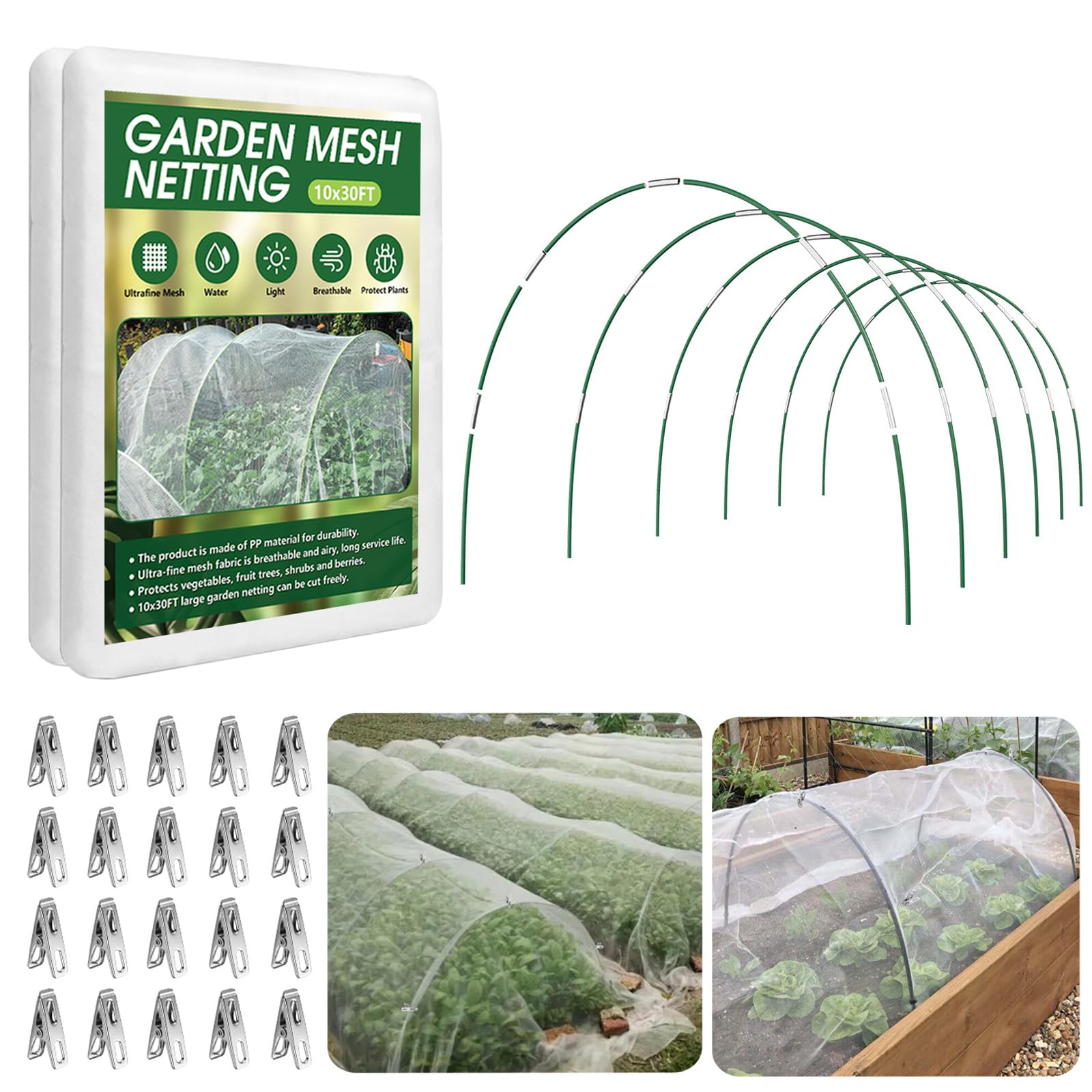
An all-in-one pest-blocking kit that includes both the frame and the netting in one box.
This is the rare kit that arrives with a 10×30-foot ultra-fine polyethylene mesh netting right alongside the hoops. The mesh openings measure 0.8mm by 1mm — small enough to keep out cabbage moths and other tiny pests while still letting air, light, and rain reach your plants. The 36 fiberglass hoops (combined with connectors into 6 sets of 8-foot arches) give you a 1.63-kilogram bundle that goes together quickly, with owners calling it “fantastic” and saying it “assembled easily.”
The hoops are adjustable in height, so you can keep the netting taut over a short row of lettuce or raise it higher for broccoli and cauliflower. Buyers consistently report that the netting stops bugs cold while the fabric is generous enough to overlap the edges and block gaps. The silver metal clips included for securing the netting get particular praise — they hold better than the flimsy green plastic clips that pop off when the wind picks up.
The trade-off is with the netting itself. A few owners warn that the fine mesh frays at the edges and can tear if snagged on a sharp stick or chewed by a determined chipmunk. The kit also contains just 36 hoops, while the OOTONAT set has 72 hoops — fine for a couple of standard raised beds but not enough for a long tunnel.
What makes it a value star
- Complete kit: hoops, connectors, netting, and clips in one purchase
- Ultra-fine 0.8mm x 1mm mesh keeps out tiny insects while passing water and sunlight
- Metal clips are easier to use and more durable than standard plastic ones
Where it cuts corners
- The mesh fabric frays at cut edges and may only last a season or two
- 36 hoops cover less ground than the 72-hoop OOTONAT kit
Who this fits: Gardeners who want everything in one box and need to keep bugs off their brassicas and leafy greens.
Think twice if: You need a large tunnel for a long bed — the hoop count is lower here — or you want a netting that survives multiple seasons without fraying.
3. Sunwuk Garden Hoops 60pcs — Medium Size (3mm Flat Fiberglass)

The 3mm-thick flat fiberglass strips that refuse to snap when bent over a wide bed.
This is the kit for the gardener who has broken round fiberglass rods before. Instead of round rods, Sunwuk uses flat strips of fiberglass that are 3mm thick — an extra millimeter over the standard 2mm — and claims 300% better bending capacity than round hoops. That extra thickness means the M-size strips can span a raised bed up to 5.5 feet wide without kinking or snapping, easily beating the 4-foot width limit of the OOTONAT set. The 60 strips are each 17 inches long, and you combine 4 to 6 of them per arch frame using the included 50 connectors.
The kit also throws in a pair of garden gloves with rubber-coated palms and fingers, along with 20 clips for securing your cover. Buyers who use these for shade cloth or bird netting over strawberry beds rave about the ease of assembly — “it only took minutes,” one owner of the set reports. The flat shape sits more flush against the soil than round hoops, so your cover fabric pulls tighter with fewer gaps at the edges.
The honest downside is that the connectors do not lock in place; the poles can separate from the connectors when you are positioning them. It is an easy fix — push them back together — but you will be doing it a few times during setup. The higher price reflects the better materials and the included gloves, but if you only need hoops for a standard 3-foot bed, the cheaper kits will work just fine.
Where it shines
- 3mm flat fiberglass handles up to 5.5-foot wide beds without breaking
- Includes garden gloves with rubber-coated palms for handling prickly plants
- 60 strips give you enough material for multiple long beds or a dense tunnel
The honest trade-offs
- Connectors pop apart during assembly — expect to re-seat them a few times
- Premium pricing that only makes sense if you actually need the extra width and thickness
Reach for this if: Your raised beds are wider than 4 feet and you have broken thinner hoops before.
Look elsewhere if: You are on a tight budget or you only need hoops for a standard 3-foot bed — the OOTONAT or Monirsen kits cost less and cover that width fine.
4. Gardener’s Supply Company Super Hoops (Set of 6)

A no-fuss steel hoop set for a quick low tunnel over a 3×3 or 3×6 foot bed.
These hoops from Gardener’s Supply Company are a different animal from the fiberglass kits above. They are made from powder-coated steel wire, which means they are heavier per hoop than fiberglass and will never snap, but they can kink if you bend them too sharply. Each hoop is 58 inches long and 4 inches wide, providing 14 inches of headroom in a 3-foot wide bed — enough for low-growing crops like lettuce, strawberries, and seedlings, but not for tall tomato plants or trellised beans.
The powder-coated finish resists rust, and the steel holds its shape well in wind. One buyer who drilled small holes in the sides of their raised bed to seat the hoop ends reported the setup became “solid” even in strong wind. Others report using six garden staples per hoop (not included) to anchor them firmly in loose soil. The functionality and quality are the most-praised aspects here — these hoops simply do what they are supposed to do, season after season.
The big limitation is the size. At just 14 inches of height, this is strictly a low tunnel for short crops. If you want to let your pepper plants grow to full size under cover, you will hit the top of the hoop. The set also includes only 6 hoops, so you are limited to a single small bed or two very short rows before you need to buy another pack.
What buyers appreciate
- Powder-coated steel is stronger than fiberglass and will not rust for many seasons
- Quick to install — just push the ends into the soil or drill anchor holes
- Works perfectly with the manufacturer’s own garden fabric for frost protection
The honest trade-offs
- Only 14 inches of headroom limits you to low-growing crops like strawberries and seedlings
- The set of 6 covers a small area — you will need multiple packs for a larger garden
Who it suits: The small-space gardener who wants a sturdy, reusable low tunnel for starting seedlings or protecting a strawberry patch.
Who should pass: Anyone growing tall crops (peppers, tomatoes, trellised plants) or trying to cover a long raised bed on a budget.
Understanding the Specs
Fiberglass vs. Steel Hoops
Fiberglass is the go-to for most hoop house kits because it is rust-proof, flexible, and light enough to bend into an arch without tools. The thickness matters: thin 2mm rods are fine for narrow beds (under 3.5 feet wide), while 3mm flat strips are needed for wider beds up to 5.5 feet. Steel hoops, like the powder-coated kind from Gardener’s Supply Company, are heavier and stronger but can kink if over-bent and need anchor staples to stay put in wind. Steel is better for a permanent low tunnel; fiberglass is better for a seasonal setup you take down and put up each year.
Hoop Count and Spacing
The number of hoops in a kit determines how long a tunnel you can build and how sturdy it will be. More hoops means you can space them closer together (2 to 3 feet apart is standard), which provides better support for the cover fabric and reduces sagging in rain or snow. A set of 6 hoops covers a single small raised bed, while a set of 72 hoops can run a continuous tunnel the length of a whole garden row. The trade-off is that more hoops also means more connectors to fuss with during assembly.
FAQ
What is the best material for hoop house hoops?
How many hoops do I need for a standard 4×8 raised bed?
Can I leave a hoop house up all winter?
Does the netting block sunlight for my plants?
How do I keep the hoops from blowing over in the wind?
What is the difference between a hoop house and a cold frame?
Can I use a hoop house for tall plants like tomatoes or peppers?
Do I need to anchor the netting to the ground?
Are cheap hoop house kits worth buying?
How do I clean and store a hoop house between seasons?
Final Thoughts: The Verdict
For most gardeners, the hoop house for garden beds winner is the OOTONAT Garden Hoops 72-Pack because it gives you the most hoops for the money — 72 fiberglass rods that cover a long bed with support bases for stability. If you want a complete out-of-the-box kit with insect netting included, grab the Monirsen Garden Netting Kit. And for wide raised beds up to 5.5 feet across where thinner hoops would snap, the Sunwuk 3mm flat fiberglass set is the one to reach for.
How We Picked
We do not accept paid placement. Every pick is matched to a real buyer and a real use-case; we do not hands-on test units.
Sources & Methodology
Specifications: manufacturer listings and product documentation. Review insights: verified customer reviews, as of July 2026. Pricing: not shown on this page (it changes often); check the current price via the retailer link.
As an Amazon Associate, Lawn Gear Lab earns from qualifying purchases. This does not affect which products we feature.