
Specs are compiled from manufacturer listings and verified buyer reviews and can change over time — please confirm the key details on the product page before buying.
Most weed killers only burn the leaves you see, leaving the roots alive to regrow. That is why you can spray the same dandelion or crabgrass patch three times in one season and still watch it come back. The real difference between a frustrating cycle and a clean yard is the chemistry you pick — if you need a total vegetation wipe-out for a gravel driveway or a selective formula that kills nutsedge but leaves your St. Augustine lawn untouched.
I’m Rikta — the founder and writer behind Lawn Gear Lab. This guide is built by comparing the manufacturers’ published specifications and the patterns across verified customer reviews, so you get each pick’s real strengths and trade-offs instead of marketing spin.
These nine herbicides represent the crowd’s proven solutions — from a 4.8-star concentrate that an owner called “the real deal” for fence-line spraying, to a targeted nutsedge killer that review pages say outperforms three competing brands. This is your straightforward look at the best herbicides to kill weeds for your specific yard.
Our Picks at a Glance


How To Choose The Best Herbicides To Kill Weeds
You have to match the chemical to the target. A broad-spectrum glyphosate concentrate (a non-selective herbicide that kills any plant it touches) that clears a fence row will also scorch your prized Bermuda lawn in one application. Here is what to check before you pour anything into a sprayer.
Selective vs. Non-Selective
A selective herbicide (like the ones formulated for cool-season grasses or southern turf) attacks specific weed types — dandelions, clover, nutsedge — while leaving your lawn grass alone. A non-selective product (typically glyphosate-based) kills every green thing it touches. If you are treating a patch of crabgrass in the middle of your fescue lawn, grab a selective formula. If you are clearing an overgrown driveway or prepping a garden bed, go non-selective.
Concentrate vs. Ready-to-Use
Concentrates require mixing with water in a tank sprayer. They deliver far more coverage per dollar — a 2.5-gallon jug can make dozens of gallons of spray solution. Ready-to-use bottles are convenient for small spot treatments but get expensive fast when you have a quarter-acre of weeds to tackle.
Active Ingredient and Mode of Action
Glyphosate is a systemic killer that travels from the leaves down into the root system, wiping out the whole plant. Other actives like 2,4-D or Triclopyr target broadleaf weeds specifically. Diquat dibromide works faster — some products show visible wilting in hours — but does not always translocate to the roots as thoroughly. Check the active-ingredient percentage so you are comparing apples to apples across jugs.
Quick Comparison
| Model | Best For | Active Ingredient | Liquid Volume | Coverage | Amazon |
|---|---|---|---|---|---|
| Albaugh Gly Star Plus★ Best Overall | Large-scale non-selective control | Glyphosate 41% + Surfactant | 2.5 Gallons | Refer to label | Amazon |
| PBI/GORDON TrimecSelective Specialist | Cool-season lawns, broadleaf weeds | Trimec | 128 fl. oz. | 32,000 to 64,000 sq ft | Amazon |
| Spectracide ConcentrateSpeed Demon | Fast visible results on driveways | Diquat Dibromide | 32 fl. oz. | 1,350 sq ft | Amazon |
| Image Nutsedge Killer | Southern lawn nutsedge & dollar weed | Herbicide | 24 fl. oz. | — | Amazon |
| Roundup Weed & Grass Killer₄ | Flower beds & walkways | Triclopyr, Diquat Dibromide | 128 fl. oz. | 300 sq ft per gallon | Amazon |
| Roundup Pro Concentrate | Large-acreage professional spraying | Herbicide | 2.5 Gallons | Up to 435,600 sq ft | Amazon |
| Remedy Specialty | Brush, pasture & fence-line trees | Triclopyr | 128 fl. oz. | Selective brush coverage | Amazon |
| Southern Ag Crossbow | Tough broadleaf weeds & brush | Garlon, 2,4-D | 128 fl. oz. | 2.23 acres | Amazon |
| Target 6 Plus (MSMA) | Dallisgrass & crabgrass in turf | MSMA 48.2% | 2.5 Gallons | Selective: Crabgrass, Dallisgrass | Amazon |
In‑Depth Reviews
1. Albaugh Gly Star Plus Herbicide (2.5 Gallons) Glyphosate Concentrate (41%) with Surfactant
Our pick — over 4.5★ from 450+ verified ratings; the strongest balance of quality and price.
A 2.5-gallon workhorse that matches Roundup’s chemistry for a fraction of the per-ounce cost.
This concentrate packs 41% glyphosate with a built-in surfactant — the same active ingredient as Roundup Ultra, but without the brand premium. The surfactant matters: it helps the spray cling to leaf surfaces rather than beading up and rolling off, so the plant absorbs more of the chemical. You get a systemic kill that moves from foliage into the root system, meaning even perennial weeds with deep taproots get wiped out completely.
The biggest win here is scale. At 2.5 gallons (320 fluid ounces), you are buying in bulk territory that covers fence lines, pasture edges, and large gravel areas easily. Buyers report that “it takes about 10 days to two weeks to see everything dead, but for the price it’s worth it” — patience is the trade-off for thorough root kill. Effectiveness is what owners praise most, and value for money is the second most-discussed aspect. Note that this is labeled for professional and commercial use and is not for sale in CA, MT, NV, OR, WA, or WY, so check your state regulations before ordering.
What wins people over
- Built-in surfactant means you do not need to buy a separate additive — saves step and money
- 41% glyphosate concentration matches the big-name professional brands exactly
- Owners call it as effective as Roundup for everything from lake lily pads to tree bases
The catch to know
- Not for sale in six western states — verify before you click buy
- Takes up to two weeks to see full die-off, which feels slow vs. faster-acting formulas
- Labeled for professional use, not residential lawn application
Best for large properties: If you have fence lines, a pasture, or a long gravel driveway to clear, this is your value king.
skip it if you need speed: The two-week wait for results is real — a faster-acting formula like Spectracide suits an impatient gardener better.
2. PBI/GORDON Trimec Lawn Weed Killer, one gallon
A gallon of targeted weed annihilation that spares your cool-season grass entirely.
Trimec is a selective herbicide designed for cool-season grasses like fescue, bluegrass, and ryegrass. It goes after broadleaf weeds — dandelions, clover, chickweed, plantain — while leaving your turf green. The gallon jug covers an impressive 32,000 to 64,000 square feet, meaning a single bottle can handle a typical suburban lawn and then some. Owners mention applying it at 83°F via hose-end sprayer and seeing Creeping Charlie die within a week, with Virginia Buttonweed showing signs after two weeks.
What owners praise most is effectiveness, with ease of use as the second most-discussed strength. The Trimec formulation is trusted by lawn pros who need a reliable post-emergent for broadleaf cleanup. The main caveat? Value for money gets mixed feedback — some owners feel it is a bit pricey per gallon compared to generic options, though they also note it works when cheaper products fail. A 73-year-old owner called it “the best weed killer I’ve ever used,” so for cool-season turf, this is the formula to beat.
For cool-season yards only: If you have a fescue or bluegrass lawn and a broadleaf weed problem, Trimec is your cleanest solution — just be ready to pay a little more per gallon than a basic glyphosate concentrate.
Best for cool-season turf: This is the specialist for lawns where you want the grass to thrive and the weeds to vanish.
Not for warm-season lawns: St. Augustine or Bermuda owners should look at Image or Target 6 Plus instead — Trimec is formulated for cool-season grasses.
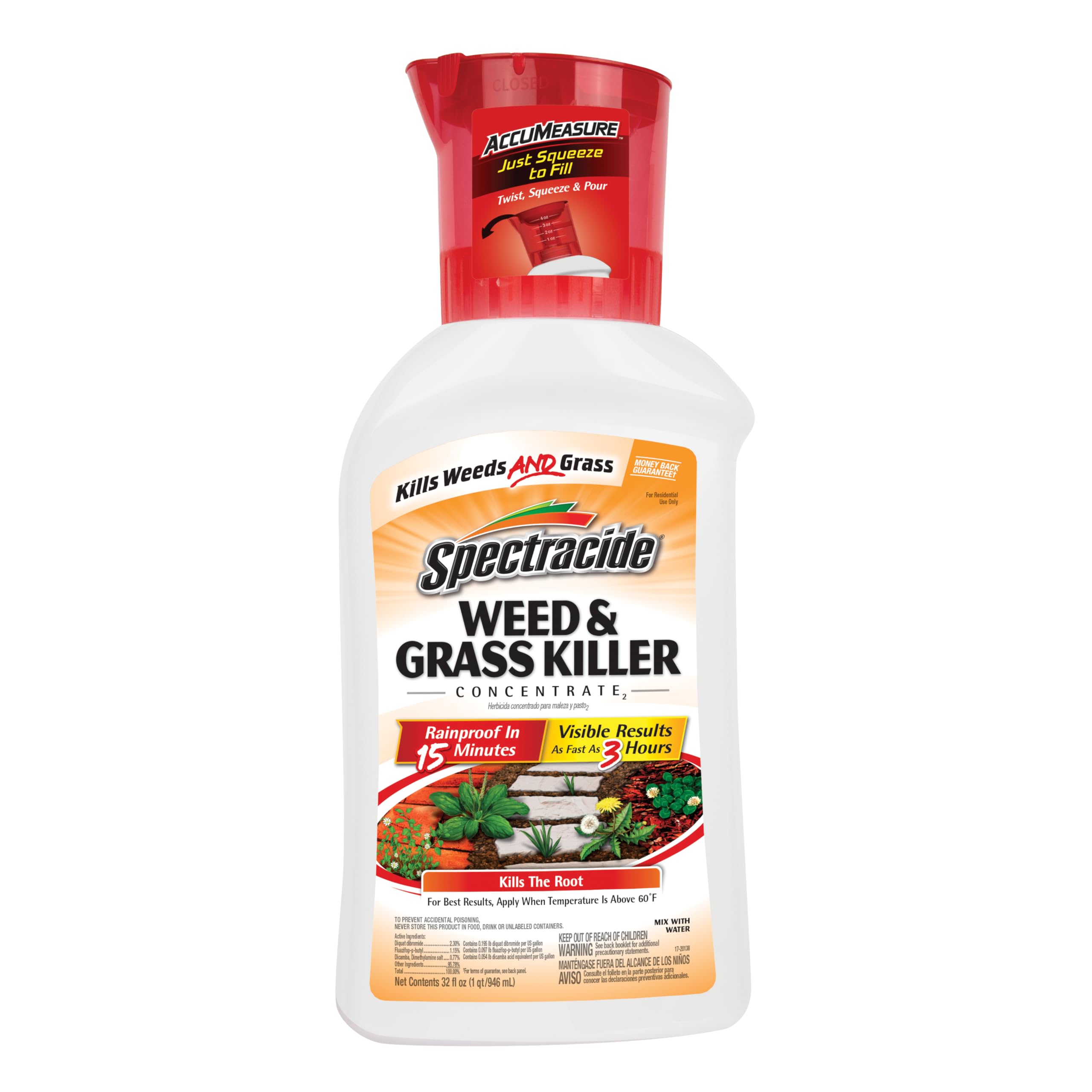
3. Spectracide Weed and Grass Killer Concentrate, 32 Ounces, With Accumeasure System
Visible results in as fast as 3 hours — the frustration cure for impatient weed warriors.
Spectracide uses Diquat Dibromide, a contact herbicide that works much faster than systemic glyphosate. You spray it on, and within hours you can see weeds wilting and yellowing. One owner sums it up: “I mix this up in my reusable spectracide 1 gallon sprayer and it kills the weeds along my curb within a day.” That speed is the defining reason to pick this jug. The 32-ounce concentrate covers 1,350 square feet, and the Accumeasure cap helps you pour the right amount without a measuring cup.
Effectiveness is overwhelmingly what buyers talk about — it is the #1 most-discussed aspect by a wide margin. The product is rainfast after just 15 minutes, so a surprise shower does not wash away your work. The catch? The Accumeasure system gets mixed reviews. Some owners find it clever, others call it a joke and simply remove it for a standard lid. This product also kills the root, so you can replant flowers and shrubs the same weekend. For walkways, driveways, and fence edges where you want immediate visual proof, this is the pick.
Instant-gratification herbicide: The 3-hour visible results are no gimmick — owners consistently confirm it works that fast, though the measuring cap is a love-it-or-hate-it detail.
Best for patios and curbs: When you need weeds gone before the weekend barbecue, Spectracide delivers the fastest visible payoff.
Skip it for deep root kill: Contact herbicides like this are fast above ground but can miss deep taproots — systemic glyphosate is better for stubborn perennials.
4. Remedy Specialty Herbicide Weed Killer & Brush Control, 1 Gallon

A pasture-grade Triclopyr concentrate that annihilates prickly pear and cogon grass.
Remedy is a top-rated pasture herbicide that goes after woody brush and mid-size trees — not your typical lawn weed. The active ingredient is Triclopyr, which works on the entire plant from roots to top growth. This is what you reach for when multiflora rose, honey locust sprouts, or cogon grass are overtaking fence rows and rangeland. One owner says it “absolutely annihilated my cogon grass problem,” while another calls it “the best thing for prickly pear control.”
It is also low-odor and safe around children and pets once it dries according to the label. You can tank-mix it with GrazonNext or ForeFront HL for broader control. The coverage is selective — it is designed for brush and mid-size trees, not broadleaf lawn weeds. Owners recommend a backpack or electric sprayer for efficient application, and one notes that a single gallon lasts for treating 100 lawns per week. The price is premium, but for heavy brush that cheaper herbicides cannot touch, it earns its keep.
Pasture-grade muscle: If your problem is woody brush, invasive trees, or serious pasture weeds, Remedy is the specialist solution that outperforms general-purpose sprays.
Best for brush and fence rows: When you need to stop resprouting stumps and knock back invasive woody plants, this is the answer.
Overkill for lawns: Stay away if you just want to kill dandelions in your front yard — this is too strong and designed for pasture-scale work.
5. Southern Ag Crossbow Specialty Herbicide, 128oz – Gallon

A 2,4-D and Garlon blend that controls English ivy, poison oak, and blackberry without glyphosate.
Southern Ag Crossbow combines two actives — Garlon and 2,4-D — to tackle both annual broadleaf weeds and woody brush like vines and ivy. One gallon makes up to 96 gallons of spray solution and covers 2.23 acres. Customers note visible die-off in 48 hours with complete kill in one week on ivy, vines, and even 8-foot weeds. A 1% solution works on most targets, and owners note it is effective on English ivy and poison oak when painted on cut stems.
The #1 most-discussed aspect is effectiveness, and the second is value for money. The product has a short 3-day soil half-life, meaning it breaks down relatively quickly in soil compared to some other herbicides. The catch? It has a long water half-life, so you need to avoid rain for at least three days after application. Results can also vary by soil type — one owner reported 85% kill in Ohio brown soil but only 30-35% in Illinois black, wet soil. A second treatment may be needed for tough targets like wild violets.
Glyphosate-free brush control: If you prefer alternatives to glyphosate-based formulas, Crossbow delivers powerful broadleaf and brush control with a shorter soil persistence.
Best for vines and ivy: Owners specifically praise this for English ivy and poison oak — it works when painted on cut stems.
Weather-dependent: The 3-day rain-free window and variable soil results mean timing your application matters more than with faster-acting formulas.
6. Image Herbicides Nutsedge Killer for Southern Lawns Concentrate 24 fl. oz.
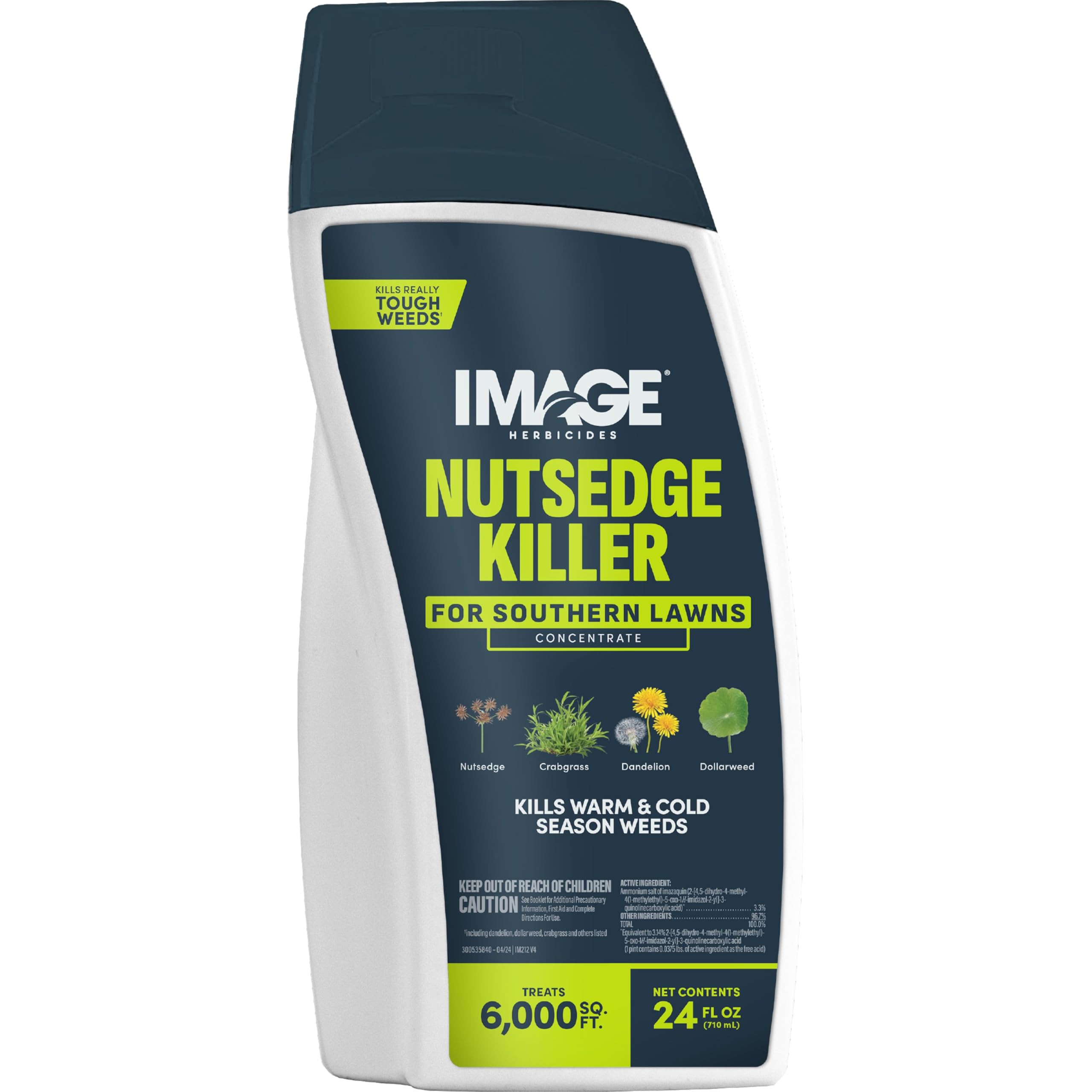
A post-emergent selective that kills nutsedge in 2-3 days and is safe on Bermuda, Zoysia, and St. Augustine.
Nutsedge (that tall, grass-like weed that grows faster than your lawn) is notoriously hard to kill — most general-purpose herbicides barely phase it. Image is a post-emergent selective herbicide specifically formulated for southern turf grasses like Bermuda, Zoysia, and St. Augustine. Reviewers point out that it “kills sedge in 2-3 days after two sprays, outperforming Ortho, Sedge Ender, and Sedge Hammer.” It also controls dandelions, crabgrass, and dollar weed, making it a versatile southern lawn companion.
The 24-ounce bottle is compact compared to the bulk jugs on this list — which makes sense because this is a targeted product for lawn care, not acre-scale spraying. Some shoppers say needing a second application for buttonweed, and that it works on dollar weed in oriental jasmine but is ineffective on wire-weed. The key limitation is that it is designed for southern grasses specifically — do not use it on northern cool-season lawns.
Southern lawn essential: If you have St. Augustine, Bermuda, or Zoysia and a nutsedge problem, this is the one product owners consistently say outperforms the competition.
Best for nutsedge in warm-season lawns: Owners confirm it works when Sedge Hammer and Ortho fail — the 2-3 day speed on sedge is real.
Not for cool-season grass: This is strictly for southern turf types — fescue or bluegrass owners need a different formula.
7. Roundup Weed & Grass Killer₄ Concentrate, 1 gal.

The household-name concentrate that works on dandelions, poison ivy, and clover with visible results in hours.
Roundup Weed & Grass Killer₄ is the familiar name that many homeowners start with, and this concentrate version makes economic sense at a gallon size. It uses a blend of Triclopyr, Diquat Dibromide, and other actives to tackle tough weeds including poison ivy, large crabgrass, and red and white clover. It is rainproof in 30 minutes and allows planting 1 to 30 days after application depending on the target. One gallon of concentrate sprays evenly over 300 square feet when mixed according to directions.
Effectiveness is the #1 most-discussed aspect, and quality is the second. The product starts working immediately according to owners, and it is versatile enough for flower beds, walkways, driveways, and even freshly cut woody stumps. The trade-off is that value for money gets mixed feedback — some owners feel it is not worth the per-gallon price compared to generic glyphosate concentrates. Also, it does not prevent new weeds from germinating, so you are treating existing growth only.
Trusted name, solid performance: Roundup is the gold standard for a reason — it works reliably on a wide range of weeds, though the price per gallon is higher than generic alternatives.
Best for familiarity and breadth: If you want one product that handles everything from clover to poison ivy with a brand you recognize, this is the safe bet.
Heads-up on price: Owners with large properties often switch to bulk generic glyphosate to save money — this makes more sense for moderate yard use.
8. Roundup Pro Concentrate Herbicide – 1 jug (2.5 gal.)
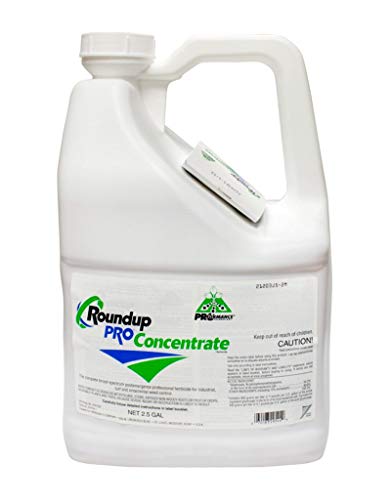
The super-concentrate that makes up to 150 gallons of spray solution from a single 2.5-gallon jug.
This is Roundup’s professional-grade super-concentrate, and it is a different animal from the consumer products. The coverage is staggering — up to 435,600 square feet from the jug, which is roughly 10 acres of weed control. Owners say it “pumps out exactly 1oz of product” and that you mix at 2.5 to 3 ounces per gallon of water for standard application. At that rate, one jug makes about 150 gallons of ready-to-spray solution, or about 30 gallons at super-strength concentration.
Effectiveness is the #1 most-discussed aspect by a significant margin, and value for money is the second. Buyers report that it works in 3-4 days with full kill in a week. The heavy jug requires a hand pump (the 63mm threaded type), which is sold separately — a minor friction point. It is not for sale in Wisconsin or New Jersey, so check local regulations. This is a serious purchase for those with miles of fence lines, large pastures, or commercial operations.
Commercial-grade value: For anyone managing acreage, the per-gallon cost of mixed spray is dramatically lower than any ready-to-use or consumer concentrate.
Best for large-acreage owners: If you have fence lines, pastures, or commercial land to maintain, this is the most economical way to buy glyphosate.
Not for small yards: A 2.5-gallon jug is overkill (and heavy) for a typical suburban lawn — you will be storing partially used concentrate for years.
9. Target 6 Plus (MSMA 48.2%) Turf Herbicide – (2.5 Gallon jugs)

The professional-grade MSMA formula that knocks out dallisgrass, crabgrass, and sandburs in turf.
Target 6 Plus contains MSMA (Monosodium acid Methanearsonate) at 48.2% concentration — a chemistry trusted for decades on golf courses, sod farms, and highway rights-of-way. It is selective, targeting grassy weeds like crabgrass, dallisgrass, Johnsongrass, and nutsedge while leaving desirable turf largely unharmed. One owner with Japanese zoysia says it “knocked out” a heavy dallisgrass infection “quite impressively.” Another calls it “potent and effective,” noting they purchased it five years ago and are still using the same jug.
The mix rate is 2 ounces per gallon of water for general applications. Effectiveness is the #1 most-discussed aspect by a very wide margin, and quality is the second. The catch is important: if it is not mixed correctly, it can brown your grass badly. Some owners mention temporary yellowing in Bermuda grass lawns, which typically rebounds. There are also mixed opinions on safety — it is a heavy-duty chemical that demands careful handling and protective gear. It is worth reading the full label before purchasing.
What owners swear by
- Extremely targeted against dallisgrass, crabgrass, and sandburs — weeds many herbicides cannot touch
- Incredibly long-lasting — one owner reports buying a jug five years ago and still using it
- Professional-grade performance at a price that owners say pays for itself quickly
The warning to heed
- Mixing errors cause serious browning of turf — follow the data sheet exactly
- Some customers note temporary yellowing on Bermuda grass that resolves with time
- Requires careful handling and protective equipment during application
Best for turf grass weeds: If dallisgrass, crabgrass, or sandburs are ruining your lawn and other products have failed, this is the specialist that works.
Mix with precision: The margin for error is slim — measure carefully or risk browning your lawn.
Understanding the Specs
Glyphosate Percentage
Glyphosate is the most common non-selective herbicide active ingredient. A 41% concentrate (like the Albaugh Gly Star Plus) is the standard professional strength — the same concentration as Roundup Ultra. Lower percentages mean you get fewer active molecules per ounce, which may require mixing at higher rates to get the same kill power. The percentage matters most when comparing generics to name brands: a 41% is a 41% regardless of the label.
Surfactant (Built-in vs. Add-Your-Own)
A surfactant (sometimes called a “non-ionic wetting agent”) helps the herbicide spread evenly across the leaf surface and stick rather than beading up and rolling off. Some concentrates include a built-in surfactant (check the ingredients or description). If yours does not, you can buy surfactant separately and add it to the tank mix. Products with built-in surfactant simplify mixing and ensure you do not skip this critical step.
Selective vs. Non-Selective Mode of Action
A selective herbicide targets specific weed types (broadleaf, grassy, or sedge) while leaving your desired grass unharmed. The chemistry is different: 2,4-D and Triclopyr target broadleaf weeds, while MSMA targets grassy weeds. A non-selective herbicide like glyphosate kills every plant it touches. Using a non-selective product on a lawn will create dead patches. The product label will clearly state whether it is safe for your specific grass type.
Rainfast Window
The rainfast window is the amount of time a herbicide needs to dry on the leaf surface before rain will not wash it off. This ranges from 15 minutes (Spectracide) to 30 minutes (Roundup Weed & Grass Killer₄) to several hours for some other formulas. A short rainfast window is critical if you live in an area with unpredictable afternoon showers — it means you can spray in the morning and be confident the product will work even if it rains later.
FAQ
What is the difference between selective and non-selective herbicides?
How long does it take for herbicides to kill weeds?
Can I use these herbicides on St. Augustine or Bermuda grass?
How much area will a gallon of concentrate cover?
What is a surfactant and do I need one?
Can I plant flowers or vegetables after using a herbicide?
Will these products kill the roots or just the leaves?
Are these herbicides safe around pets and children?
Final Thoughts: The Verdict
For the majority of shoppers, the herbicides to kill weeds winner is the Albaugh Gly Star Plus because it delivers the same professional-grade 41% glyphosate chemistry as name brands at a bulk price that makes large-scale spraying affordable. If you need a selective formula for your southern turf that spares the grass while wiping out nutsedge, grab the Image Nutsedge Killer. And for heavy brush control along fence lines and pastures where general-purpose herbicides fall short, the Remedy Specialty is the one to reach for.
How We Picked
We do not accept paid placement. Every pick is matched to a real buyer and a real use-case; we do not hands-on test units.
Sources & Methodology
Specifications: manufacturer listings and product documentation. Review insights: verified customer reviews, as of July 2026. Pricing: not shown on this page (it changes often); check the current price via the retailer link.
As an Amazon Associate, Lawn Gear Lab earns from qualifying purchases. This does not affect which products we feature.