
Specs are compiled from manufacturer listings and verified buyer reviews and can change over time — please confirm the key details on the product page before buying.
Wild violets are the stubborn gate-crashers of the lawn world. They laugh at standard weed-and-feed mixes because their waxy leaves repel most sprays. The real fix is a selective herbicide with triclopyr (an active ingredient that penetrates those waxy leaves) or a multi-ingredient blend, applied when they are actively growing. This guide compares the top chemistries so you can pick the one that matches your lawn size, your grass type, and your patience.
I’m Rikta — the founder and writer behind Lawn Gear Lab. This guide is built by comparing the manufacturers’ published specifications and the patterns across verified customer reviews, so you get each pick’s real strengths and trade-offs instead of marketing spin.
Choosing the right herbicide to kill wild violets means matching the active ingredients to your specific turf grass and the size of your yard.
Our Picks at a Glance


How To Choose The Best Herbicide To Kill Wild Violets
Wild violets are perennial broadleaf weeds with a waxy, heart-shaped leaf that beads up and repels many common sprays. They also spread through both seeds and a tough underground root system (rhizomes — horizontal stems that send up new shoots), so a spray that only burns the leaves will not stop them from coming back. You need what is called a “systemic” herbicide, one that is absorbed into the plant and travels down to the roots.
Look for triclopyr and a multi-ingredient blend
The single most effective ingredient against wild violets is triclopyr, a chemical that penetrates waxy leaves better than most others. The most reliable formulas pair it with other broadleaf killers like 2,4-D, dicamba, Sulfentrazone, or MCPA. These blends work together so that if one ingredient struggles, the others still break through the plant’s defenses. A product with just one weak ingredient will likely leave you with a lawn full of green hearts.
Match the spray to your grass type
Not all violet killers are safe for every lawn. You must check the label to see if the product is suited for your specific grass. Cool-season grasses like Kentucky bluegrass, tall fescue, and perennial ryegrass are generally safe with most broadleaf herbicides, but some warm-season grasses like St. Augustine or Centipede can be injured. The data we reviewed shows that products explicitly list which turf grasses they are safe for, so read that section before you ever mix a drop.
Choose the right format for your yard size
Ready-to-spray bottles simply attach to a garden hose, making them the easiest choice for a typical suburban yard. Liquid concentrates must be mixed with water in a pump sprayer, giving you more control but requiring you to do the math on how much to use. A 1-gallon concentrate jug covers far more ground than a small ready-to-spray bottle, so for a large property, a concentrate is usually the more practical route.
Quick Comparison
| Model | Best For | Active Ingredients | Size | Coverage | Amazon |
|---|---|---|---|---|---|
| T-Zone Turf Herbicide★ Best Overall | Whole-lawn control | Triclopyr + Sulfentrazone blend | 128 fl oz | — | Amazon |
| PBI/Gordon TZone SEPro Grade | Pro-grade power | Triclopyr (TZone SE) | 128 fl oz | 16,000 sq ft | Amazon |
| PBI/Gordon Lawn Weed KillerFast Acting | Cool-season grass | 2,4-D + Dicamba + Mecoprop | 20 fl oz | 14,000-18,000 sq ft | Amazon |
| Albaugh Sublime | Non-bleaching control | Triclopyr + Dicamba + Mesotrione | 32 fl oz | 16,000-32,000 sq ft | Amazon |
| Monterey Spurge Power | Stubborn perennials | MCPA + Triclopyr + Dicamba | 32 fl oz (2×16 oz) | 16,000 sq ft | Amazon |
| Select Source Triad TZ | Budget T-Zone rival | 2,4-D + Dicamba + Triclopyr + Sulfentrazone | 32 fl oz | 48-96 fl oz/acre | Amazon |
| Ortho Nutsedge Killer | Hose-end convenience | Sulfentrazone | 32 fl oz | 5,000 sq ft | Amazon |
| Bonide Chickweed & Clover Killer | Ready-to-use simplicity | Triclopyr + MCPA + Dicamba | 128 fl oz | — | Amazon |
| Southern AG Brush Killer | Non-lawn brush & vines | Triclopyr | 32 fl oz | 512-1,024 sq ft/gal | Amazon |
In‑Depth Reviews
1. T-Zone Turf Herbicide
Our pick — over 4.5★ from 100+ verified ratings; the strongest balance of quality and price.
The four-ingredient hammer that pros trust for the toughest broadleaf turf
This is the heavy hitter for anyone who is tired of fighting a losing battle. T-Zone SE packs four active ingredients — Herbicide, Sulfentrazone, and triclopyr among them — to target wild violets, ground ivy, oxalis, and clover all at once. Because triclopyr is in the mix, it punches through the waxy leaf coating that makes violets shrug off weaker sprays. The data confirms it also offers “suppression of young and actively growing yellow nutsedge” — a bonus for anyone with that grassy weed invasion too.
The real-world timing story is convincing. Buyers report that most weeds are yellowing by day 9 after a spray, and one owner’s account of a 30-ounce mix in a 25-gallon trailer sprayer shows how far a single jug stretches for a serious lawn. Unlike the smaller 20-ounce bottles, this 128-ounce jug with its four-ingredient chemistry is built for either a full-yard broadcast or a dedicated spot-treatment program.
There is one honest catch: it is a concentrate, so you have to do the mixing math yourself and it demands careful handling. The data shows it exhibits “improved cool-weather performance,” meaning it works when temperatures drop and other products stall out. If your violet problem is widespread rather than a few stray plants, this is the one that ends the saga.
Why owners stick with it
- Four active ingredients cover violets, ground ivy, oxalis, and clover in one pass
- 128-ounce jug suits whole-lawn broadcast spraying
- Performs better in cool weather than many rivals
Before you pull the trigger
- Concentrate requires careful mixing and a sprayer you own
- Strong formula — keep it away from flowers and ornamentals
Made for: homeowners with acres of turf and a violet infestation that spans the whole yard, not just a patch.
Fair warning: if you only have a handful of plants, the 128-ounce size is more than you need — a quart bottle will do the same job.
2. PBI / Gordon TZone SE Broadleaf Herbicide
The commercial-grade secret weapon that kills violets fast and furious
You get the same TZone chemistry that lawn care professionals use, but in a gallon jug sized for homeowners who want pro-level results. The label is blunt: it “controls wild violet, ground ivy, black medic.” That direct claim matters because wild violet has waxy leaves that resist many sprays, and the triclopyr family of chemistry here targets it without bleaching your turf.
Coverage is generous: a full gallon covers up to 16,000 square feet, which is a solid fraction of an acre from one bottle. Buyers call it “one of the best herbicides ever” and say it kills “all the weeds and quickly.” The recurring note is that it is very strong, so read the label carefully before you spray.
What separates this from cheaper options is the raw power and speed. Reviews of the whole TZone family show foliage dying within days and the roots following shortly after, which is the systemic action you need for a perennial like the violet. The honest trade-off is that this is a concentrate in the premium tier, so your upfront spend is higher than a ready-to-spray bottle, but the per-square-foot cost drops significantly.
Pro power payoff: One gallon treats up to 16,000 square feet, and owners consistently report rapid, complete kills on the toughest broadleaf weeds. If your lawn is your pride, this is the stuff the pros actually use — the data shows that sentiment repeatedly. The catch is that it is a strong concentrate; miss the dilution ratio and you risk burning your grass, so measure precisely.
3. PBI/Gordon Lawn Weed Killer Concentrate
Rain-fast results in a week, even when a downpour hits 90 minutes later
Speed is the defining trait of this PBI/Gordon concentrate. The data shows one owner sprayed, got caught in rain 90 minutes later, and still watched everything that was not grass die or die within a week. That rain-fast quality is a huge practical advantage because weather delays are the #1 reason people never get their herbicide down.
The chemistry reads like a classic broadleaf cocktail: 2,4-D 2-ethylhexyl ester at 28.57%, Mecoprop-p Acid at 5.88%, Dicamba Acid at 1.71%, and Carfentrazone-ethyl at 0.62%. That blend treats over 100 different broadleaf weeds — the data explicitly names wild violet, clover, and garlic — making it a true multi-purpose turf tool rather than a one-trick pony.
On grass safety, it is picky but clear. The data lists Kentucky bluegrass, perennial ryegrass, tall fescue, and colonial bentgrass for cool-season, plus common Bermuda and Zoysia for warm-season. A 20-ounce bottle covers 14,000 to 18,000 square feet, which is a strong coverage-per-dollar story. Owners note it is not cheap, but call it “well worth the money spent” for results seen the very first day.
Reach for this if: your violets are mixed in with creeping Charlie or plantain on a cool-season lawn and you want near-immediate visual proof it is working.
Look elsewhere if: you do not own a sprayer and want a hose-end or ready-to-use bottle, because this one is a concentrate that requires mixing.
4. Albaugh Sublime Weed Killer
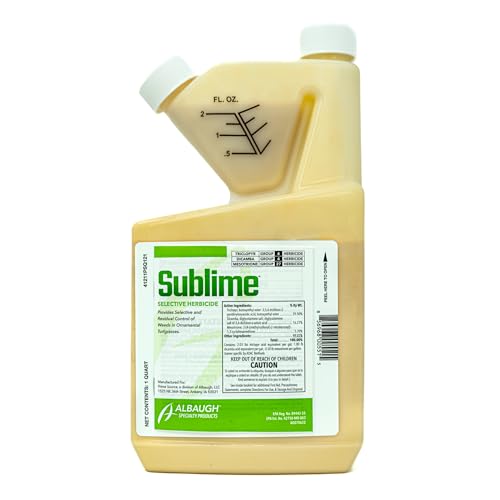
Premium weed control that spares your turf from ugly white bleaching streaks
Most strong herbicides leave an ugly, bleached look on the grass as they work, which annoys lawn perfectionists. Albaugh Sublime is built around a different promise: it “provides premium weed control without the common unsightly bleaching symptoms found in other products.” If you host gatherings or simply hate a speckled lawn for two weeks, that difference matters.
The formula mixes Triclopyr, Dicamba, and Mesotrione (three active ingredients that work together) for a broad-spectrum attack on “spurge, yellow woodsorrel, wild violet, and many more.” It is a selective herbicide, so it kills the weeds but leaves ornamental turf, golf courses, parks, and athletic fields intact — the label even lists sod farms as approved use sites.
Coverage is big: a 32-ounce bottle treats 16,000 to 32,000 square feet, which is some of the best range-per-bottle in this list. Owners mention wilting within 3 days and major elimination by day 10 on tall fescue. The recurring caution is to read the mix directions carefully — overuse browns grass, and the data shows one unit arrived with a pinhole leak in shipping, so inspect the jug on arrival.
The appeal
- Non-bleaching formula keeps the lawn looking lush while weeds die
- 32-ounce bottle covers up to 32,000 square feet
- Mesotrione adds a defense layer most rivals lack
Mind these
- Slowest of the premium picks — owners call it “very slow” on broadleaf
- Mixing mistakes will brown your grass, so dilute precisely
5. Monterey Spurge Power Post Emergent Herbicide
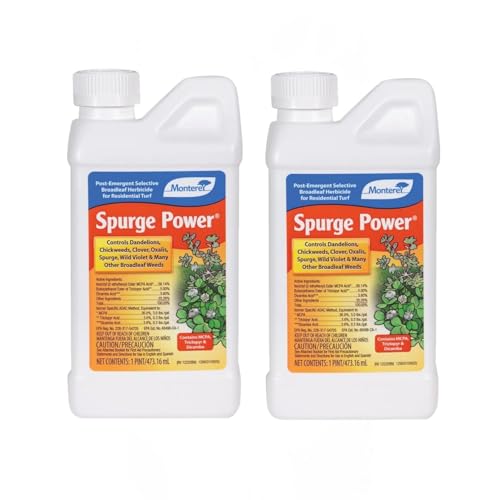
The patient spray that finally beat a three-year wild violet war
Wild violets do not surrender quickly. The best real-world proof for this Monterey product is that it took three years of seasonal applications, but the wild violet is “near gone.” That is the honest reality of perennial weed control — persistence beats a single miracle spray. This 3-way formula (MCPA, Triclopyr, and Dicamba) is built for the long game, and the label explicitly lists wild violet among its targets.
Grass safety is a highlight here. The data says it is ideal for Bluegrass, Fescue, Rye, Bahia, Bermuda, and Zoysia — a broad list that covers nearly every common American lawn grass. That gives you confidence to broadcast it rather than tiptoe around individual plants. Owners also report seeing results within a couple of days, with one calling it the “best post emergent on the market.”
The packaging is unusual: a 2-pack of 16-ounce bottles totaling 32 fluid ounces, covering 16,000 square feet. One owner’s story about killing spurge that hit the whole neighborhood — with grass unharmed and clover and dandelions dying alongside — captures how versatile this is. The trade-off is that a 2-pack format means more bottles to keep track of, and the manufacturer notes best results come from spring or early fall application.
Best for: the committed lawn owner who accepts that violent eradication takes two or three seasons and wants a broad-spectrum formula safe on nearly every grass type.
Note the pace: this is a marathon, not a sprint — the data shows patience and repeated spring/fall applications are what finally wins.
6. Select Source Triad TZ

The same 4-way chemistry as the big names, at a friendlier price
Here is a direct comparison that matters: the Select Source Triad TZ is explicitly marketed as a “Compare to T Zone” product, and the data backs it up with the exact same four active ingredients — 2,4-D, Dicamba, Triclopyr, and Sulfentrazone. That means the same mode of attack on wild violet, ground ivy, and Virginia buttonweed, but in a quart size that costs a fraction of the gallon jugs higher on this list.
For a medium lawn, this is the balance of cost and coverage. The label says it is excellent post-emergent control for dandelion, spurge, white clover, plantains, and wild violet, with suppression of yellow nutsedge. One owner describes mixing it with Mesotrione and dish soap and killing roughly 95% of weeds quickly, with a third of a bottle covering 6,000 square feet.
The use sites are broad — residential lawns, athletic fields, golf courses, parks, and even commercial sod production — which tells you the chemistry is trusted at scale. The downside is the odor, which earns mixed feedback; several owners find it unpleasant when wet. Follow the label on the 48 to 96 fluid ounces per acre rate for best results.
If your yard is a few thousand square feet and the odor does not scare you, this is the budget pick that actually works. The data shows it kills wild violet and ground ivy effectively — just plan to spot-treat missed patches.
7. Ortho Nutsedge Killer for Lawns
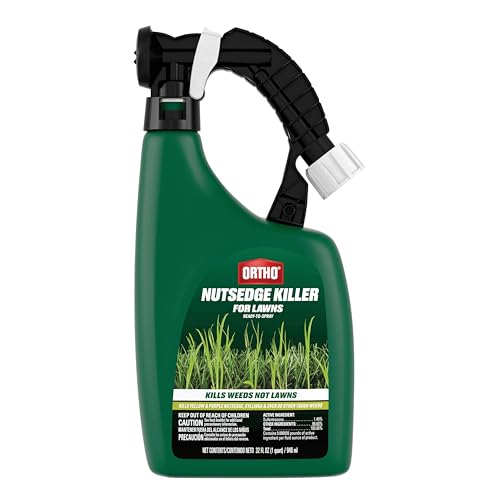
Attach a hose, spray, and watch the toughest weeds die in 72 hours
If ease of use is your #1 priority, this is the pick. The Ortho Nutsedge Killer is a ready-to-spray bottle: you connect it to a garden hose, turn on the water, and spray. No mixing, no measuring, no sprayer to clean. The data shows it covers 5,000 square feet from a single 32-fluid-ounce container, and the active ingredient is Sulfentrazone, a fast-acting chemistry that also controls wild violet and dollarweed.
The speed is the crowd-pleaser. Customers note nutsedge turns brown and dies within 72 hours of spraying, and the “customers-say” summary confirms broad effectiveness against nutsedge with high marks for ease of use. The effectiveness data is overwhelming — it is the most-mentioned positive aspect by a wide margin, with well over a thousand owners chiming in on how well it works.
There is a clear strategy in the reviews: get on the weeds early. Some owners note it becomes “less effective the longer you wait and the taller the weed gets,” so this is a spray for the vigilant, not the procrastinator. The trade-offs are a coverage limit of 5,000 square feet per bottle and mixed feedback on value for money — for a big yard, you will need multiple bottles.
Why it wins fans
- Zero-math hose-end setup — the easiest application in this list
- Fast action, with owners seeing dead weeds in about 3 days
- Effective on nutsedge, wild violet, and dollarweed together
Keep in mind
- 5,000 sq ft per bottle means large lawns need multiple units
- Effectiveness drops noticeably on tall, mature weeds
8. Bonide Chickweed, Clover & Oxalis Killer
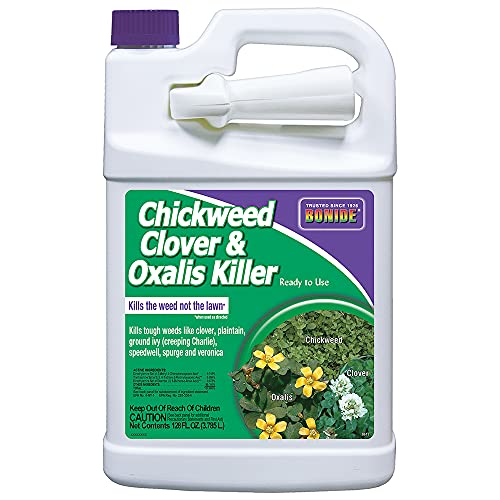
A gallon of ready-to-spray weed control for the grab-and-go homeowner
This is the lazy-Sunday solution: a 128-ounce bottle that arrives already mixed, so you shake it and spray directly onto the weeds. The data shows the active ingredients are Dicamba, triclopyr, and MCPA — a three-ingredient combo with names that actually matter for violets, and it controls more than 100 tough weeds including clover, oxalis, dandelions, and ground ivy. No measuring cups, no hose attachments, no sprayer calibration.
The value story is strong for medium yards. One owner’s detailed breakdown notes that a single 128-ounce gallon covers roughly half a yard, with clovers browning within 3 days and dandelions dying from one spray. The label guidance is clear: spray when weeds are actively growing and the temperature is below 90 degrees F, and stay away from vegetables, flowers, and other desirable plants.
There are two honest criticisms in the data. The hand sprayer attachment gets negative feedback — several reviewers point out it is the weak link, with some units arriving missing nozzles, so check the packaging immediately. And for a large lawn, you will need 4 to 5 gallons for full coverage. But for a small to medium property with patchy clover and violet invaders, the ready-to-use convenience more than compensates.
Made for: casual gardeners who want weed control without owning a sprayer or doing any mixing math. The triclopyr and dicamba blend is genuinely effective on the tough stuff.
Reality check: the spray attachment is the weak point and the per-gallon cost runs higher than concentrates — if your yard is big, a concentrate will serve you better.
9. Southern AG Brush Weed Killer

The triclopyr choice for brush, vines, and fence lines — not your lawn
This specialist belongs in your shed if your violet problem lives along fencerows, road sides, or rangeland rather than inside a manicured lawn. Southern AG packs triclopyr — the exact ingredient proven toughest on waxy leaves — into a 32-ounce quart labeled for “vines and many hard to control plants,” and it is cheap enough to use with abandon on non-crop areas. The data confirms it even prevents sprouting on clean-cut stumps.
The reviews show real patience is required. Shoppers say it works on blackberry and other shrubs in Oregon, but larger shrubs take about two weeks to dry out and turn brown. That is a different rhythm than the fast lawn sprays — this is brush control, and it works on its own schedule. One owner’s comparison is useful: it works “just as good” as Crossbow, a well-known brush killer, at a lower price point.
With a high triclopyr concentration and coverage of 512 to 1,024 square feet per gallon, this quart goes further than its size suggests for spot work. The honest catch is that this is not for your turf — it is for the rough stuff around the edges. If your violets are in the lawn itself, pick one of the lawn-safe formulas higher up this list instead.
Role in your arsenal: a budget triclopyr concentrate for the brush, vines, and stumps outside your lawn. Buyers report it matches big-name brush killers at a friendlier price, but expect a two-week pace on larger shrubs. If you need lawn-safe violet control, this is not your bottle.
Understanding the Specs
Triclopyr: the violet-specific ingredient
When you see triclopyr on a label, you are looking at the ingredient proven to break through wild violet’s waxy leaf coating. It is systemic, meaning the plant absorbs it and carries it down to the roots, which is essential for a perennial like the violet. If a product lacks triclopyr, it may burn the leaves but leave the root system ready to regrow.
Coverage: square feet per bottle
This is the number that tells you how many bottles you truly need. A 32-ounce concentrate may cover 16,000 square feet, while a 128-ounce ready-to-spray bottle might cover far less because it is pre-diluted. For a quarter-acre lawn (roughly 10,000 square feet), you need to add up coverage before you buy, not after.
Selective vs. non-selective
A selective herbicide is designed to kill broadleaf weeds while leaving your turf grass alone — this is what you want for violet control in a lawn. Non-selective sprays like glyphosate kill everything they touch, which is only useful for spot-treating a single plant or clearing a patch for replanting. Check the label for the words “selective” or “for turf” before you spray.
Cool-season vs. warm-season grass safety
Every label lists which turf grasses the herbicide is safe on. Cool-season grasses like Kentucky bluegrass, tall fescue, and perennial ryegrass tolerate most broadleaf formulas, while warm-season grasses like St. Augustine and Centipede are more sensitive. If you spray the wrong formula on a sensitive grass, you can damage the lawn you are trying to save.
Ready-to-spray vs. concentrate
A ready-to-spray bottle attaches to your garden hose and mixes itself, making it the easiest option for small lawns. A liquid concentrate requires you to mix it with water in a pump sprayer, which offers more control over coverage and a lower cost per square foot on larger properties. Your choice depends on how much lawn you have and how much effort you want to invest.
Post-emergent timing
These products all work on weeds that have already sprouted — they are “post-emergent” killers. They work best when weeds are actively growing, typically in spring or early fall, and when temperatures are mild. Spraying in extreme heat or cold reduces effectiveness, which is why the data repeatedly mentions waiting for the right weather window.
FAQ
Why do wild violets keep coming back even after I spray?
What is the best time of year to spray for wild violets?
Will these herbicides kill my lawn grass too?
What is the difference between triclopyr and 2,4-D for violets?
How long does it take to see results after spraying?
Can I use a ready-to-spray bottle on a large lawn?
Is it safe to spray near flower beds and vegetable gardens?
What should I do if the wild violet patch is huge?
Will rain wash away the herbicide before it works?
Can I use brush killer like Southern AG on my lawn?
Final Thoughts: The Verdict
For most homeowners, the herbicide to kill wild violets winner is the T-Zone Turf Herbicide because its four-ingredient triclopyr-based blend attacks the toughest broadleaf weeds across an entire lawn. If you want the convenience of attaching a bottle to your hose and spraying with zero mixing, grab the Ortho Nutsedge Killer for its fast, easy application. And for the budget-conscious buyer who wants the same 4-way chemistry as the big names, the Select Source Triad TZ delivers the closest value match in a quart format.
How We Picked
We do not accept paid placement. Every pick is matched to a real buyer and a real use-case; we do not hands-on test units.
Sources & Methodology
Specifications: manufacturer listings and product documentation. Review insights: verified customer reviews, as of August 2026. Pricing: not shown on this page (it changes often); check the current price via the retailer link.
As an Amazon Associate, Lawn Gear Lab earns from qualifying purchases. This does not affect which products we feature.