
Grape vines are tenacious. Their deep root systems and aggressive growth patterns make them one of the toughest weeds to eliminate from fence lines, trellises, and garden edges. A standard spray often only singes the leaves, leaving the root crown intact to resprout with a vengeance. Eradicating grape vines requires a systemic herbicide powerful enough to translocate from the foliage down to the deepest root nodes, stopping the plant entirely at its source.
I’m Rikta — the co-founder and writer behind Lawn Gear Lab. My process for this guide involved cross-referencing active ingredient concentrations—specifically glyphosate and triclopyr percentages—against the specific challenges of woody vine control, while also analyzing hundreds of verified owner reports to understand which formulations actually deliver a complete kill on established Vitis species.
After comparing five concentrated formulas designed for tough brush and perennial vines, the ideal herbicide to kill grape vines depends on matching the active ingredient strength and application method to your infestation’s severity.
How To Choose The Best Herbicide To Kill Grape Vines
Grape vines are woody perennials with a massive root biomass. A contact herbicide will burn the leaves, but the roots will draw on stored energy and regenerate. To fully eliminate them, you need a systemic, concentrated formula. Here are the critical factors to evaluate before purchasing.
Active Ingredient Concentration
For grape vines, the percentage of the active ingredient matters more than the brand name. A 41% glyphosate concentrate, for example, provides the translocated punch needed to move through thick bark and into the root system. Lower concentrations meant for lawn weeds often fail against mature vine wood.
Systemic vs. Contact Action
Only systemic herbicides are worth your money for this task. The chemical must be absorbed by the leaves and then travel through the phloem to the roots. Contact-only sprays leave the root system alive, and the vine will regrow from the crown within weeks. Products labeled for brush control are typically systemic and thus more effective.
Surfactant and Rain-fastness
Grape vine leaves are often waxy, which can cause spray droplets to bead up and roll off. A built-in surfactant improves adhesion and absorption. Similarly, a fast rain-fast window—ideally 30 minutes to 2 hours—ensures your application isn’t wasted by an unexpected shower. Concentrates that require you to add your own surfactant add an extra step but can be more flexible for tank mixing.
Quick Comparison
On smaller screens, swipe sideways to see the full table.
| Model | Category | Best For | Key Spec | Amazon |
|---|---|---|---|---|
| Plus Herbicide 41% | Concentrate | Deep root kill | 41% Glyphosate | Amazon |
| Ranger Pro 2.5 Gal | Concentrate | Broad-spectrum woody brush | Built-in surfactant | Amazon |
| Remedy Specialty | Concentrate | Brush & pasture vines | Triclopyr active | Amazon |
| Roundup Dual Action | Concentrate | Bare-ground regrowth prevention | Diquat + triclopyr + imazapic (no glyphosate) | Amazon |
| Gordon’s Brush Killer for Large Property | Concentrate | Fence-line & property-edge vines | Triclopyr + 2,4-D + Dicamba | Amazon |
In‑Depth Reviews
1. Plus Herbicide – 41% Glyphosate with Surfactant – 2.5 Gallon

The Plus Herbicide 41% Glyphosate concentrate is the gold standard for large-scale grape vine eradication. At 41% glyphosate, this is the highest concentration available for residential use, meaning it delivers enough active ingredient to penetrate the thick bark and travel deep into the root mass of mature grape vines. The 2.5-gallon jug provides exceptional value for coverage, mixing down to over 100 gallons of finished spray at the standard 2-ounce-per-gallon rate for tough brush.
Users consistently report total kill on stubborn woody species like blackberry bushes and wild grape vines. The built-in surfactant improves adhesion to waxy vine leaves, reducing runoff and improving uptake. The systemic action is aggressive—visible wilting within 24 to 48 hours, with complete root death following over the next two weeks. This is a non-selective formula, so precision spraying is required to avoid damaging nearby trees or shrubs.
The main drawback reported is the packaging seal. Several buyers noted the cap was sealed with silicone, requiring cleanup before use. Once you get past that, the performance density compared to retail-store concentrates is unmatched. For anyone facing a heavy grape vine infestation covering a fence line or wooded edge, this is the most direct solution available per dollar.
What works
- Maximum 41% glyphosate concentration for deep root translocation
- Large 2.5-gallon volume offers the best cost per mixed gallon
- Integrated surfactant improves uptake on waxy vine foliage
What doesn’t
- Cap seal can be messy and may contain silicone debris
- Non-selective; requires careful application to avoid off-target damage
2. Ranger Pro 2.5 Gallon with Gloves and Pest ID Card
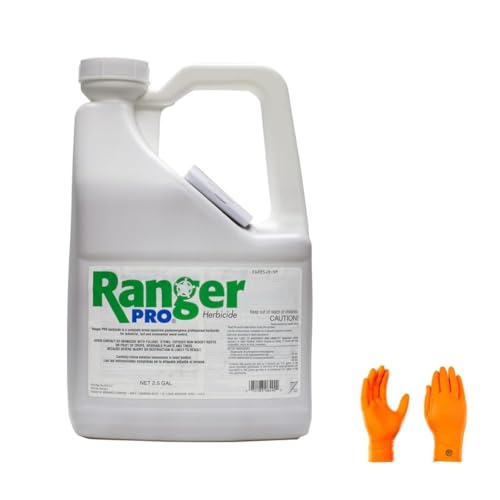
Ranger Pro is a professional-grade glyphosate concentrate registered by Monsanto Company (EPA Reg. No. 524-517; Monsanto is now part of Bayer) — not BASF, as sometimes miscredited on resale listings — that competes directly with top-tier brands in performance. This 2.5-gallon concentrate is formulated with a built-in surfactant and designed for broad-spectrum control of annual and perennial weeds, including woody brush and trees. For grape vines, its systemic action is the key selling point—it moves from the leaf surface down through the vascular system to destroy the entire root structure, leaving no residual soil activity for future plantings.
Owners who have used this on heavy brush like goatheads and multiflora rose report it performs significantly better than standard retail formulas, often citing a fraction of the per-use cost of popular brands. The inclusion of chemical-resistant gloves and a pest identification card adds immediate practical value, especially for users new to concentrated herbicides. The product is rain-fast relatively quickly after drying, reducing the risk of losing your application to weather.
The only real downside is the container’s handling at 25 pounds—this is a heavy jug that requires a sturdy sprayer setup. The large volume is ideal for two-acre-plus properties but may be overkill for a single fence line. For users with extensive vine problems across multiple acres, the cost efficiency and complete kill rate make this a top-tier investment in total eradication.
What works
- Full systemic translocation kills the entire root system of grape vines
- Packaged with chemical-resistant gloves and reference card
- No residual soil activity allows safe replanting after breakdown
What doesn’t
- Large 25-pound jug is heavy to handle and transport
- Volume may exceed needs for small or single-infestation jobs
3. Remedy Specialty Herbicide – Triclopyr Concentrate, 1 Gallon
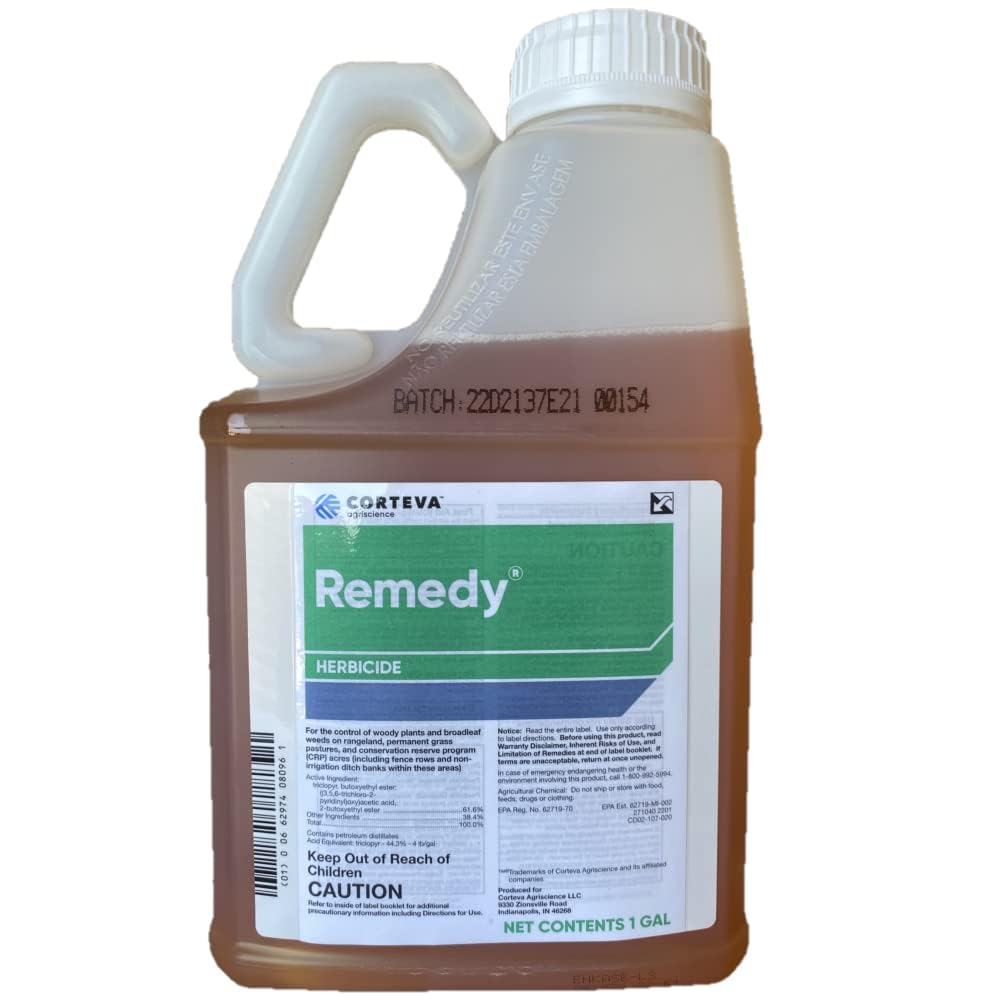
Remedy Specialty uses triclopyr as its active ingredient, which offers a different mechanism of action compared to glyphosate. Triclopyr is particularly effective on woody vines and brush, making it a primary choice for grape vine removal in rangeland and pasture settings. This concentrate is designed for low-odor application, which is a practical advantage when working near occupied areas. It works on the entire plant—both top growth and roots—and provides long-lasting control.
For grape vines specifically, users have had success with basal bark applications. Mixing one part Remedy with three parts diesel or a similar carrier and spraying the base of the vine trunk delivers near-100% kill rates with minimal resprouting. This method is especially useful when the vine is climbing desirable trees, as it avoids foliar spray drift. The product is also effective as a cut-stump treatment for larger woody stems.
The primary limitation is that triclopyr is less effective on grassy weeds and may require tank mixing with a 2,4-D or aminopyralid pasture herbicide for broad-spectrum pasture management. Additionally, it is one of the more expensive concentrates per gallon. However, for dedicated woody vine control on fence lines and in pastures where you want to preserve grass cover, its selective action against broadleaf brush is unmatched.
What works
- Triclopyr is highly effective on woody vine species and brush
- Low-odor formulation is comfortable for large-area application
- Basal bark application method kills vines without foliar drift
What doesn’t
- Expensive per-gallon cost compared to glyphosate concentrates
- Ineffective on grassy weeds without a tank-mix partner
4. Roundup Dual Action Weed & Grass Killer Plus 4 Month Preventer Concentrate, 32 fl. oz.

Roundup Dual Action is a unique entry in this list because it combines a fast-acting contact herbicide with a pre-emergent component that prevents new growth for up to four months. Its EPA label (Reg. No. 71995-69) lists four active ingredients — diquat dibromide, fluazifop-P-butyl, triclopyr (triethylamine salt), and imazapic — with no glyphosate at all. The concentrate mixes at 6 fluid ounces per gallon and covers up to 1,600 square feet per bottle. It is rainproof in 30 minutes and the diquat component shows visible burn-down within 3 to 6 hours on many weed species.
For grape vines specifically, be clear-eyed about what this product is and isn’t: its own EPA weed list is built around lawn and hardscape weeds and grasses (dandelion, clover, crabgrass, and similar), and it does not name wild grape, grapevine, or woody brush as controlled species. The triclopyr component can scorch actively growing green shoots that get direct spray contact, and the imazapic barrier will help keep bare, cleared soil free of new seedlings for up to four months — but this is a maintenance tool for ground you’ve already cleared, not a substitute for a triclopyr or glyphosate brush herbicide that is actually labeled for woody vine control. Treat any “kills grape vines” framing of this product as marketing shorthand, not a label claim.
The concentrated format requires you to supply your own sprayer, and to get the full prevention benefit, you must spray the entire area—not just the visible weeds. It is not labeled for use near desirable plants that you intend to keep, as the pre-emergent barrier will prevent new growth of any kind for the four-month window.
What works
- Combines fast contact burn-down (diquat) with a 4-month pre-emergent barrier (imazapic)
- Rainproof in 30 minutes for reliable application timing
- Visible results often appear within 3 to 6 hours
What doesn’t
- Contains no glyphosate, and its EPA label does not name wild grape or woody vines as controlled species
- Best used as post-clearing maintenance, not as a primary tool against established grape vines
5. GORDON’S Brush Killer for Large Property, 1 Gallon

GORDON’S Brush Killer for Large Property, made by PBI-Gordon Corporation (EPA Reg. No. 2217-950), combines triclopyr, 2,4-D and dicamba in one concentrate. Unlike some brush mixes that only imply vine control through marketing copy, wild grape is explicitly named on this product’s own EPA label, in the “Brush, Woody Plants and Vines Controlled” table, alongside species like wild rose, sumac and poison ivy — a label-verified match that makes it one of the more defensible picks specifically for wild grape vine removal along fence lines and large properties.
The three-way active ingredient blend gives it broader spot-treatment flexibility than a single-active herbicide: triclopyr and 2,4-D translocate from the foliage into the root system, while dicamba helps knock down harder broadleaf brush. The label’s spot-treatment rate table scales from 2 fluid ounces per gallon of water for young, actively growing vines up to 5 fluid ounces per gallon for large, dense, or hard-to-control infestations, so you can dial in intensity rather than committing an entire tank to one concentration.
This is a non-selective broadleaf herbicide, so the same precautions apply as with any triclopyr or 2,4-D product: keep spray and drift off desirable trees, shrubs, and cultivated grapevines, and check your state’s pasture and rangeland grazing or haying restrictions before treating forage areas, since 2,4-D and dicamba each carry their own grazing intervals that differ from a straight triclopyr product.
What works
- Wild grape is explicitly listed on the EPA label’s controlled-species table, not just implied in marketing copy
- Adjustable spot-treatment rate (2 to 5 fl oz per gallon) scales from young to hard-to-control vines
- Three active ingredients (triclopyr, 2,4-D, dicamba) broaden brush coverage beyond a single-active product
What doesn’t
- Non-selective on broadleaf plants; drift can injure desirable trees, shrubs, and cultivated grapevines
- 2,4-D and dicamba both carry their own grazing/haying restrictions, so pasture use needs a label review first
Hardware & Specs Guide
Glyphosate 41%
The highest standard concentration available for residential use. This percentage indicates 41% of the liquid is the active isopropylamine salt of glyphosate. This concentration is necessary for penetrating the woody bark of mature grape vines and translocating to the extensive root system. Concentrations below 20% often fail on woody perennials, requiring multiple reapplications.
Sufactant Integration
Grape vine leaves have a natural waxy cuticle that repels water. A built-in surfactant (or non-ionic surfactant added to the tank mix) reduces the surface tension of the spray droplets, allowing the herbicide to spread evenly across the leaf surface and penetrate the stomata. Products with integrated surfactants save a mixing step and ensure reliable adhesion.
FAQ
Will 41% glyphosate kill grape vine roots completely?
Can I spray grape vines without killing the tree they are climbing on?
What is the best time of year to apply herbicide to grape vines?
Final Thoughts: The Verdict
For most gardeners and property owners, the herbicide to kill grape vines winner is the Plus Herbicide 41% Glyphosate because it delivers the highest systemic concentration needed for total root elimination at a cost per mixed gallon that beats anything on a big-box shelf. If you need selective control in a pasture without harming your grass, grab the Remedy Specialty Triclopyr for basal bark applications on established vines. And for keeping a cleared fence line free of new weed growth after treatment, nothing beats the Roundup Dual Action with its built-in 4-month pre-emergent barrier (note: this product is a bare-ground maintenance formula, not a labeled grape-vine killer in its own right).