
Specs are compiled from manufacturer listings and verified buyer reviews and can change over time — please confirm the key details on the product page before buying.
Zoysia grass is a tough, dense lawn that chokes out many weeds on its own — but the stubborn ones like nutsedge, clover, and creeping charlie need a selective chemical approach that won’t wipe out your grass with the weeds. The wrong herbicide turns your thick zoysia into a patchy mess in a single application, so choosing a formula that targets only the intruders is the whole game.
I’m Rikta — the founder and writer behind Lawn Gear Lab. This guide is built by comparing the manufacturers’ published specifications and the patterns across verified customer reviews, so you get each pick’s real strengths and trade-offs instead of marketing spin.
Below you will find four top-rated, zoysia-safe formulas that handle everything from nutsedge tubers to broadleaf invaders, each with a different active-ingredient strategy. This is your practical roadmap to the best herbicide for zoysia grass that keeps your lawn intact while killing the weeds.
Quick Picks
- Nufarm Change Up, Premium Selective Herbicide — Best Overall
- Sulfentrazone 4SC Herbicide (Dismiss) (6 oz) — Nutsedge Specialist
- Atticus Empero Q-Pak Nutsedge Killer (2-Pack) — Budget Nutsedge Killer
- Fertilome (10525) Weed Free Zone (32 oz) — Creeping Charlie Killer
How To Choose The Best Herbicide For Zoysia Grass
Zoysia is a warm-season grass that goes dormant in cooler weather, and many herbicides that work on fescue or bluegrass can damage it. The key is picking a formula that explicitly lists zoysia on the label and targets your specific invader — nutsedge requires a different active ingredient than broadleaf weeds like clover or dandelion.
Match the Active Ingredient to the Weed
Halosulfuron-methyl is the gold standard for nutsedge control because it travels down to the root tubers. For broadleaf weeds like clover, chickweed, and spurge, look for a blend of MCPA, fluroxypyr, and dicamba. If your problem is a mix of sedge and broadleafs, sulfentrazone covers both as a pre- and post-emergent.
Check the Application Rate and Coverage
Concentrated formulas vary wildly — a 6-fluid-ounce bottle of sulfentrazone covers a different area than a 32-fluid-ounce bottle of a broadleaf mix. Always look for the per-1,000-square-foot rate on the label so you know exactly how much product you need for your lawn size.
Quick Comparison
| Model | Best For | Active Ingredient(s) | Volume | Coverage per Unit | Amazon |
|---|---|---|---|---|---|
| Nufarm Change Up | Broad-spectrum broadleaf control | MCPA, fluroxypyr, dicamba | 32 fl oz | 0.46–1.1 oz / 1,000 sq ft | Amazon |
| Sulfentrazone 4SC | Nutsedge + broadleaf grassy weeds | Sulfentrazone | 6 fl oz | 0.5 fl oz / gal | Amazon |
| Atticus Empero Q-Pak | Nutsedge in established lawns | Halosulfuron-methyl | 13.5 g (2 packets) | 1 packet / 1 gal | Amazon |
| Fertilome Weed Free Zone | Creeping charlie and tough broadleafs | Dicamba | 32 fl oz | Full lawn (per label) | Amazon |
In‑Depth Reviews
1. Nufarm Change Up, Premium Selective Herbicide (32 oz)

A premium three-active-ingredient blend that kills over 200 broadleaf weeds without harming your zoysia.
This is the pick if you need a broad-spectrum clean sweep. Nufarm Change Up combines MCPA (51.05%), fluroxypyr (6.0%), and dicamba (4.17%) — a fast-acting trio that shows you results in days, not weeks. One reviewer noted the clover was gone in a little over a week, and the grass underneath survived just fine. It is labeled specifically for zoysiagrass, as well as St. Augustine, bermudagrass, and fescue, so you are not guessing.
You apply it at a rate of 0.46 oz to 1.1 oz per 1,000 square feet, which makes the 32-fluid-ounce bottle go a long way. Unlike the Atticus Empero Q-Pak below, which is a 5.3x smaller volume at 6 fluid ounces, this bottle gives you far more applications for whole-lawn treatment. Just be sure to spray when the weeds are young and actively growing, and avoid applying to a freshly cut lawn so the leaves can absorb the chemistry down to the roots.
Reviewers also note you will see exactly where you missed, because the missed plants stay green — a handy visual guide for touch-ups. One catch: do not treat a freshly cut lawn, as the product needs leaf surface area to work down to the root system.
Why it wins
- Covers more than 200 broadleaf weed species — dandelion, plantain, oxalis, chickweed, thistle, and more
- Labeled safe for zoysia plus nine other common turfgrasses
- Visible results in about a week, according to buyers
One limit
- Not designed for nutsedge; you will need a halosulfuron or sulfentrazone product for sedge
- Requires leaf surface to work — avoid spraying right after mowing
Reach for this: If your zoysia lawn is fighting a mix of clover, dandelions, chickweed, and other broadleaf weeds, this is the safest and most complete single-bottle solution.
Look elsewhere if: Your main problem is nutsedge — for that, you need one of the two specialty killers below.
2. Sulfentrazone 4SC Herbicide (Dismiss) (6 oz)

Fast-acting sulfentrazone that kills sedge, broadleaf, and grassy weeds while staying gentle on zoysia.
Sulfentrazone 4SC works as both a pre-emergent and post-emergent, meaning it stops weeds before they sprout and kills the ones already growing. It controls sedge, broadleaf weeds, and some grassy weeds in established turfgrass, and multiple buyers confirm it is safe for both St. Augustine and zoysia. One buyer mentioned their side yard cleared completely after treatment.
You mix it at just 0.5 fl oz per gallon of water, which is a very concentrated formula — the 6-fluid-ounce bottle goes further than its small size suggests. The catch: a professional reviewer with 24 years of experience warns that bleaching can occur when temperatures climb above 70–80°F, though it resolves after the next mow. Over-application will kill your grass, so measure precisely. Compared to the 32-fluid-ounce Nufarm Change Up, this is a specialty bottle rather than a broadleaf generalist.
Buyers report visible results in 24 to 48 hours and full kill of nutsedge root and top in 1 to 2 days. One reviewer also found it effective on dayflowers, but be patient — some users saw results only after 7+ days when conditions were not ideal.
Where it shines
- Visible results in 24–48 hours on sedge
- Pre- and post-emergent control in one bottle
- Safe for zoysia and St. Augustine, per verified reviews
Watch out for
- Can bleach your zoysia above 70–80°F if not applied carefully
- Small 6-oz bottle — less volume than the 32-oz broadleaf options
Best for: Zoysia owners battling nutsedge, dayflowers, or mixed sedge-broadleaf invasions who want fast visual confirmation the product is working.
Not for: Someone who wants a one-size-fits-all broadleaf spray — this is a targeted sedge tool, not a clover-killer.
3. Atticus Empero Q-Pak Nutsedge Killer (2-Pack)

A two-pack of pre-measured halosulfuron packets that travel to the root tubers for complete nutsedge kill.
Halosulfuron-methyl is the active ingredient lawn pros reach for when nutsedge is the issue, and Atticus puts it in a convenient water-dispersible granular packet. You mix one packet with one gallon of water and spray. The coverage is rated for 2,000 square feet per product, though owners mention that one packet often covers more. One owner reported it killed most of their nutgrass in one application in one month, and it did not harm their bluegrass or fescue — a strong sign it will be safe on your zoysia too.
The pre-measured packets (13.5 grams total, split into two) come pre-mixed with a surfactant, so you do not need to buy a separate wetting agent. This is a huge convenience advantage over the liquid concentrates that require measuring small amounts. The trade-off is that it works slowly — several customers note it takes about two weeks to see visible yellowing and up to a month for complete kill. One reviewer also mentioned that a second application was needed for tall, blooming nutgrass. It is also note that one customer observed it killed their grass in some areas, so spot-test first if you have a sensitive lawn variety.
At 13.5 grams total for the two-pack, this is the smallest-volume option here, but its targeted chemistry and simplicity make it the budget-friendly nutsedge specialist.
Why choose it
- Pre-measured packets (one per gallon) — no measuring or mixing guesswork
- Travels to roots and tubers for complete top-down kill
- Gentle on warm- and cool-season turf including zoysia, according to buyers
Keep in mind
- Works slowly — expect 2–4 weeks for full results
- Not effective on broadleaf weeds like clover or dandelion
Reach for this if: You have a small-to-medium zoysia lawn with a nutsedge problem and want a no-mix, low-cost solution.
skip it if: You need fast results or your trouble is broadleaf weeds rather than nutsedge.
4. Fertilome (10525) Weed Free Zone (32 oz)
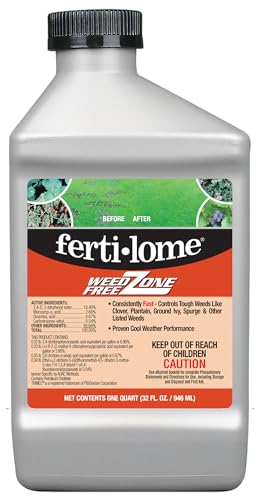
A dicamba-based concentrate that controls over 80 broadleaf weeds and is legendary for stopping creeping charlie.
Fertilome Weed Free Zone is the rare product that buyers consistently call the only thing that truly kills creeping charlie (ground ivy) — a weed that laughs at most over-the-counter sprays. One user highlighted visible wilting and death within five days despite rain, and another said it set the gold standard for creeping charlie control. It is safe on Kentucky bluegrass, bermudagrass, bahiagrass, and zoysiagrass, per the label, so you can spray your zoysia lawn with confidence.
The formula is active ingredient dicamba, which provides rapid evidence of injury within hours of application. It controls over 80 broadleaf weeds including clover, spurge, chickweed, and thistle. The liquid volume is 32 fluid ounces, matching the Nufarm Change Up, but Weed Free Zone typically costs less per bottle. Some reviewers point out you may need to double the recommended dose for clover, and adding a few drops of Dawn dish soap improves adhesion to waxy weed leaves.
The main honest limit: several buyers call it expensive relative to other broadleaf options, and it requires a bit of testing to find the right rate for your specific weeds. One shopper added a little goes a long way, so start low and increase concentration only if the first application does not fully knock out the target weed.
What stands out
- One of the few products that reliably kills creeping charlie
- Controls over 80 broadleaf weeds — clover, spurge, chickweed, thistle, and more
- Safe on zoysia and other major turfgrasses
One drawback
- May need double the labeled dose for clover, according to buyer experience
- Some users find the price per bottle high for a dicamba-only formula
Who it suits: Zoysia owners whose main nemesis is creeping charlie, or those who want a fast-visual broadleaf spray that works even in cool, wet weather.
Who should pass: If your lawn has nutsedge, choose one of the specialty killers above instead.
Understanding the Specs
Active Ingredient and Weed Target
This is the most important decision point. Halosulfuron-methyl travels to nutsedge tubers. Sulfentrazone works as both pre- and post-emergent on sedge and some broadleafs. MCPA + fluroxypyr + dicamba is a broadleaf generalist covering over 200 species. Dicamba alone is great for creeping charlie but lacks sedge control. Match the ingredient to your weed, not the bottle size.
Concentration and Mix Rate
The per-gallon or per-1,000-sq-ft rate tells you how far the bottle goes. A 6-ounce bottle of sulfentrazone at 0.5 fl oz/gal can treat the same number of sprayer loads as a 32-ounce bottle of something mixed at 2 oz/gal — do not judge by bottle volume alone. Pre-measured packets (like the Atticus Empero Q-Pak) eliminate mixing errors but lock you into a single application rate.
FAQ
Can I use any broadleaf weed killer on zoysia grass?
What is the best active ingredient for nutsedge in zoysia?
How long should I wait to see results after spraying?
Can I apply these herbicides during zoysia dormancy?
Will these products kill clover without hurting my zoysia?
How do I avoid killing my zoysia when using sulfentrazone?
What is the difference between a pre-emergent and post-emergent herbicide?
Can I use these products on a newly seeded zoysia lawn?
Should I add a surfactant to these herbicides?
How long after spraying can my pets or kids go on the lawn?
Final Thoughts: The Verdict
If you want one dependable pick, the best herbicide for zoysia grass winner is the Nufarm Change Up because its three-active-ingredient formula knocks out over 200 broadleaf weeds while staying safe on zoysia, and buyers consistently report visible results in about a week. If your main problem is nutsedge, grab the Sulfentrazone 4SC for fast visible control in 24–48 hours. And for creeping charlie or tough broadleafs on a budget, the standout is the Fertilome Weed Free Zone.
How We Picked
We do not accept paid placement. Every pick is matched to a real buyer and a real use-case; we do not hands-on test units.
Sources & Methodology
Specifications: manufacturer listings and product documentation. Review insights: verified customer reviews, as of July 2026. Pricing: not shown on this page (it changes often); check the current price via the retailer link.
As an Amazon Associate, Lawn Gear Lab earns from qualifying purchases. This does not affect which products we feature.