
Specs are compiled from manufacturer listings and verified buyer reviews and can change over time — please confirm the key details on the product page before buying.
Wisteria doesn’t quit. Its woody vines can pull down porch railings, snake under siding, and re-sprout from a root piece no bigger than your thumb. Standard weed sprays barely phase it because they only kill the top growth. The right herbicide needs to hit the root system through a fresh cut, and the strength of the active ingredient determines whether your wisteria problem comes back next season or stays gone.
I’m Rikta — the founder and writer behind Lawn Gear Lab. This guide is built by comparing the manufacturers’ published specifications and the patterns across verified customer reviews, so you get each pick’s real strengths and trade-offs instead of marketing spin.
Below you will find nine weed killers capable of stopping wisteria and other tough woody vines, from ready-to-use stump treatments to concentrated gallons for large infestations. This is the complete buyer’s guide to the best herbicide for wisteria — no fluff, just what works.
Our Picks at a Glance


How To Choose The Best Herbicide For Wisteria
Wisteria is a woody perennial vine with a deep, resilient root system. Spraying a general-purpose weed killer on its leaves rarely kills the entire plant because the chemical doesn’t travel far enough down. The most effective approach is the cut-stump method: you cut the vine near the base and apply a concentrated systemic herbicide directly to the fresh cut, which the plant then pulls into the roots.
Active Ingredient Is What Matters
Triclopyr is the most common and proven active ingredient for woody brush and vines like wisteria. It moves through the plant’s vascular system and kills the roots. Imazapyr is even stronger — it provides broad-spectrum control and can remain active in the soil for months, so you need to be very careful using it near desirable trees.
Ready-to-Use vs Concentrate
A ready-to-use (RTU) bottle costs more per ounce but is zero-fuss for a single wisteria trunk or a few stumps. A concentrate is much more cost-effective if you have a large infestation, a whole fence line, or multiple invasive species to tackle. Concentrates require a separate sprayer and careful mixing.
Safety and Placement
These are non-selective herbicides that kill any plant they touch. Drip or overspray onto a tree root or a lawn can cause dieback. Always read the label restrictions, avoid applying before rain, and wear gloves and eye protection. Some products also contain a surfactant (a sticking agent) that helps the chemical cling to the cut surface or leaves.
Quick Comparison
| Model | Best For | Active Ingredient | Volume | Form | Amazon |
|---|---|---|---|---|---|
| Tordon RTU Brush Killer★ Best Overall | Best Overall — toughest woody vines | Not specified | 32 fl oz | Ready-to-use | Buy |
| Southern AG 01113 Brush Weed KillerBest Value | Budget concentrate for large areas | Triclopyr | 32 fl oz | Concentrate | Buy |
| Image Brush & Vine Killer ConcentrateBest Coverage | Kudzu and blackberry infestations | Triclopyr | 32 fl oz | Concentrate | Buy |
| Bonide Vine & Stump Killer 2 Pack | Small cut-stump jobs on foundation vines | Sodium metabisulfite | 16 fl oz total | Concentrate | Buy |
| Monterey Brush and Vine Control | Simple pour-and-go application | Triclopyr | 32 fl oz | Concentrate | Buy |
| Omni Depot Stump Stop | Ready-to-use stump killer with gloves | Not listed | 32 fl oz | RTU | Buy |
| Alligare Imazapyr 4 SL | Long-term bare-ground control | Imazapyr | 32 fl oz | Concentrate | Buy |
| Southern Ag Brush Killer 1 Gal | Value gallon for heavy brush | Triclopyr (8.8%) | 128 fl oz | Concentrate | Buy |
| Crossbow Herbicide 2.5 Gal | Large-scale pasture and fence-line work | Triclopyr | 320 fl oz | Concentrate | Buy |
In‑Depth Reviews
1. Tordon RTU Brush Killer (1 Quart)
Our pick — over 4.5★ from 500+ verified ratings; the strongest balance of quality and price.
The ready-to-use firehose for invasive wisteria and weed trees.
Tordon RTU is a ready-to-use herbicide that you apply straight from the bottle, so zero measuring or mixing is needed. That convenience matters when you are up on a ladder cutting wisteria trunks that have wrapped a tree — grab the bottle, paint the fresh cut, and move on. The non-selective coverage means it kills anything it touches, which is exactly what you want against a vine as stubborn as wisteria.
Buyers report that this is “the only thing that works to kill a hydra” — a fitting image for a plant that seems to regrow heads every time you cut one off. The effectiveness is the most-discussed topic in owner reviews, and the consensus is that it delivers on tough mulberry, buckthorn, and honeysuckle just as well as on stumps. A few owners note that it is not cheap, and you only get a quart, so for a full acre of brush you will run out fast. But for a targeted assault on a few established wisteria plants, this is the most reliable pick.
Why owners reach for it
- No mixing — apply straight from the quart bottle
- Proven on wood vines like buckthorn and honeysuckle
- Kills the root, stops regrowth in its tracks
The honest trade-offs
- Price per ounce is higher than a concentrate you mix yourself
- 32 oz goes fast if you have many stumps or a large area
Reach for it: You have one or two big wisteria vines and want a grab-and-go solution that punches way above its size.
Better to skip: You are treating a fence line or pasture where a mixable concentrate would be far more economical for the volume.
2. Southern AG 01113 Brush Weed Killer (1 Quart)
A budget-friendly triclopyr concentrate that packs the same active ingredient as pricier brands.
This one is a concentrate, so you will need a pump sprayer and a measuring cup, but the cost per gallon of mixed solution is dramatically lower than any ready-to-use. The active ingredient is triclopyr — the same chemical that powers the premium brush killers — at a concentration strong enough that buyers have watched blackberry and cherry tree leaves “wilted by day’s end” after a morning application. The coverage rating of 512 to 1024 square feet per gallon means a single quart stretches to treat a serious wisteria stand if you hit the stumps and cut vines.
A few owners note that it struggled with strangler fig, so extremely tenacious woody vines may need a second pass or a stronger product. On the other hand, homeowners who had failed with big-box weed killers came back to say this did exactly what they needed. At this price point, there is very little risk in trying it first.
Stretch it far: A 32-oz bottle mixes to many gallons of spray, giving you more coverage than the Tordon RTU for the same volume of concentrate, at a lower price.
Grab it if: You have a moderate-to-large area with wisteria, want to save money, and already own a sprayer.
Skip if: You prefer the grab-and-go convenience of a ready-to-use bottle.
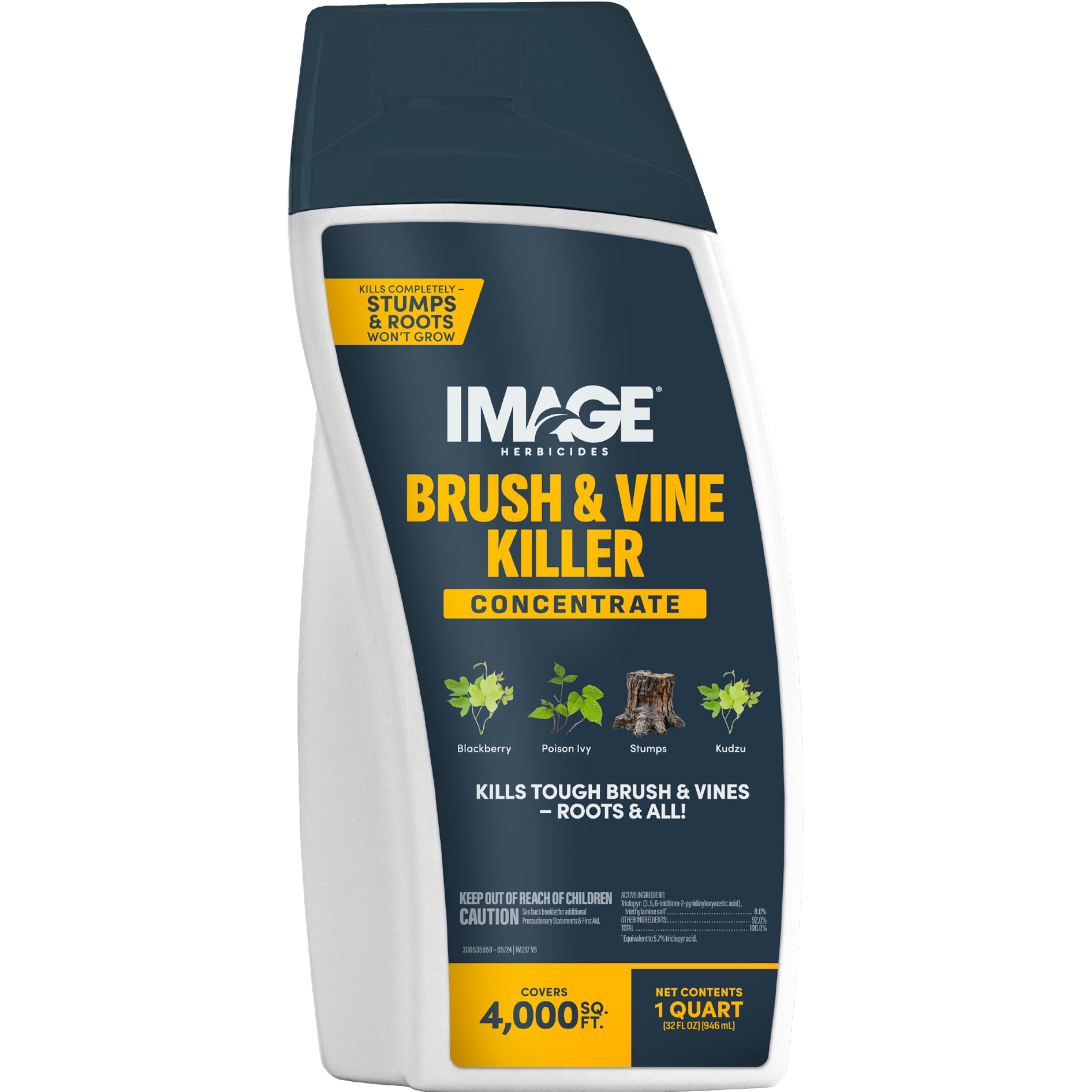
3. Image Brush & Vine Killer Concentrate (32 oz)
Tough on kudzu and Himalayan blackberry, and it has the army of reviews to prove it.
Image is a concentrate that claims about 4000 square feet of coverage, and the data bears that out — buyers tackling large blackberry patches report a successful eradication timeline. One owner tracked the process carefully: at a mix of 4 oz per gallon, the leaves yellowed and wilted in just over ten days, and were fully yellow after three weeks. A stronger 5 oz per gallon mix speeded things up even more. That kind of detailed owner feedback is rare and gives you confidence the product performs as advertised on woody vines.
A small tip that shows up repeatedly: adding a squirt of dish soap as a surfactant (a sticking agent that helps the liquid cling to the waxy leaf surface) improved results on kudzu and poison ivy. The product works without it, but owners who added soap saw a noticeable difference. One missing piece is that Image is not quite as potent per ounce as some of the premium triclopyr concentrates, so really thick wisteria stems may need a follow-up application.
The owner insight: Budget-friendly per gallon of mix, and the concentrated formula means you store less plastic in your garage.
Reach for: Large infestations of wisteria, kudzu, blackberry, or poison ivy where you are willing to spend a little time mixing for huge savings.
Think twice: The wisteria trunks are thicker than your wrist and you want a guaranteed one-shot kill — consider a stronger concentrate or ready-to-use triclopyr.
4. Bonide Vine & Stump Killer With Applicator Concentrate (8 Oz, 2 Pack)
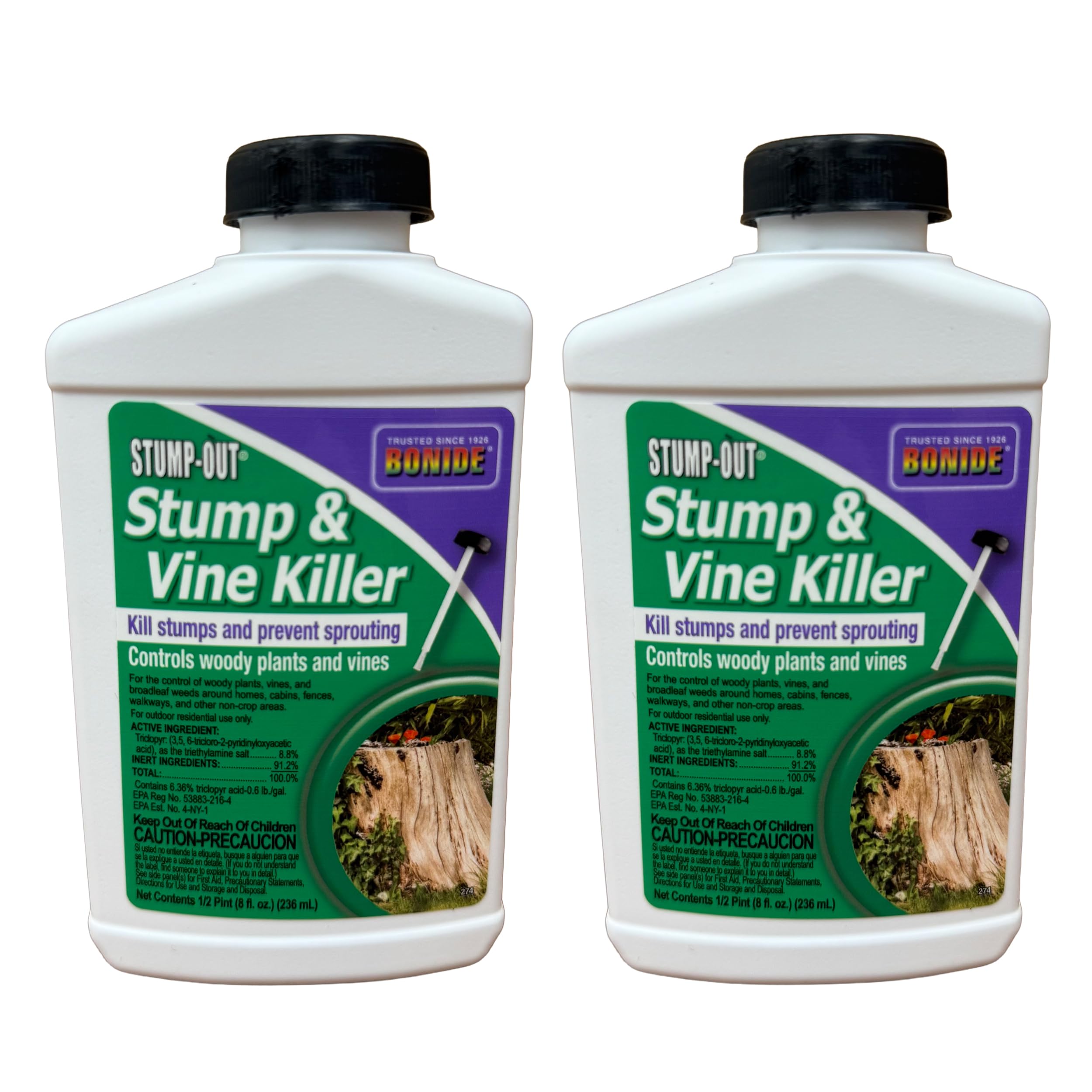
Two small bottles that fit in a tool belt, purpose-built for painting cut stumps.
Bonide markets this specifically for vines and stumps, and owners mention consistent results — they snipped ivy vines at the base, painted the concentrate onto the fresh cut, and watched the vine die back to the roots over the following weeks. The active ingredient, sodium metabisulfite (a chemical that kills plant tissue on contact), works differently from triclopyr, but owners say it works on wisteria-sized vines in a manageable timeframe. Each bottle is only 8 fl oz, so you get a total of 16 fl oz in the two-pack, which is a stark contrast to the 32 oz quart bottles above.
The biggest and most consistent complaint involves leakage. Multiple owners mention the caps being loose and losing half the bottle in shipping. Plan for the mess — order the two-pack and consider it a backup in case one bottle leaks. The small size also means you pay a premium per ounce, but if your wisteria problem is limited to a few trunks near your foundation, the included applicator tip makes precision painting easy and reduces waste.
Best use case: Exactly what it says — small cut-stump jobs where you can snip and paint dozens of individual vines without dragging a sprayer around.
Reach for it: Wisteria is growing up the side of your house and you need precise application near siding and windows.
Skip it: You have a sprawling wisteria patch across a quarter acre — you will burn through two bottles fast and will want a full quart or gallon.
5. Monterey Brush and Vine Control (1 Qt with Spoon)

A triclopyr concentrate that lives up to the “pour on anything” promise.
Monterey is a triclopyr concentrate that comes with a measuring spoon included — a small detail but a welcome one when you are mixing in the field. The label says freshly cut stumps need undiluted application, and owners confirm that a direct pour onto the cut surface kills invasive shrubs and vines to the root. The effectiveness is so consistent that one buyer called it “best vine and weed killer” and another reported it “killed everything” on the first pass.
One pattern to note: a few owners found that poison ivy needed a second application, so the most tenacious woody vines may require a repeat dose after a few weeks. The product is designed for outdoor residential use only and should not be sprayed near edible crops or desirable trees. If you like the idea of triclopyr power but found the Tordon RTU or Southern AG options too small or too large, this quart with a free spoon hits a comfortable middle spot.
What wins people over: The “pour on anything you don’t want to grow” simplicity — no elaborate mixing protocol, just pour concentrated into the cut.
Grab it if: You need a triclopyr concentrate for cut-stump work on wisteria and want the measuring spoon included.
Look elsewhere: You want a ready-to-use formula for zero-effort application.
6. Omni Depot Stump Stop (32 Fl. Oz, with Gloves)

The stump killer that arrives with protective gloves already in the box — smart thinking.
Omni Depot Stump Stop is a ready-to-use formula that is pre-mixed, so you open the bottle and pour it onto a fresh-cut stump or into drilled holes. The package includes a pair of thick rubber gloves, and the review pages make clear that glove use is not optional: one buyer’s imperative advice is “glove up,” because the liquid can splash. The product is marketed as non-toxic to animals once dry, and owners confirm it stops regrowth effectively, with large thistles wilting within two days in one documented case.
A few units have arrived with leaking bottles, so check the seal before you head to the job site. The formula is stated as safe for grazed areas, meaning livestock can return to the area after the solution dries. For a single wisteria stump or a row of cut vines along a fence, this is a low-effort, low-mess solution that avoids the mixing step entirely.
Key owner note: “Apply to fresh-cut stump top for best absorption” — so make your cut, wait no more than a few minutes, then pour.
Reach for it: You want the easiest possible stump treatment with no measuring or cleanup.
Skip it: You are treating dozens of wisteria vines across a large property; the per-ounce cost is higher than a concentrate you mix.
7. Alligare Imazapyr Herbicide 4 SL (1 Quart)
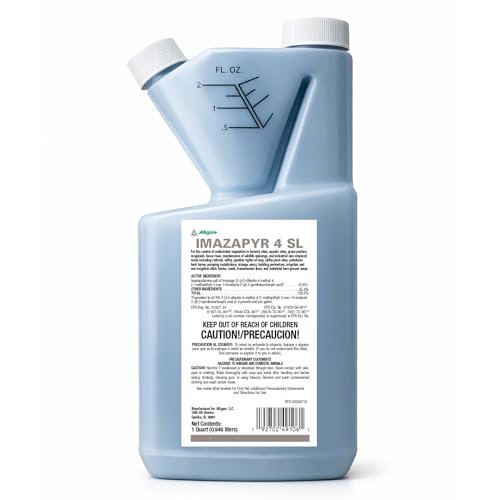
Total root annihilation for bamboo and wisteria that laugh at triclopyr.
Alligare uses imazapyr, a different active ingredient that is significantly more persistent in the soil than triclopyr. Owners who had “tried everything” on bamboo — which has the same aggressive root system as wisteria — found that cutting the stalks and applying Alligare to the exposed roots finally solved the problem. The product covers up to 1 acre when mixed, making it a serious tool for large infestations. The key difference: imazapyr remains active in the ground for months, so it prevents any seed or root fragment from sprouting nearby.
That soil persistence is also the warning. This is not selective — it kills grass, it kills garden plants, and it can spread through tree roots within the soil. Owners recommend mixing at 1 to 2 oz per gallon with a non-ionic surfactant for foliar spraying on blackberry and fence lines. Results are visible in one to two weeks, and the effect lasts for months without reapplication. This is for the buyer who has declared total war on a wisteria patch and is willing to sacrifice everything within the treated zone.
The catch: Imazapyr kills grass and can harm desirable trees through root uptake — this is not a spot-treatment tool.
Grab it if: Wisteria has overtaken a whole ditch or fence line and you need one treatment to keep it gone for the entire season.
Avoid it if: Wisteria is growing near a prized oak, a vegetable garden, or your lawn — the imazapyr will travel.
8. Southern Ag Brush Killer 8.8% Triclopyr (1 Gallon)

A full gallon of 8.8% triclopyr for the buyer who needs to treat acreage.
This is the larger sibling of the Southern AG quart above, and the concentration is stated clearly: 8.8% triclopyr. Customers note excellent results on poison ivy, sumac, sassafras, and briar bushes — wisteria fits the same profile of woody brush. The application guidance from experienced buyers is to use 4 oz per gallon of water for most vines and to bump up to 8 oz per gallon for tougher species like yaupon. Kills the roots, and repeat reviewers point out no regrowth after eight months on some applications.
However, the review averages mask a split: about as many owners call it a great value as call it a waste of money. Some recent bottles seem to have performed poorly, with one buyer suspecting dilution. The most reliable method is to test the mix on a single wisteria stem before spraying the whole patch. Also note that the gallon containers often arrive without any product labeling or mixing instructions — the label itself is missing. If you already know how to mix triclopyr, this is a fine value; if you need instructions printed on the bottle, you may be frustrated.
Owner advice: “Poor around the trunk and wait a day or two, then cut it down, or cut it down low first to make easier stump removal.”
Reach for it: You have a significant wisteria problem spanning a hillside or fence line and want the lowest cost per ounce of triclopyr.
Think twice: You are a beginner who needs clear mixing directions on the bottle — look at the smaller Southern AG quart instead.
9. Crossbow Herbicide (2.5 Gallon)

The tractor-ready jug that kills blackberries dead and leaves the grass standing.
Crossbow is a post-emergent herbicide that combines triclopyr with 2,4-D. The biggest practical advantage: it kills woody brush and broadleaf weeds while leaving grasses unharmed. For a field or pasture where wisteria is invading among grass, this selectivity is gold. The coverage rating is 2.5 acres, which makes this the clear choice for a large-scale wisteria problem on rural property. The product is rainfast within two hours, so you are not at the mercy of an afternoon shower.
At this volume, you need a dedicated sprayer — a hand-pump backpack or a tractor-mounted rig. One buyer called it the “best herbicide for thistles, autumn olive, Japanese barberry, and broadleaf weeds” with a single-spray kill rate. The price is a significant upfront investment, but the cost per acre is lower than any other product in this list. For the odd wisteria vine in a suburban yard, this is overkill and heavy to handle. For a farm, a hunting property, or a long fence line, it is the correct tool.
The data point: There are no grazing restrictions for non-lactating dairy animals after application, so livestock land stays usable.
Buy it when: Wisteria and brush are overtaking acreage and you want a one-trip solution that does not destroy your pasture grass.
Skip it: You are treating three wisteria stumps in a backyard — you would waste most of the jug and it is physically heavy to handle.
Understanding the Specs
Triclopyr Concentration
Triclopyr is a systemic herbicide that mimics a natural plant-growth hormone, causing the plant to grow itself to death from the inside. The higher the concentration percentage, the stronger the mix; an 8.8% concentrate gives you more flexibility per gallon of water than a ready-to-use formula which is already diluted. For wisteria, a cut-stump application with undiluted or lightly diluted triclopyr is the standard approach. Brands like Tordon, Southern AG, Image, and Monterey all rely on triclopyr as the heavy lifter, so the main difference is convenience (RTU vs concentrate) and price per ounce.
Cut-Stump Method
This is the only method that reliably kills a mature wisteria root system. You cut the vine at waist height (or as low as you can reach), then immediately paint or spray the herbicide onto the fresh-cut surface before the plant starts sealing the wound. The chemical travels down the vascular tissue (the plant’s internal transport system) into the root. Roots can re-sprout even years after cutting the vine, so this method stops that recovery. Most of the products in this guide are designed for this exact technique — check the label for “cut stump” or “stump treatment.”
FAQ
Can I just spray wisteria leaves with herbicide and kill it?
What is the best time of year to treat wisteria?
Will triclopyr kill my grass if I spill it nearby?
How long does it take for the herbicide to kill the whole wisteria root?
Is it safe to use herbicide near a pond or water source?
Can I use the same herbicide on poison ivy and wisteria?
What if the wisteria vine is growing up a living tree I want to keep?
Which ready-to-use product is the strongest for wisteria?
Final Thoughts: The Verdict
For most people, the best herbicide for wisteria is the Tordon RTU Brush Killer because it arrives ready to use, is proven on the toughest woody vines, and the crowd of buyers with over 500 ratings agree it kills everything from stumps to weed trees. If you want to stretch your dollar across a large infestation, grab the Southern AG 01113 Brush Weed Killer — same triclopyr chemistry at a fraction of the cost per mixed gallon. And for the buyer facing acres of wisteria and wanting to keep the grass intact, the Crossbow Herbicide 2.5 Gallon is the one to reach for.
How We Picked
We do not accept paid placement. Every pick is matched to a real buyer and a real use-case; we do not hands-on test units.
Sources & Methodology
Specifications: manufacturer listings and product documentation. Review insights: verified customer reviews, as of July 2026. Pricing: not shown on this page (it changes often); check the current price via the retailer link.
As an Amazon Associate, Lawn Gear Lab earns from qualifying purchases. This does not affect which products we feature.