
Specs are compiled from manufacturer listings and verified buyer reviews and can change over time — please confirm the key details on the product page before buying.
Water lilies choking your pond, turning your peaceful view into a green mat that blocks the sun and steals the oxygen? You are not just fighting a plant — you are fighting a root system (a rhizome) that can stretch across an entire lake bottom, and surface clippings only make the problem worse. Getting rid of them means picking the right aquatic herbicide that kills the whole plant, roots included, without harming your fish or other water life.
I’m Rikta — the founder and writer behind Lawn Gear Lab. This guide is built by comparing the manufacturers’ published specifications and the patterns across verified customer reviews, so you get each pick’s real strengths and trade-offs instead of marketing spin.
From fast-acting liquid sprays to slow-release granules that work all season, this guide cuts through the confusion to help you find the best herbicide for water lilies for your specific pond, lake, or shoreline.
Quick Picks
- Alligare Ecomazapyr 2 SL Herbicide — Best Overall
- Atticus Semera SC Herbicide — Top Performer
- Atticus Semera 51.0% WDG Aquatic Herbicide — Best Value
- CattPlex Pro – Aquatic Herbicide — Versatile Spray
- ALLIGARE Flumigard Herbicide — Budget Champion
- SonarOne Aquatic Herbicide 5 lbs EPA-Approved — Slow-Release Pro
- Navigate Granular Aquatic Herbicide — Pro Grade
How To Choose The Best Herbicide For Water Lilies
Choosing the wrong product can mean wasting money on a contact killer that burns the leaves but leaves the roots to regrow in a week. Here is what you actually need to look for.
Systemic vs. Contact Action
Water lilies have thick, waxy leaves and a massive rhizome root system (a thick underground stem that stores energy and sends up new shoots). Contact herbicides only kill the part they touch — the leaf — so the plant rebounds fast. A systemic herbicide (like flumioxazin or imazapyr or a granular slow-release formula) travels through the plant to kill the roots, and that is how you get rid of water lilies for good rather than just pruning them.
Active Ingredient Matters
Not all active ingredients work the same. Flumioxazin is a fast-acting contact with some systemic action on young weeds, and it works well for floating weeds like duckweed and water lilies. Imazapyr is a broad-spectrum systemic that controls a huge range of plants including water lilies, but it can also harm desirable shoreline trees if over-applied. Imazamox (the active in CattPlex Pro) is more selective for aquatic environments and spares more beneficial plants. Granular options often use a different chemistry that slowly releases in the water column to target roots over weeks.
Application Method and Convenience
You have to match the product to your setup. Granular pellets (like SonarOne or Navigate) are simply tossed by hand over the surface, which is perfect for large ponds or lakes without a sprayer. Liquid concentrates (like Alligare Ecomazapyr or Atticus Semera SC) require a tank sprayer and careful mixing, which gives more precise spot treatment but takes more gear. Pre-mixed ready-to-spray options (like CattPlex Pro) are the easiest for small quick jobs around a dock or shoreline.
EPA Approval and Fish/Wildlife Safety
Always verify the product is EPA-approved for aquatic use. Every product on this list is labeled for use in water, but some are safer for fish and wildlife than others. SonarOne and Navigate are both EPA-approved and non-toxic to fish, pets, and wildlife when used according to the label. Others may have waiting periods before the water can be used for swimming or irrigation. The label is the law — read it before every application.
Quick Comparison
| Model | Best For | Active Ingredient | Form | Total Weight | Amazon |
|---|---|---|---|---|---|
| Atticus Semera SC Herbicide (8 oz) | Fast liquid spot treatment | Flumioxazin 44% | Liquid | 8 Ounces | Amazon |
| Alligare Ecomazapyr 2 SL Herbicide (1 Qt) | Broad-spectrum year-long control | Imazapyr 27.8% | Liquid | 32 Ounces | Amazon |
| ALLIGARE Flumigard Herbicide (1 lb) | Fast-acting algae and young weed control | Flumioxazin | Granule | 16 ounces | Amazon |
| Atticus Semera 51.0% WDG Herbicide (1 lb) | Season-long control for floating weeds | Flumioxazin 51% | Water-Dispersible Granule | 16 ounces | Amazon |
| SonarOne Aquatic Herbicide (5 lbs) | Slow-release for large ponds or lakes | — | Granule, Pellets | 5 Pounds | Amazon |
| CattPlex Pro Aquatic Herbicide (32 oz) | Targeted aquatic weed control with minimal harm | Imazamox | Spray | 32 Ounces | Amazon |
| Navigate Granular Aquatic Herbicide (50 lbs) | Pro-grade spot treatment for large water bodies | Herbicide | Granule | 50 Pounds | Amazon |
In‑Depth Reviews
1. Alligare Ecomazapyr 2 SL Herbicide – Broad-Spectrum Brush & Weed Killer for Aquatic & Terrestrial Areas – 27.8% Imazapyr, 1 Quart
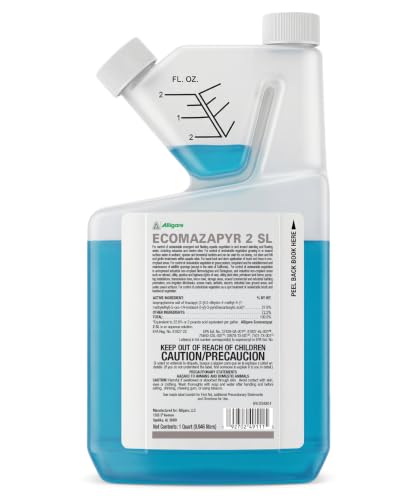
Kills the whole water lily from root to leaf, and works on over 185 other weed types — so you do not need a separate product for shoreline brush.
This is the herbicide to reach for when you want one product that handles water lilies, emergent brush (plants growing at the water’s edge), and shoreline weeds without needing three different bottles. It contains 27.8% Imazapyr, a systemic active ingredient that moves through the plant and kills the roots, unlike a contact spray that just burns the leaves. The manufacturer says it provides long-lasting residual control, meaning a single treatment can keep your pond clear for the whole growing season.
It gives you several application options — cut stump, basal bark (treating the base of the stem), stem injection, and spot treatment — so you can be precise around desirable plants. The liquid volume is 1 quart (32 fluid ounces), making it a concentrated option that mixes before spraying. One downside is that its broad-spectrum power means it will kill any vegetation it touches, so you need to be careful with overspray near trees or ornamentals you want to keep.
Unlike the Atticus Semera SC which is a faster-acting contact herbicide with 44% flumioxazin at 8 fluid ounces, the Alligare Ecomazapyr is a slow systemic that delivers full root-kill over time. The trade-off is patience — you may not see the lily pads die back for a week or two, but buyers report that when they go, they stay gone.
Why it dominates
- Controls more than 185 weed species — trees, brush, and aquatic weeds
- 27.8% imazapyr concentration is one of the highest systemic loads you can buy
- Multiple application methods let you spot-treat around sensitive plants
Plan for
- Non-selective — kills any plant it contacts, not just water lilies
- Slow-acting compared to contact flumioxazin options; results take days to weeks
The heavy lifter: Best for pond owners who want a single product that controls everything from water lilies to shoreline brush and can wait for systemic root-kill.
Watch for overspray: Do not use near desirable trees or ornamentals unless you spot-treat carefully — this will kill them too.
2. Atticus Semera SC Herbicide (8 oz) – 44% Flumioxazin Weed Killer – Season Long Lawn and Aquatic Weed Control

Burns back floating weeds in a few days, and stops new seeds from sprouting for up to six months — so you get fast visible results plus lasting prevention.
This liquid concentrate uses 44% flumioxazin, which is a fast-acting contact herbicide that also has residual pre-emerge power (pre-emerge means it stops weed seeds from sprouting). That means it kills the water lilies and floating weeds you see now, while also stopping new seeds from germinating for up to six months. Atticus says one application works all season, and because it offers both pre-emerge and post-emerge control (post-emerge means it kills weeds that have already grown) up to 2 inches in height, you have some timing forgiveness if you missed the early window.
At only 8 fluid ounces total, this is a compact product ideal for spot treatments around a dock or small pond. It is noticeably smaller than the Alligare Ecomazapyr which is 32 ounces — at 8 fluid ounces versus the Alligare Ecomazapyr at 32 fluid ounces — so you will need to buy more if you have a larger infestation. It controls a good list of aquatic weeds including duckweed, alligator weed, coontail, hydrilla, pondweed, water fern, water lettuce, and watermilfoil, though water lilies are not explicitly listed in the coverage label, so confirm your specific weed on the label.
Owners mention that the liquid mixes easily in a standard tank sprayer and shows visible results within a couple of days on floating weeds. The catch is that it is primarily a contact killer, so while it burns back lily leaves fast, it may not fully kill the rhizome (the thick underwater stem) on its own — heavy water lily growth may require a follow-up systemic.
Rapid response: If you need floating weeds gone in days, this 8 oz concentrate delivers fast results for smaller ponds and docks.
Mind the coverage: At just 8 ounces, you get less volume than the Alligare (32 oz), so it works best for targeted spots rather than a full lake treatment.
3. Atticus Semera 51.0% WDG Aquatic Herbicide (1 lb) – Controls Duckweed & Unwanted Submerged & Floating Vegetation – Flumioxazin 51%
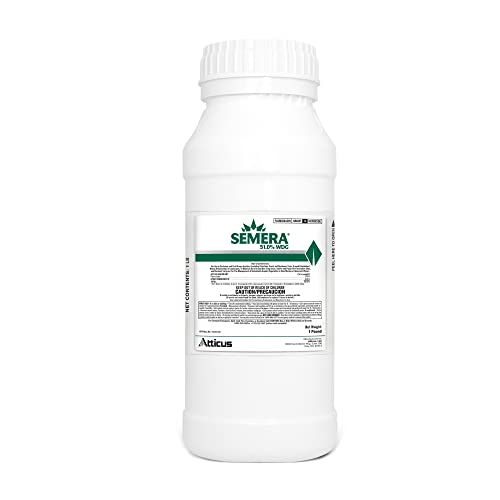
Gives you the most active ingredient per container at 51% flumioxazin — so you use less product for each application than you would with the 44% liquid version.
This is the concentrated granular version of flumioxazin, and at 51% active ingredient (compared to 44% in the SC liquid), it is slightly more potent per ounce. It comes as a water-dispersible granule (WDG — a dry powder that dissolves in water for spray application), meaning you mix it with water in a sprayer, and it goes to work as a fast-acting contact herbicide with pre-emerge residual (killing existing weeds and stopping new seeds). The manufacturer says it offers six-month weed control with one spray, and it handles submerged, emergent, and floating weeds including duckweed, alligator weed, coontail, hydrilla, pondweed. Water lilies are not explicitly listed but it targets the same floating weed family.
At 16 ounces (1 pound), the total weight is comparable to the Alligare Flumigard at 16 ounces, but with a different active ingredient. While the Flumigard uses flumioxazin in a granule form for surface and subsurface treatment, the Semera WDG is designed for spray application after mixing. That gives you more precise control over where the chemical lands, but it requires a sprayer, unlike the throw-and-go pellets.
The key advantage here is active ingredient density — 51% means you need less product per application compared to lower-concentration formulas. Customers note that one pound covers more area than expected, making this a strong mid-range value for anyone who already owns a sprayer.
Power per pound
- Highest flumioxazin concentration on the list at 51%
- Pre-emerge and post-emerge control in one product
- Versatile for aquatic, landscape, and turf applications
Requires a sprayer
- Must be mixed with water — not a direct broadcast granule
- Flumioxazin is contact-primary, so very mature lilies may need a repeat spray
Concentration champion: Best for property owners who want the most active ingredient per dollar and already have a tank sprayer ready.
Not a toss-and-go: Unlike pellet products, this granule must be mixed into a spray solution before application.
4. CattPlex Pro – Aquatic Herbicide – Kills Cattails, Water Lilies, Grasses & More – Quart (32 Ounces)
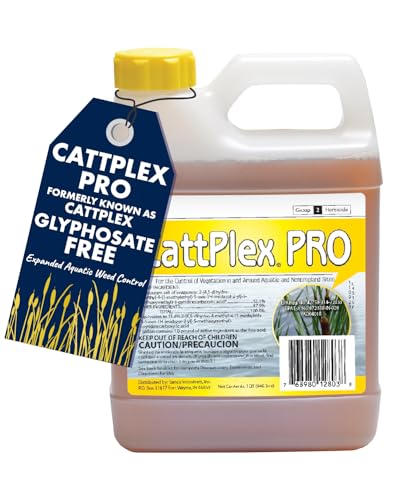
Spares your shoreline trees and beneficial plants while killing water lilies, because it uses a selective systemic active ingredient made for aquatic environments.
CattPlex Pro uses Imazamox as its active ingredient, which is a systemic herbicide (travels through the plant to kill the roots) designed specifically for aquatic environments. Unlike broad-spectrum options like imazapyr, imazamox is more selective — it targets common aquatic weeds like water lilies, cattails, water milfoil, pondweed, and duckweed while having a minimal impact on beneficial flora and fauna. The manufacturer says it is trusted by aquatic management professionals and helps preserve the balance of the ecosystem.
At 32 fluid ounces, the liquid volume is the same as the Alligare Ecomazapyr (32 fluid ounces), but the active ingredients are different. The CattPlex Pro covers 1,000 square feet per quart according to the specs, which makes it ideal for smaller ponds, docks, or shoreline patches. It also names water lilies directly in its description, which is reassuring if that is your primary target. The item weight is 32 ounces, matching the application volume precisely.
The trade-off is that reviewers point out it is priced higher than the other options, but they get a product specifically formulated for aquatic environments that is safer for the things you want to keep. One buyer reports that visible die-back on cattails and surface lilies appears within a week, and that the spray formulation is easy to apply with a backpack or handheld sprayer.
Ecosystem-aware: The best pick for pond owners who want to kill water lilies without nuking everything else in the water.
Small-area focus: Covers 1,000 square feet, so it is perfect for targeted spot treatments but not a full-lake solution.
5. ALLIGARE Flumigard Herbicide – Fast-Acting Flumioxazin Weed Killer for Rapid Control of Aquatic Algae and Terrestrial Weeds – Granules – 1lb
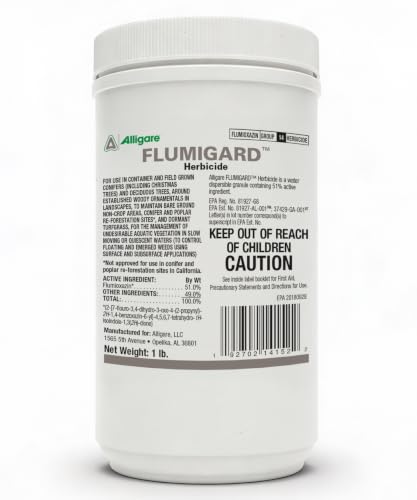
No sprayer, no mixing — just toss these 16 ounces of granules onto the water to knock back algae and young weeds within days.
This is a granular flumioxazin product, so you do not need a sprayer or mixing tank — you just broadcast the granules over the water surface. It gives rapid knockdown of filamentous algae (stringy, hair-like algae) and young terrestrial weeds, making it a fast-acting contact option. The manufacturer says to apply when weeds are young and healthy, and in sunny conditions above 65°F, as moisture activates the herbicide in the soil for residual control (continued prevention of regrowth).
At 16 ounces (1 pound), the item weight is the same as the Atticus Semera WDG (16 ounces), but the form is different — Flumigard is a granule for direct broadcast, while the Semera WDG is a water-dispersible granule for spray mixing. The Flumigard is specifically designed for both surface and subsurface treatments in lakes, ponds, canals, and around woody ornamentals. It also pairs well with systemic herbicides like glyphosate, according to the manufacturer, to boost post-emergent control.
The 1-pound bag is a smaller quantity, so unlike the 50-lb Navigate or the 5-lb SonarOne, this is best for small ponds or early-season spot treatments. Reviewers appreciate that it works fast on algae mats, but for established water lilies, you may need a systemic partner product to also kill the roots.
Fast and easy
- No sprayer or mixing needed — just toss the granules on the water
- Works quickly on filamentous algae and young broadleaf weeds
- Compatible with systemic herbicides for a tank-mix boost
Smaller coverage
- 1 pound goes fast on even a modest pond
- Contact action means it mainly hits surface growth, not deep rhizomes
Quick knockdown without gear: Ideal for pond owners who want a no-fuss granular option for algae and young floating weeds in a smaller water body.
Not a one-shot for big lilies: Mature, deep-rooted water lilies will likely need a follow-up systemic treatment after the initial burn.
6. SonarOne Aquatic Herbicide 5 lbs EPA-Approved Pellet for Systemic Control of Hydrilla, Coontail, Elodea and Other Invasive Weeds, Slow-Release Granules for Long-Term Weed Management, Easy to Apply
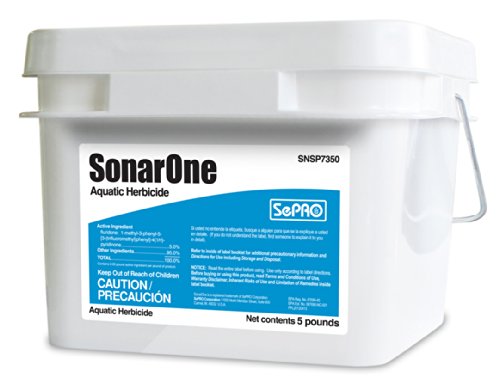
Kills weeds from the roots up without a sudden oxygen crash that can suffocate your fish, because the 5-pound bag of pellets releases the herbicide slowly over time.
SonarOne works differently from the contact killers above. It uses a slow-release pellet that sinks and disperses the herbicide through the water column over time, killing weeds systemically (through the roots). The big advantage here is safety for fish and pets — the manufacturer states it is EPA-approved and non-toxic to fish, pets, and wildlife, so it is safe for residential ponds, farms, and lakes. By killing weeds slowly rather than all at once, it prevents sudden oxygen depletion that can suffocate fish.
At 5 pounds, it is a significant step up in quantity from the 16-ounce (1-pound) bags of Flumigard and Semera WDG. The unit count is 80.0 ounces, compared to the 8.0-ounce unit count of the Atticus Semera SC — 80 ounces versus 8 ounces. It covers approximately 0.25 to 1.0 acres per 5-pound bag, making it a mid-to-large pond solution. Application is simple: just throw the pellets evenly over the pond surface — no mixing, no spraying.
The downside is that slow release means slow results. You will not see rapid leaf burn like with flumioxazin; instead, the weeds slowly wither over a couple of weeks as the chemical works through the root system. The manufacturer says it targets hydrilla, coontail, elodea, duckweed, and milfoil, among others, but water lilies are not explicitly listed in the product data — check the full label to confirm.
Oxygen-safe weed control: The best choice for fish-stocked ponds where you cannot risk a sudden oxygen crash from fast die-off.
Patience required: Does not provide the overnight results of a contact flumioxazin. Expect to wait 1-3 weeks for full die-back.
7. Navigate Granular Aquatic Herbicide – 50 lbs EPA-Approved Systemic Weed Control for Eurasian Milfoil, Water Lily, Bladderwort, etc. Pro Grade – Spot Treatment
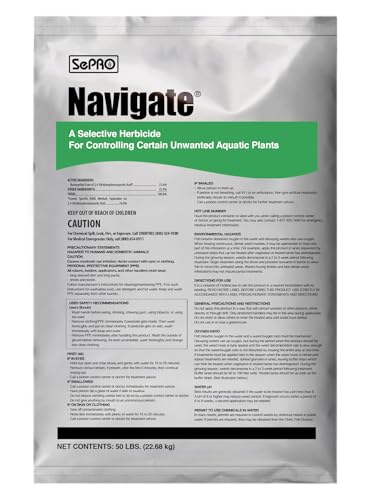
Explicitly lists water lily and spatterdock in its treatment list, in a 50-pound bag that covers 1 to 2 acres — made for lake-sized jobs the smaller products cannot handle.
This is the heavy artillery. Navigate is a 50-pound bag of granular herbicide designed for large ponds, lakes, and other freshwater habitats. It uses granule technology for controlled dispersion throughout the water, meaning you can spot-treat specific zones rather than treating an entire water body at once. The treatment list is explicit: it controls watermilfoil, waterstargrass, bladderwort, water lily, coontail, watershield, water chestnut, and spatterdock — all of which are common nuisance aquatic plants.
At 50 pounds, the item weight and unit count (800 ounces) dwarf every other product on this list. It covers approximately 1 to 2 acres per bag, making it the clear choice for large-scale problems. Unlike the SonarOne at 5 pounds which covers 0.25 to 1.0 acres, the Navigate is designed for serious infestations. The manufacturer says it is especially effective against Eurasian watermilfoil, an aggressive invasive species found nationwide, and can be used as a spot treatment for targeted zones.
The sheer size is the main barrier here — 50 pounds of granules is heavy to transport and apply by hand, and you need a significant infestation to justify the volume. Shoppers say that it works well on shoreline lily pads, but application requires careful measurement to avoid over-treating. Check state restrictions before ordering, as it cannot ship to AK, CT, FL, HI, ME, NJ, NY, VT, WA, or Canada.
Bulldozer coverage
- 50 pounds covers 1–2 acres, class-leading by the smaller bags in this list
- Explicitly lists water lily and spatterdock in its controlled weeds
- Granule technology allows controlled dispersion and spot treatment
Major commitment
- Heavy 50-pound bag is difficult to transport and spread by hand
- Cannot be shipped to many states — check local regulations before buying
Lake-sized solution: The right pick for large lakefront owners or land managers who need to treat an acre or more of water lilies and invasive milfoil.
Not a weekend project: Requires careful measurement, physical strength to handle 50 pounds, and verification that your state allows it.
Understanding the Specs
Active Ingredient
The active ingredient is the chemical that actually kills the weed. Flumioxazin (44% or 51%) is a fast-acting contact option with pre-emerge residual (stops new seeds from sprouting) — you see results in days, but may need reapplication for deep-rooted lilies. Imazapyr (27.8%) is a non-selective systemic that kills the whole plant, roots included, over a longer period. Imazamox is a more selective systemic designed for aquatic environments and is safer for beneficial plants. Always match the active ingredient to your specific weed and your tolerance for collateral damage.
Form: Liquid vs. Granule vs. Pellet
The form changes how you apply the product and how it behaves in water. Liquids (like Atticus Semera SC and Alligare Ecomazapyr) mix with water in a tank sprayer for precise spot treatment. Granules (like Alligare Flumigard and Navigate) are tossed directly onto the water surface — no sprayer needed — and either sink or dissolve. Pellets (SonarOne) are slow-release and provide a constant dispersion of herbicide over time, preventing sudden oxygen crashes. The right form depends on your pond size, your gear, and if you need immediate or gradual action.
FAQ
How do I kill water lilies without killing my fish?
Can I just cut the lily pads off instead?
What is the difference between flumioxazin and imazapyr for water lilies?
How much does a 50-pound bag of Navigate cover?
Do granules work better than liquid sprays for water lilies?
Will these herbicides harm my grass or trees near the pond?
How long does it take for water lilies to die after applying herbicide?
Can I swim in my pond after applying aquatic herbicide?
Why is CattPlex Pro more expensive than the other options?
What happens to the dead lily pads after treatment?
Final Thoughts: The Verdict
For the majority of shoppers, the herbicide for water lilies winner is the Alligare Ecomazapyr 2 SL because its 27.8% imazapyr concentration delivers systemic root-kill for water lilies plus over 185 other weed types, all from a single quart that works all season. If you want fast-acting spot treatment for floating weeds, grab the Atticus Semera SC (8 oz). And for large lakes or heavy infestations, the Navigate Granular (50 lbs) explicitly names water lilies in its treatment list and covers 1 to 2 acres per bag — that is the one to reach for when the smaller bags run out.
How We Picked
We do not accept paid placement. Every pick is matched to a real buyer and a real use-case; we do not hands-on test units.
Sources & Methodology
Specifications: manufacturer listings and product documentation. Review insights: verified customer reviews, as of July 2026. Pricing: not shown on this page (it changes often); check the current price via the retailer link.
As an Amazon Associate, Lawn Gear Lab earns from qualifying purchases. This does not affect which products we feature.