
Thistles laugh at weak herbicides. Their deep taproots and waxy leaves shrug off most consumer-grade sprays as if they were rain. Winning against this persistent weed means choosing chemistry that penetrates the cuticle and follows the root system down to where the regrowth lives — anything less is just temporary cosmetic relief.
I’m Rikta — the co-founder and writer behind Lawn Gear Lab. I’ve spent hundreds of hours analyzing active-ingredient profiles, comparing application rates, and cross-referencing owner reports to find the formulas that actually stop thistle colonies from recurring season after season.
This guide cuts through the marketing to deliver the most effective, research-backed picks for eliminating creeping, bull, and Canada thistles. Here is your complete resource for finding the best herbicide for thistles that delivers visible results without wasted time or repeated treatments.
How To Choose The Best Herbicide For Thistles
Thistles store energy in their taproot system. A spray that only burns the foliage will leave the plant alive to regrow within weeks. You need a herbicide formulation that is absorbed by the leaves and translocates all the way down to the root tips. Here are the three most critical factors.
Active Ingredient Profile
Thistles respond best to systemic active ingredients. Dicamba and Triclopyr are the heavy hitters for thistle control because they translocate effectively. Products that combine 2,4-D with Dicamba and Triclopyr (like four-way mixes) deliver a broader spectrum of attack. For bull and Canada thistles, a non-selective formula containing glyphosate or a brush killer with triclopyr works well in non-lawn areas where you don’t mind killing surrounding grass.
Selective vs. Non-Selective
If you are spraying thistles in a lawn of Kentucky bluegrass, tall fescue, or Bermuda, you need a selective herbicide that kills broadleaf weeds without harming the turf. Look for products labeled safe for your grass type — most that contain 2,4-D, Dicamba, and MCPP-p will protect cool-season grasses. For pastures, food plots, or gravel driveways, a non-selective formula gives you more flexibility to target thistles at higher concentrations.
Additives and Application
Thistle leaves have a waxy cuticle that causes spray droplets to bead up and roll off. A non-ionic surfactant — or a product that already includes one — drastically improves adhesion and absorption. Applying during the rosette stage in early spring, when daytime temps are between 50-80°F, increases translocation. Avoid spraying during drought stress or when temperatures exceed 85°F, as the plant closes its stomata and reduces chemical uptake.
Quick Comparison
On smaller screens, swipe sideways to see the full table.
| Model | Category | Best For | Key Spec | Amazon |
|---|---|---|---|---|
| SpeedZone EW Lawn Weed Killer | Mid-Range | Fast-acting cool-weather thistle kill | 4 active ingredients + carfentrazone | Amazon |
| Select Source Triad TZ | Mid-Range | Selective four-way broadleaf control | Triclopyr + Dicamba + Sulfentrazone | Amazon |
| ALLIGARE 2,4-D Amine | Premium | Large-area pasture and aquatic sites | 46.8% 2,4-D active ingredient | Amazon |
| Ferti-lome Weed Free Zone | Premium | Lawn-safe thistle and creeping charlie | 32 oz concentrates to 20+ gallons | Amazon |
| ALLIGARE MSM Turf Herbicide | Mid-Range | Low-rate economy for large turf areas | Metsulfuron methyl at 0.2 oz/acre | Amazon |
| Roundup Poison Ivy Plus Tough Brush Killer | Premium | Non-lawn woody brush and vine patches | Triclopyr + Diquat + Fluazifop | Amazon |
| Whitetail Institute Arrest Max | Premium | Selective grass control in food plots | Clethodim for clover & alfalfa safety | Amazon |
In‑Depth Reviews
1. SpeedZone EW Lawn Weed Killer

SpeedZone EW is the rapid-response choice for thistle infestations in cool-season lawns. It contains carfentrazone, a contact herbicide that shows visible wilting within hours, plus a systemic base of 2,4-D, dicamba, and mecoprop-p that translocates into the taproot. Users report thistle browning in two days and no regrowth for the remainder of the season when applied at the rosette stage.
The emulsifiable concentrate formulation spreads evenly across waxy thistle leaves without excessive beading. SpeedZone EW is rainfast in just three hours, giving you flexibility if afternoon storms are forecast. It controls over 90 listed broadleaf weeds including ground ivy and spurge, making it a versatile weapon for a full lawn weed program.
Be precise with your spray volume. Oversaturating the turf can burn grass alongside the thistles — the label specifies 1.5 fl. oz. per gallon for cool-season turf. Some users found the measuring cap imprecise, so consider using a graduated mixing bottle for accuracy. The 20-ounce bottle covers roughly 13,000 square feet at the labeled rate.
What works
- Visible results within hours of application
- Rainfast in only 3 hours
- Reseed as soon as 7 days after treatment
What doesn’t
- Easy to overdose and scorch surrounding grass
- No built-in measuring device included
2. Select Source Triad TZ

Triad TZ combines four distinct active ingredients — 2,4-D, Dicamba, Triclopyr, and Sulfentrazone — into a single concentrate. This multi-mode approach is critical for thistle control because it attacks the plant through different metabolic pathways, reducing the chance of resistance buildup. Users in Texas and Pennsylvania confirmed it killed Canadian thistle in as little as one day at recommended rates.
The formulation is labeled for residential lawns as well as golf courses and sod farms. Sulfentrazone adds suppression of yellow nutsedge, a common companion weed in moist areas where thistles often first appear. Triad TZ is quickly absorbed through leaves and stems, with growth ceasing within hours and full death occurring in one to four weeks depending on weed sensitivity.
A quart treats between 48 and 96 fluid ounces per acre depending on target weed pressure. Mixing with a non-ionic surfactant improves coverage on waxy thistle foliage. Some customers reported leakage from the bottle during shipping — inspect the cap seal before storage and transfer to a dedicated sprayer if possible.
What works
- Four active ingredients reduce resistance risk
- Kills Canadian thistle in one day on contact
- Suppresses yellow nutsedge as a bonus
What doesn’t
- Shipping seals occasionally leak during transit
- Label requires a separate surfactant for best results
3. ALLIGARE 2,4-D Amine Weed Killer Concentrate
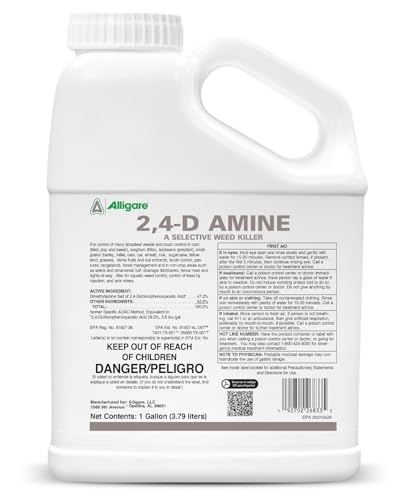
For large-acreage thistle management, the ALLIGARE 2,4-D Amine concentrate delivers the highest active percentage in this comparison at 46.8%. The amine formulation mixes readily with water and remains stable in tank mixes for pasture, rangeland, and aquatic site applications. Users saw thistle and pigweed die-off within days when mixed at the labeled rate of 1 to 2 quarts per acre.
This is a farm-grade product designed for broadleaf control across multiple environments, including drainage ditches, fence lines, and crop perimeters. It is labeled for use on pastures and lawns but requires careful species identification — 2,4-D can damage sensitive grasses like St. Augustine if overapplied. The one-gallon jug provides enough concentrate to treat up to 4 acres depending on weed pressure, making it the most economical choice for large properties.
Application caution is mandatory. The product is non-selective enough to kill ornamentals and vegetable gardens if drift occurs. Use a spray dye to track coverage and avoid double-spraying. Note that this formulation is restricted in some states — check local regulations before ordering, as some buyers in Texas reported fulfillment denials.
What works
- Highest active ingredient concentration available
- Treats up to 4 acres from a single gallon
- Versatile across pasture, aquatic, and lawn sites
What doesn’t
- State-level shipping restrictions apply
- Requires precise mixing to avoid grass damage
4. Ferti-lome Weed Free Zone
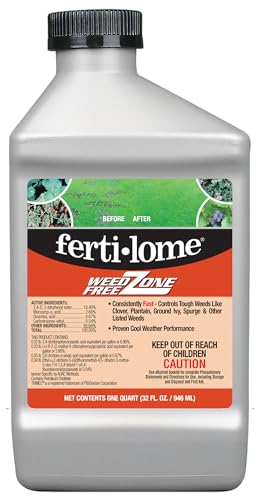
Ferti-lome Weed Free Zone is specifically formulated to kill thistle, clover, and creeping charlie without harming established turfgrass species like Kentucky bluegrass, Bermuda, or Zoysia. It contains Dicamba as its primary active ingredient, which translocates effectively into deep thistle roots. Users reported that creeping charlie — a notoriously difficult broadleaf — was wiped out overnight, a strong indicator that thistles face the same fate.
The concentrate mixes with water at rates of 1 to 2 ounces per gallon depending on weed maturity. Multiple users noted that the recommended label rate was insufficient for heavy clover and thistle stands. They achieved full control by doubling the concentration and adding dish soap as a surfactant to improve leaf adhesion. The 32-ounce bottle makes up to 32 gallons of spray solution, offering strong coverage for medium-sized lawns.
Application timing matters with this product. Spray when thistles are young and actively growing — spring rosette or early fall — for the best translocation to root reserves. Avoid spraying during high heat or drought, as stressed plants shut down uptake. Some users found that second applications were needed for mature bull thistles with thick stems.
What works
- Highly selective for most cool/warm-season lawns
- Kills creeping charlie and thistle quickly
- Large 32-ounce bottle covers significant area
What doesn’t
- Recommended rate often too weak for heavy infestations
- Requires added surfactant for best leaf adhesion
5. ALLIGARE MSM Turf Herbicide 60 DF
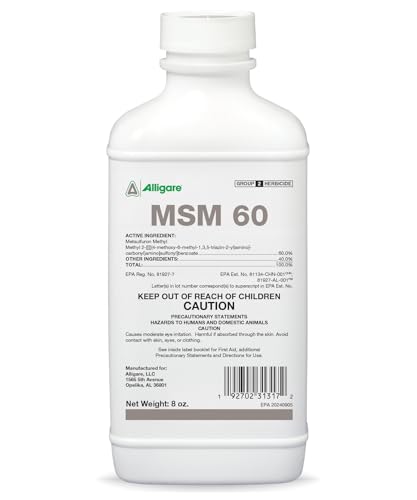
ALLIGARE MSM Turf Herbicide uses metsulfuron methyl — a sulfonylurea that stops cell division in broadleaf weeds and woody brush at extremely low use rates. The 8-ounce dry flowable bottle treats several acres because the application rate is only 0.2 ounces per acre. This makes it an exceptional value for landowners managing large pastures, rangelands, or roadside thistle patches on a tight budget.
MSM is selective to cool-season and Bermuda grass pastures, so you can spot-spray thistles without destroying desirable forage. It controls over 100 weed species including dandelion, dollar weed, and brush species. The dry flowable granules dissolve readily in water and remain tank-mix compatible with other herbicides, allowing you to create a custom broad-spectrum blend if needed.
Patience is required — metsulfuron works more slowly than synthetic auxin herbicides. Full weed death may take two to four weeks depending on temperature and soil moisture. The product is most effective when applied as a post-emergent on actively growing thistles in the rosette stage. A single 8-ounce container can last a homeowner several seasons, as most users only mix a fraction of a teaspoon per gallon.
What works
- Extremely low use rate stretches a single purchase for years
- Selective for cool-season and Bermuda pastures
- Tank-mix friendly for custom weed programs
What doesn’t
- Slow visual results — can take 2-4 weeks
- Dry flowable requires careful measurement
6. Roundup Poison Ivy Plus Tough Brush Killer₂

When thistles have grown into dense, woody patches — or are mixed with poison ivy, blackberry, and kudzu — the Roundup Poison Ivy Plus Tough Brush Killer₂ offers an aggressive non-selective solution. Its triple active formula of Triclopyr, Fluazifop, and Diquat Dibromide provides both contact burn and systemic translocation, producing visible results within hours and rainfast protection in as little as 30 minutes.
This concentrate is ideal for non-lawn areas: fences, cabin lots, trail edges, and freshly cut stumps. Users with acreage reported dramatic die-off in poison ivy thickets within days and total kill of woody vines within two weeks. The hack-and-squirt method — cutting the stem and spraying directly into the wound — was especially effective for mature thistle stands with thick crowns that resist foliar sprays alone.
Safety precautions are mandatory. The formula contains Diquat, which is a potent desiccant that can cause severe skin irritation. Wear long sleeves, boots, and eye protection, and wash all exposed clothing separately. The 32-ounce bottle covers roughly 1,500 square feet depending on mixing ratio, so large-area projects will need multiple bottles or a more economical non-selective alternative.
What works
- Visible results in hours on woody thistle patches
- Rainfast in just 30 minutes
- Triple active ingredients prevent resistance
What doesn’t
- Non-selective — kills all vegetation on contact
- Strong chemical requires strict PPE protocol
7. Whitetail Institute Arrest Max

Arrest Max is a grass-specific herbicide developed for clover and alfalfa food plots. While its primary target is grass weeds, thistles are broadleaf plants, so this product is a niche pick for situations where you need to control grass competition in a plot that already has a thistle problem while protecting your clover. The active ingredient Clethodim kills grass without harming broadleaf forage species.
Users in food plot applications saw complete grass kill at 13 days after application when mixed with crop oil and applied during active grass growth. The 1-pint bottle covers 1 to 4 acres depending on weed pressure. For thistle control specifically, Arrest Max is not a direct solution — but it prevents grasses from outcompeting your clover, which allows the clover to create a dense canopy that naturally suppresses thistle germination.
Clethodim is safer to handle than glyphosate-based products, but it still requires a non-ionic surfactant or crop oil for best results. The label recommends application when grasses are 2 to 8 inches tall and actively growing. For thistle management in a food plot, pair Arrest Max with a broadleaf herbicide that is safe for clover to create a comprehensive weed control program.
What works
- Highly selective — won’t harm clover or alfalfa
- Effective grass control allows clover to outcompete thistles
- Safer handling than glyphosate-based formulas
What doesn’t
- Does not kill thistles directly — only assists indirectly
- Requires crop oil or surfactant for proper coverage
Hardware & Specs Guide
Active Ingredient Concentration
The percentage of active ingredient determines how much product you need per gallon of water. Alligare 2,4-D Amine leads with 46.8%, meaning a smaller volume of concentrate treats more square footage. SpeedZone EW uses a blend of four actives that allows lower per-gallon rates while maintaining efficacy. Always match the active to your target species — Dicamba and Triclopyr are more effective on thistles than 2,4-D alone.
Surfactant Compatibility
Thistle leaves have a cuticle that repels water-based sprays. Most of these products benefit from adding a non-ionic surfactant at 0.25% to 0.5% of the spray volume. Ferti-lome Weed Free Zone and Triad TZ both respond well to dish soap or commercial surfactants. Products like SpeedZone EW already contain emulsifiers that improve coverage, but still benefit from a surfactant in heavy dew conditions.
FAQ
What active ingredient kills thistles at the root?
How long does it take for a thistle herbicide to show results?
Can I spray thistle herbicide before mowing my lawn?
Why do thistles keep coming back after spraying?
Final Thoughts: The Verdict
For most gardeners, the herbicide for thistles winner is the SpeedZone EW Lawn Weed Killer because it combines fast visual feedback with systemic translocation deep into the root system, and stays rainfast in just three hours — critical for unpredictable spring weather. If you need a lawn-safe selective that won’t hurt your turf, grab the Ferti-lome Weed Free Zone and double the rate for heavy thistle stands. And for large property owners tackling thistle patches in pastures or along fence lines, nothing beats the economy and coverage of the ALLIGARE 2,4-D Amine with its 46.8% active ingredient.