
Lily pads choke the surface of a pond, blocking sunlight and depleting oxygen. Selecting the wrong herbicide wastes time and risks collateral damage to the surrounding ecosystem.
I’m Rikta — the co-founder and writer behind Lawn Gear Lab. I’ve analyzed dozens of aquatic weed control products, comparing their active ingredients, coverage rates, and real-world customer outcomes to separate the effective solutions from the marketing hype.
This guide breaks down seven top-tier options to help you restore clear, healthy water. Here is the definitive assessment of the best herbicide for lily pads based on active chemistry and proven owner results.
How To Choose The Best Herbicide For Lily Pads
Lily pads are a robust perennial that demands a specific chemical strategy. A wrong pick means regrowth in weeks, murky water, or harm to non-target plants. Focus on chemistry, formulation, and coverage rate.
Active Ingredients: Flumioxazin vs. Diquat vs. Endothall
Flumioxazin provides pre- and post-emergent control lasting up to six months. Diquat dibromide delivers fast contact kill in 3–7 days but won’t stop regrowth from roots. Endothall works well on tough submerged weeds and algae but requires careful application timing and permits in some states. For lily pads specifically, a flumioxazin-based product often outperforms because it hits the foliage and the root zone simultaneously.
Formulation: Granules vs. Liquid Concentrate
Granular herbicides are broadcast by hand or spreader and sink to the bottom for root uptake. Liquid concentrates are mixed with water and applied with a sprayer for direct leaf contact. For heavy lily pad coverage on large ponds, a liquid concentrate with a surfactant penetrates the waxy leaf cuticle more reliably. Granules work well for early-season prevention on smaller ponds.
Coverage Rate and Pond Size
Every product label specifies ounces per surface acre. Ignoring this ratio leads to under-treatment that triggers rapid regrowth or over-treatment that risks fish health. Measure the surface area of your pond and calculate the exact dose. Most flumioxazin products require 6 to 12 ounces per surface acre, while diquat concentrates ask for 1 to 2 gallons per acre.
Quick Comparison
On smaller screens, swipe sideways to see the full table.
| Model | Category | Best For | Key Spec | Amazon |
|---|---|---|---|---|
| Atticus Semera 51% WDG | Pre/Post Emergent | Season-long lily pad control | 51% flumioxazin | Amazon |
| ALLIGARE Flumigard | Contact + Residual | Mixed duckweed and lily pads | Flumioxazin granules | Amazon |
| Tsunami DQ | Contact Liquid | Rapid knockdown of surfaced pads | 37.3% diquat dibromide | Amazon |
| Weedtrine D | Contact Liquid | Large pond surface treatment | Diquat dibromide 1 gallon | Amazon |
| Hydrothol 191 Granular | Broad-Spectrum | Bottom-rooted pad control + algae | 11.2% endothall granules | Amazon |
| Airmax Knockdown Defense | 2-in-1 Liquid | Fast pad removal in decorative ponds | 16 fl oz concentrated | Amazon |
| Airmax Treatment Booster Plus | Surfactant | Enhancing herbicide penetration | Surfactant 1 gallon | Amazon |
In‑Depth Reviews
1. Atticus Semera 51.0% WDG Aquatic Herbicide
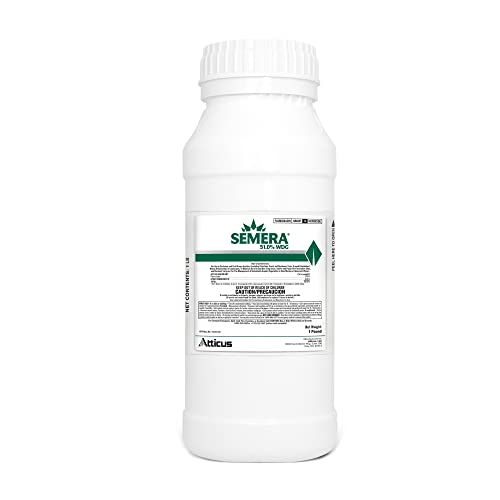
The Atticus Semera delivers 51 percent flumioxazin in a water-dispersible granule that provides both pre-emergent and post-emergent kill. One pound covers a significant 1/8-acre area for surface weeds including lily pads, duckweed, and alligator weed. The formulation dissolves quickly in a pump sprayer and binds to the foliage without requiring a separate surfactant for initial adhesion.
Owner feedback highlights complete lily pad dieback within 7 to 14 days. Multiple reports confirm that a single application wiped out dense duckweed coverage on 1.5-acre ponds, with regrowth not appearing until the following season. The fast-acting nature of flumioxazin also killed filamentous algae mats that floated to the surface for easy manual removal. Some users noted that thick, root-locked mats required a second spot spray a month later.
The 16-ounce unit count means you need to measure carefully for larger bodies of water. The product cannot be shipped to Alaska, Hawaii, Connecticut, Puerto Rico, or Vermont due to state registration restrictions. For a versatile, season-long solution that truly controls lily pads from multiple angles, this is the top choice.
What works
- 51% flumioxazin delivers six-month residual control
- Works on duckweed, water lettuce, and alligator weed
- Fast dissolve granules for easy mixing
What doesn’t
- Not registered for sale in several New England states
- Thick mats may need a follow-up treatment
2. ALLIGARE Flumigard Herbicide
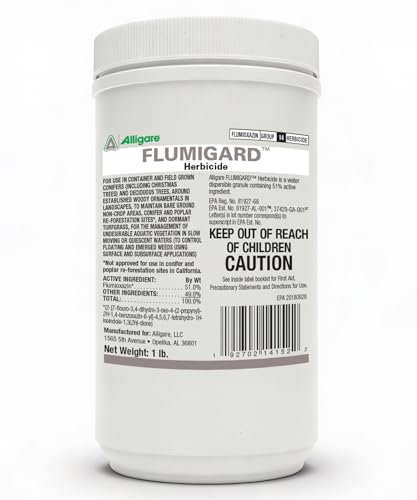
Flumigard brings the same flumioxazin chemistry in a granular format that simplifies broadcasting over larger water surfaces. Each 1-pound bag treats approximately 1/4 surface acre when applied according to the label, making it a strong choice for medium-sized ponds choked with lily pads. The granules sink and release the herbicide at the root zone while also contacting floating leaves.
Real-world reports from Louisiana pond owners confirm that half a container mixed with diquat and a surfactant cleared duckweed in one week and lily pads in two to three weeks. The product spread through the water column, killing pads without requiring direct spot spraying. Users also noted that the herbicide did not harm fish or turtles when used at recommended rates. A second application in late summer handled surface scum regrowth.
The primary downside is the cost per treatment for larger bodies of water. At roughly one pound per 1/4 acre, a 2-acre pond requires eight bags for a full treatment. For property owners who already own a broadcast spreader, the granular application is faster than mixing liquid. Combining Flumigard with a surfactant improves leaf penetration for thick lily pad waxy coatings.
What works
- Granules spread easily and sink to root zone
- Effective on both lily pads and duckweed
- Fish-safe when applied per label directions
What doesn’t
- Cost per acre adds up for large ponds
- Best paired with a surfactant for thick leaf cuticles
3. Tsunami DQ Aquatic Herbicide

Tsunami DQ relies on 37.3 percent diquat dibromide to deliver contact kill on any treated leaf within three to five days. The quart-sized bottle covers up to 4 surface acres at the lowest application rate, offering one of the best treatment-per-dollar ratios for large ponds. This is a non-selective contact herbicide that turns lily pads brown within a week of direct spray.
Customer reviews consistently praise its speed. One user reported that a light mist killed every sprayed pad by the following week. Another noted that the product killed surface weeds effectively but required a second pass for extremely overgrown subsurface growth. Because diquat works on contact, complete coverage of each lily pad leaf is essential — undersides and stems left dry will survive and regrow.
The main limitation is residual control. Diquat degrades quickly in water and provides no long-term prevention. Ponds with a heavy seed bank of lily pads will see regrowth within four to six weeks unless followed by a systemic product like flumioxazin. Sales restrictions apply in Arizona, California, Connecticut, Maine, Minnesota, New Hampshire, New Jersey, New York, Oregon, Vermont, and Washington.
What works
- Fast visual results in 3–5 days
- High concentrate treats large surface areas
- Fish-safe when used to label rates
What doesn’t
- No residual control for regrowth
- Not available in several states
4. Weedtrine D Aquatic Herbicide
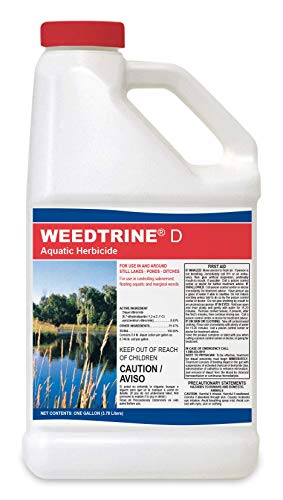
Weedtrine D packs diquat dibromide in a full gallon container that treats about half an acre of dense weed growth. This is a professional-grade contact herbicide that works on floating lily pads, submerged pondweed, and emergent cattails along the shoreline. The liquid formulation dilutes rapidly in water and is best applied through a backpack or handheld pump sprayer for targeted coverage.
Owner feedback particularly emphasizes its effectiveness on stubborn duckweed that had resisted other products for years. One user reported that a single application following the label’s instructions finally cleared a pond that had been completely covered. The herbicide works fast — visible wilting begins within 24 hours, and dead pads sink to the bottom after a week. Fish and wildlife remain safe when water use restrictions (no irrigation, drinking, or swimming) are observed for the specified period.
The gallon jug is heavy and requires careful measuring. A surfactant is mandatory for any weed on or above the water surface; without it, the diquat runs off the waxy lily pad leaves. Sales are restricted in Alaska, California, Connecticut, Hawaii, Maine, New Jersey, New York, Washington, and Canada. For large-acreage pond owners on a budget, this gallon concentrate delivers the most volume per dollar.
What works
- Gallon size treats large areas economically
- Works on lily pads, duckweed, and emergent weeds
- Visible die-off within 24 hours
What doesn’t
- Requires a separate surfactant for leaf adhesion
- Not available in many northeastern states
5. Airmax Knockdown Defense 2-in-1

Airmax Knockdown Defense combines an algaecide and an aquatic herbicide into one 16-ounce concentrated bottle. The 2-in-1 formulation targets lily pads, watermeal, duckweed, hydrilla, and filamentous algae simultaneously. The recommended dosage is 0.75 to 1.5 fluid ounces per 1/8 acre, making this a highly concentrated solution that goes a long way before needing a refill.
Users report that a single application removed 100 percent of duckweed in roughly two weeks. The product is designed for use in ponds, lakes, and slow-moving canals. It works best when applied through a tank sprayer mixed with a surfactant like Airmax Treatment Booster Plus to break the waxy leaf cuticle. One pond owner noted that it effectively stunted cattails and other marginal vegetation without killing the grass along the edge.
The downside is the upfront investment for a 16-ounce bottle that covers roughly 1.5 acres at maximum dosage. For small ponds under a quarter acre, a single bottle lasts multiple seasons. The liquid formulation is easy to measure and mix, but users must follow the label to avoid harming aquatic life — overdosing can affect the entire water column. For property owners who want a premium all-in-one treatment, this is the top contender.
What works
- 2-in-1 tackles both algae and lily pads
- Highly concentrated for small to medium ponds
- Fast results in 3–5 days
What doesn’t
- Premium price per ounce
- Requires a surfactant for maximum effectiveness
6. Airmax Treatment Booster Plus
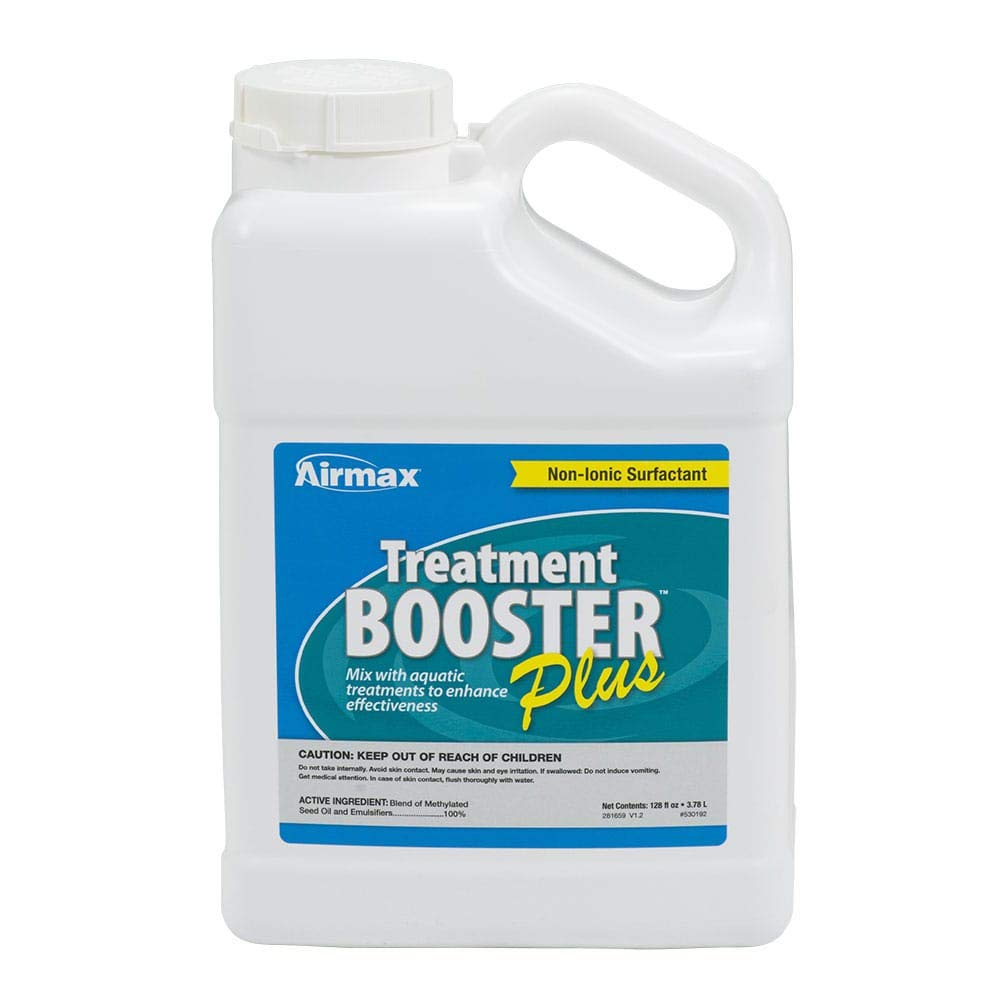
This is not a standalone herbicide — it is a surfactant designed to break the water surface tension and help the active ingredient penetrate the thick, waxy cuticle of lily pads. The 1-gallon container mixes at 2 fluid ounces per gallon of chemical solution, improving absorption so you can use less herbicide while achieving better coverage. It works with any liquid aquatic herbicide or algaecide.
Customer feedback confirms that this additive dramatically improves results on tough floating vegetation. One pond owner reported that once they started using Treatment Booster Plus with their diquat-based herbicide, the lily pads died twice as fast and did not bounce back. The formula is non-toxic to fish, birds, snails, and other aquatic wildlife when used at label rates. It also prevents the spray droplets from beading up and rolling off the leaves.
The only note is that a surfactant alone cannot kill lily pads — it is a supporting product. If you already own a liquid herbicide that struggles with adhesion, this booster is a cost-effective upgrade. For new pond owners, the gallon size is large enough for multiple full-pond treatments over several seasons. Consider pairing it with the Tsunami DQ or Weedtrine D for maximum impact.
What works
- Breaks waxy leaf cuticle for better kill rates
- Safe for fish and other aquatic life
- Reduces the total amount of herbicide needed
What doesn’t
- Not a standalone treatment for lily pads
- Must be mixed with a compatible herbicide
7. Hydrothol 191 Granular
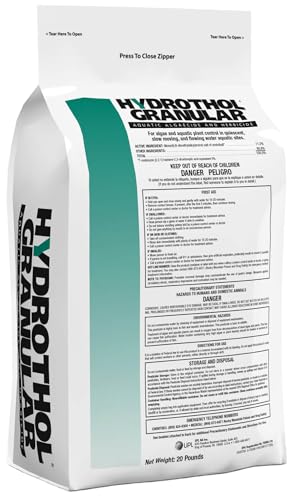
Hydrothol 191 Granular contains 11.2 percent endothall, a broad-spectrum organic compound that acts as both an algaecide and an herbicide. The 20-pound bag is purpose-built for large-scale pond and lake treatments. Endothall works primarily through root uptake, making it effective on rooted lily pads and submerged pondweed that other contact herbicides miss. It remains effective in murky or muddy water because it does not bind to suspended sediment.
Users report that granular endothall cleared stubborn algae blooms in a few days without harming fish. One reviewer with a river behind their house confirmed that it controlled invasive aquatic plants on the bottom. Another noted excellent results on curly leaf pondweed when applied early in the season at around 50°F water temperature. Because the granules sink, you need to apply them across the entire affected area rather than spot-treating individual lily pads.
The biggest drawback is the cost — a full bag can exceed , and treating a 1-acre pond may require the entire bag. State permitting requirements often apply for endothall products, so check local regulations before ordering. Sectional treatments are recommended to avoid trapping fish in treated zones. For pond owners with large expanses of rooted pads and algae, this is the most comprehensive granular solution available.
What works
- Works on rooted submerged weeds and algae
- Effective even in murky, sediment-heavy water
- Quickly dissipates without bioaccumulation
What doesn’t
- High cost per bag for large ponds
- May require state permits for application
Hardware & Specs Guide
Flumioxazin
This active ingredient provides both pre-emergent and post-emergent control. Water-dispersible granules dissolve quickly and provide up to six months of residual activity. The 51% concentration in the Atticus Semera delivers the highest percentage on this list. Flumioxazin works best when water temperatures are above 65°F and weeds are actively growing.
Diquat Dibromide
Diquat is a non-selective contact herbicide that kills any green plant tissue it touches within 3–7 days. The 37.3% concentration in Tsunami DQ and the 1-gallon volume of Weedtrine D offer the fastest visual knockdown of lily pads. Diquat degrades rapidly in water, providing no residual — perfect when you want immediate results without long-term water use restrictions.
Endothall
Endothall (11.2% in Hydrothol 191) is an organic compound that targets algae and rooted aquatic weeds. It does not bind to suspended sediment, making it effective in ponds with poor water clarity. Endothall has a very short half-life of less than seven days and does not bioaccumulate in fish or hydro soil.
Surfactant
A surfactant like Airmax Treatment Booster Plus breaks the water surface tension and penetrates the waxy cuticle of lily pads. Adding 2 fluid ounces per gallon of chemical solution improves coverage and reduces the total amount of herbicide needed. This is mandatory for any liquid product sprayed onto floating leaves.
FAQ
Will flumioxazin kill all the lily pads in my pond?
Is diquat safe for fish when treating lily pads?
How many ounces of herbicide do I need per acre of lily pads?
Final Thoughts: The Verdict
For most gardeners, the herbicide for lily pads winner is the Atticus Semera 51% WDG because its 51% flumioxazin provides season-long residual control and works on both emerged and submerged vegetation. If you want rapid knockdown without long-term persistence, grab the Tsunami DQ. And for a large-scale granular treatment that hits rooted pads and algae simultaneously, nothing beats the Hydrothol 191 Granular.