
Specs are compiled from manufacturer listings and verified buyer reviews and can change over time — please confirm the key details on the product page before buying.
Japanese knotweed laughs at most weed killers. Its root system can run nine feet deep, meaning a casual spray of grocery-store poison only singes the leaves while the plant regrows stronger. You need a systemic herbicide that travels from the leaf all the way down to the deepest rhizome to actually end the invasion for good.
I’m Rikta — the founder and writer behind Lawn Gear Lab. This guide is built by comparing the manufacturers’ published specifications and the patterns across verified customer reviews, so you get each pick’s real strengths and trade-offs instead of marketing spin.
Whether you are fighting a small patch behind the garage or a sprawling thicket along a fence line, finding the right herbicide for japanese knotweed is the single most important choice you will make in the battle.
Quick Picks
- Plus Herbicide — 41% Glyphosate with Surfactant — 2.5 Gallon Credit 41 Extra — Best Overall
- Albaugh Gly Star Plus Herbicide (2.5 Gallons) Glyphosate Concentrate (41%) with Surfactant — Top Value
- ALLIGARE Agri Star Triclopyr 4E Herbicide, 1 Gallon, Liquid concentrate — Woody Brush Champ
- RoundUp Promax 1.67 Gallon Jug — Rain-Ready Power
- Remedy Specialty Herbicide Weed Killer & Brush Control at Rangeland, Pasture and Fence Lines, Triclopyr Concentrated, 1 Gallon — Pasture Protector
How To Choose The Best Herbicide For Japanese Knotweed
You cannot win against knotweed with a surface-level spray. The key is choosing a formula that moves down into the plant’s vascular system to kill the root network. Pay attention to three things: the active ingredient, the concentration, and whether a surfactant is already mixed in.
Active Ingredient: Glyphosate vs. Triclopyr
Glyphosate (like the 41% concentration in top picks) is a non-selective systemic killer — it stops an enzyme that only plants have, so it works on broad leaves, grasses, and woody vines alike. Triclopyr, on the other hand, is often used for brush and woody species and works well on knotweed when mixed with glyphosate. For a stubborn perennial like knotweed, both can be effective, but a high-concentration glyphosate is the most common first choice because of its proven track record on deep-rooted weeds.
Concentration Matters
The concentration of the active ingredient directly determines how much you need to use. A product with 41% glyphosate is much stronger than a typical 18% home-garden spray. You mix less per gallon, get more coverage from each bottle, and deliver a lethal dose to every part of the plant. Lower-concentration products might seem cheaper upfront, but you will use more of them and may need repeated applications.
Built-In Surfactant
A surfactant is a spreading agent that helps the herbicide stick to the leaves instead of beading up and rolling off. Japanese knotweed leaves are somewhat waxy, so a built-in surfactant — essentially a wetting agent — makes a noticeable difference in how well the chemical penetrates. Products that include it save you a mixing step and improve coverage.
Quick Comparison
On smaller screens, swipe sideways to see the full table.
| Model | Best For | Active Ingredient | Size | Concentration | Amazon |
|---|---|---|---|---|---|
| Plus 41% Glyphosate | Best Overall for large areas | Glyphosate | 2.5 Gallons | 41% | Amazon |
| Albaugh Gly Star Plus | Top value with surfactant | Glyphosate | 2.5 Gallons | 41% | Amazon |
| ALLIGARE Triclopyr 4E | Brush & woody species | Triclopyr | 1 Gallon | 4EC | Amazon |
| RoundUp Promax | Fast rain protection | Glyphosate | 1.67 Gallons | High-strength | Amazon |
| Remedy Specialty | Pasture & fence line brush | Triclopyr | 1 Gallon | Ultra | Amazon |
In‑Depth Reviews
1. Plus Herbicide — 41% Glyphosate with Surfactant — 2.5 Gallon Credit 41 Extra

The heavy 2.5-gallon jug that makes a deep knotweed infestation your only session.
This is the workhorse for anyone with a serious knotweed problem. At 41% glyphosate, it delivers the high concentration needed to travel through the leaf tissue and down to the root rhizomes. The built-in surfactant means you do not have to buy a separate wetting agent — the chemical already spreads evenly across waxy knotweed leaves. Mix it at 2 ounces per gallon of water for general use, and you have enough ready-spray to cover 50-1,000 square feet.
The item weight comes in at 11.52 kilograms, versus 4.45 kilograms for the Triclopyr 4E option. In terms of liquid volume, you get 2.5 gallons (320 fluid ounces) compared to the Triclopyr’s 1 gallon (128 fluid ounces). Buyers report that “This stuff killed all my sticker bushes and weeds, Just dont step in it and walk on your grass lol,” which highlights its power but also its non-selective nature.
One honest catch: a buyer found the cap sealed with silicone, making it tricky to open and requiring them to strain the material out. It is a packaging issue worth knowing before you reach for the lid on a rushed Saturday morning.
Why it leads the pack
- 41% glyphosate with built-in surfactant saves a mixing step
- 2.5 gallons covers large knotweed patches without reordering
- Buyers confirm it kills stubborn sticker bushes and deep perennial weeds
One real annoyance
- Some jugs arrive with silicone sealant in the cap, requiring filtration
- Non-selective — overspray will kill grass and shrubs you want to keep
Reach for this if: you need the most glyphosate per jug to tackle a heavy knotweed patch and you want surfactant already in the mix.
Look elsewhere if: you want a selective formula that spares grass, or you prefer a triclopyr-based option for woody brush.
2. Albaugh Gly Star Plus Herbicide (2.5 Gallons) Glyphosate Concentrate (41%) with Surfactant

Same 41% glyphosate as the top pick, but with noticeably slower, deeper kill timing.
Gly Star Plus matches the 41% glyphosate concentration and the 2.5-gallon size (320 fluid ounces) of the Plus Herbicide above, and it also includes a fully loaded surfactant system. The maker claims you will see visible effects within 2-4 days on most annual weeds and 7 or more days on perennials like knotweed. That slower timeline is actually a good sign — it means the chemical is moving systemically through the plant to reach the root system.
One trade-off worth knowing: this product is labeled as “Professional Use Only” and carries geographic restrictions — it is not for sale to CA, MT, NV, OR, WA, or WY. If you live in one of those states, you need to look at an alternative. Owners mention that “Takes about 10 days to two weeks to see everything dead, but for the price it’s worth it,” which aligns perfectly with the slow systemic action you want against knotweed. At 15 pounds, it is lighter than the RoundUp Promax’s 17 pounds despite holding 2.5 gallons versus 1.67 gallons.
The instruction booklet reportedly covers many different plant types with clear detail, so beginners have a reliable guide for their first application. Just keep in mind: no soil residual activity remains after application, so you can replant after the treated area clears.
Solid value features
- 41% glyphosate with surfactant included at a competitive price point
- 2.5 gallons gives plenty of spray for knotweed patches of any size
- Clear instructions for different plant types help first-time users
Watch out for
- Not labeled for residential use — commercial-label product
- Not available for purchase in several western states
Pick this for: large knotweed jobs where the slower, systemic kill gives you confidence the roots are dying, and where you are okay with a non-residential label.
skip it if: you live in CA, MT, NV, OR, WA, or WY, or if you need a product clearly labeled for home use.
3. ALLIGARE Agri Star Triclopyr 4E Herbicide, 1 Gallon, Liquid concentrate
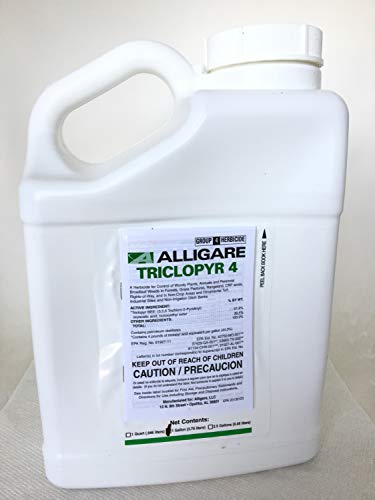
The triclopyr specialist if your knotweed is mixed with woody brush and tree saplings.
When knotweed grows alongside black locust, multiflora rose, or tree-of-heaven, a straight glyphosate product might struggle. Triclopyr 4E is a different active ingredient — it targets broadleaf plants and woody species more aggressively than glyphosate. Customers note it is “identical to Garlon 4 (60% triclopyr)” and call it superior to glyphosate for woody plants. For knotweed that has intergrown with brush, this is a powerful rotation partner or standalone option.
The catch is volume: at 1 gallon (128 fluid ounces), this jug holds less liquid volume than the 2.5-gallon glyphosate options at 2.5 gallons (320 fluid ounces), so you will be mixing smaller batches. One reviewer noted success using a recipe of 1-2 oz of Triclopyr 4E with 16 oz of oil, 2 oz of dish soap, and water to fill a gallon, seeing results in 1-2 days. However, the same reviewer noted that volatile ester vapors damaged nearby vine maples, so you must be careful about drift. The item weight is 4.45 kilograms, versus 11.52 kilograms for the Plus Herbicide, making this far easier to carry and pour.
Buyers mention that “Effective on Lamium galeobdolon; mixing concentrate is cheaper than ready-mix.” On the downside, the smell is described as very strong, so store this one outside or in a well-ventilated shed.
Why choose triclopyr
- Excellent on woody brush and species glyphosate alone may not finish
- Highly concentrated — a little goes a long way for cut-stump treatments
- Mixing your own concentrate saves money versus ready-mix sprays
Downsides to factor
- Strong odor — buy for outdoor storage only
- Volatile ester can drift and damage nearby desirable trees
Best suited for: knotweed in brush-heavy areas where you want a triclopyr option that hits woody species harder than glyphosate.
Not for you if: you need a huge ready-to-spray volume, or you have sensitive trees close to the treatment area.
4. RoundUp Promax 1.67 Gallon Jug
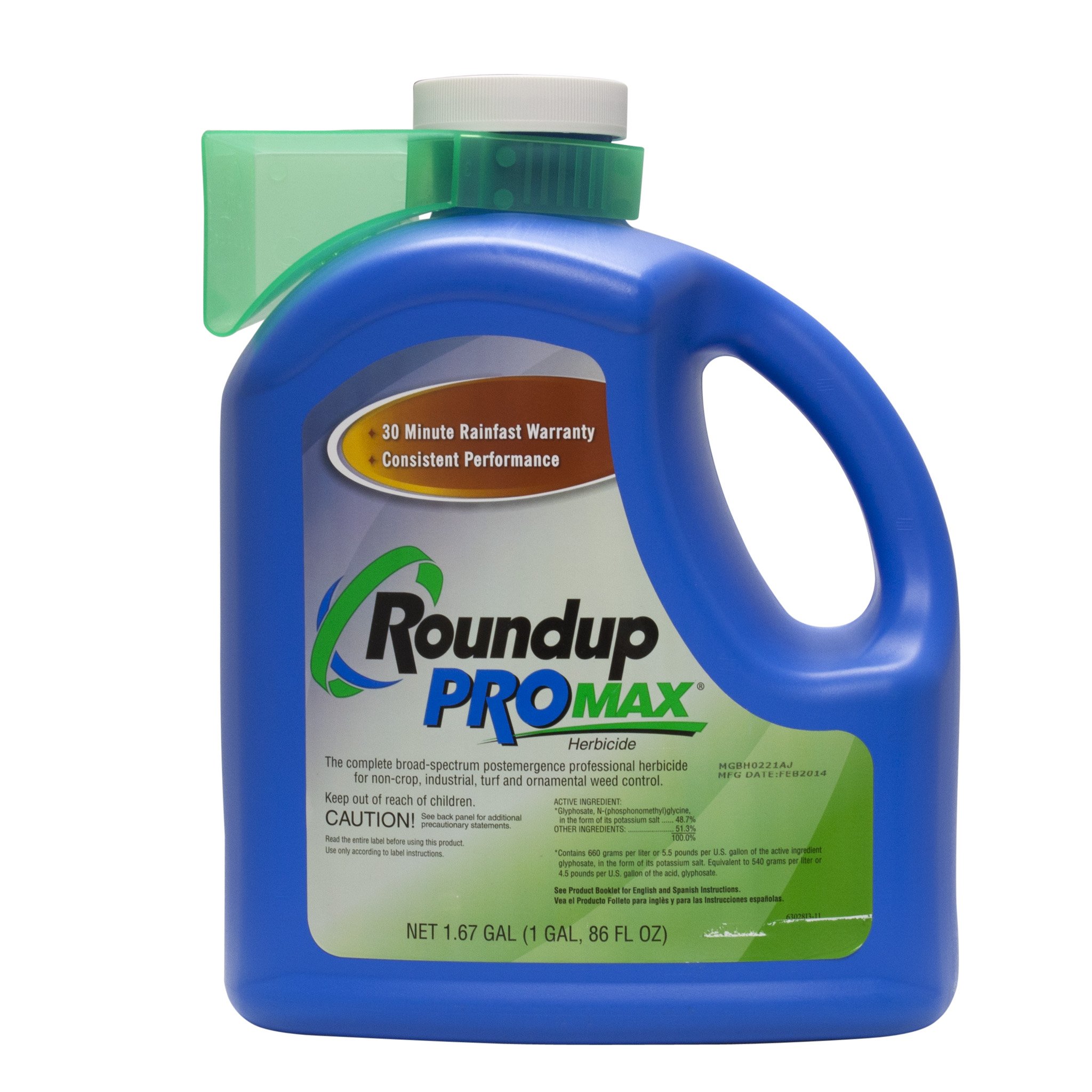
The brand-name pick that gets rain-fast in half an hour so weather worries fade fast.
Rain can ruin a knotweed treatment by washing the herbicide off before it absorbs. RoundUp Promax is rain-fast within 30 minutes of application, which is a real advantage if you live in an area with unpredictable afternoon showers. The 1.67-gallon jug contains a high-strength glyphosate concentrate, and at 17 pounds it is heavier than the Albaugh Gly Star Plus (15 pounds) despite holding less volume — a sign of denser active chemistry. The recommended mix ratio is 2 oz per gallon, and one buyer calculated that this treats over 400,000 square feet at a 1.5% mix.
Reviewers point out it works slower than some other Roundup formulations — killing in 7-10 days — but that it is “truly fatal” to deep-rooted perennials like Kudzu and Ivy. For knotweed, that same slow systemic action is exactly what you want. One buyer mentioned, “2 oz/gal ratio lasts long,” meaning a single jug stretches further than you might expect.
The downside: at the higher price point, you get less liquid volume than the 2.5-gallon options above. You are paying for the brand name and the rapid rain-fast guarantee. Shoppers say great results, but the slower visual deadening can make you wonder if it worked — trust the timing.
Standout benefits
- Rain-fast within 30 minutes — great for unpredictable weather
- 2 oz per gallon ratio makes the jug last a long time
- Proven on deep-rooted perennials like Kudzu and Ivy
Considerations
- Less total volume than the 2.5-gallon competitors at a higher price
- Slower visual kill (7-10 days) may test your patience
Go for this when: you are on a tight spraying schedule and cannot afford rain washing away your work within that 30-minute window.
Choose another if: sheer volume per dollar matters more than rain-fast speed, or you prefer a product with a built-in surfactant.
5. Remedy Specialty Herbicide Weed Killer & Brush Control at Rangeland, Pasture and Fence Lines, Triclopyr Concentrated, 1 Gallon
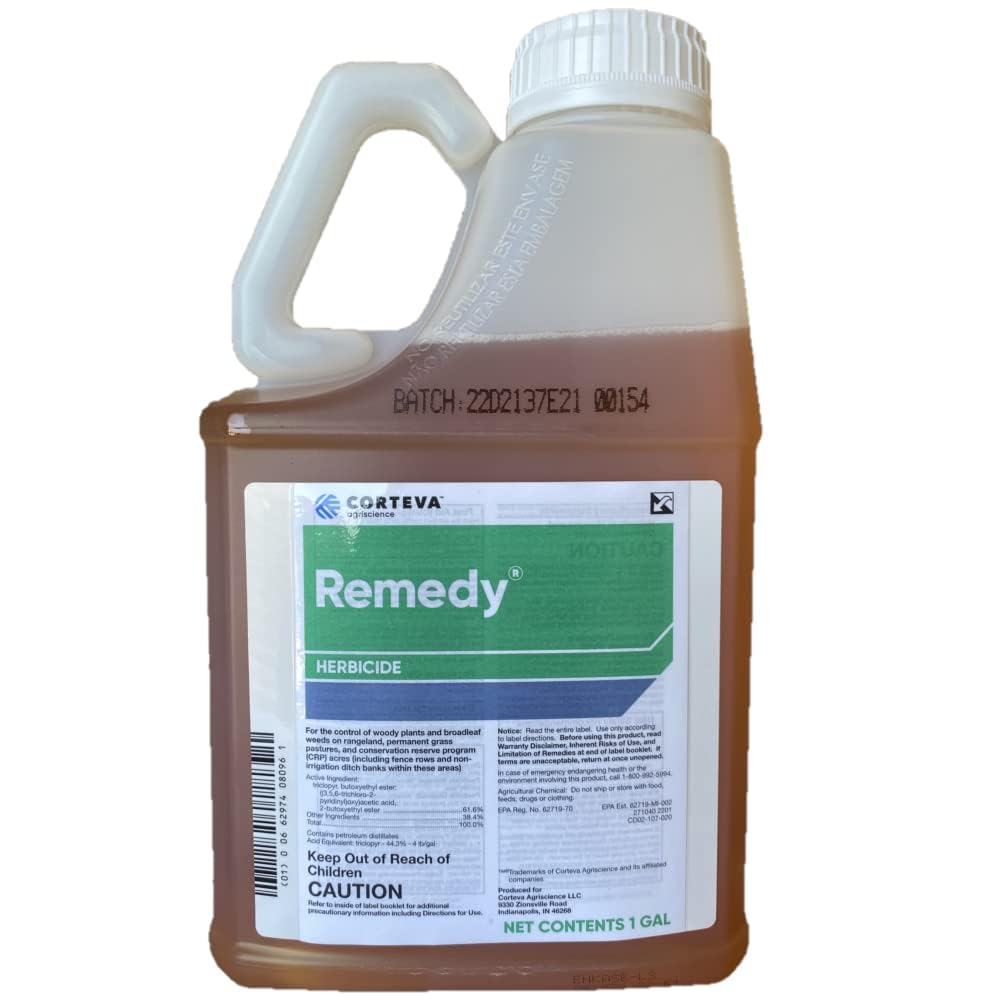
The low-odor triclopyr built for pasture restoration and fence-line brush invasions.
If your knotweed problem runs along fence lines or into pasture areas where livestock graze, Remedy Specialty is designed for that exact scenario. It is a selective triclopyr-based concentrate that targets brush and mid-size trees without harming grass, and the maker claims it is safe to use around children and pets when applied according to the label. One owner reported it “absolutely annihilated my cogon grass problem,” which speaks to its strength on tough invasive species similar to knotweed.
This is a 1-gallon jug (128 fluid ounces), so you get the same volume as the ALLIGARE Triclopyr 4E but in a low-odor formulation that is more pleasant to work with. Users report successful results by mixing 1 part Remedy with 3 parts diesel for basal bark applications on honey locust and multiflora rose — a method that would translate well to knotweed stems. It takes a couple of weeks to kill small trees, but they are gone for good.
One honest note: a buyer admitted it was expensive and not suited for their needs because they were targeting weeds rather than brush. If your primary target is knotweed growing among grass, Remedy is a good choice. If you are fighting a pure knotweed patch with no grass, you might get more bang for your buck with a high-volume glyphosate concentrate.
What it does well
- Low-odor formula makes handling more pleasant than standard triclopyr
- Selective on brush — spares grass in pasture and fence-line settings
- Proven on tough invasives like cogon grass and multiflora rose
Things to know
- Priced near the top of the range — less volume per dollar than glyphosate options
- Not effective on weeds and unwanted grass, only on woody brush and trees
Ideal for: selective knotweed control in pasture or fenceline areas where you want to keep the grass alive and avoid heavy chemical odor.
Look elsewhere if: you need a high-volume, non-selective knockdown for a pure knotweed stand without grass underneath.
Understanding the Specs
Glyphosate vs. Triclopyr
Glyphosate is the household name for non-selective weed killing. It stops a plant enzyme called EPSPS that only plants have, which means it works on almost everything green. Triclopyr, by contrast, mimics a plant growth hormone and is particularly effective on broadleaf plants and woody brush. For Japanese knotweed, a high-concentration glyphosate (41%) is the most common first approach, but adding a triclopyr product in rotation or tank-mix can help on older, woodier patches.
Surfactant
A surfactant is a spreading agent that reduces the surface tension of the spray droplets. Knotweed leaves have a waxy coating that can cause plain herbicide to bead up and roll off. A built-in surfactant — often listed right in the product name or ingredient list — helps the chemical spread into a thin film across the leaf so it absorbs properly. If your product does not contain surfactant, you will need to add a few drops of dish soap or a commercial wetting agent per gallon.
FAQ
Will these herbicides kill Japanese knotweed completely?
Can I mix glyphosate and triclopyr together for knotweed?
When is the best time to spray Japanese knotweed?
How long after spraying can I let pets or kids back on the lawn?
Is RoundUp Promax the same as the RoundUp from the hardware store?
Do I need a special sprayer for these concentrates?
Can I use these products on knotweed near water?
How do I prevent overspray from killing my grass?
Final Thoughts: The Verdict
For the majority of shoppers, the herbicide for japanese knotweed winner is the Plus Herbicide 41% Glyphosate because it delivers the highest volume of concentrated glyphosate with surfactant included, giving you the best chance of a one-session knockout. If you want a triclopyr option for knotweed mixed with woody brush, grab the ALLIGARE Triclopyr 4E. And for a rain-fast glyphosate that lets you spray before a storm without worry, choose the RoundUp Promax.
How We Picked
We do not accept paid placement, and we did not hands-on test every unit. Instead, we match each pick to a real buyer and use-case by comparing the manufacturers’ published specifications against the patterns in verified customer reviews — so you get each pick’s real strengths and trade-offs instead of marketing copy.
Sources & Methodology
Specifications: manufacturer listings and product documentation. Review insights: verified customer reviews, as of July 2026. Pricing: not shown on this page (it changes often); check the current price via the retailer link.
As an Amazon Associate, Lawn Gear Lab earns from qualifying purchases. This does not affect which products we feature.